Tag: fibonacci

  • Investing for Dummies

    I use scores of chart patterns, Fibonacci grids, technical indicators and proprietary models in my daily attempts to forecast various markets.  Some are fairly complex, multivariate models that involve a half-dozen inputs.  Others are quite simple.

    One of my favorite simple indicators is the well-known 10-day/20-day moving average cross. It maintains that when the SMA10 crosses below the SMA20, it’s generally bearish. When it crosses back above, it’s bullish.

    Of course, in a heavily “managed” market such as the one I’ve been posting about for the past 7 1/2 years, the crosses are occasionally head fakes.  The cross is well-known and a component of many algorithms.  So, it’s not unusual for markets to reverse rather soon after such a cross.  Sometimes, markets even reverse just before a likely cross in order to avoid one.

    The yellow arrows below mark the various bearish crosses so far in 2018.  The thin red line is the SMA10 and the white line is the SMA20.  Other moving averages are the 50 (purple), 100 (yellow) and 200 (thick red.)

    Only a couple 10/20 crosses were followed by significant sell-offs: Feb 6 and Mar 22.  The others produced either moderate or modest declines (i.e. head fakes — the purple arrows) or near misses (the white arrows.)  I mention it this morning because we’re experiencing another 10/20 cross in the pre-market.

    There is much bearish commentary out there.  VIX just broke out of a 8-month trend, tagging our next upside target yesterday.  SPX and ES have both tested the critical support we identified last week [see: The 10Y Breaks Out.]  And, the usual suspects involved in a rescue operation are, so far at least, MIA.

    Will this be another head fake/near miss — or the real thing?

    continued for members

    My best guess continues to be that if 2878.50 (SPX 2872.87) doesn’t hold, we’ll see the white channel get fleshed out.  If the white channel doesn’t hold, it opens up the SMA200 and, ultimately, the 2.24 at ES 2728.79 (SPX 2702.78.)

    SPX wouldn’t flesh out its white channel until reaching 2800 – the white .786 Fib.  Again, if the white channel fails, we’re looking at the SMA200 at 2765 and the 2.24 at 2703.62.

    CL and RB are getting a little bump from Hurricane Michael and the usual MENA-based speculation.

    Note that RB, in particular, has clung to a smaller rising channel.  It won’t last.

    USDJPY still looks likely to backtest its SMA100 at 111.19 or .500 at 111.78 — which lends credence to the downside case – at least on an intra-day basis.VIX continues to be the big question mark.  It has clearly broken out of the falling white channel.  If given free rein, it still has plenty of upside potential with 24.20 looking very reachable. I’ll be out all day today.  More later this evening or in the morning.

    GLTA.

    (more…)

  • It’s a Wonderful Market

    SPX and ES had no trouble reaching our initial downside targets — a backtest of their January highs.  We wondered, however, whether the SMA20s, loitering just below, might come into play.

    Sure enough, ES tagged its SMA20 with ease.  But, emini traders strongly resisted a drop through the SMA20 – bad mojo, don’t you know.

    So, SPX only reached 2867.29, just shy of the SMA20 at 2866.27. And, faster than you can shout “help me Clarence!” SPX bounced the 16 points we anticipated, just like it did on Wednesday.

    It was a near miss..or, was it?  As we discussed on Tuesday…

    One little trick we often see on days when it’s difficult to convince the machines to sell/short down to an obvious bounce point such as the SMA10 is to drive the price merely to where the SMA10 will be tomorrow.  The SMA10 will likely increase by another 5 points tomorrow, so getting within 2-3 points is potentially “good enough.”

    As luck the algos would have it, today’s SMA20 came in at…wait for it…2866.27.  January highs and SMA20 were both tagged.  So, all is well, right?  Not so fast.  Futures are currently off 10 points, banks are tanking, oil and gas are slipping, FB is scurrying toward the basement and TSLA has tumbled 15% since Tuesday’s short call.

    In the distance, sirens.  A mob of nervous investors crowds the door.  Might the Building & Loan actually be in trouble?

    Thanks to overeager algos, the S&P 500 has thus far ignored the threats of tariffs, political turmoil, emerging market meltdowns, rising interest rates and historically high multiples. None of that matters as long as corporations can borrow cheap and repurchase their own shares, VIX can be hammered when necessary, the dollar continues rising and oil/gas prices don’t crash.

    If any of those support mechanisms falters, however…  Well, we’ve seen what can happen.  Keep an eye on 2867.29.

    continued for members(more…)

  • Crypto Carnage

    As the currency turmoil continues, it’s interesting to note that cryptocurrencies are having a worse go of it than EMs.

    Meanwhile, futures dipped enough overnight to finally backtest the SMA10.  They’ve since rebounded enough to backtest the broken red channel.  It remains to be seen whether SPX will join in and backtest its SMA10 and whether both can manage a backtest of their January highs.

    On the commodity front, RB finally tagged our next downside target — cratering 4.5% from yesterday’s highs.

    continued for members… (more…)

  • How Not to Manipulate Stock Prices

    Sometimes you just can’t catch a break.  TSLA shares rose from 22 in 2012 to 387 in 2017 — helping drive Musk’s net worth to well over $20 billion.  But, the shares have since formed a triple top, failing to top 390 and coming perilously close to breaking down.

    This isn’t the first time Musk has faced such a challenge.  The stock spent three years trying to crack 290 – the red trend line below.

    We’ve documented past interventions — which have, by and large, been successful.  Musk’s well-publicized $25 million open market purchase (the white arrow) on June 12-13, for instance, saw the stock gap past the .618 Fib level and a trend line connecting recent highs.

    It was a nice gesture and helped divert attention from the mass layoffs announced the day before.  But, it didn’t take long for investors to realize that while $25 million is a lot of money to most people, it represented only 1% of Musk’s net worth.  And, it increased his holdings of the common stock by a pittance (0.2%.)

    It’s pretty obvious why Musk did it.  After breaking above 290 in April 2017, the stock had fallen back below it in March 2018.  The 200-DMA, rising white channel, and purple trend line all broke down in the process.

    After a miraculous, tweet-aided recovery, Musk got the stock back above the red trend line.  But, he needed it above 390.  It was not meant to be.  Too many missteps, too many worrisome headlines.  The best it could manage was a backtest of the broken white channel and the .886 retracement of its drop from 389 to 244.

    The stock slipped back below the red TL and 200-DMA, eventually bouncing off 290 yet again in late-July on news of a major new factory to be built in Europe.  The company’s earnings call a few days later featured a well-behaved Musk, a revenue (obviously not income) beat, and a promise not to float additional additional shares.

    Musk: We do not — we will not be raising any equity at any point, at least that’s — I have no expectation of doing so, do not plan to do so … And we certainly could raise money, but I think we don’t need to and we — yeah, I think, it’s better to — it is better discipline not to.

    Again, the stock gapped higher — back above the 200-DMA and the yellow trend line.  But, the naysayers weren’t having any of it.

    Despite having produced the promised number of Model 3’s, the company was dogged by reports of quality issues and was losing money on every sale — even though these were the higher end models with potentially larger profit margins.

    This was apparently the point when desperation set in.  As we discussed at the time [see: Is the Pressure Getting to Elon Musk?] it was fairly obvious to any competent chartist that Musk’s going-private tweet — like all the others — was designed to get the stock over the latest hump.

    It didn’t take long for Tesla watchers to question the deal.  The financing was supposedly secured, but no one stepped forward.  The board seemed genuinely alarmed.  Shorts launched lawsuits.  And, the SEC announced an inquiry.

    The latest rally ran out of steam at 387 – just shy of the September 2017 highs.  The stock tumbled back to the red trend line yet again.  It bounced, but that was before Friday night’s (11pm Friday night, following Thursday’s decision) admission that the going-private transaction was dead in the water.  As of this morning, the stock is heading back toward 290.

    Despite my cynicism, I’m rooting for Elon and Tesla.  We obviously need alternatives to carbon-based transportation for many reasons.  But, the stock is at these lofty levels based on the (aging) premise that it’ll soon be self-funding and turn a profit.

    The shorts are right to question this premise.  But, anyone who shorts at these levels, before the stock breaks down below the tangle of support at 290ish is ignoring the obvious — this is a CEO who will do whatever it takes to prop up his stock.

    TSLA might ultimately come crashing down.  But, I would absolutely wait until the purple trend line and horizontal support break down before jumping on board.

    Now, on to the rest of the market.

    continued for members… (more…)

  • Charts I’m Watching: Aug 20, 2018

    Futures are hanging on to a 4-pt gain, primarily on a continuing decline in VIX.  With Jackson Hole coming up, we could see more volatility — particularly if Fed speakers back off their hiking schedule.

    Speaking of backing off…TSLA is back down to its horizontal and trend line support.  As readers will recall, this is a critical line in the sand.As we concluded last May [see: Can TSLA Avoid a Crash?] a drop through this key level could easily land the stock below 200.  Our chart from back then, before the craziness really got going…

    Apparently JPM has also adopted this view.  And, an increasing number of observers are coming to the same conclusion we did a couple of weeks ago regarding Musk’s emotional state [see: Is the Pressure Getting to Elon Musk?]

    continued for members(more…)

  • Engineering AAPL’s Breakout

    The big news yesterday was AAPL’s market cap reaching $1 trillion.  For chartists, however, the big story was the breakout shown below.

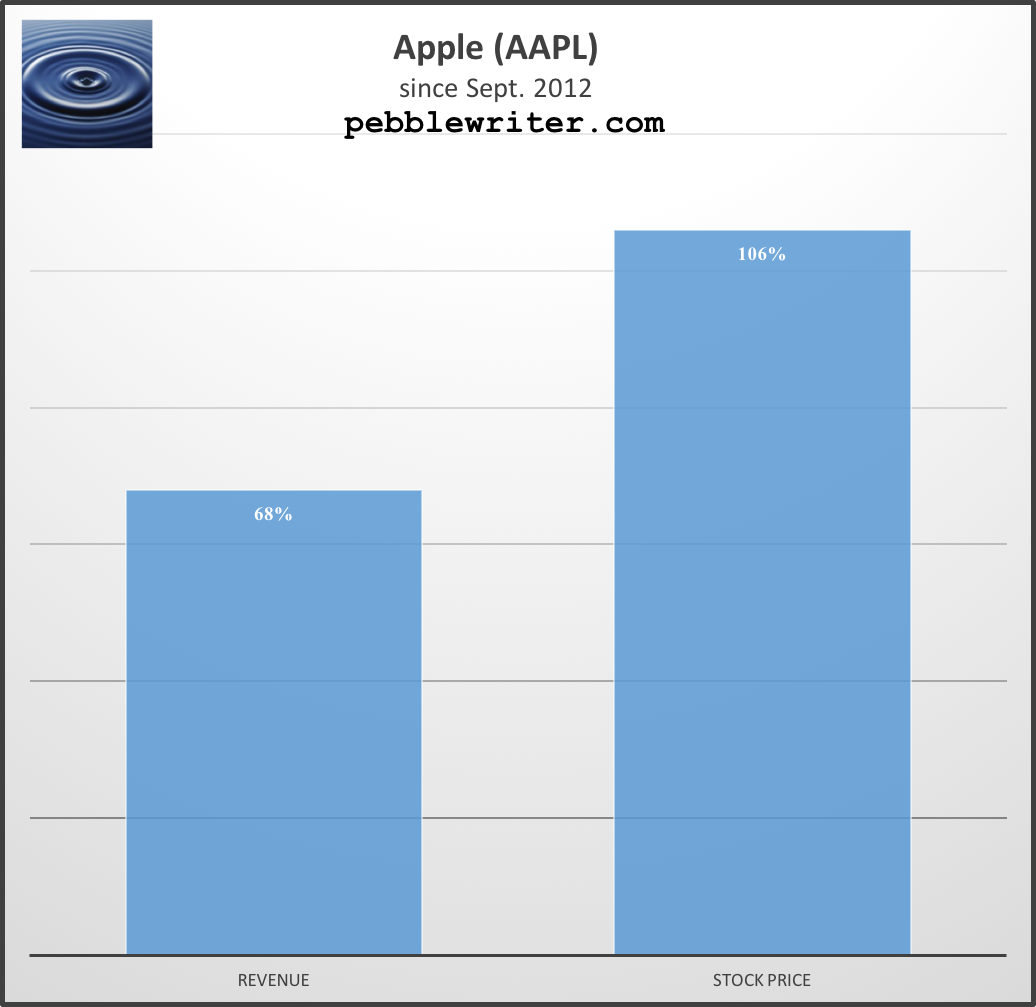
    It’s hard to overstate the importance of this move.  Just a few days ago, the stock had broken below a trend line dating back to April 27 and was retreating from its 2.24 Fibonacci extension.  From a charting standpoint, it was in trouble.Revenues have grown 68% since that first market peak in 2012 — about 9.04% on an annually compounded basis (based on estimates of $263 billion for FY2018.)  The stock price, however, has grown 106%, a compounded annual rate of 12.9%.

    Those who follow AAPL know it has been the poster child for stock buybacks.  The board has approved a total of $310 billion since Apr 2012.  Might this activity account for some of the stock’s success?  Let’s take a closer look.

    $310 billion is a lot of money.  But, consider that the average daily trading volume in AAPL in the 1,600 trading days since the program started was $5.7 billion.  In other words, the entire program comprises about 54 days worth of volume.  Fifty-four out of 1,600 — could it make much difference?When we compare the announcements to stock prices, we can see that most were beneficial.  When we compare them to chart patterns, though, the extent of the benefit is startling.  As they say, timing is everything.

    $10B Announcement (2012):  I don’t know what prompted this first announcement, but it came shortly after the stock had broken above a trend line (red, dotted line below) going back to April 2010.  The company also announced outstanding earnings and the resumption of dividend payments, the first time since 1995.$50B Announcement (2013):  This one is a little more obvious.  Not only had the red trend line given way, but the white channel which had guided prices higher for the past decade had broken down.

    As I warned in November 2012 [Update on AAPL] and again in January 2013 [AAPL: Flirting with Disaster], AAPL had completed a Head & Shoulders pattern that targeted the June 2011 lows. The losses from the Sep 2012 highs would have exceeded 50%.

    The massive $50B addition to the share repurchase plan held AAPL’s losses to a “mere” 45%.  Unbeknownst to us at the time, it also established the gently rising purple channel AAPL just broke out of.$30B Announcement (2014): In November 2013, Carl Icahn — who had accumulated $2.6B since August — filed a shareholder proposal to encourage Apple to distribute $150B to shareholders.

    In addition to Icahn breathing down its neck, Apple’s stock was having a tough time.  Keep in mind the rising white channel was still broken down.  In addition, a rising wedge (in yellow below) had formed and broken down.

    Last, the stock had reversed just shy of its .618 Fib and been unable to rise above a Fibonacci fan line (yellow, dashed) from its 2012 highs.  Increasing the share repurchase plan by another $30B seemed to help.$50B Announcement (2015):  Fortunately for Apple, someone had convinced them to pay attention to Fibonacci patterns along the way.  Unfortunately for Apple, the action they took in April 2015, when AAPL reached its 1.618 extension and the top of the small, white channel from early 2013 wasn’t enough to stave off the effects of the S&P 500 having reached critical resistance [more on this later.]

    Despite the announcement on April 27, AAPL topped out the next day.  It struggled to stay aloft until late July, but finally succumbed, tumbling 31.6% (compared to SPX’s 12.5%) by the time the broader market bottomed out on August 24.

    $35B Announcement (2016): The 2016 expansion was purely defensive.  Having held horizontal support when the market bottomed out in February, AAPL had failed in its attempt to hold the purple channel midline or break out of the trend line (red) connecting its recent highs.  It was also dipping perilously close to its September 2012 highs (100.72.)

    The $35B addition wasn’t enough.  The company reported its first quarter-over-quarter revenue drop since 2003 and its first year-over-year drop in iPhone sales ever.  The stock gapped down 8%, wiping out nearly $50 billion in market cap in a day.  It would take three months to recover.

    $35B announcement (2017): A rising tide lifts all boats.  So it was in April 2017 when SPX has broken out past important resistance and AAPL needed just enough to hold its 1.272 Fib and purple channel .786 lines.  This was a tweak, and an earnings beat and upbeat guidance — along with the iPhone X launch — helped the stock hold its own when it revisited this level two months later.$100B announcement (2018):  Apple has apprently spent every dime of the $210B previously announced.  That’s six years of timely support, lucky bounces, fortunate developments, $100 million paydays.  Could you walk away from it?  Neither could Tim Cook.

    The $100B just announced couldn’t have come at a better time.  The stock has been struggling with the purple 1.618 extension at 162.39.  It failed to punch through in August 2017, made it through in October 2017, plunged back below it in February 2018, screamed above it a week later, and tumbled back to it on Apr 24.

    Had the biggest share repurchase plan expansion plan ever not been announced 5 days later, the stock likely would have dropped through the 1.618 and the bottom of the rising red channel.  But, we’ll never know.Clearly, it was enough to create a bounce off of those, push through the purple 2.24 extension, and break out of the rising purple channel on yesterday’s Q3 earnings report.  As “luck” would have it, AAPL managed to close 0.53 above the purple 2.618 extension today.

    Effects on the Overall Market

    The AAPL chart below shows SPX’s key Fibonacci levels as they have played out since 2012.   AAPL’s announcements line up quite well with key breakouts and backtests.

    • SPX’s break out past its .786 Fib which marked the 2011 highs (Mar 13 vs Mar 19, 2012)
    • SPX’s break out past its 2007 highs at 1576 (April 23, 2013)
    • SPX’s backtest of its 1.272 extension at 1823 (Apr 24 vs Apr 13, 2014)
    • SPX’s attempt at its 1.618 extension (topped May 20 vs AAPL’s Apr 27, 2015)
    • SPX’s break above the trend line from 2015 highs (Apr 26, 2016)
    • SPX’s break out past a smaller pattern 1.618 (Apr 24 vs May 1, 2017)
    • SPX’s recovery after dipping below its SMA200 (7th time was a charm – May 3 vs May 1)

    The same info from SPX’s point of view:

    Since investors (algos) have come to rely on Apple’s buyback announcements every April, we may as well put these on our calendar.

    In Conclusion

    It seems clear to me that the timing of Apple’s buyback announcements played an important role in the stock reaching its recent highs.  If the company published the actual transactions, I suspect we would find that they were instrumental in overcoming resistance and holding support.

    From an earnings standpoint, this sort of financial engineering is clearly beneficial.  Borrowing money to buy back shares increases EPS and shifts dividend expense (non-deductible) to interest expense (deductible.)

    Is it a good thing that AAPL has managed to break out and achieve a $1 trillion valuation?  I doubt there are many shareholders who would complain.  Employees who own stock or whose employment prospects are enhanced by Apple’s success are probably happy, too.  So, what’s the problem?

    In a Harvard Business Review article Profits Without Prosperity, William Lazonick makes a pretty good argument that buybacks represent stock manipulation.  By driving prices artificially higher, corporate executives increase the value of their stock awards and options — about 83% of their compensation.

    He further argues that funds going toward repurchases could be better spent on innovation, employee (the other 99%) compensation, and productivity improvements.  Although I can find no fault with Mr. Lazonick’s conclusions, I’m a chartist – not an ethicist.

    My goal is to accurately forecast price movements.  So, when I consider the effects of Apple’s repurchase program, I think about price manipulation and market integrity.  Equities are subject to substantial price manipulation from many sources, exacerbated by the fact that only 10% of trading volume is conducted by fundamental, discretionary traders.

    As the largest component of the stock market (4.25% of the S&P 500) and the largest component of the FAANG stocks — which contributed over 100% of the S&P 500’s gains during the first half of 2018 — AAPL will continue to exert a great deal of influence.

    Of course, influence works in both directions.  Some feel that Apple has reached a plateau in terms of innovation.  At some point, a slightly different screen size and slightly faster processing speed might not produce an increase in sales.

    And, competitors certainly haven’t conceded the race for market share.  Since buybacks were first announced in 2012, Apple’s share of smartphone sales have actually dropped from 23% to 12.1%. I have owned Apple products ever since my first Titanium Powerbook in 2001.  I enjoyed the “oohs and aahs” it drew from passersby.  My family uses Mac computers and iPhones exclusively.  And, I can’t imagine ever leaving the Apple environment.

    But, I only recently upgraded from my iPhone 6 (not waterproof, as it turns out!) out of necessity.  I could have lived with it for another year or two, no problem.  I’ve owned the laptop and Mac Pro sitting on my desk since 2013 and see no need to upgrade.  Of course, I could be an outlier.

    But, Apple reported Wednesday that iPhone sales increased just 1% year-over-year.  The average price of an iPhone increased substantially, from $606 to $724. But, with real retail sales and wage growth stagnating lately, I question whether a 20% increase is sustainable.

    Bottom line, Apple’s share repurchase plan is a force to be reckoned with.  It has helped propel the stock to historic levels — and, beyond.  Now, all Apple has to do is deliver.


    Related posts:

    Update on AAPL: Nov 27, 2012
    AAPL: Flirting with Disaster
    AAPL: Is it Safe?
    Update on AAPL: Jul 31, 2013
    Update on AAPL: Aug 19, 2013
    Update on AAPL: Dec 23, 2013
    How Exposed is AAPL?
    AAPL: Still Tasty?


  • Is Market Integrity Even a Thing Anymore?

    Want to know where markets are going?  Just check Facebook.  The stock, that is.

    As I pointed out in March [see: Facebook Flops] the stock is a very reliable indicator of overall market direction.  And, right now, it’s threatening new all-time highs.

    But, its accomplishment raises an important question: does it matter how the stock got to where it is?  What about market integrity and price discovery?  Do they matter?

    As we’ve discussed, each time FB tagged or dropped through its 200-DMA (the red line below,) the S&P 500 swooned — or even underwent a full-fledged correction.  The 2015-2016 correction is the most obvious.But, FB’s November 2016 dip was potentially more serious.  Not only did the stock drop through its 200-DMA, but it remained there long enough to produce a bearish death cross, where the 50-DMA crosses below the 200-DMA.

    The impending death cross could be seen a mile away.  So, after a week of the stock lingering below its 200-DMA, the FB board announced a $6 billion stock buyback plan.  The stock bounced a few times, finally clearing the 200-DMA on the very same day that the death cross occurred.  What better way to convince investors that the death cross wasn’t anything to be concerned about?

    Facebook doesn’t publish detailed transaction reports for stock buybacks; but, it seems likely that the shares purchased under the plan were timed to help the stock clear its 200-DMA.FB ran up to new highs, ignoring the 4.23 Fib extension as it had all the others.  A year later, however, it managed to drop back below its 200 DMA.   In the process, it completed a bearish Head & Shoulders pattern that targeted 133-140 — another 17-20% drop on top of the 13% it had already shed.

    After dropping through the neckline of the H&S Pattern, the stock couldn’t even manage a full backtest before plunging anew. The dreaded death cross occurred on April 13.  On the 25th, the company announced a $9 billion expansion of the stock repurchase plan.  This was particularly significant, as there was still $4 billion left over from the original $6 billion plan.

    The very next day, FB spiked up through its neckline and 200-DMA. Since then, it’s tacked on 25%.  Are any shareholders complaining?  Of course not.  Ditto for the many employees who own shares.  So, what’s the problem?  All’s well that ends well, right?

    I suspect most investors would agree with that sentiment.  There has been little outcry, even though 54% of corporate profits — over $5.1 trillion — has been dedicated to buybacks over the past 10 years.

    Prior to 1982, buybacks were prohibited.  They were considered a form of market manipulation. After passage of Rule 10b-18, however, corporations were offered a safe harbor as long as they met certain conditions.

    Supporters of buybacks say they are beneficial.  Over half of all Americans own stocks, even if indirectly through a 401(k.)

    Critics maintain that they are a financial engineering trick, inflating EPS even if profits aren’t actually growing.  Chrisopher Cole of Artemis Capital figures that 40% of EPS growth since 2009 is from share repurchases.

    NYU professor Edward Wolff says they benefit the rich more than anyone else, as the top 10% of households own 84% of all stocks.  Yale professor Robert Shiller calls buybacks “smoke and mirrors.”

    It’s safe to say that as long as corporate management can borrow money at historically low rates in order to drive their stock higher, the practice will continue.  But, it’s hard to look at a stock like FB without wondering whether market integrity is still a thing.


  • Update on Gold: Apr 11, 2018

    In our last major update [see: Jan 26 Update] we noted that gold, 1355 at the time, had reached the same price level at which it had frequently reversed.  Even though we’d had a bullseye at 1377-1380 for over a year, it had stopped short several times.

    GC is sitting just below the neckline of the huge IH&S that could result in a significant breakout.  The fly in the ointment: I don’t think TPTB will let it break out.  So, you should either take profits here in the 1348-1365 range, or at least set your stops at this level.

    As it happened, 1365 (reached the day before) was the cycle high.  Gold tumbled 4.1%, then bounced around between roughly 1308 and 1362 for the next two months.  Our interim posts caught most of the moves:

      * * *

    Feb 8: Analog Details  “[Gold] has dropped 4.1% since reversing where expected in late Jan, and just reached fanline and double channel support [1321.] Could it finally be ready to tag 1377-1380?”  Bottomed that day, rallied to 1364 over the following week (+2.51%.)

    Feb 15: Where to, Next?  “GC might have run out of steam here [1360.] Cautious types should consider taking profits, while the daredevils out there remain focused on 1380.” Topped out the following day at 1364 (+2.95%.)

    Feb 27: Powell’s French Toast   “Gold is getting clobbered…our analog suggests a Mar 1 turning point. The SMA100 should be around 1303 by then and would be a better bounce spot.”  Bottomed on Mar 1 at 1303.60 (+4.15%.)

    Mar 27: Algos to Markets – All Better  “GC, which tagged its 1362 resistance yet again, has retreated once more… It still has a good shot at 1380, but only if/when DXY finally breaks down.” Reached 1369.40 today (+5.05%.)

     * * *

    So, here we are, sitting on a tidy 14.7% gain.  It’s not terrible for 2 1/2 months work, considering gold has only netted a 0.9% gain during that period.  But, I hate to leave money on the table. Is it time to pull the plug on 1377-1380?  Or, are we about to reach or exceed it?

    continued for members

    The two major factors at work are the ongoing saga of the US dollar and the possibility of a shooting war with Russia in Syria.  I can’t speak to the question of a war other to say anything’s possible, especially with the crew currently running the ship.

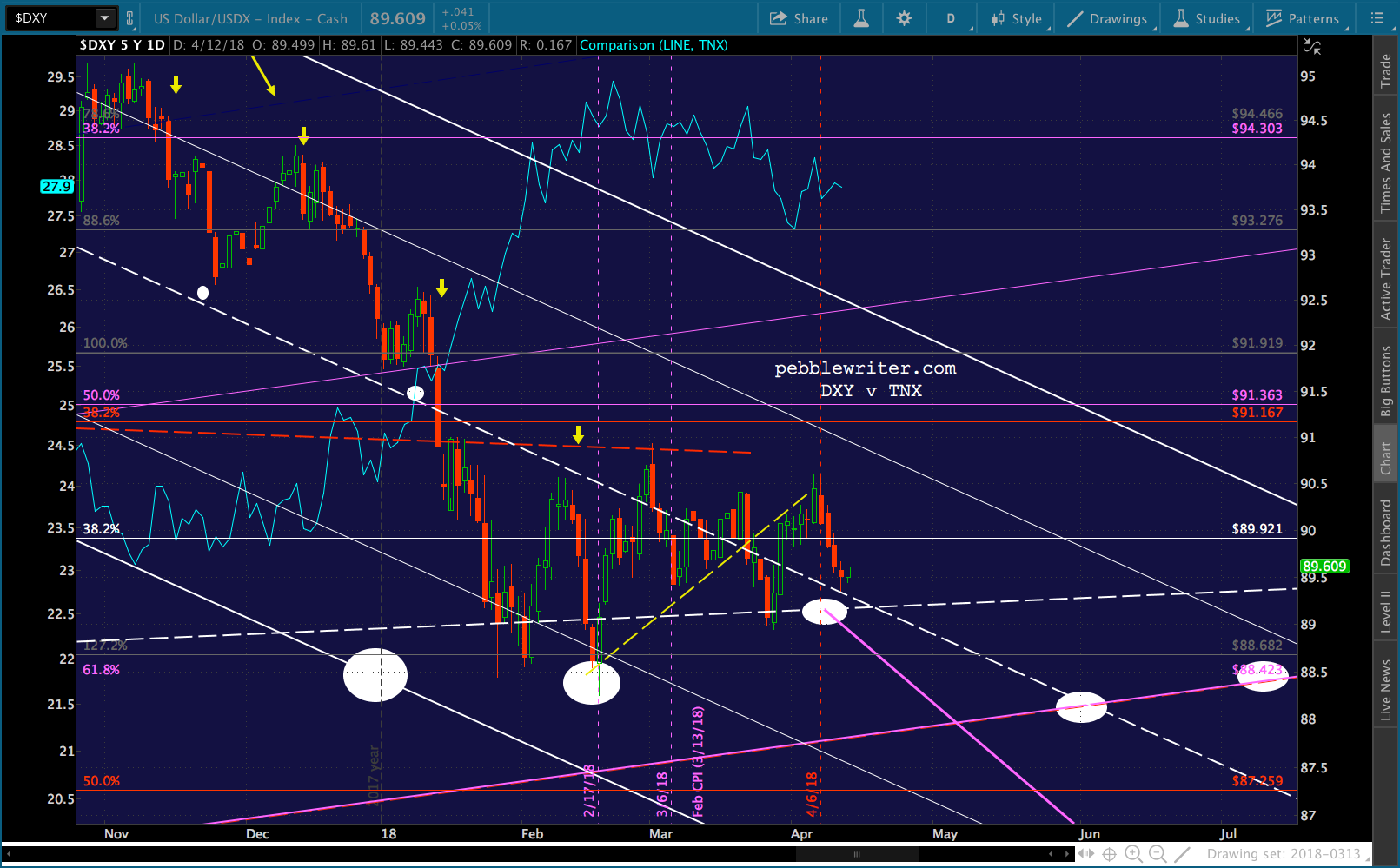
    The dollar is another matter.  While it normally rises and falls in sync with interest rates, this relationship reversed at the end of 2017.    At that point, DXY logged another leg lower while TNX spiked. At just shy of 3%, the TNX became a drag on equities — the whole “going broke” thing [see: Why Rising Rates Are a Problem This Time.]  But, as the gyrations in equities picked up again, great care was taken to ensure it didn’t plunge in value.

    I suppose the thinking was that lower rates would weaken the dollar’s appeal.  Or, maybe it was just fear of a yield curve inversion.  In any case, TNX’s purple TL has refused to break down. DXY also refuses to break down.  And, this could go on for quite a while.  It needs to tag the bottom of the rising purple channel.  But, until mid-July rolls around, that would mean dipping below the .618 at 88.423.  So, it’s quite possible TPTB will prop it up for another three months! 

    Remember, Mnuchin publicly stated he wants to support the USD.  And, it goes without saying that he, like every central banker, loathes any serious price appreciation in gold, as it undermines the value of the mighty dollar. One silver lining, EURUSD suggests a shorter timeframe, say Jun 5.  But, even two months would be a long time to wait for another few points.  An escalation in MENA tensions could obviously accelerate things.  But, is it worth taking the risk for 10-15 points?  I think not.  I’d pull the plug or at least enter stops here at 1367.  If it pops above 1380, great.  No argument with going long, again.  DXY could drop to 87 tomorrow, and GC could easily reach 1377-1380 or higher.

    But, if DXY continues sideways, and unless war breaks out in the next day or two, it seems likely that gold’s next move will be lower.  The most obvious support is at the rising white channel bottom and SMA100, currently around 1315.2-1318.  If the channel breaks down again, the SMA200 will reach the purple channel line later this month, probably around 1300.  I’ll update things if we see a material deviation in either direction.

    GLTA.


  • The Market’s Latest “Lucky” Bounce

    That’s a relief!  For months, pundits have been arguing whether the Fed needed to hike interest rates three times or four times this year — you know, because of all the growth coming down the pike.

    Fed Über-Dove and “Man Who Thinks Market Integrity is Overrated” Jim Bullard just announced that the correct number is zero.  That’s right.  Everything is perfect just like it is.

    Amazingly, and quite by coincidence, this pronouncement occurred on the exact same day that several stock market indices were in danger of falling below a very important technical level of support: their 200-day moving averages.  As we discussed on Monday, falling below the SMA200 isn’t usually very healthy for markets.

    For visitors and new members, this seems like a good time to take a walk down memory lane.  This isn’t Mr Bullard’s first rodeo.  Nor is it the first time “someone” did something clever to ensure the market’s continued ascent.

    The S&P 500 illustrates the phenomenon quite well, having experienced a number of such fortunate events at crucial times. October 2014 – Bullard!

    Bullard appeared on Bloomberg to explain that another round of QE might be in order. As “luck” would have it, this enabled SPX to reverse right as it reached important Fibonacci support, ending a 9.9% tumble and narrowly averting an official correction.

    Big assist from USDJPY, which soared 16% over the next 7 weeks in spite of the fact that more QE should have weakened the US dollar.  The Yen Carry Trade in all its glory.

    August 2015 – USDJPY!

    This 12.5% correction was set up by USDJPY falling back below a critical Fibonacci level (the .618 at 120.11) in the wake of SPX reaching a key Fibonacci extension (the 1.618 at 2138.)

    We had correctly forecast the top [see: The Last Big Butterfly] but it was unclear whether or not USDJPY could remain above 120.  SPX plummeted when 120 finally fell but, as “luck” would have it, was (temporarily) rescued by USDJPY’s bounce back above it.

    February 2016 – Oil!

    The price of West Texas Intermediate Oil (CL) had fallen 77% between Aug 2013 and Feb 2016.  While this crushed inflation to a manageable level, it made investors in and lenders to energy-related companies pretty nervous.

    As “luck” would have it, CL bottomed out on Feb 11, 2016 — the exact same day that SPX reached that critical Fibonacci support level of 1823.  CL doubled over the next four months, and SPX rebounded sharply.  By accurately forecast the bottom in oil, we could confidently call a bottom for SPX [see: USDJPY Finally Relents.]June 2016 – USDJPY!

    Stocks plunged in the wake of the Brexit vote.  As “luck” would have it, USDJPY — which had used CL’s rally as an opportunity to reset — picked this particular day to bottom out and spiked 8% higher over the following month.

    Futures had sold off by 6.5%, but by the time SPX opened the next morning the recovery was well underway.  It was soon back above its recent highs and the critical 1.618 extension at 1.618.  In other words: new all-time highs.

    November 2016 – Trump*!  Unfortunately for stocks, the US election results weren’t conducive to a rally.  Once Trump’s election became apparent, futures plummeted over 5% in a matter of hours.  SPX had bounced off its SMA200 a few days earlier.  Unless something was done quickly, it would drop through this key support the following morning.As “luck” would have it, USDJPY picked this particular day to bottom out.  It spiked 5% over the next few hours and 18% over the next few weeks — a supersized version of the exercise which had saved stocks post-Brexit.

    And, if that weren’t enough, VIX — the widely accepted indicator of fear and volatility — plummeted even as futures were plunging.  It’s the equivalent of calling your insurance broker to cancel your homeowner’s policy as a hurricane bears down on your beach house.  How very, very “lucky” indeed.Futures recovered almost all of their losses by the time the cash market opened the following morning. VIX went on to shed over 50% of its value and broke down through trend line support (above, the white arrow.)

    Stocks were soon registered new all-time highs. The talking heads called it the “Trump Rally” and attributed the gains to the incoming president’s pro-business orientation and deal-making acumen. But, I think it deserves an asterisk…on account of the incredible “luck” involved [see: Why the Trump Rally is a Fraud.]

    The SPX chart isn’t labeled as such, but the rise from 2138 to 2703 (the next major Fib level) wouldn’t have been possible without continued support from oil and VIX.  After doubling in value, CL proceeded to construct a well-formed rising channel (below, in purple) that was very supportive of stocks.  It oscillated between the channel’s top and bottom like clockwork — until December 2017.  We’ll come back to that.Also during that time, VIX was trying something new.  After years of occasionally bouncing off the bottom of a long-term channel (below, the yellow arrows) it decided to plunge below that channel bottom and spend 80% of its subsequent days in the cellar — reaching new all-time lows in the process.This sent a strong all-clear signal to stocks (or, at least the algos that trigger stock purchases) that the coast was clear. It was completely safe to buy stocks, which they did — producing a rally that accelerated all the way up to the 2.24 extension at 2703.

    December 2017 – Oil!

    At that point, oil’s breakout (remember the purple channel above?) and the onslaught of new, daily lows in VIX combined to give SPX the boost it needed to climb above that resistance.  I mean, how “lucky” can you get?  It popped above 2703 and tacked on another 6.3% for good measure.

    Unfortunately for stocks, though, there was a practical limit to how high CL could go without creating problems.  Someone had forgotten that higher oil prices mean higher inflation.  And, higher inflation means higher interest rates.  And, when you’re $21 trillion in debt and pass a tax bill and budget that greatly widen the deficit considerably…higher interest rates are not exactly lucky [see: Why Higher Interest Rates Are a Problem This Time.]

    Between that realization and a growing disconnect between price and supply & demand, CL had to drop.  When it did, and the (dashed, red) trend line from August 2017 finally broke down, stocks didn’t take it well.SPX plunged almost 12% over the next two weeks, one of the sharpest corrections ever.  Luckily, the SMA200 was there to catch it.  A few days later, CL popped back above its channel top and SPX recovered to back above 2703.

    As the bounce began to fade, we had a surprise message from Bullard that “too many rate hikes could slow the economy.”  It was enough to extend SPX’s bounce for another few weeks.  But, ultimately it slipped back down below 2703 to tag its SMA200 again.  And, again.  And, again.  And, again.

    By then, DJIA and RUT had finally risen to the point where they could tag their SMA200s as well.  SPX bounced at our 2561 target.  Investors were in luck!  Until this morning.

    April 2018 – Bullard!

    Apparently, someone forgot to explain to the Chinese that we were supposed to win the trade war (winning them is easy!)  This morning, we found out that China had the gall to fight back.  When I was woken by an price alert at 3:15 this morning, the futures were off 55 points.  SPX would open back below its SMA200.

    But, the futures didn’t know what they were up against!

    Then came Larry Kudlow, the guy who in May 2008 called the impending Great Financial Crisis a “non-recession recession.”  Some people might have misunderstood; but, obviously he meant it would be much worse than a recession.  (I can’t wait to find the pot of gold!)

    As “luck” would have it, the market was quite pleased with all this positive scuttlebutt.   ES, once down 55 points, closed up 34 points.  SPX and the Dow rose about 1%.  RUT added 1.30%.  And, COMP — which never did tag its SMA200 — popped 1.45%.  Take that, 200-day moving average!

    Bounces are nice, whether driven by oil, the USDJPY or Fed cheerleaders.  This one got SPX back above its SMA200, which is a good start.  Next comes the 2.24 Fib, which SPX has crossed some twenty times in the past two months.  Can it rise back above and stay there this time?

    Oil’s limitations haven’t disappeared.  Managing inflation and interest rate expectations will continue to dominate its price action.  Lately, the market has a very narrow range within which it feels comfortable.

    USJDPY is threatening to break out from a falling flag pattern, but one has to wonder why it hasn’t done so already.  Japan got no love from Trump in the trade war chatter to date.  It’s quite possible they’re done cooperating with currency intervention. VIX, after popping back above the yellow channel bottom in dramatic fashion in February, has fallen back to a trend line (red, dashed) from its January lows.  Every time it pops above the trend line, SPX stumbles.  Every time it drops below it, SPX rips.  Today, it tagged it and reversed lower – hence the day’s gains.  It has plenty of additional downside potential, with the potential to drive stocks back above 2700.  But, again, it hasn’t done so yet.

    It makes one wonder whether SPX will be allowed to put in a lower low in order to make the corrective wave look a little more conventional and give COMP a shot at its SMA200.  We have oodles and oodles of downside targets if SPX’s SMA200 should fail.  That white dot at 2138 in the chart above is there for a reason [see: More Where That Came From.]

    There are countless other factors I haven’t even mentioned: our yield curve model (which tentatively turned bullish today), 10yr note rates, the US dollar’s buoyancy, various momentum indicators, and the continuing sagas of FB, TSLA, AMZN and DB — all of which have played a role in the market’s gyrations (mostly of the bad luck variety.)

    Whatever happens, it’s hard to imagine we could reach new highs without plenty more luck.  Trade safe, and stay tuned.


  • Update on COMP: Mar 20, 2018

    Facebook is only 5.5% of the Nasdaq Composite (COMP), but yesterday’s plunge [see: Facebook Flops] was a good reminder to update our outlook.

    In our last update [see: Nov 6, 2017 Update] we identified 7619.37 as our next upside target.

    At this point, it’s pushing into the top quadrant of the rising white channel where it will soon reach the top of the rising purple channel — currently at 7260.

    It probably won’t stop there, though, as the 1.618 and the rising white channel intersect at 7619.37 at the end of the year. It’s too convenient a target to ignore. And, I fully expect it to reach it unless we get a nasty surprise on the geopolitical front.

    As it happened, COMP’s tag of 7619 was delayed by the February correction. It topped out last week and has since retreated 352 points — about 4.5%.  Since COMP reached its important 1.618 Fibonacci extension and the top of a well-formed channel, it’s fair to ask whether there’s more downside ahead.

    continued for members(more…)