
Posts

  • Were We Invading Mexico?

    Late last night, the FAA announced that El Paso International Airport would be closed to all incoming and outgoing flights for the next 10 days. The only reason I can think of for such an action is that the US would be flying into Mexico to apprehend some drug kingpin, Venezuela style. Moments ago, they announced that the closure had been revoked – presumably because whatever security emergency had existed no longer exists. Just another day…

    Meanwhile, less than a week after the largest number of job cuts in any January since 2009, a very positive job growth print was released (+130K versus 55K expected, 4.3% versus 4.4% expected.) Note that the job cuts data came from private outplacement firm Challenger, Gray & Christmas and the job growth print comes to us from the data-made-to-order folks at the BLS.

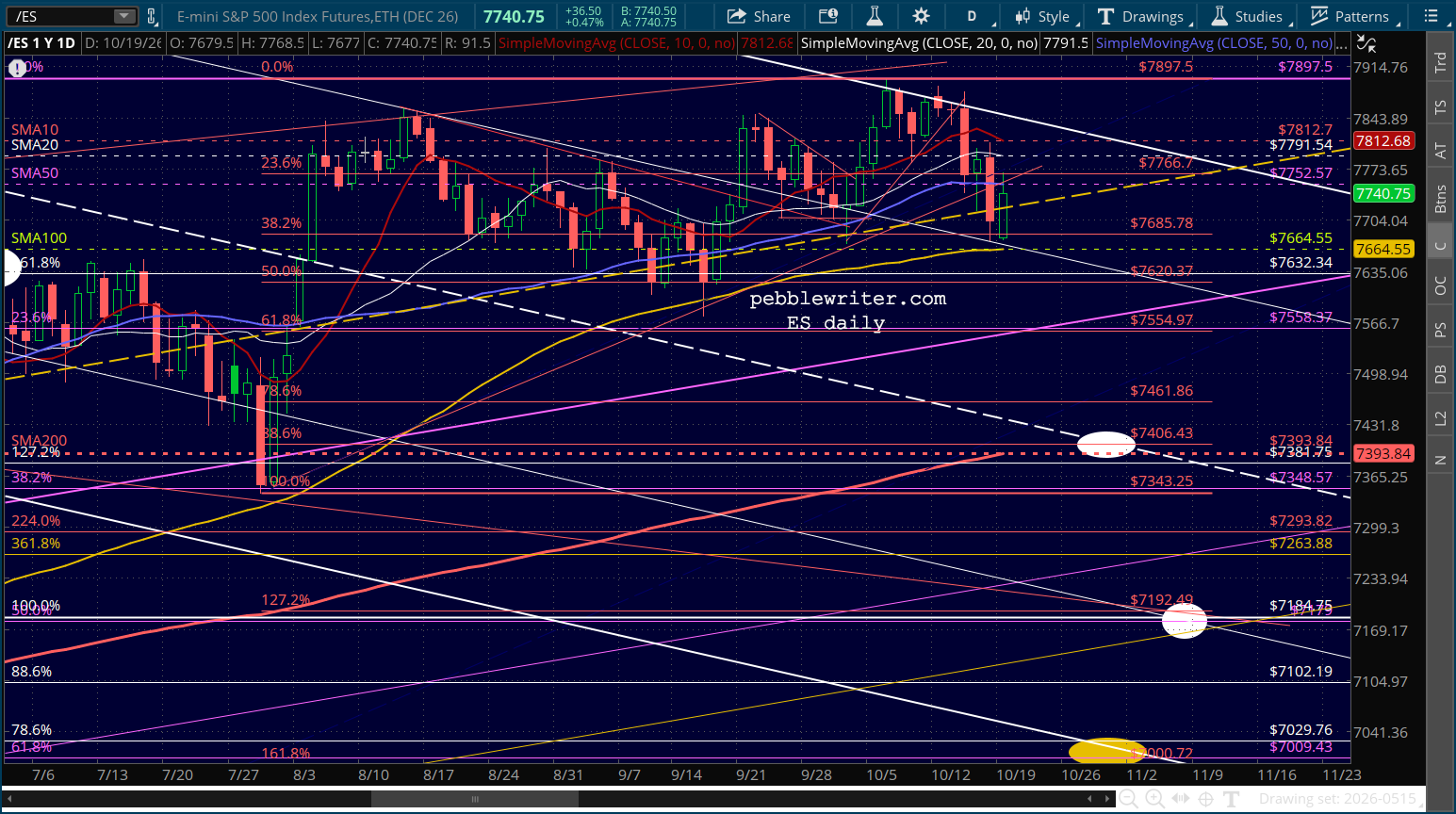
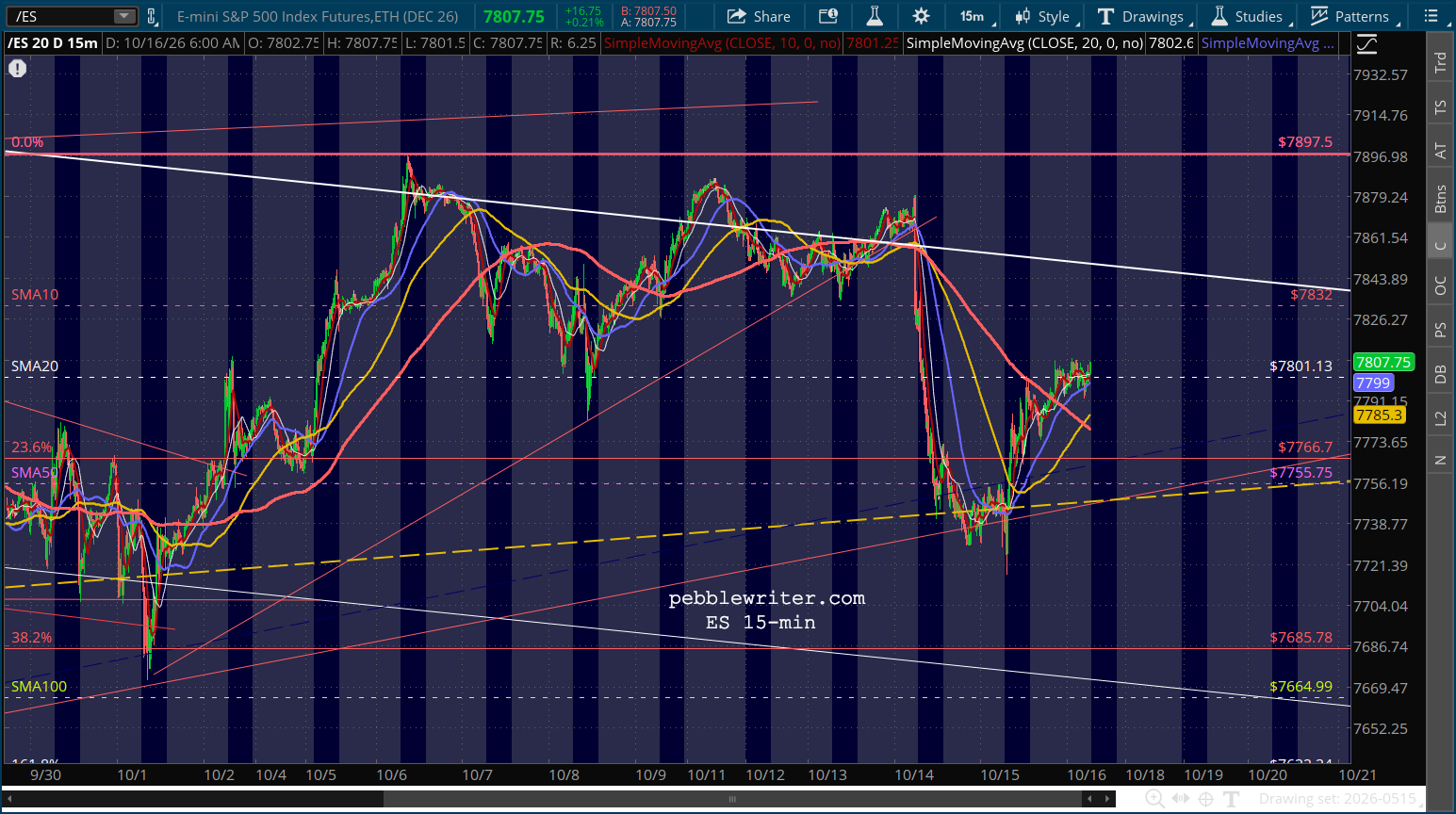
    The futures think this is just fine and have soared by nearly 40 points…

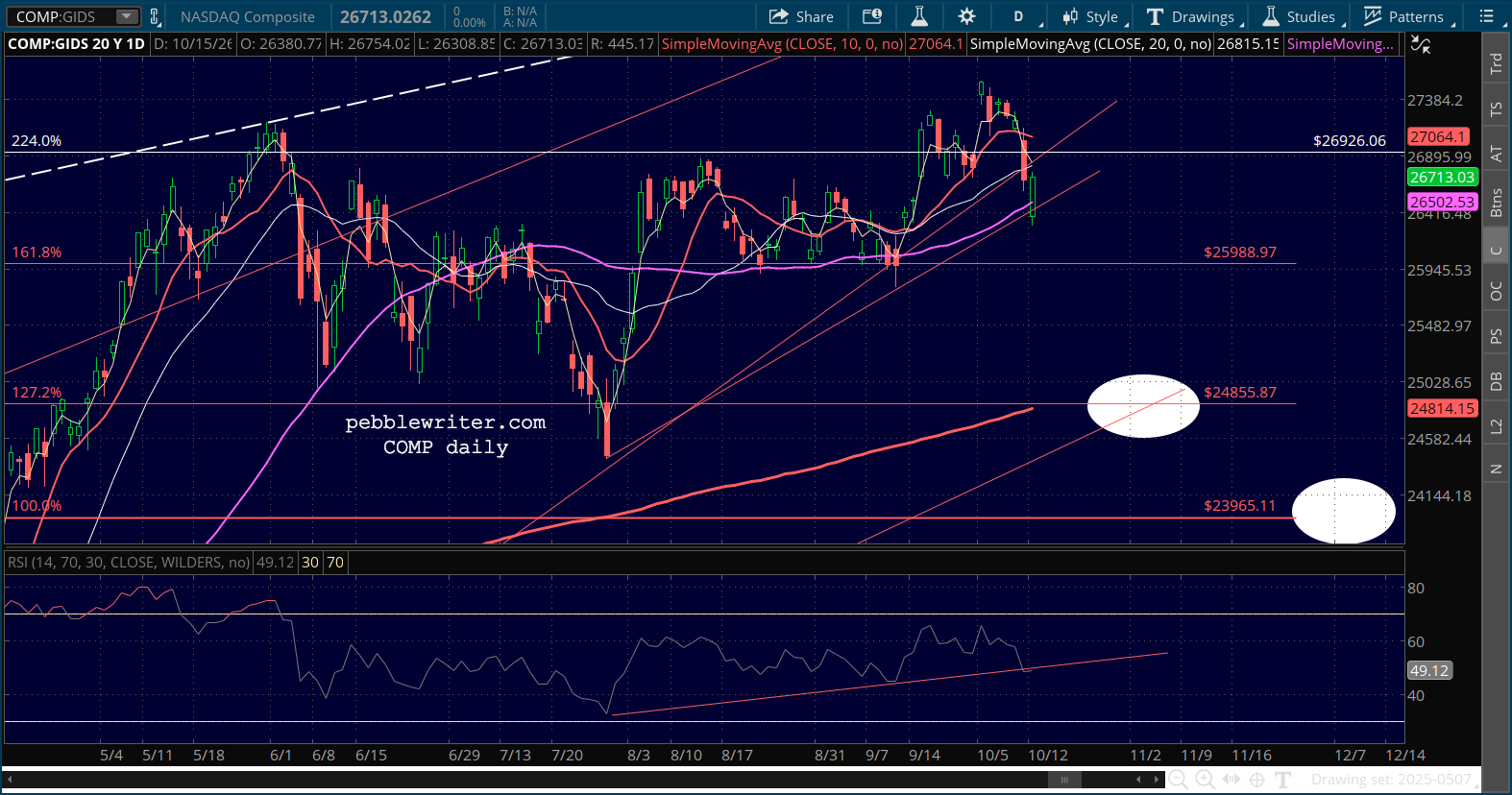
    …ignoring the shooting star candle that the DJIA left in its wake yesterday.

    The only problem with this jobs data, of course, is that it shoots the odds of a Fed rate cut in the foot. It also suggests that the inflation print coming out Friday will be lower than expected.

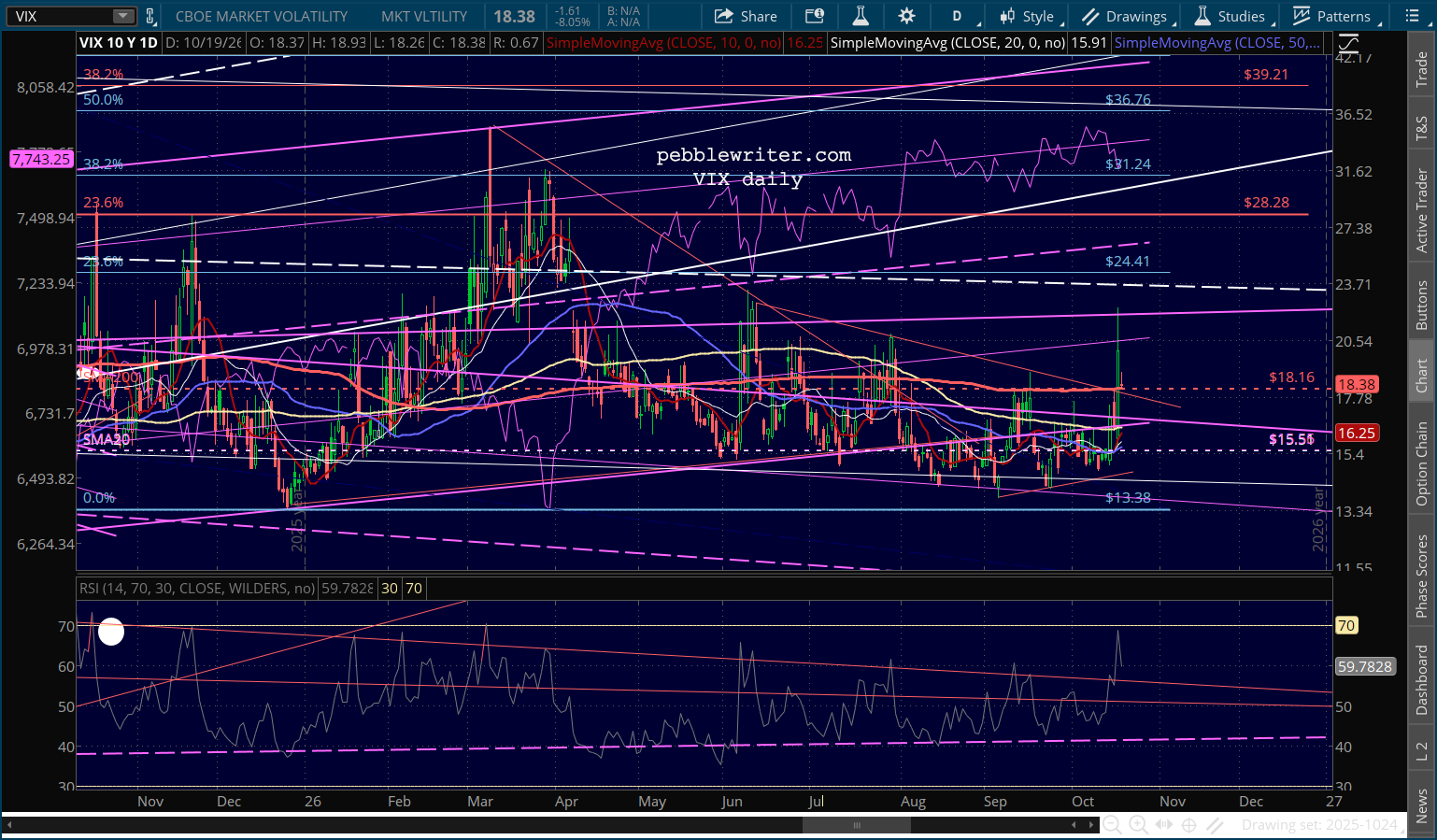
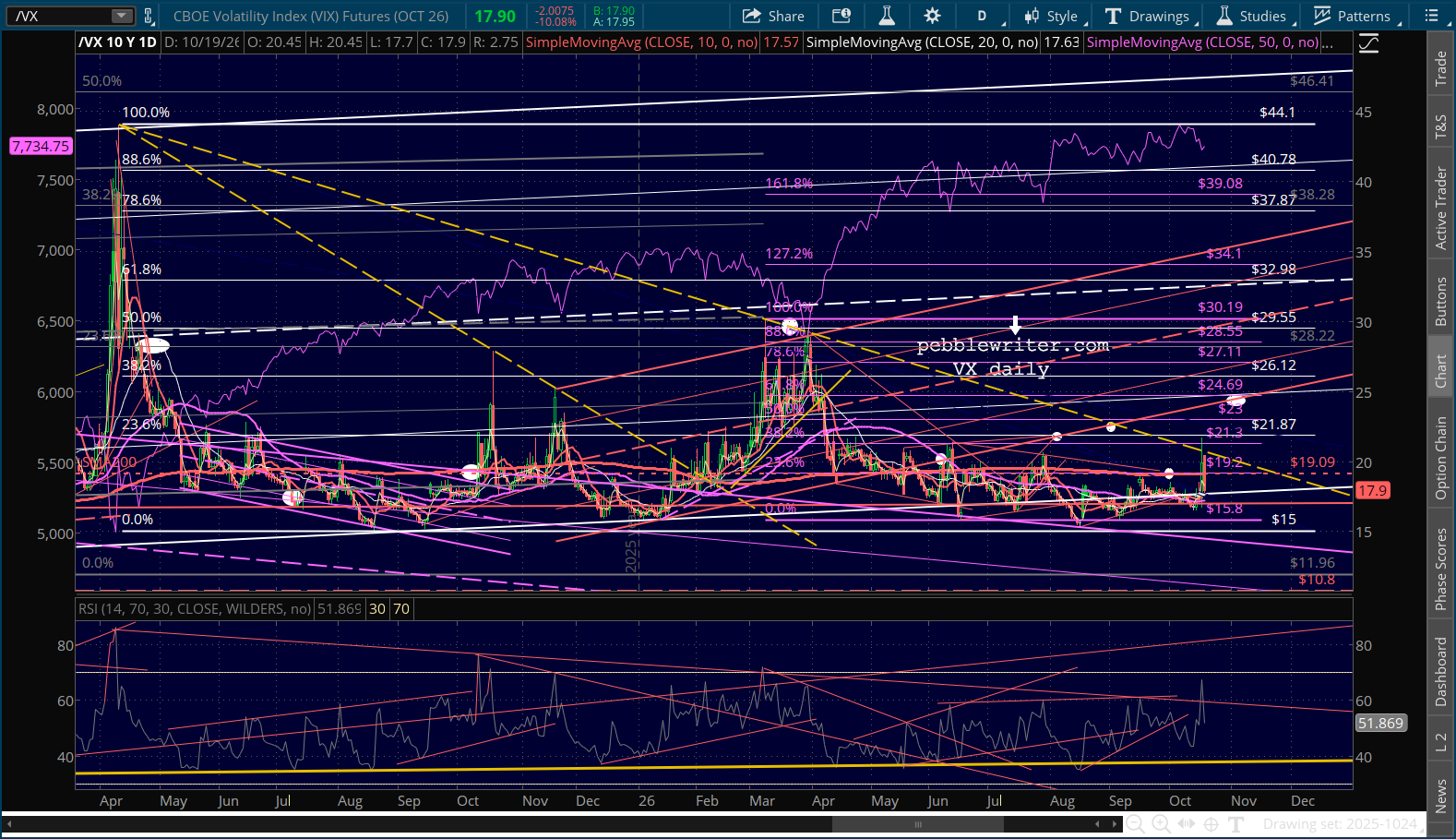
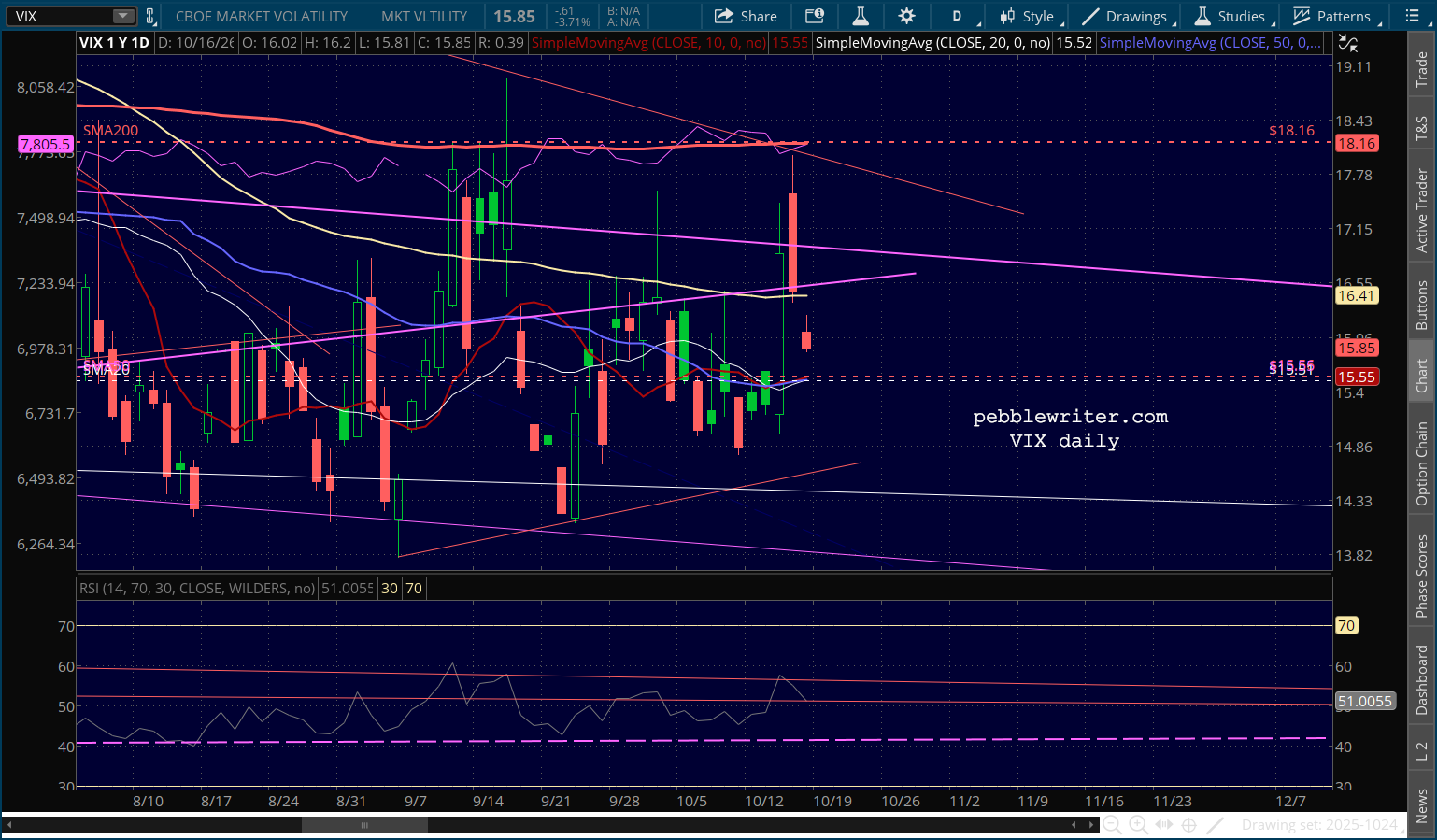
    While numerous indicators still suggest a significant/imminent downturn, VX is doing its level best to prevent a meltdown.

    Stay tuned…

  • Retail Sales Tumble

    U.S. retail sales were unexpectedly flat in December, confirming that the overall economy is on a slower growth path than most economists had believed. November’s print was a strong 0.6% increase. Futures are flat as the jobs and inflation data also due out this week are viewed as more important.
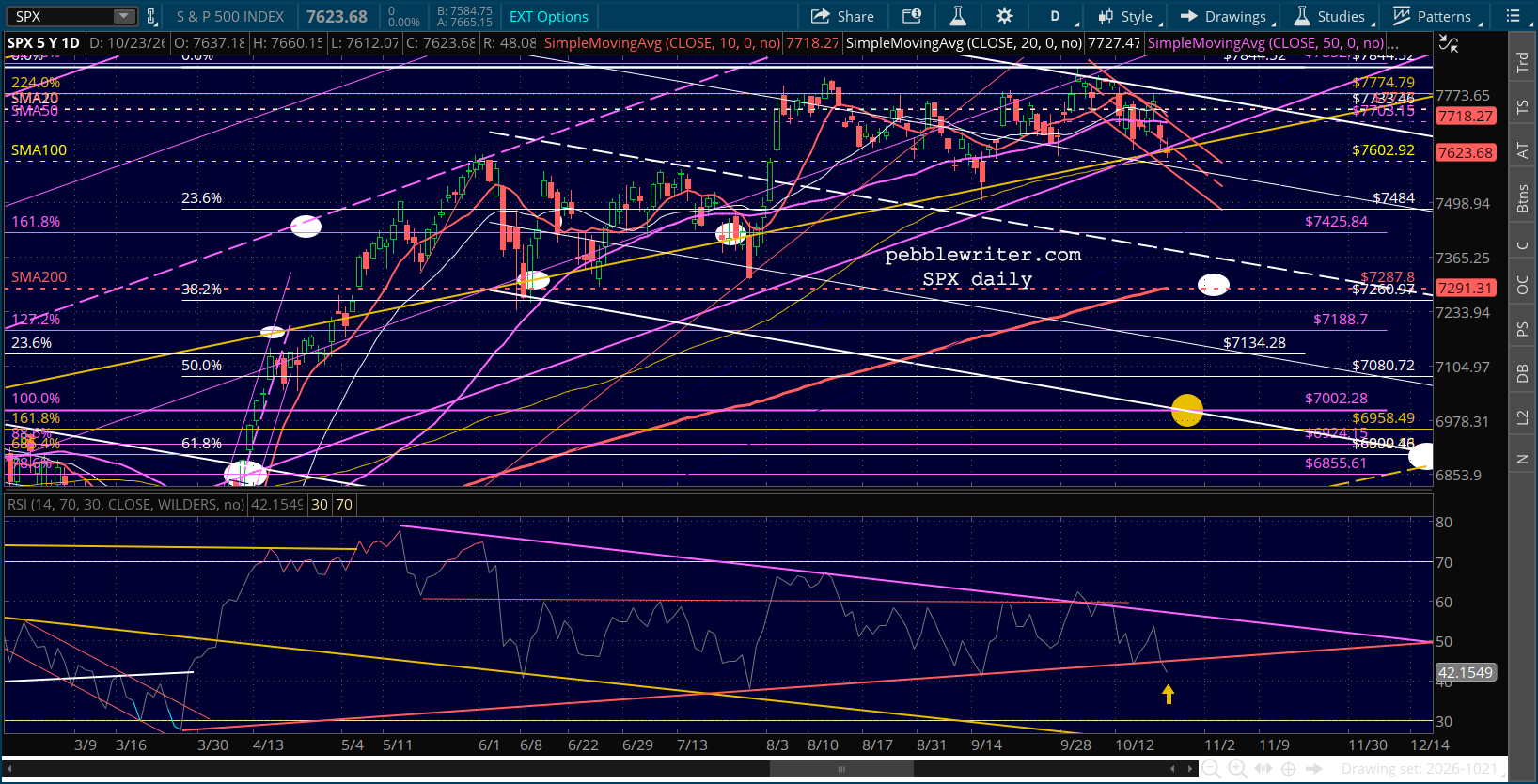
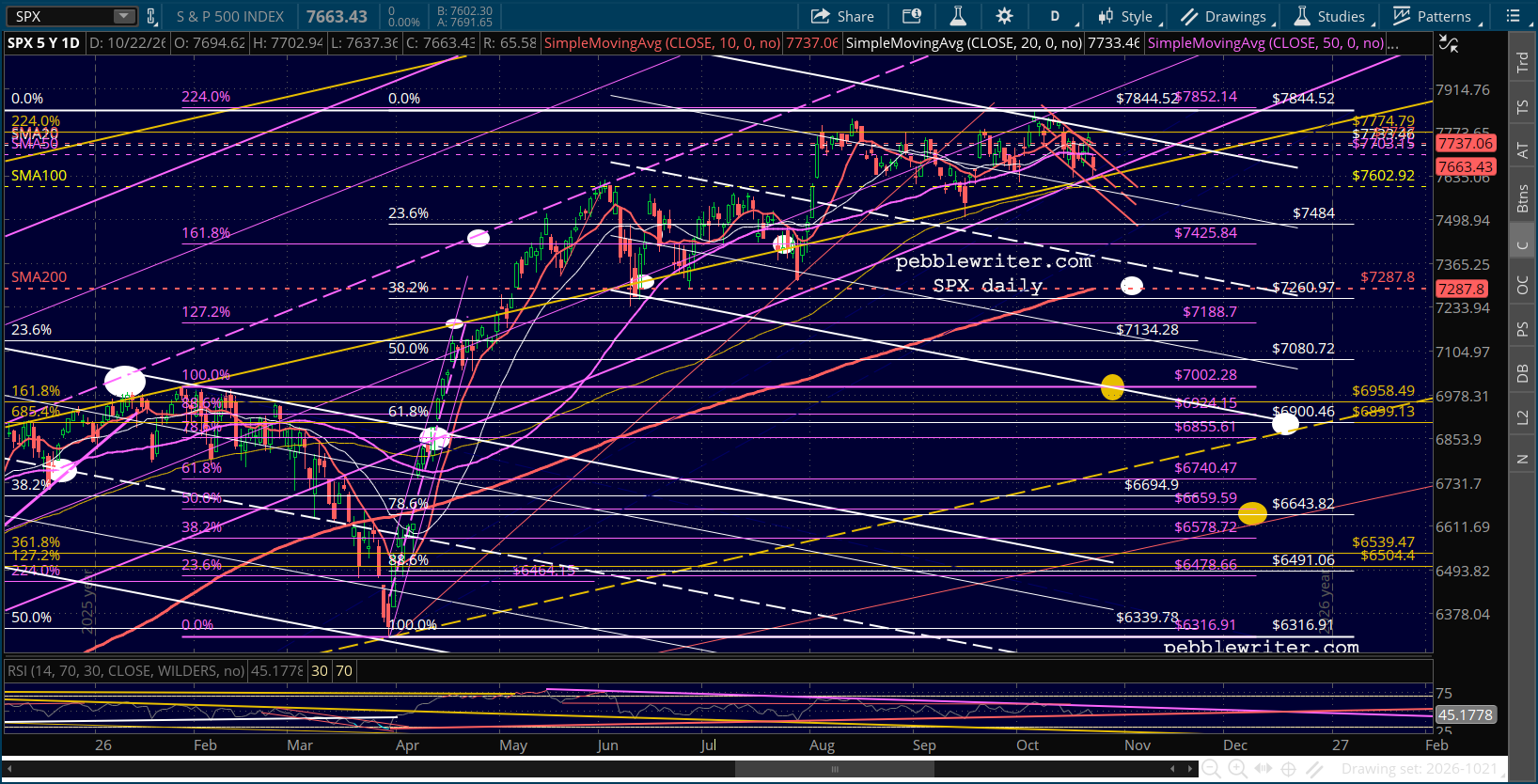
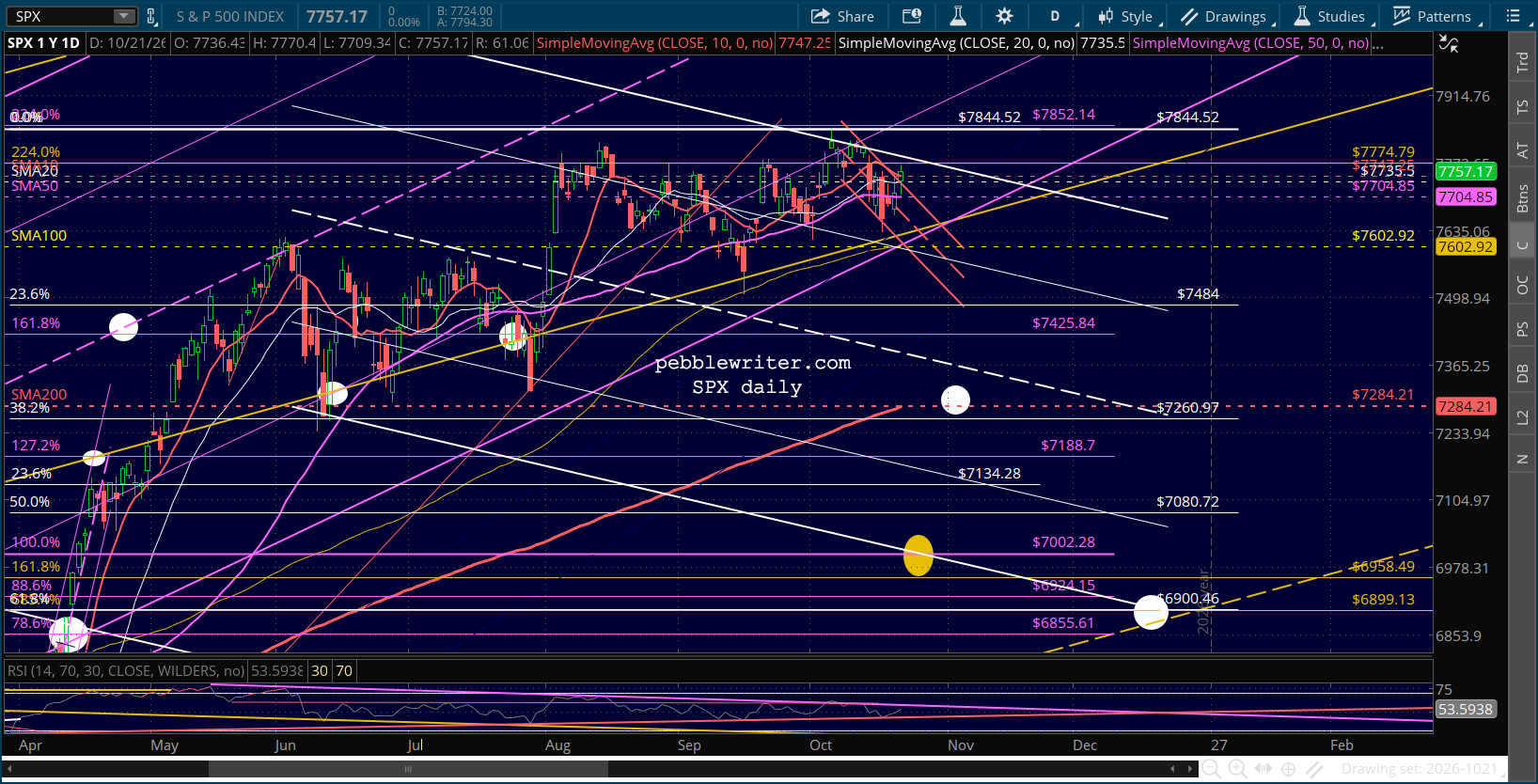
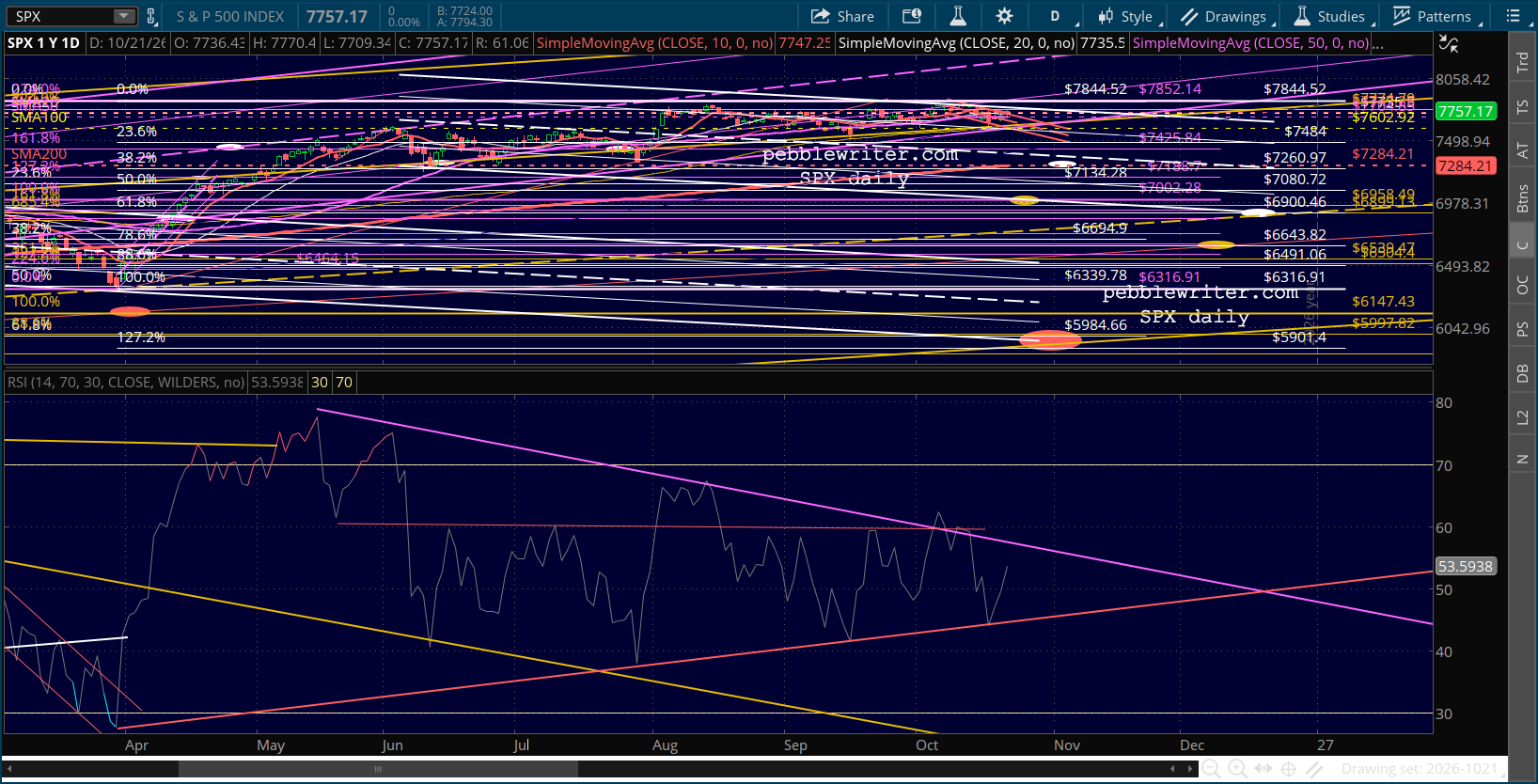
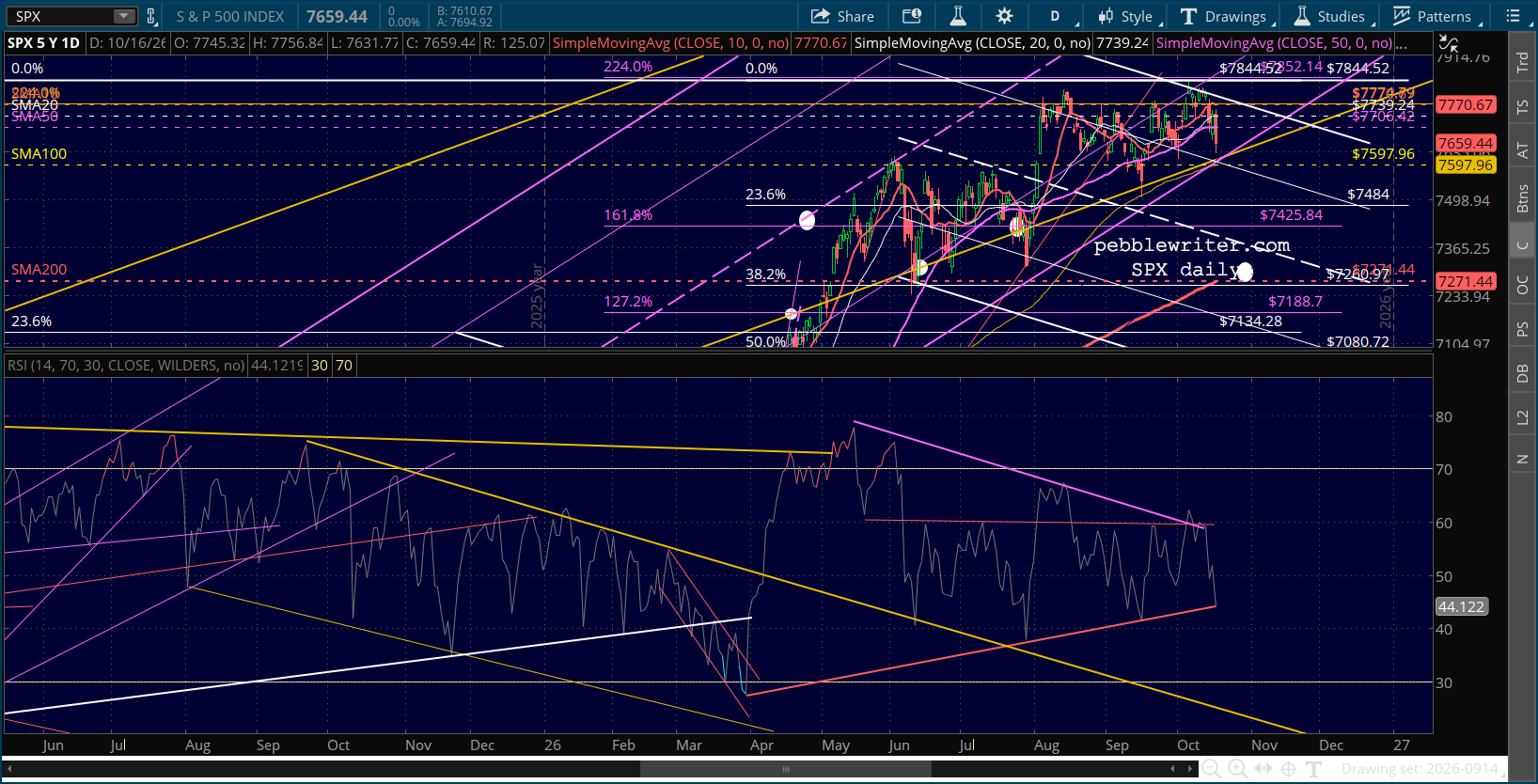
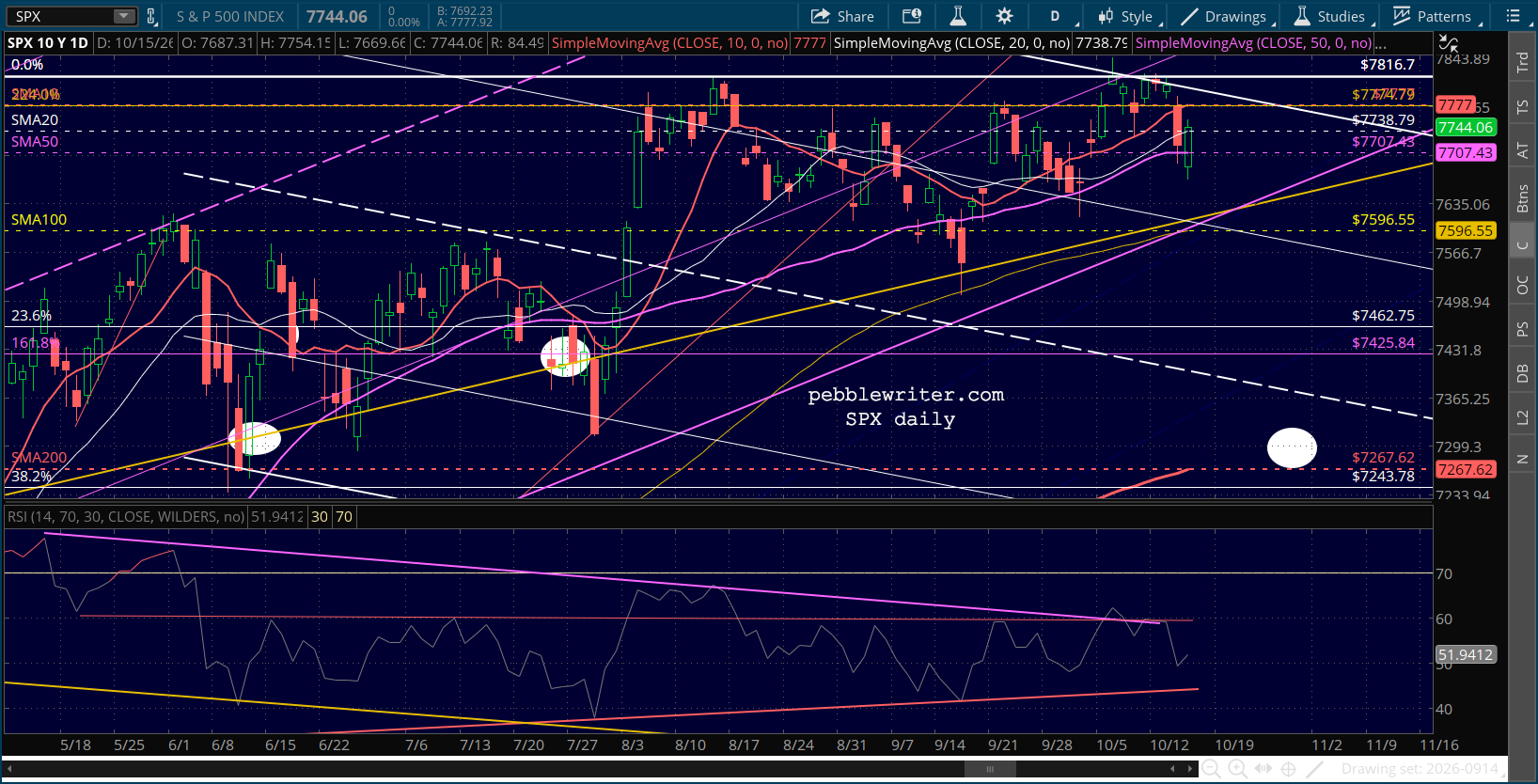
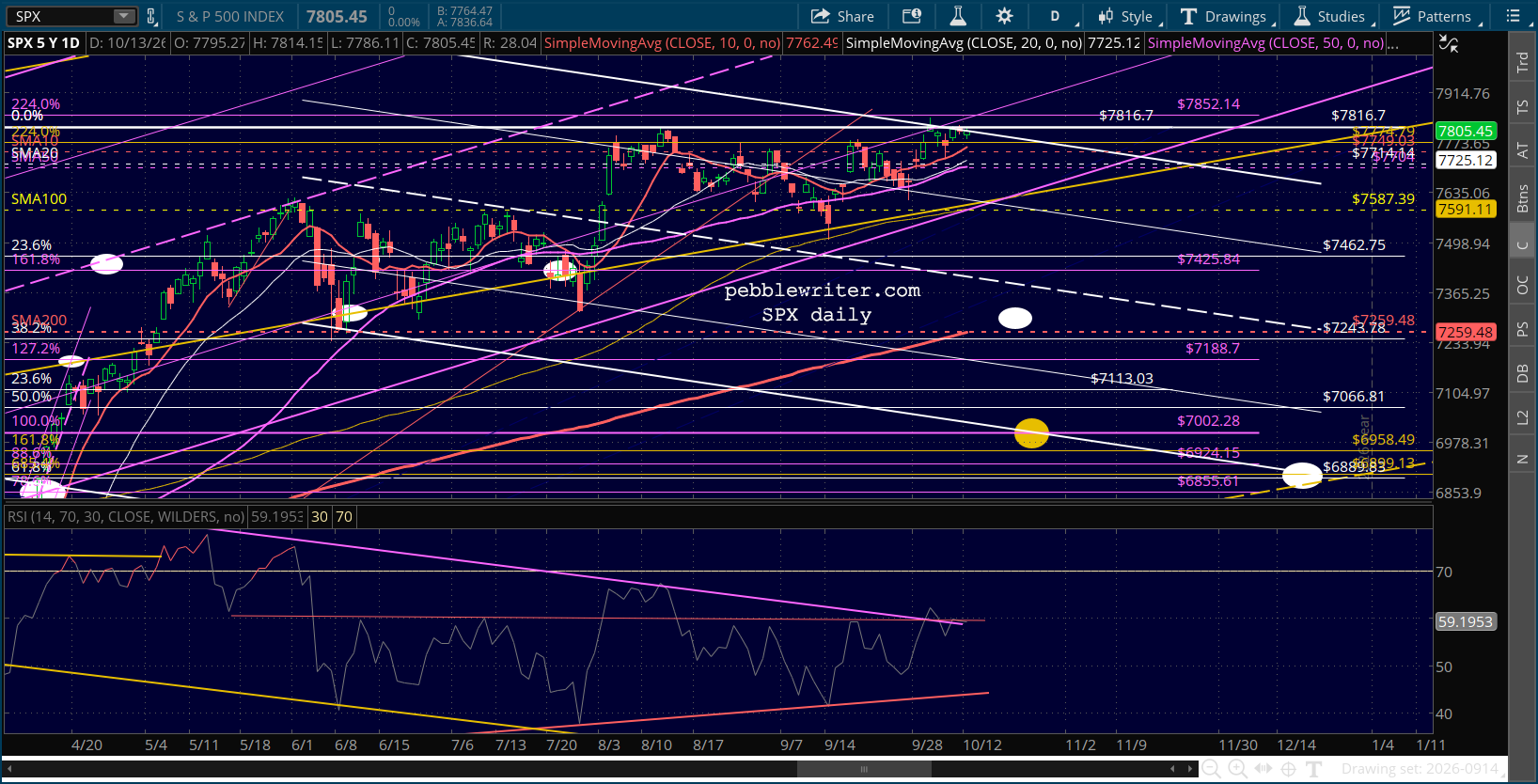
    Note that RSI for both SPX and ES has been making lower highs, diverging from the higher highs in the indices themselves.
    DJIA has officially tagged its 1.1618 Fibonacci extension.
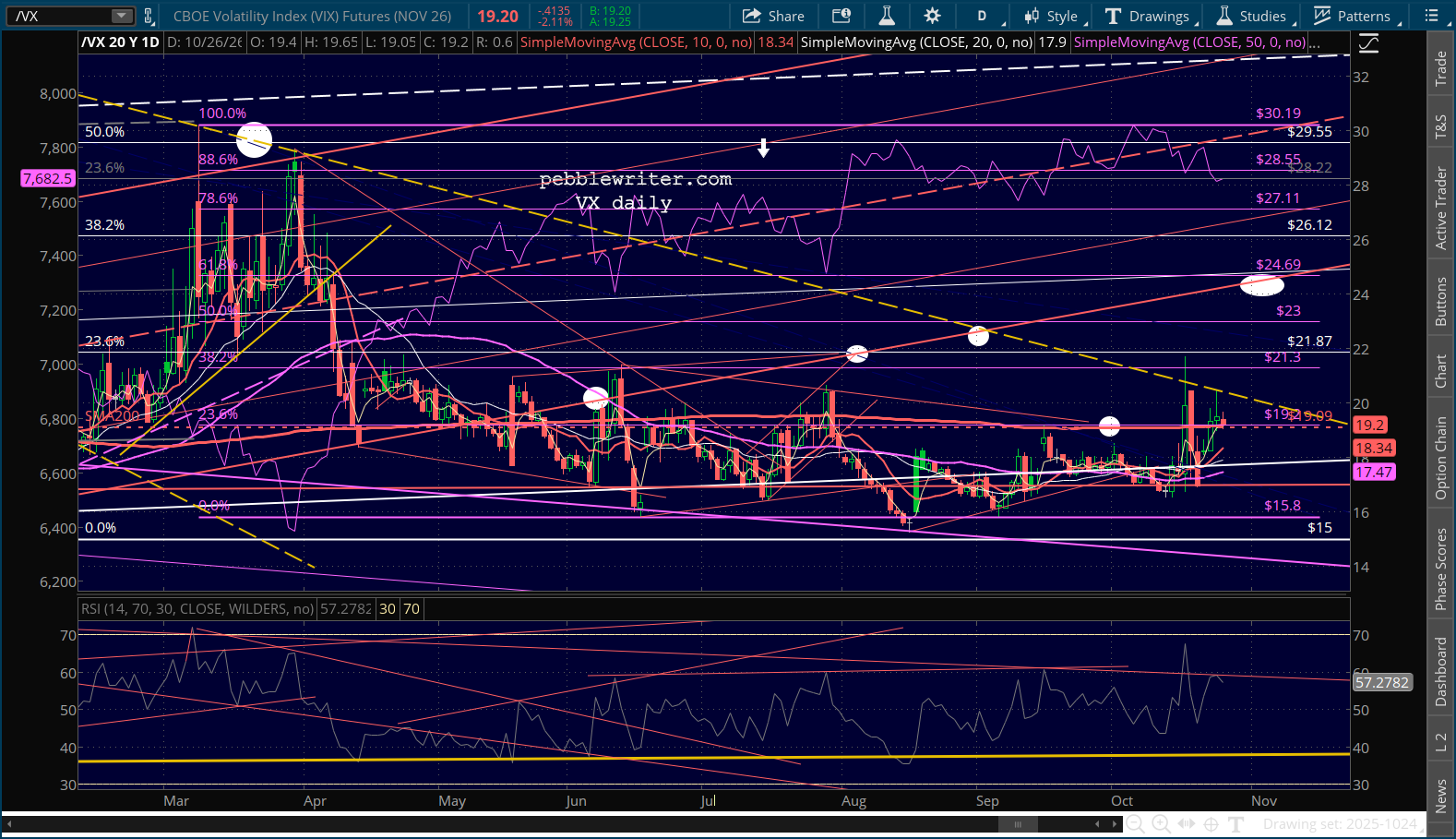
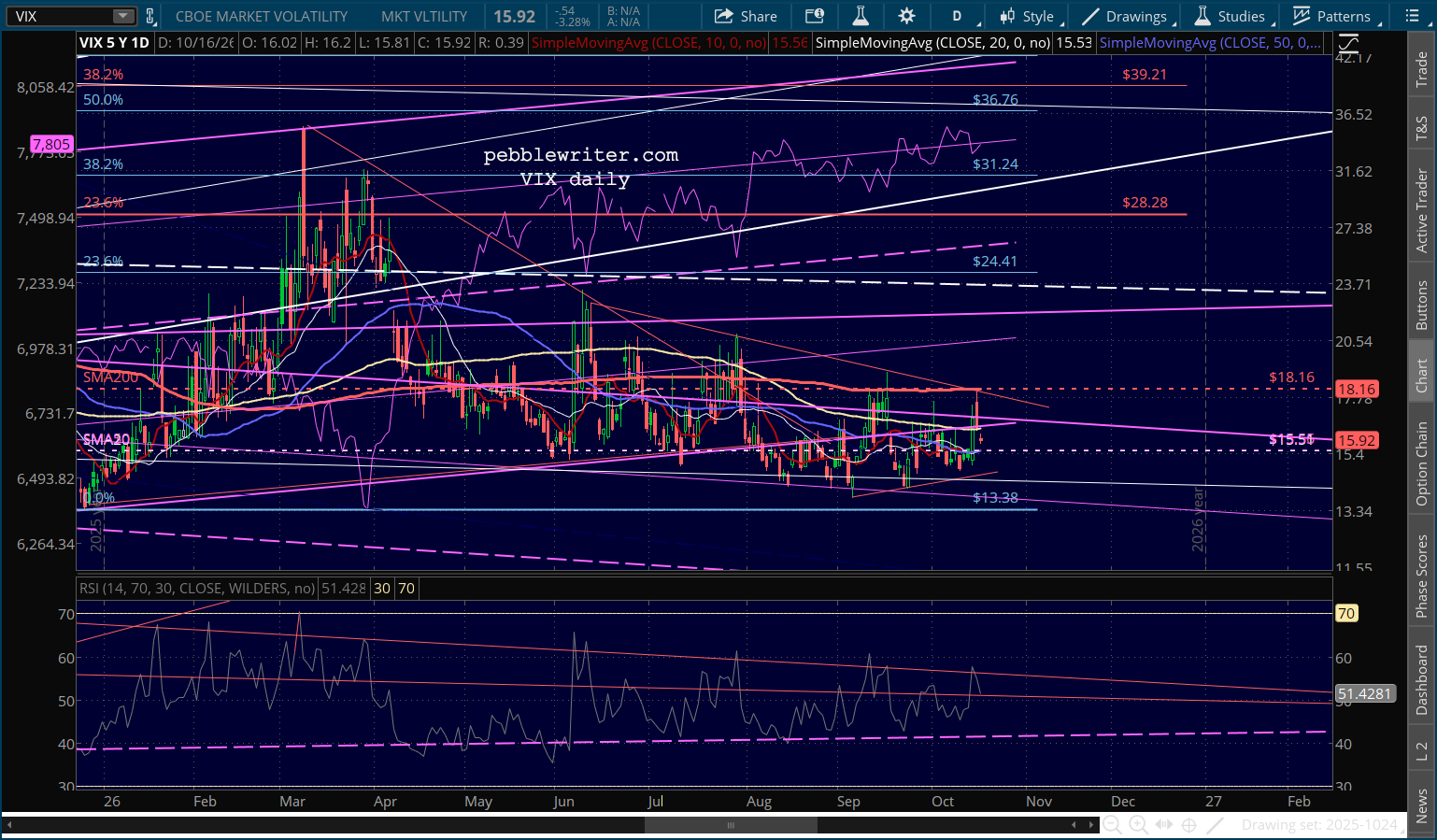
    VX remains below the TL and SMA200, propping up stocks for now.
    Our model continues to suggest a significant drop is imminent.
  • Charts I’m Watching: Feb 9, 2026

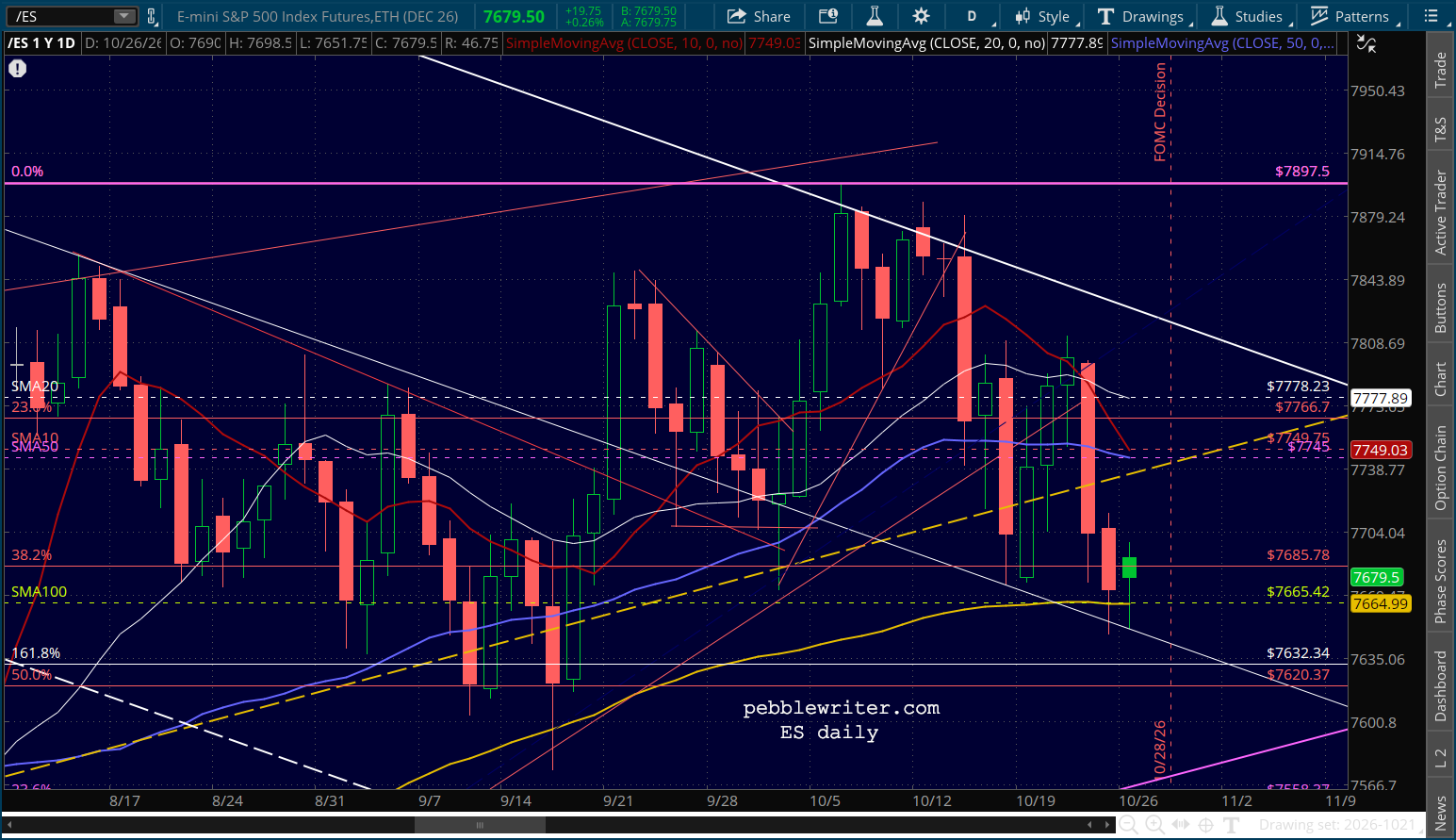
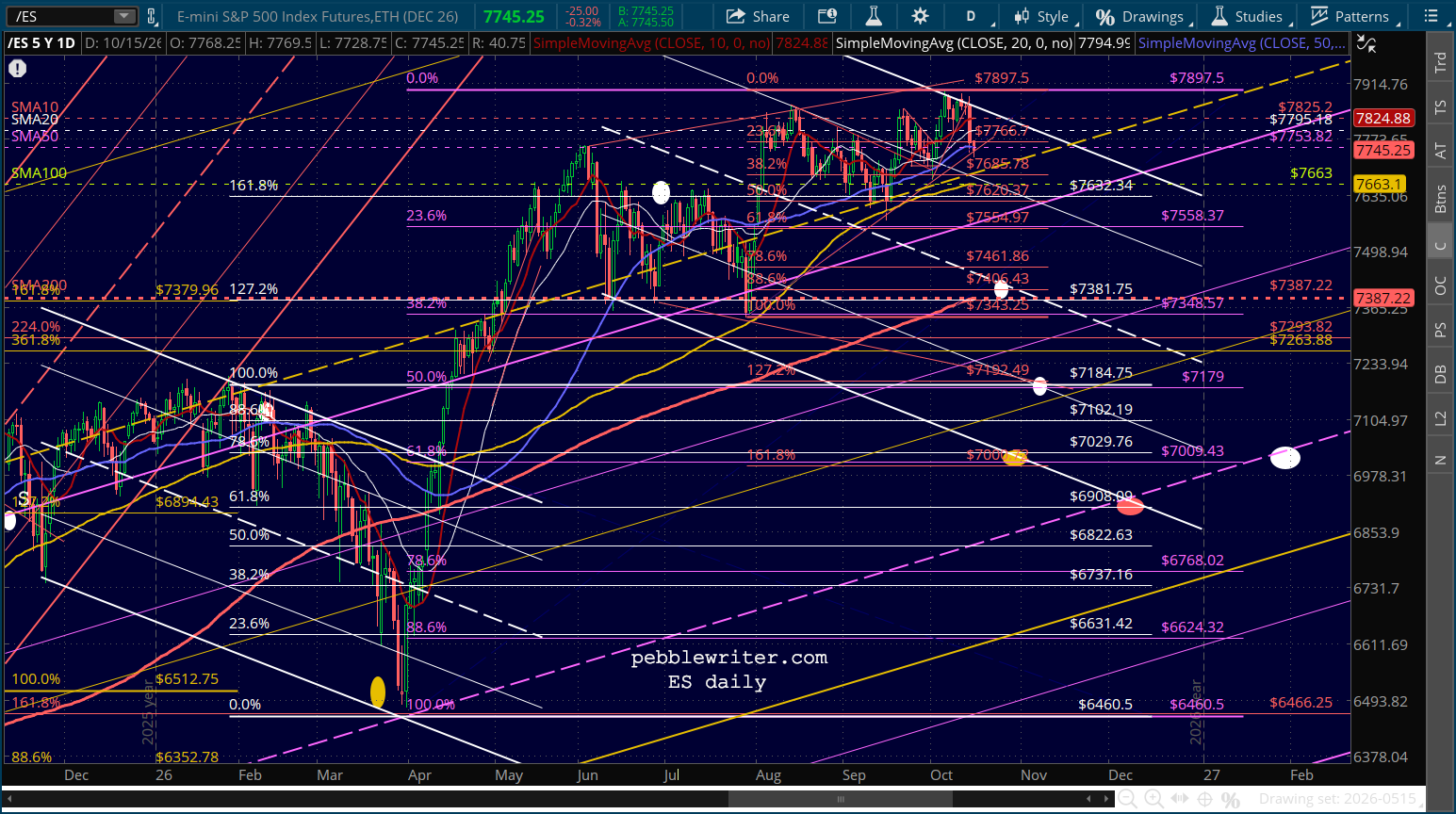
    Futures are off moderately ahead of delayed economic data due out later this week. Friday’s knee-jerk rally took SPX to 7,000, so a pullback back below the SMA50 would be significant.

    Note that a pullback to the SMA200 will soon be able to occur without producing a lower low.

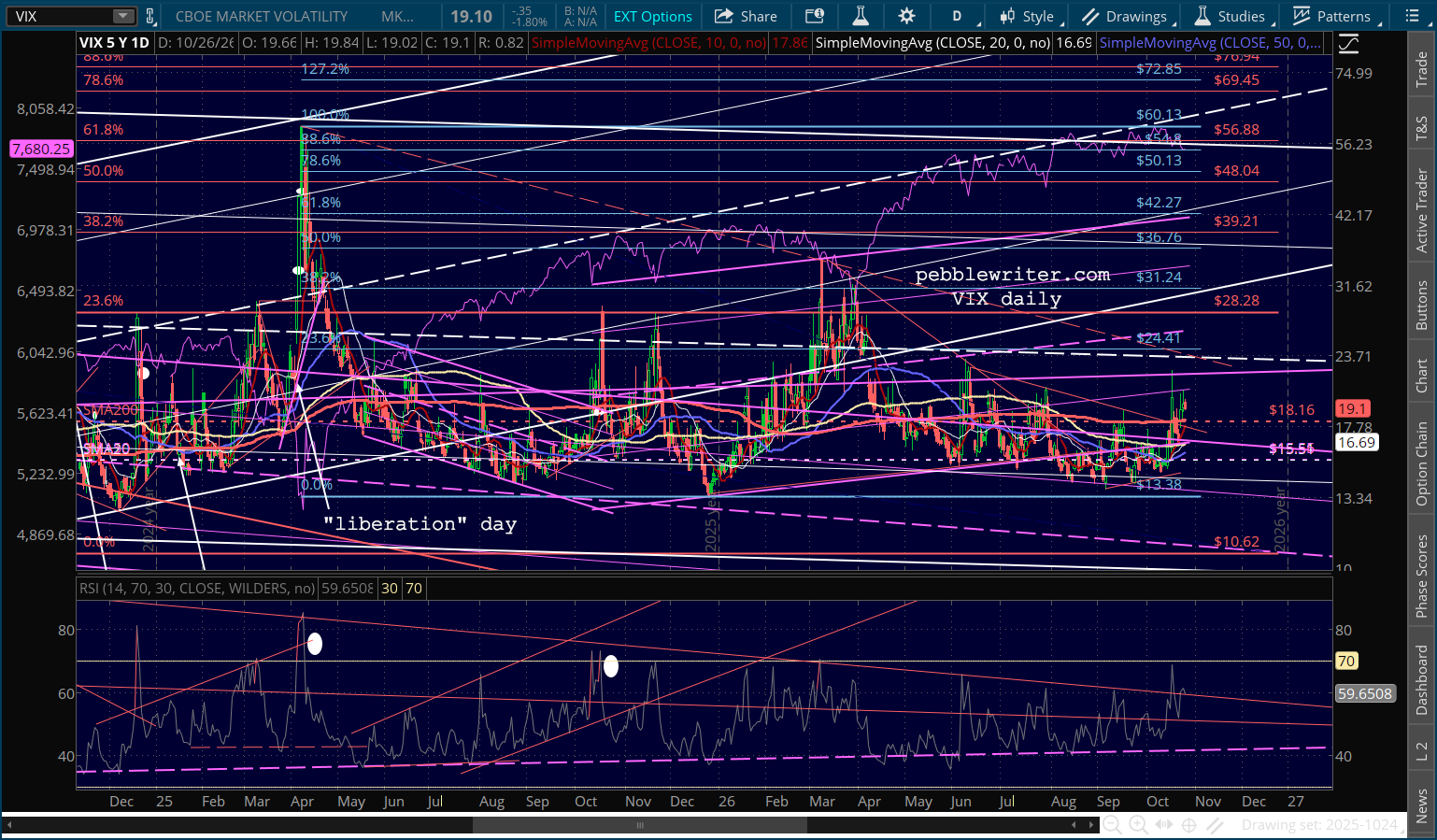
    As we noted last week, the bulls need VX back below that TL and its SMA200. It remains on the bubble this morning.

    Another measure on the bubble: DXY.

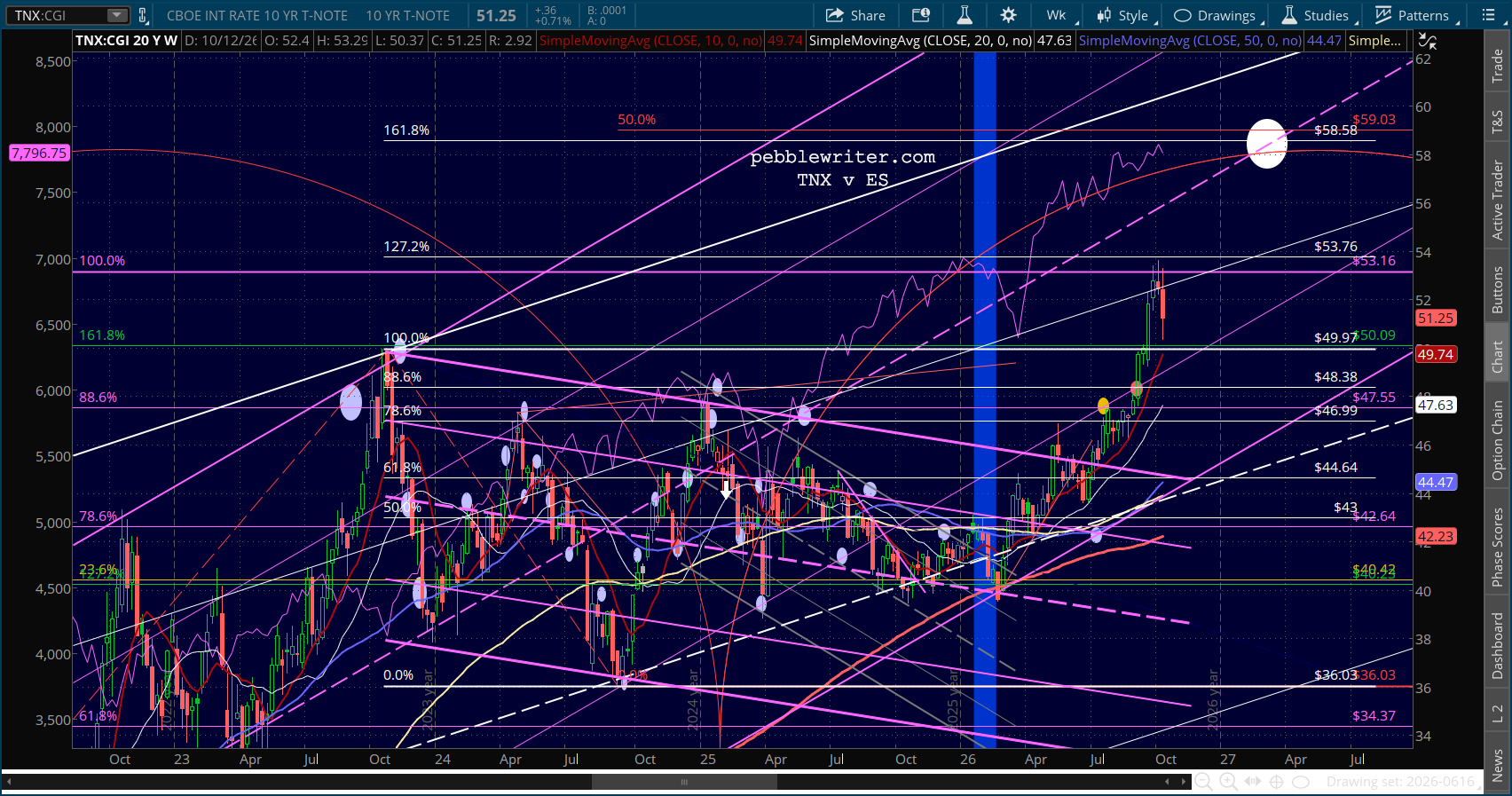
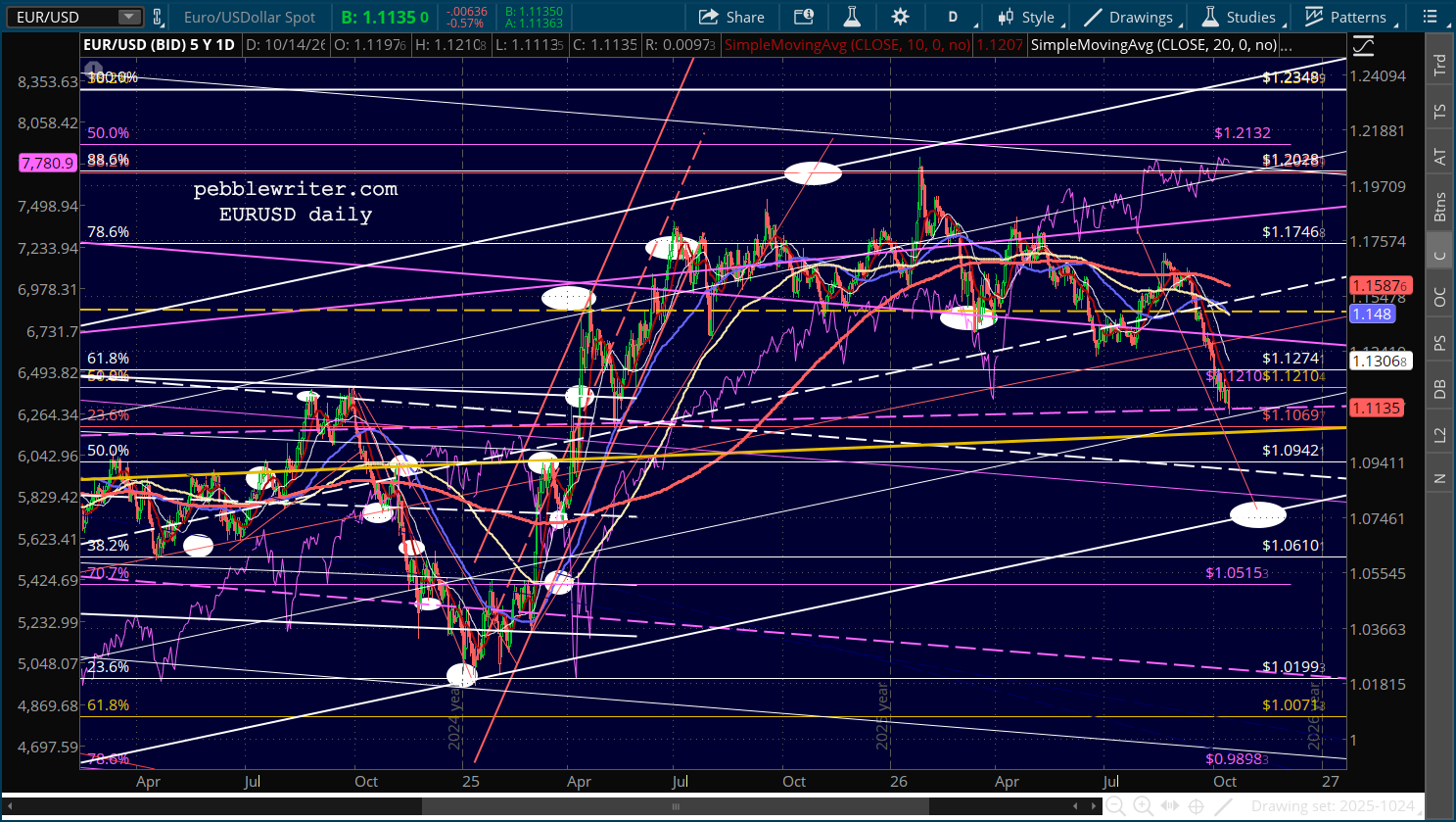
    With EURUSD reaching out 1.20 target and interest rates still rising, it has an important decision to make.

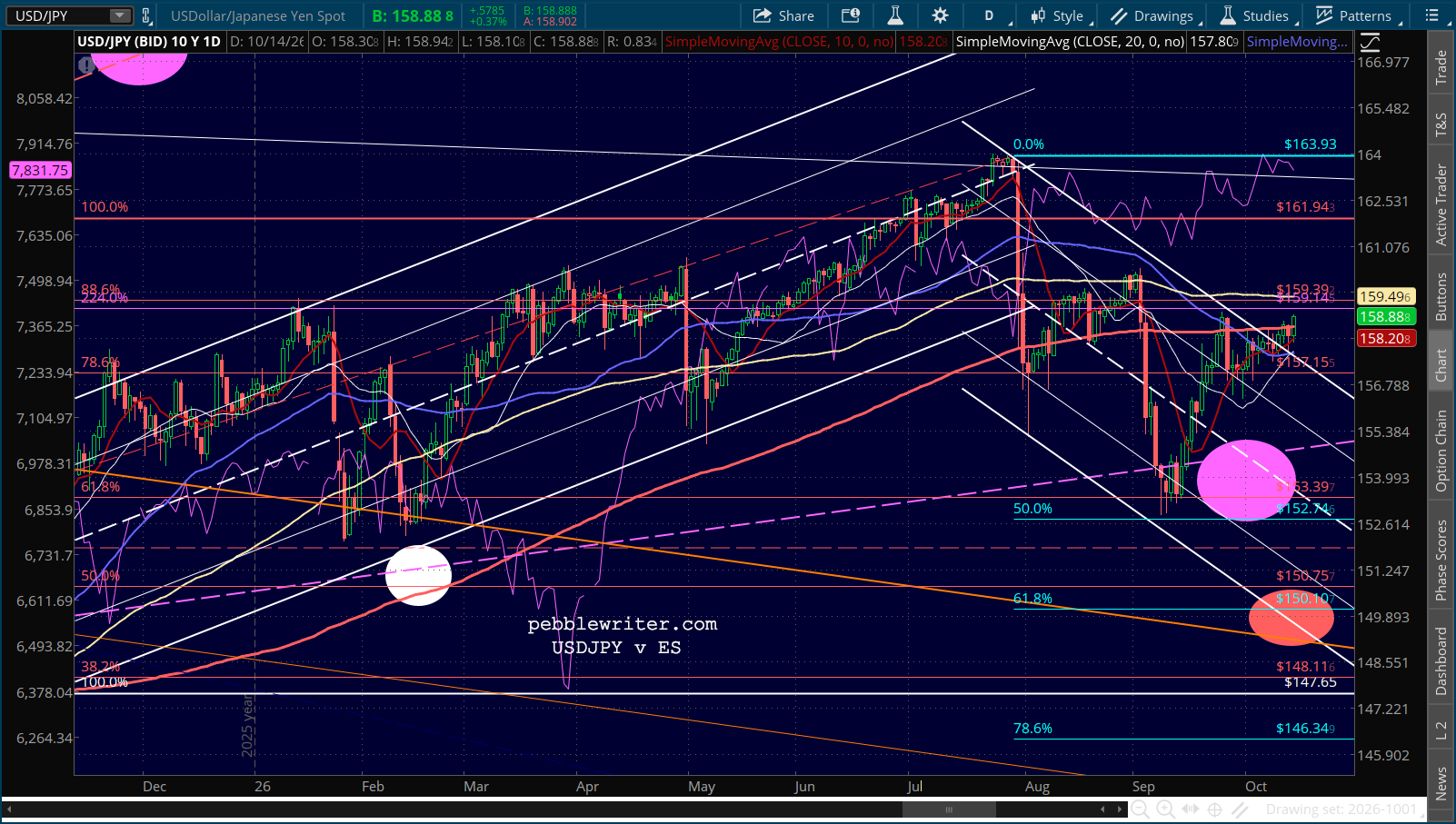
    In Japan, the Liberal Democratic Party won by huge margins – a mandate for Takaichi and her expansionary fiscal policy agenda and large investments in “national champions.” The resulting rise in interest rates has halted the USDJPY’s recent rally, at least for now.

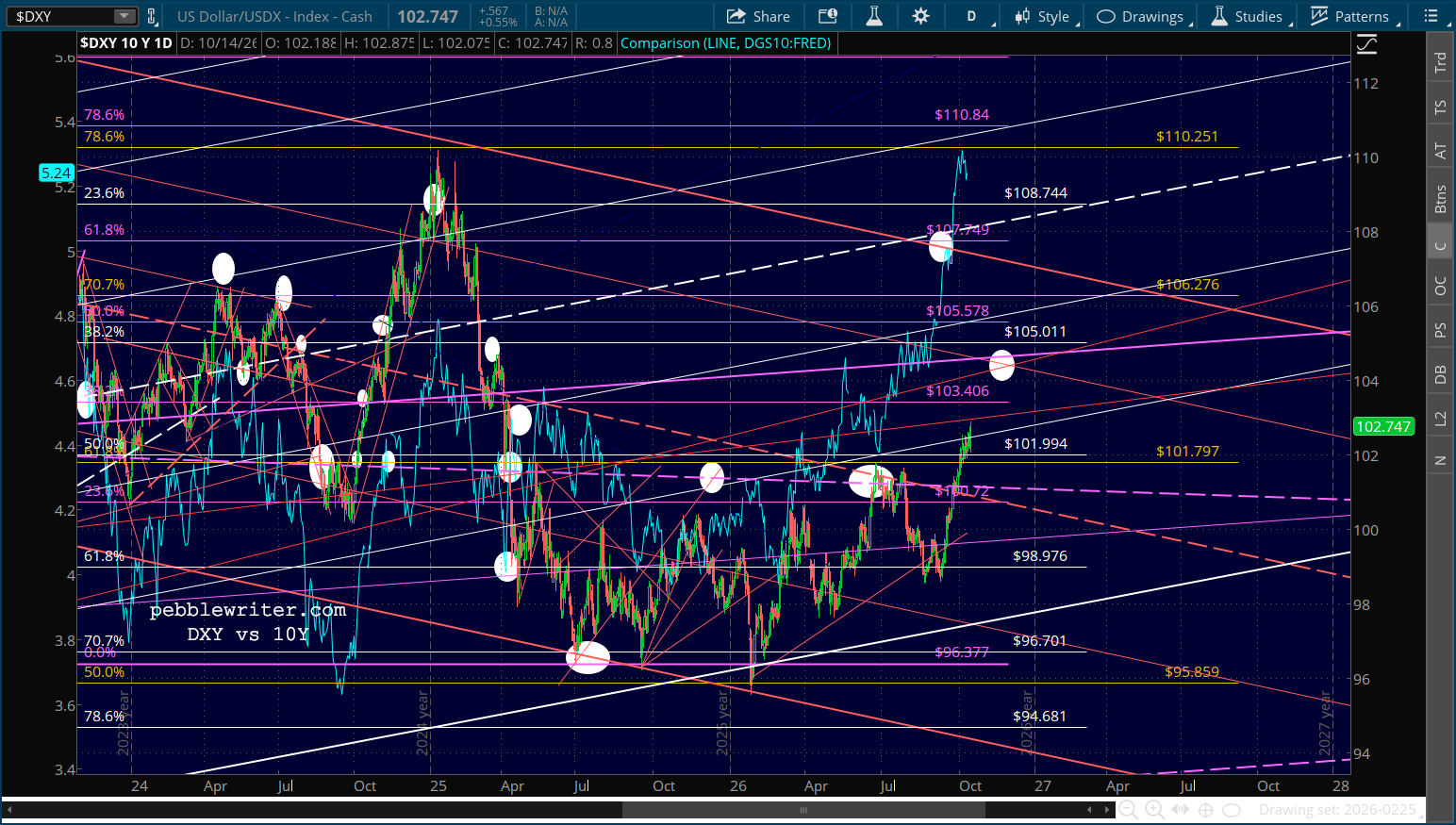
    In the US, the divergence between the DXY and the 10Y continues.

    Tech, software and the effects of AI on the Mag 7 continue to present significant risks to the market.


    Stay tuned…

  • Battle Ahead

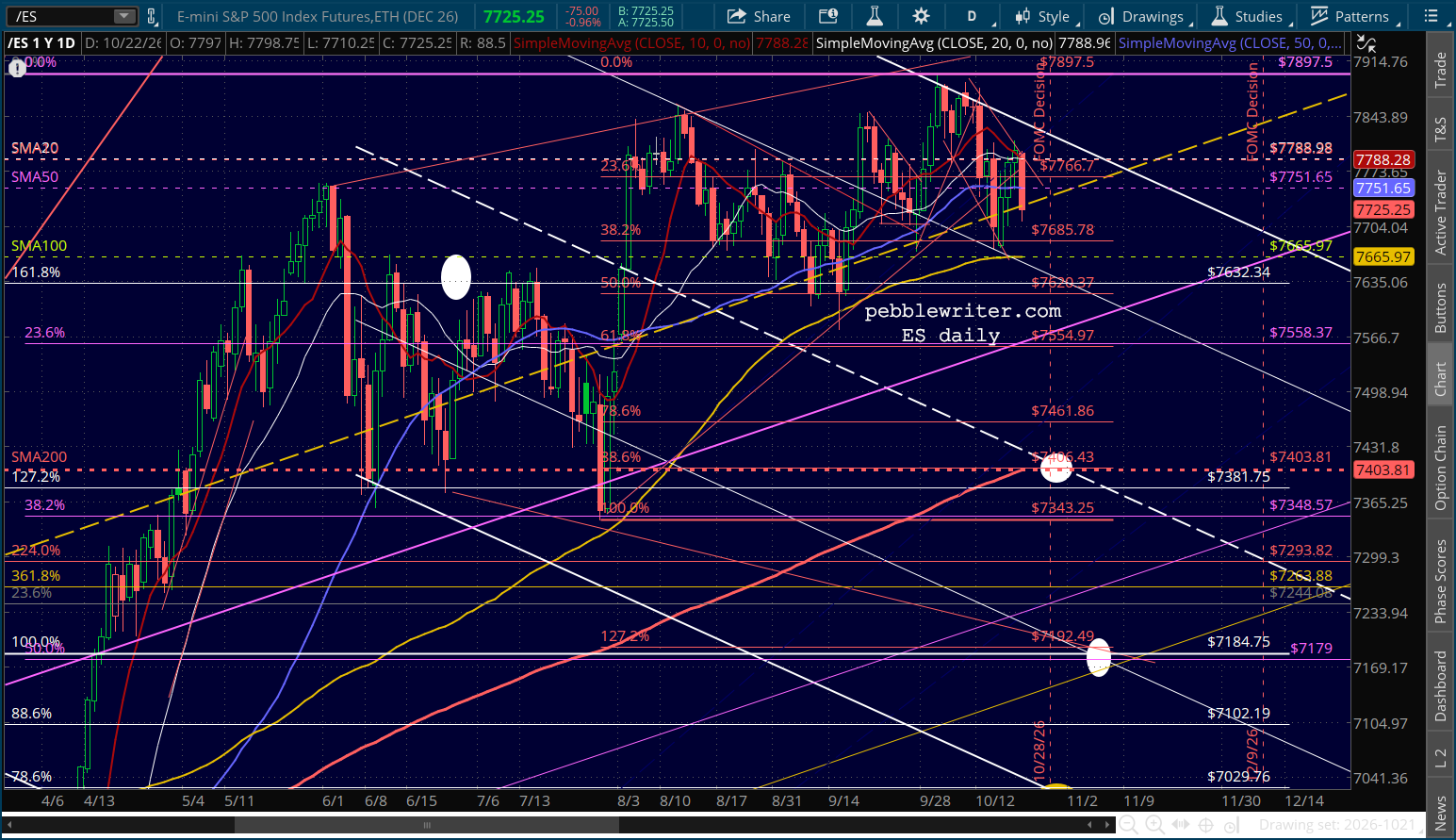
    There’s a battle shaping up at ES 6580, where the 200-day moving average is about to catch up to horizontal support at the previous lows. If it doesn’t hold, the next major support is another 210 points lower.

    Much will depend on whether or not AMZN can hold 200. If not, the next highest levels of support are way down at 175 and 147.

    As always, VX deserves close scrutiny. Its recent breakout above the trendline from last April and its SMA200 is highly significant. Bulls need it to fail.

    Note that in a V-shaped recovery, the DJIA has to contend with our target at the 1.618 Fib extension at 50,303.

  • The Year Ahead: 2026

    If 2025 felt chaotic, 2026 is asking us to hold its beer. The major themes from last year remain stubbornly persistent: tariffs, artificial intelligence, conflicts in Ukraine and the Middle East, elevated inflation and unemployment, and political dysfunction. The only measurable change? Each has managed to become either demonstrably worse or at least more elegantly complicated.

    Tariffs are still with us, but have expanded to additional countries and causes. Thanks to Trump’s whackadoodle tariff-laced threats over Greenland, tariffs have evolved into a tool to empower American imperialism. Of course, the Supreme Court might rule that he had no authority to impose them under the 1977 International Emergency Economic Powers Act. But Trump has a number of fallback options which, though more complicated and limited in scope, would likely get the job done. But, to what end?

    Tariffs generate treasury revenues which could theoretically reduce the national debt. However, a recent study shows that 96%  of the costs are borne by consumers. Therefore, tariffs function as a regressive tax paid by American consumers on foreign goods, making them inherently inflationary. Any benefit to the national debt is likely to be offset by a weakening economy which inflicts the greatest pain on those least able to afford it. Economists describe this outcome as a “K-shaped economy” which is a clever way of referencing the financial divergence between the fortunes of the “haves” and the “have nots.”

    Market Implications

    What does it mean for markets? There, things get a little complicated, and more than a little counterintuitive.  The recovery after the tech bust of 2000-2003 relied on a sharp drop in interest rates. But, the GFC and Covid crashes followed a different pattern characterized by much more powerful policy responses. Since 2005, all sizeable divergences increase just prior to equity market peaks, experience a blow-off top during market downturns, then expand again once the inevitable policy response (rate cuts and QE) arrives.

    The mechanism? While affluent households are more likely to be impacted by market downturns (the top 10% own over 90% of stocks), they are the primary beneficiaries of the subsequent policy response which drives stock prices back up. The have-nots surviving on unemployment benefits are unable to benefit from the rebound until it produces a broader economic recovery which lifts job prospects and income.

    This creates a perverse dynamic. Really bad economic news is simply bad news if not severe enough to engender a policy response. But, it’s good news when it’s catastrophic enough to precipitate ZIRP and QE.

    Where We Stand

    I’ve created a “Divergence Index” based on income and spending and mapped it against the S&P 500 and fed funds since 1999.

    I’m a big believer in the power of charts to illuminate important patterns. This one reveals four critical insights:

      • At 82.3, our Divergence Index is at an all-time high
      • The higher the divergence, the faster and more aggressive the Fed response
      • Each crisis temporarily reduces divergence, but subsequent policy responses drive it (and stocks) even higher
      • Each subsequent Fed response has been faster and more extreme

    This pattern of [Crisis -> Policy Response ->Asset Inflation -> Higher Divergence] creates a policy put for assets but a “doom loop” for equality. Like the national debt, inequality has been steadily rising for decades and, importantly, the policy response has escalated alongside it. 

    The Escalating Pattern of Fed Interventions

    During the tech bust, the Divergence Index was in a modest range of 15-20, prompting gradual rate cuts from 6.50% to 1.00% over 2.5 years and never reaching ZIRP.  In the GFC, the Divergence Index spiked to 67.7, and the Fed cut from 5.25% to 0.15% in just 15 months. They maintained ZIRP for 7 years (from 2008-2015) and invented QE , injecting $4 trillion in liquidity. The recovery took 5.5 years.

    In the COVID crash, the Divergence Index reached 70-73 prior to the crash. The Fed cut from 2.40% to 0.05% in just 2 weeks (the fastest ever.) Unlimited QE was unleashed immediately, reaching $5 trillion in a few months. Despite ZIRP being held for only 2 years and the fastest rate hiking cycle in history (as CPI soared past 9%) the market recovered in a record 5 months.

    It’s hard to look at the fed funds line on the above chart without seeing that the policy responses were solid early warning signals for equity investors. It’s therefore impossible to look at the most recent fed funds decline witho0ut wondering whether the equity markets are headed for another downturn. Has the Fed seen the recessionary writing on the wall and, if so, what does the pattern suggest about the timing and size of any related correction? 

    I examined all such Fed policy reactions since 1970 and the results were compelling. The correlation between Fed policy pivots and market peaks was strongly positive and remarkably consistent. Of 7 cycles examined:

      • All 7 experienced market declines
      • 6 were associated with recessions
      • Average market decline was -38.4%
      • Range: -19.9% to -56.8%

    As of Dec 31, 2025, we were overdue for a similar outcome.  Spoiler alert: we still are.

      • 29.2 months had elapsed since the last Fed rate hike – a 90% increase over the 15.3-month average
      • 15.4 months had passed since the first Fed rate cut – a 23% increase over the 12.5-month average
      • The stock market had not yet peaked.

    Bottom line, a substantial correction is overdue. Based on 55 years of data, there is a 95% probability a decline of -25% to -45% will occur in Q1-Q2 2026. 
     

    If you want to know what time it is and not how the watch works, you can stop reading right here.


    The Geopolitical Powder Keg

    Still reading? Okay, let’s get into it. We’ve barely scratched the surface on the very significant geopolitical risks facing the US. The past several weeks have seen a dangerous rupture between the US and some of its closest allies – one that could easily spell the end of NATO. If the alliance were to dissolve in the wake of America’s threatened takeover (whatever that means) of Greenland and Venezuela, it would almost certainly greenlight China’s ambitions for Taiwan and Russia’s for Ukraine.

    Taiwan produces 92% of the world’s advanced logic chips and controls ~64% of global foundry market share through TSMC. The economic stakes are staggering:

      • Chinese blockade: $2.7-2.8 trillion (-2.8% of global GDP)
      • Full invasion: $10 trillion loss (-10.2% of global GDP)

    By contrast, the GFC produced a 54% crash in the S&P 500 with a mere 1.7% global GDP decline.

    The Davos Debacle

    Since this post is taking shape over a couple of weeks, we have had the opportunity to observe the geopolitical scene through the lens of the goings on in Davos, Switzerland. Many in America are accustomed to Trump’s ranting, raving and bullying. But it was truly stunning to watch Trump brag, insult, and threaten the world’s financial and political elite. No doubt, some in MAGA were heartened to see Trump being Trump, and algos were thrilled to learn that Greenland (or, was it Iceland?) would not be invaded. But, otherwise, it was an unmitigated disaster. 

    Much has been written about the debacle, so I won’t pile on. Suffice it to say that Trump did an enormous amount of damage to any foreign relations which haven’t already been torched.  It’s not an overstatement to say that his buffoonery could mark the beginning of the end of American hegemony.  If the Davos speech didn’t do it, the threatening letter he sent to Norwegian prime minister Jonas Gahr Støre should.

    Dear Jonas:

    Considering your Country decided not to give me the Nobel Peace Prize for having stopped 8 Wars PLUS, I no longer feel an obligation to think purely of Peace, although it will always be predominant, but can now think about what is good and proper for the United States of America. Denmark cannot protect that land from Russia or China, and why do they have a “right of ownership” anyway? There are no written documents, it’s only a boat that landed there hundreds of years ago, but we had boats landing there, also. I have done more for NATO than any person since its founding, and now, NATO should do something for the United States. The World is not secure unless we have Complete and Total Control of Greenland. Thank you! President DJT

    It’s there for everyone to see: not just the gaslighting, but the erratic behaviour suggesting serious cognitive decline. In a single 24-hour period, Trump:

      • Threatened to impose 25% tariffs on countries which supported Denmark’s sovereignty over Greenland
      • Backed off and announced the “framework of a [non-existent] future deal” when markets tumbled and the EU pushed back
      • Threatened Canada with 100% tariffs when prime minister Mark Carney said what the rest of the world is thinking: that the US is no longer a reliable trade or defense partner.

    It Was Fun While it Lasted

    Is this the guy who should control the nuclear codes, negotiate with the China and Russia, or even represent the US in trade? The stakes are enormous.

    Studies show that the dollar’s global reserve status saves the US anywhere from $250-500 billion annually through:

      • Lower borrowing costs
      • Reduced transaction and interest costs
      • Absence of currency risks
      • Sanctions power
      • Geopolitical and network effects

    Foreign governments and investors have always turned to the US dollar for its liquidity and safety. What if the dollar lost its luster? Even a 50% ($4.5 trillion) decline in foreign holdings would increase yields by 90-270 bps. Imagine the de-dollarization cascade that would occur if the 10Y treasury soared from 4.5% to 5.4-7.2%. Actually, this isn’t hypothetical.  The dollar’s share of global foreign exchange reserves has already declined from over 70% in 2000 to approximately 58% today.

    In just the past few days, the DXY came perilously close to breaking down below a channel dating back to 2009, dropping below the lows last seen in July and November. But there’s a crucial difference: back then, the dollar fell because interest rates were falling. This time, it’s dropping while interest rates are rising – a concerning divergence last seen in April 2025 when Trump announced his tariffs and the market plunged 21%.  Trump’s dismaying comments and erratic policies have produced a crisis of confidence in the US dollar which reflects the crisis of confidence in the US. 

    We see it in the comments and actions by foreign heads of state. After the Davos debacle, both Canada and the UK struck trade deals with China. Predictably, Trump threatened to impose additional tariffs.

    For years, Trump has expressed his preference for a low US dollar – presumably because it aids US exporters. But, the more likely reason is because a low US dollar typically occurs when US interest rates are low and, therefore, supportive of stock prices. A low US dollar-high US interest rate environment wouldn’t be so conducive to stocks. Such an environment would accelerate de-dollarization.

    It’s shocking that the administration seems to either not understand the dynamics or maybe just doesn’t care. If they’re really concerned about inflation, they should. The US imports $1 trillion more than it exports. Since a lower dollar increases the cost of those imports (on top of tariffs) it increases inflation. Add in the reduction in foreign workers resulting from Trump’s  immigration policies, and the cost of everything increases even more. Twenty-five percent of those in construction, for instance, come from abroad. So do many of the scientists, AI researchers and engineers who are key to the AI bubble’s continuing inflation.

    Speaking of Bubbles

    AI continues to drive the S&P 500. While hugely beneficial in driving the index to recent highs, it now threatens current valuations – particularly among the Mag 7.  Collectively, Microsoft, Meta, Google and Amazon are expected to spend $470-527 billion on AI infrastructure in 2026 – up from $350-400B in 2025. This represents 94% of their free cash flow and, importantly, occurs as their AI earnings growth is decelerating has decelerated from 30% to just 18% – the slowest since 2022’s 41% crash. 

    In my opinion, the market is telling us that a correction has already begun. The rotation is now clear, with equal-eight S&P outperforming the broader index and small caps beating large. Flows are leaving the concentration, which always precedes corrections. Differentiation is also making a comeback, with investors picking winners and losers. While Meta performed well after recent earnings, Microsoft was punished severely. 

    Bottom line, the AI put is expiring, with the demise of “build it and they will come” thinking. Capex is now expected to show an immediate ROI, especially since it has often been debt-funded (Meta’s $30 billion deal) at a time when interest rates are vulnerable. Investors are skittish, particularly with SPX testing and retreating from 7,000. If our forecast of a 25%+ correction proves out, it would mean at least a 40-50%+ Mag 7 decline.  The writing’s on the wall.

    We’ve already seen a spending surge, disappointing revenue growth, and a failure to monetize the AI capex. We should know in the next few weeks whether valuations can hold up, and whether NVDA will join the party after its Feb 25 earnings release. But, for now, we’re quite concerned.

    The Day After Tomorrow

    Investors can take solace in the fact that markets have recovered from every crash or correction they’ve ever suffered. The caveat, of course, is timing. A 20-40% decline in your portfolio is irrelevant if you don’t need to tap the assets for 20+ years. However, if you need a sizeable sum in a few months to purchase a new home or pay for a wedding, that correction is a real concern. Traders are also keen to know when a recovery is on tap.

    If there’s a silver lining to our forecast, it’s that the Fed has a very strong track record of ever faster and stronger reactions to whatever financial calamity comes along. Remember, the calamity virtually guarantees a recovery through the Fed reaction function:

    Stage 1: Divergence Rises

        • Top 10% capture more income/wealth
        • Bottom 90% struggle
        • Political pressure builds

    Stage 2: Crisis Hits

        • Any crisis (pandemic, recession, financial)
        • Markets sell off
        • Pressure intensifies

    Stage 3: Policy Response

        • Fed cuts rates → Benefits asset owners (top 10%)
        • QE launched → Inflates stocks/bonds (top 10% own 90% of these)
        • Fiscal stimulus → Some to bottom 90%, but…
        • Inflation from stimulus → Erodes real wages of bottom 90%

    Stage 4: Asymmetric Outcomes

        • Assets inflate dramatically
        • Top 10% gain enormously (own the assets)
        • Bottom 90% get temporary relief, then fall further behind
        • Divergence increases → Setting up the next cycle

    Over the past 20 years, our Divergence Index has been in a consistent uptrend, with each crisis temporarily reducing it, only for Fed policy responses to drive it even higher. The policy responses have also progressed, with larger and larger drops taking place over shorter periods of time. These responses, in turn, have produced faster and more powerful recoveries.

      • The Dot-Com crash began with divergence at 15-20 and involved gradual rate cuts over 2.5 years. At 5.5%, the total Fed response was modest and never reached ZIRP. The market took 13 years to recover.

      • The Great Financial Crisis crash featured divergence at 67.7. The Fed cut from 5.25% to 0.15% in just 15 months and maintained ZIRP for 7 years, from 2008-2015. They also invented QE, pumping $4 trillion into the markets. The result was a much speedier 5.5-year recovery.

      • The COVID-19 crash saw divergence at 70-73. The Fed cut rates from 2.40% to 0.05% in 2 weeks, the fastest cuts in history. It held them at ZIRP for two years (before soaring inflation forced the fastest hikes in history.) Unlimited QE was unleashed immediately, reaching $5 trillion in months. The V-shaped market recovery took 5 months.

    The pattern is unmistakable: The Fed’s speed and magnitude of response is directly proportional to the divergence level. With the current Divergence Index at new all-time highs of 82.3, it’s reasonable to expect the most aggressive Fed response ever when the next crisis hits. I expect:

      • Virtually instant (~ 1 week) drop to ZIRP when the crisis hits

      • Immediate, unlimited QE (>$5 trillion)

      • A V-shaped recovery (faster than COVID’s 5 months)

    Throw it all together, and the expectation is for a vicious downturn, followed by a powerful rebound. The question is not whether the Fed will respond in force, but much they’ll throw at the market and how long it will take the market to rebound.  

    Summary

    Market dynamics are a little different from the last few crashes. There is greater exposure in private credit and crypto but less in real estate. Oil markets will likely be better supported thanks to Trump’s strong relations with Saudi Arabia – though this could come undone depending on what happens with Iran.  Geopolitical risk is much greater than in 2020. And, though there’s plenty of room for the Fed to cut to ZIRP, inflation remains a concern thanks to tariffs and the breakdown in the US dollar.

    As a result, there might be no more rate cuts until a recession or market crash necessitates one or the Supreme Court approves Trump’s wholesale line change at the Fed. The BoJ has recently shown interest in working with the US to protect markets, but the ECB might not be as cooperative since Trump took a chainsaw to EU relations. The EURUSD matters more to markets. 

    And, let’s not forget about the Chinese. Known for playing the long game, their influence around the world grows every time America’s influence suffers. Aside from potentially taking control over Taiwan – key to the aging tech boom – their investments in US treasuries and markets around the world afford them a great deal of power over flows, yields and market prices. 

    The administration has obviously shown a much greater whatever-it-takes interest in “protecting” markets. 


  • Site Maintenance

    We will be making changes to the site’s hosting today and should be able to post the 2026 outlook tomorrow.

    In the meantime, CNBC’s Sarah Eisen just had an interesting conversation with former Fed Chair Janet Yellen regarding Trump’s continuing effort to fire current Fed Chair Jerome Powell:

    “I find it extremely chilling for Fed independence. The notion that he lied in his testimony…knowing Chair Powell as well as I do…the odds that he would have lied are zero. So, I do believe they’re going after him because they want his seat and they want him gone. I’m surprised the market isn’t more concerned, it seems to me that the market should be concerned.”

    She also commented on Trump’s campaign to pressure the Fed to lower interest rates.

    “You have a president that says the Fed should be cutting rates to lower payments on the Federal debt…completely disagree with that. It is the road to a banana republic.”

    Yellen cited examples of other governments such as Argentina, Turkey and Venezuela which have pursued a similar path in the past. These governments, because of mismanagement and bad fiscal policy, had to rely on their central banks to monetize the debt and then you get hyperinflation.

    Trump faces an important roadblock from within his own party to replacing Powell. Yesterday, Sen. Thom Tillis (R-N.C.) said he would block any Trump appointee to the Fed until the matter is resolved.

    “If there were any remaining doubt whether advisers within the Trump Administration are actively pushing to end the independence of the Federal Reserve, there should now be none. It is now the independence and credibility of the Department of Justice that are in question,

    I will oppose the confirmation of any nominee for the Fed — including the upcoming Fed Chair vacancy — until this legal matter is fully resolved,”

    Update: 10:40 am  Statement on the Federal Reserve

    The Federal Reserve’s independence and the public’s perception of that independence are critical for economic performance, including achieving the goals Congress has set for the Federal Reserve of stable prices, maximum employment, and moderate long-term interest rates. The reported criminal inquiry into Federal Reserve Chair Jay Powell is an unprecedented attempt to use prosecutorial attacks to undermine that independence. This is how monetary policy is made in emerging markets with weak institutions, with highly negative consequences for inflation and the functioning of their economies more broadly. It has no place in the United States whose greatest strength is the rule of law, which is at the foundation of our economic success.

    UPDATED SIGNATORIES

    Ben Bernanke – two-term Chair of the Board of Governors of the Fed, and Chair of the Council of Economic Advisers under President George W. Bush.

    Alan Greenspan – five-term Chair of the Board of Governors of the Fed, first appointed by President Ronald Reagan and then reappointed by Presidents George H.W. Bush, Bill Clinton, and George W. Bush. He also was Chair of the Council of Economic Advisers under President Gerald Ford.

    Janet Yellen – 78th Secretary of the Treasury under President Joe Biden, Chair and Vice Chair of the Board of Governors of the Fed, Chair of the Council of Economic Advisers under President Bill Clinton, and President and CEO of the Federal Reserve Bank of San Francisco.

    Henry Paulson – 74th Secretary of the Treasury under President George W. Bush.

    Tim Geithner – 75th Secretary of the Treasury under President Barack Obama, as well as President and Chief Executive Officer of the Federal Reserve Bank of New York.

    Robert Rubin – 70th Secretary of the Treasury under President Bill Clinton, and first director of the White House National Economic Council.

    Jason Furman – Chair of the Council of Economic Advisers under President Barack Obama.

    Phil Gramm – Texas senator and Chairman of the Senate Banking Committee

    Jacob Lew – 76th Secretary of the Treasury under President Barack Obama.

    Glenn Hubbard – Chair of Council of Economic Advisers under President George W. Bush.

    Jared Bernstein – Chair of the Council of Economic Advisers under President Joe Biden.

    Greg Mankiw – Chair of Council of Economic Advisers under President George W. Bush.

    Christina Romer – Chair of the Council of Economic Advisers under President Barack Obama.

    Ken Rogoff – Maurits C. Boas Professor of International Economics at Harvard University and former chief economist of the International Monetary Fund.


    note: FWIW, eight are Republicans and six are Democrats

  • The Year in Review: 2025

    We approached 2025 with a great deal of trepidation: elevated equity valuations, elevated inflation, rising unemployment, impending tariffs, war, etc. It left me feeling bearish, but with a significant caveat. We posted The Year Ahead: 2025 on Jan 13, with the S&P 500 closing at 5836 and offered the following forecast:

    I’m looking for December CPI due out this Wednesday to top 3% and to go even higher for January (due out Feb 12.) Depending on how inflationary Trump’s tariff and deportation announcements are next week, we could easily see the 10Y reach 4.83-5.0% – testing the Nov 2023 highs.

    …the Jan 2022 highs of 4818 were never backtested. This price level would cross the yellow channel .236 line in April 2025 or the yellow channel bottom in Feb 2026.

    Taking all the above into account, I have a bearish bias going into 2025, even though Trump’s (and Musk’s) laser focus on positive stock performance renders any bearish forecast suspect. If I’m wrong, then we can expect a number of factors to come into play such as a weaker dollar, lower oil/gas prices and, of course, much lower values for VIX.

    If I’m right, however, the following downside targets should be recognized.

    • 4818-4883 (-21%)
    • 4518 (-25.9%)
    • 5459 (-10.5%)
    • 5329 (-12.6%)

    I want to be clear, however, that any drop below 5459 (-10.5%) would likely be met with an enormous effort to prop up stocks. It’s also safe to say that the bulls will definitely defend the SMA200 – currently at 5578.

    A few days later, CPI reached 2.9% [it would reach 3.0% the following month] and the 10-year reached 4.81%. It was a 5-alarm fire for Trump, who had returned to power on the promise that he’d “end inflation on Day One” and the implicit promise that equity prices would rise.

    Oil, which had spiked by over 20% in the previous 30 days, was the first fire to be targeted. Trump’s first state visit was to Saudi Arabia, resulting in a spectacular 32% crash in oil prices over the next three months. It must have rankled the oil company CEOs who had pledged $1 billion to aid Trump’s election.

    It might have actually crushed inflation had it not been for Trump’s ill-advised rollout of widespread, inflationary tariffs on Apr 2.

    As we expected, the rise in inflation in January and February had led to a fear of stagflation, which resulted in the market stalling and ultimately topping out on Feb 19 at 6147.  The tariff announcement gave SPX a push. It tumbled to our 5459 target on Apr 3, our 5359 target on Apr 4, and our 4818-4883 target on Apr 7. At the eventual bottom at 4835 – 18 points from our backtest target – it had fallen by 21.3%.

    The afore-mentioned crash in oil prices began in earnest at this time, sinking 24% in a single week. It temporarily brought CPI down into the 2.3-2.7% range, though it was back above 3.0% by September. Stronger measures were needed, and they provided the boost the market needed to rebound.

    Rebounds are always the tougher aspect of our forecasts. It didn’t help that there was substantial divergence among the major indices.

    SPX came up just shy of a full backtest, while COMP overshot its backtest target. But, as in 2016, it was the DJIA that mattered the most – crashing 13.6% in a single week to nail the January 2022 highs. Two sessions later, it rallied 8.3% in a single day when Trump announced a pause in the tariffs he had just unleashed on the global economy – the equivalent of an arsonist sprinkling a little water on the fire he started.

    The rebound eventually took hold two weeks later when SPX backtested the falling channel it had broken out of. The fundamental picture was muddled at best because the tariff picture was muddled. As we wrote in our Apr 29 Big Picture post:

    ,,,this Big Picture forecast comes with a massive caveat: they are absolutely subject to the continuation of Trump’s tariffs. If he backpedals, reverses, or changes the terms enough, the risk is to the upside – at least short term. If he sticks to his guns, the risk is very much to the downside – at least until the markets force him to blink again.

    It didn’t help that the data coming out of the federal government was becoming increasingly suspect. Almost all of the inspectors general had already been fired (right after the 2024 election.) The BLS commissioner was fired after a disappointing jobs report (which didn’t support Trump’s rosy narrative.) And Fed chair Jay Powell was under attack for not being dovish enough.

    The FOMC was justifiably concerned about the inflationary effects of Trump’s tariffs, but also about a worsening employment situation which raised the specter of stagflation.

    Trump found himself in a catch-22: admit to worsening employment and the need for a rate cut or insist that the economy was doing great (and, was therefore in no need of a rate cut.) In the end, the solution was vintage Trump: secure a sharp drop in oil/gas prices from his Middle East pals to bring down inflation and interest rates, keeping up the pressure on the FOMC, and “fine-tuning” the tariffs when markets needed a boost.

    Since CPI is a year-over-year measure, inflation only needed to be held steady for few months. It was the opposite of what happened to gas prices in 2021, when the huge year-over-year price change from the COVID lows of 1.88 to 5.06…

    …saw CPI race from 1.7%  in Feb 2021 to 9.1% in Jun 2022. It was worsened significantly by Russia’s invasion of Ukraine in Feb 2022.

    Prices are still 11% higher than they were in 2018. But, the YoY change in gas prices has been negative every month since Feb 2025 – offsetting the inflationary changes in many other components of CPI such as food away from home (+3.7%), fuel oil (+11.3%), natural gas (+9.1%), electricity (+6.9%), and used cars (+3.6%),

    The result is that CPI has appeared to be under control, mitigating the impact of tariffs which would otherwise support a stagflationary outlook. The lows that we called in May [see: CPI Lower Than Expected] didn’t hold, but were low enough to get stocks up over the resistance we had identified.

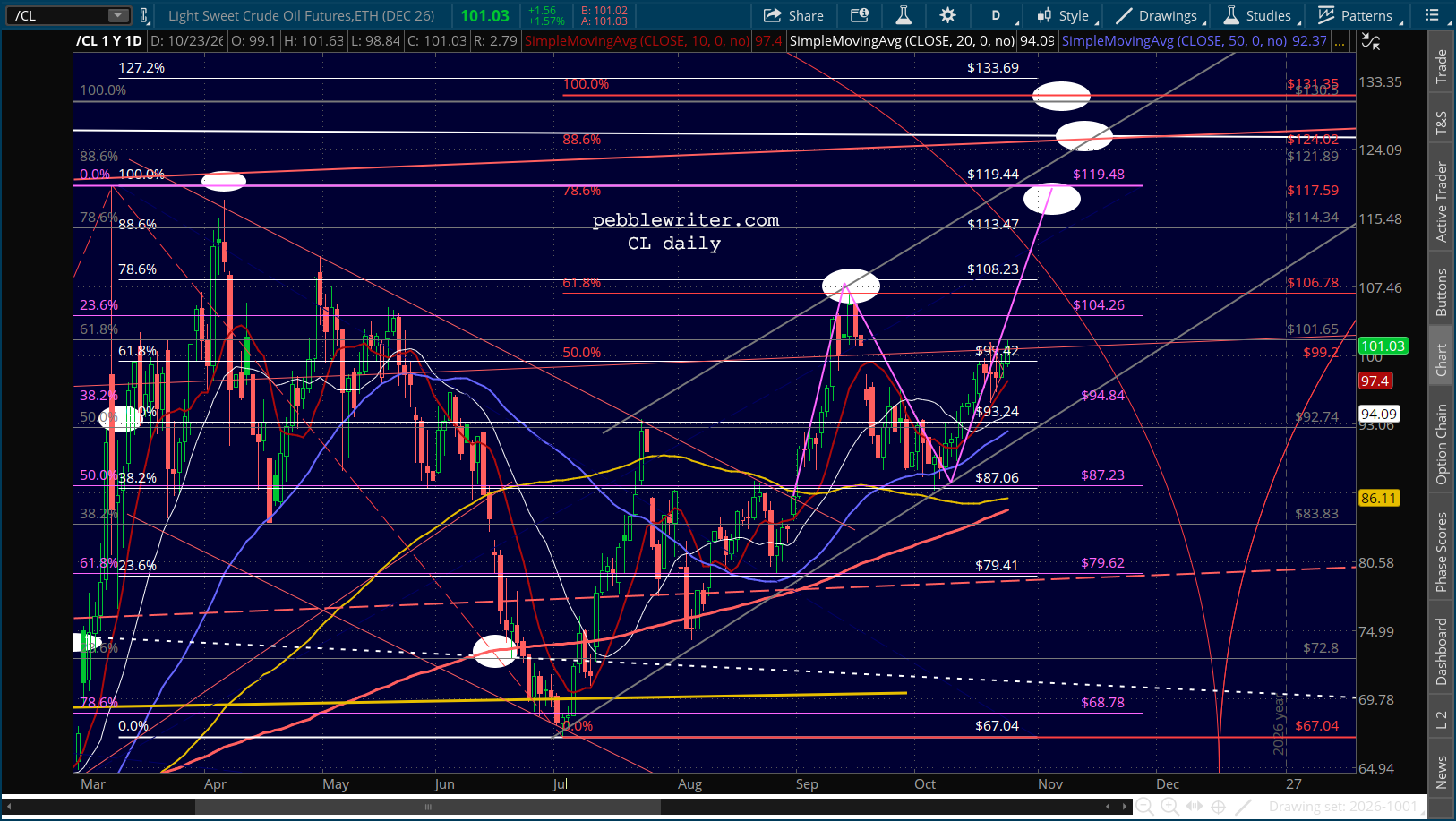
    The biggest contributor to lower inflation remains oil and gas, which registered double digit declines. Unfortunately, the 12% YoY decline in retail gas prices has likely bottomed out unless CL and RB continue to fall. At current prices, the YoY delta will be back to flat – removing a key source of falling inflation rates.

    As we discussed in our Jun 20 Big Picture post, the runup in oil/gas prices had likely run its course. On Jun 23, with CL at a high of 78.40 and RBOB at 2.40, we hazarded a forecast:

    A spike in oil prices makes Fed rate cuts extremely unlikely. At some point, it even argues for a rate hike. Therefore, I assume that oil prices are due for a retreat – unless, of course, things spiral further out of control in the Middle East.

    Remember, the last time oil prices reversed back below the triangle top they fell about 25%. (from January to April.) CPI fell commensurately, from 3.00% in January to 2.35% in April. There is nothing so appealing to Trump as a huge drop in inflation that would force the Fed’s hand in cutting rates.

    WTi had fallen to 56 and RB to 1.74 by the middle of October, enabling CPI to remain below 3.0%. CL had no trouble reaching our 57 target and came within 2% of our 53.87 target.

    RB slightly overshot our 1.75 target.

    Currency pairs were a mixed bag in 2025 – at least as they related to equity prices. The yen carry trade was relatively reliable, with a strong positive correlation between yen weakness and equity strength. But, the range was relatively small as the value of the USD was pummeled by the disintegration with formerly cooperative trading partners and, of course, by the volatile inflation and tariff picture.


    We discussed the damage done to the dollar in Currencies and Yields Send a Serious Warning on April 11 as euro and the yen both approached important targets from 2024.

    Don’t look now, but DXY has almost fallen to our 98.976 target from last year. The culprits are numerous, led by the euro and yen which are both soaring relative to the greenback. The EURUSD has broken out and has nearly reached our 1.15 target.

    These moves represent a very serious development for US markets, as the targets were initially established as part of a worst case scenario in 2024 and are exacerbated by a breakout in the 10Y yield.

    The breakout in the 10Y is contrary to (temporarily) tame inflation and, as we have discussed, is consistent with a rejection of the USD and of Treasuries at a time when they would normally be buoyed by a flight to safety.

    The correlation between DXY and SPX was all over the map, so it was easier to forecast the moves in currencies than it was to forecast the impact on equities.


    The volatility in interest rates, both in the US and in the eurozone, made forecasts all the more difficult.


    In the end, euro strength and USD weakness were aided by rising interest rates in the eurozone – due largely to the reduction in US military support for Europe and NATO pursuant to Trump’s America First posture.


    As for US interest rates, the initial Apr 2025 plunge in the 10Y which was driven by the tariffs and trade wars (and, later, remedied by the sharp drop in oil/gas prices) saw the 2s10s break out. Had the 2s10s not reversed by early May, the equity downturn would surely have been much worse.


    As detailed above, drops in oil/gas prices were plentiful and convenient, enabling occasional flattening on an as-needed basis.


    We’ll dig into most of these developments in greater depth in our next post – a look ahead at 2026, due out in the next week or so.

    In the meantime, stay frosty. More geopolitical and economic uncertainty is on the way.

    Stay tuned….


  • Charts I’m Watching: Dec 19, 2025

    Another day, another dearth of data. But, VIX is off 4% (so far) so the algos are only too happy to begin their run to the barn.

    I got a good chuckle out of John Williams’ interview on CNBC this morning. While agreeing with me that the latest CPI data was hinky (my word, not his), he insists the Fed’s resumption of large scale treasury purchases is (obviously) definitely! not! QE!

    “We are … obviously not doing QE, from my point of view, We’re not trying to change the 10-year, you know, term premium or something like that… The purchases are designed “to provide reserves to the banking system to meet the demand that the banks in our country and that operate here need in order to carry out their business.”

    When I buy a new pair of jeans, the sales clerk doesn’t question whether I’m updating my wardrobe or a tornado ripped the pants from my body on the way to the store (a truly cataclysmic wardrobe malfunction.) Either way, they would ring up the sale, thus preserving our capitalist society for future generations.

    Likewise, tossing another $500 billion annually into the money supply is quantitative easing and will stimulate the economy regardless of what you call it. Obviously.

    continued for members

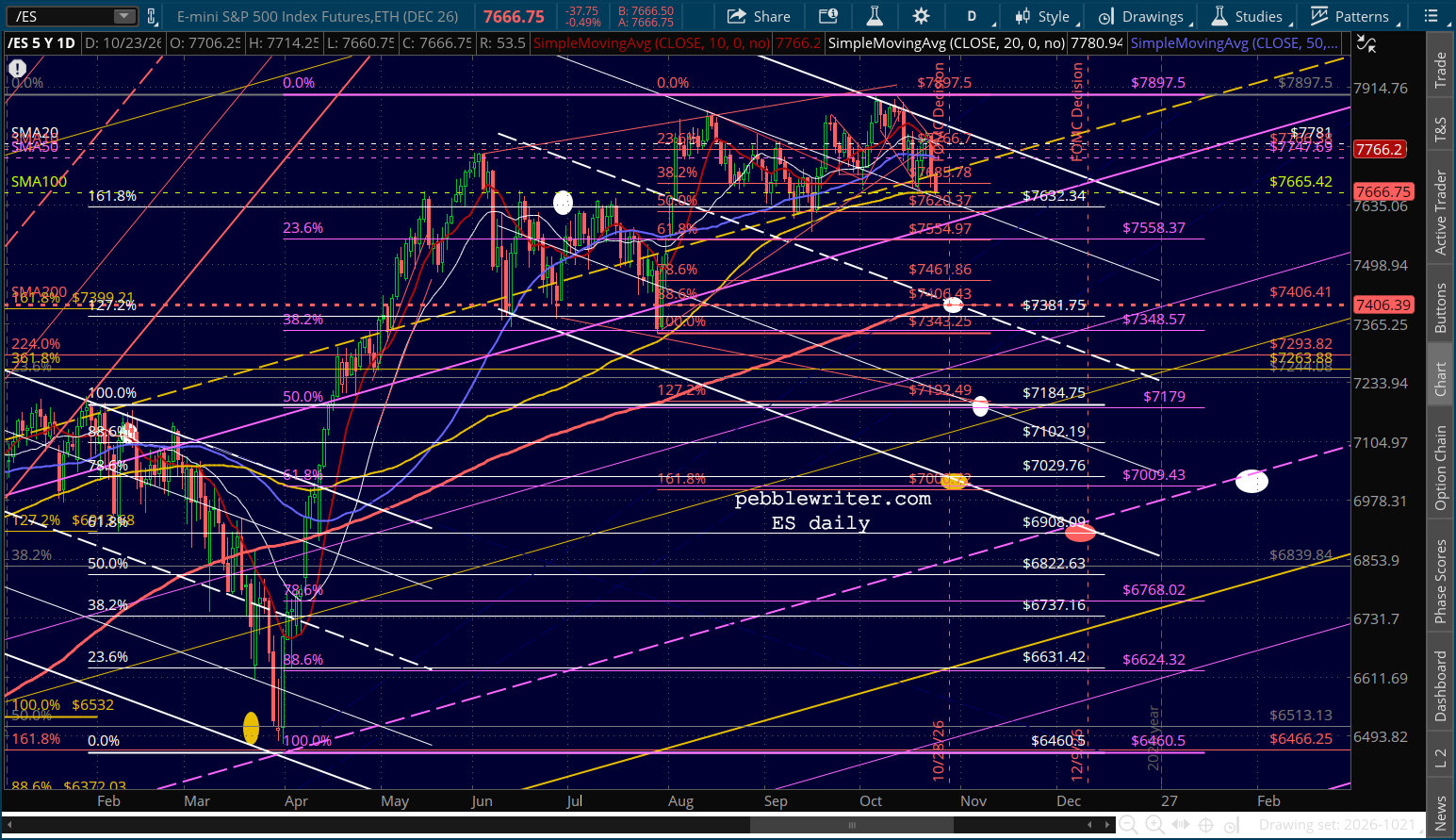
    If ES can hold 6865, it will complete a small IH&S targeting 6970. SPX has one, too, completing at 6816 and targeting 6913. Keep in mind that today is a triple witching day, so volatility could be quite high (i.e. it ain’t over till it’s over.)

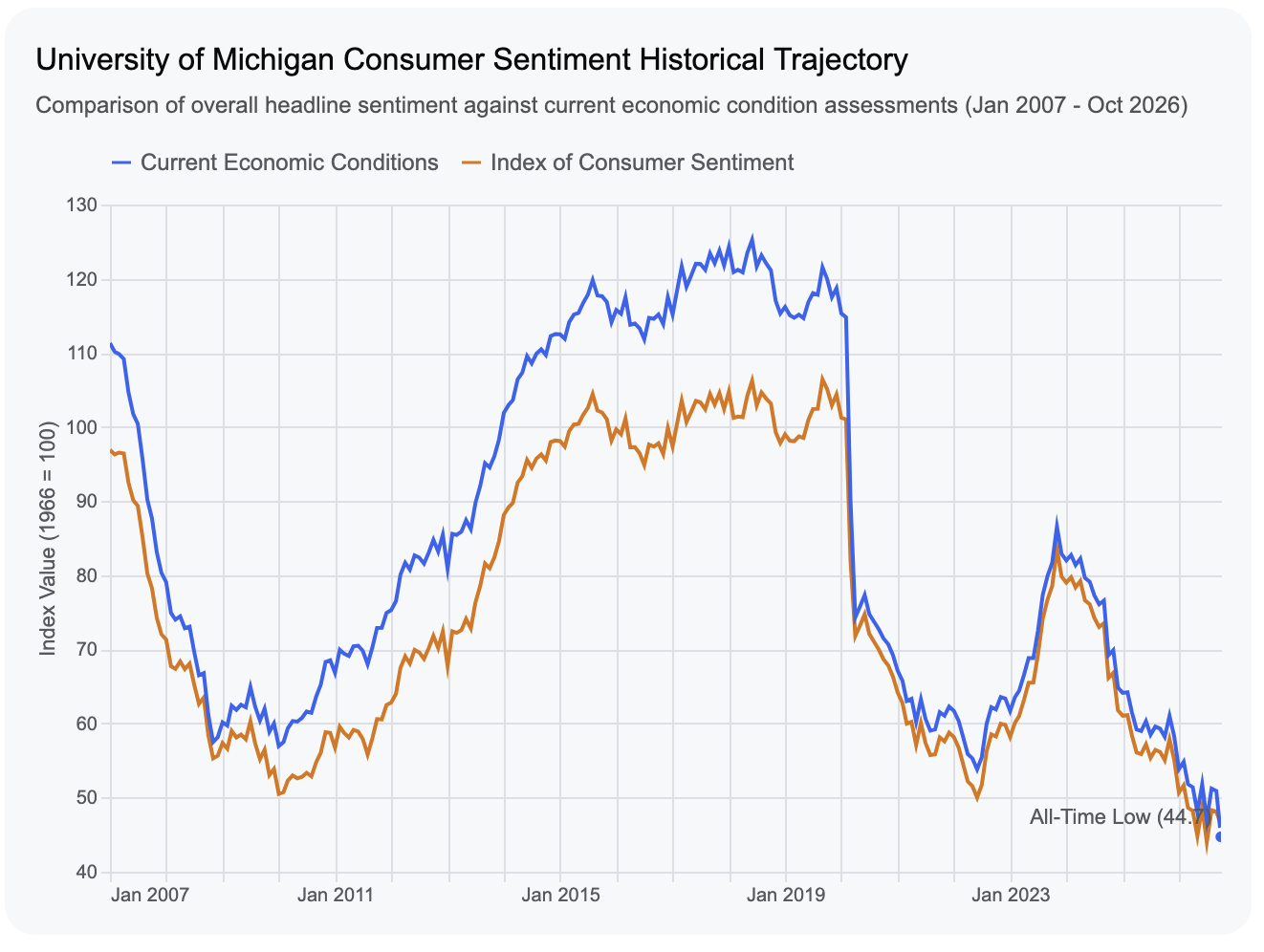
    We should get existing home sales and UMich consumer sentiment at 10am.

    VIX made it out of the falling purple channel (16.50) by the close yesterday, but it’s right back in it today. And, VX has a shot at a bullish 10/20 cross today, but it will depend on it remaining above 17.95ish.

    It’s another moment of truth for USDJPY.  It broke out of the rising white channel on Nov 19 in order to halt a minor meltdown. Yen strengthening has ended many a rally [see: Yen Carry Trade.] Will it do it again?

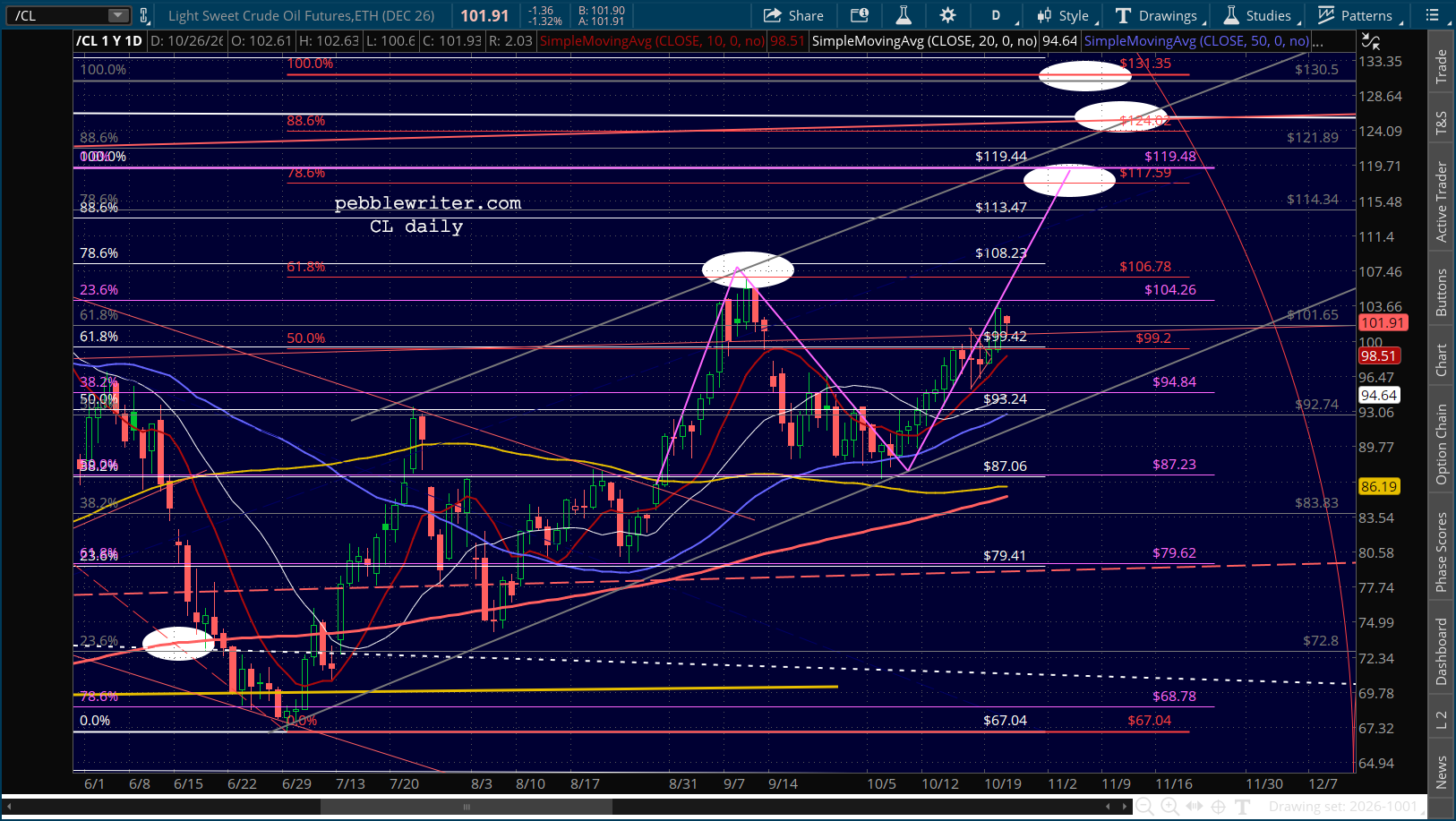
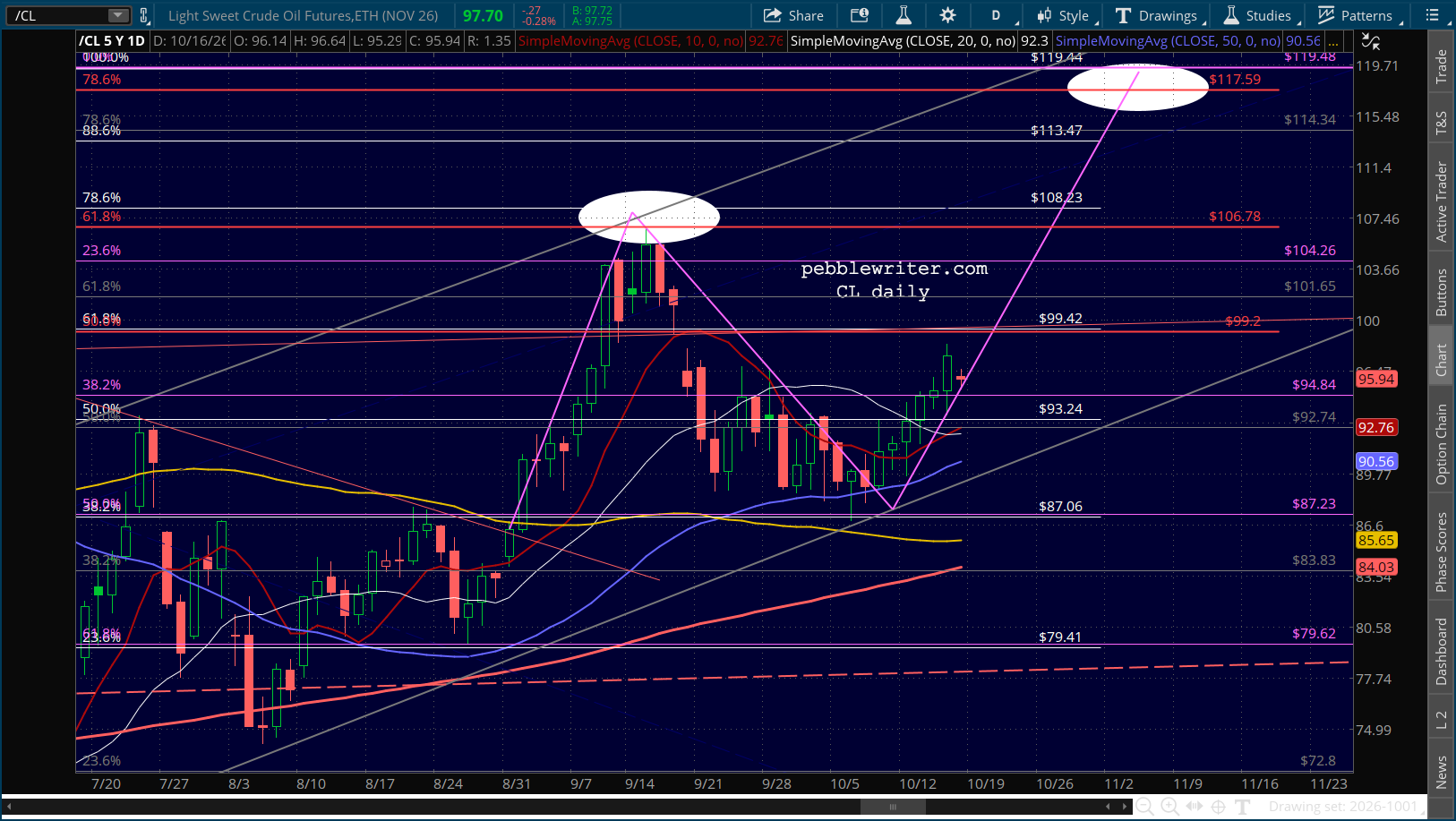
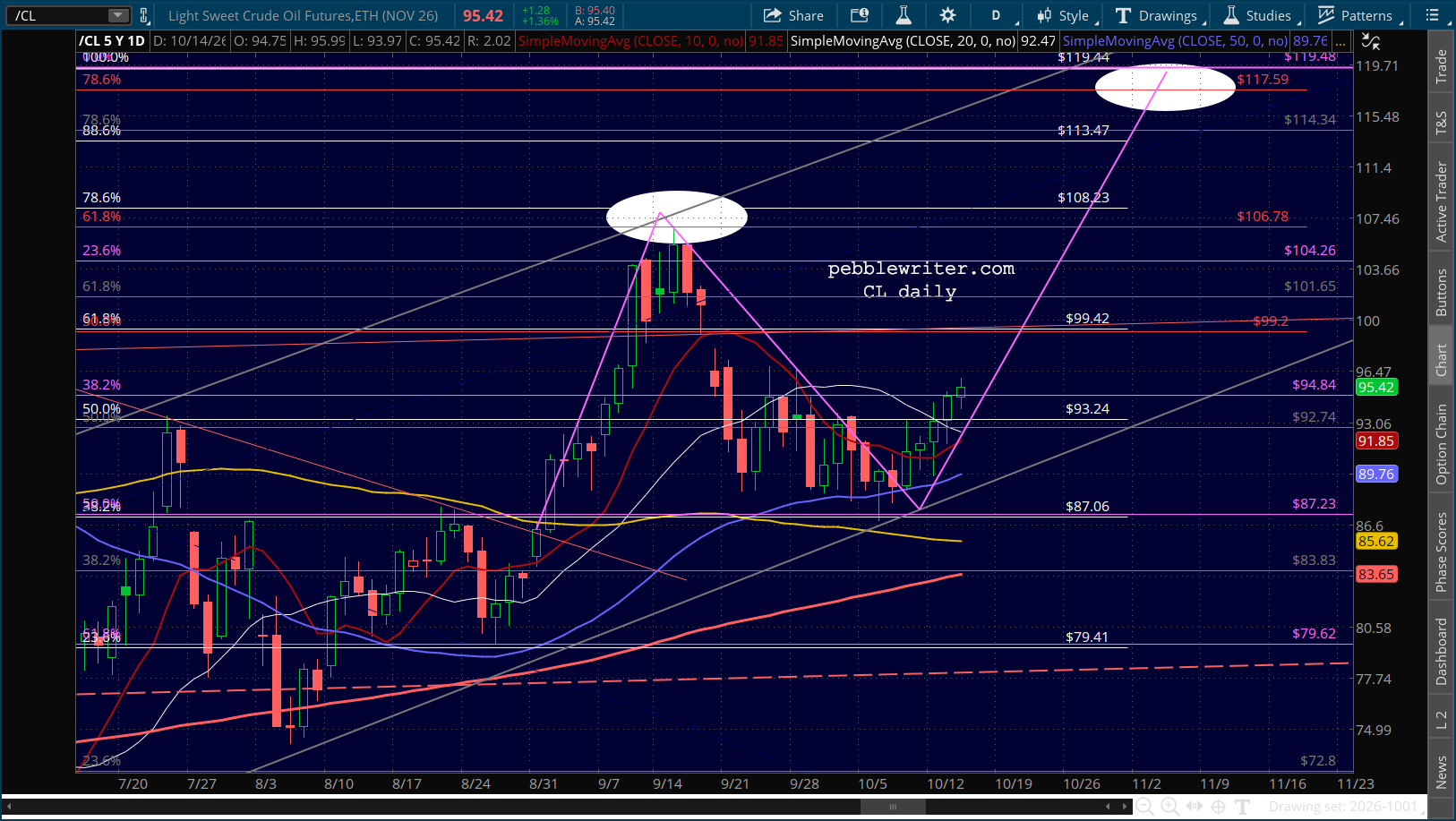
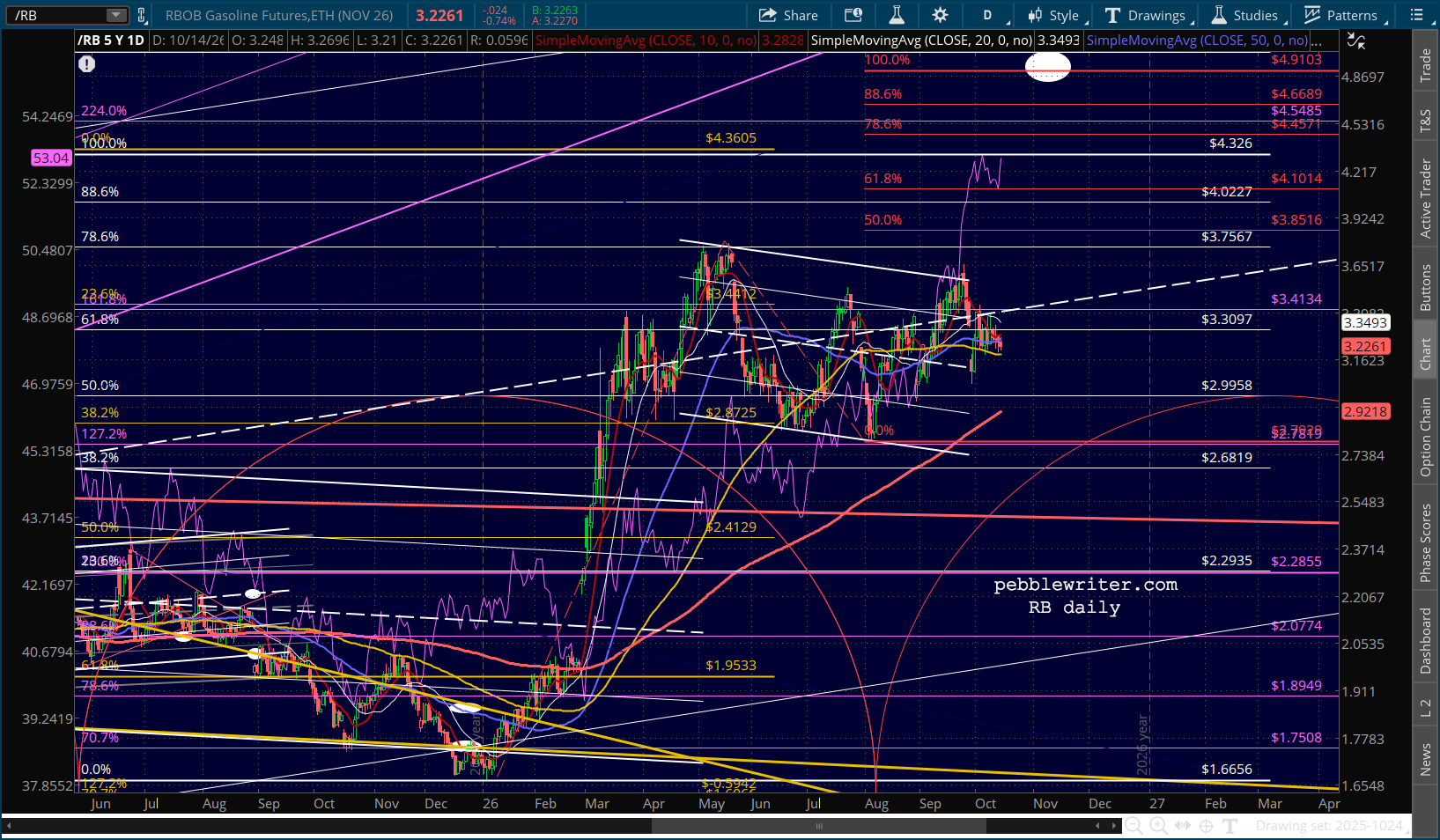
    It’s another day of stabilization for CL and RB…

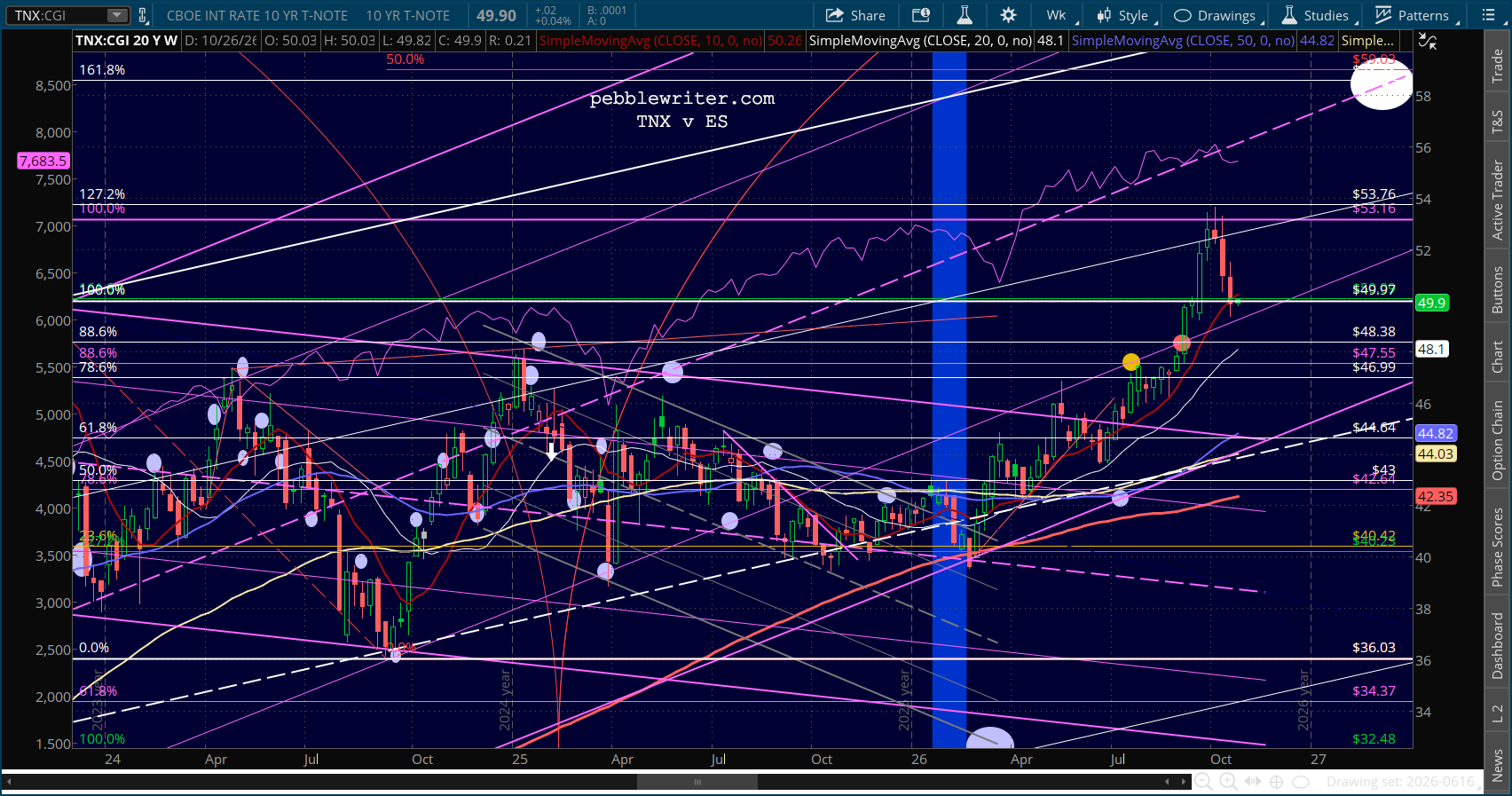
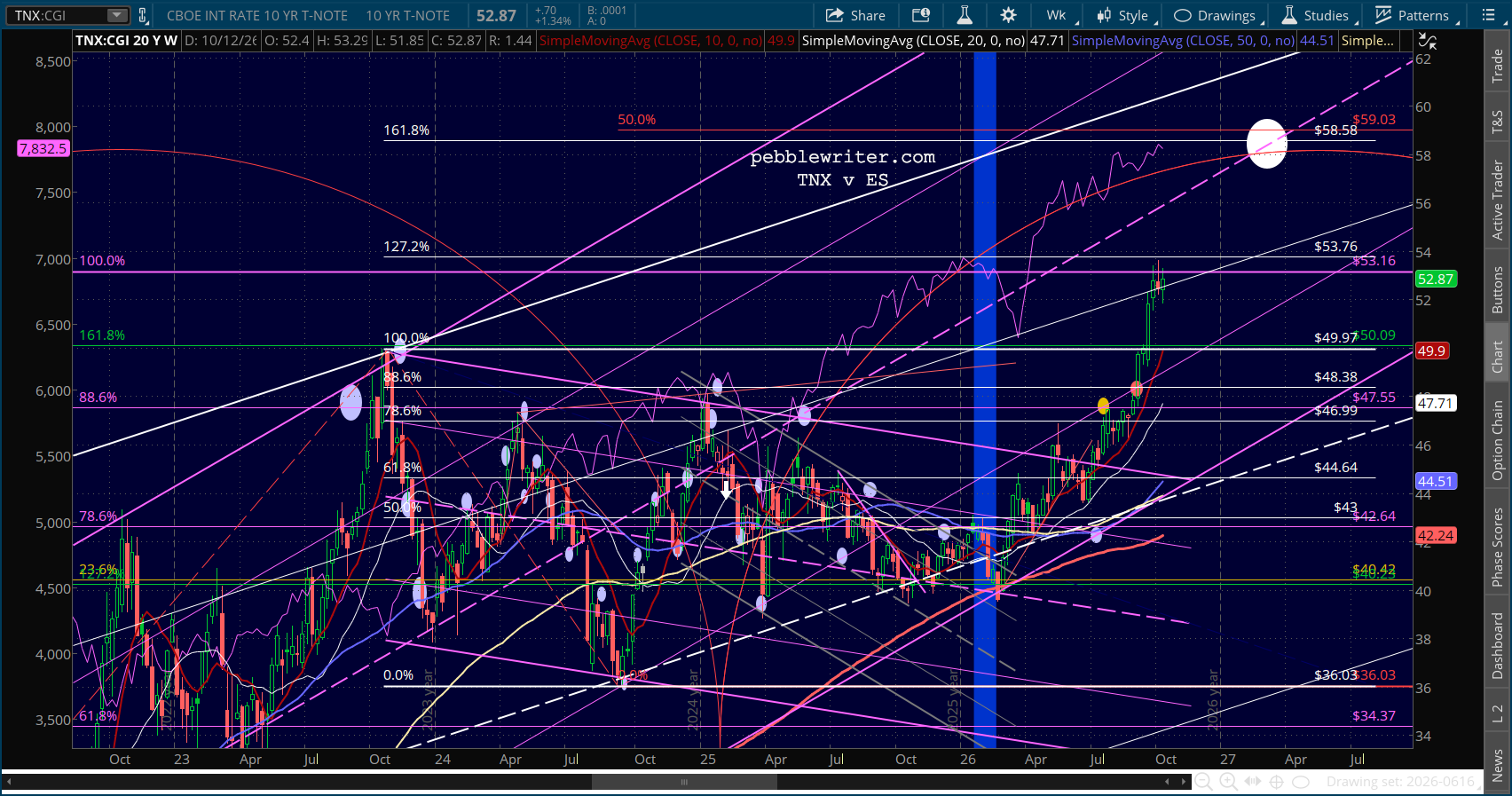
    …which has produced a small gap higher for TNX.

    The approaching holidays remind us that it’s time to produce our 2025 Review and 2026 Forecast. We’ll take a break next week from daily posts (unless something really exciting goes down) and try to harness the remaining brain cells into producing something interesting, if not profound.

    Stay tuned…

  • CPI (Maybe) Lower

    Inflation data was already going to be suspect enough, given that Trump only likes “good” data and that the Secretary of Labor was one of the very few people who hailed Trump’s decision to fire the head of Labor Statistics over her “bad” data.

    Toss in the absence of October data due to the shutdown, and you’d need the faith of a village idiot to believe that CPI increased only 0.2% from Sept-Nov.

    If the annual rate of 2.7% were accurate, it would be the first time in years that CPI increased during a period when YoY gas prices were increasing.

    Nevertheless, the algos liked what they heard and didn’t hesitate to react as though Stephen Miran was the new Fed chair.

    continued for members

    Yet, it’s interesting that ES hasn’t broken out of the small, falling red channel. Either the downtrend is still intact and this is a nice big bump designed to shake loose a few bears, or TPTB are getting nervous.

    The answer will likely depend on whether carbon-based analysts call BS on the sketchy data. I, for one, declare it so.

    Ceteris paribus, VIX suggests there’s more downside. Keep on eye on VIX 16.56.

    We’ll also keep a close eye on USDJPY. The BoJ has shown unusual restraint so far, but then again the Nikkei is doing just fine.

    And, EURUSD still owes us a SMA200 backtest.It shapes up as a good chance of DXY surprising folks to the upside.

    We’ve talked a lot about oil and gas this week. With the administration (and OPEC) declaring that inflation is over and rate cuts are urgently needed, it’s not surprising to see CL and RB bouncing today even as the 10Y is lower.

    Of course, the 2s10s is still flashing a big, red warning sign.

    GLTA


  • Charts I’m Watching: Dec 17, 2025

    Futures continue to vacillate about the 50-day moving average as algos grapple with incomplete and contradictory economic data. According to the Census Bureau, retail sales for November will be released “at a later date.”

    continued for members

    Dropping through the SMA50 (6765 for SPX) would be problematic for the bulls.

    VIX has reversed course again, retreating back below the purple channel it has broken out of several times over the past two months.

    Currencies remain muted, with the euro and the yen both reversing yesterday’s moves and lending a bit of strength to the DXY.

    Oil and gas have bounced after yesterday’s trouncing, with RB still technically broken down.

    The 10Y is unch, leaving the 2s10s at 66 bps.

    GLTA.