Tag: Dollar

  • Coincidences and Consequences

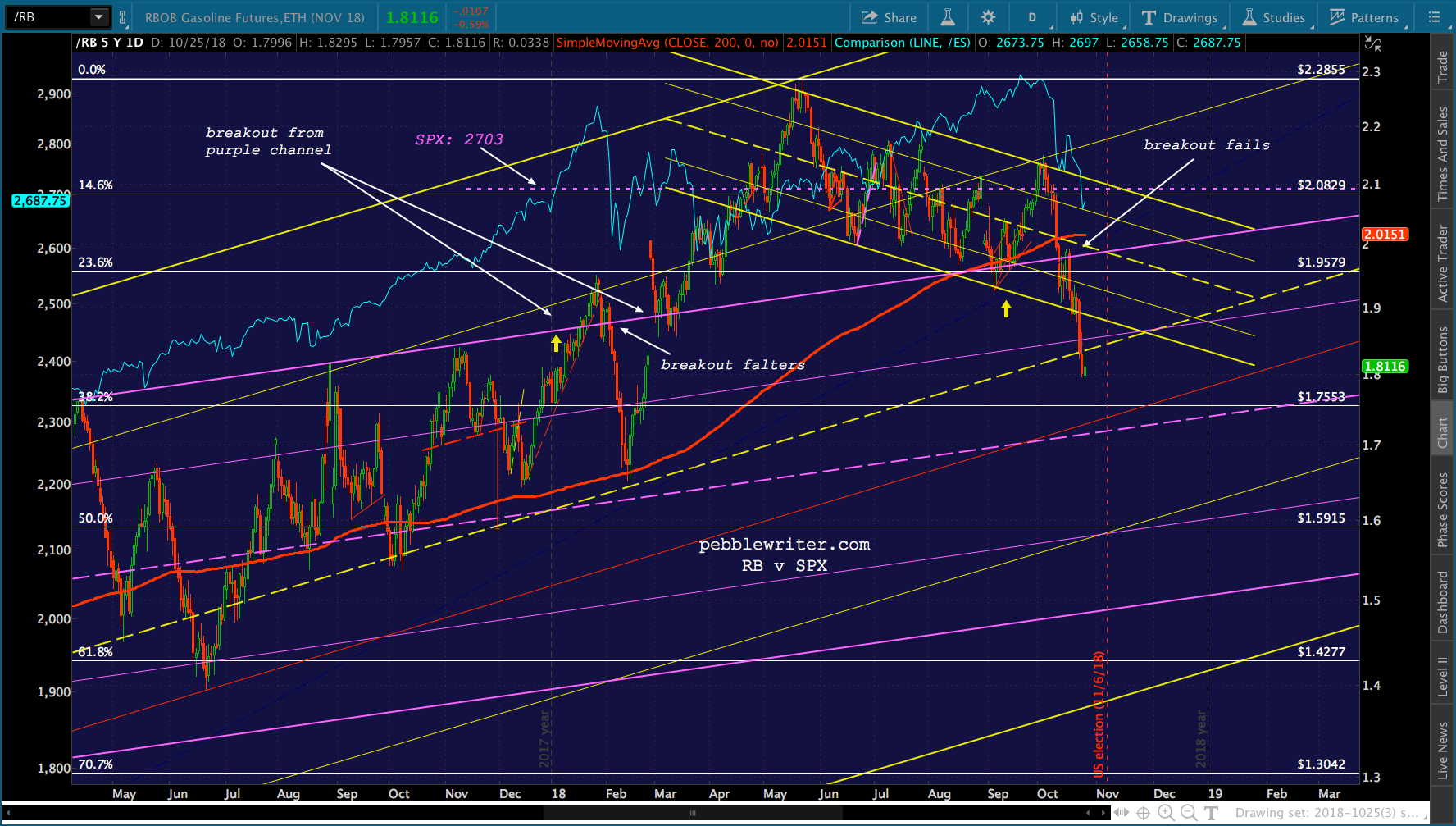
    It’s interesting how Khashoggi’s murder top-ticked oil and gas prices…

    …and, so soon after Trump’s latest demand that OPEC lower oil prices.

    I’m certainly not insinuating that Trump had anything to do with Khashoggi’s murder.

    But, OPEC ignored Trump’s Sep 20 demand.  Two weeks later, oil prices had spiked 10% higher.  Since Oct 3, the day of the murder, WTI has fallen 14.5% and RBOB has fallen 16.7%.

    As Churchill famously said, “never let a good crisis go to waste.”

     *  *  *

    Sometimes it’s quite difficult to anticipate a major market move.  You’ve got hundreds of companies, all with their own earnings, outlooks, and market-moving headlines.  Then, there’s the economic news of the day, both domestic and foreign.  And, of course, there are geopolitical developments such as who’s dismembering or cozying up to whom?

    And, sometimes it’s not so difficult at all. It can be as simple as the VIX chart we’ve discussed all week.  From Time to Panic on Tuesday:

    Note that VIX need only break the purple TL [for SPX to bounce.] If VIX doesn’t break down, this should be the end of the line for this bounce.

    It didn’t bounce.  SPX plunged.  Next?

    Or it can be slightly more complex, but still fairly straightforward — such as is the case with oil and gas.

    As we all know, central bank support (low interest rates, among other accommodations) has been critical to stock prices since 2009.  Low interest rates, of course, rely on low inflation.  And, low inflation relies to a great extent on low oil and gas prices (more accurately, low MoM and YoY increases in those prices.

    From last April in Oil & Gas, Inflation and Interest Rates: A Delicate Balance or Goal Seeking?

    The complicating factor, of course, is that oil and gas prices took over the job of stimulating algos (chief among the 90% of all trading activity which is conducted by machines) to drive stocks higher.

    Most recently, oil, gas and SPX all bottomed on Feb 11, 2016 and oil and gas prices played an integral role in stimulating the subsequent rally.  The most important nudge was in December 2017, when oil and gas prices broke out of an already rising channel.

    To chartists, and to algos, this is a very bullish maneuver.  It also has the effect of driving inflation and interest rates higher. CPI rose from 2.11% in December 2017 to 2.95 in July 2018.  The 10Y rose from 2.31% in December to 3.24% just a few weeks ago.

    The Fed told us they were okay with this, that they were going to let the economy and inflation “run hot.”  I was among the many doubters, citing the damage that higher rates would inflict on our already alarming budget deficit, but darned if they didn’t do it anyway. I suppose that, at the end of the day, a temporary increase in the rate at which the debt and interest expense are expanding was less important than having a higher perch from which to crash rates during the next GFC.

    Stocks ignored the implications for a while, happy to play follow the leader with oil and gas prices.  The day that RBOB popped out of the rising purple channel was the day that SPX popped above its 2.24 Fibonacci extension at 2703 – a level which might otherwise have provided serious overhead resistance.  It can be seen as the horizontal, purple trend line on the chart below. In early February, though, RBOB’s breakout faltered.  No surprise, but SPX followed along, suffering its biggest and sharpest decline in years.  Like magic, RB quickly popped back above the purple channel top – rescuing SPX and helping it back above 2703.

    Note that SPX went on to new all-time highs in September, only after RB backtested the purple channel and bounced higher.

    And this lovely little correction we’re enjoying?  SPX topped the day that RB failed to break out of the falling yellow channel (also the day of Khashoggi’s murder.)  SPX fell through its 200-day moving average on the day that RB plunged back below the purple channel top.  And, SPX plunged below 2703 on the day that RB fell out of the falling yellow channel.

    With the elections less than two weeks away, I’m not expecting a sharp rebound in oil and gas prices any time soon.  So, the algos will have to rely on other tools — such as VIX, which has now shed 12.5% since tagged our 26 target yesterday.

    So far, VIX’s decline has produced a pretty nifty bounce.  Is it enough to offset weakness in oil and gas and a hawkish Fed which has been browbeaten by a “low-interest rate president?

    continued for members... (more…)

  • A Backtest or More?

    Today should shape up as a battle between holding a much-cherished round number (SPX 2900) and backtesting solid support (the January highs.)

    The futures are off about 5, with yesterday’s downside target of 2878.50-2881.95 still looking good — if SPX will relinquish 2900.

    Much will depend on the yen, which is strengthening in the midst of the EM turmoil…

    …and the 10Y, which has been in a holding pattern for months.  It looks ripe for a breakdown, but that would almost certainly invert the curve and usher in more than a backtest.

    continued for members(more…)

  • CPI: The Games Continue

    Everyone who drives knows that gas prices increased more than 3% month-over-month  – the official, seasonally adjusted numbers from the BLS in this morning’s CPI report.  Data put together by non-governmental sources confirms it.But, folks like GasBuddy and AAA aren’t responsible for cost of living adjustments for millions of Americans.  So, unlike the BLS, they have no incentive to fudge the numbers. Maybe they’re also aware that gas stations don’t allow customers to pay the “seasonally-adjusted” price.

    Using the EIA’s (also fudged) numbers, gas prices were up 6.2% for April — more than twice BLS’ goal-seeking 3%.  So, the BLS was able to report 0.2% instead of the 0.3% expected for April CPI.Similar games are played, of course, with respect to shelter (+3.4% YoY,) medical care (+2.2%) and vehicles (-1.6% new, -0.9% used.) I’ll pick on vehicle data this morning, as it illustrates another shortcoming of the BLS approach.

    Consumers buy food and gas every few days, while they tend to hold on to vehicles for several years at a time.  Even if vehicle prices were to drop, that savings wouldn’t flow through to a consumer until they purchase a vehicle.  When they did, of course, they’d be hit with higher interest rates than were in place last month or last year.

    The algos don’t care much about the veracity of the numbers.  Futures are up 8 points ahead of the open — another overnight VIX bashing that has it below the SMA200 and about to test the .886 Fib and channel midline at 13.23ish.  While it’s nice to nail a forecast, it’s distressing to see how easily the algos can be manipulated. The flip side of under-reporting inflation, of course, is the effect it has on currencies and interest rates. With “no” inflation pressure, interest rates have receded from 3% — sapping some of the dollar’s strength. continued for members(more…)

  • Update on Gold: Apr 11, 2018

    In our last major update [see: Jan 26 Update] we noted that gold, 1355 at the time, had reached the same price level at which it had frequently reversed.  Even though we’d had a bullseye at 1377-1380 for over a year, it had stopped short several times.

    GC is sitting just below the neckline of the huge IH&S that could result in a significant breakout.  The fly in the ointment: I don’t think TPTB will let it break out.  So, you should either take profits here in the 1348-1365 range, or at least set your stops at this level.

    As it happened, 1365 (reached the day before) was the cycle high.  Gold tumbled 4.1%, then bounced around between roughly 1308 and 1362 for the next two months.  Our interim posts caught most of the moves:

      * * *

    Feb 8: Analog Details  “[Gold] has dropped 4.1% since reversing where expected in late Jan, and just reached fanline and double channel support [1321.] Could it finally be ready to tag 1377-1380?”  Bottomed that day, rallied to 1364 over the following week (+2.51%.)

    Feb 15: Where to, Next?  “GC might have run out of steam here [1360.] Cautious types should consider taking profits, while the daredevils out there remain focused on 1380.” Topped out the following day at 1364 (+2.95%.)

    Feb 27: Powell’s French Toast   “Gold is getting clobbered…our analog suggests a Mar 1 turning point. The SMA100 should be around 1303 by then and would be a better bounce spot.”  Bottomed on Mar 1 at 1303.60 (+4.15%.)

    Mar 27: Algos to Markets – All Better  “GC, which tagged its 1362 resistance yet again, has retreated once more… It still has a good shot at 1380, but only if/when DXY finally breaks down.” Reached 1369.40 today (+5.05%.)

     * * *

    So, here we are, sitting on a tidy 14.7% gain.  It’s not terrible for 2 1/2 months work, considering gold has only netted a 0.9% gain during that period.  But, I hate to leave money on the table. Is it time to pull the plug on 1377-1380?  Or, are we about to reach or exceed it?

    continued for members

    The two major factors at work are the ongoing saga of the US dollar and the possibility of a shooting war with Russia in Syria.  I can’t speak to the question of a war other to say anything’s possible, especially with the crew currently running the ship.

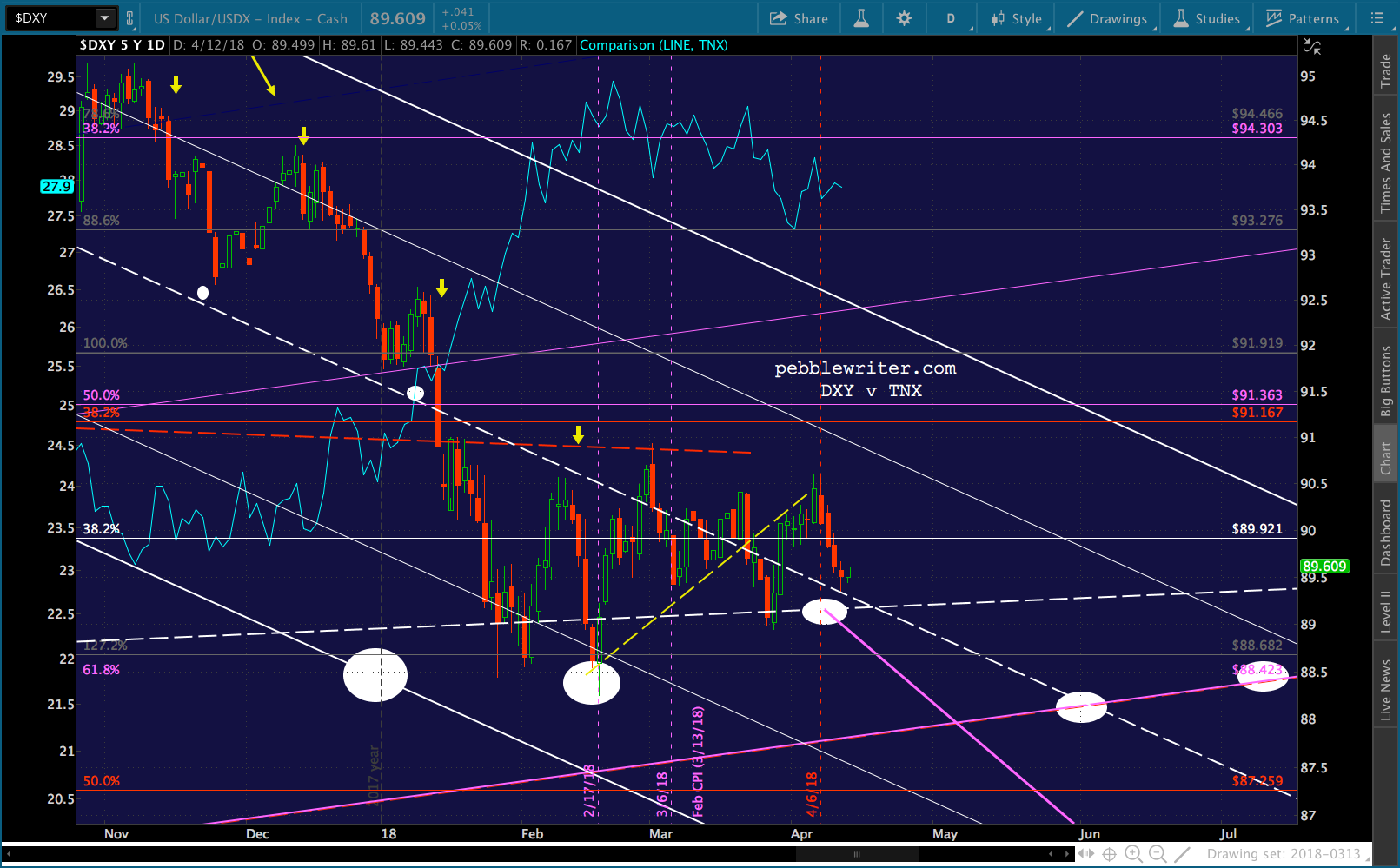
    The dollar is another matter.  While it normally rises and falls in sync with interest rates, this relationship reversed at the end of 2017.    At that point, DXY logged another leg lower while TNX spiked. At just shy of 3%, the TNX became a drag on equities — the whole “going broke” thing [see: Why Rising Rates Are a Problem This Time.]  But, as the gyrations in equities picked up again, great care was taken to ensure it didn’t plunge in value.

    I suppose the thinking was that lower rates would weaken the dollar’s appeal.  Or, maybe it was just fear of a yield curve inversion.  In any case, TNX’s purple TL has refused to break down. DXY also refuses to break down.  And, this could go on for quite a while.  It needs to tag the bottom of the rising purple channel.  But, until mid-July rolls around, that would mean dipping below the .618 at 88.423.  So, it’s quite possible TPTB will prop it up for another three months! 

    Remember, Mnuchin publicly stated he wants to support the USD.  And, it goes without saying that he, like every central banker, loathes any serious price appreciation in gold, as it undermines the value of the mighty dollar. One silver lining, EURUSD suggests a shorter timeframe, say Jun 5.  But, even two months would be a long time to wait for another few points.  An escalation in MENA tensions could obviously accelerate things.  But, is it worth taking the risk for 10-15 points?  I think not.  I’d pull the plug or at least enter stops here at 1367.  If it pops above 1380, great.  No argument with going long, again.  DXY could drop to 87 tomorrow, and GC could easily reach 1377-1380 or higher.

    But, if DXY continues sideways, and unless war breaks out in the next day or two, it seems likely that gold’s next move will be lower.  The most obvious support is at the rising white channel bottom and SMA100, currently around 1315.2-1318.  If the channel breaks down again, the SMA200 will reach the purple channel line later this month, probably around 1300.  I’ll update things if we see a material deviation in either direction.

    GLTA.


  • The Market’s Latest “Lucky” Bounce

    That’s a relief!  For months, pundits have been arguing whether the Fed needed to hike interest rates three times or four times this year — you know, because of all the growth coming down the pike.

    Fed Über-Dove and “Man Who Thinks Market Integrity is Overrated” Jim Bullard just announced that the correct number is zero.  That’s right.  Everything is perfect just like it is.

    Amazingly, and quite by coincidence, this pronouncement occurred on the exact same day that several stock market indices were in danger of falling below a very important technical level of support: their 200-day moving averages.  As we discussed on Monday, falling below the SMA200 isn’t usually very healthy for markets.

    For visitors and new members, this seems like a good time to take a walk down memory lane.  This isn’t Mr Bullard’s first rodeo.  Nor is it the first time “someone” did something clever to ensure the market’s continued ascent.

    The S&P 500 illustrates the phenomenon quite well, having experienced a number of such fortunate events at crucial times. October 2014 – Bullard!

    Bullard appeared on Bloomberg to explain that another round of QE might be in order. As “luck” would have it, this enabled SPX to reverse right as it reached important Fibonacci support, ending a 9.9% tumble and narrowly averting an official correction.

    Big assist from USDJPY, which soared 16% over the next 7 weeks in spite of the fact that more QE should have weakened the US dollar.  The Yen Carry Trade in all its glory.

    August 2015 – USDJPY!

    This 12.5% correction was set up by USDJPY falling back below a critical Fibonacci level (the .618 at 120.11) in the wake of SPX reaching a key Fibonacci extension (the 1.618 at 2138.)

    We had correctly forecast the top [see: The Last Big Butterfly] but it was unclear whether or not USDJPY could remain above 120.  SPX plummeted when 120 finally fell but, as “luck” would have it, was (temporarily) rescued by USDJPY’s bounce back above it.

    February 2016 – Oil!

    The price of West Texas Intermediate Oil (CL) had fallen 77% between Aug 2013 and Feb 2016.  While this crushed inflation to a manageable level, it made investors in and lenders to energy-related companies pretty nervous.

    As “luck” would have it, CL bottomed out on Feb 11, 2016 — the exact same day that SPX reached that critical Fibonacci support level of 1823.  CL doubled over the next four months, and SPX rebounded sharply.  By accurately forecast the bottom in oil, we could confidently call a bottom for SPX [see: USDJPY Finally Relents.]June 2016 – USDJPY!

    Stocks plunged in the wake of the Brexit vote.  As “luck” would have it, USDJPY — which had used CL’s rally as an opportunity to reset — picked this particular day to bottom out and spiked 8% higher over the following month.

    Futures had sold off by 6.5%, but by the time SPX opened the next morning the recovery was well underway.  It was soon back above its recent highs and the critical 1.618 extension at 1.618.  In other words: new all-time highs.

    November 2016 – Trump*!  Unfortunately for stocks, the US election results weren’t conducive to a rally.  Once Trump’s election became apparent, futures plummeted over 5% in a matter of hours.  SPX had bounced off its SMA200 a few days earlier.  Unless something was done quickly, it would drop through this key support the following morning.As “luck” would have it, USDJPY picked this particular day to bottom out.  It spiked 5% over the next few hours and 18% over the next few weeks — a supersized version of the exercise which had saved stocks post-Brexit.

    And, if that weren’t enough, VIX — the widely accepted indicator of fear and volatility — plummeted even as futures were plunging.  It’s the equivalent of calling your insurance broker to cancel your homeowner’s policy as a hurricane bears down on your beach house.  How very, very “lucky” indeed.Futures recovered almost all of their losses by the time the cash market opened the following morning. VIX went on to shed over 50% of its value and broke down through trend line support (above, the white arrow.)

    Stocks were soon registered new all-time highs. The talking heads called it the “Trump Rally” and attributed the gains to the incoming president’s pro-business orientation and deal-making acumen. But, I think it deserves an asterisk…on account of the incredible “luck” involved [see: Why the Trump Rally is a Fraud.]

    The SPX chart isn’t labeled as such, but the rise from 2138 to 2703 (the next major Fib level) wouldn’t have been possible without continued support from oil and VIX.  After doubling in value, CL proceeded to construct a well-formed rising channel (below, in purple) that was very supportive of stocks.  It oscillated between the channel’s top and bottom like clockwork — until December 2017.  We’ll come back to that.Also during that time, VIX was trying something new.  After years of occasionally bouncing off the bottom of a long-term channel (below, the yellow arrows) it decided to plunge below that channel bottom and spend 80% of its subsequent days in the cellar — reaching new all-time lows in the process.This sent a strong all-clear signal to stocks (or, at least the algos that trigger stock purchases) that the coast was clear. It was completely safe to buy stocks, which they did — producing a rally that accelerated all the way up to the 2.24 extension at 2703.

    December 2017 – Oil!

    At that point, oil’s breakout (remember the purple channel above?) and the onslaught of new, daily lows in VIX combined to give SPX the boost it needed to climb above that resistance.  I mean, how “lucky” can you get?  It popped above 2703 and tacked on another 6.3% for good measure.

    Unfortunately for stocks, though, there was a practical limit to how high CL could go without creating problems.  Someone had forgotten that higher oil prices mean higher inflation.  And, higher inflation means higher interest rates.  And, when you’re $21 trillion in debt and pass a tax bill and budget that greatly widen the deficit considerably…higher interest rates are not exactly lucky [see: Why Higher Interest Rates Are a Problem This Time.]

    Between that realization and a growing disconnect between price and supply & demand, CL had to drop.  When it did, and the (dashed, red) trend line from August 2017 finally broke down, stocks didn’t take it well.SPX plunged almost 12% over the next two weeks, one of the sharpest corrections ever.  Luckily, the SMA200 was there to catch it.  A few days later, CL popped back above its channel top and SPX recovered to back above 2703.

    As the bounce began to fade, we had a surprise message from Bullard that “too many rate hikes could slow the economy.”  It was enough to extend SPX’s bounce for another few weeks.  But, ultimately it slipped back down below 2703 to tag its SMA200 again.  And, again.  And, again.  And, again.

    By then, DJIA and RUT had finally risen to the point where they could tag their SMA200s as well.  SPX bounced at our 2561 target.  Investors were in luck!  Until this morning.

    April 2018 – Bullard!

    Apparently, someone forgot to explain to the Chinese that we were supposed to win the trade war (winning them is easy!)  This morning, we found out that China had the gall to fight back.  When I was woken by an price alert at 3:15 this morning, the futures were off 55 points.  SPX would open back below its SMA200.

    But, the futures didn’t know what they were up against!

    Then came Larry Kudlow, the guy who in May 2008 called the impending Great Financial Crisis a “non-recession recession.”  Some people might have misunderstood; but, obviously he meant it would be much worse than a recession.  (I can’t wait to find the pot of gold!)

    As “luck” would have it, the market was quite pleased with all this positive scuttlebutt.   ES, once down 55 points, closed up 34 points.  SPX and the Dow rose about 1%.  RUT added 1.30%.  And, COMP — which never did tag its SMA200 — popped 1.45%.  Take that, 200-day moving average!

    Bounces are nice, whether driven by oil, the USDJPY or Fed cheerleaders.  This one got SPX back above its SMA200, which is a good start.  Next comes the 2.24 Fib, which SPX has crossed some twenty times in the past two months.  Can it rise back above and stay there this time?

    Oil’s limitations haven’t disappeared.  Managing inflation and interest rate expectations will continue to dominate its price action.  Lately, the market has a very narrow range within which it feels comfortable.

    USJDPY is threatening to break out from a falling flag pattern, but one has to wonder why it hasn’t done so already.  Japan got no love from Trump in the trade war chatter to date.  It’s quite possible they’re done cooperating with currency intervention. VIX, after popping back above the yellow channel bottom in dramatic fashion in February, has fallen back to a trend line (red, dashed) from its January lows.  Every time it pops above the trend line, SPX stumbles.  Every time it drops below it, SPX rips.  Today, it tagged it and reversed lower – hence the day’s gains.  It has plenty of additional downside potential, with the potential to drive stocks back above 2700.  But, again, it hasn’t done so yet.

    It makes one wonder whether SPX will be allowed to put in a lower low in order to make the corrective wave look a little more conventional and give COMP a shot at its SMA200.  We have oodles and oodles of downside targets if SPX’s SMA200 should fail.  That white dot at 2138 in the chart above is there for a reason [see: More Where That Came From.]

    There are countless other factors I haven’t even mentioned: our yield curve model (which tentatively turned bullish today), 10yr note rates, the US dollar’s buoyancy, various momentum indicators, and the continuing sagas of FB, TSLA, AMZN and DB — all of which have played a role in the market’s gyrations (mostly of the bad luck variety.)

    Whatever happens, it’s hard to imagine we could reach new highs without plenty more luck.  Trade safe, and stay tuned.


  • Does the Yield Curve Matter? A Closer Look

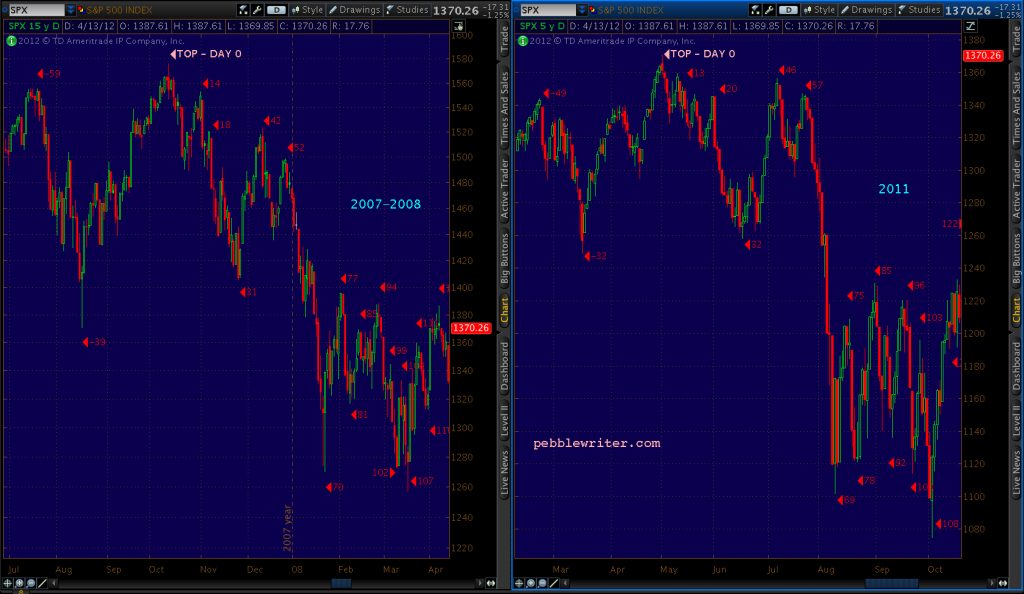
    I called a top in SPX on May 20, 2015 [see: The Last Big Butterfly] because it was about to reach the 1.618 Fib extension at 2138 — our upside target from way back in 2012.  SPX peaked the following day and fell over 300 points before it was all over.

    What I didn’t notice at the time was the bond market. We’ve focused on this from time to time, most recently on Dec 29 [see: Should You Fear the Yield Curve?]  We noted at the time that while the spread between 10Y and 2Y was dropping rapidly, it only represented a warning unless it bottomed out and rose rapidly.  From that post:

    …the above shows that while the potential is there for a recession, this is just an early warning at this time. If the yield curve bottoms out here and rapidly steepens, we’ll have a lot more to worry about.

    Two sessions later, the spread did bottom out, and has been on a tear ever since.  What does this mean?  Let’s look at how things unfolded in the past.

    The spread had been tightening since Dec 31, 2013.  It bottomed in Feb 2015 and began rising again.  In early May, it broke above a trend line (red, dashed) connecting its highs.

    About the same time that SPX was peaking, it backtested that TL and continued higher.  It broke trend (purple, dashed) around Jul 31, a few days before SPX fell off a cliff.  It broke down to new lows (the red, dotted line) in Jan 2016, about the same time that SPX bottomed out.What the yield curve said, then, in simple terms:

    – a breakout from the downtrend marked an equity top (bearish)
    – a breakdown of the subsequent uptrend was really bearish
    – a break to new lows represented a potential bottom (bullish)

    Before I go any further, I want to point out that there were four significant bottoms in 2015-2016.  The first two came close to backtesting the 1.272 Fib at 1823, but didn’t quite make it.  The second two did.Now, let’s look at the same period, but comparing the 10Y (TNX) itself to SPX.  Note that SPX peaked shortly after TNX reached the falling red TL, and began having trouble once TNX broke out.

    SPX fell off its cliff when TNX fell back through the rising purple TL, making bottoms each time TNX did. On Jan 20, 2016, TNX tested its Aug and Sep lows, at which point SPX bottomed at 1812.  A week later, TNX plunged below the previous bottoms and didn’t bounce until it reached the Jan 2015 lows (dashed, purple line.)

    The message delivered by TNX was slightly different from the 10Y2Y:

    – rising up to tag the falling trend line represents a bearish turning point
    – breaking out above it is okay, as long as the uptrend continues
    – a breakdown of the subsequent rebound is really bearish
    – stocks won’t bottom until TNX does

    If we look at the chart below, we can see that the 10Y tracked the 10Y2Y quite closely until it diverged in late 2015 in a failed effort to support stock prices.  It didn’t provide decisive support until it bottomed in Feb 2016 at its Feb 2015 lows.  For a few brief days, the divergence disappeared.Why is this even remotely interesting, you might ask?

    As in 2015, we have also experienced a huge divergence between the 10Y2Y and the 10Y itself.  This is noteworthy in and of itself.But, the comparison gets even more interesting.   As in 2015, we have had an extended slump (14 months vs 17 in 2015), a breakout above the falling red trend line, and a backtest of the trend line.The big differences, so far, are that the spread hasn’t gone on to new highs and that the (presumed) low came as spreads were peaking and only two weeks (versus 8 months) following the peak.

    But, so far, the lessons from 2015 are holding.  The breakout above the falling red TL definitely produced a drop in stocks.  The backtest of the red TL has occurred, but it hasn’t quite reached the purple TL.  As long as it continues bouncing and doesn’t drop back through that TL, stocks should be able to continue rising.  The day it drops back through it, things could get nasty.

    Next, let’s look at the current TNX chart.  We could look at the drop since the Mar 2017 highs, but it was rather short-lived and the subsequent rebound has resembled a moon shot.  Instead, let’s look at the big picture.

    A trend line from the 2008 highs connected with the 2010, 2011 and 2017 highs.  After reversing at each, TNX was accompanied by a large drop in stocks.  TNX’s reversal from its 2013 highs never produced a stock selloff; but, then again, it didn’t quite reach the TL.

    Zooming in a little, we can see that TNX reached this trend line a couple of times in 2017: first, in March, when its reversal accompanied by a mild 78-pt drop in SPX, and again on Dec 20 in a reversal which never gathered any steam.  TNX was back to and punched through the TL on Jan 8.  It reached another TL (gray) drawn through other recent highs on Jan 22 at 26.65.  This was a potential top, meaning the bond folks breathed a sigh of relief.

    On Jan 26, however, it popped up through the gray trend line.  Not so coincidentally, that was the day that SPX peaked.Remember our lessons from TNX in 2015:

    1. reversing off the falling trend line represents a bearish turning point – it didn’t reverse

    2. breaking out above it is okay, as long as the uptrend continues – it did, but as it approached 3%, folks started getting nervous.

    3. a breakdown of the subsequent rebound is really bearish – we got a potential reversal at 29.43, but it has a long ways to go before reaching the rebound trend line, currently at 24.40.

    Interestingly, that TL intersects the falling red TL at about 24.60 on Mar 13, the day that CPI for February is reported.

    And this is where it gets interesting.  If TNX continues to rally, bond folks and equity folks will get nervous (the fiscal fiasco.)

    If it were to fall to the rising purple trend line and backtest the red trend line at 24.60, it might be somewhat bearish unless: (a) it reflects a big drop in inflation (in keeping with my oil and gas forecast) and (b) it rebounds there.

    If it fell below 24.60, the TNX lessons suggest that SPX would be in big trouble.  With a Fed meeting a week later, we can assume Powell et al would be focused on preventing that from happening.  But, as our analog suggests, this preceeds an important inflection point by just a few weeks.

    If TNX falls through 24.60, remember lesson 4…

    4.  stocks won’t bottom until TNX does

     *  *  *

    Now, onto our analog update. In our initial post and follow up from Feb 6-7 [see: Analog Watch], we anticipated SPX would rebound from 2533 (our downside target) to 2765 by Feb 14 and 2812 by Feb 23.  Instead, it bounced from 2532.69 to 2742 on Feb 16 and to 2789 — 23 points short and 4 days late — by Feb 27.

    An adjustment was clearly necessary, given that SPX and ES bottomed on different days.  We’ll try to reconcile the two, along with some economic forecasts which are definitely outside the norm.

    continued for members(more…)

  • The Same, but Different

    Yesterday started out with a VIX-driven pop that quickly fizzled and nailed our downside target before rebounding and hitting our upside target.  Since SPX closed right at resistance, it needed a boost overnight.  So, why not go back to the same clever trick that worked the day before?

    Yes, VIX’s red channel has broken down again.  And, the algos are eating it up… to the tune of +5 on ES.

    Will it pop and drop, again, or will this one take?

    continued for members(more…)

  • Price Alert: Gold

    Gold is approaching our next upside target from two weeks ago [see: Gold – Following the Yellow Brick Road.]

    continued for members(more…)

  • This is a Test

    Yesterday, we got a taste of what happens to United Airlines passengers who are “disruptive and belligerent.”   In what is being described as one of the biggest PR fails in recent memory, United CEO Oscar Munoz defended the action taken to forcefully drag an Asian-American doctor from a flight that United had overbooked.

    No doubt United would have found the volunteers it needed had it upped the compensation it was offering to $1,000, $1,500 or even $2,000.  Instead, it will pay millions to the passenger, and many more millions in lost revenues from prospective passengers who are too horrified to “fly the friendly skies.”

    The stock is likely headed for at least 61.72, a 14% drop from yesterday’s highs — about $3 billion off its market cap.  And, that would be a positive outcome — if it’s able to hold both horizontal support and its SMA200.

    While the event itself was shocking, it’s equally surprising that the CEO of a major airline could be so tone deaf as to email his employees that “I want to commend you for continuing to go above and beyond to ensure we fly right.”

    The most interesting CEO on the world stage, right now, is our own Donald Trump.  He faces much greater challenges than Munoz did: escalating military conflicts with both Syria and North Korea and, by proxy, Russia and China.

    We’ve had a taste of Trump’s leadership skills with respect to the battles over health care, tax reform, and scores of executive orders relating to the environment, energy, etc.  He won some, and he lost some. None of those, however, involved the risk of nuclear war.

    Is it any wonder that investors are a little nervous and stocks have, so far, not shaken off this particular geopolitical risk?

    On Feb 10, SPX broke out of a large, year-old channel that was averaging 17% YoY returns.  It has backtested that channel top seven times in the past several weeks — including a serious plunge below it on Mar 27.

    Today, it’s happening again.  Will it survive this test?  It might just depend on whether or not Trump survives his.

    continued(more…)

  • Gold: Following the Yellow Brick Road

    I’m not a gold bug.  I’ve always thought the price is pretty heavily manipulated (long before it hit the headlines) and I guess I’ve avoided it on principle.  Looking back at my forecasts over the past year or so, that was probably a mistake.

    Since our December 14, 2015 forecast, GC has gained about 19% — not shabby.  However, if one heeded the forecasts offered with each subsequent update, the net return would have been over 80%.

    I’ve said many times, lately, that forecasting stocks has become a lot tougher than forecasting the various drivers of stock prices.  In the case of gold, it is obviously affected by the value of the US dollar, which is an important component of USDJPY — a key driver of equity algos.

    Thus, GC — like USDJPY, WTI and VIX — is one of those things that’s been relatively easy to forecast even though I’ve devoted only the occasional hour or two to its study.  Before we touch on today’s forecast, let’s take a look at the past year’s periodic forecasts.The numbers in the above chart correspond to the posts below.

    1. Dec 14, 2015 (GC: 1060):
      “If DX plunges further, as I expect it will, GC’s 4th bounce could be a doozy: 1150-1180 for starters, and 1286 after that.”  GC reached 1180 by Feb 8, topped out at 1287.80 on Mar 11.
    2. Mar 4, 2016 (GC: 1280):
      “I’d be very cautious in chasing GC at this point…acts like it’s reversing between here and 1286…take the gains…it could easily backtest the .618 at 1207.60.”  GC reached 1286 the next week, then reversed to backtest 1206.
    3. April 8, 2016 (GC: 1240):
      “If [gold] breaks above the purple midline [at 1270] then 1379-1380 is the next logical target…”   Gold reached 1377.50 three months later.
    4. July 7, 2016 (GC: 1361):
      “Our target range from April 8 was 1379-1380.  Yesterday’s 1377.50 was probably close enough.  If it can’t make new highs today, the next stop is the neckline at 1307..”  GC, which peaked at 1377.50 on Jul 6, dropped 5% to 1310 over the next 2 weeks.
    5. Aug 26, 2016 (GC: 1324):
      “…[there’s a] huge IH&S Pattern, the neckline of which is the former high at 1307ish.  If TPTB are serious about discrediting GC anytime soon it’ll involve getting it back below that [1307] support.”  GC tumbled to 1307, testing it three times before breaking down to 1243 on Oct 7.
    6. Oct 7, 2016 (GC: 1254): “…GC tagged its SMA200 and the bottom of a pretty good looking channel earlier — usually good for a bounce.”  GC bottomed the next day at 1243, bounced for a month, reached 1339 on Nov 9.
    7. Nov 14, 2016 (GC: 1227): …GC’s channel finally broke down two days ago and has potential to 1083 — a 12% drop from here.  What better way to finish the year out?  GC plunged 103 (8.4%) over the next month.
    8. Dec 5, 2016 (GC: 1175): If the .618 [1172.40] breaks down, then the next support isn’t until the red TL at 1130, followed by the .886 at 1083.50… GC reached 1130 on Dec 15.
    9. Dec 15, 2016 (GC: 1129): “GC is currently testing an important internal TL of support… a potentially important test…that could produce a bounce to the purple midline [at 1230] or the SMA200 — currently at 1278.”  GC reached the SMA200 at 1264.60 on Feb 27.

    After tagging its 200-day average in February, gold tumbled about 67, back below a key channel midline.  But, it is right back in the swing of things, having nearly reached the SMA200 a second time just yesterday.

    With all the discussion about what the Fed will or won’t do for the rest of the year, what’s next?

    continued for members(more…)