Tag: stocks

  • USDJPY’s Turn

    Members will recall that one critical component of our oil/gas decline scenario is USDJPY’s breakout from the falling channel from 2017 shown below.  Guess what?

    The yen carry trade is a tried and true method of goading the algos into buying equities – even overpriced ones. It works especially well as a counterweight to falling oil/gas prices as we first observed in 2015 [see: Did TPTB Crash Oil?]

    So, it’s absolutely no surprise to see central banks pull it out of the playbook at a time when folks are suddenly curious about hidden, systemic risks and oil/gas prices are in the midst of a healthy reset.

    continued for members

    (more…)

  • The Usual Suspects

    There’s a well-known scene at the end of the classic film Casablanca where Captain Renault (Claude Reins), having seen Rick (Humphrey Bogart) shoot a Nazi in order to enable Ilsa and Lazlo to escape, tells his men to “round up the usual suspects.” It saves Rick, Ilsa and Lazlo’s collective bacon (though I suspect it sucks for the usual suspects.)

    click to play

    So it is with the algos driving equities lately. With oil/gas prices on their back heels and VIX being bid up every day by nervous carbon-based investors, it falls to the the usual suspects in the currency markets to provide algos with the proper “motivation.”

    Think of USDJPY’s breakout not so much as a bug, but a feature of the modern market — one of the many quiddities which allows futures to ramp higher on, say, disappointing economic news.

    While it is sometimes difficult to know when stocks will get much-needed support, these tools have been fairly predictable and have provided excellent trading opportunities.

    continued for members(more…)

  • Update on Gold and Silver: Mar 25, 2021

    We have multiple targets being reached this morning, and several more in the works. We’ll start with ES, which just tagged our SMA50 target in a backtest of the falling white channel from which it broke out two weeks ago.

    The one we’ve been waiting on for what feels like forever, though, is silver. SI broke out of the falling white channel twice before it managed to tag our 30.35 target in January. But, as we discussed at the time [see: Hi Ho Silver]:

    With the SMA200 crawling along toward current prices, we can’t discount the potential for a long overdue backtest.

    We’re finally getting that backtest. But, given DXY’s breakout, we have to wonder whether SI’s backtest will hold. We’ll update the prognosis for silver and gold and also sneak in a discussion of EURUSD, which officially reached our next downside target yesterday.

    continued for members(more…)

  • Update on Energy Markets: Feb 16, 2021

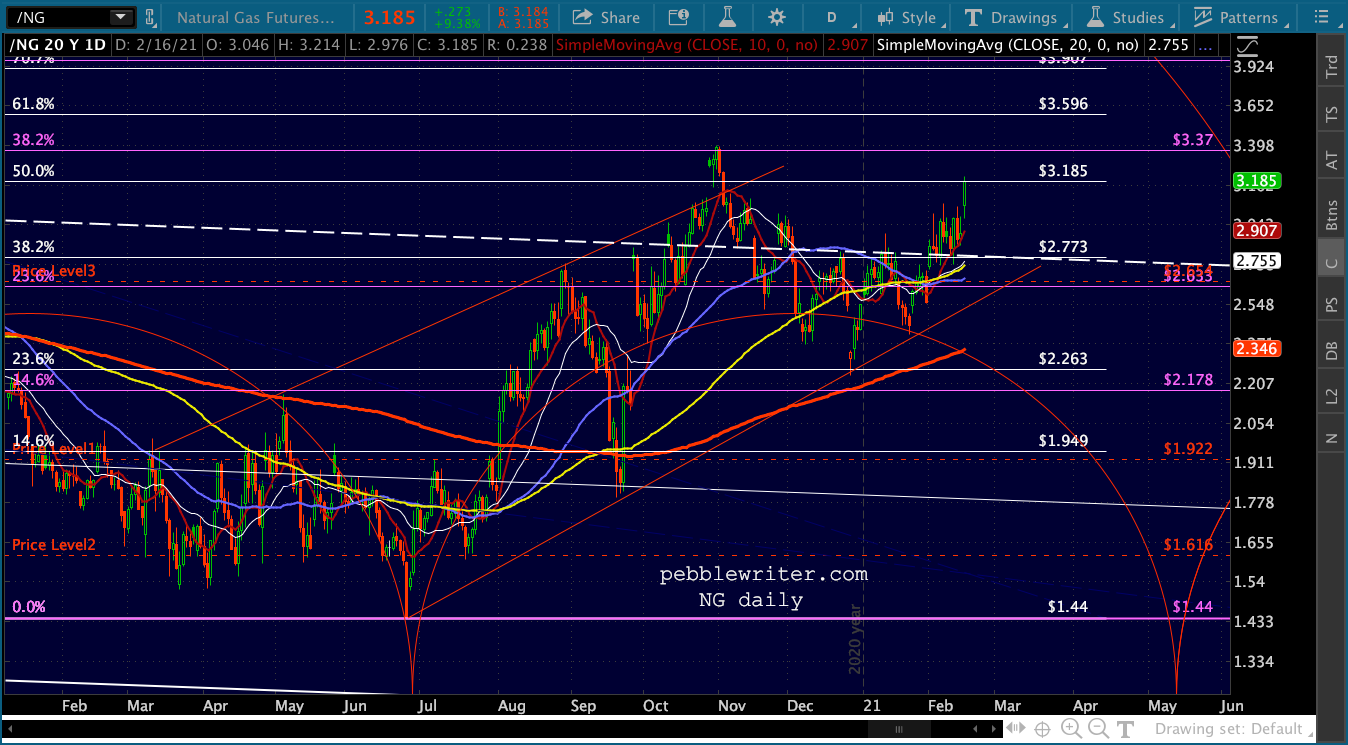
    Texas, the energy capital of the US, is running short of energy. The cold snap is breaking records throughout the state, with temperatures so low that many wind and water turbines are frozen and not able to produce energy. Refineries are shut down. As of last night, over 3.5 million Texans are without power.

    Not surprisingly, oil, gasoline and especially natural gas prices have shot higher.

    continued for members(more…)

  • Powell: Let’s Get This Party Started

    Jerome Powell gave a good news/bad news speech to the Economic Club of New York. He noted that employment is still 10 million below February 2020 levels and that a broader range of unemployment would put the current rate at 10%, adding, “We are still very far from a strong labor market whose benefits are broadly shared.”

    As the algos were spinning up their sell orders, he delivered the good news upon which the market relies: “Achieving and sustaining maximum employment will require more than supportive monetary policy.” He added that it could take “many years” to overcome the effects of long-term unemployment and scoffed at the idea of problematic inflation.

    From my vantage point, he’s right and he’s wrong. The strong earnings and cheerleading from pandemic lockdown beneficiaries have drowned out the wails from the pandemic’s have-nots: those who find that even a $1,400 stimulus check won’t pay the rent, the millions of small businesses and self-employed who couldn’t qualify for PPP loans, the millions for whom unemployment  benefits are unobtainable or inadequate.

    But, make no mistake about inflation. Yesterday’s CPI data reiterates our long-held conviction that, although official core inflation is mild, actual inflation is much higher.  Even the understated official CPI will soon soar to levels not seen since before the pandemic (when 10Y yields topped 2%) unless the manufactured rebound in oil and gas prices unwinds posthaste.

    The morning after, futures have regained most of their losses and are again knocking on the door of the 1.272 Fibonacci extension……thanks primarily to yet another VIX “breakdown” from its rising channel which, as we discussed yesterday, has produced another bearish (bullish for stocks) 10/20 SMA cross.Will it be enough to offset the cold water with which Powell just drenched the reinflation trade?

    continued for members(more…)

  • Mission Accomplished

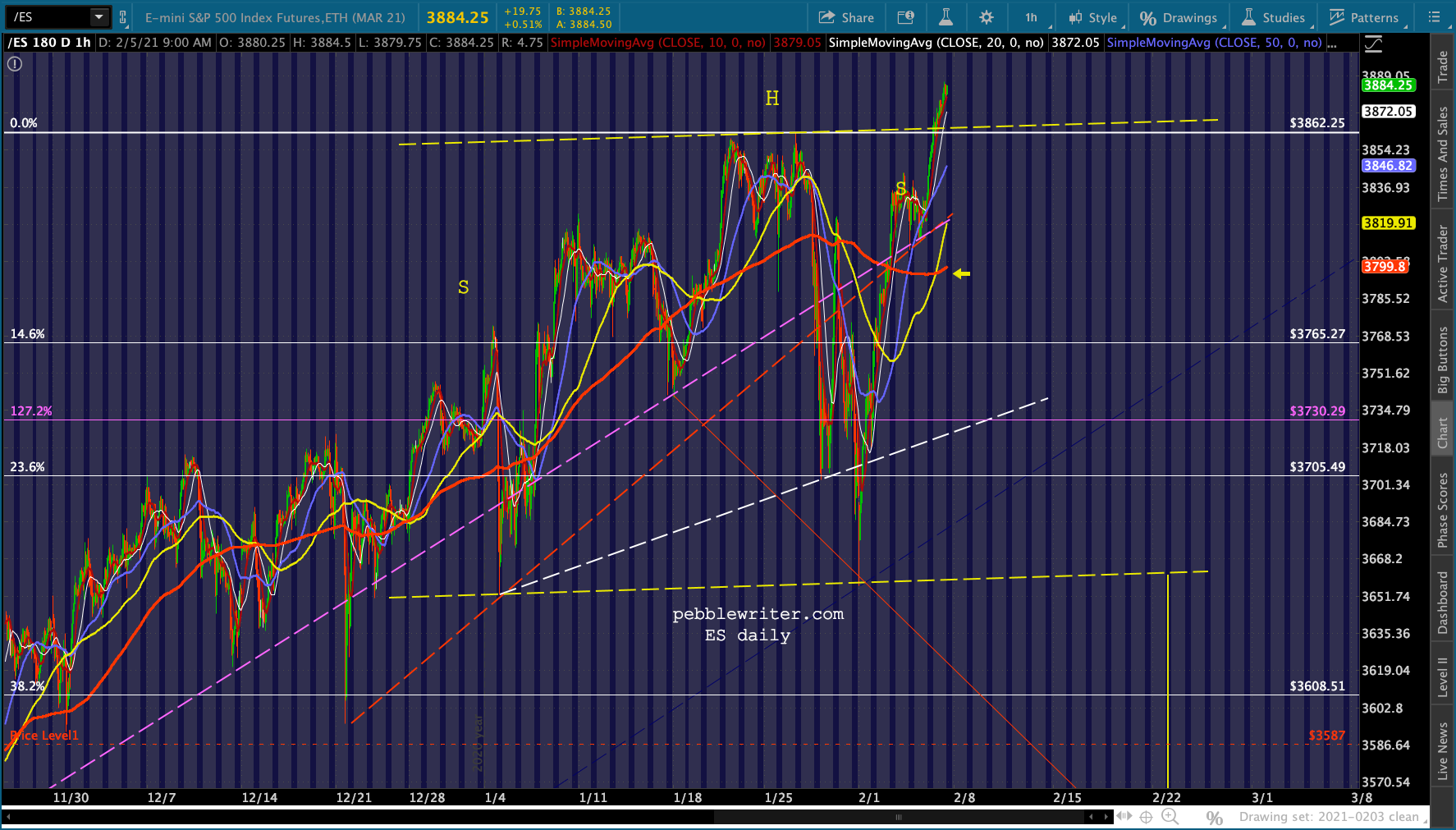
    In another obvious show of how easily this market can be manipulated, ES’ final bearish Head & Shoulders Pattern was busted in the final five minutes of trading yesterday. This morning, SPX’s H&S Pattern will also be busted with a burst higher in the wake of another disappointing jobs report.

    And all it took was for the “Bad News is Good News” algo to pin futures to their ramp job highs until 9:31. The BN=GN algo, of course, has nothing to do with additional stimulus.

    We already know $1.9 trillion is on the way to some who desperately need it and countless more who don’t. It also has nothing to do with additional QE. That’s an ongoing $120 billion per month, rain or shine.

    No, it is about the usual tricks employed by central banks and their proxies: shorting VIX… …shorting bond futures……ramping WTI futures……and shorting the yen. They have all been employed over the past week just to make sure that any lingering bearish patterns were undeniably busted. Just another day in the “markets.”

    continued for members(more…)

  • VIX: Just a Flesh Wound?

    In Friday’s post VIX: Back From the Dead we noted that VIX had recovered from the breakdown below trend dating back to Nov 27. This morning, it’s testing overhead resistance from Jan 4 and, if it’s able to break through, will likely take on resistance from Dec 21 or even Oct 29. Bears might want to hold off on the champagne just a bit longer, though. One of VIX’s favorite tricks is to race up to resistance in the pre-market so it has someplace to reverse lower from.

    The FOMC will issue its latest pearls of wisdom on Wednesday. And, as ES’s chart aptly illustrates, they are loathe to allow a significant decline in the lead-up to these exercises in obfuscation.

    Here’s the chart we posted Friday evening. continued for members(more…)

  • Update on Oil and Gas: Jan 13, 2021

    The last time we were this bearish on oil and gas was on October 3, 2018 [see: VIX Takes the Plunge.]  Our reasoning at the time:

    CL and RB [have] not only reached overhead resistance by our measure, but must deal with inflation that’s too high, bearish API data, another round of Trump tweeting, and a large build in EIA inventory. I think the time has finally come to revert to short…

    WTI and RBOB both tumbled about 40% over the next three months.

    At nearly 3%, inflation had been too high – sending the 10Y to 3.5%. Highly correlated, both had recently broken out of long-term downtrends: CPI above the black dotted line and the 10Y above the blue dotted line.Historically, this might have been perfectly acceptable. But, as we were shouting from the rooftops at the time [see: Why Rising Rates Are a Problem This Time] rising rates with a $1 trillion deficit and debt soaring past $20 trillion was completely unacceptable.

    And, inflation was too high primarily because energy prices were too high. The correlation with the YoY rise in gasoline prices, in particular, has been quite strong over the years.

    No doubt the Fed saw the writing on the wall – as did the White House. Trump had been tweeting about oil prices being too high for months. His tweets had taken on a decidedly desperate tone.

    Yet Saudi Arabia politely ignored him, and oil prices continued higher – until Crown Prince Mohammed bin Salman slipped up in a very big way.

    It took about 5 minutes for virtually everyone to connect Khashoggi’s murder with MBS – who suddenly found himself without friends.  Except for one who, coincidentally, needed a favor.  As we wrote in Coincidences and Consequences at the time:

    It’s interesting how Khashoggi’s murder top-ticked oil and gas prices…and, so soon after Trump’s latest demand that OPEC lower oil prices. As Churchill famously said, “never let a good crisis go to waste.”

    Some were aghast that we would insinuate such a thing.  But, Bob Woodward’s excellent Rage recently shed some light on the topic…But, we digress.  Oil and gas prices crashed 40%.  Inflation and interest rates receded.  The story might have had a happy ending, but the Fed and White House had apparently forgotten about the strong correlation between oil/gas prices and the stock market. When RB plunged 42%, SPX gave up 20%.

    Not coincidentally, they both bottomed on Dec 24 (when Treasury Secretary Mnuchin convened the Plunge Protection Team – but that’s another story.) Trump probably texted to MBS…something to the effect of “jk!!! LOL!!!  ” because oil and gas prices rebounded sharply.

    Wait, you’re probably wondering, what about interest rates?  Bond yields drop for all kinds of reasons. Sometimes it’s because inflation is dropping. Other times, it’s because a stock market crash scares the crap out of equity investors who sell everything that isn’t nailed down and pile into bonds.

    While the PPT’s volatility crush gathered momentum, the Fed announced that the recent round of rate hikes was kaput and began cutting. Stocks were thrilled.

    The occasional mini-crashes in the stock market helped drive rates even lower, until the 10Y finally bottomed out at 1.43% on Sep 3, 2019 – down sharply from its 3.25% October 2018 highs.

    Oil and gas, which had nudged stocks back to their September 2018 highs, could take a breather. Their ascent had been way out of line with the fundamentals, and the charts strongly suggested a reversal.  As we wrote on April 22, 2019 [see: Oil Fails to Rally Stocks]:

    One of the more effective factors in prompting algos to buy stocks is the price of oil. Yet, as we’ve been discussing, higher oil prices are a double-edged sword as they can drive inflation to levels which prompt uncomfortably high interest rates. The oil and gas picture shows RB and CL have both run out of room. It’s time to short again.

    CL, which closed at 75.04 that day, fell 15% over the next six weeks. It bounced around in  in the 60-70 range until January 2020, when it finally broke down.  RB, which closed at 2.13 on Apr 22, fell 32% before stabilizing somewhat. It finally broke down in March 2020.

    The culprit this time, of course, was the coronavirus pandemic. As we noted on February 20 [see: Buckle Up] the stage was set for the algos to keep pushing stocks higher. But, as we had discussed on January 6 [see: Middle East Tensions Escalate] the repeated failure to break out in response to numerous opportunities was itself a strong sell signal.

    CL has tagged its white .886 and, having broken out above the red TL, will threaten the April highs if it breaks 64.77.  If it can’t break the April highs, it will be very susceptible to a downturn. Remember, if the rising white channel breaks down, we could be looking at a major crash. Meanwhile, RB failed to break out past either its SMA200 or the red TL from the April highs. For those not already short, this is the place.

    It certainly was.

    continued for members(more…)

  • Moment of Truth for Bonds

    ZN broke down from its rising red channel back on the 6th. Since then, it has found support in a falling channel – from which it is now threatening to break down.This is a moment of truth for bonds and the many correlated assets such as GC, shown above.  Stocks might not be amused.

    continued for members(more…)

  • Update on XLF: Nov 17, 2020

    After being stuck in a textbook triangle pattern for almost six months, XLF finally broke out last week.

    We noted its having reached overhead resistance a few weeks ago [see: Yield Curve Model – Correction Imminent.] At the time, the 2s10s was threatening a breakout which, per our model, suggested a downturn for equities in general and XLF in particular.The 10Y did, in fact, reverse as expected and XLF dutifully tumbled – but, to a higher low. By Oct 30, a triangle was very well established and we were again facing a break out vs break down decision. Note that XLF had dropped through its SMA200 and was in a bearish SMA10/20 alignment. Had interest rates continued falling, I have no doubt that the triangle would have broken down and XLF would have reached the .618 Fib at 21.06. Instead, the 10Y popped back above its SMA200 (the yellow arrow)……and XLF got a much-needed bounce back to the top of the triangle. Yes, again. This time, however, TPTB were ready. After bumping into the top of the triangle on Nov 5 and 6, XLF received a fabulous gift.

    The 10Y gapped sharply higher, again breaking above the SMA200 it had fallen below and even above the top of the rising white channel. It was a massive move from 74.8 bps to 97.5 bps (point 6 in the chart above) in just two sessions thanks to the announcement of a vaccine from Pfizer and better than expected employment data [see: Vaccine!]

    As a result, the 2s10s broke above overhead resistance. A steeper yield curve is theoretically the solution to the banks’ woes. Though, historically, major breakouts in the 2s10s have led to equity crashes. Even for XLF. We’ll see if this time is any different.

    In the meantime, XLF has backtested the midline of the rising white channel from its 2009 lows… …following its very obvious failure to break out to new highs in February which resulted in its 44% crash. Note that a failure to push above the midline means at least a backtest of the triangle top around 25.26. Much will depend on some very fancy footwork by the Fed.The Fed’s exercise in ZIRP, which served as a lifeline to many sectors of the economy – not to mention the stock market, is a weight around the neck of the financial sector.

    Rising rates and a steeper yield curve might be okay with $7-8 trillion in debt. But, at $28 trillion, it’s a tad scary.Can the Fed find a way out of the corner into which they’ve painted themselves? Can they maintain the disconnect between the S&P 500 and the pandemic-stricken real world in which 30% of Americans are expected to be infected and another 200K are expected to die?

    “We’ll spend the next three months probably infecting another 15% and get to 30%, maybe more,” [former FDA Commissioner Scott] Gottlieb, now a CNBC contributor, said on “Squawk Box.” “Thirty percent assumes the current run rate if things don’t get any worse.”

    Stay tuned.