
Tag: cpi

  • Time to Sell Your Home?

    I’ve recently discussed this very issue with several friends who are a little nervous about the sharp runup in prices…and very nervous about the prospect of a selloff.

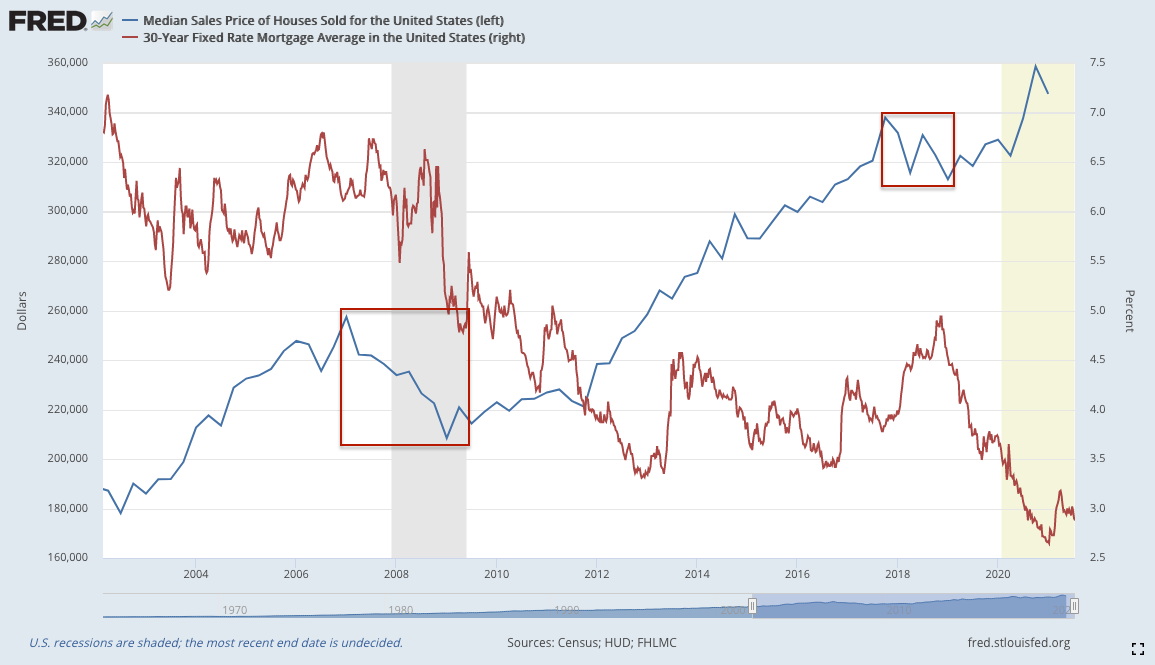
    Most of us remember how ugly things got during the Great Financial Crisis: the sharp rise and the much sharper plunge when the bubble burst.  According to HUD, the median sales price of a home fell about 20% from $257,400 in Q1:2007 to $208,400 in Q1:2009. The fallout was both disastrous and widespread. Yet, years later, it appears modest compared to the subsequent reinflation. The median sales price reached $358,700 in Q4:2020.  It’s the size and speed of the bubble’s reflation that has many worried – particularly given the Fed’s involvement.  How so, you ask?

    In the wake of the pandemic, the Fed cut short-term rates to zero and began large scale asset purchases which have been more than enough to purchase the entirety of Treasury’s monthly borrowings: $120 billion per month, including $40 billion in mortgages.  The net effect was to drive interest rates to all-time lows and keep them there.
    If you’re feeling pretty smart about all the money you’ve made in real estate over the past year, make sure you fire off a thank you note to Jerome Powell.

    Most home buyers purchase as much house as their income will allow. That is, they focus more on the monthly payment than the purchase price. Lenders, likewise, use a formula to compare your monthly housing costs to your income.

    These debt-to-income ratios vary. But, in this example, we’ll assume a 33% ratio – meaning the total house payment should be no more than 33% of your monthly gross income.

    A home purchased for $1 million with a $200,000 down payment at the current jumbo mortgage rate of 2.6% would require a monthly payment of about $3,203. Toss in $1,000 per month for taxes and insurance, and you’d be looking at a total payment of $4,203.  With a 33% ratio, the required annual income would be around $152,826.

    If mortgage interest rates had been 6% instead of 2.6%, the monthly payment for that same $1 million house would have been much higher: about $5,796, requiring an income of $210,778 to qualify for an $800,000 mortgage.

    And, there’s the rub. Cutting rates to all-time lows clearly reinflated real estate prices. People have been able to afford more and more expensive homes because the Fed kept cutting rates, keeping the payments super low even as the prices soared.

    What happens if rates ever rise back to normal levels? The chart below shows the relationship between falling rates and rising prices. But, you can read it the other way around too. If rates rose, what would the price need to drop to in order to maintain the same monthly payment?

    A rise in rates from 2.6% to 3.6% equates to a price drop from $1 million to $880,000.   A rise to 4.6% would mean a drop to $780,000 – enough to wipe out your equity and leave you owing money at the closing.*

    The Fed has managed to hold interest rates low by buying up all the bonds it sees. The flood of QE required to suppress rates has bid up not just real estate but most other categories of goods and services as well, thereby amping up the pressure to raise rates.

    The Fed could mitigate inflation by raising rates or suppressing oil prices, but either would do some damage to stocks – another overinflated market. So, instead, they keep insisting that everything’s just fine, even as they paint themselves into a corner.

    Is it time to sell your home? If you’re planning on it any time soon, consider the above and keep a very close eye on the market and on interest rates. It won’t necessarily happen tomorrow. In fact, sales/prices typically increase in the short run when rates begin to rise because buyers fear even higher mortgage rates to come.

    But, spoiler alert: it will happen by this time next year. The Fed is playing a dangerous game – not because they love taking enormous risks but because, having reinflated all these bubbles, they have no other choice.

    We all remember what happened the last time inflation reached these levels. From the July 2008 FOMC statement to Congress, the only time in the past 30 years that CPI has topped last month’s 5.4%:

    According to these projections, the economy is expected to expand slowly over the rest of this year. FOMC participants anticipate a gradual strengthening of economic growth over coming quarters as the lagged effects of past monetary policy actions, amid gradually improving financial market conditions, begin to provide additional lift to spending and as housing activity begins to stabilize.

    Stocks crashed 50% over the next 8 months as the Great Financial Crisis decimated the economy.

      *  *  *


    * the spreadsheet below shows the effect on price of a change in mortgage rates, while holding payment and qualifying income steady.


  • CPI: Still Transitory?

    Will the Fed be able to stick to their “inflation is transitory” shtick this morning?  If the financial media is any guide, there are plenty of adherents among money managers. And, why not? After all, there isn’t exactly a clear definition of what transitory inflation means. Is it elevated for 3 months? Six? A year?

    When it was just oil and gas’ base effect driving the numbers, it wasn’t that tough to argue that CPI would decline from May’s highs as we approach the end of the year. Assuming gas prices hold current levels, CPI could peak at around 4.2-4.3% and begin a decline into the end of the year. But, with labor, used cars, food, medical, etc. all joining the march higher, there is a very real risk of a much higher print and an upward price spiral that won’t unwind any time soon.

    In any case, look for stocks to finally express some doubts – depending on how broken the bond market turns out to be.

    continued for members(more…)

  • Not Transitory, Not Even Close

    If gasoline prices remain where they are or continue to rise, Powell will be just plain wrong about inflation being transitory. This is what to expect if gas prices were to flatline at this level through December. Unless most of the other components of inflation were to nosedive, CPI will remain well above 2% for the remainder of the year.

    Persistent enough for you, Mr. Powell?

    But it doesn’t matter. At least not yet. Although the (flawed) CPI data is more relevant to almost everybody, the Fed focuses on PCE, which mutes the reported inflation even more than CPI.  March PCE is due out tomorrow, and should continue not to alarm anyone.

    In addition, the blowout 3%+ April CPI won’t be reported until May 12. The Fed might roll the dice and leave prices where they are, hoping that they can control the fallout from truly alarming numbers.

    Or, we could see some preventative price action in the futures starting as soon as Sunday. The third option, of course, is the good old “miscalculation” of oil/gas prices, resulting in a CPI print that’s not so scary. They’ve done it plenty of times before.

    continued for members(more…)

  • Update on Bitcoin: Apr 13, 2021

    It is fitting that BTC chose the day the latest CPI data is released to reach our next upside target.  From Bonds Not Buying It on Feb 23:

    BTC even managed a proper backtest of the last major Fib level, opening the door to the next upside target at the purple 3.618 extension at 62,977.

    continued for members(more…)

  • Powell: Let’s Get This Party Started

    Jerome Powell gave a good news/bad news speech to the Economic Club of New York. He noted that employment is still 10 million below February 2020 levels and that a broader range of unemployment would put the current rate at 10%, adding, “We are still very far from a strong labor market whose benefits are broadly shared.”

    As the algos were spinning up their sell orders, he delivered the good news upon which the market relies: “Achieving and sustaining maximum employment will require more than supportive monetary policy.” He added that it could take “many years” to overcome the effects of long-term unemployment and scoffed at the idea of problematic inflation.

    From my vantage point, he’s right and he’s wrong. The strong earnings and cheerleading from pandemic lockdown beneficiaries have drowned out the wails from the pandemic’s have-nots: those who find that even a $1,400 stimulus check won’t pay the rent, the millions of small businesses and self-employed who couldn’t qualify for PPP loans, the millions for whom unemployment  benefits are unobtainable or inadequate.

    But, make no mistake about inflation. Yesterday’s CPI data reiterates our long-held conviction that, although official core inflation is mild, actual inflation is much higher.  Even the understated official CPI will soon soar to levels not seen since before the pandemic (when 10Y yields topped 2%) unless the manufactured rebound in oil and gas prices unwinds posthaste.

    The morning after, futures have regained most of their losses and are again knocking on the door of the 1.272 Fibonacci extension……thanks primarily to yet another VIX “breakdown” from its rising channel which, as we discussed yesterday, has produced another bearish (bullish for stocks) 10/20 SMA cross.Will it be enough to offset the cold water with which Powell just drenched the reinflation trade?

    continued for members(more…)

  • There Will be Typos

    It’s a little known fact that if you’re trying to get over the pain of back-to-back knee replacements, you should have rotator cuff surgery. At least that’s what my horoscope said. As a result, my typing skills will be a little off this morning, which means my market insight might also be a bit off.  But, here goes.

    After tagging our IH&S target yesterday, ES tumbled back below the bottom of the channel which broke down back in late October. It’s sitting right there at this moment, meaning the bulls and bears have yet to sort things out.

    continued for members(more…)

  • Inflation Craters

    Headline CPI fell 0.8% MoM – the biggest drop since 2008…

    …thanks primarily to plunging energy prices.

    Core CPI fell 0.4% MoM, the biggest drop since it began being tracked in 1961.

    The details show strong upticks in food and medical care but weakness almost everywhere else.Like almost all economic data lately, the algos have chosen to ignore inflation, as VIX dropped another 7.7% from its overnight highs. For the moment, nothing else seems to matter much.

    VIX has fallen from 47.77 to 26.37, a 45% decline, since ES backtested its 2.24 Fib extension on April 21. SPX has climbed a total of 8% during that time – with the great majority of its gains on overnight ramp jobs driven by plunges in VIX.

    Today, the algos are also watching the bond market quite closely, as the Fed is slated to dip its toe into corporate bonds – including junk bonds – for the first time.What could go wrong?

    continued for members(more…)

  • Crude Carnage

    May WTI futures are off almost 35% since Friday’s close.  This drops it below the 17.12 target we first identified in March 2019 when, at 59.32, CL had completed a rising wedge and tagged multiple channel lines.

    Members might recall the 17.12 target was originally set for April 2023 in keeping with a March 2019 cycle study [see: Macro Factor Cycles and Regime Shifts.] The chart patterns and Fib levels fit nicely with the concept of a recurring 2600-day cycle for significant lows.We’ve reiterated the 17.12 target many times, including last December as CL finished on a high note after plunging 45% in the wake of Jamal Khashoggi’s Oct 2018 murder (when the US achieved maximum leverage over the Saudis – see: Coincidences and Consequences.) The last significant bounce accommodated both the Aramco IPO and the year-end equity ramp.

    Oil has been a favorite tool of not only the Saudis but also central bankers and politicians.  In fact, understanding the relationship between oil/gas and inflation, interest rates and equity valuations has made it possible to accurately forecast most of its major moves over the years.

    At times, this has meant ignoring the frequently misleading supply/demand data, OPEC deliberations, and presidential tweets and focusing instead on where central bankers needed oil/gas to go in order to achieve a particular inflation and interest rate goals.

    As interest rates rose over the past few years, for instance, it became obvious that inflation would need to moderate to relieve the building budgetary pressure.

    One major theme on which we’ve focused since calling the top on interest rates in October 2018 [see: Suddenly Interest Rates Matter] has been the relationship between CPI and the YoY delta in gas prices. By “managing” the price of RBOB, CPI and, thus, interest rates could be managed higher or lower as needed.This was a very reliable theme for most of 2018, 2019, and early 2020 – when the focus shifted to oil’s strong correlation to stock prices.

    Oil has long been a major factor in triggering algos to bid up stocks. So, when oil’s major channel from 2016 broke down in February, we knew stocks were in deep trouble.

    With CL dropping through its 2001 lows and approaching its 1998 lows, what might we expect from oil and what are the implications for stocks? As we discussed last week:

    A drop through 19.27 would be reason enough to revert to short with 17.12 and 10.65 the only support between here and zero.

    continued for members(more…)

  • Update on Oil: Apr 6, 2020

    Many seasoned investors are surprised to see how positively correlated stock returns have been to oil prices. Energy stocks make up 8% of the overall market, so you’d expect them to have some influence. But, thanks to the increasing prominence of algorithms and quantitative trading, the impact has grown well beyond what 8% should contribute – with most of the market’s significant highs and lows perfectly aligned with oil’s over the years.A 2017 study by JP Morgan estimated that only 10% of trading volume is by discretionary investors who focus on fundamentals. This means that 90% of all volume is driven by passive and quantitative techniques including everything from index funds and ETFs to high-frequency trading and corporate buybacks.

    The tail that wags the quantitative dog is algorithmic trading, where hundreds or even thousands of factors are constantly monitored and provide instant input for trading decisions.  While these factors include big picture economic data such as interest rates, inflation or employment figures, the Big Three that consistently drive big moves on a daily basis are VIX, the USDJPY and the price of oil – specifically WTI futures [CL.]

    Oil is the only one of the Big Three which has an almost immediate and substantial impact on the US economy. So, when prices are manipulated higher or lower, we see a change in inflation data, interest rates and, of course, stock prices.

    This is why we were able to call the top on October 3, 2018:

    CL and RB…not only reached overhead resistance by our measure, but must deal with inflation that’s too high, bearish API data, another round of Trump tweeting, and a large build in EIA inventory. I think the time has finally come to revert to short…

    CPI had recently reached almost 3%, dragging interest rates higher as well. The 10-YR reached 3.25% on Oct 5, threatening to break out of a channel dating back over 20 years at a time when debt was exploding higher.

    Trump had been jawboning and tweeting his desire for lower oil prices. But, his entreaties had fallen on deaf ears until Oct 3, when journalist Jamal Khashoggi was brutally murdered and dismembered by agents of Saudi Arabia for criticizing Saudi Crown Prince Mohammad Bin Salman (MBS.)

    As details emerged and MBS’ complicity became evident, Saudi Arabia suddenly needed friends in high places. Trump was happy to oblige, but had one condition: oil prices needed to decline immediately – which they did.  CL plunged 45%  over the next 11 weeks.The YoY drop in oil and gas prices was immediately reflected in inflation. CPI dropped from 2.52% in October to 2.18% in November and a low of 1.52% by February 2019.

    The 10-YR dropped from 3.25% in October 2018 to 2.36% by March 2019.  Prices at the pump plunged as well, and Americans rejoiced at more affordable commuting costs.

    Remember, oil is one of the Big Three drivers of stock prices. So stocks plunged as well – shedding about 20% by December, when Treasury Secretary Mnuchin convened the Plunge Protection Team to prop up the market – enabling stocks to reach new highs while CL merely enjoyed an extended bounce.Saudi Arabia needed the bounce every bit as much as did stocks. The troubled Aramco share offering had been delayed time and again, and higher oil prices made a larger raise possible. The plunge resumed within a few weeks of the IPO.Then came the slowdown.  Demand had already been ebbing and prices had been settling lower for weeks. But, after a very brief bounce, oil prices plunged when COVID-19 came onto the scene. Suddenly, fundamentals mattered again.

    Prices plunged to the bottom of a falling channel from 2008 over 3 years ahead of schedule per the cycle study we first posted in March 2019 [see: Macro Cycles and Regime Shifts.]This added fuel to the fire for stocks, which already had plenty of reason to plunge as global economic activity screeched to a halt.  Algos, which might normally have been employed to prop up stocks, were pressuring them lower.  At the same time, the USDJPY was falling as the Japanese yen rallied and VIX spiked higher on greatly increased volatility.

    Note that long-term trends in gasoline prices were also in danger of breaking down.

    Perhaps more alarming to Team Trump, the Dow had fallen to levels not seen since the 2016 election. The energy industry is vitally important to the US, with millions of jobs and billions in loans dependent on prices stabilizing. It’s no surprise that the federal government would support it as it has many other industries which have been decimated by the global pandemic. Many majors oppose price supports, perhaps hoping to scoop up highly-leveraged players at a bargain price when they failed.

    However, instead of making low or no-interest loans available to tide the industry over as it has with every other affected industry, Trump has focused on artificially inflating prices — first with a series of Tweets and lately with a threat to impose tariffs on imported oil.

    As a result, oil has spiked over 50% higher in a mere 4 sessions…

    …facilitating a 24% bounce in the Dow.

    While some are thrilled with the outcome, there are winners and losers. The biggest losers are those who can least afford it: consumers. Higher oil and gas prices are a regressive tax on those consumers who must still drive (disproportionately those less affluent) or buy heating oil or natural gas to keep their families warm during the waning days of cold weather.

    It’s important to recognize that Trump’s insistence on higher oil prices might be partly about saving oil industry jobs, but it’s really about saving the stock market which has learned to take its cues from oil prices.

    If Trump’s “friend” Mohammad Bin Salman — a “man of the people” — still owes any chits from 2018, oil prices could be well supported going forward. But, of course, it will require the assistance of Trump’s other friend, Vladimir Putin, whose willingness to cut back production involves slightly different priorities.

    With COVID-19 deaths in the US topping 10,000, Putin’s response will be important in crafting the next headline-stealing development. But, most studies I’ve seen indicate that supply now exceeds demand by at least 25 million bpd. So, even the 10-15 million cut suggested by Trump would do nothing to erase the massive oversupply but would merely slow the rate at which the excess is building.

    Rumor has it that Russia will play ball as long as every other oil producing nation is willing to share the pain – including US shale producers, many of were already on life support before COVID-19 (and expect a decent return on their political donations.)

    If I sell you 100 barrels at $30 instead of 200 at $15, have I made any more money?  Will I now be able to pay back that overdue loan?  Will the market reward my stock? Unfortunately, it only works if the pain is borne by the other guys — which will likely boil down to good, old-fashioned horse trading.  Trump’s opening ante is throwing down-and-out Americans under the bus. We’ll see if it’s enough.

    continued for members(more…)

  • Update on Gold: Jan 2, 2020

    In our Aug 28, 2019 Update on Gold I noted that although GC had just reached our 1560 target, ZN had also reached our 132’100 target.  The picture was further muddled by the fact that DXY and GC had been moving in unison – an unusual occurrence, to say the least.

    ZN’s resistance could put the brakes on, meaning rates would rise and GC would theoretically fall.  But…I expect ZN’s pullback to be modest — possibly only 3-4% — suggesting GC’s pullback would also be fairly modest.

    As it turned out, GC and ZN both reversed.  Although DXY made a half-hearted effort to break out, it was limited to 1.5% and GC’s reversal was limited to 1446.

    DXY’s rally stopped making any sense at all once FOMC members began hinting at additional rate cuts. When the Fed resumed QE (QE-not as we like to call it), the market knew what to do: DXY has been steadily selling off and GC has climbed back to within $30 of its August highs.

    Does this mean more upside ahead?

    continued for members(more…)