Tag: USDJPY

  • How Not to Manipulate Stock Prices

    Sometimes you just can’t catch a break.  TSLA shares rose from 22 in 2012 to 387 in 2017 — helping drive Musk’s net worth to well over $20 billion.  But, the shares have since formed a triple top, failing to top 390 and coming perilously close to breaking down.

    This isn’t the first time Musk has faced such a challenge.  The stock spent three years trying to crack 290 – the red trend line below.

    We’ve documented past interventions — which have, by and large, been successful.  Musk’s well-publicized $25 million open market purchase (the white arrow) on June 12-13, for instance, saw the stock gap past the .618 Fib level and a trend line connecting recent highs.

    It was a nice gesture and helped divert attention from the mass layoffs announced the day before.  But, it didn’t take long for investors to realize that while $25 million is a lot of money to most people, it represented only 1% of Musk’s net worth.  And, it increased his holdings of the common stock by a pittance (0.2%.)

    It’s pretty obvious why Musk did it.  After breaking above 290 in April 2017, the stock had fallen back below it in March 2018.  The 200-DMA, rising white channel, and purple trend line all broke down in the process.

    After a miraculous, tweet-aided recovery, Musk got the stock back above the red trend line.  But, he needed it above 390.  It was not meant to be.  Too many missteps, too many worrisome headlines.  The best it could manage was a backtest of the broken white channel and the .886 retracement of its drop from 389 to 244.

    The stock slipped back below the red TL and 200-DMA, eventually bouncing off 290 yet again in late-July on news of a major new factory to be built in Europe.  The company’s earnings call a few days later featured a well-behaved Musk, a revenue (obviously not income) beat, and a promise not to float additional additional shares.

    Musk: We do not — we will not be raising any equity at any point, at least that’s — I have no expectation of doing so, do not plan to do so … And we certainly could raise money, but I think we don’t need to and we — yeah, I think, it’s better to — it is better discipline not to.

    Again, the stock gapped higher — back above the 200-DMA and the yellow trend line.  But, the naysayers weren’t having any of it.

    Despite having produced the promised number of Model 3’s, the company was dogged by reports of quality issues and was losing money on every sale — even though these were the higher end models with potentially larger profit margins.

    This was apparently the point when desperation set in.  As we discussed at the time [see: Is the Pressure Getting to Elon Musk?] it was fairly obvious to any competent chartist that Musk’s going-private tweet — like all the others — was designed to get the stock over the latest hump.

    It didn’t take long for Tesla watchers to question the deal.  The financing was supposedly secured, but no one stepped forward.  The board seemed genuinely alarmed.  Shorts launched lawsuits.  And, the SEC announced an inquiry.

    The latest rally ran out of steam at 387 – just shy of the September 2017 highs.  The stock tumbled back to the red trend line yet again.  It bounced, but that was before Friday night’s (11pm Friday night, following Thursday’s decision) admission that the going-private transaction was dead in the water.  As of this morning, the stock is heading back toward 290.

    Despite my cynicism, I’m rooting for Elon and Tesla.  We obviously need alternatives to carbon-based transportation for many reasons.  But, the stock is at these lofty levels based on the (aging) premise that it’ll soon be self-funding and turn a profit.

    The shorts are right to question this premise.  But, anyone who shorts at these levels, before the stock breaks down below the tangle of support at 290ish is ignoring the obvious — this is a CEO who will do whatever it takes to prop up his stock.

    TSLA might ultimately come crashing down.  But, I would absolutely wait until the purple trend line and horizontal support break down before jumping on board.

    Now, on to the rest of the market.

    continued for members… (more…)

  • Currency Complications

    USDJPY reached our target at the SMA100/SMA200 overnight, at least temporarily bringing the pair back below the top of the falling white channel from which it broke out on July 10.  Readers will recall that breakout was instrumental in helping SPX break above its faux IH&S neckline 66 points ago.

    A USDJPY rebound here is all stocks might need to make new highs.  EURUSD, which is backtesting after a major channel breakdown, would certainly support a strengthening of the USD……as would DXY — which is the latest victim of “unpresidented” tweets.

    As central bankers have recently discovered, however, there are complications from continued dollar strength which would suggest that it will take a break here.  Will they heed those warnings, or are new all-time highs in equity markets more important?

    continued for members(more…)

  • Charts I’m Watching: Aug 20, 2018

    Futures are hanging on to a 4-pt gain, primarily on a continuing decline in VIX.  With Jackson Hole coming up, we could see more volatility — particularly if Fed speakers back off their hiking schedule.

    Speaking of backing off…TSLA is back down to its horizontal and trend line support.  As readers will recall, this is a critical line in the sand.As we concluded last May [see: Can TSLA Avoid a Crash?] a drop through this key level could easily land the stock below 200.  Our chart from back then, before the craziness really got going…

    Apparently JPM has also adopted this view.  And, an increasing number of observers are coming to the same conclusion we did a couple of weeks ago regarding Musk’s emotional state [see: Is the Pressure Getting to Elon Musk?]

    continued for members(more…)

  • JGBs Gone Wild

    Lots of excitement in the currency markets this morning — particularly the yen.  The USDJPY plunged rather decisively to our nearest downside target… …after stories appeared in the financial press that the BoJ was embarking on a buying spree, offering to buy “an unlimited amount of bonds.”  Why would they do such a thing?  Yields on the 10-year had soared to as high as – gulp – 0.09%.

    So far, futures have remained mostly flat — thanks to VIX’s continuing slump and oil and gas’ ramp.  But, can it last?

    continued for members…
    (more…)

  • The Art of Hat Holding

    One nice thing about patterns is that they give you something to hang your hat on.  When we drew the Inverted Head & Shoulders Pattern on Jul 3 [see: Holiday Headfake] there was nothing in the news to suggest a 100-pt rally in the ensuing week.

    Yet, SPX and ES landed within a point or two or their IH&S targets yesterday all the same.  Likewise, all the news was rosy yesterday — incessant talk of renewed buyout fever and imminent, glowing earnings reports.Yet, completion of the pattern, combined with a channel midline, put a pause on the rally right where expected.  With its SMA200 now a mere 30 points below its 2.24 extension, SPX can backtest any time it likes with plenty of support around 2700.

    In fact, if ES is able to hold the (formerly broken) channel into which it reinserted itself, the damage would be limited to 20-30 points.

    One key: VIX.  So far, it has put the brakes on at a backtest of the recently broken straw-man trend line.  If it can remain below the red TL and the SMA200, and USDJPY keeps ramping, stocks will suffer a mild pullback.  If the coming drops in oil and gas get going, then SPX will do well to hold 2750 and, depending on the PPI/CPI numbers due out today and tomorrow, could test 2700 again.

    If we should dip below the SMA200 and 2.24 extension again, then it’s time to hold on to your hat.

    continued for members(more…)

  • The Market’s Latest “Lucky” Bounce

    That’s a relief!  For months, pundits have been arguing whether the Fed needed to hike interest rates three times or four times this year — you know, because of all the growth coming down the pike.

    Fed Über-Dove and “Man Who Thinks Market Integrity is Overrated” Jim Bullard just announced that the correct number is zero.  That’s right.  Everything is perfect just like it is.

    Amazingly, and quite by coincidence, this pronouncement occurred on the exact same day that several stock market indices were in danger of falling below a very important technical level of support: their 200-day moving averages.  As we discussed on Monday, falling below the SMA200 isn’t usually very healthy for markets.

    For visitors and new members, this seems like a good time to take a walk down memory lane.  This isn’t Mr Bullard’s first rodeo.  Nor is it the first time “someone” did something clever to ensure the market’s continued ascent.

    The S&P 500 illustrates the phenomenon quite well, having experienced a number of such fortunate events at crucial times. October 2014 – Bullard!

    Bullard appeared on Bloomberg to explain that another round of QE might be in order. As “luck” would have it, this enabled SPX to reverse right as it reached important Fibonacci support, ending a 9.9% tumble and narrowly averting an official correction.

    Big assist from USDJPY, which soared 16% over the next 7 weeks in spite of the fact that more QE should have weakened the US dollar.  The Yen Carry Trade in all its glory.

    August 2015 – USDJPY!

    This 12.5% correction was set up by USDJPY falling back below a critical Fibonacci level (the .618 at 120.11) in the wake of SPX reaching a key Fibonacci extension (the 1.618 at 2138.)

    We had correctly forecast the top [see: The Last Big Butterfly] but it was unclear whether or not USDJPY could remain above 120.  SPX plummeted when 120 finally fell but, as “luck” would have it, was (temporarily) rescued by USDJPY’s bounce back above it.

    February 2016 – Oil!

    The price of West Texas Intermediate Oil (CL) had fallen 77% between Aug 2013 and Feb 2016.  While this crushed inflation to a manageable level, it made investors in and lenders to energy-related companies pretty nervous.

    As “luck” would have it, CL bottomed out on Feb 11, 2016 — the exact same day that SPX reached that critical Fibonacci support level of 1823.  CL doubled over the next four months, and SPX rebounded sharply.  By accurately forecast the bottom in oil, we could confidently call a bottom for SPX [see: USDJPY Finally Relents.]June 2016 – USDJPY!

    Stocks plunged in the wake of the Brexit vote.  As “luck” would have it, USDJPY — which had used CL’s rally as an opportunity to reset — picked this particular day to bottom out and spiked 8% higher over the following month.

    Futures had sold off by 6.5%, but by the time SPX opened the next morning the recovery was well underway.  It was soon back above its recent highs and the critical 1.618 extension at 1.618.  In other words: new all-time highs.

    November 2016 – Trump*!  Unfortunately for stocks, the US election results weren’t conducive to a rally.  Once Trump’s election became apparent, futures plummeted over 5% in a matter of hours.  SPX had bounced off its SMA200 a few days earlier.  Unless something was done quickly, it would drop through this key support the following morning.As “luck” would have it, USDJPY picked this particular day to bottom out.  It spiked 5% over the next few hours and 18% over the next few weeks — a supersized version of the exercise which had saved stocks post-Brexit.

    And, if that weren’t enough, VIX — the widely accepted indicator of fear and volatility — plummeted even as futures were plunging.  It’s the equivalent of calling your insurance broker to cancel your homeowner’s policy as a hurricane bears down on your beach house.  How very, very “lucky” indeed.Futures recovered almost all of their losses by the time the cash market opened the following morning. VIX went on to shed over 50% of its value and broke down through trend line support (above, the white arrow.)

    Stocks were soon registered new all-time highs. The talking heads called it the “Trump Rally” and attributed the gains to the incoming president’s pro-business orientation and deal-making acumen. But, I think it deserves an asterisk…on account of the incredible “luck” involved [see: Why the Trump Rally is a Fraud.]

    The SPX chart isn’t labeled as such, but the rise from 2138 to 2703 (the next major Fib level) wouldn’t have been possible without continued support from oil and VIX.  After doubling in value, CL proceeded to construct a well-formed rising channel (below, in purple) that was very supportive of stocks.  It oscillated between the channel’s top and bottom like clockwork — until December 2017.  We’ll come back to that.Also during that time, VIX was trying something new.  After years of occasionally bouncing off the bottom of a long-term channel (below, the yellow arrows) it decided to plunge below that channel bottom and spend 80% of its subsequent days in the cellar — reaching new all-time lows in the process.This sent a strong all-clear signal to stocks (or, at least the algos that trigger stock purchases) that the coast was clear. It was completely safe to buy stocks, which they did — producing a rally that accelerated all the way up to the 2.24 extension at 2703.

    December 2017 – Oil!

    At that point, oil’s breakout (remember the purple channel above?) and the onslaught of new, daily lows in VIX combined to give SPX the boost it needed to climb above that resistance.  I mean, how “lucky” can you get?  It popped above 2703 and tacked on another 6.3% for good measure.

    Unfortunately for stocks, though, there was a practical limit to how high CL could go without creating problems.  Someone had forgotten that higher oil prices mean higher inflation.  And, higher inflation means higher interest rates.  And, when you’re $21 trillion in debt and pass a tax bill and budget that greatly widen the deficit considerably…higher interest rates are not exactly lucky [see: Why Higher Interest Rates Are a Problem This Time.]

    Between that realization and a growing disconnect between price and supply & demand, CL had to drop.  When it did, and the (dashed, red) trend line from August 2017 finally broke down, stocks didn’t take it well.SPX plunged almost 12% over the next two weeks, one of the sharpest corrections ever.  Luckily, the SMA200 was there to catch it.  A few days later, CL popped back above its channel top and SPX recovered to back above 2703.

    As the bounce began to fade, we had a surprise message from Bullard that “too many rate hikes could slow the economy.”  It was enough to extend SPX’s bounce for another few weeks.  But, ultimately it slipped back down below 2703 to tag its SMA200 again.  And, again.  And, again.  And, again.

    By then, DJIA and RUT had finally risen to the point where they could tag their SMA200s as well.  SPX bounced at our 2561 target.  Investors were in luck!  Until this morning.

    April 2018 – Bullard!

    Apparently, someone forgot to explain to the Chinese that we were supposed to win the trade war (winning them is easy!)  This morning, we found out that China had the gall to fight back.  When I was woken by an price alert at 3:15 this morning, the futures were off 55 points.  SPX would open back below its SMA200.

    But, the futures didn’t know what they were up against!

    Then came Larry Kudlow, the guy who in May 2008 called the impending Great Financial Crisis a “non-recession recession.”  Some people might have misunderstood; but, obviously he meant it would be much worse than a recession.  (I can’t wait to find the pot of gold!)

    As “luck” would have it, the market was quite pleased with all this positive scuttlebutt.   ES, once down 55 points, closed up 34 points.  SPX and the Dow rose about 1%.  RUT added 1.30%.  And, COMP — which never did tag its SMA200 — popped 1.45%.  Take that, 200-day moving average!

    Bounces are nice, whether driven by oil, the USDJPY or Fed cheerleaders.  This one got SPX back above its SMA200, which is a good start.  Next comes the 2.24 Fib, which SPX has crossed some twenty times in the past two months.  Can it rise back above and stay there this time?

    Oil’s limitations haven’t disappeared.  Managing inflation and interest rate expectations will continue to dominate its price action.  Lately, the market has a very narrow range within which it feels comfortable.

    USJDPY is threatening to break out from a falling flag pattern, but one has to wonder why it hasn’t done so already.  Japan got no love from Trump in the trade war chatter to date.  It’s quite possible they’re done cooperating with currency intervention. VIX, after popping back above the yellow channel bottom in dramatic fashion in February, has fallen back to a trend line (red, dashed) from its January lows.  Every time it pops above the trend line, SPX stumbles.  Every time it drops below it, SPX rips.  Today, it tagged it and reversed lower – hence the day’s gains.  It has plenty of additional downside potential, with the potential to drive stocks back above 2700.  But, again, it hasn’t done so yet.

    It makes one wonder whether SPX will be allowed to put in a lower low in order to make the corrective wave look a little more conventional and give COMP a shot at its SMA200.  We have oodles and oodles of downside targets if SPX’s SMA200 should fail.  That white dot at 2138 in the chart above is there for a reason [see: More Where That Came From.]

    There are countless other factors I haven’t even mentioned: our yield curve model (which tentatively turned bullish today), 10yr note rates, the US dollar’s buoyancy, various momentum indicators, and the continuing sagas of FB, TSLA, AMZN and DB — all of which have played a role in the market’s gyrations (mostly of the bad luck variety.)

    Whatever happens, it’s hard to imagine we could reach new highs without plenty more luck.  Trade safe, and stay tuned.


  • Bullard!

    I remember Oct 15, 2014 like it was yesterday.   SPX had risen sharply on the back of the yen carry trade, popping through important Fib resistance at 1823. But, it had just broken trend line and channel support.  To make matters worse, it had just dropped through its SMA200 at 1905.The culprits? USDJPY had reversed off heavy resistance and its 10-week rising channel had broken down.  And, equally concerning, the bond market signaled more stock carnage to come.

    As we noted at the time:

    The more troubling development for Mr. Market is the bond market. The 10-yr note futures shot through the previous high overnight, complicating the prospects of a quick resolution to the market’s correction.

    Note that while we might see a reversal today on the white Fibonacci grid — the .786, .886 or the 1.272 itself — we still have to deal with the grey grid, which suggests the possibility of a drop to the .786 at 1798 or the .886 at 1770.

    A drop to 1800 would have meant giving up that important Fib support at 1823.  More importantly, a 10% correction would occur with a drop to 1817.33 or lower.  Who needed those headlines in the middle of spectacular rally to new all-time highs?

    The solution?

    SPX’s plunge halted at 1820.66 — 3.33 points above what would have been an official correction.  No fuss, no muss.  The Fib line which had once loomed as formidable resistance could now be reclassified as support.

    What has been is what will be,
    and what has been done is what will be done,
    and there is nothing new under the sun.
    Ecclesiastes 1:4-11

    As I went to sleep last night, marveling at how SPX had taken a rather circuitous path to our 2703.62 target,I wondered whether the 2.24 Fib would hold.

    I found myself thinking back to 2014.  Maybe Fed President Bullard would make another appearance.  I didn’t have long to wait.

    On CNBC this morning…

    click to play video


    Futures are currently up 27 points off their overnight lows (bounced at the 10-day moving average, probably about 60 seconds after Bullard was booked on CNBC.)  At least we weren’t kept in suspense too long!

    Oh, and for those wondering why/how yesterday unfolded as it did, take a look at VIX.  See that little dip (yellow arrow) below the trend line from Jan 26?  Yep, that’s all it took.

    When VIX climbed back above the yellow trend line, SPX promptly gave up all its pre-minutes ramp job.VIX has obviously proven it’s still incredibly powerful.  Who needs a 40% spike when a 20% one can put on the brakes so effectively?  The flipside, of course: if VIX decides to pop up to 26 anyway, SPX will likely ignore Bullard and also test its SMA10.

    Bullard might be able to divert attention from the interest rate problem.  But, it clearly hasn’t gone away.

    This time, it’s a spike in rates rather than a plunge.  So it’s a different kind of interest rate problem.  As a result, this one might be tougher to rectify.  And, the implications for the overall economy are much more serious.

    continued for members(more…)

  • That Escalated Quickly!

    It was just last Tuesday we asked “where’s the bounce?”  SPX had gapped lower and failed to rebound the way it always seems to has for the past year.

    We had watched a trend line dating back to Dec 29 (below, in red) break down, and were wondering about the small, white channel.  From Where’s the Bounce?

    After that, it gets a little messy. ES has an important backtest at 2773, which would be 2730 on SPX — nothing all that important in the vicinity. Below that, however, the white 2.24 at 2703.62 remains very interesting. It would be a hell of a drop from here: 117 points or 4.1%.

    The closer we got to 2703, the more plausible it seemed.  When we reached it today, though, SPX leveled off for only about 10 minutes before plunging lower.  Why?

    There are two primary reasons.  The first, of course, is VIX.  Was there a single session this past year when I didn’t bitch about the degree to which timely beatdowns in VIX were triggering algos to bid up stocks?  Doubtful.

    After VIX broke out of the falling channel on Friday, Our charts suggested it would reach 16.29 and, if/when that broke, 25.65. 

    When 25.65 broke, at approximately 11:48 this morning, it triggered an additional wave of selling from those very same algos which have learned so well to take their clues from VIX’s every twitch.  Live by the sword…

    The second reason was USDJPY and the ubiquitous yen carry trade.  As we noted in our last update [see: Jan 24 Update on USDJPY], the pair reached a channel bottom which represented important support.

    We’ve reached the bottom of the rising white channel which has held on four previous occasions since its origin in late 2012…Bottom line, USDJPY isn’t necessarily done until DXY is done. We had bounces at the .500 and .618, so an overshoot to the .786 at 108.90 or even the .886 at 108.16 is a distinct possibility.

    As it so happens, the white channel bottom didn’t hold.  Despite Kuroda’s desperate jawboning, USDJPY has continued to falter.  It backtested trend line resistance yesterday — all well and good.

    But, instead of catching support as it almost always does, it broke down.  At 11:56, it dropped through a tiny trend line of support.  Seconds later, when that TL broke down……it broke down through a larger TL of support.

    Bottom line, VIX and USDJPY are the two most powerful drivers of algos there are (oil occasionally takes the lead.)  When they were going strong…melt up.  The slightest hint that they’re not…melt down.

    SPX bottomed out yesterday at 2638.17 and closed a good 55 points below the 2.24 Fib.  While it’s always scary to see major Fibonacci support fail, there was an obvious effort to keep the uptrend alive.  Note the SMA100 crosses the bottom of the rising channel which was established with the Feb 11, 2016 lows.  In other words, it’s important.

    Significantly, the channel bottom was defined by the Nov 9, 2016 lows.  If that date sounds familiar, it was the election night in the US.  And, it was the last time a major effort was made to salvage important Fibonacci support. [see: Why the Trump Rally Is a Fraud.]

    It worked spectacularly, resulting in a 38% rally.  All it took was a 17% spike in USDJPY, a 55% rally in oil, and a 63% collapse in VIX.

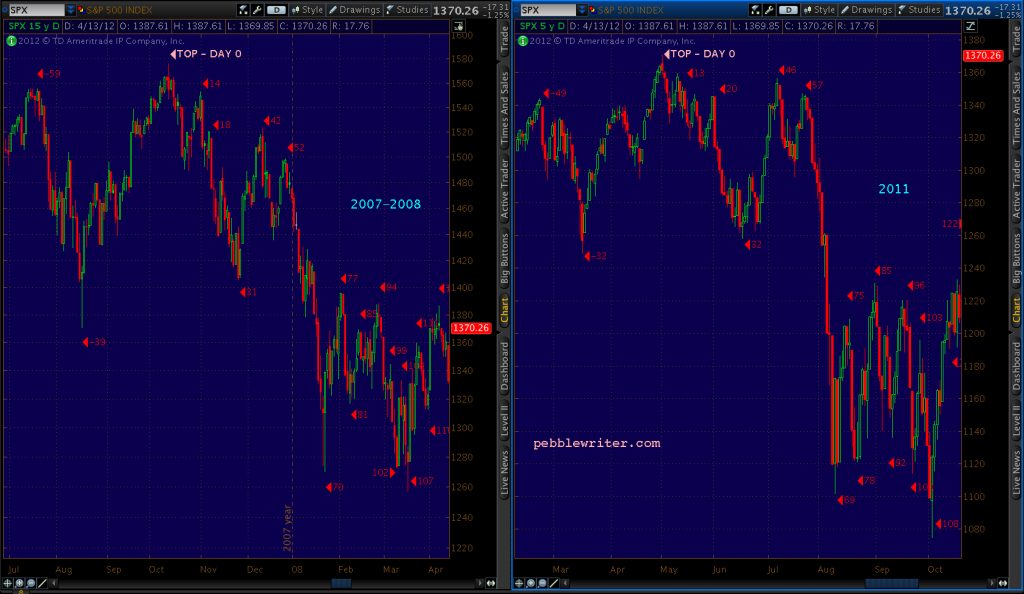
    How about now?  The algos are primed and conditioned to respond.  I’m sure Jim Bullard still knows his way to Bloomberg’s studios.  Can TPTB manufacture another recovery?  For the answer, we need only to examine two similar, previous meltdowns: the night of the US election in Nov 2016, and August 16, 2007.

    continued for members(more…)

  • The Rally That VIX Built

    As discussed yesterday, stocks spent the night building a cushion based on VIX (currently off 5.4%) in preparation for tomorrow’s FOMC announcement.  It started just before the close, yesterday, and has built to a 6-pt gain in the futures.Actually, it’s been less of a rally, lately, and more of an effort to maintain ES at levels above its IH&S Pattern target reached back on Jun1.  Remember the mantra “stay fully invested, because you never know when a sudden rally will appear out of nowhere and you can’t afford to miss it”?  These days, it’s the corrections that pass in a flash, like Friday’s 31-pt plunge which was reversed so quickly that it won’t even register on daily charts.

    But, I digress.  Today’s action is all about putting more distance in between SPX and the Support Below Which it Must Not Go in the wake of the FOMC meeting.

    continued for members(more…)

  • Pulling Out All the Stops

    When unexpected unpleasantness unfurls, you can count on central banks to pull out all the stops. Such is the case with the British election results which, like Brexit, have wreaked havoc on FX markets.

    EURGBP, having broken down from its rising red channel dating back to mid-2015, was well on its way to a perfectly nice backtest at .80ish. Instead, it’s backtesting the broken red channel itself. Hence…the stop pulling.It should start with nice bounces from USDJPY and CL — which, as discussed yesterday, have already reached interim bottoms — and, of course, a sharp plunge by VIX.

    Look for USDJPY to pop through its SMA200 for good measure… …and CL at least hold its own in the midst of strong selling pressure.

    continued for members(more…)