Tag: DXY

  • VIX: Just a Flesh Wound?

    In Friday’s post VIX: Back From the Dead we noted that VIX had recovered from the breakdown below trend dating back to Nov 27. This morning, it’s testing overhead resistance from Jan 4 and, if it’s able to break through, will likely take on resistance from Dec 21 or even Oct 29. Bears might want to hold off on the champagne just a bit longer, though. One of VIX’s favorite tricks is to race up to resistance in the pre-market so it has someplace to reverse lower from.

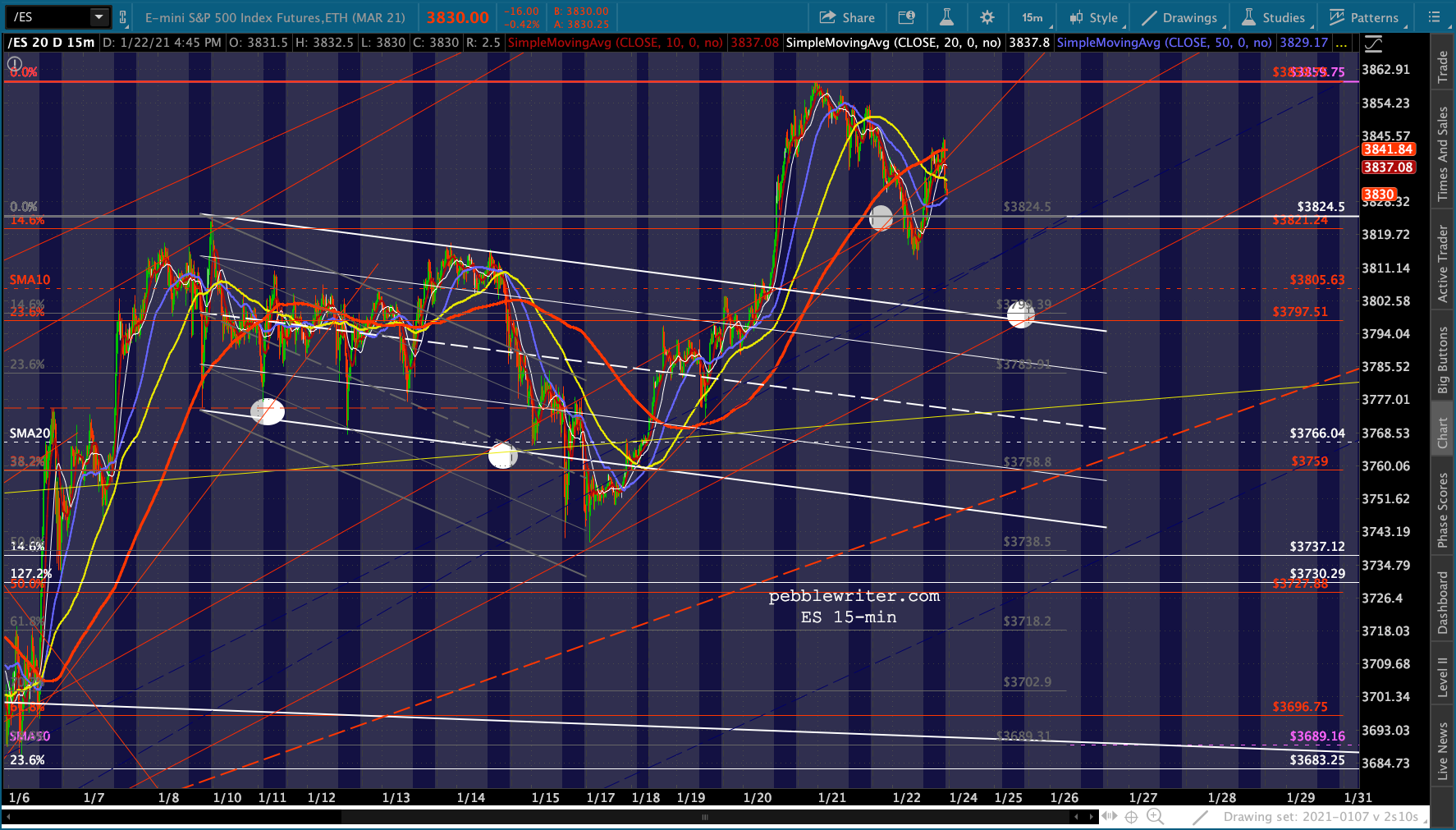
    The FOMC will issue its latest pearls of wisdom on Wednesday. And, as ES’s chart aptly illustrates, they are loathe to allow a significant decline in the lead-up to these exercises in obfuscation.

    Here’s the chart we posted Friday evening. continued for members(more…)

  • This Is Getting Old

    Lots of calls and emails yesterday from folks wondering how the hell the market could be up so strongly in the face of the violent unrest in D.C.

    When the capitol was breached, shortly after 2pm, the S&P 500 was already up 55 points on the day.  This came on the heels of a sharp 22-point plunge on the open.  Altogether, the S&P 500 rallied 78 points from the daily lows before finally topping out.

    We know why this happened. As is so often the case, the algos were directed to erase any signs of dissatisfaction with the events of the day: an abysmal ADP employment reading, FOMC minutes, a brewing constitutional crisis, etc.

    Note the slight breakdown of the futures around the time ADP employment (-123K vs prior month +304K and +120K consensus) was released at 8:15.  Now, see if you can tell when Fed minutes, which the Fed obviously knew reflected a less than rosy assessment of the economy, were released.

    I’ve marked it in case it’s not obvious.  Note that it didn’t stop until ES had made a new all-time high (by 1.5 points at 2:15.)Now, here’s what happened to VIX as the market opened and the day progressed.  The breakdown of a falling red channel and the 10-day moving average are pretty common and effective algo signals. I’ve marked the release of the Fed minutes with a yellow arrow. As fate would have it

    Sure, there’s too much liquidity in the markets thanks to central banks’ obvious agenda to prop up stocks. But, the cash on the sidelines we always hear so much about didn’t suddenly materialize yesterday at 9:30.

    Let’s be honest about what’s really moving markets like this: the systematic and deliberate crushing of volatility which, in turn, signals the machines to buy anything that isn’t nailed down. It happens over and over – and especially when the market’s protectors fear a potential downturn.

    As I wrote yesterday…

    Either this is the start of a chart-busting rally, or things are about to get very ugly right as ES’ 50-day SMA has reached its Dec 21 lows.


    continued for members(more…)

  • Update on Bitcoin: Jan 4, 2021

    BTC reached our next upside target at 29,890-30,108 [see: Dec 22 Update on BTC.]  Had it remained in either the rising pink or purple channel, it might have taken quite some time. But, as we discussed last month, it broke out of both channels and topped the Fib target at almost exactly the time forecast by our cycle model.

    continued for members(more…)

  • Update on Bitcoin: Dec 22, 2020

    In our last regular update on BTC [see: Nov 17 Update], we noted that it had reached our Inverted Head and Shoulders target of 17,150 well ahead of schedule and was due to test the .886 Fib at 17,780.

    Note that the red IH&S target at 17,150 is only slightly below the blue .886 Fib at 17,780. So, there’s plenty of overhead resistance here which, combined with a somewhat bearish RSI chart, argues for at least a breather. On the other hand, BTC has clearly popped out of the rising pink channel from its March 13 lows – always a positive from a momentum standpoint. If I thought DXY [92.30] was done dropping, I’d be inclined to take profits here. But, I don’t think it is. [Our forecast remains a] drop to 91.358 or even 89.88.

    Whenever we get conflicting signals like that, it’s fairly likely that an alternative upside target will serve as a backtest target after the breakout.  That’s exactly what happened here. As it broke out of the pink channel, BTC rallied for another week before taking a 16.6% breather, ultimately backtesting 17,780 on Dec 9 and Dec 11.

    Because DXY hadn’t reached support at 91.358 much less 89.88, though, BTC wasn’t done. As we noted on Dec 4:

    USDJPY threw its hat into the bullish ring with a backtest of its broken TL, theoretically slowing DXY’s descent and still leaving a path for BTC to reach its 1.272 at 24,166 around the end of the year.

    For those patient enough to let DXY’s decline play out, we were rewarded a few days ago with a tag of 24,166.BTC is now up 5.3X since its March lows. There are those calling for 100,000, 500,000 and even 1,000,000. Can it keep up this pace?

    continued for members(more…)

  • Collateral Damage

    Maybe Warren Buffett can get through to Congress. In a CNBC interview aired this morning:

    “It’s so important that small businesses, which have become collateral damage in a war that our country needed to fight, but we, in effect, voluntarily had an induced shut down of parts of the economy, and it hit many types of small businesses very, very hard… We made some provision for that in March in terms of the CARES Act, but then nobody really knew how long this self-inflicted recession would last with this particular effect on small businesses, so we need another injection to complete the job.”

    Congress, the Treasury and the Fed have done a terrific job of “saving” corporations that already had access to plenty of cheap capital and whose stock prices could then vouch for the strong recovery from the pandemic.  The rest of the economy?  Not so much.

    For all the independent restaurants, mom and pop stores, non-big box retailers, things are dismal. And, to all the unemployed folks barely hanging on to their house or their apartment, it will get much worse if Congress doesn’t act in the next few days to prevent them from being evicted during the depths of winter in the midst of a pandemic.

    Naturally, futures are up 25 points.According to VIX, it probably won’t last.

    continued for members(more…)

  • The Yield Curve Model: Dec 8, 2020

    One of my favorite market indicators is our yield curve model. It has warned us several times in advance of significant correctionsthis year.

    Warnings over the past few years have included:

    July 16, 2018: The Yield Curve Update – We were a little early. SPX closed at 2798 that day, rose to 2940 before crashing 20% by Dec 26.  The final 13% was signaled on Dec 5: The Yield Curve’s Warning.]

    April 25, 2019: The Yield Curve Model Warns Again – SPX gained 21 points over the next four sessions before quickly shedding 226 points.

    February 20, 2020: Buckle Up – SPX (which had topped out the day before) crashed by over 35% over the next month.

    August 25, 2020: Update on AAPL – We were about a week early, but the model signaled a correction which saw SPX fall 11%, followed by another 9% the next month.

    The recent breakout of the 2s10s is clearly a bearish signal – though it hasn’t yet paid off.  Is the model still working?  First, a little history. Among other things, the model holds that breakouts above significant resistance are bearish for equities.

    If we plot the 2Y and 10Y together, we can see that significant sell-offs in stocks were marked by more rapid declines in 2Y yields than in 10Y yields (i.e., a widening of the spread between the two.)

    The shaded areas below illustrate the period during which stocks experienced their most significant corrections between 2000-2013. Though the 2Y and 10Y both declined during these periods, the 2Y yields clearly fell faster.

    But, as we saw in 2015-2016 and again in late 2019, not all corrections involved a steepening. These selloffs occurred without the yield curve model signal being triggered. Did the model stop working?  Hardly. The decline earlier this year was a stark reminder of its predictive power.  What made these corrections different?  More importantly, what is the model signaling now, and how likely is it to play out?

    continued for members(more…)

  • Update on XLF: Nov 17, 2020

    After being stuck in a textbook triangle pattern for almost six months, XLF finally broke out last week.

    We noted its having reached overhead resistance a few weeks ago [see: Yield Curve Model – Correction Imminent.] At the time, the 2s10s was threatening a breakout which, per our model, suggested a downturn for equities in general and XLF in particular.The 10Y did, in fact, reverse as expected and XLF dutifully tumbled – but, to a higher low. By Oct 30, a triangle was very well established and we were again facing a break out vs break down decision. Note that XLF had dropped through its SMA200 and was in a bearish SMA10/20 alignment. Had interest rates continued falling, I have no doubt that the triangle would have broken down and XLF would have reached the .618 Fib at 21.06. Instead, the 10Y popped back above its SMA200 (the yellow arrow)……and XLF got a much-needed bounce back to the top of the triangle. Yes, again. This time, however, TPTB were ready. After bumping into the top of the triangle on Nov 5 and 6, XLF received a fabulous gift.

    The 10Y gapped sharply higher, again breaking above the SMA200 it had fallen below and even above the top of the rising white channel. It was a massive move from 74.8 bps to 97.5 bps (point 6 in the chart above) in just two sessions thanks to the announcement of a vaccine from Pfizer and better than expected employment data [see: Vaccine!]

    As a result, the 2s10s broke above overhead resistance. A steeper yield curve is theoretically the solution to the banks’ woes. Though, historically, major breakouts in the 2s10s have led to equity crashes. Even for XLF. We’ll see if this time is any different.

    In the meantime, XLF has backtested the midline of the rising white channel from its 2009 lows… …following its very obvious failure to break out to new highs in February which resulted in its 44% crash. Note that a failure to push above the midline means at least a backtest of the triangle top around 25.26. Much will depend on some very fancy footwork by the Fed.The Fed’s exercise in ZIRP, which served as a lifeline to many sectors of the economy – not to mention the stock market, is a weight around the neck of the financial sector.

    Rising rates and a steeper yield curve might be okay with $7-8 trillion in debt. But, at $28 trillion, it’s a tad scary.Can the Fed find a way out of the corner into which they’ve painted themselves? Can they maintain the disconnect between the S&P 500 and the pandemic-stricken real world in which 30% of Americans are expected to be infected and another 200K are expected to die?

    “We’ll spend the next three months probably infecting another 15% and get to 30%, maybe more,” [former FDA Commissioner Scott] Gottlieb, now a CNBC contributor, said on “Squawk Box.” “Thirty percent assumes the current run rate if things don’t get any worse.”

    Stay tuned.
  • Update on Bitcoin: Nov 17, 2020

    Almost 8 months ago I posted our first outlook on BTC [see: FOMC Embraces MMT.]   We noted at the time that the FOMC was “officially in the short-squeeze business” after ES came within 19 points (trading was halted there) of our 2155 target and the Dow was set to test the Nov 8, 2016 (election day) lows.

    This was the perfect time to assess what unleashing massive amounts of liquidity might do to crypto.  We noted at the time that BTC should bounce from its triangle bottom (on the arithmetic chart) and return to test the top trend line at around 9,925. We also noted that BTC had rebounded back above a TL on its log chart – an encouraging sign that supported the fundamental outlook. We left off with the note:

    If you believe that BTC will necessarily rise (as gold will) as QE explodes, the charts support a continuing bounce. If you believe the FOMC will do whatever it takes to support the USD and crush surrogates such as BTC and GC, then keep an eye on that TL (5,000ish) as a fairly clear stop level.

    As it turned out, BTC did return to the triangle top where, as we noted in our May 28 Update on Bitcoin that it had an important decision to make. Having reached 10,074, it had held an important trend line on its arith chart…

    …but had failed to break out above a fan line on its log chart.Our outlook at this point was that price action should determine the next move.

    Is BTC a buy here on a potential breakout? Maybe. But, given the fact that it’s barely off its April highs, cautious types might want to wait for an actual breakout. If it occurs, there would be a small opportunity loss from not getting in here.  But better to give up a few percent than lock in a trade with a lot more downside.

    The alternative for more nimble types: go long but watch that rising TL from Mar 16 on the arith chart like a hawk. If BTC drops below it, run for the hills.

    It took over three weeks, but BTC eventually broke out and, in the process, completed an IH&S pattern we’ve been watching and, just this morning, tagged the pattern’s 17,150 target well ahead of our target date in mid-December.After exploding 2.65X since Mar 23, what’s next?

    continued for members(more…)

  • CPI: MIA

    Futures remained slightly lower following lower than expected initial claims (709K vs 740K consensus) and CPI – which came in at 1.2% annual and 0.0% for October.  Note that it took a plug number outlier +1.2% pop in electricity to keep CPI from going negative.

    One would think if the economy were really all that healthy, especially with the flood of liquidity still being thrown at it, we’d see at least some inflation.  But, hey, we got the 10/20 crosses we were expecting in ES, SPX and VIX. So, the rally is safe…right?

    continued for members(more…)

  • There Will be Typos

    It’s a little known fact that if you’re trying to get over the pain of back-to-back knee replacements, you should have rotator cuff surgery. At least that’s what my horoscope said. As a result, my typing skills will be a little off this morning, which means my market insight might also be a bit off.  But, here goes.

    After tagging our IH&S target yesterday, ES tumbled back below the bottom of the channel which broke down back in late October. It’s sitting right there at this moment, meaning the bulls and bears have yet to sort things out.

    continued for members(more…)