POSTED: 2:40 PM
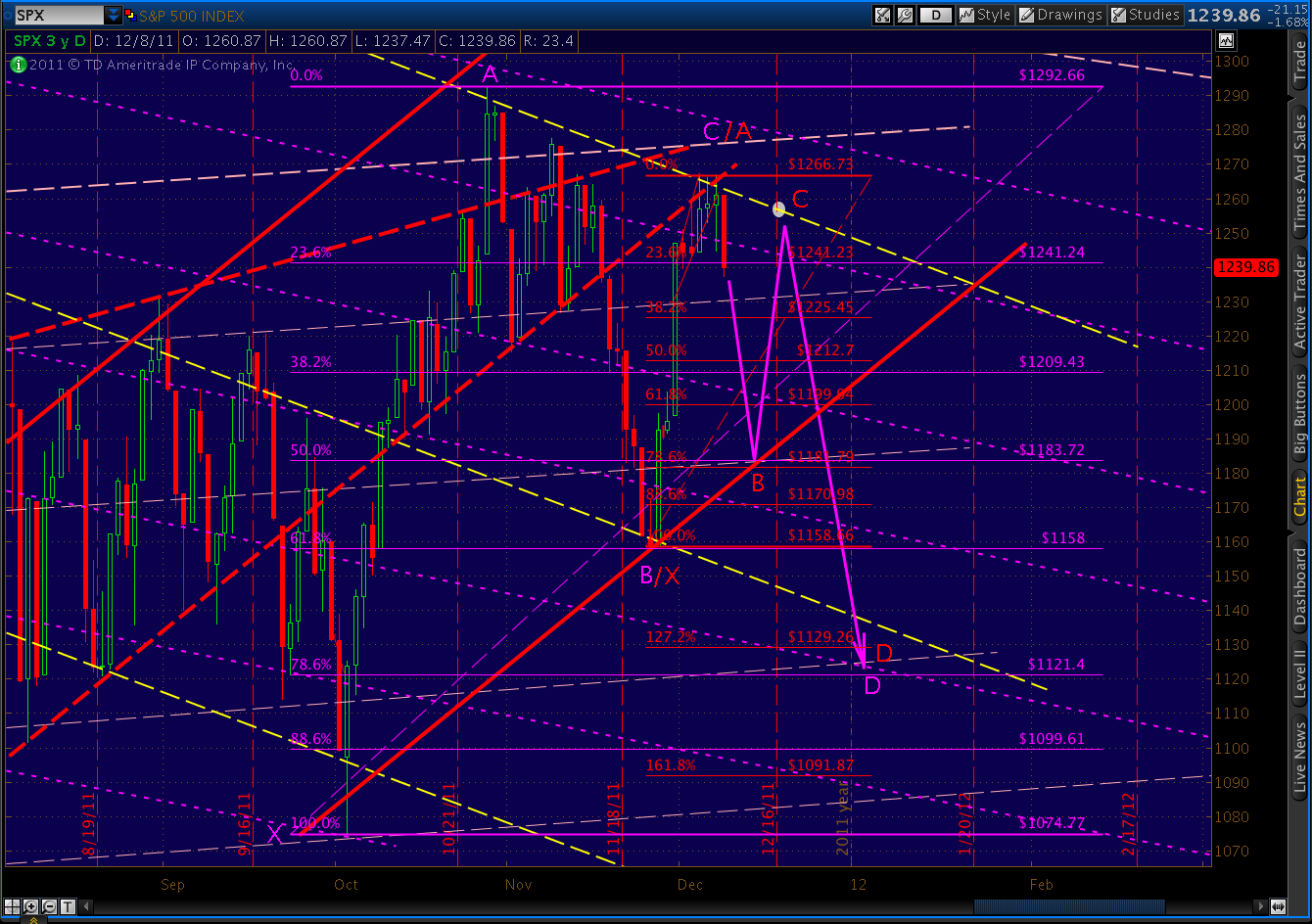
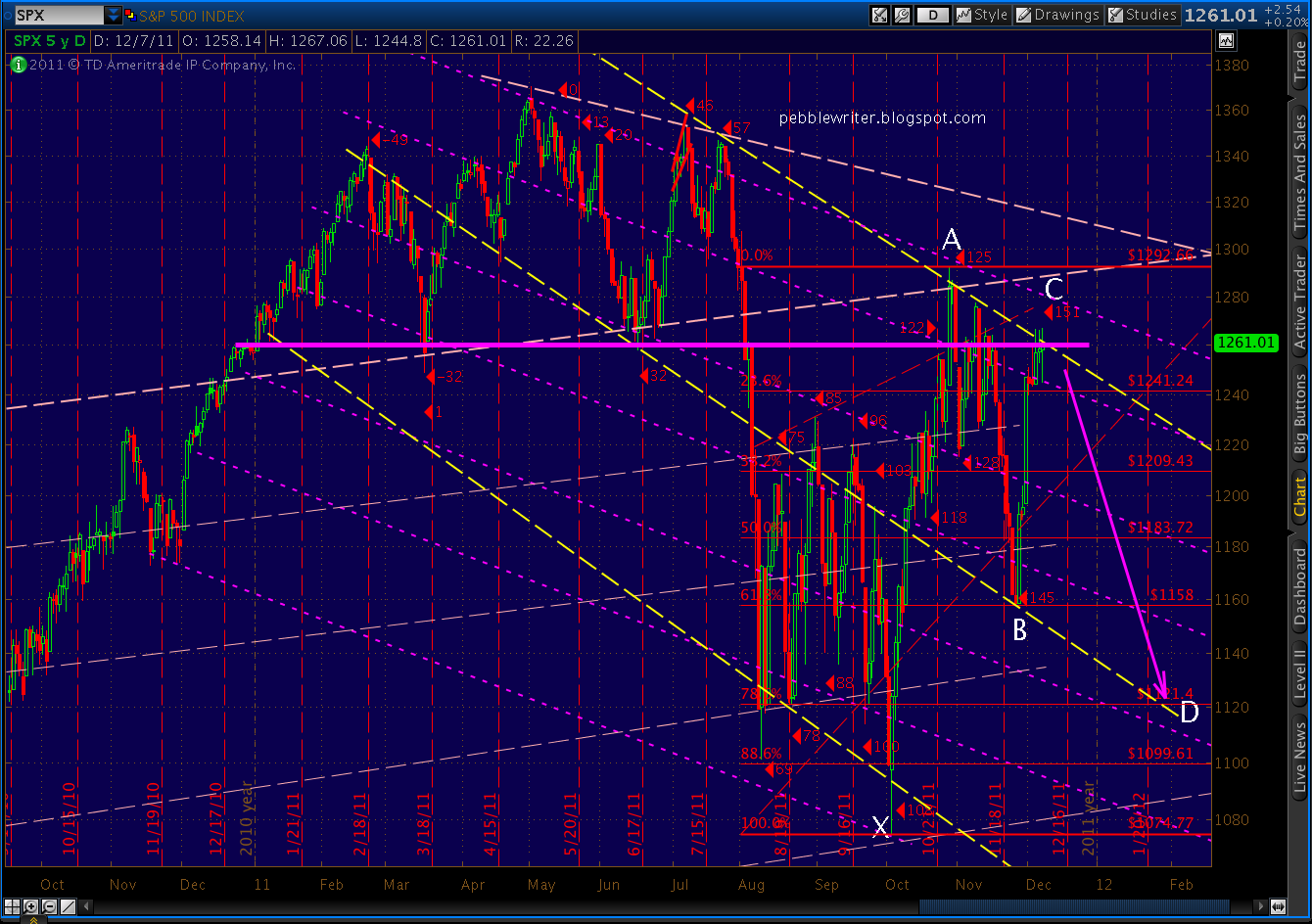
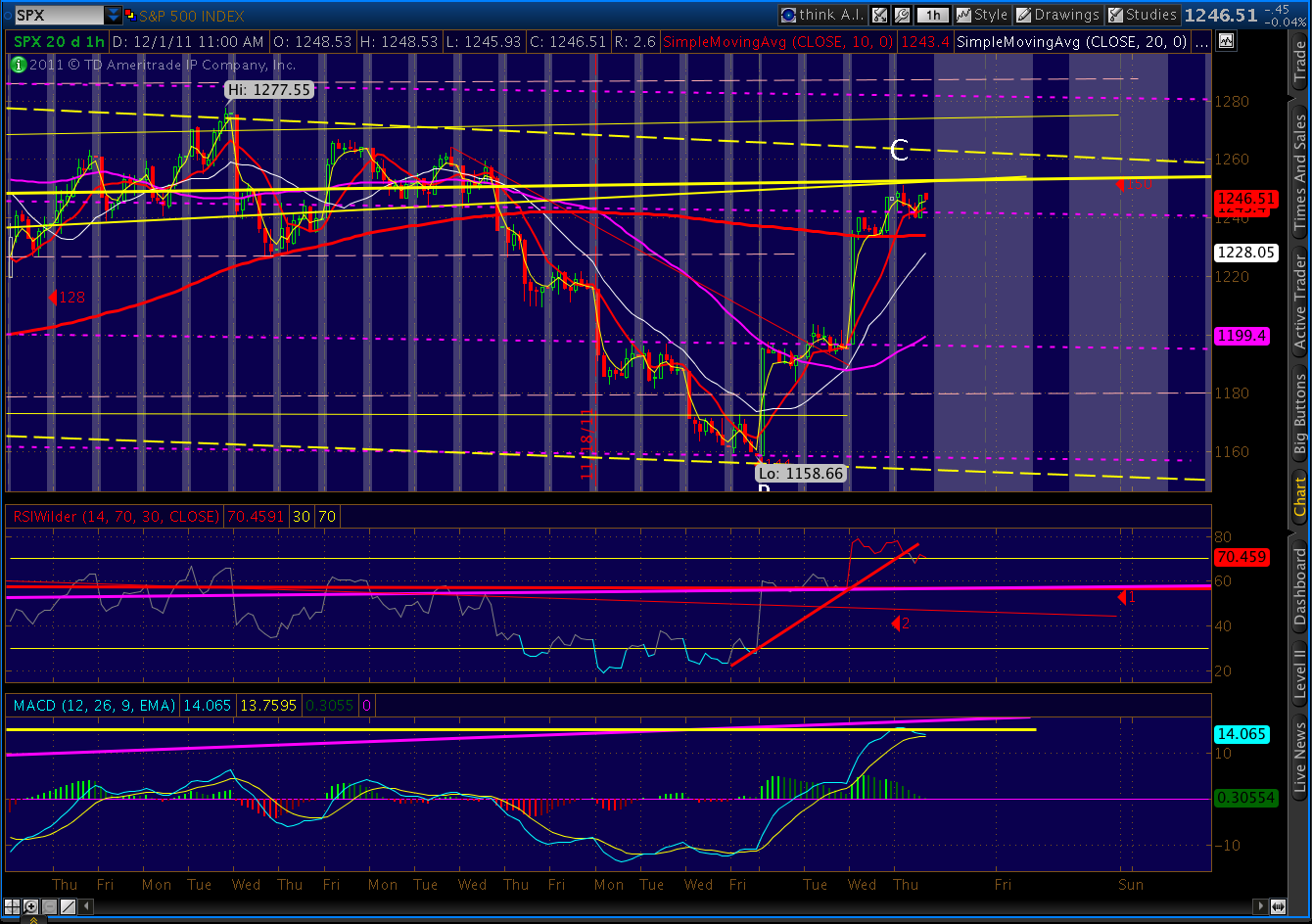
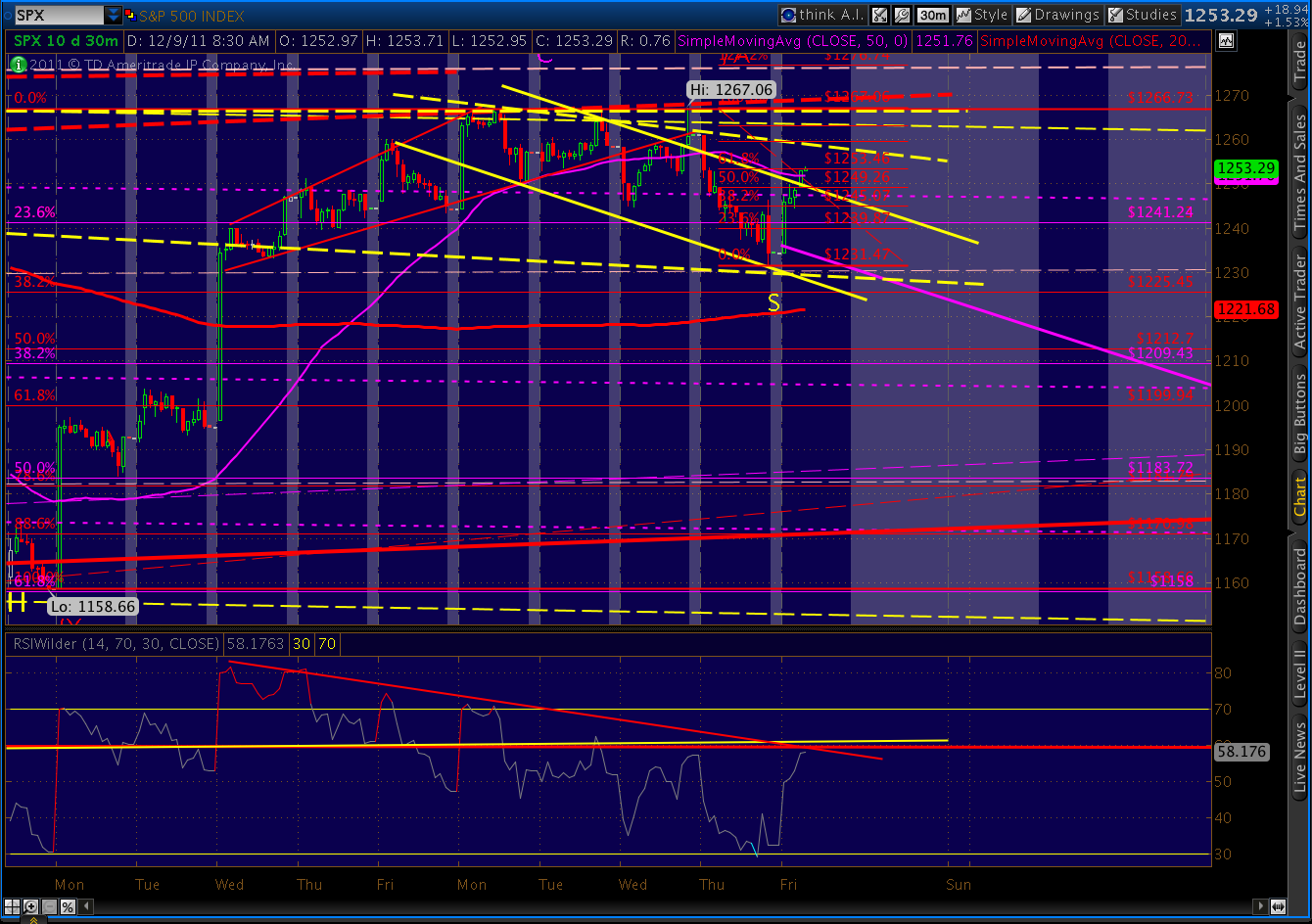
This little pause brought to you by Fan Line C. Don’t worry, RSI and MCO promise plenty more downside to come.
The H&S; completion is up ahead at around 1146.
You can’t make this stuff up.
Seriously, it’s got all the elements of a Hollywood drama. From today’s WSJ:
Jürgen Stark, chief economist (and chief hawk) of the ECB, just quit over the ECB’s decision to ramp up their version of QE. It leaves three Italians on the governing council versus only one German.
That’s like putting the former head of Halliburton in charge of military purchases or the CEO of JP Morgan on the Board doling out TARP money, or…. you get the point.
The ECB’s continued existence depends on the Germans. As Germans everywhere are wondering why they should be doling out their (sagging) Euros to their spendthrift cousins, this is one of those important plot twists.
If Trichet insists on whipping out the debt bazooka to battle what’s clearly an issue of too much debt already, Stark’s defection might end up looking like a fractal for the ECB itself.
Thank God we have no such problems here in the US, right Ben?
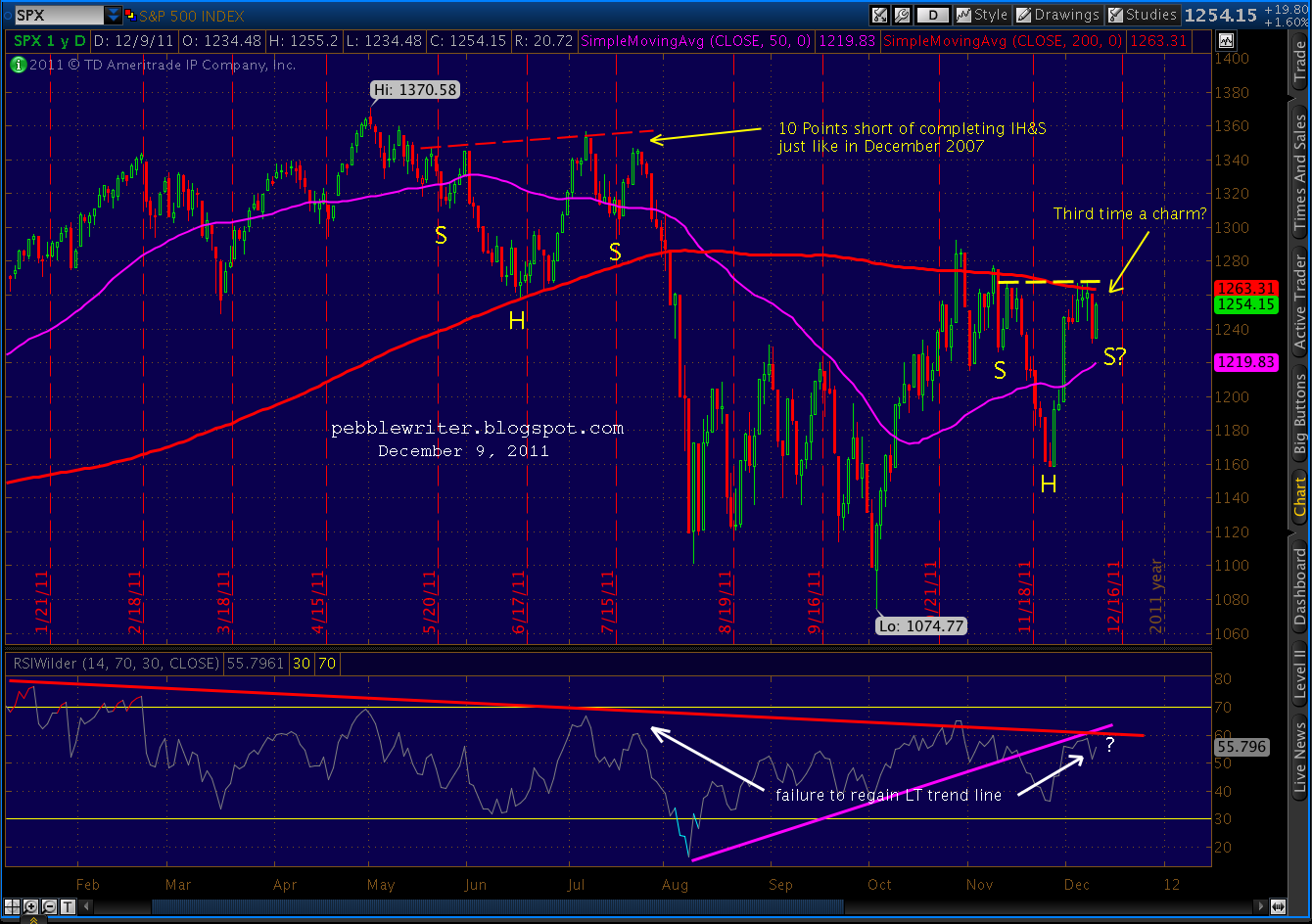
Bears have been amply rewarded by the large H&S; pattern that completed in early August. The new ones now shaping up will make that one look puny by comparison.
Pure speculation, but if the H&S; and Butterfly patterns play out on the daily chart [The Big Picture] we would complete a larger H&S; pattern. The initial target would be 820, but along the way we’d create a new neckline indicating 743. Seen here on the weekly chart…
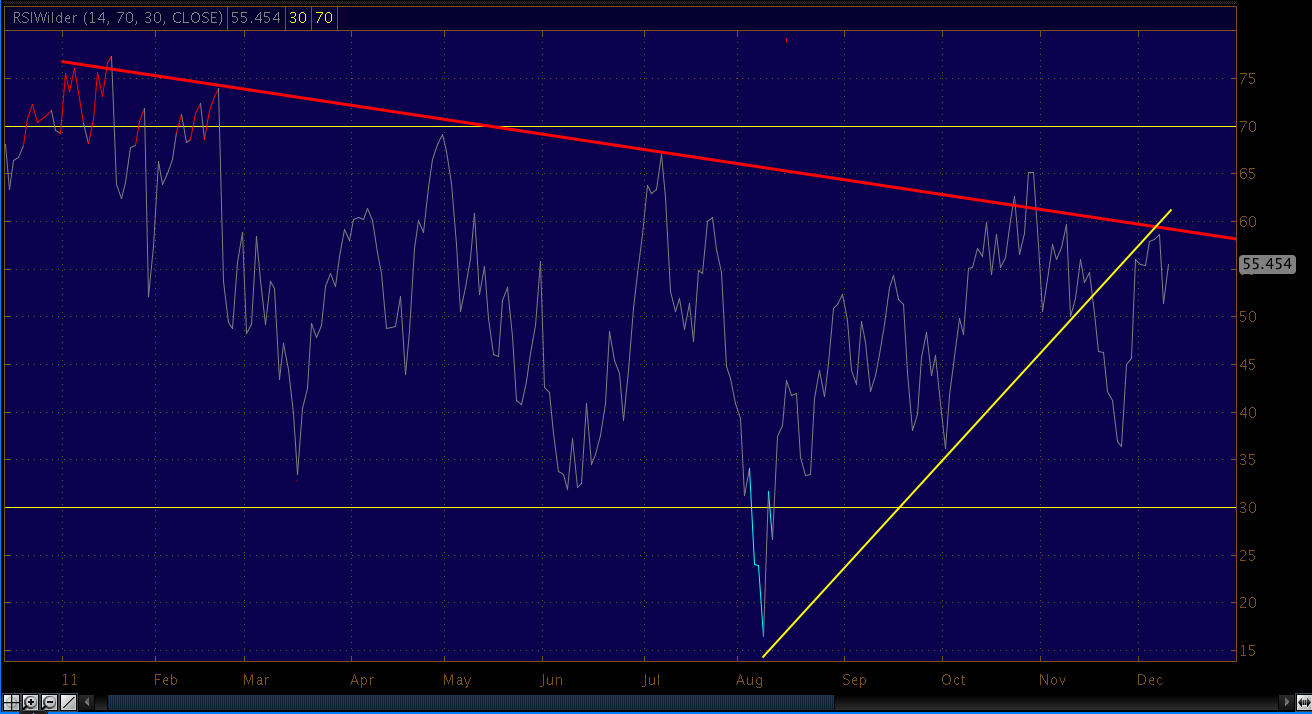
Also, note how clearly the wave count is laid out on the weekly RSI.
I took the day off from tree-watching to develop a better view of the forest. Here’s what I came up with.
First, recall that harmonic patterns are what brought us to this point in time. They occur on a regular basis, and are believed to play out successfully about 70% of the time. Here’s one of the first ones I posted about last May, a Gartley pattern that came within 1.5% of predicting the 2011 pattern high. It called for 1381, and we topped out at 1370.
Some investors are mystified by harmonic patterns. But, they’re really just a series of failed breakouts that retrace at Fibonacci levels. Prices start with a move from a turning point called X to another turning point called A. From A, prices attempt to retrace the just completed move, but fail — typically making up only 38.2% to 88.6% of the distance. This is point B.
Prices then reverse again, trying to retrace the just completed move. Again, they fail, only retracing 38.2% to 88.6% of the distance — our point C. Here, they reverse again and try to get back to the starting point X. In some harmonic patterns, such as Gartley and Bat patterns, they fall short — retracing only 78.6% to 88.6% of the original XA leg.
In others, namely the Butterfly and Crab, they zip past X and establish D at an extension of the BC and/or XA leg. The retracement that establishes B typically tells us whether we’ll stop short of or extend beyond X.
When they reach point D, harmonic patterns reverse. Here’s an updated look at that first Gartley from May. Note how prices reversed at the .786 Fibonacci retracement, falling first to the .50 level before rebounding to the .618 level at 1230 on Aug 31.
The primary target for a Gartley pattern is the .618 retracement of the AD measurement. In the case of SPX, that means 935. Gartley’s don’t always reach their targets, and many traders just play the reversal and grab a few points without worrying about the long term targets. But, for forecasting purposes, we assume the .618 retracement unless other factors come along and exert greater influence.
It’s always helpful to have confirmation, such as trend lines, other harmonic patterns, technical indicators, chart patterns, candles, correlated instruments and even fundamentals. In the case of SPX, we have many. Let’s start with Fan Lines.
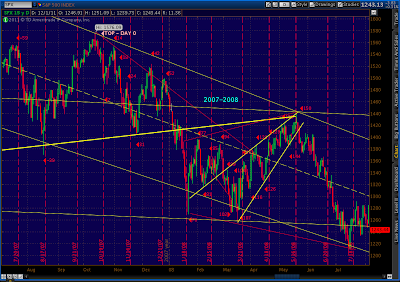
Fan lines are nothing more than trend lines drawn between important turning points (highs and lows) in price. They’re pretty easy to see from looking at a chart. For SPX, some of the most important emanate from the Oct 2007 high of 1576, intersecting with important turning points over the last year or two. I’ve labeled them on the above chart with letters A-G.
Like all trend lines, they often go on to influence future price movements. Fan line B started off as a trend line connecting the opening prices on October 11 and 15, 2007. It then remained irrelevant until early January 2011, when it influenced several days in a row. Then, on Mar 16, it halted a 90-point slide from the Feb 18 high.
In so doing, it achieved elevated status — a potential influencer of future price movements. It played such a role on Aug 31, putting a lid on a powerful 130-point advance. Because it stopped both a powerful decline in March and an even more powerful advance in August, it joins the fan line Hall of Fame — and it hasn’t even retired yet.
The best fan lines mark major “steps” in price action. In declines, they serve as support to a certain point; then, when prices finally push below them, they serve as resistance. In price advances, the order is reversed. Fan lines 1, 4 and D are great examples — along with B, of course.
I’m always very interested in intersections of important fan lines, as they frequently mark major turning points. Fan lines 4 and D intersected on Aug 31 at what was also: (1) a trend line from horizontal support (from 3 years ago, no less); (2) a trend line from the Feb 18 high; (3) a trend line from the Jul and Aug 2010 lows (#4); and, (5) a channel from the July highs. A five-way intersection draws my attention every time — especially when it’s confirmed by other elements.
Let’s assume for the moment that Aug 31 marked an interim high at 1230. What kind of confirmation might we have? For starters, the channel SPX has followed since the July highs passed through the closing price of 1219 on Aug 31. Tomorrow, Sep 8, it passes through 1200 or so.
We’ve also established four of the five necessary points for a Butterfly pattern, with Aug 31’s 1230 high being point A and today’s 1199 high very close to a perfect point C. Point B was a .786 retracement. At 1203, C would be a .707 retracement. The final point D would optimally be a 1.618 extension of AB, or 1056; although, a 1.272 extension at 1091 would also be acceptable.
It’s pretty obvious that a Butterfly point C at 1199-1203 would also serve as a great right shoulder in a Head & Shoulder Pattern. Depending on where it crosses the neckline, such a pattern would have a target of around 1053 — almost identical to the 1056 Butterfly target.
Zooming out, we can see that both the 1053 and 1056 targets remain within the falling channel. In fact, they are located right at the intersection of the channel, fan line E and horizontal support at 1056. That’s three fan/trend lines combined with a Butterfly and H&S; target — another one of those nifty intersections.
While we’re at it, it’s worth mentioning a potential falling wedge setting up on the daily chart. It terminates in 1030 area; though, we usually don’t reach all the way to the apex before a breakout.
Of course, if we do head down towards 1056, we’ll complete a very large H&S; pattern that indicates a downside of 820. The neckline is essentially trend line #5. This target, even lower than the Gartley target of 935 mentioned above, is completely consistent with my view that we’ll break 666 within the next six months.
A couple more things… I find it interesting that we’ve reached the vicinity of the downward sloping trend line on the daily RSI, and other technical indicators are possibly turning negative. The daily histogram looks to be setting up for a lower high, while the 60-min is pretty clearly topping. The put-call ratio and bullish percentage might also be rolling over. While many of these indicators could still go either way, they appear to be on the cusp of a change, indicating a coming reversal.
If we break out of the channel, the short term bearish case gets a little dicey. But, it all depends on where we close for the day. Although the Butterfly looks fine with point C at the .707 Fib level, it would work just as well with a high of 1210 (the .786 level.) So, again, we’ll see if we can close at or below the channel upper bound. We’re in a very ripe bear flag pattern, and it should play out in the next day or two.
We appear to be finishing wave 2 of 5 of 1 down. If so, wave 3 down should be more powerful than what we’ve experienced thus far. If we clear the channel, it will likely mean we’re in wave 4 of 1 down, with a 5 of 5 to come.
UPDATE: 3:55 PM
SPX bumping that internal trendline. Taking the rebound back as far as it can go without breaking the channel. I’ll call today a draw. Apparently both bulls and bears unwilling to extend themselves with so much at stake from Eurozone tomorrow.
UPDATE: 2:35 PM
The dollar continues to soar. DX is up .737 at 75.906 and is closing in on the 200-day moving average at 76.504. The last time DX approached the 200 SMA, it reversed hard, dropping 2.18 (2.8%) in two days and 3.57 (4.6%) in two weeks.
While I expect it to offer resistance again, we should retrace no further than a backtest of the falling wedge. To fall further would require a complete turnaround in the Euro’s prospects, not very likely given the disastrous German legal situation.
SPX is locked in a channel and trying to complete a backtest of its would-be triangle. If it can hold here at 1164, we should see much greater downside.
UPDATE: 10:40 AM
With the CHF rug pulled out from under them, gold’s one of the only games left for USD bears. Cue the CME margin increase.
UPDATE: 10:20 AM
The ISM services numbers are just out, and on the surface look pretty positive at 53.3, up from 52.7 in July.
But, there’s significant weakness when you dig beneath the surface. Most of the apparent increase comes from rising prices (double-edged sword, TSTL) and from rising exports (not so reliable in a rising USD environment.) The “core” measures, business activity/production and employment both declined.
As we discussed with the manufacturing report last week, rising prices are great when there’s an expanding economy and increasing real income to apply toward purchases. But, in a contracting economy with declining real income, increasing prices are a serious warning sign.
To QE fans everywhere, they underscore the serious inflationary issues that accompany the practice of pumping more cash into the economy.
UPDATE: 9:00 AM
Yesterday’s action in the European equities markets had the feel of a serious crack opening up underfoot.
In 2007/8, we had a nearly 2/3 drop in the SPX when a number of important companies failed (Lehman, AIG, Bear.) Now, as we contemplate failing countries instead of companies, we have to assume the downside is at least as great.
If the cash market follows the futures’ lead, it will complete another leg in a large, rather obvious bearish flag pattern.
The weekly chart also speaks volumes:
ORIGINAL POST: 10:30 PM
The dollar has broken convincingly out of its falling wedge, courtesy of the SNB’s decision to devalue the Franc by fixing it to the Euro. We should expect a backtest at some point, but we’re off to a good start.
Meanwhile, follow-through to Friday’s weak equities markets in the futures…
The focus will be on the continuing crisis in the Eurozone (with an important German court decision due Wednesday morning), Tuesday’s ISM services report and Thursday’s employment numbers.
UPDATE: 3:30 PM
The dollar’s had a good run today, but might soon be running into some technical headwinds. In a harmonic pattern that’ll probably end up being a Crab, it’s currently at its 1.272 XA and 2.618 BC extension.
A properly formed Crab should see it reach its 1.618 XA extension at 75.153, but to get there it’ll have to break out of the falling wedge it’s been in for over a year.
UPDATE: 2:20 PM
Just got back from my local BofA. Several video screens in the lobby looped an in-house documentary about the thousands of BofA employees who volunteer in their local communities, making this a better world. Strange, no mention of the several hundred foreclosures being processed daily… or, the $8.5 billion being offered to settle foreclosure fraud charges.
All the Suits were gathered around the branch manager’s computer, probably wondering whether they should spruce up their resumes after reading senior management’s latest missive:
As we discussed at the time, the Buffet deal was a great deal for Buffet… but, not so much for BAC shareholders. Apparently, some of the employees see it that way, too.
When questioned about the deal, CFO Thompson could have said that Buffet’s investment was a “powerful endorsement of the value of the company” or “an opportunity to partner with one of the greatest investors of all time.”
No doubt thinking about his own rapidly evaporating stock options, he replied instead that Buffet’s investment was a “strong validation of management.”
He went on to say that BofA told the old coot to take a hike the first time he tried to give them money. He just kept coming back, apparently annoying them to the point where they took his $5 billion just to get him to go home.
If you’re reading this, Warren, my door is always open.
UPDATE: 1:30 PM
Just completed a bearish Gartley pattern on gold (GC). Indicates an initial downside target of 1770.
But, the cult of Gold followers seems to be shaken only by margin increases, so we’ll see if this plays out or not. Re margin, there should be another increase any day now given the volatility lately.
UPDATE: 10:15 AM
The bearish Gartley pattern has played out perfectly, reversing just past the .786 Fibonacci level. And, Fan Line B has continued to hold. As mentioned many times before, the intersections of multiple fan lines (from above and below) often serve as important turning points.
A look at the big picture.
ORIGINAL POST: 9:15 AM
Can’t have a recovery without an improvement in unemployment… I’m looking for any glimmer of hope in this morning’s NFP report, and have yet to find it.
From Briefing.com:
And, the BLS:
UPDATE: 1:00 PM
XEU v SPX: syncing up nicely the past couple of weeks, as they’re both an anti-dollar play. Ordinarily more of an inverse relationship.
PM’s playing the same role, with GLD and SPX moving together as an anti-dollar play.
USD v SPX: inverse relationship a bit stretched right now….
Has that “something’s gotta give” look about it, as the dollar rally hasn’t been fully reflected in SPX.
UPDATE: 10:50 AM
The dollar responded well to today’s economic news. DX has been in a falling wedge within a larger falling wedge, and broke out last week. We had a nasty backtest last Friday the 26th that has since reversed. DX is once again threatening the longer term trend line that’s limited its upside since Jun 10.
![]() |
| 5 YEAR – DAILY |
![]() |
| 1 YEAR – DAILY |
![]() |
| BREAKOUT ON 60-MIN |
One way or the other, DX will be forced out of its falling wedge by the end of September.
UPDATE: 10:10 AM
ISM data out, and not as bad as many expected thanks primarily to a troublesome growth in inventories. Increasing inventories are a sign of confidence, as business owners are increasing their stocks of products in anticipation of greater sales. In an expansion, increasing inventories are a bet that’s likely to pay off. In a contracting/slowing economy, they signal that someone made a bad bet.
The trend across the board is not pretty. From briefing.com:
A reminder, this is a survey of purchasing managers’ attitudes about business conditions. An index above 50 indicates conditions are better, and below 50 indicates they are worse. Because it’s not generated by a department of people who can be fired by Congress or the White House, it is not considered to be “managed” as are many DOL and DOC reports.
Exports continue to cling to a positive score, benefitting from a cheap dollar — a factor that might not last much longer.
ORIGINAL POST: 9:20 AM
From Briefing.com, a nice view of labor productivity and costs. Not a healthy path, to say the least.
UPDATE: 1:00 PM
I’ve seen some huge manipulations of economic data before, but the July factory orders numbers from Census take the cake.
Total for all manufactures goods fell almost 7.5%, from $472B to $437B. This is huge news. So, why wasn’t that the headline, instead of…
Because, through the magical seasonal adjustment process, it was reported as a $446 to $453 billion increase. The durable goods component fell from $213B to $186B, but was seasonally adjusted to a $197B to $202B increase.
The rest of the report is filled with stuff that has manufacturers shaking in their boots, but you’ll never see it reported as such. That would be negative and might scare investors who, apparently, can’t be trusted with the truth.
Quick note on the ADP numbers, which are always amusing and seldom accurate. The 91K (versus 100K expected) doesn’t include the striking Verizon workers. So, the real headline should be 46K versus 100K. A bit more of a shortfall, no?
Likewise, the Challenger Gray job cut numbers were reported as a sharp drop in layoffs. The reality is that YTD job cuts are at 363K versus 2010’s 335K. The 2011 v 2010 monthly comparisons continue to look bleak.
And, finally, the ISM Business Barometer out of Chicago hit a 21-month low.
UPDATE: 10:30 AM
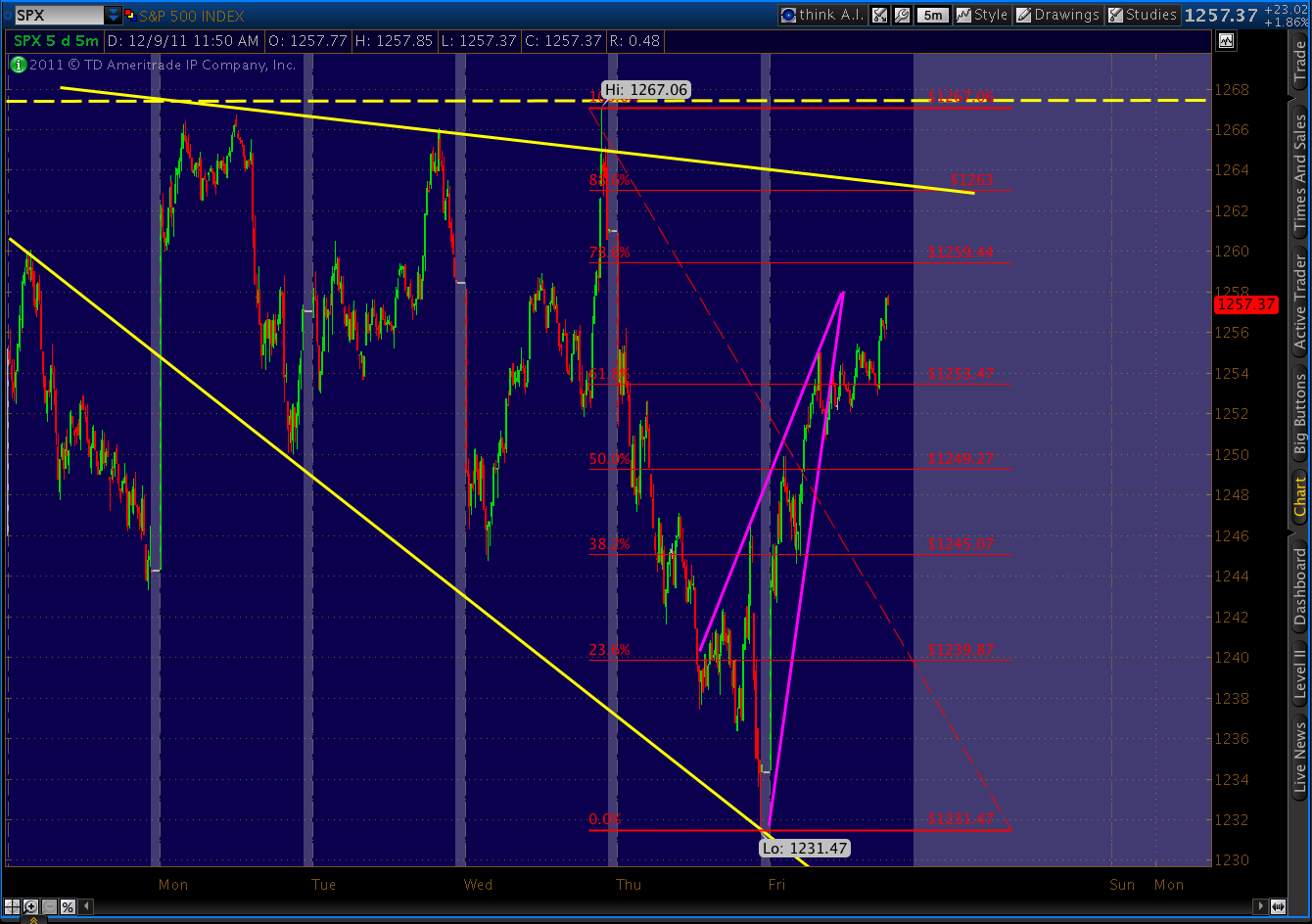
Rising wedge inside a rising wedge on the 5-minute chart.
More importantly, a bearish Gartley pattern just completed on SPX.
I’m always a bit skeptical when a Gartley point X isn’t at a clear pattern high or low. In this case, it’s a distinctive point from Aug 3, but was clearly part of a continuing downturn that was larger in scale.
I might have been tempted to ignore it all together, except for this bearish Gartley on AAPL, the point X of which is at AAPL’s all-time high.
And, this, COMP at a major backtest of its neckline.
And, this, NDX (Nasdaq 100) backtesting its SMA 200.
There are other indicators, but you probably get my point. We’re at an inflection point here, where there’s plenty of reason to be cautious regarding the upside.
If we close above Fan Line B, I’ll be very surprised. I won’t be surprised if we put in an interim high at 1230.
ORIGINAL POST: 4:00 AM EST
I redrew Fan Line B to eliminate the shadow from March 16th. It’s still hanging in there as the limit of this latest move up.
As noted yesterday, it intersects right here with not only yesterday’s high, but Fan Line #4 (from Jul 09 via Aug 10) as well.
It also intersects with Fan Line G from the Apr and Nov 10 highs and a very important Trend Line from the Feb 18 highs that also marked the Apr 18 and Jun 16 lows. They’re all marked here as purple lines.
For FL B to hold, we’re going to have to reverse tonight’s futures rally. My gut is that something in this morning’s economic reporting — PMI, Factory Orders or Employment — will start us off in the right direction.
UPDATE: 12:50 PM
The more I look at Fan Line B, the more I like it as the upward limit here.
I’m having second thoughts about 2011 having slowed relative to 2008. I’m looking at the alternative — that we’ve sped up again on a relative basis — and am growing more comfortable with it.
I might just have to get over the fact that we had hardly any blips on the way down to the 1101 bottom. But, I’m not ready to abandon a 5th wave down just yet. To do so means the 22nd’s 1121 low was a truncated 5th, and I’m just not buying that.
Consider the Fibonacci similarities if we accept the alternative. These levels are drawn off the patterns highs — i.e. 1576 for 2007 and 1370 for 2011.
We’ve retraced to just above the .382 level twice, which is just what happened in 2008. In 2008, the valley in between was a .618 retrace; 2011’s was a .886 retrace. If this comparison were to hold, prices should head back down in the next few days for a proper wave 5 at new lows.
It gives me a little more confidence that we have a rising wedge and obvious divergence, seen here on the 15-minute chart.
There’s plenty of important economic news coming out in the next few days — the perfect catalyst for the next leg down.
UPDATE: 10:20 AM
Consumer Confidence plummets from 59.2 to 44.5. Expectations Index even worse, from 74.9 to 51.9.
Case-Shiller 20-City Home Price Index is also out. Prices rose 3.6% from the 1st quarter, but are still off 5.9% from 2Q 2010.
And, from the folks who would have reported Lincoln’s assassination as “Excellent Play Enjoyed by Nearly Everyone”…
Don’t forget the growing contract cancellation problem. Yun refers to it here rather obliquely, but this will be a larger issue going forward given the plunge in consumer confidence we’re watching.
UPDATED 10:00 AM
Yesterday’s rally, the 6th in 7 days as talk radio crowed all day, was either the result of (depending on whom you believe):
(1) an increase in consumer spending;
(2) relief that New York was spared; or,
(3) Bernanke’s “many options” to stimulate the economy.
I’ll leave NY alone; readers will no doubt have their own ideas about whether it being spared was a good thing. The increase in spending was accompanied by a decrease in income and increase in debt — definitely not a good thing.
Bernanke’s speech was hardly encouraging. If people believe he has the ability to save the economy, then he’s won half the battle. In fact, it’s so much better than actually instituting QEn and having investors discover that it won’t stop the next slide.
Okay, quick thoughts on patterns. The H&S; is kaput. Ditto the bullish Butterfly and the triangle. What we’re left with is a bearish potential harmonic pattern and a few interesting fan lines. BTW, Fan Line B finally stopped yesterdays’s rally, as it did on Aug 5, 15 and 17.
First the harmonics:
Note that the C point is at a .786 retracement of AB. The question is where’s our point X, which would determine how great the AB retracement is? The most interesting point to me is the August 3-4 high around 1261.20.
It puts point B at a .618 and makes the pattern into a potential Gartley. Point D’s on Gartleys are typically at the .786 retrace, which here would be 1227. The .886 would be at 1243. The next moving average to the upside is the 50 day at 1259 — further confirming that as the highest possible target in this pattern.
These points also happen to coincide with a couple of interesting fan lines, so they bear close watching. I already mentioned Fan Line B, which was the terminus of Monday’s rally.
Other fan lines to watch on the upside are Fan Line #4, at 1220 and Fan Line A, at 1249. Line #4 is also the level of horizontal resistance from the fractally similar pattern last November. Fan Line A is potentially very important as it’s the same fan line that stopped this past June’s slide, and also marks the low from the Mar 16 plunge.
It’s also worth noting we’ve retraced to approximately the .382 level off the May 1370 highs. While it wouldn’t be very satisfying from a harmonic standpoint, there’s a small possibility that the Fibonacci level of .382 and Fan Line B are enough to stop this rally here. After all, it was Fan Line B that stopped the afore-mentioned Mar 16 plunge.
UPDATE: 9:45 AM
We are very close to the .886 Fib retrace at 1198.51. If we hold here, it bolsters the Butterfly and H&S; cases nicely.
UPDATE: 9:30 AM
Real Disposable Income down, spending and inflation up. Not a good recipe for growth, unless you’re talking about credit cards and car loans.
This rally should fizzle between 1190 and 1199.
UPDATE: 12:25 AM
Link for tomorrow’s economic data.
We’re expecting personal income, spending and prices at 8:30 EST. Shouldn’t be any surprises, as this data has been largely been covered in other reports this past week.
Keep an eye on the Butterfly pattern. Remember, we’ve put in our X, A, B and C points already. Point C came at 1190.68 on Thursday (the .786 level) but could be replaced at the .886 level of 1199 if prices exceed 1191. If we reverse hard off either of those prices, look out below.
Also, note that Point A marks the top of the head of our H&S; pattern, and Point C marks the right shoulder. The H&S; target is 1040, essentially the same as the Butterfly target at the 1.618 extension. Gotta love coincidences.
Just a quick note…the discrepancies between the two tops have all come at times like this — when there was a great deal of confusion and dissension, especially in the bear camp.
I will be traveling Monday – Wednesday, so intra-day posts will be spotty at best. Good luck to all.
ORIGINAL POST: 9:15 PM
This is a very confusing time, with many of the indicators I watch slowly turning bullish — but with a total lack of uniformity, on very low volume and in the face of awful economic news. I attribute the failure of the market to turn down to the highly anticipated Jackson Hole affair. Investors have been hyper-focused on the prospect of another round of QE.
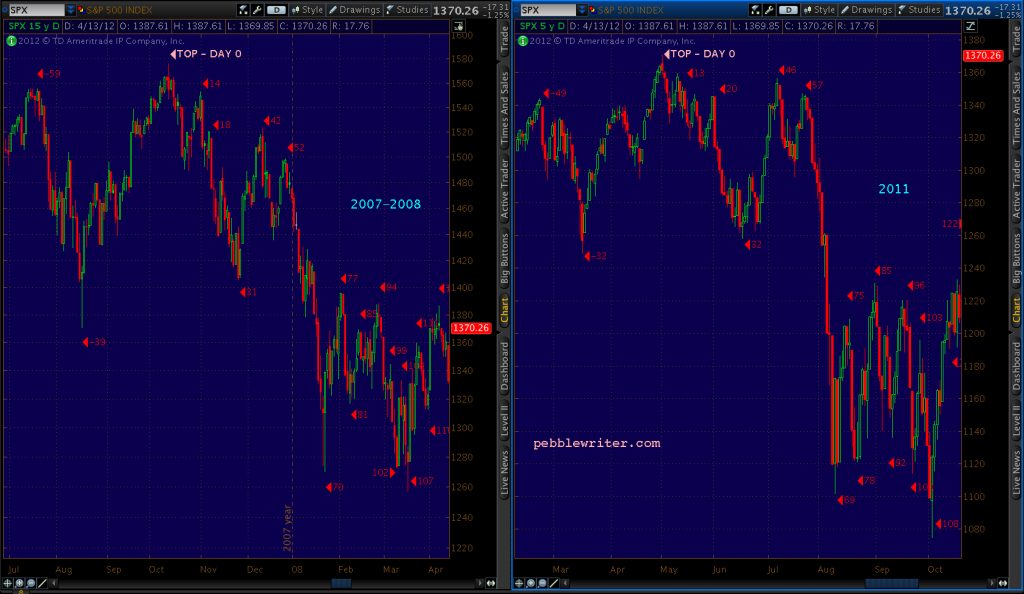
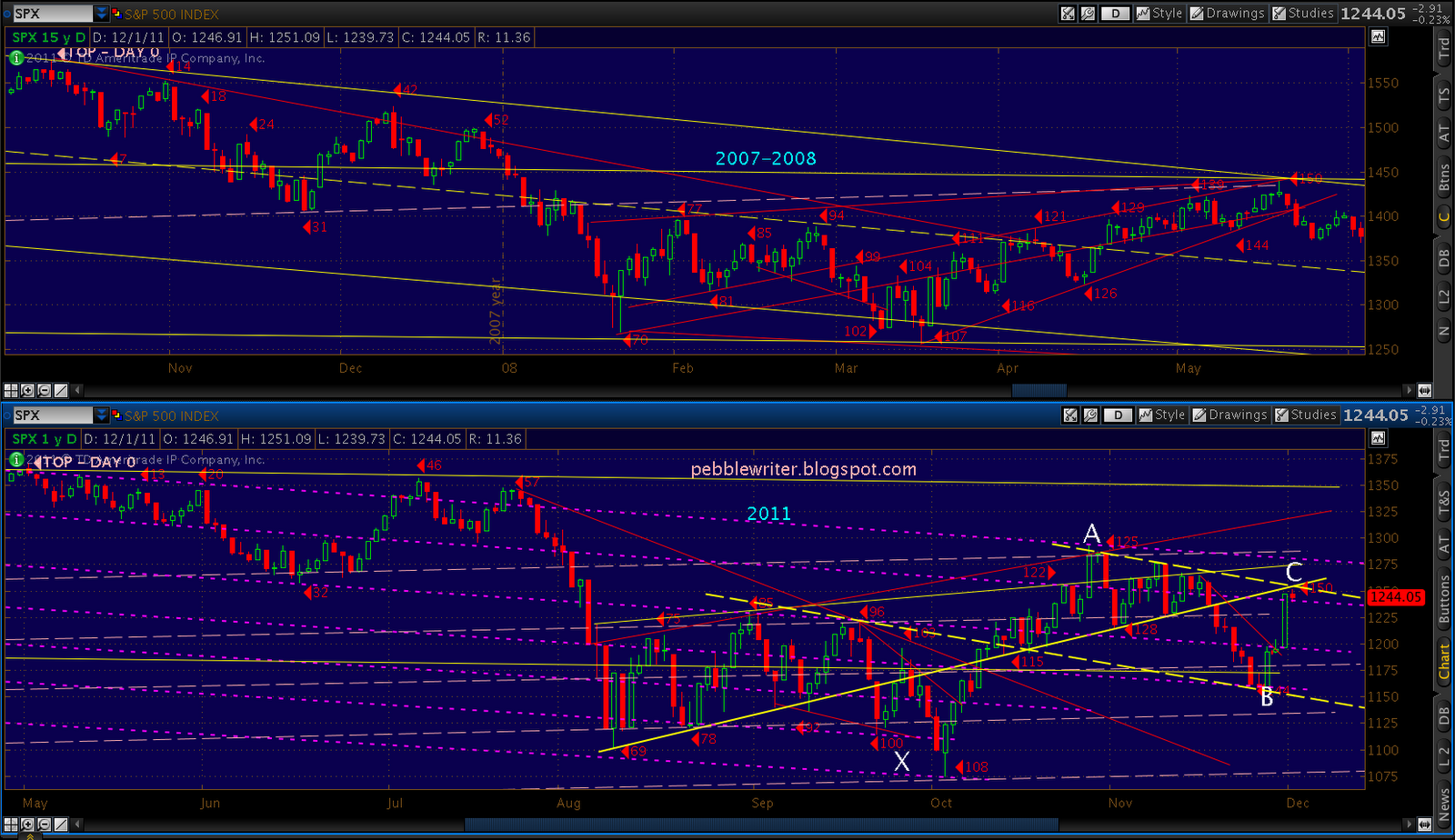
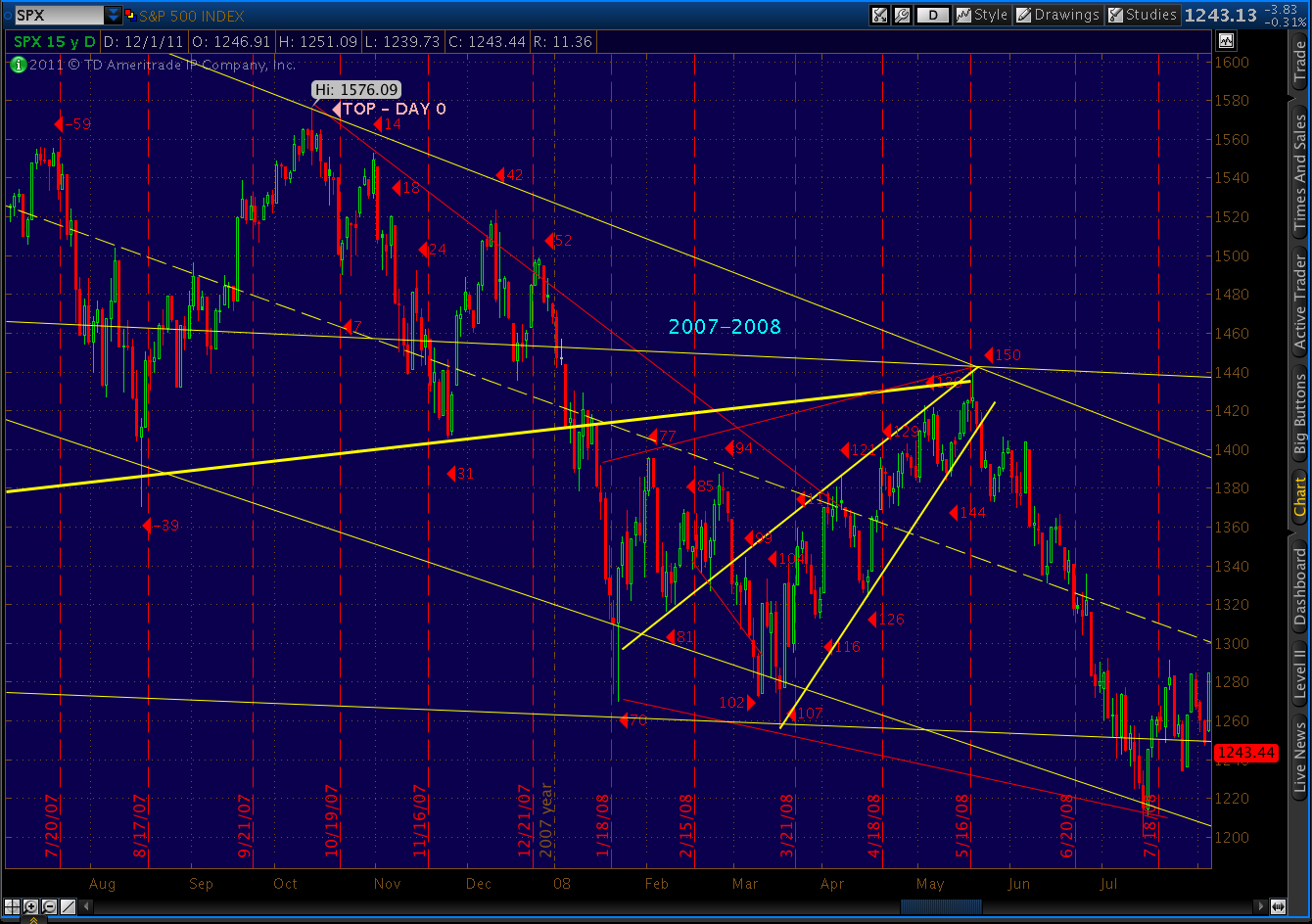
Bottom line, I think the 2007/8 vs 2011 comparison is still in play, but with the current period “slowed down” by this distraction. It’s happened several times before. The idea probably sounds a bit odd, but I noticed months ago that the biggest difference between this and the 2007/8 market was the speed at which the topping pattern unfolded.
In February, this market was completing the topping pattern at a faster pace than did the 2007/8 market. By May, the speed had caught up. By June, it was running a little slower; and, if I’m correct, it’s continued to slow relative to back then. Consider some move comparisons:
2007/8 2011 equiv.
7/7 – 8/16/07 (20 days) 2/22 – 3/16/11 (16 days)
9/17 – 10/11/07 (16 days) 4/16 – 5/2/11 (17 days)
10/11 – 11/26/07 (30 days) 5/2 – 6/16/11 (32 days)
11/26 – 12/11/07 (11 days) 6/16 – 7/7/11 (14 days)
12/11 – 1/9/08 (19 days) 7/7 – 8/9/11 (23 days)
1/9 – 1/23/08 (9 days) 8/9 – 8/26 (13 days so far)
Here’s a picture of the late June 2011 divergence. The market had bottomed just like in 2007 and was headed back up. But rather than a 10-day rally to an interim high, we had a significant hiccup after 4 days when the administration foolishly tampered with the strategic petroleum reserve.
The market tumbled back to its lows and had to restart the rally. It eventually reached its comparable target, but took an additional several days.
I believe the timing divergence is at play again. Instead of oil manipulations, the prospect of Bernanke letting loose another round of QE simply stalled the current market.
As of Friday, we were running 4 days “behind” the 2007 equivalent. This gave a number of chartists (myself included) pause. It seemed as though bears didn’t have the cajones to finish the job it started, and bullish sentiment (and price action) has started creeping back in.
But, in my opinion, we’re simply taking longer to process the 4th wave, with points A-B-C-D corresponding to 2008’s 1-2-3-4 on the above chart.
A number of bears are calling the 8/22 low of 1121 a truncated 5th wave. I’m no Elliott Wave expert, but I find this explanation dissatisfying. Such a powerful 3rd wave should have more follow-through than this wimpy little triangle-looking action.
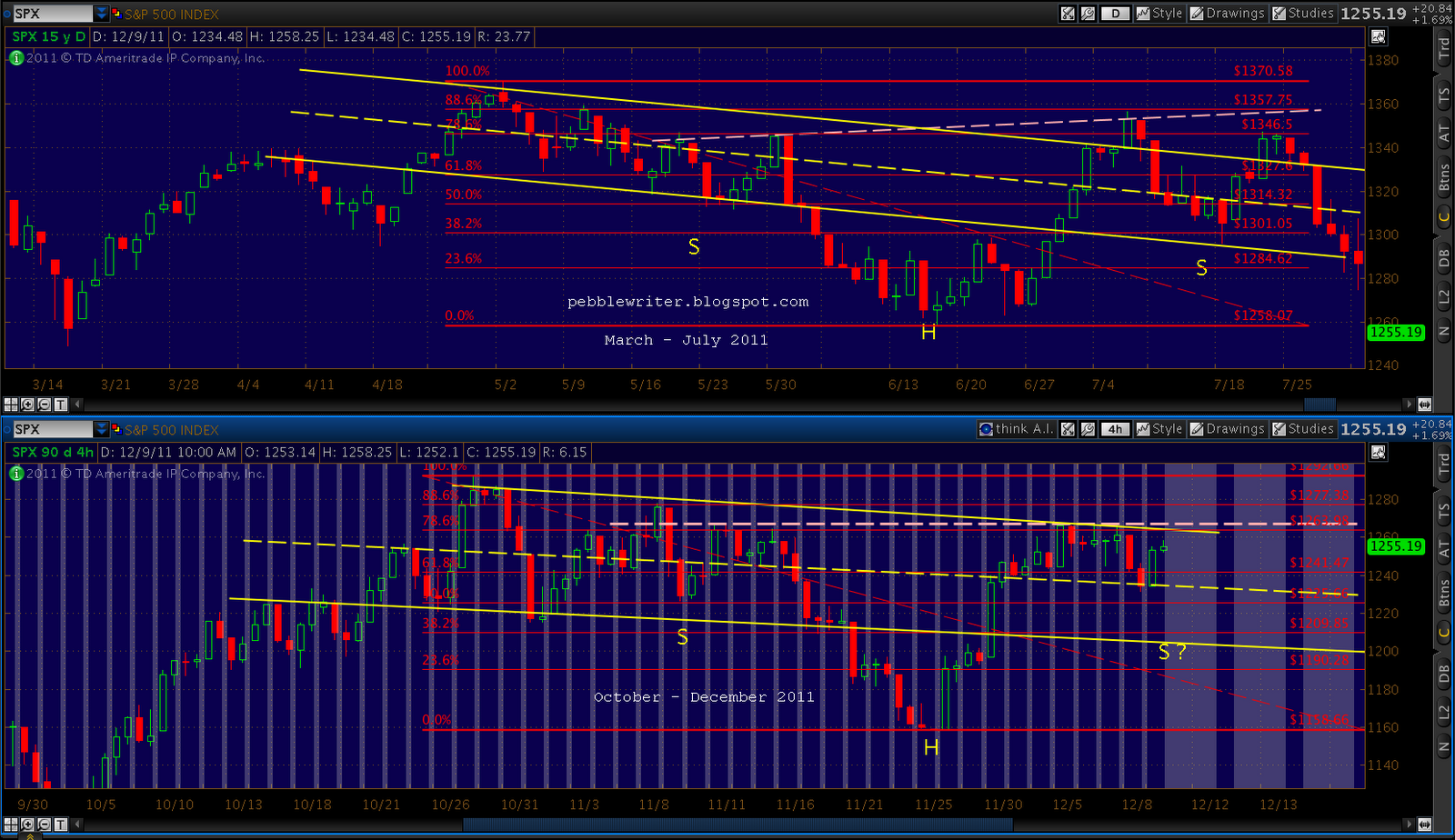
Consider the 2008 equivalent. There’s a very obvious triangle-looking a-b-c thingy (told you I wasn’t an EW expert) in the 4th wave position from 1/9 – 1/15/2008 that corresponds nicely to the triangle we’re currently tracing out. I consider it a pennant, and these are usually continuation patterns.
It’s also entirely likely that we’re trying to trace out a similar harmonic pattern. In 2008, the triangle formed a nice little Butterfly pattern that took SPX down to a 3.00 XA extension.
As of this past Thursday, we completed points X-A-B-C of a Butterfly pattern. Typical 127.2 and 161.8 extensions would locate point D at 1072 or 1035 respectively. I like these numbers, as they correspond nicely with some of the other targets we’ve been eyeing (H&S;, etc.)
A 3.00 extension would mean 888. I’m not currently looking for anything that extreme (but certainly wouldn’t complain.)
There are a lot of other indicators sending mixed signals. For this reason, I’m going to handicap this idea of mine at about 60/40. If I’m wrong, we head back up to as high as 1250 before heading much lower. So, I’m not terribly concerned about timing, as the ultimate destination is the same.
In any case, we should know in the next few days. There has been a surfeit of horrid economic news, and one of these days very soon it’s going to overwhelm the Plunge Protection Team’s best efforts.