
SPX came with an inch of our downside target yesterday before the meltup began. Given the ramp job overnight, it’ll probably do — especially since VIX is in a prime position to keep the ramp alive. The algos love it when a rising channel breaks down, and it’s almost certain to happen this morning. continued for members… (more…)
Author: pebblewriter
-
Charts I’m Watching: Aug 22, 2017
-
Capitulation
We’ve had a nice run, of late, as SPX, CL, VIX and USDJPY have all tagged targets where expected. As meltdowns go, this one has been very well behaved. Even the bounce we anticipated on Friday played out as expected, with the capitulation waiting until the final hour or so or trading.
if SPX can remain below the SMA5 20, there’s a clear shot to 2415 at the bottom of the red channel. Otherwise, we’ll get jerked around for the rest of the day with the promise/threat of a drop hanging over our heads for hours and hours.
Today should see the rest of that particular leg complete, though the target has moved just a bit. And, as we noted on Aug 10 when we first laid out these targets, there is considerably more downside if this low doesn’t hold.
continued for members… (more…)
-
News Flash: Algos Work Both Ways
There’s an old saying: “live by the sword, die by the sword.” No one was complaining when algos, prompted by a soaring USDJPY and plunging VIX, nudged stocks ever higher. Now that they’ve exacerbated SPX’s drop — almost (shudder) 2.5% off the highs — will investors be as enamored?
SPX’s sharply rising channel broke down on Wednesday with a close at our initial downside target. Yesterday, SPX tagged our next downside target, bounced around for an hour, then proceeded to break below a larger channel dating back to Dec 30, 2016.
Needless to say, this was a more serious breach and leaves the door open for the downside targets we posted last week.
continued for members… (more…)
-
Central Banks Goof (Again)
SPX landed right where we expected yesterday, the bottom of a sharply rising channel that — were it to continue — would levitate the index to 2500 by next week. That, of course, was before things got crazy in the currency markets.
I’ve been pretty adamant that EURUSD overshot in its recent push past our 114.70 target. I still don’t buy the idea of the ECB tightening any time soon. The most recent ECB minutes appear to confirm this viewpoint.
The appreciation of the euro to date could be seen in part as reflecting changes in relative fundamentals in the euro area vis-a-vis the rest of the world” but “concerns were expressed about the risk of the exchange rate overshooting in the future.”
The EURUSD sold off further on this and other choice comments…
 …with the net result being another breakdown for ES.
 Fortunately for equities, CL reached our downside target this morning and stands ready to prop stocks up — at least in the short run — with a nice bounce of its SMA50 at 46.46. But, with both EURUSD and USDJPY tumbling, will it be enough?
 continued for members… (more…)
 -
Cat and Mouse
VIX toyed with important support all day yesterday, keeping equities in the dark as to the next steps.
 As a result, ES spent the entire day continuing to dip below its SMA10 and SMA20 — even closing below a nice little trend line off its earlier highs as VIX refused to dive below the all-important yellow channel bottom.
 It was all for naught, however, as the usual ramp job stepped in around 1am. It should allow SPX to tag yesterday’s 2470.58 target on the open. After that, however, the picture gets a bit muddled.
continued for members… (more…)
-
Just What We Needed
So far, the bounce is going pretty much as expected. VIX continues to tumble, USDJPY continues to rebound, and CL continues to sell off. About the only surprise so far is that traders seem to have taken Dudley’s nonsensical hawkishness to heart.
Given the hesitation USDJPY initially showed in reversing, however, it’s just what the doctor ordered and has left our rebound right on track.
 continued for members… (more…)
 -
Fun While it Lasted
It was fun while it lasted. After 23 straight sessions of VIX being suppressed below its long-term channel bottom, we finally got a taste of real volatility. This morning, VIX is off over 15% and screaming back toward its recent lows in the absence of any further provocation from our Tweeter in Chief.
 Has the risk of all-out nuclear war disappeared? Only time will tell. But, for now, the algos are happy — as they have been with each tag of the falling white channel top. SPX’s rising red channel — dented but not broken — remains intact.
continued for members…
(more…) -
Inflation Disappoints Again
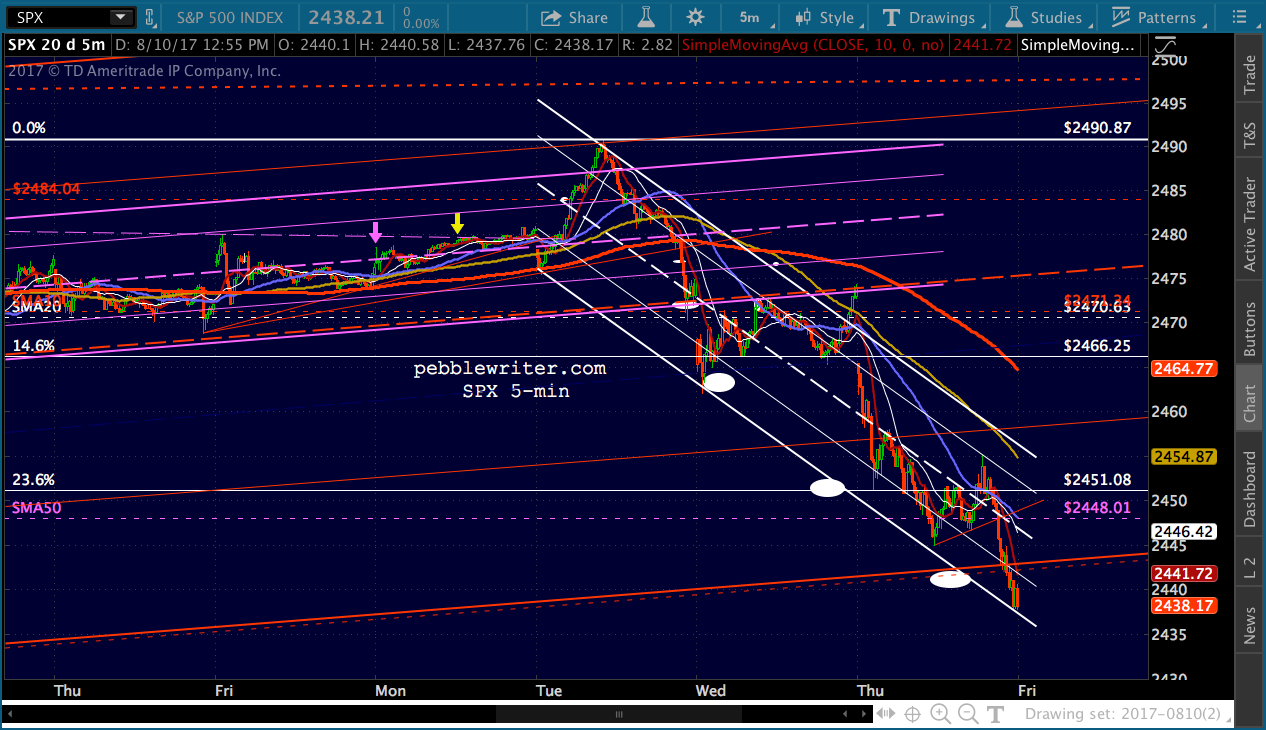
SPX reached both of our downside targets yesterday, closing slightly below our 2440.81 target at 2438.17.
 It was a nice 50+ point gain from our short at 2490.10 on Tuesday [12:18 Update], and came reasonably close to Wednesday’s forecast.
 The slight overshoot did little damage to our rising red channel. Bulls are no doubt more concerned about inflation, which disappointed again in July. CPI came in at 1.7% (1.8% expected) and core remained at 1.7% (in line.)
 As we expected, energy prices were key, turning in a 3.4% YoY increase.
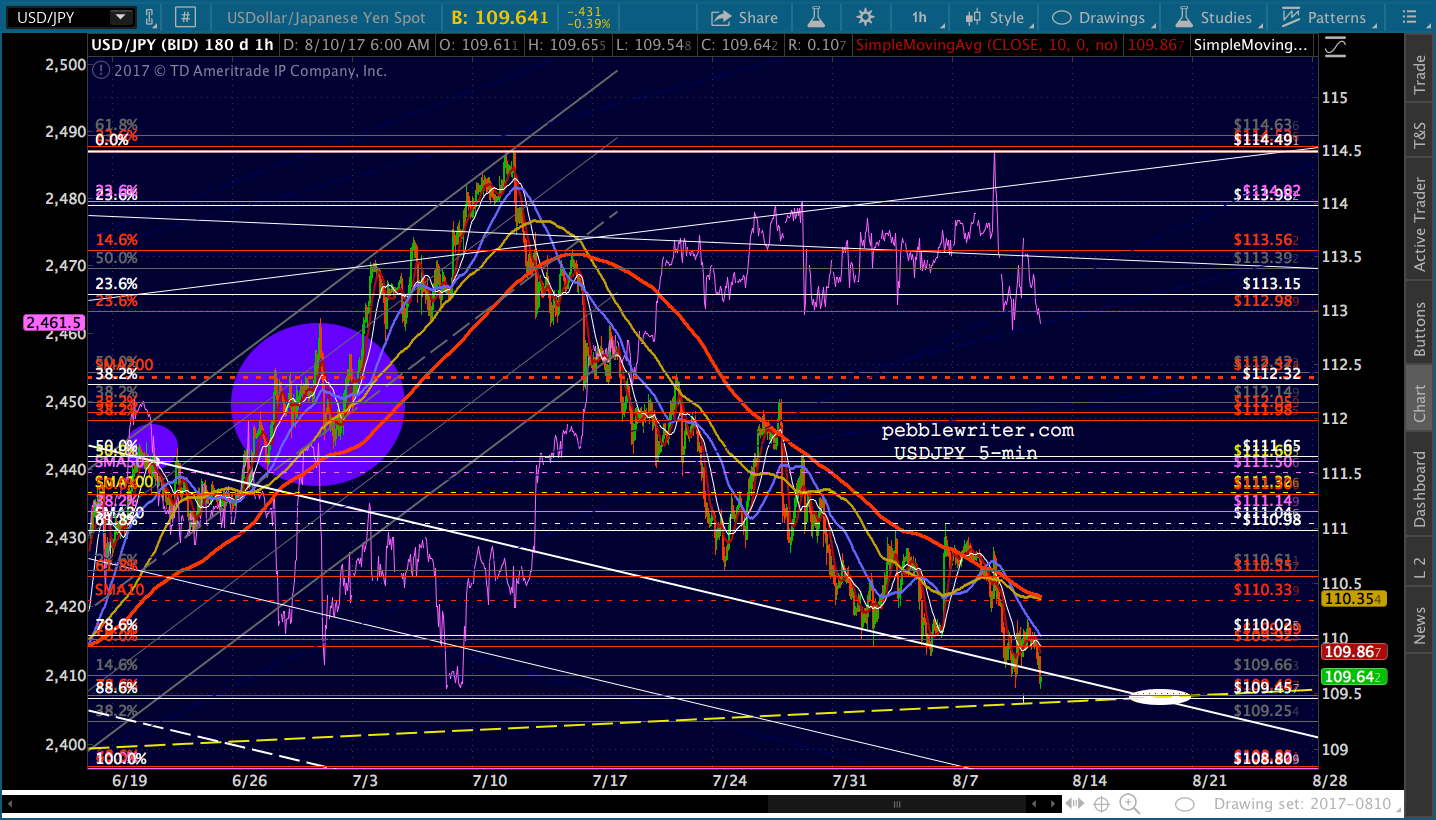
Needless to say, traders are more skeptical than ever that the Fed will find reason to hike any time soon. The USD is sliding again — except against the yen, of course. The plunge in USDJPY lasted just long enough to facilitate a tag of the red .886 Fib.
 Between that bounce and VIX’s reversal at the white channel top, futures are up over 10 points from their overnight lows. In other words, our expectation of a bounce appears to have been correct. The trick will be in maintaining it.
 The USD might not be much help to stocks — though we do have two Fed speakers on tap to explain why a rate hike is still a great idea.
Instead, oil and VIX will likely drive whatever bounce we get, with CL having tagged our 48.10-48.16 target range overnight.
 It’s a tough assignment, with headline risk still weighing heavily on real people and algos. As we discussed yesterday, if the rising red channel doesn’t hold, it could be a long way down.
continued for members… (more…)
-
Update on Nikkei: Aug 10, 2017
As we discussed last month [see: Jul 14, 2017 Update] the Nikkei faced important overhead resistance at the .886 Fib retracement at 20306 (an error, should have read 20286.) As I noted at the time:
At SPX prepares to make a new all-time high, we have to take note that NKD has not yet pushed through its .886. Does this matter? Well, yes and no.
According to the harmonics gods, we should be looking at a Bat Pattern reversal which takes NKD down to at least the .618 Fib at 18698. [That], however, would require that several channel lines be broken, not to mention the SMA200.
 If there’s one thing the BoJ hates, it’s a drop through the SMA200. They wouldn’t even a allow a tag… back in March when they decided that holding the 2007 highs was more important.
20306 is the critical line in the sand. If NKD can push above it, then 20990 and 21459 look pretty good. If not, the next support is at the SMA100 at 19539 and then the SMA200, currently at 18959.
Almost a month and 700 points later, NKD is breathing down the neck of the SMA200 (now at 19260.) It took some pretty impressive maneuvers, including a rare 2% drop today.
 The timing is understandable. Japan is one of several targets in the line of fire between a dangerous crackpot (who, in addition to blurting out whatever incendiary thought pops into his head, could very well act on a whim and start a nuclear war) and Kim Jong-un.
Today’s action begs the question: is the BoJ ready and willing to support the NKD here, or is there more to come?
With the USDJPY currently sitting right at support, I think it’d take a shooting war for NKD to break down here. I suspect USDJPY will bounce strongly (not sure the pretext) and NKD will rise along with it after tagging the SMA200 around 19,290 in the next 24 hours.
If it drops through the SMA200, then all hell has broken loose in the markets (and, possibly in the Korean Peninsula.) In that case, the next support is the .618/.786 combo at 18631-18687. Below that, only April’s lows at 18255 and the .500 at 17903 stand between NKD and the abyss.
 GLTA.
GLTA. -
Charts I’m Watching: Aug 10, 2017
SPX slightly overshot (1.38 pts) our initial downside target yesterday before VIX was reigned back in, prompting an halting recovery for the remainder of the session.

With futures currently off 12 points, yesterday’s lows are going to be tested again — with an excellent chance of tagging our next downside target unless USDJPY bounces strongly off our target at 109.457.
 continued for members… (more…)