Author: pebblewriter

  • VIX Drives Stocks Higher…Again

    Just last week, we reiterated how VIX has evolved from a reliable indicator of market risk to a tool with which stock prices are being supported [see: How Broken is the Market?]  Since December, tags on the bottom of the long-term yellow channel above have increased in frequency from once a year to about once every four sessions.

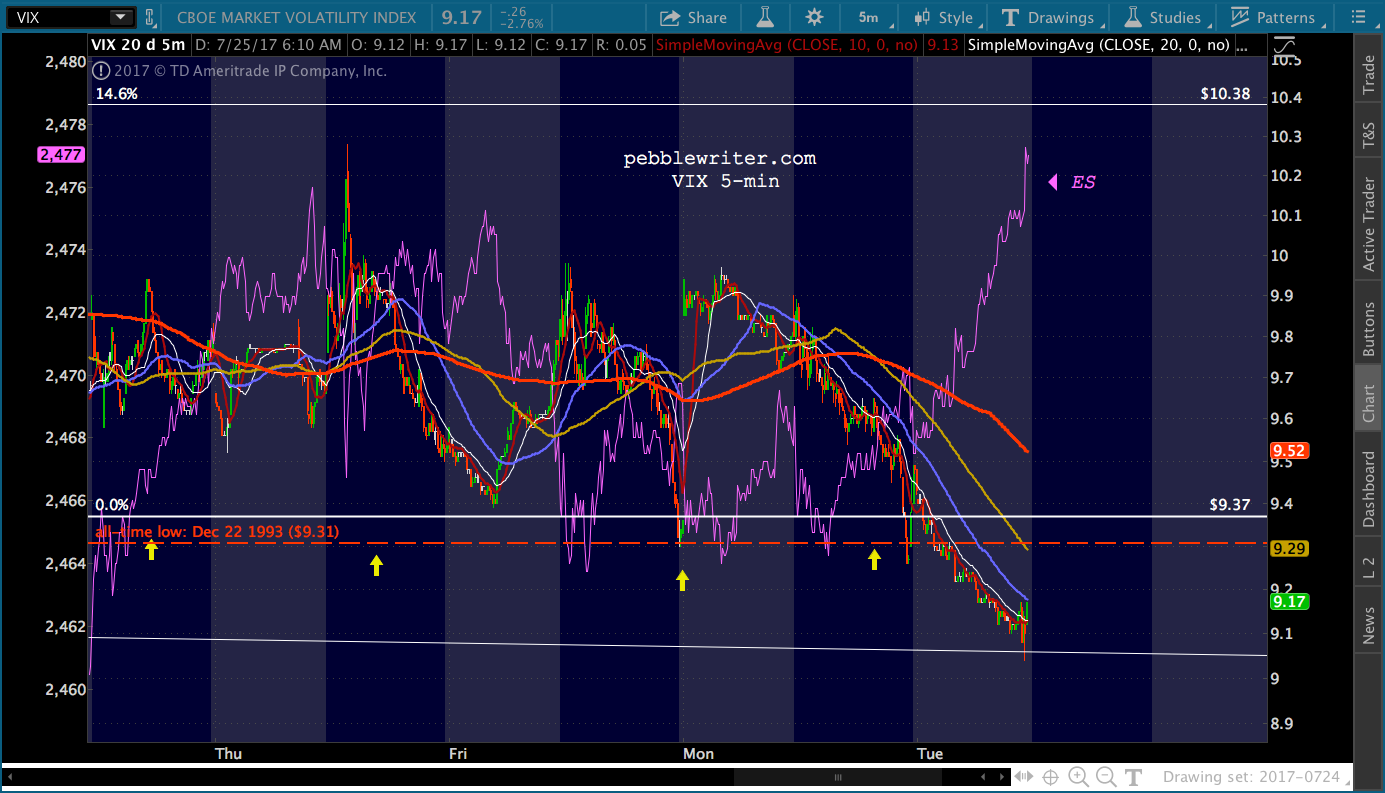
    As if on cue, VIX’s actions yesterday should put any lingering doubts to rest.  It was hammered to single digits, lower than it has been since Feb 2007 and a scant 0.59 from its all-time lows set on Dec 22, 1993.To be clear, VIX did not fall to 9.9 because investors looked at the investing landscape and decided that downside protection was unnecessary.  It was driven to new lows specifically to support stocks when they were in danger of losing momentum.

    The two critical moments were at the open, when SPX was in danger of repeating its pop and drop from last Friday — and, around 1pm — when SPX was losing momentum and had dropped back into a falling channel.

    They are marked with yellow arrows on the 5-min SPX chart below.

    Note that VIX had already dropped 37% in the past week in order to help SPX break out.  It sat near its Feb lows five sessions in a row, dancing about the .886 retracement of its rise from those lows.

    Yesterday, as ES began to break down from its overnight momentum (purple arrow), VIX suddenly plunged .45 within seconds.  I call this a “shot across the bow.”  It’s designed to scare off bears, and it usually works.

    SPX was in danger of dropping back through the neckline of a nice little H&S Pattern that targeted 2376.  And, VIX’s action held it above the neckline for about 30 minutes.

    At 10AM, however, SPX began to fall below the neckline again.  So, VIX began dropping again, eventually falling below the dotted red TL (which connected last week’s lows) when SPX suddenly plunged all of 5-points at 12:50PM.

    Instead of falling to flesh out the white, or even red channels, SPX broke out again and even topped its .886 Fib for two hours before closing unchanged on the day.

    Is it a problem that central banks and their allies can manipulate stocks lower at will by shorting VIX?  Should it bother us that rallies can be ordered up like a burger and fries at a fast food joint?

    I could make a pretty good argument for the importance of market integrity.  But, that ship has already sailed, as detailed last week in How Broken is the Market?  Instead, I’ll remind investors and traders alike that every previous effort to prop up stocks long after the underlying economic reality argued for a correction has failed.  Every.  Single.  One.

    I see no reason why this one should be any different.

    continued for members(more…)

  • Update on US Dollar: May 1, 2017

    In our last update on the US dollar [see: Mar 27 Update] I noted that it had reached our previous target at an important Fib level and two important trend lines.  The only thing it hadn’t tagged was the 200-day moving average, which would have meant dropping through all that other important support.

    DX reached the yellow TL and the .618 Fib lines — arguably our most important downside targets.  The one mystery is the SMA200, currently at 98.447.  Note that DX reached it back on Nov 9 (aftermath of election day) and got a very sharp bounce.  I wouldn’t be surprised to see another such sharp plunge and recovery sometime in the next few days.  Though, the bulls would probably rather it wait until the SMA200 has reached 98.901 so there aren’t any Fib-related mishaps.  If so, that might not be for another few weeks.

    It will come as no surprise to regular readers that the bulls got their way.  DX bottomed that day, then bounced for several weeks until the SMA200 had finished climbing to that key Fib at 98.901.  It tagged it on Apr 24 and has been going sideways ever since. We’ve talked in the past about how the Fed has a love-hate relationship with the dollar.  As a net importer, the US needs a strong dollar in order to avoid inflation.  And, a strong dollar usually supports strong stock prices.

    By offering yields that are much higher than Japan and the eurozone, it hasn’t been all that difficult to attract capital.  And, that’s where the “hate” side of the equation comes in.  The US needs higher interest rates like a fish needs a bicycle.  If it can’t balance its budget with the 10-yr at 2%, how in the world will it manage at 3-6%?

    It must have unnerved the FOMC when the dollar slipped lower following the Mar 15 rate increase.  Plenty of jawboning later, they got their bounce on Mar 27.  But, we’re right back at those lows — meaning investors don’t especially believe the FOMC’s narrative regarding additional hikes this year.

    We’ll take a look at what the charts say.  For the past several years, they’ve been much more accurate than all those Fed press conferences put together.

    continued for members

    Remember, when it comes to the dollar (and, just about everything else) it’s all about keeping stocks on the rise.  Since the yen carry trade took off in 2011, a rising dollar has been instrumental to higher stocks prices.  The only exception was when rising oil prices took over from Feb-Jul 2016.

    Looking at the daily chart, we can see several periods where DX floundered, and stocks suffered as a result.Here’s a closeup, with the bulk of CL’s rally (from 26 to 52) marked with the red arrow.Note that DXY has clearly broken the purple TL — though it has been able to hold the SMA200 (more or less.)  With CL having reached TL support on Apr 27, it seemed like it might be taking over for DX and USDJPY again — especially since it rebounded above its SMA200 over the next two days.

    But, CL is currently trading below its SMA200, which casts considerable doubt on DXY’s plans.  As we’ve discussed many times, higher oil prices have real consequences: higher inflation, which leads to rate increases (or, at least expectations of them) and thus an even more unbalanced budget.

    For the past few months, CL has bounced back and forth in an effort to prop up stocks without generating too-high inflation.  Then, there’s the corollary: too low inflation, which would knock DXY back.When DXY broke below the rising purple TL, stocks were propped up by VIX — which just today dipped into single digits at 9.9.  It hasn’t been lower since 2007 when it reached 9.39.  The all-time low is 9.31 from 1993.

    So, it would seem that VIX is running out of room to the downside, unless TPTB are going to try to convince investors that risks have never been lower — perhaps a tough sell with valuations near all-time highs.

    This brings us back to DXY.  It should continue sideways for quite a while, bouncing just enough to keep stocks level while CL deflates as necessary, and dropping back down to the yellow TL whenever CL is bouncing.  VIX would be the equalizer and fill in the gaps when the algos are too confused to buy — just like today.Of course, if DXY drops through the SMA200 and the yellow TL, then we have some very obvious Fib targets including the .786 at 97.583, the .886 at 96.789 and the purple .618 where it intersects the purple channel midline at 96.465 in July or August.

    If the purple midline breaks down, the next major support isn’t until 91 in early September and 87-88 as early as the end of the year.

    Regardless of which way it goes, the upcoming Fed presidents’ speeches, in the wake of this week’s meeting, should make for very interesting exercises in obfuscation.

    Stay tuned.


  • Charts I’m Watching: May 1, 2017

    Lots of charts to get to today.  I spent the weekend looking at currencies, and will be posting updates on each over the next few hours.

    Futures are currently up 5 points, which is largely a function of a continuing increase in USDJPY and the 32nd instance of VIX dipping or, in this case, simply remaining below its long-term channel bottom since December.continued for members(more…)

  • Stagflation?

    If the US facing stagflation?  Or, maybe it’s already there.  Like artificially low interest rates and all-time highs in the stock market, the official economic data isn’t exactly alarming.  But, where’s the growth?  Where’s the spending?  Maybe, just maybe, the official data doesn’t paint a very accurate picture.

    It doesn’t take an economist to see that, at this rate, GDP growth will be negative in the second quarter.

    Personal spending has essentially fallen off a cliff.

    The official unemployment rate might be below 5%, but seems to have reached a long-term floor.  Of course, it’s been redefined over the years.  Without those changes, the actual numbers are much more troubling.And, aside from a slight decline last month when the YoY increase in oil prices moderated, inflation is clearly on the rise.

    Like unemployment, the way that official inflation data is collected/reported has changed drastically over the years.  The actual picture explains why consumer spending is MIA.

    If it walks like a duck, and quacks like a duck…

    continued for members... (more…)

  • Striking Distance

    This is day 8 of our membership promotion, running now through the end of the month for members and non-members alike. We’re offering a 25% rebate off the first month of Monthly and Quarterly auto-renew subscriptions. Annual memberships are available at a very substantial discount (rewarding those who act quickly!)

    Remember, the annual pricing is available to current members. If your current membership hasn’t expired yet, we’ll tack your new subscription on to your current expiration date. This can be especially valuable for those who took advantage of a special last year which offered a discount on the first year of a auto-renewing annual subscription.

    To sign up for a new monthly or quarterly subscription, CLICK HERE. For details on an annual subscription, drop us a line with the subject line “sign me up!”

    * * *

    After SPX’s break out on the back of a 37% plunge in VIX, it’s no surprise that the VIX has kept it within striking distance of new all-time highs.

    In dropping that 37%, VIX completed a deep retracement of its rise from 9.97 — the lowest it’s been since 2007 — to 16.28.  The .886 retracement is considered the last stop before prices drop through the previous lows.  Imagine: risk being considered lower than at any time since 2007!

    Yesterday, VIX spent the entire day dancing around that .886, with a dip below it every single time SPX started slipping.  The message to algos was that VIX was about to drop to new lows and, therefore, stocks should be bought.It was enough to keep SPX from completing a simple retracement from its .886 to its .786, or any meaningful dip until the final minutes of an otherwise nonsensical session.Today’s a new day, as CL is closing in on our 48.35-48.45 target and investors are no doubt anxious to express their disappointment with the lack of details provided for the fantastic, big-league tax cuts “revealed” yesterday.

    Despite the slight bump in futures overnight, our downside targets remain intact – starting with 2384.

    continued for members(more…)

  • Calm Before the Storm: Apr 26, 2017

    After a furious VIX-inspired rally the past two days, futures are dead flat.  VIX’s continuing slump (-1.4%), USDJPY’s continuing ramp (+0.32%) and WTI’s continuing threat to break its SMA200 (-1.0%) seem to have perfectly balanced one another out.Depending on whom you ask, Trump’s tax plan due out later today will either provide a nice spark for a continuing rally or lead to massive disappointment.

    continued for members(more…)

  • Who Let CAT Out of the Bag?

    Is Caterpillar’s gap higher the real deal or a dead cat bounce?

    There was an interesting post on Zerohedge this morning discussing its earnings.  GAAP versus non-GAAP made a huge difference, as is so often the case these days.

    Because while CAT reported adjusted EPS of $1.28, up exactly 100% from a year ago  – almost as if it was goalseeked – something far less appetizing emerges when looking at CAT’s actual, GAAP EPS, which happen to be exactly one quarter of the non-GAAP number, or $0.32, a 30% drop from a year ago.

    The term “goalseeked” caught my attention.  As it turns out, I chart CAT from time to time.  On Jan 27, CAT reached the top of a falling channel shown below in red at the same time that it completed a Gartley Pattern at the .786 Fib.

    The channel looked pretty legit, as it was based on two recent, prominent lows.  And, the .786 Fib was legit enough, as CAT had a significant reversal just shy of its .618.  The last time I charted it, I assumed it would reverse off the .786 and, at the very least, tag its SMA200 as it approached the .618 at 90.41.

    As an aside, it had already reached 90.41 (on the nose) on Mar 9 — a few days after Federal officers raided its offices, looking for evidence of accounting irregularities.  It dipped even lower by Mar 27, but was saved from a worse fate by a timely Goldman Sachs “conviction buy” upgrade (a more accurate call than Goldman’s sell recommendation at its lows of 57 in Jan 2016…but, I digress.)

    Until the VIX smackdown of the past two days, sub-90.41 looked fairly likely.   CAT had fallen below its 10, 50 and 100-day moving averages and was working lower in a channel that intersected with the SMA200 at 89.65 yesterday.

    Instead, CAT rose over 11% over the next two sessions.  It reminds me a great deal of GS’s goal-seeked “breakout” back in November [see: Goldman’s Slick Trick.] which saw it gap above strong resistance and pile on 20% just about the time — and, I’m sure this is a coincidence — that stock options became exerciseable.

    That analysis stuck in my mind because it was so “goalseeked” as to be blatantly obvious.  In fact, just today GS reached an important price level that could have significant implications for both it and broader markets.Back to CAT.  Maybe the fabulous, non-GAAP numbers will be enough to send it up to new highs.  Maybe, they won’t.  Aside from the .886 Fib at 105.18, there’s one final trend line (in purple) that suggests at least a pause.

    And, of course, there’s the issue of oil prices — which, because they’re highly correlated with CAT’s business and stock price — could have an even greater impact than creative accounting going forward.

    Stay tuned.

     *  *  *

    For more on goal-seeking SPX targets through creative and timely VIX bashing, check out How Broken is the Market?

  • How Broken is the Market?

    Yesterday, VIX experienced its 4th biggest drop ever, plunging 25.9% from Friday’s close even though France’s election delivered the very same results that just about everyone expected.

    It has dropped even more this morning, and is now off 33.3% from Friday’s highs — despite the fact that there’s the potential for war on the Korean Peninsula and the probability of a government shutdown later this week.

    Is there any logic to this?  What should we take away from the behaviour of the “Fear Index?”

    Between 2014-2016, VIX very rarely tagged the bottom of a huge, rising channel (shown below in yellow.)  When it did, this meant that fear was unusually low.

    Without fail, however, every tag on the yellow channel bottom meant that stocks were at or very near a significant top.

    Things changed, however, following the US election.  VIX plunged right in the middle of stock futures’ 5.7% mini-crash.  This was beyond ridiculous.  Selling VIX as futures are plunging is the equivalent of cancelling your homeowners policy as a tornado is ripping the roof off your house.Who would do such a thing?

    It would have to be someone with unbelievably deep pockets — someone for whom ensuring that stocks continued to march higher was more important than the many billions of dollars they might lose in the process.  In other words — central banks.

    In a note on Apr 21, Merrill Lynch reported that central banks have already “invested” over $1 trillion YTD — an amount on track to top 2008’s $2.8 trillion by 25% and more than double last year’s $1.7 trillion.

    Some central banks, like the BoJ and SNB, invest directly in equities in order to manipulate stock prices higher. It’s more effective than big, clumsy measures like QE.  Over the years, however, they’ve discovered they can get more bang for their buck by using more refined measures like the yen carry trade, oil futures and VIX to drive algorithms.

    Simply put, algorithms look to a variety of indicators to tell them when to buy and sell stocks.  If oil spikes higher, stocks will too.  If USDJPY rallies, you can bet that stocks will be close on its heels.  And, if VIX sheds 25% in a day, well…we’ve seen what happens, haven’t we?

    Machine trading is gradually replacing real, live people — traders in pits who might look up, scratch their heads and ask “wait a second, does that make any sense!?”  Just a few weeks ago BlackRock, the world’s largest investment manager with $5 trillion under management, announced it was laying off human traders and increasing its emphasis on machine trading.

    When VIX drops, algos don’t ask why.  They simply read it as a reduction in risk and trigger buy orders.  However, as VIX approaches long-term support such as the huge, yellow channel, algos know that the rally is almost over.  At least, that’s what they used to think.

    In its last “normal” tag, on Aug 9, 2016, VIX correctly signaled a drop in ES that extended to 163 points at its election night lows.  But, as mentioned above, VIX was hammered that night and, by mid-November, had broken down through channel support (the white arrow) in order to produce new all-time highs in stocks.

    The next time VIX tagged the yellow channel line, on Dec 21, it produced a very modest 34-pt drop in ES.  Were the algos learning?  Was VIX signalling a fundamental change in the level of risk in the markets?Since Dec 21, VIX has dipped below the yellow channel bottom 27 times — an astounding one out of every four sessions.  More importantly, the dips always come at crucial moments, when ES and SPX are in danger of breaking trend (thin purple lines below) or need a boost to get up over resistance.

    The latest example, of course, is this week.  ES and SPX have both been locked in a falling channel since their all-time highs on Mar 1.  Yesterday, based largely on VIX’s historic plunge, futures broke out of that channel and are threatening to make new, all-time highs.  Improbably, this has occurred during a week of highly elevated geopolitical and macroeconomic risks.

    At 10.22 this morning, VIX almost reached the Feb 1 lows of 9.97 (the day it plunged 23% to convince algos that the Fed’s rate increase was no big deal.)  The last time VIX was this low was in Feb 2007, just months before the S&P 500 peaked and crashed 58%.  I’m not suggesting that a crash is imminent. But, I think it’s important to realize that the “market” is broken, and that its gains (e.g. the “Trump Rally“) possess all the integrity of a campaign promise.

    There was a time when VIX was a great indicator of fear in the markets.  Now, it’s just another tool with which to drive stocks higher.  Put simply, the tail is wagging the dog.  And, the people doing the tail-wagging are not only determined, they have access to an unlimited amount of free money.

    Now, on to today’s forecast.  SPX backtested to within .79 of our target at the yellow neckline yesterday before deciding that appearances aren’t all that important.

    continued for members... (more…)

  • If At First You Don’t Succeed…

    SPX has seen two bullish IH&S Patterns busted over the past two weeks.  They came close enough.  The latest even completed last Thursday before fizzling after the overnight ramp fell apart under scrutiny of the mounting risks in the markets.

    VIX’s 26th Drop Below Support this Year

    But, there’s nothing like a 1%+ gap higher over a weekend when investors are already on edge, to complete an IH&S —  which is exactly what we’re facing this morning.  While the French election results were a relief to the status quo, there are still other significant risks out there.  This week.

    Sure, they can hammer VIX back down below support (-32% in the past week!) and break USDJPY out of its latest bearish pattern; but, will the breakout hold this time?  Last I heard, the Korean situation hadn’t gone away, and the US government still faces a potential shutdown Friday night.

    continued for members(more…)

  • On the Cusp

    CLICK HERE for details on our new membership promotion.  The faster you jump on it, the more you save!

     *  *  *

    SPX reversed at the very last possible moment, yesterday, before the meltup could be labeled a breakout.  For now, we remain nervously short from 2361.32 for what should be at least a 10-pt gain.

    Why “nervously”?  As we discussed yesterday, the good news for bulls is they’re at the cusp of a strong breakout.  The good news for bears is they’re at the cusp of a breakdown.  That’s right.  This is one of those critical turning points that will determine the course of the next few months — and, who gets to celebrate come Monday.

    Of course, the French election is only one in a list of several potentially landscape altering events scheduled for next week.  There’s also the possibility of a government shutdown, potential nuclear war in North Korea, and the very real and expanding wars in Syria, Afghanistan and wherever else we’re about to bomb.

    One thing’s for sure…real, live investors, speculators and traders have woken up to the risk.  Remember the string of VIX plunges (the yellow arrows) below the yellow channel bottom?  As of a few weeks ago, it was averaging one of every four sessions.  Not so much, any more. Might markets exhibit a little nervousness in the lead up to the week ahead?  Stay tuned.

    continued for members(more…)