
Ten years ago, I posted my first public observations on the state of the stock market. In Collision Looming, I noted a number of chart patterns which indicated a potential top, writing:
Price target if the longer term wedge plays out is 46 – 100% of the rise [from 666], indicating 320-700 points on the SPX.

With the S&P 500 at 1370, this meant a drop of at least 23% to a target of 670-1050 – a startling scenario since the market had more than doubled since its 2009 lows and sentiment was quite bullish.
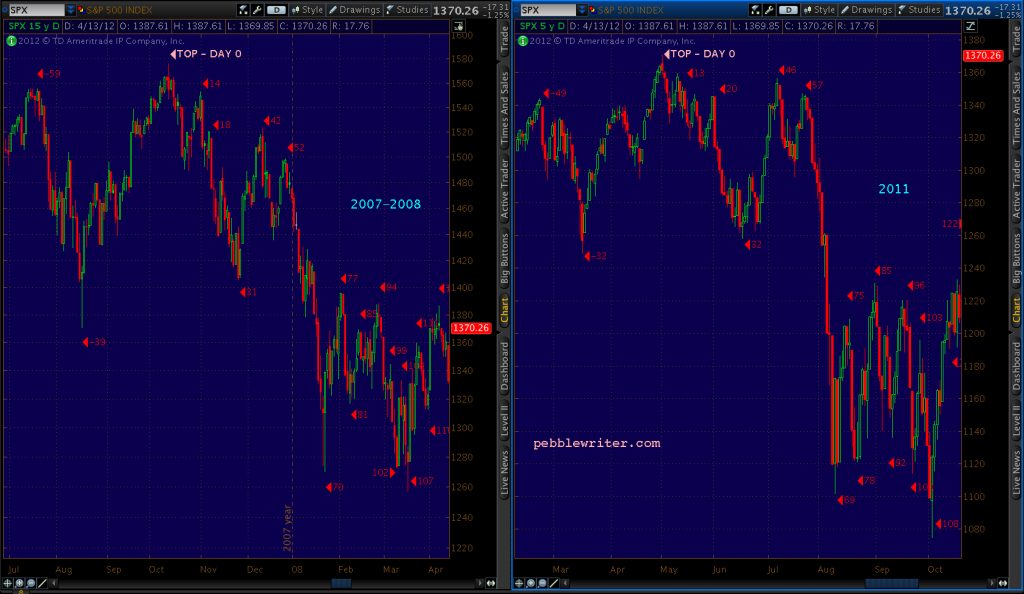
A few weeks later, I made an even more startling discovery: the S&P 500 was following in the footsteps of the 2007 top – an analog. Daily moves matched it in both timing and magnitude. If the trend were to continue, it would confirm what I had written back on May 2: a very significant selloff.
I began posting about the analog on June 8 [see: Deja Vu] noting at the time:
In any case, if SPX bounces as I expect here at 1280, it will have set up a similar channel. The implication is that we will, indeed, start what looks like a new bullish move to the upside.
It’s not. Judging from past results, it’s a major headfake that will retest the former support line (bottom of the rising wedge) before resuming its decline.
I expect the rebound to stop somewhere short of 1320 before the end of June — ideally Wednesday the 29th… Once we start down, we’ll complete the H&S that’s been forming for six months (the channel bottom is the neckline).
Bottom line: we have about two weeks left to plan those masterful bearish trades, but there are still a couple of pennies left in the path of this steamroller.

I fine tuned the forecast extensively over the following weeks, adjusting the timing and price level of the final peak to July 21 and SPX 1344. On July 20 [see: Merry Christmas!] I wrote:
In an effort to be as clear as possible… tomorrow is Christmas Eve 2007. If you’ve been following this blog, you know what that means and what to do. We have maybe 20 points at the most to the upside, with 1340-1344 a reasonable target.
Following up the next day in Pulling the Trigger:
1347 might be the last best chance at an excellent short. I expect it to start down in earnest around 10:45 AM Pacific time.

The rest, as they say, is history. SPX topped at 1347 shortly thereafter and didn’t stop correcting until it reached 1074 in October – a 22% and 296-point correction which came reasonably close to the original 23% and 320-pt decline the charts indicated five months earlier.

As the chart below shows, the analog had played out quite well. At least a few followers made a decent return trading on the drop, and a few more were able to protect their portfolios.
 As for me, I was hooked on the power of charting and technical analysis. Many times over the past 10 years, I’ve seen the markets respond exactly as they forecast, irrespective of bullish sentiment, earnings and Fed prognostications. It has been very gratifying.
At times, though, it can be quite frustrating as actions are taken to counteract or mitigate the moves suggested by charts. In October 2011, when SPX was in a position to construct another leg down per the 2011 as 2007 analog… …we saw a breakout in the USDJPY and resurrection of the yen carry trade which busted the pattern.
 USDJPY began an impressive 68% ascent in October 2011, pouring gasoline on the bullish fire the Fed reignited with Operation Twist the previous month.
 With the success of the yen carry trade, the Fed and other central banks “taught” the increasingly algorithm-driven markets to pay strict attention to certain signals. This was a simpler and far less expensive way of triggering a particular response at a critical time than rolling out another round of QE. But, there were occasional complications.
USDJPY’s ascent (devaluation of the Japanese yen) meant that oil (priced in US dollars) prices soared – particularly after Japan’s nuclear reactors were shut down in the wake of Fukushima. With Japanese CPI nearing 4% (inconvenient when you’re trying to keep interest rates at or below 0%), the yen carry trade was running out steam.
So, as “luck” would have it, oil prices suddenly crashed – at exactly the same time that USDJPY began another leg up.
 A few years later, when plunging oil prices began to worry investors about the strength of the economy, oil would bottom out on Feb 11 – the exact same day as stock prices.
 In addition to USDJPY and oil prices, VIX has become a favorite tool of the market’s protectors. Algos have learned that plunging volatility is a great signal to buy stocks. So, we’ll often see a sharp reversal or breakdown in VIX when stocks have reached critical support such as in the wake of the 2016 presidential election.
 These use of these and other tools have “saved” markets time and time again. They have also protected the reputation of central bankers at the Fed and ECB who, unlike the BoJ, insist that any connection between their actions and the stock market is purely coincidental.
They have been able to “fine tune” the markets, nudging it hither and yon, promoting the premise of market integrity while saving big bazookas such as asset purchases for those instances when more drastic action is necessary.
They have also complicated my job. As mentioned above, many bearish signals over the years have been countered or mitigated by central bank actions. The historically dependable Death Cross (where the 50-day moving average declines below the 200-day) for instance, has often as not resulted in an important bottom rather than a breakdown.
 Head & Shoulders patterns are frequently busted by a sudden, unexplained plunge in VIX or pop in USDJPY. We saw it happen again just the other day in order to prevent a “whopping” 1.8% decline after an apparent trend line breakdown at a key Fibonacci level.
 The increasing frequency of these false alarms augments the effectiveness of central bankers’ tools, as traders are less likely to pile into a short position at the first sign of a downturn. Investors are more content to buy each dip – turning more and more traders into buy-and-hold, longer-term investors.
While complicating the task of forecasting equity turning points, the use of these tools has actually improved our forecasts in other areas such as currencies and commodities. For instance, the need to protect important price levels for SPX or DJIA quite often necessitates a dramatic and very predictable move in USDJPY or CL.
We’ll still get those occasional home run short calls like May 20, 2015 [The Last Big Butterfly], October 3, 2018 [VIX Takes the Plunge], and Feb 20, 2020 [Buckle Up.] But, the Fed is doing its best to turn traders into investors and to convince investors to never sell.
Over the past few months, I have been working with a quant friend to fine tune a model which combines powerful quantitative sector rotation signals with chart patterns and technical analysis in order to optimize timing and enhance risk-adjusted returns. The model has generated risk-adjusted returns well in excess of the S&P 500 with very low volatility and minimal trading. I hope to be able to share with members by the end of May.
In the meantime, I’d like to thank the members of this little club of ours. In the past 10 years, I’ve posted over 3,000 times, entailing over 50,000 charts and 2,500,000 words (think War and Peace times 5) and generating over 10 million page views – all without a single Cialis banner ad.
Members have come and gone over the years, but I’m thrilled to say that many of the original 30-40 members from July 2011 are still on board. I’m working harder than ever, usually putting in 12-hour days and still enjoying the challenge of what I feel is one of the best puzzles out there.
I encourage members to reach out with any ideas re coverage in the coming year. Many of you have alerted me over the years to market conditions or anomalies which have led to interesting insights that benefit all of us. Questions are always welcome.
Last, I’ve been heartened that a number of members who have drifted away over the years are finding their way back to us. Now through May 10, former members may rejoin at their last subscription price. Contact me for details. And, for those who would like to try out the site, we are again offering a discounted first month at only $99. Click Here for details and to sign up.
Cheers,
Michael


