Category: Charts I’m Watching

  • New Analog I’m Watching

    ORIGINAL POST:  4:15 AM

    I’ve been watching several analogs for the past several weeks, and this is one screaming the loudest just now.

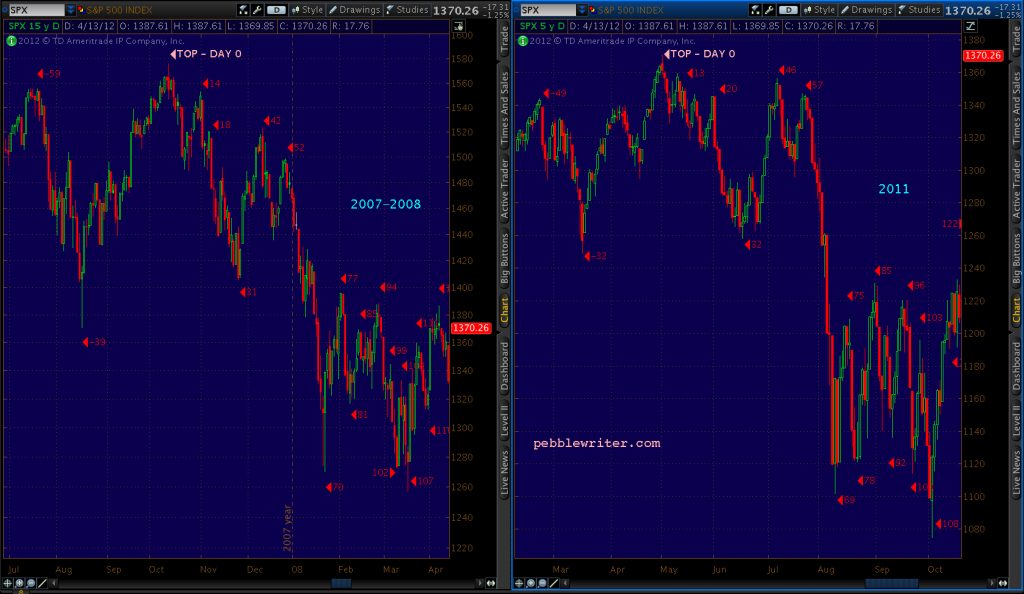
    As always, an analog makes a lot more sense when there’s a plausible case to be made for the expected path forward.  That was certainly the case last year, when I posted extensively about the 2007/8 as 2000 analog [see: OMG, WTF and Money Back Guarantees and Happy New Year.] I believe this one qualifies, though there are a few hoops to jump through first.

    2010 Rising Wedge
    2011-2012 Rising Wedge

    The odds of it playing out rise dramatically if the bump we saw Wednesday extends up to 1380-1400 before any further declines.   If so, the bold purple dashed line above — the midline of the channel I expected would stop Tuesday’s sharp sell-off — would make a terrific neckline for a H&S pattern that targets 1305-1317.

    The H&S pattern is key.  If the neckline holds — probably around April 24-26 — the H&S fails and we head up to 1462-1472 around May 4-8 for the end of the bullish ride.   Likewise, if we see no reversal by 1430, the H&S busts and we’re practically guaranteed an immediate new high.

    Note that Tuesday’s low was at the .786 of the 1340-1422 rise, making it a perfect Point B for a Butterfly pattern.  Such patterns extend to the 1.272 (1317) or 1.618 (i.e., 1288, which would slightly overlap the Oct 27 1292 high and might be problematic for the EW picture.)

    To me, a drop to 1305-1317 seems fairly plausible.  The tricky part comes in calling for a reversal after SPX has fallen 120 points from its recent high.  The timing looks to be early May, and we have a couple of Fed-centric events around then: consumer credit on the 7th and minutes from Apr 24-25 on the 16th.   So, I suppose anything’s possible.

    If the analog is still in play, this is make or break time.  Those who, like me, have been resolutely bearish are itching to get the party started.  Sentiment would be fiercely negative.  But, a strong bounce around 1300 would be the signal that the analog is good.

    If so, we’re likely to go back and tag the price level of the original apex (about 1462) of the rising wedge we’ve been in since last August.  I’ve seen this phenomenon play out again and again on both large and small scales.

    While completion of the Crab pattern which might set up by then would indicate potential to 1489, I believe the .886 Fib of the Oct 07 – Mar 09 decline (a Bat pattern) will step in to prevent a rise in excess of 1462-1472.

    But the greater limiting factor is the  bold, red dashed trend line labeled “midline” running through the chart.   It’s an incredibly important TL that dates back to March of 1935, running right down the middle of the channel guiding SPX ever since (it’ll show up on another bigger, more important analog I’m finishing up.)

    If all those fairly logical (but, by no means guaranteed) pins drop into place, the lock will click and the door will swing open to all sorts of fun stuff.  I’ll be watching it along the way, of course, waiting for the whole mess to come crashing down in a heap.  As I mentioned, there are other analogs at work that have potential.   One of them really knocked my socks off, and I’ll probably post it this weekend here on the new website.

  • Was That It?

    UPDATE:  1:30 PM

    We got a bounce just below 1395 as expected, and the market is currently retesting that level.  Again, if the rising wedge and our little channel hold, there is decent upside ahead.   There’s a lot riding on today’s sell off for both bears and bulls.

    Note the RSI TL tag (red arrow) to go along with the rising wedge lower bound test.  This chart shows the yellow Butterfly pattern with inception at 1347.  The 1.272  at 1421 was already tagged on Monday — which was also the .886 in price and about .86 in time of the yellow rising wedge that lies within the huge red, dashed rising wedge.  This was our preferred Butterfly pattern completion.

    But, as noted in All the Pretty Butterflies last week, there are two other ways of looking at this same Butterfly pattern.  Starting the pattern on July 7 at 1356.48 yields a 1.272 at 1433, just beyond the rising wedge’s .886 in price (1420)…

    …and a May 2 start at 1370.58 results in a 1.272 completion at 1451 — just shy of the rising wedge apex — in fact, close enough to be considered on target (within a margin of drawing error.)

    I think it’s important to realize that the big, red rising wedge is still hanging out there, drawing prices higher for at least one last tag.  It intersects with the apex of the yellow wedge, somewhere between 1460 and 1470 and between May 7-11 (the range results from having to consider/ignore the impact of shadows on earlier peaks and bottoms.)

    Prices could conceivably stay in the rising wedge all the way there, but there are also many instances of rising wedges breaking down, only to BACK TEST TO THE ORIGINAL APEX.

    Either way, if we can get through the next few days without the yellow rising wedge breaking down, we could see 1433 around the 13-15th.

    If the yellow rising wedge does break down, it’s possible we’ll get back to 1433 or even 1451 on a back test.

    These are precarious times, when a single initial claims report or failed Spanish bond offering could sink the market.  While I’m positioned for lower prices, I’m hedging my bets because I’m concerned the bull isn’t quite done over the short term.

    NYA and RUT, in the meantime, have definitely broken their rising wedges.  I’ll post more on them after the close.

    When SPX does break, the damage could be severe.  The big red rising wedge is currently all the way down at 1180 — 15.7% below current prices.


    UPDATE:  10:25 AM

    The market continues to sell off, with SPX about to break 1398.  Here’s a close up of the wedge and the relevant fib levels.  Remember, an intra-day break of the channel isn’t nearly as important as a close beneath the lower bound (in yellow).  I’m also watching the little channel that set up over the past couple of weeks, marked in red, dashed lines.

    The .886 Fib level lines up with the bottom of that channel at 1395.08, meaning it’s the most likely place for a bounce — if we get one.

    Meanwhile, VIX is getting a pretty good bounce this morning — up over 10% to an intra-day high of 17.66 and testing its falling wedge.There’s a little rising channel to match SPX’s falling channel.  It breaks through the falling wedge at around 17.75.  It also appears VIX is possibly tracing out either a Bat or Crab pattern (in purple) with potential point B’s at the .382 or .500.

    A Bat completion would target the .886 at 20.38, while a Crab would target the 1.618 at 25.92.  All contingent, of course, on whether we can break out of the wedge without merely widening it as has happened several times.

    The VIX RSI channel I theorized a couple of months ago has played out very accurately, and appears to support the idea of VIX having more upside than just the falling wedge boundary.

    ORIGINAL POST:

    A few days ago we discussed the three Butterfly patterns we were watching, each of which was posed a legitimate level at which the melt-up should abate [see: All the Pretty Butterflies.]  My favorite completed at 1421, which we reached (high of 1422.38) on Monday the 2nd.

    Since then, we’ve not bested 1422.  And, with this morning’s imminent sell-off, it’s possible the yellow rising wedge will break.  The key will be 1396, below which we’re no longer in this smaller wedge and have downside potential to 1380 or so.

    A bounce at 1396, on the other hand, means we’re likely to find our way higher.  But, the narrowing rising wedge is almost done.  Today, it ranges from 1396 to 1431.  By this time next week, it’ll be 1410-1437 and will have reached the .886 of it’s time span (to match the .886 of its price span already reached on Apr 2.)

    We’re about to find out just how much investors have been relying on the idea of QE3 for their bullishness.

    Stay tuned.


  • The Wipeout Ratio

    A simple calculation comparing major banks’ derivatives positions to their assets and capital shows how little it would take to wipe out either.  The first ratio is the multiple that derivatives represent of Tier 1 capital.  The second shows the miniscule percentage decline in the value of derivatives portfolio it would take to completely wipe out Tier 1 capital.


    Goldman Sachs, for instance, has $47 trillion in derivatives exposure — 2,480 times its Tier 1 capital.  A 0.04% decline in the value of the derivatives portfolio would wipe out Tier 1 capital altogether.

    Overall, a 0.18% decline would do the entire bunch in.    Something to think about, especially as the vast majority of derivatives are OTC, are not priced in public markets, and are obscured/netted out in balance sheets.  Remember, “too big to fail” really means “subject to taxpayer bailout.”

    A little over a week ago in a Zerohedge article we learned that Italy’s previously hidden derivatives exposure amounted to 11% of the country’s GDP.    A recent $3.4 billion payment to Morgan Stanley to settle a 1994 contract wiped out half the value of the tax hikes recently imposed on an already crumbling economy.

    If this doesn’t seem terribly important, consider that the derivatives exposure of the five banks above alone, at $240 trillion, is four times the combined GDP of every country on earth.  JPM, by itself, has notional derivatives exposure that exceeds the combined global GDP.

    I fear this is the story of the year, folks.  And, it’s just now starting to get some press.  As we learned with AIG, if one segment of the financial markets suffers unanticipated losses, the entire house of cards can come crashing down.  Banks know how bad the situation is; how else to explain the lack of interbank lending — particularly in the euro zone?

    Stay tuned.

  • All the Pretty Butterflies

    In typical end-of-the-quarter fashion, the markets seem to be running in place.  But, by one measure, the melt-up might already be finished.

    Recall we were looking at 1419 as one of two possible tops (the other being 1433) when SPX was at 1402 back on March 23 [see: The Tipping Point.]   I mentioned it as a target of certain harmonic patterns.  We also recognized it as the .886 Fib price level of a small rising wedge within a larger rising wedge.

    There are actually three potential harmonic targets suggested by the Butterfly pattern that features 1074.77 as its Point A and 1292.66 as its Point B.  All of them assume the pattern completes at the 1.272 extension; but, keep in mind that Butterflies can also complete at the 1.618 extension.  If you have no idea what I’m talking about, visit Crabs and Butterfly Patterns Explained for more info.

    Like all harmonics, Butterfly Patterns begin at a meaningful peak or trough (though frequently you can find smaller patterns within patterns.)  The primary requirement is that the Point B be at the .786 Fib level.  Here are my three candidates for the pattern we’ve been watching for the past several months.

    #1 is the most bullish and begins at 1370.  I like the fact that 1370 was the high for all of 2011, back on May 2.  But, it leaves us with a less than ideal Point B — 14 points below the .786 (1292 v 1306).  It would complete at 1451.


    #2 begins at 1356 on July 7 and features a Point B only 4 points below its ideal .786 of 1296.19.  It completes at 1433.  Closer still.


    Butterfly #3 — my personal favorite — begins at 1347 and Point B ((at an intra-day high of 1292) is 4 points above its ideal of 1288.74.  The closing price of 1284 was 4 points below.   This particular pattern completes at 1421.05 — just 1.90 from the Mar 27 high of 1419.15.


    Could 1419 have been the end of this wave?  You bet.

    I always like it when one harmonic pattern matches up with one or more other harmonic patterns and chart patterns.  Here’s one I just can’t get out of my head.


    Seems just a little too coincidental that a TL connecting current prices to the 2007 high would be exactly parallel (log scale) to a TL connecting the two major bottoms of the past decade — all at a time when we’re:

    • at .618 (in time) of the huge rising wedge dating back to Mar 2009, and;
    •  within a stones throw of the .786 or .886 retrace (take your pick) of the 2007-2009 decline.

    Here’s a couple of charts with the Fibs thrown in.


    If you’re an überbull, there’s a potential silver lining.  The May 2nd 1370 peak — a .786 retrace of the 2007-09 drop, could be the Point B of a much larger Butterfly pattern.  If it were, we’d have a 1.272 extension up around 1823 and a 1.618 at 2137.

     
    Of course, if you are an überbull, you’ll probably want to use the arithmetic instead of log scale and draw your channels more like this:

     >

    Of course, that scenario would probably mean $8 gas, 12% T-bills and $3000 gold to go with our $20 trillion in debt.  But, that might just be the price of a “healthy” economy, right Ben?
  • What Do Bankers Dream Of?

    When Wells Fargo CEO John Stumpf sleeps, he dreams — like all good bankers — about numbers.  He probably doesn’t dream about the number 600 — the number of foreclosure packages signed each day by his robosigners.  He probably doesn’t dream about 14,420 — the number of conveyance claims fraudulently submitted to HUD in exchange for $1.7 billion from the FHA [Inspector General report.]

    And, he almost certainly doesn’t dream about his share of the laughably small $25 billion penalty he and his fellow bankers might have to pay to slough off legal liability for the millions of Americans they’ve helped make homeless (don’t know why they’re bellyaching…they’re all getting $2,000!)

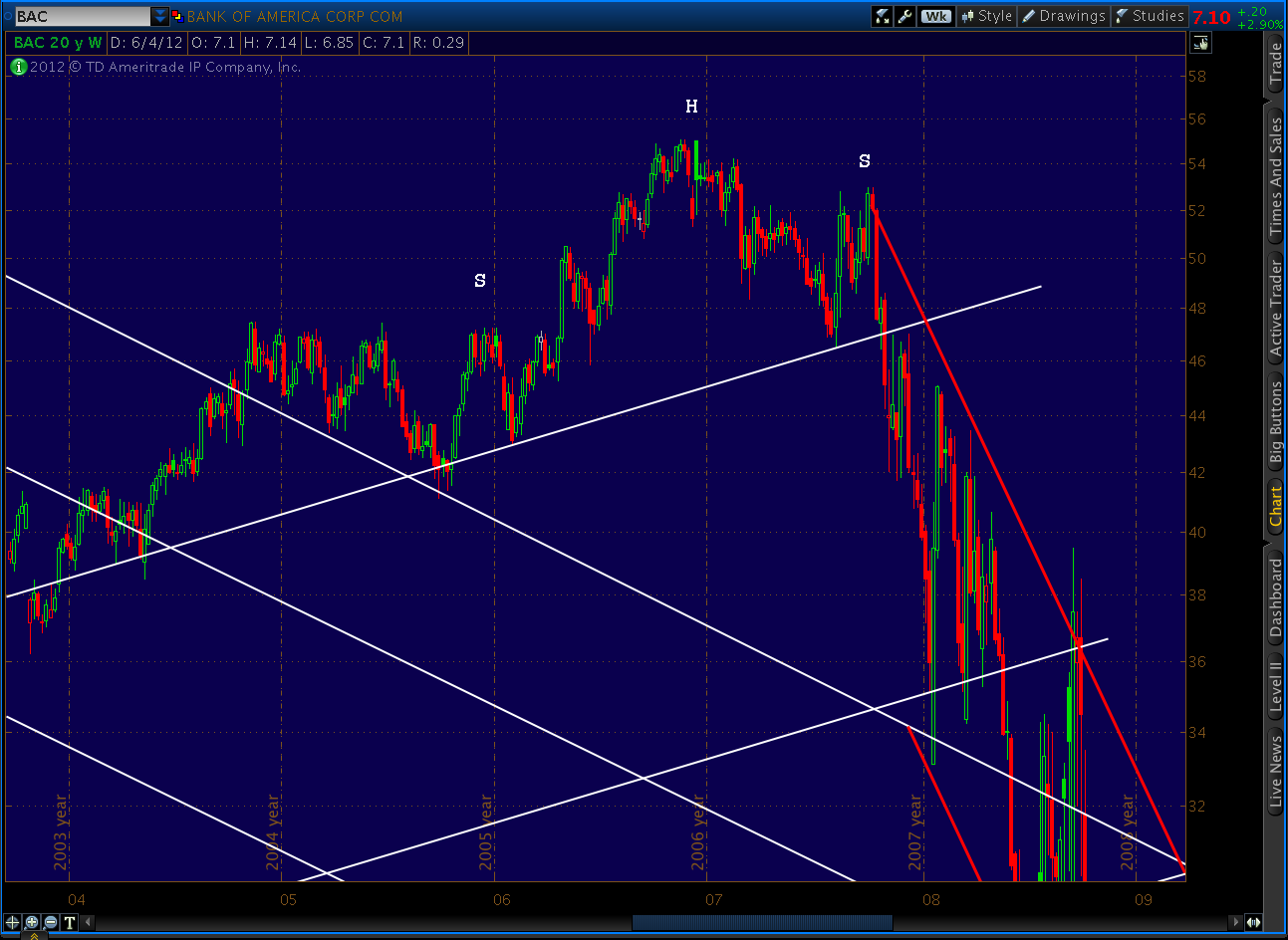
    No, I imagine the number he fixates on is 35 — the third rail around which his stock seems to go into spasms every time it gets close.   I’m exaggerating, of course; it’s only happened three of the last four times since November 2007.  The other time, in September ’08, the stock soared right through 35 to nearly 45.  That would be great — except it plunged to 7.80 six months later.

    See that yellow resistance line?  At least that’s what we call it.  To Stumpf, it’s a 625-volt reminder of all the ugliness of the past five years: bailouts, Occupy Wall Street protests, and that humiliating testimony before Congress (what’s a fella gotta do to buy off a few Congressmen?)

    Stumpf might be dreaming about 35 a lot this week, as the stock’s edging toward that buzzing rail yet again.  It’s really crummy timing for the stock to have completed a bearish Crab Pattern.

    And, darn it, did the SEC have to pick this week to file that subpoena to compel him to hand over the documents he promised in regards to a $60 billion fraud investigationNow, with earnings coming up in a couple of weeks?

    That reminds me of another number, 13 — as in the number of times WFC got zapped after reporting earnings in the last 17 quarters.  Earnings reports that came in the vicinity of that third rail have been particularly eventful.

    Let’s not forget 6,867,990 — the number of shares of Stumpf’s WFC stock and options that’ll be worth considerably more if the 35 price point is breached.  A 22 cent bump will make up for the horrendous pay cut he’s suffered over the past two years (from $21.3 million to $19.8 million, and we all know how tough it is to live on a lousy $54,000 a day!)

    Hey, how about $85 million — the amount the Federal Reserve Bank fined Wells Fargo last year?

    And, $25 billion — the low-interest loan the Fed slipped Wells Fargo a few years back when its survival seemed iffy.

    Which brings to mind $29.4 million, the amount the money-center banks spent on lobbying in 2010 (not including the ABA.)

    Then there’s $19.8 billion — the amount of hyper-hypothecation exposure on Wells Fargo’s books,  17% of Tier 1 capital?

    Which reminds me — $1,274,000,000 in pre-tax trading losses for 2011.

    And, lest we forget — $2.8 trillion notional in derivatives on the books.

    I could go on all night, but I think you see where I’m going with this.  We should all keep John Stumpf in our thoughts and prayers; with all those numbers to think about, the poor guy might have trouble getting a good night’s sleep.   Somehow, I think he’ll manage as long as he sees $35 in the rear-view mirror…and soon.

  • Lots More Where That Came From

    Not to be outdone, GS just completed a bearish Gartley Pattern on (need I say it?) strong negative divergence.


    And, because Morgan Stanley wants to be just like GS when it grows up (rumor has it MS is negotiating an exclusive deal with The Grouch)  it’s .51 away from completing its own Gartley at the intersection of fan lines off its Jun ’07 high and Nov ’08 low.


    And, speaking of fan lines…


    More later.

  • End of the Line

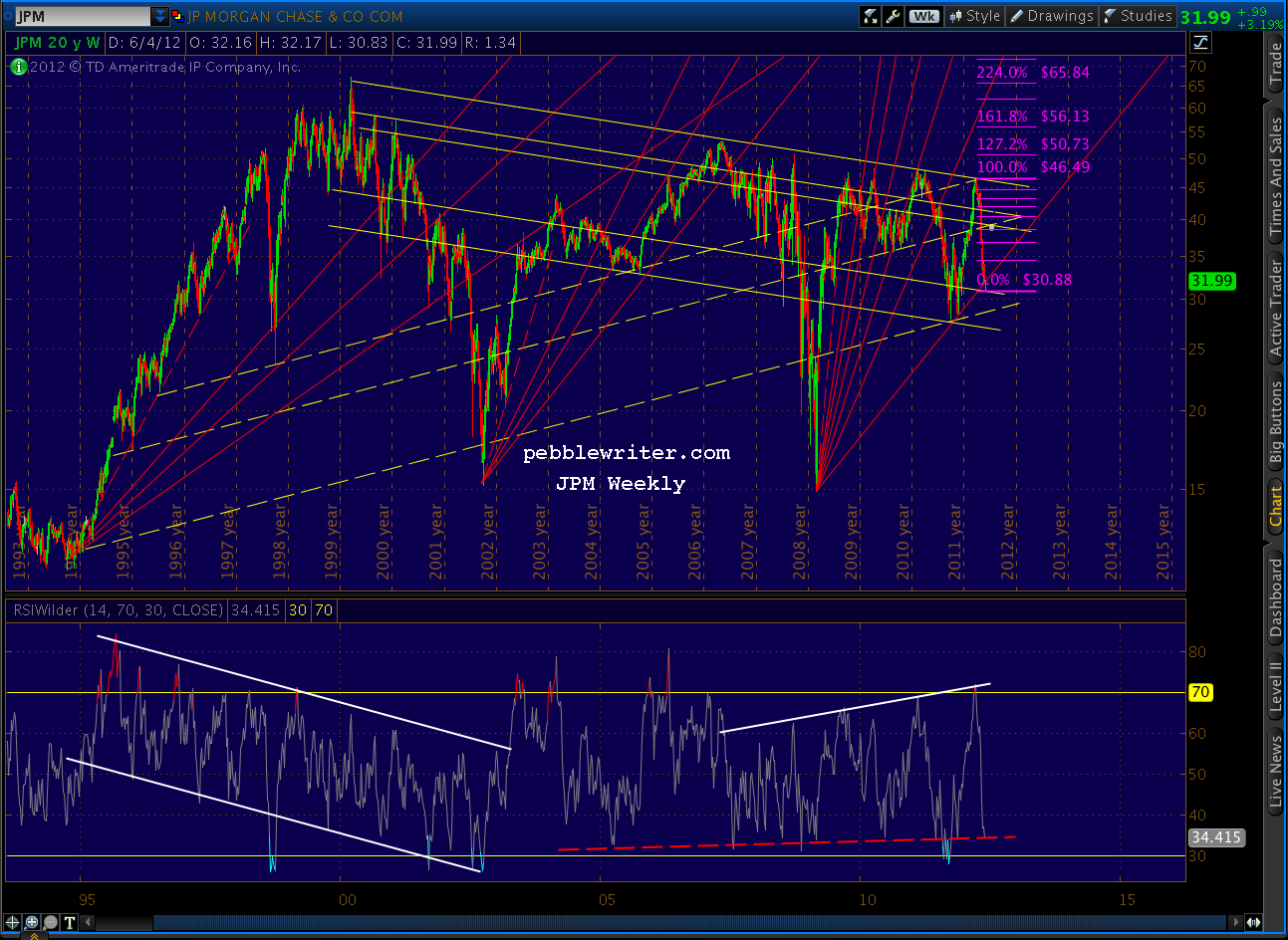
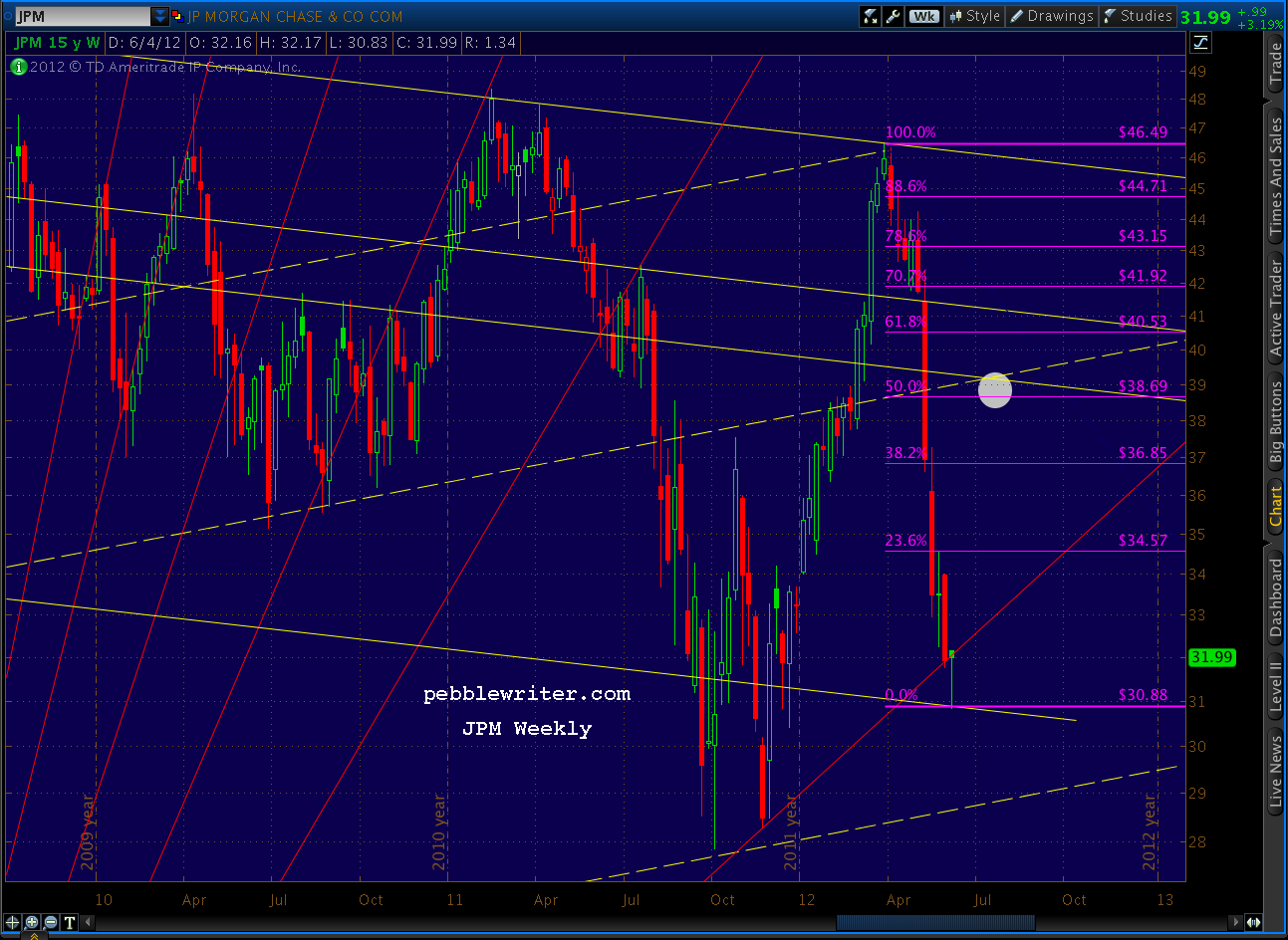
    JPM has had a phenomenal run of late, but a long term fan line off the Mar 24, 2000 all-time high should put an end to all the fun.

    It doesn’t help that JPM also just completed a bearish Bat pattern and is back-testing an internal TL that dates back to 1996.

    And, that over the last week, JPM has completed a Crab pattern way up in the tip of the Bat.

    Dimon’s pulled off some pretty slippery tricks in his tenure; we’ll see if he can beat the odds this time.

  • A Tipping Point: March 23, 2012

    Bears are understandably shell-shocked after the past three months.   Top picking has been a frustrating and humbling experience, as markets — like an addict in search of his next fix — have ignored everything but the promise of additional QE.  But, the improbable low-volume, non-stop melt up might finally be at a tipping point.

    As noted in yesterday’s post, several key indices have finally reacted off their harmonic pattern targets.

    RUT completed a Crab Pattern within the last leg of a Bat Pattern and has yet to clear a key trend line off the May and July highs.  COMP completed a tiny Crab within a little Butterfly pattern and tagged a key trend line off the 2007 highs.  DJIA completed a Crab pattern just a few points away from completing a Butterfly pattern and large Bat pattern.

    Each of the indices is showing bearish divergence on the daily time frame within an overextended rising wedge that’s in danger of being broken — but haven’t broken yet.  In spite of the completed patterns, there are some potential bullish patterns, such as the Dow’s Bat and SPX’s Butterfly, that should take prices just a little higher.

    I’ve spent the past several days wandering the charting desert in search of some sign of things to come.  I posted a bit the other day about the SPX wedge within a wedge and how we’re at Fibonacci levels of time and price in each.   I started by charting some basic channels and fib levels, along with the rising wedges.

    As we discussed the other day [see: Big Picture, Part 2], the smaller yellow wedge apex is not only right at the .886 of the 2007-2009 price decline, but also the .886 fib levels of the larger rising wedge apex.  On top of all that, it’s also at the .618 of the large rising wedge in terms of time.  This is significant, because rising wedges commonly give up the ghost around 61.8% of the way to their apex.

    And, within the smaller rising wedge, we can also see we’re at important fib levels — .786 in terms of price and .886 in terms of time.

    All this is well and good, and we clearly got the reaction we were looking for when we were looking for it.   The key level coming up is the small rising wedge bottom at 1374.   If we take that out, we could find our way down to 1300 in a jiffy.  And, the bottom of the large red rising wedge is currently all the way down at 1165.

    But, I know I don’t have to remind anyone here that rising wedges can hang on for a long time — especially lately.   And, as mentioned earlier, there are still some potential bullish Butterfly Patterns that could fulfill to the upside — notably SPX 1419 and 1433.  And, sometimes harmonic reactions are pathetically small bumps on the road to bigger and better things.

    Bottom line, I believe we’re not quite to our turning point.  But, we will be in the next couple of weeks.  Stay long, but stay frosty.

    ************

    Thus, the days spent wandering the desert.  And, let me be clear, this is pure spit-balling folks.  I’ve been looking at long-term patterns in the markets, trying to discern similarities that might offer a clue as to the big picture.  One era that fascinates me is the 1970s.

    We had a decade-long war in Vietnam and an oil shock when OPEC imposed an embargo in response to our military support of Israel in the Yom Kippur War.  Oil prices went from $3/bbl in 1970 to nearly $40 in 1980.  The following chart, from the EIA and posted on Wikipedia, shows the blow by blow.  (For history buffs, there’s an interesting chronology available here.)

    Inflation went from 3.6% in 1973 to 11.8% in 1975 and 13.9% in 1980.   P/E ratios went from 17.7 in 1970 to 6.7 in 1975.  The 1-yr went from 4.62% in 1972 to 11.03% in 1974.  And, stocks were all over the map.  After gains of 25% from 1970-72, the S&P; 500 had losses of 23% in 1973, 29% in 1974 and 14% in 1977; and, gains of 29% in 1975.

    In short, it was an important inflection point. To Elliott Wave guys, it was an important turn in wave counts.  To all the rest of us, it was the payoff to The Great Crab.

    What?  You don’t remember The Great Crab?  Okay, so it’s possible I just made that name up.  But, it’s kinda catchy.  And, more importantly, it fits.

    First, well… it’s a Crab pattern.   It features a point B at about 50% of the XA price difference (for those who skipped the lesson, go back and read: Crab and Butterfly Patterns Explained.)   Second, it began in the Great Depression, so that gives the name a ring of authenticity.

    And, finally, what else would you name a pattern that in 1937, after a 90% drop, 300% rally and subsequent 60% drop, pretty accurately predicted the following reversals at key Fibonacci points?

    Fib.          Year       Decline

    1.618         1956        19%
    2.618         1961        28%
    3.618         1969        36%

    All that coolness aside, I believe the 1970s offer important clues to what lies ahead.  I’m doing some research that I’ll publish in the next day or two that, quite frankly, is knocking my socks off.

    Stay tuned.

  • Charts I’m Watching: March 22, 2012

    ORIGINAL POST: We’re finally seeing reactions on the harmonic pattern completions we’ve been watching for what seems like forever [see: Everything’s Coming Up Crabs.]RUT completed a Crab Pattern (in red) within the last leg of a Bat Pattern (purple) off the 2011 highs.  It never has cleared the TL off the May and July highs.  The May 2011 high was a double-top to 2007’s.

    COMP completed a tiny Crab within a little Butterfly pattern and tagged a key trend line off the 2007 highs.

    I call it a trend line because it’s exactly parallel to the line connecting the 2002 and 2009 lows.  A reversal here would make for four touches — i.e. a channel.  But, COMP could continue bucking its bearish divergence and go up to complete the larger Butterfly pattern (purple) at 3250-3295.

    DJIA still hasn’t made a new high since completing a Crab Pattern a stone’s throw away from a Butterfly Pattern (purple) completion at 13,338.64.  We’re still watching for a clean break of the rising wedge in the price chart and the trend line in the RSI chart.


    Though, it’s important to note that, at these prices, we came within 28 points of completing a Bat pattern (yellow) at the .886 (13,317) in the weekly chart.  That would make for a logical back test if/when the rising wedge finally breaks.  It might also be the 5th and final wave target if today’s move stays within the wedge itself — which is just as likely.

    Coming up….SPX.

  • Charts I’m Watching: March 20, 2012

    A quick summary of the major charts…

    RUT has completed a Crab Pattern (in red) within the last leg of a Bat Pattern (purple) off the 2011 highs.  Significantly, it hasn’t been able to clear the TL off the May and July highs.  The May 2011 high was a double-top to 2007’s.

    COMP is tagging a trend line off the 2007 highs which is exactly parallel to the line connecting the 2002 and 2009 lows.  A reversal here would make for four touches — i.e. a channel. 

    While the largest potential Butterfly Pattern 1.272 completion is still some distance away (3295 v current 3071), it completed a small Crab within a small Butterfly at 3062 and 3048 respectively.  I think that between the TL and the smaller Butterfly, we should get at least an interim low in the short run — even though there’s more medium-term upside to the 3250-3300 level.

    DJIA peaked at 13,289, completing a Crab Pattern a stone’s throw away from a Butterfly Pattern completion at 13,338.64.

    Zooming out, we see that we’re also bumping up against the .886 of the Oct ’07 to Mar ’09 drop at 13,317.09.  Either of these patterns could be considered close enough to be complete, but a small intra-day bump to tag the actual target is very feasible.

    SPX is closing in on the .886 of the Oct 07-Mar 09 drop at 1472.43.  But, we’re reaching important resistance levels in the rising wedge — which is getting long in the tooth.

    On a smaller scale, the Butterfly pattern from last July is approaching its 1.272 extension at 1421 — assuming a Point X of 1347 on July 21.  This is the best fit for the Butterfly pattern, but it could be started at May 2’s 1370 or July 7’s 1356 — resulting in slightly higher 1.272 extensions.

    There is ample bearish divergence in every time frame.
     

    More later.