Author: pebblewriter

  • Analog Update: Mar 5, 2018

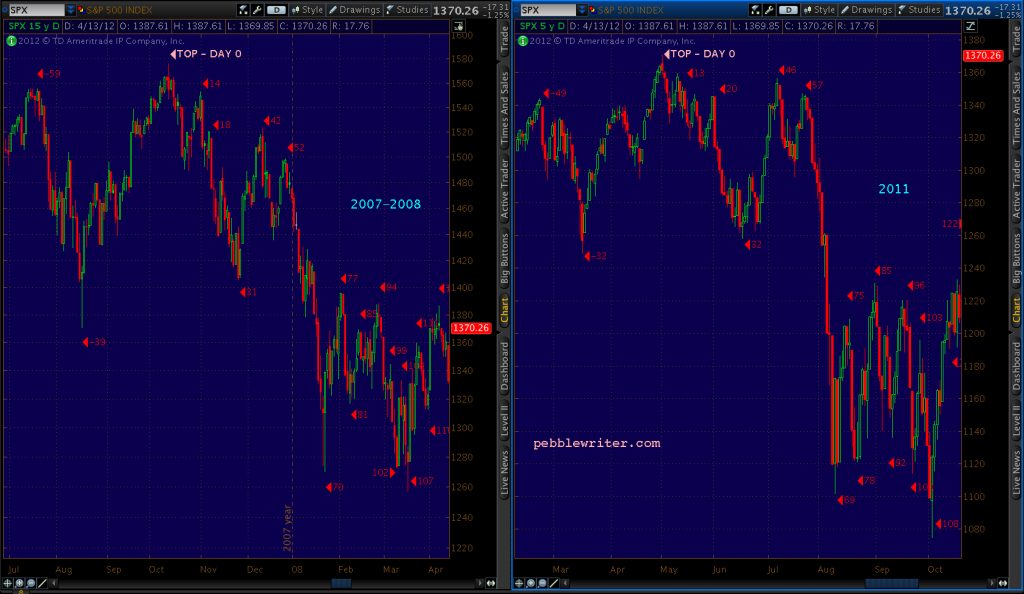
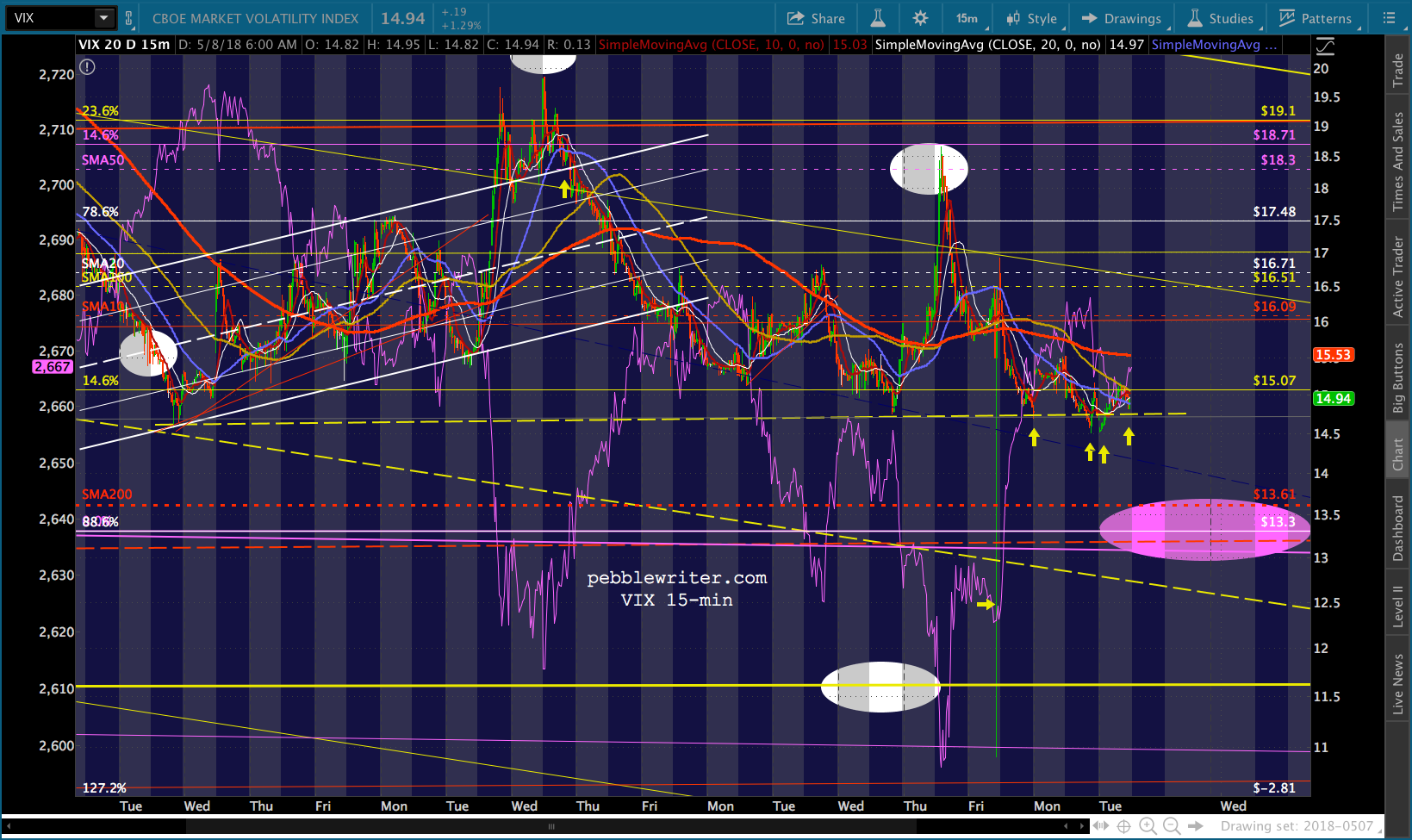
    While direction and price targets are going well, timing continues to be a bit of a challenge — primarily due to equities’ hypersensitivity to VIX.  VIX reached our initial 25.65 target on Friday, at least a day early.SPX’s meltdown and recovery also came early, meaning today’s sell off could extend beyond what the futures currently indicate unless VIX backs off last week’s highs.

    continued for members(more…)

  • Gone Chartin’


    I’m taking the day off to catch up on charting.
    Please refer to yesterday’s post for current forecasts.


  • Does the Yield Curve Matter? A Closer Look

    I called a top in SPX on May 20, 2015 [see: The Last Big Butterfly] because it was about to reach the 1.618 Fib extension at 2138 — our upside target from way back in 2012.  SPX peaked the following day and fell over 300 points before it was all over.

    What I didn’t notice at the time was the bond market. We’ve focused on this from time to time, most recently on Dec 29 [see: Should You Fear the Yield Curve?]  We noted at the time that while the spread between 10Y and 2Y was dropping rapidly, it only represented a warning unless it bottomed out and rose rapidly.  From that post:

    …the above shows that while the potential is there for a recession, this is just an early warning at this time. If the yield curve bottoms out here and rapidly steepens, we’ll have a lot more to worry about.

    Two sessions later, the spread did bottom out, and has been on a tear ever since.  What does this mean?  Let’s look at how things unfolded in the past.

    The spread had been tightening since Dec 31, 2013.  It bottomed in Feb 2015 and began rising again.  In early May, it broke above a trend line (red, dashed) connecting its highs.

    About the same time that SPX was peaking, it backtested that TL and continued higher.  It broke trend (purple, dashed) around Jul 31, a few days before SPX fell off a cliff.  It broke down to new lows (the red, dotted line) in Jan 2016, about the same time that SPX bottomed out.What the yield curve said, then, in simple terms:

    – a breakout from the downtrend marked an equity top (bearish)
    – a breakdown of the subsequent uptrend was really bearish
    – a break to new lows represented a potential bottom (bullish)

    Before I go any further, I want to point out that there were four significant bottoms in 2015-2016.  The first two came close to backtesting the 1.272 Fib at 1823, but didn’t quite make it.  The second two did.Now, let’s look at the same period, but comparing the 10Y (TNX) itself to SPX.  Note that SPX peaked shortly after TNX reached the falling red TL, and began having trouble once TNX broke out.

    SPX fell off its cliff when TNX fell back through the rising purple TL, making bottoms each time TNX did. On Jan 20, 2016, TNX tested its Aug and Sep lows, at which point SPX bottomed at 1812.  A week later, TNX plunged below the previous bottoms and didn’t bounce until it reached the Jan 2015 lows (dashed, purple line.)

    The message delivered by TNX was slightly different from the 10Y2Y:

    – rising up to tag the falling trend line represents a bearish turning point
    – breaking out above it is okay, as long as the uptrend continues
    – a breakdown of the subsequent rebound is really bearish
    – stocks won’t bottom until TNX does

    If we look at the chart below, we can see that the 10Y tracked the 10Y2Y quite closely until it diverged in late 2015 in a failed effort to support stock prices.  It didn’t provide decisive support until it bottomed in Feb 2016 at its Feb 2015 lows.  For a few brief days, the divergence disappeared.Why is this even remotely interesting, you might ask?

    As in 2015, we have also experienced a huge divergence between the 10Y2Y and the 10Y itself.  This is noteworthy in and of itself.But, the comparison gets even more interesting.   As in 2015, we have had an extended slump (14 months vs 17 in 2015), a breakout above the falling red trend line, and a backtest of the trend line.The big differences, so far, are that the spread hasn’t gone on to new highs and that the (presumed) low came as spreads were peaking and only two weeks (versus 8 months) following the peak.

    But, so far, the lessons from 2015 are holding.  The breakout above the falling red TL definitely produced a drop in stocks.  The backtest of the red TL has occurred, but it hasn’t quite reached the purple TL.  As long as it continues bouncing and doesn’t drop back through that TL, stocks should be able to continue rising.  The day it drops back through it, things could get nasty.

    Next, let’s look at the current TNX chart.  We could look at the drop since the Mar 2017 highs, but it was rather short-lived and the subsequent rebound has resembled a moon shot.  Instead, let’s look at the big picture.

    A trend line from the 2008 highs connected with the 2010, 2011 and 2017 highs.  After reversing at each, TNX was accompanied by a large drop in stocks.  TNX’s reversal from its 2013 highs never produced a stock selloff; but, then again, it didn’t quite reach the TL.

    Zooming in a little, we can see that TNX reached this trend line a couple of times in 2017: first, in March, when its reversal accompanied by a mild 78-pt drop in SPX, and again on Dec 20 in a reversal which never gathered any steam.  TNX was back to and punched through the TL on Jan 8.  It reached another TL (gray) drawn through other recent highs on Jan 22 at 26.65.  This was a potential top, meaning the bond folks breathed a sigh of relief.

    On Jan 26, however, it popped up through the gray trend line.  Not so coincidentally, that was the day that SPX peaked.Remember our lessons from TNX in 2015:

    1. reversing off the falling trend line represents a bearish turning point – it didn’t reverse

    2. breaking out above it is okay, as long as the uptrend continues – it did, but as it approached 3%, folks started getting nervous.

    3. a breakdown of the subsequent rebound is really bearish – we got a potential reversal at 29.43, but it has a long ways to go before reaching the rebound trend line, currently at 24.40.

    Interestingly, that TL intersects the falling red TL at about 24.60 on Mar 13, the day that CPI for February is reported.

    And this is where it gets interesting.  If TNX continues to rally, bond folks and equity folks will get nervous (the fiscal fiasco.)

    If it were to fall to the rising purple trend line and backtest the red trend line at 24.60, it might be somewhat bearish unless: (a) it reflects a big drop in inflation (in keeping with my oil and gas forecast) and (b) it rebounds there.

    If it fell below 24.60, the TNX lessons suggest that SPX would be in big trouble.  With a Fed meeting a week later, we can assume Powell et al would be focused on preventing that from happening.  But, as our analog suggests, this preceeds an important inflection point by just a few weeks.

    If TNX falls through 24.60, remember lesson 4…

    4.  stocks won’t bottom until TNX does

     *  *  *

    Now, onto our analog update. In our initial post and follow up from Feb 6-7 [see: Analog Watch], we anticipated SPX would rebound from 2533 (our downside target) to 2765 by Feb 14 and 2812 by Feb 23.  Instead, it bounced from 2532.69 to 2742 on Feb 16 and to 2789 — 23 points short and 4 days late — by Feb 27.

    An adjustment was clearly necessary, given that SPX and ES bottomed on different days.  We’ll try to reconcile the two, along with some economic forecasts which are definitely outside the norm.

    continued for members(more…)

  • Interest Rates: Just Kidding

    Stocks were not thrilled with Powell’s somewhat hawkish testimony yesterday.  Bottom line, he didn’t do much to inspire confidence that tightening would be limited to three rate hikes.

    The killer line came, however, when he admitted that the US is not on a sustainable fiscal path.  It was, perhaps, the least surprising comment he might ever utter during his tenure.  But, the algos were not amused that he said it out loud.

    This sent note yields spiking higher…

    …which sent stock prices tumbling lower.  Fortunately for the bulls, SPX’s slide landed it right at important support.  It will be very easy to measure whether or not the bounce has run its course for now.

    Keep an eye on TNX and VIX today, as they should both provide clear signals.

    continued for members(more…)

  • Powell’s French Toast

    I made French toast for my daughter this past weekend.  Most people think I’m a pretty decent cook, especially with weekend staples like French toast, pancakes, etc.

    I left her to chow down while I went back to work — only to find this when I returned.  The conversation went something like:

    Me: Didn’t you like it?
    Her: I don’t like the crust.

    It reminds me of the task ahead for newly minted FOMC Chair Jerome Powell.  He must somehow convince investors that the economy is yummy, but that inflation (the crust) isn’t a problem.

    In his prepared remarks, he cites the 1.5% core PCE annual rate (as of December) in describing inflation as “low and stable.”  He further makes reference to some of the monthly data:

    We continue to view some of the shortfall in inflation last year as likely reflecting transitory influences that we do not expect will repeat; consistent with this view, the monthly readings were a little higher toward the end of the year than in earlier months.

    By “a little higher” he is apparently referring to the 0.4% November monthly CPI figure —  carefully avoiding mention of the 0.5% increase registered in January.Hopefully, he will do a good job of explaining how strong economic growth is compatible with low inflation.  The market will not be pleased if he can’t demonstrate more intelligence than Steve Mnuchin did last week, insisting that “you can have wage inflation and not necessarily have inflation concerns in general.”

    I suspect Powell is not only much more knowledgeable, but less likely to stick his foot in his mouth.  If his word salad of prepared remarks are any indication, he will walk the same fine line as his predecessor.  Look for his testimony to promise nothing more than the Fed’s continued focus on maximum employment and price stability.

    All he really has to do is buy some time, keeping a lid on rates until February’s inflation data is released on Mar 16.  The way things are shaping up, it should be considerably lower, supporting the narrative that inflation was transitory after all, irrespective of actual inflation [see Inflation: The Charade Continues.]

    Our analog remains on track. For those who’ve been away, note that I revised the timeline yesterday.  Details may be found in the members’ section at A Break or A Breakdown?  Tomorrow, Feb 28 is our new Day 12.

    Powell’s testimony is a potential disruptor.  But, for now, the algos like what they’re hearing.

    continued for members…
    (more…)

  • A Break or a Breakdown?

    The 10Y yield has clearly broken trend as expected, with a couple of Fib tests the only things standing between it and our downside targets.  Our 28.56 upside target from Jan 10 [see: China – It’s Not Me, It’s You] has officially yielded. This is what stocks were waiting for — a sign that interest rates’ climb past 3% wasn’t as certain as most analysts suggested.  ES broke out of its slump and pressed on to new highs, finally joining SPX in regaining its 2.24 Fib extension.

    This leaves our analog on track with our next targets easily in reach.  It also confirms the time adjustment that was suggested by the most recent dip and the redrawing of VIX’s (and everything else’s) path for the next six weeks.

    continued for members(more…)

  • Why Rising Rates Are a Problem This Time

    A sharp drop in interest rates has traditionally been a negative for stocks.  The chart below shows that most significant declines in 10-year yields over the years were associated with steep drops in the S&P 500.  Usually, equity losses precipitated the drops in yield.  As stock declines accelerate, money flows into bonds — raising prices and depressing yields.  The crashes of 2000-2003 and 2007-2009 are striking examples.  So are the corrections of 2010, 2011, 2015 and 2016.

    There were several exceptions, when stocks were supported through carry trades and other algo-stroking forces: the 15% rise in SPX between Dec 2013 and Feb 2015, the minor 6.1% drop between Mar and Jul 2016, and the 2.5% rise between Mar and Sep 2017.

    But, significantly, not a single equity correction occurred without a concurrent and significant drop in yields.  This begs the question, then, of whether increases in yields are positive for stocks.

    In 2008, yields bottomed almost 2 months before stocks did in 2009.  But, in the 2000-2003 crash, yields bottomed 9 months after stocks.  Most other yield rallies from significant bottoms also lagged stocks: 4 months in Oct 2010, 9 months in Jul 2012, 3 months in Jan 2015, 5 months in Jul 2016.

    It would seem at least some bond buyers take a “show me” approach, waiting until the coast is clear in equities before shifting money back into bonds.  This analysis ignores the considerable influence that Fed purchases had on bond yields — an influence which the Fed maintains will diminish over the next few years.

    So, what are we to make of the latest spike in yields which began on Sep 7, 2017?  The 10Y rose from 2.03% to 2.94% through Feb 21.  SPX rallied along with it, up almost 17% by Jan 26 — then promptly did a gut wrenching 11.8% nosedive in only 2 weeks.

    Fortunately for the bulls, it got a strong bounce off its 200-day moving average and subsequently bounced to its 61.8% retracement. But, pundits seem fixated on the 10Y with rates nudging up against 3%.  Does it matter?

    In a word, yes.  Even though 3% is still well below historical yields, the level of debt has risen dramatically over the years.  The chart below shows the annual interest expense (the orange line) and the US’ rapidly growing pile of debt. Superimposed over each is the average interest rate (the black line) paid on that debt.

    Even though interest rates have flatlined since 2013, the expense of servicing the rapidly expanding debt has risen sharply — recently breaking out to all-time highs.

    Clearly, if rates were to normalize the interest expense would be unmanageable.  How unmanageable, you ask?

    Between 2000 and 2007, the average interest rate was 4.84%.  On the current $20.6 trillion balance, that would mean an annual interest expense of roughly $1 trillion.  And, we haven’t even begun to talk about the effect on consumer debt, the mortgage market, debt issued to fund corporate buybacks, etc.

    Obviously, an increase in the 10Y yield doesn’t immediately reprice the entire pile of debt.  But, it’s a clear step in the wrong direction.  And, investors are right to be concerned.  I imagine the Fed is also quite concerned — which is why I put a target of 2.85% on the 10Y back on Jan 10 [see: China – It’s Not Me, It’s You.]

    Not only did it represent channel and Fib resistance, but it seemed like a good tipping point for what I expected to be rising concern (one can hope) about our shaky fiscal situation.  TNX overshot it a little, which has been fairly common over the years (Feb 2011, Sep and Dec 2013, etc.)

    Those previous overshoots typically helped stocks get past resistance.  It might work this time, too.  But, judging from the mood out there, I don’t believe stocks will be led higher by higher interest yields this time.  And, I have trouble believing the Fed isn’t working to put a lid on long rates – yield curve be damned.

     *  *  *

    Related Posts:

    Where To Next?
    The End is (Probably) Near
    CPI: The Charade Continues
    Update on Bonds: Jan 29, 2018


  • Bullard!

    I remember Oct 15, 2014 like it was yesterday.   SPX had risen sharply on the back of the yen carry trade, popping through important Fib resistance at 1823. But, it had just broken trend line and channel support.  To make matters worse, it had just dropped through its SMA200 at 1905.The culprits? USDJPY had reversed off heavy resistance and its 10-week rising channel had broken down.  And, equally concerning, the bond market signaled more stock carnage to come.

    As we noted at the time:

    The more troubling development for Mr. Market is the bond market. The 10-yr note futures shot through the previous high overnight, complicating the prospects of a quick resolution to the market’s correction.

    Note that while we might see a reversal today on the white Fibonacci grid — the .786, .886 or the 1.272 itself — we still have to deal with the grey grid, which suggests the possibility of a drop to the .786 at 1798 or the .886 at 1770.

    A drop to 1800 would have meant giving up that important Fib support at 1823.  More importantly, a 10% correction would occur with a drop to 1817.33 or lower.  Who needed those headlines in the middle of spectacular rally to new all-time highs?

    The solution?

    SPX’s plunge halted at 1820.66 — 3.33 points above what would have been an official correction.  No fuss, no muss.  The Fib line which had once loomed as formidable resistance could now be reclassified as support.

    What has been is what will be,
    and what has been done is what will be done,
    and there is nothing new under the sun.
    Ecclesiastes 1:4-11

    As I went to sleep last night, marveling at how SPX had taken a rather circuitous path to our 2703.62 target,I wondered whether the 2.24 Fib would hold.

    I found myself thinking back to 2014.  Maybe Fed President Bullard would make another appearance.  I didn’t have long to wait.

    On CNBC this morning…

    click to play video


    Futures are currently up 27 points off their overnight lows (bounced at the 10-day moving average, probably about 60 seconds after Bullard was booked on CNBC.)  At least we weren’t kept in suspense too long!

    Oh, and for those wondering why/how yesterday unfolded as it did, take a look at VIX.  See that little dip (yellow arrow) below the trend line from Jan 26?  Yep, that’s all it took.

    When VIX climbed back above the yellow trend line, SPX promptly gave up all its pre-minutes ramp job.VIX has obviously proven it’s still incredibly powerful.  Who needs a 40% spike when a 20% one can put on the brakes so effectively?  The flipside, of course: if VIX decides to pop up to 26 anyway, SPX will likely ignore Bullard and also test its SMA10.

    Bullard might be able to divert attention from the interest rate problem.  But, it clearly hasn’t gone away.

    This time, it’s a spike in rates rather than a plunge.  So it’s a different kind of interest rate problem.  As a result, this one might be tougher to rectify.  And, the implications for the overall economy are much more serious.

    continued for members(more…)

  • Any Minute Now…

    The last time the FOMC released minutes was Jan 3 [see: Will the FOMC Minutes Save the Dollar?]  At the time, we looked at the effect of FOMC rate hikes on the dollar index (DXY.)  The obvious conclusion was that rate hikes in 2017 had marked interim tops, while failures to hike rates has produced temporary bumps that lasted anywhere from 1-6 weeks.

    Here’s the exact same chart, updated with January’s non-hike.  In honor of today’s Fed minutes release, I’ve also added markers (the purple arrows) for previous releases.

    Looking at each, you’d have to conclude that either: (1) the FOMC knew what they were doing, and wanted to talk the dollar down throughout 2017; or, (2) they had no clue how to prop it up.  What’s interesting to me, as a chartist, is how well the inflection points occasioned by the minutes releases tracked our falling white channel — allowing our forecast from last May [see: Update on US Dollar May 1, 2017] to play out very precisely.Our conclusion back on Jan 3 was that the minutes would not only not save the dollar, but its continued slide would present problems for stocks.

    With TNX about to break out, we can expect continued weakness in DXY.  Needless to say, this will present difficulties for the yen carry trade crowd and, ultimately, equities.  I suspect the dollar’s slide isn’t over — with our targets at 88.423-88.682 the next major support when it breaks below September’s lows.

    If [SPX can’t push through 2703] then the first real support is the bottom of the gray channel, currently around 2588. And, if that fails, then the SMA100 is currently around 2560 and the SMA200 is around 2485.

    We all know what happened next.  The minutes produced a momentary bump in DXY and USDJPY, safely escorting SPX through the resistance at 2703.  At the same time, CL went on a month-long 11% tear and VIX continued to plunge when necessary.  SPX didn’t look back until reaching 2872.

    At that point, the rally ran out of steam.  Obviously, it was overbought.  But, DXY’s slide from 92 to 88 didn’t help.  Nor did USDJPY’s plunge from 112.5 to 105.5.

    The most intractable problem, however, was the sharp rise in interest rates.  They reflected a growing recognition that the sharp spike in oil and gas prices which helped fuel algos throughout December and January would also produce inconveniently high inflation.

    When the 10Y broke out on Jan 10 [see: China – It’s Not Me, It’s You] we slapped a 28.56 target on TNX — a target it reached on Feb 5.  Not so coincidentally, Feb 5 was the day SPX plunged back below support (formerly resistance) at 2703.  The next day, SPX plunged to within 5 points of our 2588 target.  Three sessions later, it tagged the 200-day moving average.

    The rally off of 2532 has been impressive, following our analog [see: Analog Watch] very closely for the past two weeks.  As we wait for word on whether to expect three or four rate hikes in 2018 (at least, so everyone says,) our analog suggests that the Fed will have to deal with the divergence between spreads and the 10Y itself.It might not be pretty.

    continued for members…
    (more…)

  • Fibs, Fans and Logs

    The chart below usually stops charting skeptics cold in their tracks.  We can argue all day about whether Fibonacci levels should matter.  But, it’s pretty obvious they have.

    The reversal in 2010 at the .618 Fib resulted in a drop tot he .382.  The tag in 2011 at the .786 Fib yielded a drop to the .500.   The most recent large reversal came in 2015 at the 2.618 at 2138, resulting in additional backtests of the 1.272 at 1823.We can also see the importance of moving averages — with the 100-day (yellow) and 200-day (red) figuring prominently over the years.  And, of course, channels have been extremely helpful in identifying periodic tops and bottoms.

    I tend to chart in logarithmic scale because, besides making more logical sense to me, it offers earlier warnings of breaks in trend.  According to the chart in log scale above, SPX has bounced (off the SMA200) to the midline of the rising white channel — often a point where reversals occur.

    But, if we map a channel to the past couple of years in arithmetic scale, we get a very different result: a wild overshoot that corrected and is now back to the channel top — a moment of truth for the bulls.

    Today is Day 9 of our analog, so we have a pretty good idea what to expect.

    continued for members(more…)