
Tag: fed

  • Time to Sell Your Home?

    I’ve recently discussed this very issue with several friends who are a little nervous about the sharp runup in prices…and very nervous about the prospect of a selloff.

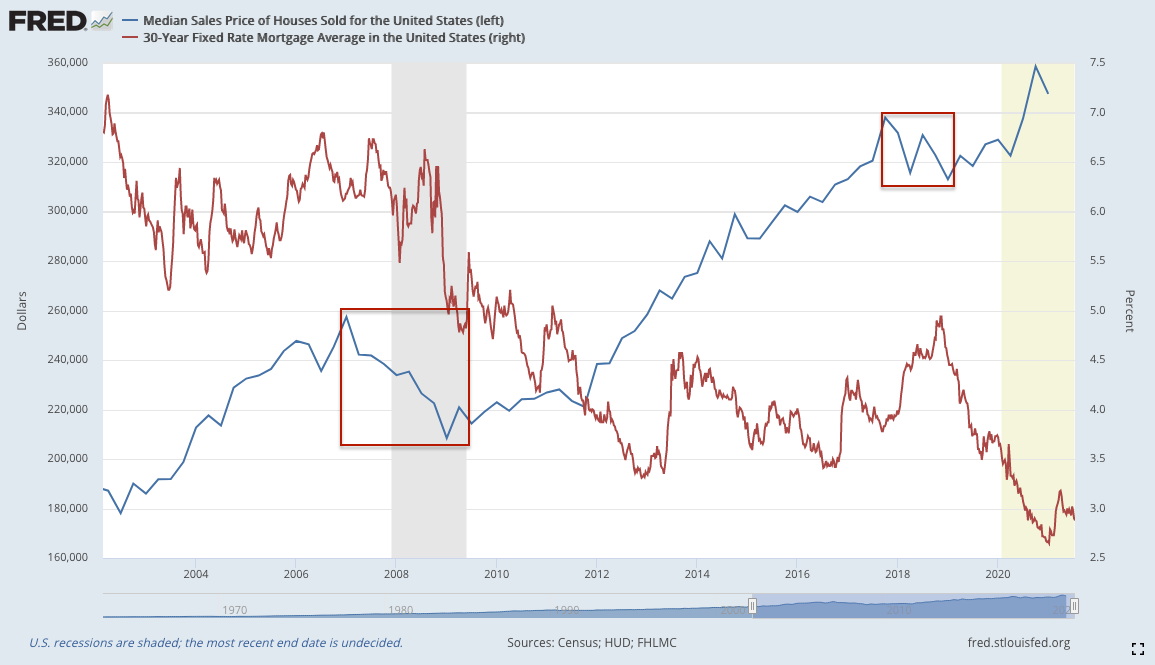
    Most of us remember how ugly things got during the Great Financial Crisis: the sharp rise and the much sharper plunge when the bubble burst.  According to HUD, the median sales price of a home fell about 20% from $257,400 in Q1:2007 to $208,400 in Q1:2009. The fallout was both disastrous and widespread. Yet, years later, it appears modest compared to the subsequent reinflation. The median sales price reached $358,700 in Q4:2020.  It’s the size and speed of the bubble’s reflation that has many worried – particularly given the Fed’s involvement.  How so, you ask?

    In the wake of the pandemic, the Fed cut short-term rates to zero and began large scale asset purchases which have been more than enough to purchase the entirety of Treasury’s monthly borrowings: $120 billion per month, including $40 billion in mortgages.  The net effect was to drive interest rates to all-time lows and keep them there.
    If you’re feeling pretty smart about all the money you’ve made in real estate over the past year, make sure you fire off a thank you note to Jerome Powell.

    Most home buyers purchase as much house as their income will allow. That is, they focus more on the monthly payment than the purchase price. Lenders, likewise, use a formula to compare your monthly housing costs to your income.

    These debt-to-income ratios vary. But, in this example, we’ll assume a 33% ratio – meaning the total house payment should be no more than 33% of your monthly gross income.

    A home purchased for $1 million with a $200,000 down payment at the current jumbo mortgage rate of 2.6% would require a monthly payment of about $3,203. Toss in $1,000 per month for taxes and insurance, and you’d be looking at a total payment of $4,203.  With a 33% ratio, the required annual income would be around $152,826.

    If mortgage interest rates had been 6% instead of 2.6%, the monthly payment for that same $1 million house would have been much higher: about $5,796, requiring an income of $210,778 to qualify for an $800,000 mortgage.

    And, there’s the rub. Cutting rates to all-time lows clearly reinflated real estate prices. People have been able to afford more and more expensive homes because the Fed kept cutting rates, keeping the payments super low even as the prices soared.

    What happens if rates ever rise back to normal levels? The chart below shows the relationship between falling rates and rising prices. But, you can read it the other way around too. If rates rose, what would the price need to drop to in order to maintain the same monthly payment?

    A rise in rates from 2.6% to 3.6% equates to a price drop from $1 million to $880,000.   A rise to 4.6% would mean a drop to $780,000 – enough to wipe out your equity and leave you owing money at the closing.*

    The Fed has managed to hold interest rates low by buying up all the bonds it sees. The flood of QE required to suppress rates has bid up not just real estate but most other categories of goods and services as well, thereby amping up the pressure to raise rates.

    The Fed could mitigate inflation by raising rates or suppressing oil prices, but either would do some damage to stocks – another overinflated market. So, instead, they keep insisting that everything’s just fine, even as they paint themselves into a corner.

    Is it time to sell your home? If you’re planning on it any time soon, consider the above and keep a very close eye on the market and on interest rates. It won’t necessarily happen tomorrow. In fact, sales/prices typically increase in the short run when rates begin to rise because buyers fear even higher mortgage rates to come.

    But, spoiler alert: it will happen by this time next year. The Fed is playing a dangerous game – not because they love taking enormous risks but because, having reinflated all these bubbles, they have no other choice.

    We all remember what happened the last time inflation reached these levels. From the July 2008 FOMC statement to Congress, the only time in the past 30 years that CPI has topped last month’s 5.4%:

    According to these projections, the economy is expected to expand slowly over the rest of this year. FOMC participants anticipate a gradual strengthening of economic growth over coming quarters as the lagged effects of past monetary policy actions, amid gradually improving financial market conditions, begin to provide additional lift to spending and as housing activity begins to stabilize.

    Stocks crashed 50% over the next 8 months as the Great Financial Crisis decimated the economy.

      *  *  *


    * the spreadsheet below shows the effect on price of a change in mortgage rates, while holding payment and qualifying income steady.


  • Update on Currencies: Jul 2, 2021

    As we noted yesterday, EURUSD is finally fulfilling our expectation of a breakdown from the trend established at the Mar 2020 lows.  This move has been a long time coming and has potentially significant consequences for the DXY.

    continued for members(more…)

  • Are Things Really Better?

    Under ordinary circumstances, a 2.3% MoM bump in Durable Goods orders would be very welcome – especially on the heels of last month’s -1.3% print. When inflation is a growing concern due to the Fed’s largesse, however, it complicates things. For instance, might it cause the Fed to take its foot off the gas?

    Not to worry, VIX was hammered sharply lower for the fourth session in a row. It’s now off 35% since Monday’s highs and has reached levels last seen on Feb 14, 2020, a few days before the market crashed. Note that this is the target we first charted back in early April [see: Irrational Exuberance and You]…

    …when we observed that VIX was repeating a pattern seen many times over the years.

    It should come as no surprise that VIX did break down and SPX did, indeed, rise above 3956. Like all the other breakdowns, this one has the potential to keep the party going long past curfew.

    This time, it went a step further – breaking below a falling trend line – especially bearish for VIX and bullish for stocks. It now has the opportunity to break below the trend line from 2017 — all the reassurance algos would need in order to bid stocks even higher.

    Along the same lines, RBOB futures just topped their May 2018 highs (CPI was 2.8%) and are now 27% higher than their Feb 2020 (2.33% CPI) peak – even though total miles driven in April 2021 were 10% lower than April 2020 and 11% lower than in May 2018. RBOB hasn’t been higher than this since Oct 2014 when CPI, now 5%, was retreating from its recent 2.13% highs.

    If this all seems a little overdone, you’re right. The economy has rebounded. But, few responsible economists would argue that things are better than in Feb 2020 when markets crashed as the pandemic roiled the global economy.

    The obvious X-factor, of course, is the massive amount of money the Fed has thrown at markets. The less obvious factor is the ease with which the Fed can manipulate algos. The warning signs which used to cause correction-causing reversions to the mean — rapidly rising inflation and interest rates, rising volatility, etc. — are no longer legitimate concerns.

    Why? Because the Fed has proven that stocks can keep rising even in the face of data that would otherwise be problematic. So what if inflation is out of control? Interest rates sure don’t reflect it. Below trend GDP? All the more reason for massive QE. They haven’t learned how to cure the patient, let alone prevent him from getting sick. But, they’ve rigged the thermometer, the blood pressure cuff, and the stethoscope to indicate that everything is just fine.

    continued for members(more…)

  • Charts I’m Watching: Jun 21, 2021

    ES came within 9 points of our next downside target before getting a nice bounce motivated primarily by USDJPY, which was working flat out to save the NKD from a scary, and long overdue dive to its SMA200.

    This bounce will be quite important to the bulls, who are no doubt hoping to avoid a bearish 10/20 cross.

    continued for members(more…)

  • Bullard: Wait, Did I Say That?

    Not that futures needed any help melting down this morning, but Jim Bullard just poured gas on the fire. Yes, Jim Bullard! The Fed president who never had a hawkish thought in his life.

    Then, he trashed the Fed’s most nonsensical policy: throwing $40 billion per month into the mortgage market when mortgage rates are already at all-time lows.

    Bulls better hope that ES can bounce at our next downside target: the 50-day moving average currently at 4174.

    It appears that algos are finally being given the green light to (drumroll please) decline.

    continued for members

    (more…)

  • Currencies: Tick-Tock

    Neither yesterday’s FOMC announcement nor Powell’s press conference produced any meaningful surprises. Yes, the dots shifted slightly, but everyone knows they’ll shift a lot more before long.

    Futures easily reached our initial downside target and came within 5 points (so far) of our second. But, the real action was in currencies, which were finally turned loose. Look for EURUSD to finally reach our backtest target where it faces an enormously consequential decision.continued for members(more…)

  • The Fed’s Big Day

    We’ve pretty much beat the inflation horse to death on these pages over the past six months. Bottom line, It’s too high and potentially out of control.

    So far, however, the Fed’s been able to hoodwink investors and algos and commandeer the bond market. Aside from making things much more difficult for the little guy – who they claim to care about – there have been few negative repercussions.

    But people are starting to talk. At first it was just fringe strategists like yours truly. Lately, it’s financial pundits, important bankers and hedge fund managers. Has the trance been broken? And, if so, will the market care? Today, we’ll finally find out how clever the Fed can be.

    Two years ago, before any of us had ever heard of COVID-19, our charts already called for some pretty dramatic outcomes.  We were pretty sure the 10Y, having reversed right on target at 3.25% in October 2018, was headed for at least 1.55%…

    …a target that was adjusted to 0.15% — 1.33% on January 13 at which point Wuhan City had reported only 40 suspected cases and one death.  On March 8, it reached 0.398% – well ahead of schedule thanks to COVID-19. Its rebound has been impressive – aided by a sharp rebound in inflation due primarily to the even more impressive recovery in oil prices.

    Ah, oil… We became convinced in March 2018 that oil was headed for a major breakdown, noting important cycles in its peaks and troughs. At the time, our model showed WTI (then at $62) dropping below $20 in early 2023.

    On Jan 3, 2020 we got more specific, pinpointing $17.12 on April 23, 2023.

    Of course, it dropped much lower and much faster than that. And, it’s recovery has been higher and faster than anyone imagined (or the fundamentals would support.)Interest rates and oil prices are irrefragably joined at the hip.  Gasoline prices are especially highly correlated with inflation… …which has traditionally been highly correlated with interest rates.   But, that all changed in the last couple of months when, thanks to the Fed’s ability to control interest rates, the bond market stopped caring about inflation.

    The stock market was elated as short rates flatlined while the 10Y marched higher…

    …leading to the first time in 20 years that a rapidly rising 2s10s didn’t lead to a market crash.The Fed has pulled off a pretty masterful reinflation of the everything bubble. Are they clever enough to avoid the inevitable pop?

    continued for members(more…)

  • CPI: Still Transitory?

    Will the Fed be able to stick to their “inflation is transitory” shtick this morning?  If the financial media is any guide, there are plenty of adherents among money managers. And, why not? After all, there isn’t exactly a clear definition of what transitory inflation means. Is it elevated for 3 months? Six? A year?

    When it was just oil and gas’ base effect driving the numbers, it wasn’t that tough to argue that CPI would decline from May’s highs as we approach the end of the year. Assuming gas prices hold current levels, CPI could peak at around 4.2-4.3% and begin a decline into the end of the year. But, with labor, used cars, food, medical, etc. all joining the march higher, there is a very real risk of a much higher print and an upward price spiral that won’t unwind any time soon.

    In any case, look for stocks to finally express some doubts – depending on how broken the bond market turns out to be.

    continued for members(more…)

  • Is the Snoozefest Over?

    You know when the market is in a holding pattern by how VIX behaves. For the most of the past three weeks, we’ve seen sudden collapses in VIX just ahead of the cash open. It doesn’t always last, but it’s very effective in reminding algos to smack the snooze button, “fixing” any overnight declines and sending ES back to within a few points of its all-time highs.

    Almost every day for the past several weeks, investors have turned over and gone back to sleep. But, tomorrow, we’ll get some very important CPI and claims data that could change everything.  Are investors in for a rude awakening?

    continued for members

    (more…)

  • Bad News is Good Again

    If yesterday’s better than expected ADP jobs data was bad news, then it stands to reason that today’s worse than expected DOL NFP print would be good for the market.  Well, that, and the 13% pounding VIX has taken…

    As it was hammered back below its SMA10, ES was ramped up above its SMA10. Funny how that works.continued for members(more…)