
Periodically, I like to go through and chart the various harmonic scenarios for both the upside and downside.
It helps to pass the time while sitting and staring at the computer monitor, watching our forecast play out (so far, so good.)
It’s also helpful in generating a set of potential outcomes for the market over both the near and longer-term.
DOWNSIDE SCENARIOS
Remember, all harmonic patterns begin with a significant reversal which we call Point X. Over the past year, we can identify several obvious Point X’s, each of which generates its own set of Fibonacci retracements when paired with the recent 1422 high.
continued…
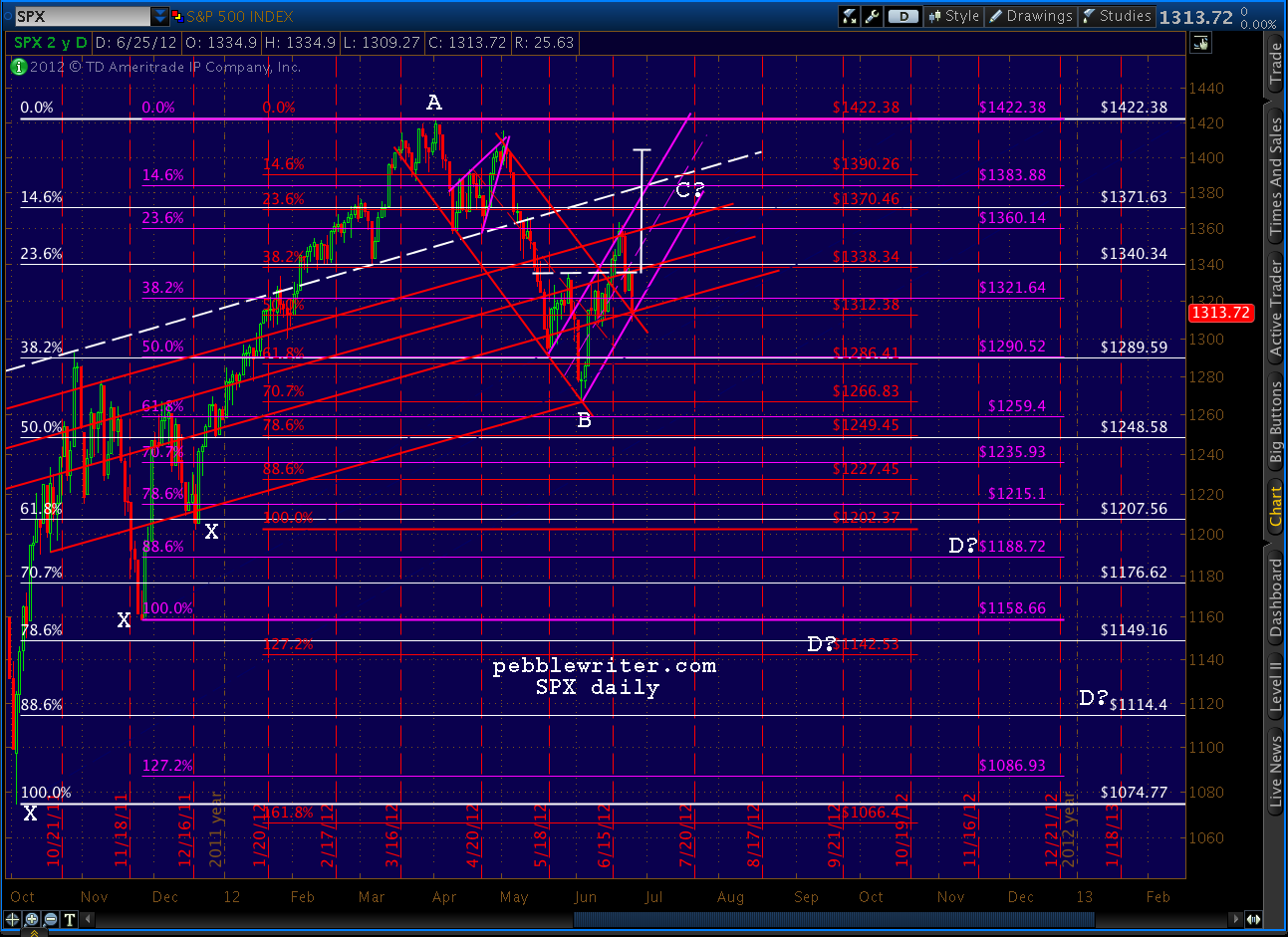 Once we establish a Point X, we start looking for Points A, B and C — with the hopes of being able to forecast Point D — the target of the next major leg down. Remember, we’re in a topping pattern unless it proves otherwise. This exercise is all about how high we can go before a serious downturn, and then how far that downturn will take us.
Point A is set at the recent high of 1422. Point B is currently 1266, though the potential exists for a lower point. It slightly exceeded .382 of the white grid, .500 of the purple and .707 of the red grid. So, all four patterns are still a possibility: Gartley, Bat, Butterfly and Crab.
Point C is what we’re watching now. If it comes in lower than Point A, we have a valid harmonic pattern. The guidelines are that it can retrace anywhere from .382 to .886 of A-B, though I’ve seen patterns play out successfully outside those parameters.
On June 19, prices had retraced .618 of A-B at 1363 (just missed .619 on 6/19). So, we have to remain open to the possibility that 1363 was our Point C. But, it’s not my top case — for a variety of reasons. If prices could break down out of the upward sloping channel they’re currently in, for instance, I’d warm to the idea.
For now, our leading candidates for Point C are 1389 and 1404 – for reasons we’ll discuss in the UPSIDE case below. A reversal at either price would set up a lower Point D, the object of bears’ desire.
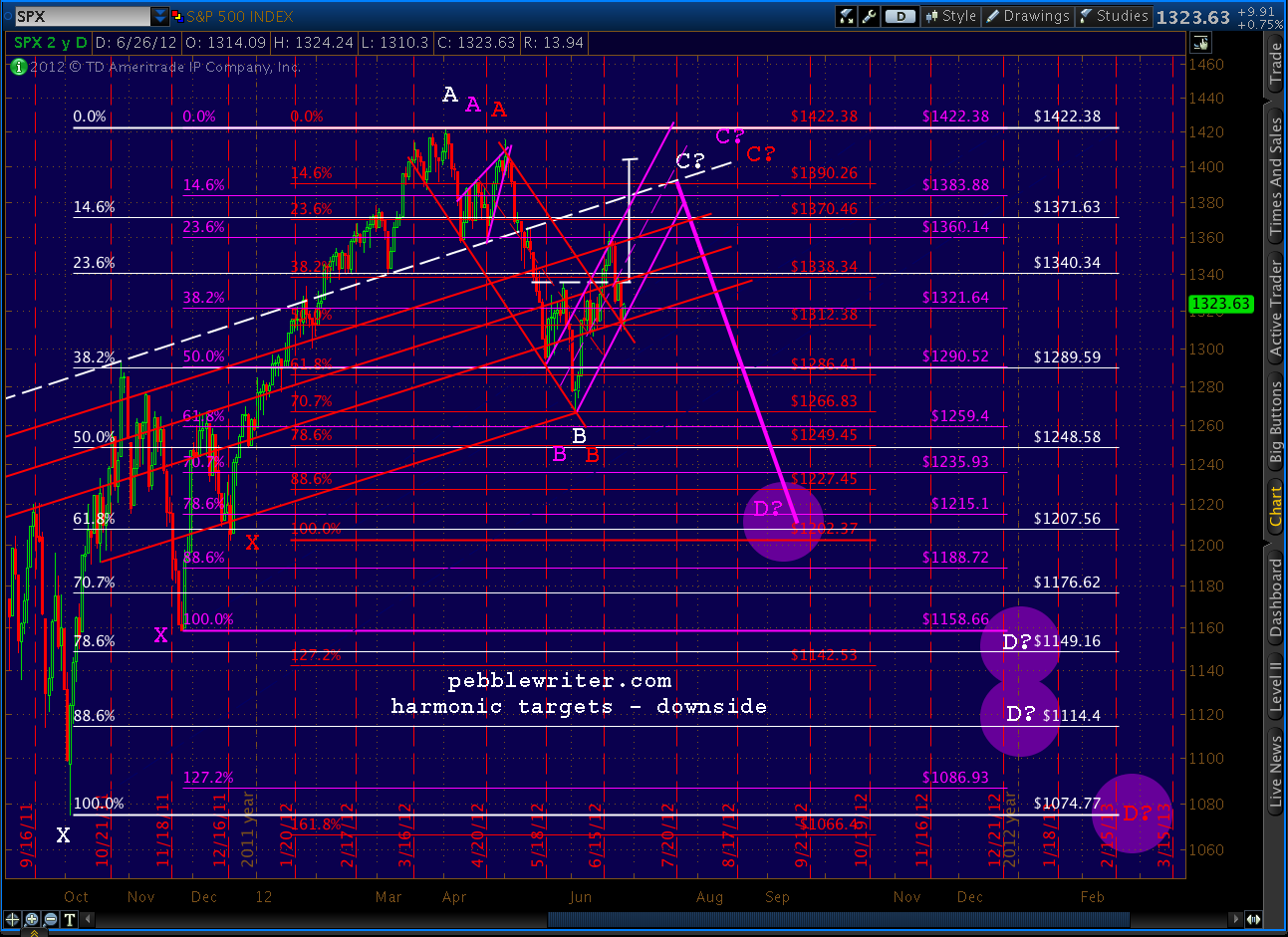
Assuming we get that Point C reversal (and, don’t exceed 1422), we get the following possibilities:
White Grid
The Point B at just shy of the .500 retracement level leaves open all possibilities. Bat patterns feature Point B’s at .618 or less. Crab’s permit Point B anywhere between .382 and .886. Gartley’s reverse at .618 — which could happen down the line; and, Butterflies reverse at .786 — which could also still happen.
- Gartley: 1206 (.618), then 1149 (.786)
- Bat: 1114 (.886)
- Butterfly: 1149 (.786), then 980 (1.272) or 860 (1.618)
- Crab: 860 (1.618)
Purple Grid
A Point B that’s only 7 pts away from the .618 is pretty good. It elevates this grid to the top of the heap in terms of probable validity/importance. All four harmonic patterns are possible, but a .618 Point B is most closely associated with a .786 Point D in a classic Gartley pattern. Having said that, Gartley’s often reverse at the .786 — only to later morph into a Butterfly or Crab pattern. Here are the possibilities:
- Gartley: 1215 (.786)
- Bat: 1188 (.886)
- Butterfly: 1086 (1.272) or 860 (1.618), after 1215 (.786) first
- Crab: 860 (1.618)
Red Grid
A .707 Point B has to be a Crab. It’s too great to be a Bat or Gartley (limited to .618), too small to be a Butterfly (.786). A Crab completion would take prices down to the 1.618 at 1066.
Summary
Putting all these patterns together, we look for points of intersection and overlap. I’m going to give preference to the purple grid, simply because of the precise .618 Point B. If we go on and complete a Gartley at the .786 of 1215, we’ll also be very close to the .618 of the white grid (not to mention 100% of the red pattern.)
And, a tag at the .618 on the larger, white pattern would portend a potential Gartley – completing at the .786 of 1149 (nearly 100% of the purple grid.)
Of course, a .786 completion on the purple grid could also set up a Butterfly, which would complete at the 1.272 (1086), which just so happens to be only 12 pts away from 100% of the white pattern.
Charted (without respect to timing), the most likely possibilities look something like this:
UPSIDE SCENARIOS
The upside cases are pretty easy to follow. The biggest pattern has either played out, or portends much more upside.
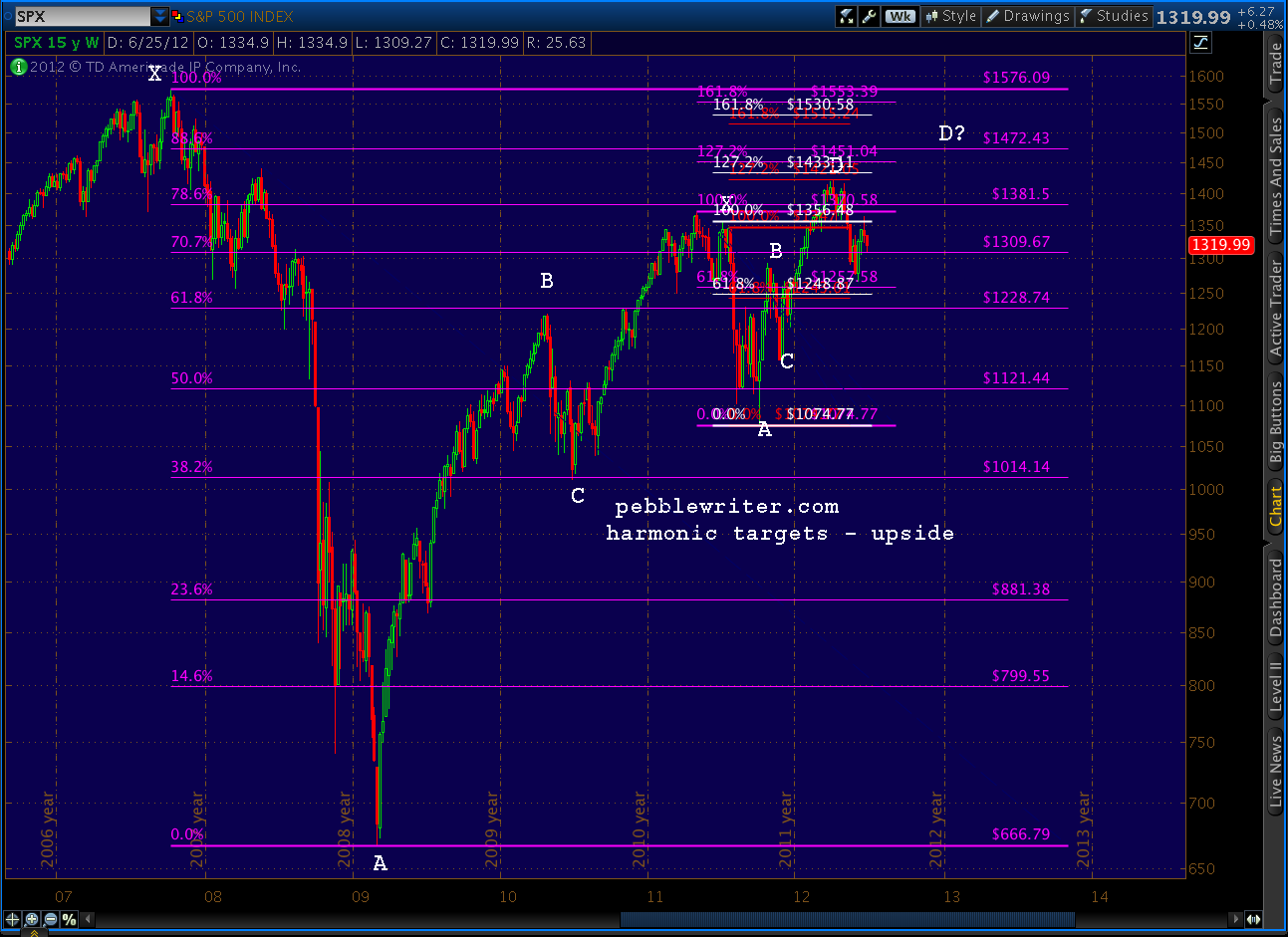 Most folks think this was a big Gartley that payed off very close to the .786 (1381.50) in May of 2011 at 1370.58. The bears (including me) were fixated on the downside when SPX not only came back and tagged 1381.50, but tacked on another 40 points to boot.
But, that May 2011 high could just as easily be viewed as a Point B in a big Butterfly pattern that pays off at 1823 (the 1.272) or 2138 (the 1.618.) Obviously, this is an exceptionally bullish view that would entail either a remarkable turnaround in the global economy and/or a massive injection of liquidity into the markets a la QEx.
The other, less momentous scenario is that we leave Point B where it was at the .618 and call this a Bat pattern. Such patterns complete at the .886, which in this case is 1472. Some readers may recall 1462-1472 was the potential upside target of the analog we followed in April and May.
Tell me how much QE is coming, and I’ll tell you whether either scenario makes sense or not. If nothing else, they’re something to be aware of. We’re in unchartered territory with respect to money supply and debt, and the what-if’s are all over the map.
A little closer to home, there are a number of smaller scale patterns to watch. Zooming in…
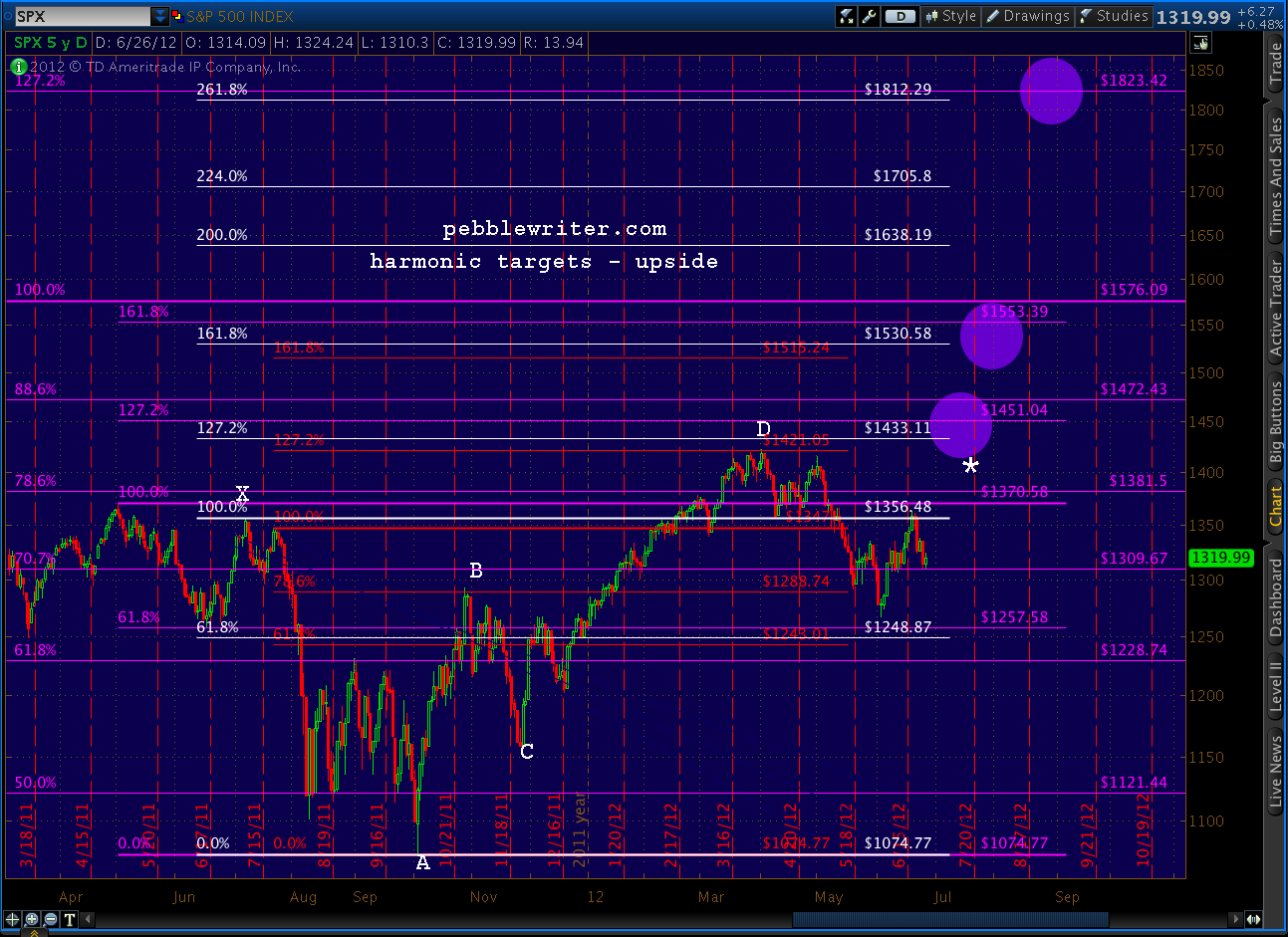 The white asterisk marks our current upside target: 1389-1404 by July 20. A break of 1422, however, could mean a ride to 1433-1472, 1515-1576 or 1812-1823 (marked by the purple circles.)
The smaller patterns intersect with the larger one (from 1576 in 2007) at its .886 at 1472, its 100% retracement at 1576 (aka double top) and its 1.272 extension at 1576, so these are the ones to watch if 1422 is taken out.
Zooming way in, we can see the .786 and .886 of the current smaller pattern at 1389 and 1404. Remember, we have an inverse H&S pattern that completes at 1404, so this gets top billing IMHO.
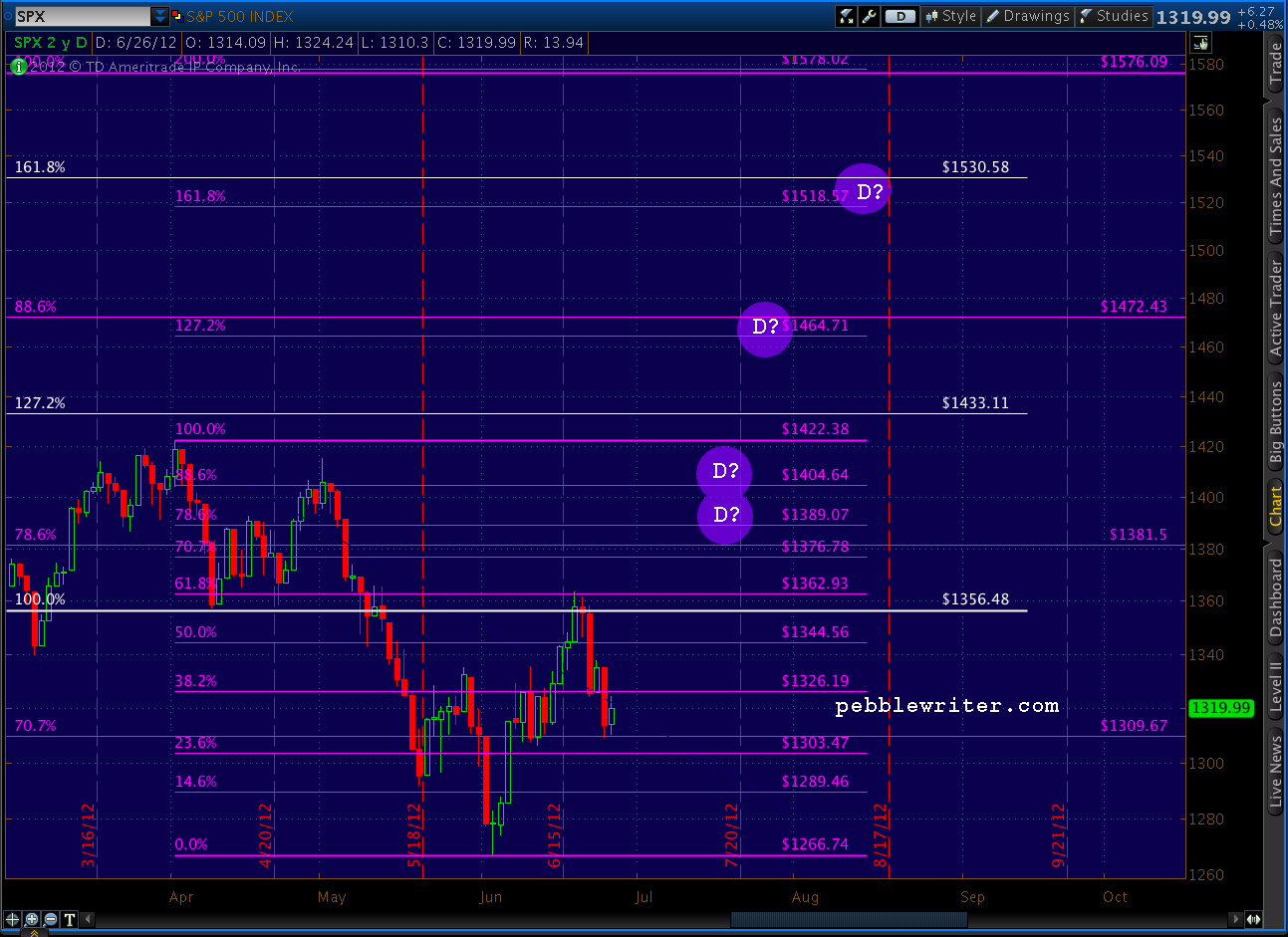 Just beyond that, we have the viable .886 of the medium pattern (from 1370) at 1433; it can be considered part of the same bunch (except for the fact that it would represent a new high for SPX.)
We also have another intersection at 1464-1472 — the .886 of the largest pattern and the 1.272 of the smallest. This level also marks the mid line of the channel that dates back to the 1920s, so it’s plenty viable.
And, last, there’s the 1.618 of the smallest and medium-sized patterns, coming together around 1518-1533.
SUMMARY
Harmonic patterns usually won’t tell you whether the market is going up or down. But, they’re really good at telling you where a rising or falling market will turn: sign posts, as it were.
I’ll probably refer back to these charts a lot in the coming weeks, so they’re worth bookmarking. In the meantime…
I still think there’s a good chance that markets will move higher over the next couple of weeks. But, anyone who reads or listens to the news is well aware of the countless problems facing both Europe and the US. As always, use stops and practice good trade management (i.e., don’t risk it all on a bet one way or the other.)
Good luck to all.
Comments
10 responses to “Harmonics Scenarios”
Hello PW, correct me if I am wrong. Either the downside scenario or the upside scenario has a path to lead to around 1403 in mid July. If that target is reached in mid July, we still can’t tell whether it would be a downside scenario or upside scenario? (In other words, suppose today is July 20 and SPX is 1405, can we tell whether we are in the downside scenario or the upside scenario?) Thanks!
This is true. I hope for more clarity if/when we approach 1400. But, if not, I’ll probably scale back my exposure until the tea leaves are easier to read. My gut is that we’ll see a serious plunge at that point, but I’m only 60:40 on it at present.
Question about…”A .707 Point B has to be a Crab. It’s too great to be a Bat or Gartley (limited to .618), too small to be a Butterfly (.786). A Crab completion would take prices down to the 1.618 at 1066.”
Isn’t point B in a crab limited to .618? If not, what is the limit?
A Crab Point B can be up to .886. Bats are limited to .618, though there are plenty of exceptions with a .786 Point B and .886 reversal, like on AUDUSD recently.
Pretty key assumption…
On June 19, prices had retraced .618 of A-B at 1363 (just missed .619 on 6/19). So, we have to remain open to the possibility that 1363 was our Point C. But, it’s not my top case — for a variety of reasons. If prices could break down out of the upward sloping channel they’re currently in, for instance, I’d warm to the idea.
What about the scenerio that 1363 is point c?
Good question, David. If so, no higher highs any time soon. We’d take out 1266 on our way to 1207-1215 (at least.) The key is the channels — both SPX and its RSI. Any serious breach and I’m flipping.
hello Michael, if point C were 1390 shouldn’t the VIX be diving right now?
It’s weird that VIX is up at all on a day when SPX is up 13 — but, not unusual. VIX is often late to the party. I think it’s currently hung up on the former neckline of the H&S pattern that it overly-aggressively back tested. Check out the little acceleration channel on VIX’s RSI. Unless it breaks out right about now, there’s a lot of downside baked in.
This was extremely helpful for me – thanks!
Nice helpful post! Thank you!