
Author: pebblewriter

  • Housing: More of the Same

    Again, ignore the headlines. 

    The numbers that really matters are ytd sales (without a seasonal adjustment) and median sales price.  Here, without the glitzy graphics or Census Dept spin, is the unvarnished truth.

                                         US      Northeast   Midwest    South     West

    2011 v 2010 ytd         -7.9%      -29.7%       -9.7%      -4.1%     -6.1%
    percent change in
    units sold

    Median price:

                 June                         $ 240,200
                 July                             230,900
                 August                        210,900
                 September                  204,400

                 Sep ’11 v Sep ’10         -10.3%

    The high-end market remains in a coma.  Sales of homes $750,000 and over have topped 1,000 units per month only twice this year, with homes $400,000 – 750,000 only marginally better.

    Briefing.com maintains some great graphs that show what’s really happening.

  • Charts I’m Watching: October 25, 2011

    UPDATE:  4:30 PM

    Good, strong close at low for the day.  Guess I’m not the only one looking for disappointing news from Brussels. Here’s a peek at the DX daily chart.  Note the .618 Fib intersecting with the SMA 200 and a reversal candle for the day. 

    And, just for grins, here’s a pattern that doesn’t quite fit in any traditional harmonic pattern.

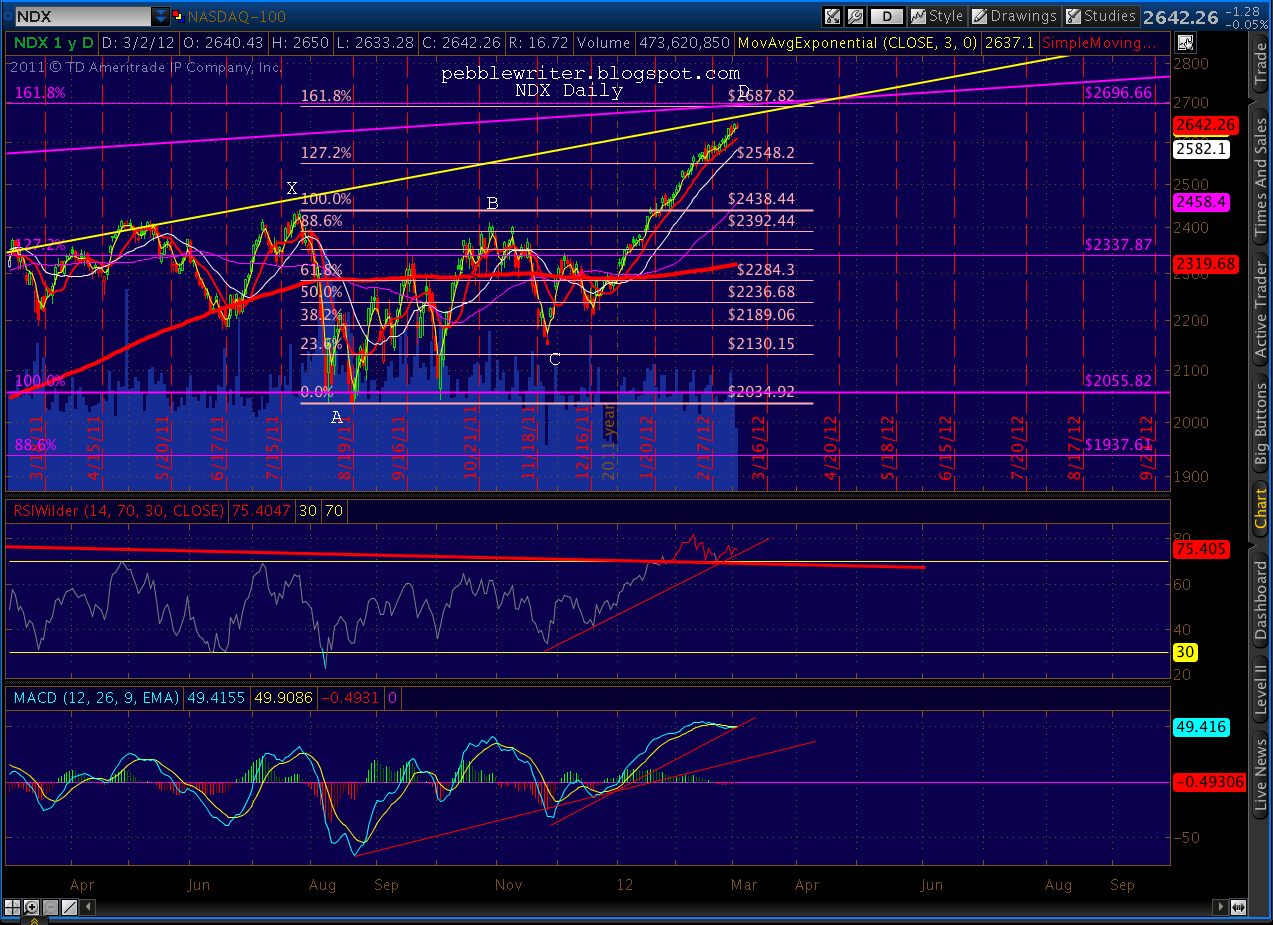
    A Gartley Point B should be at .618, with a D at the .786.  So, this is a little high on both (53 and 37 points.)  It could be a Butterfly, which has a B at the .786, though we came up 15 points shy of that.  If so, Point D should be at the 1.272 which is 2548.  It could be a Bat, but B should be below .618.  If it were, it would have a target of the .886 at 2392 – 3 points beyond yesterday’s high.

    My guess — Butterfly.  If the market’s up tomorrow, look for the Butterfly to play out to the 1.272 at 2548 before reversing.  If the market’s down, my bet is it’ll be down big and the form of the pattern won’t much matter.

    UPDATE:  3:15 PM

    SPX just completed small H&S; that could produce a quick drop to 1210.  It echoes the pennant we made earlier in the day, and would leave the index appropriately close to the center line of the regression channel we’re following (dotted yellow line in daily chart below.)

    Given the structure of the rise these past two weeks, there are several other H&S; patterns that could complete, depending on how the next day or two go.  A bump back up from 1210, for instance, could form a right shoulder for a 50-pt pattern that helps get us to the 1160 area.  Worth keeping an eye on.

    Recapping the forecast…

    The Purple Line:

    If we don’t do a big Euro-dump tomorrow, we’ll likely bounce off 1205-1210 to one last high around 1265-1270 before Wave 3 gets started in earnest.

    The Yellow Line:

    If we sell off big, I’m looking for a leg down to 1160ish for starters.  If that comes off as our B wave, then the final push should be to 1307 or so.  If B is done, then the floor drops out.  The big question will be how to know which one it is.  Here, we’ll just have to pay attention to the quality of the news — dead deal or more can-kicking.

    ORIGINAL POST:

    Interesting that we paused at the .618 (from the May 1370 top to the 1074 bottom.)   Remember that Gartley patterns reverse at the .618, retrace .382 – .886 of that, then reverse again to test the .786 before heading back in the other direction — typically at least .618 of the last leg, potentially 1.618 or more of it.

    Just speculating here, but if we should reverse here and follow the yellow line, completing a more significant B wave in this corrective wave 2,  I’ll be on the lookout for a C wave that terminates at the .786, completing a Gartley pattern at 1307.   Note that this would potentially intersect with a trend line (purple, dashed) off the May 2 and Jul 7 highs.

    That’s not to say we couldn’t get there without a more significant B wave; it’s just that this rising wedge is getting very, very long in the tooth and I can’t see it continuing to melt up without more of a break.

    I’m going to go ahead and alter the yellow line to reflect this possibility, but keep in mind this is speculating on what I consider an alternate count.  My preferred outcome is a sell-off following disappointment over what’s (not) happening in Brussels.

    Speaking of which, I’m starting to see more and more expectation management out of the Eurozone.  My favorite is this one:

    He’s correct when he says they “never talked about this summit as the decisive summit.”  The decisive summits were February 14,  March 24, June 23, July 21 and September 16.  Here’s a great visual from Reuters, courtesy of Zerohedge.  It does a great job of charting Italian bond yields over the past year of promises and missteps by the Eurostooges.

    More later.

  • Too Far, Too Fast: Oct 24, 2011

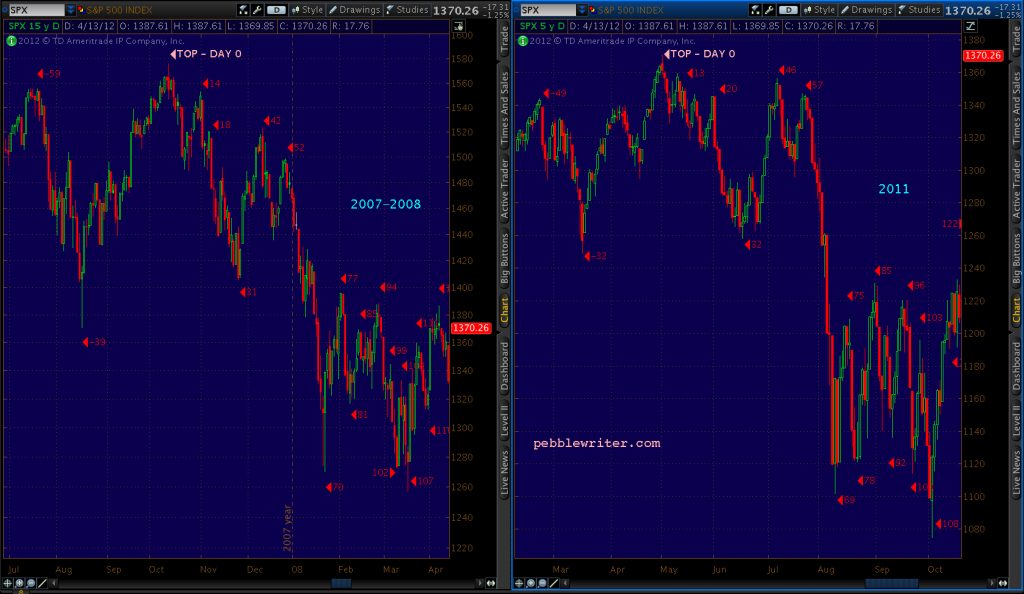
    In looking at the 2011 v 2008 analog, it’s obvious we’ve advanced at a much faster pace these past two weeks than the analog would suggest.

    From a price standpoint, we’ve very nearly reached our wave 2 target a good month or more early.  We can debate the causes — everything from “animal spirits” to expectations of a Euro miracle.  It’s also possible that the analog I’ve been following since May has simply become too well known.

    I have no idea whether someone else noticed it before I.  But, in August, EWI started talking it up.  And, just this morning, I saw a chart in a recent Demark interview that looked oddly familiar.  It’s entirely possible folks have taken such a shine to it that they jumped the gun, trying to get out in front of the last rise before the downturn.

    There I go again, saying “downturn” when I mean “crash.”

    Thanks to the speed and distance of this rise, I get to redraw the internal channels of the 2011 pattern.  One fun discovery is that the revised slope is…wait for it…the same as the 2007/8 top.  At least, it could be.  The reality is that there are dozens of ways to draw these channels.

    But, given the similarities between the two tops, I think it makes sense to look for similar channel lines, too.  Take a gander.  First, the original:

    Note the channels in 2011 are steeper than those is 2007/8.  That made sense when it appeared that wave 2 would be bouncing back from 1040.  Here’s what we got instead:

    A little closer view…

    And, the close up.

    If you look closely, you’ll see there are two paths from today’s close.  The yellow line starts down right away, forming a real B wave instead of the sissy B wave we had last week.  It then takes its sweet time forming a C wave that ends in December — maybe around 1285. 

    The purple line wastes no time.  Like the yellow line, it reverses this week — maybe even tomorrow around 1266, but doesn’t stop running until Bernanke is reduced to a quivering blob of pale, green jello and Merkozy’s love child springs from the womb shooting stardust and rainbows from its fingertips. 

    Personally, I’m leaning toward the first option, reaching 1266 Tuesday or Wednesday, at which point the whole Euro-agreement should be ready for the shredder.  Or maybe we just gap down from here.  Our high today was within $1 of the .618 (from 1370 top to 1074 bottom) and within $2 of the Jun 16 low.

    I show the two courses coming back together in Jan-Feb 2012, doing a side-step for a month before heading down to complete Minor 3 of Intermediate 1 at around 650.  The SMA 200 is around 1274, and the put-call ratio is back down to .53 — very toppy.   The RSI, stochastic and McClellan Oscillator are all looking bearish.

    More later.

  • Dollar Days – October 23, 2011

    UPDATE:  2:00 PM

    Melt up continuing in what feels like an Apple or Gold-like throw-over…  Watching a rising wedge, crab pattern (just got to the 1.618 extension) and oodles of negative divergence developing on the 5-min chart.

    Here we are, in late October, in the general vicinity of our December target.  Talk about too far, too fast.  The next move should be a quick dump to 1197 or so.  But, given the market’s rumor-driven euphoria, who can say when/if rational behavior will resume?

    UPDATE:  October 24, 12:00 PM

    Big news rumors this morning — reports that the EFSF might be increased to 1 trillion euros and/or China and Brazil might step in and buy euro bonds and/or the IMF will jump in and start supporting the euro… blah, blah, blah.

    The only real news is that Markit Economics PMI (purchasing manager index) fell to the lowest level and is falling at the fastest rate since July 2009.  The PMI has been a very good predictor of GDP growth.  Manufacturing output, orders, backlogs, employment, confidence — all bad and getting worse.

    In other words, don’t expect the Eurozone to work itself out of its mess through economic growth.   What will be necessary, says Moody’s, is a lot of pain.  In an article headlined “Euro Credit Pressures Yet to Peak:”

    The rating agency therefore expects that severe market pressures will likely persist for the foreseeable future, with the potential for higher long-term financing costs and an elevated risk of constrained access to funding.

    That’s a fancy way of saying “credit freeze.”  In the meantime, Morgan Stanley (in a blatant case of book talking) recommended clients go long the Euro this morning, with a near term target of 1.4060 before falling back to 1.30 by year’s end.  The bump was enough to complete a bearish Bat pattern, the third embedded bearish harmonic pattern over the past couple of weeks. 

    EUR likely maxed out just past the .886 Fib at 1.3946; look for a reversal here in EUR/USD and SPX, which is showing marked negative divergence.

    ORIGINAL POST:

    One way or the other, the Brussels befuddlement will drive markets this week.  If you’re a glass-half-full type, the long-awaited solution to Eurozone problems is imminent, and the market is due for a rip-roaring surge that’ll take us to new highs.  If you’re more glass-half-empty, this summit will be like all the rest, ending in a promise to resolve things “soon” that will be followed by… more promises.

    I guess I’m more a “there is no glass” kind of guy.  It baffles me how many times the investing public has bought the “this time for sure” malarkey.   One thing for sure, there is no solution to the problem that doesn’t involve substantial write-downs for banks and other institutional investors….unless, of course, the ECB takes a page from Helicopter Ben’s book and simply starts printing (literally or figuratively.)  Neither is good for the Euro.

    The harmonic patterns in the markets are confirming said diagnosis.  Take a look, for instance at the dollar index (DX.)  It reached significantly oversold status on Friday solely on rumors that things had been settled.  But, in so doing, it has traced out nestled bullish harmonic patterns.

    The Butterfly pattern (in yellow) completed at the 1.272 extension, while the smaller (purple) Crab pattern completed at the 1.618 extension.   If you have no idea what this means, don’t worry.  Just know that the dollar, which recently suffered in relationship to a rebounding Euro, is about to snap back in a big way — probably to the 78.61 range.

    For laypeople who think this is irrelevant because they don’t invest in currencies, think again.  The Dollar/Euro relationship has been a very powerful indicator of stock market performance for many weeks, now.  Bottom line, a surging dollar/falling Euro has been very bearish for stocks.

    Look for DX to remain in the channel we’ve drawn, with Friday’s dip written off as an aberration.   Next up, the .618 Fibonacci level at 78.989 from Jun 2010, which might represent some resistance.  It’s also the .382 from the more recent October highs.

    The EUR/USD, on the other hand, is poised to plunge.  Last week’s attempt to break out of its bearish plunge will fail.   It’s completed a bearish Bat pattern (in purple) at the .886 Fib and a bearish Butterfly (in yellow) at the 1.272 that should see it hit 1.35 within the next few days.  My medium-term target is 1.15 between now and mid-March 2012.

    Note the recent 50 SMA cross below the 200, a so-called death cross implying EUR has officially entered a bear market.  The 50/200 weekly chart clearly shows the recent attempt to turn bullish again has failed.

    More later.

  • 2011 v 2008: Day 121

     It’s probably safe to say the 2011 v 2007/8 analog is back in sync.  While there were numerous reasons to expect a lower low than the 1074 we got, in the end we got something truncated — whatever count you want to put on it.

    I’m disappointed (and poorer), but am happy if things are back to a higher degree of predictability.  Here’s where the counts are as of today.

    Assuming we get through the day without a sudden plunge, it appears as though one is coming as early as Monday (conveniently, right after OPEX.)   If I’m right, it’ll take us down to the 1140-1150 area and establish the lower ray of a rising wedge that peaks in December.

    Here’s a closeup of the equivalent 2008 action, just for grins.  I’m working on the 2011 upside target.   My current thinking is around 1260, but I have more work to do before committing to that. 

    In the meantime, a very tradeable 60 point dip and likely 100 point rally into December.  Plenty here to help me get over the lost 40 points.

    If I’m wrong, and we get the lower low I’ve been expecting, then it’s coming either really early or really late.  No question that this rally has been faster and stronger than most expected.  I heard that EWI is suggesting that the corrective wave is actually over – recommending leveraged short positions for the imminent wave 3 of 3.

    Let’s discuss moving averages for a moment.  People are divided over whether to use simple versus exponential.  The EMA gives more weighting to recent price moves than older ones, so it reflects recent volatility more effectively.  On the other hand, that volatility sometimes generates false signals that wouldn’t have been made under the smoother SMA methodology. 

    Which should you use?  It’s kind of like the exponential vs arithmetic charting argument.  You should use both, if for no other reason than to be aware of what others might be watching (and acting upon.)  I bring it up today because SPX passed beyond the EMA 200 today (thick red line.)

    The thick purple line is the SMA 200, and is still a good 36 points away.   While both are some distance from their 50-day moving averages (and, thus, still in death cross mode) the EMA makes a really good case for a reversal right here.

    BTW, 200 sessions ago was around Jan 7, 2011 — at which time the SPX closed at 1271 on its way to 1344 about 30 sessions later.  So, the MA should retain a slight negative slope as long as we’re replacing 1280-1344 days with anything less than that.  In other words, it’s coming to where we are as much as we’re heading towards it.

    Last, a note on currencies and moving averages.  DX just saw the SMA 50 cross above the 200, confirming a bullish market for the dollar.  Likewise, AUD and EUR both just saw a bearish cross on the 50/200 and their prices smack up against the 200.

    While it’s possible we could see a continued stock rally in face of a rising dollar, that’s not how it’s been playing out lately.  It lends credence to the idea of a sharp pullback in stocks and rise in the dollar, followed by a period of chop that will carry DX back across the channel, possibly expanding it if completing wave 2 takes much longer.

    **************

    A word about comments on this blog.  All I ask is that you provide an underlying rationale for your thoughts.  A statement such as “now we’re heading back to 1350” does very little to enlighten anyone.  Provide some context, so that others can decide for themselves whether your reasoning is sound.

    I don’t even mind if your comment isn’t about technical analysis.  We can all learn from each other.   Although, if you get bullish every time the hummingbirds outside your window have sex, I suggest you start your own blog (and seek professional help.)

    Also, for the first time ever, I deleted a troll’s discourteous comment today.  I have no issue with those who disagree with me.  Obviously, I won’t always be right.  But, we’ve had a great run, going back to my first post on May 2 (wondering if we were near the top — who would’ve thunk?)

    I’ve given back some profits over the past couple of weeks, but am still up very substantially ytd.  Anyone who shorted heavily on July 26 [see: All Aboard] after seeing this chart has probably done all right, too. 

    I’m often early, and have a definite bearish bias.  But, I try to always have a sound reason for my forecasts.  I always tell the truth as I see it, and don’t charge a dime for my thoughts.  Having said that, this is not investment advice.  Anyone who shadows my trading does so at their own considerable risk.

  • Topping Pattern?

    UPDATE:  3:45 PM

    Despite all the drama, EUR still looking like the bottom’s about to fall out.  All the players are hedging, talking about needing a few more days past Sunday (the most recent deadline for the miracle cure.)

    Note the RSI trendline, still within the channel we’ve been watching.  And, of course, we’re up against the 200 day moving average. 

    UPDATE:  12:30PM

    Well…that’s the thing about 50-50 shots.  They don’t work out half the time.  For newcomers to the site, this is why I recommend stops.  Even harmonic patterns, which are considered to be successful 70% of the time, will lose you money the other 30% of the time.  

    All successful traders set stops just beyond the expected move to cover those contingencies.   Because, regardless of what the tea leaves say, you never know when a Guardian article or MENA despot’s death is going to pop out of the woodwork.

    Here’s what’s happened to DX.  The price action is obvious, but look closely at the RSI and the histogram.  The histogram, which had been forming a nice bottom, decided to put in a lower bar.  If it stands, this is a good indication that the channel is expanding.

    Likewise, the RSI, which had been following trend line 1 until recently,  appears to be more heavily influenced by 2 and 3 at the moment.   We frequently see aberrations which require a little finessing, but this one needs resolution on a grander scale.  By that, I mean look at 2 vs 3.  In a day or two, RSI will have to decide between staying below TL 3 of staying above TL 2.  It can’t do both.

    I’m inclined to leave the slope of the channel alone.  It’s been a very consistent guide to price action since Mar 08.  When prices have corrected out of the channel, they’ve resumed a few clicks to the right, in a wider channel or, to my eye, a parallel channel.    Here’s an example from Mar 2010.

    In every case, defection from the existing channel has been the result of intersecting with an important fan line.  I’ve drawn in the obvious ones from the Mar 09 top (equity markets bottom) in red.  The line that stopped the Sep 10, Jan 11 and early Sep 11 rallies was broken on 9/21.

    But, it came back for a backtest and continued back below that fan line on 10/12, finding support instead on the white fan line from the Apr 08 bottom.   DX is backtesting that line, too, although from on top — meaning it has a bullish (for the dollar) potential.

    The two fan lines are seen here as A and B.  So, think of it as A trying to keep the dollar down and B trying to keep it up.  In the background, the inclination for the index to follow the same slope that’s been in place for years in the form of the channel.

    We could bounce around in the triangle formed by both lines through the end of the year, committing to neither.  It wouldn’t be surprising, given the chop we’ve seen in the equity markets for several months now.

    It’s also entirely possible that today’s drop is just a momentary excursion from the channel — typically a couple of days, or even intra-day.  The same thing has happened on numerous previous occasions.   But, unless we get a vicious snap back of today’s decline, we’re looking at a widening of the channel.

    With that said, I’d be remiss if I didn’t at least mention the third possibility: that the dollar has gone as far as it’s going to.  If the Euro weren’t circling the drain, I’d take that possibility seriously.  But, there seems to be little chance of a EUR miracle; every such report has been proven optimistic and/or just plain false (still, the press gobbles them up like so many Halloween treats.)

    But, it’s worth remembering, we are in a counter-trend rally — albeit it a very large one.  Even if we make it all the way to my 87 price target, we would just have completed a channel that started back in 1998 or so.  The DX’s strength is a function of other currencies’ weakness (the least dirty shirt.) 

    It’s hard to say how long it will be able to retain safe haven status once markets everywhere are falling.  Some day in the not too distant future, EUR will be resolved for better or worse.  And, investors will turn their attention back to America’s sorry state of affairs.

    ORIGINAL POST:

    Just a quick post, as I’m traveling on business this week.  The futures 15-minute chart shows a definite topping pattern that’s a dead ringer for the pattern I found in most every major top for the past 80 years.  This one is on a much smaller scale, of course, but check out the details.

    It works with both the fan line methodology and the 2-standard deviation regression channel [for background and derivation, see Update: Channel Surfing among others].  It finishes with a touch of the midline, just like 2007’s (the 2011 pattern finished at the 1-std dev line instead.)

    It even forms a nice little head & shoulders pattern which, if it plays out, would be good for 45 points or so to, say, 1150.  We just happen to have a major fan line there which grazes several of the bottoms these past couple of months (purple dashed line below.)

    The only hitch I can see is that the pattern isn’t there on the cash index — only the futures.  In SPX, what would be the right shoulder is actually higher than the head.  Of course, that was the topping pattern formed by NDX, so it isn’t necessarily invalid — just not a perfect match.

    I’d give this a 50-50 shot at playing out in the next trading day or two.  Like everything else these days, it’ll be at the mercy of the Euro Zone rumor mill.

    Also noting the dollar is facing a decision — whether to stay in the channel or remain below the fan line it’s been testing this past week.  My vote is with the channel, meaning DX is ripe for a breakout.  I’ve been posting for a while now, so this is just icing on the cake.

    The 60-minute illustrates the two paths quite clearly.

    Good luck to all.

  • Charts I’m Watching: October 19, 2011

    UPDATE:  2:40 PM

    And, right on cue, the fan line that messed with a perfectly good plunge so many times already.   It’s the red dashed line on the daily chart below, seen here in close up.   I think its minutes are numbered.

    ORIGINAL POST:

    The dollar looks like it’s finally ready to break out (barring another Guardian news flash.)

    More later.

  • Ignore the Headlines

    Yesterday, it was The Guardian’s phoney “Euro Zone is saved” leak.  Today, it’s CNBC’s  “Housing Starts Jump 15%.”

    Sure enough, when you dig into the story, you see that it was annualized multi-family starts that jumped (53%).  Single-family slumped — to a measly 1.7% annual increase.  Of course, that won’t stop the requisite bump in KB or Toll Bros.

    Look two inches below the fold, where even CNBS reporters could have seen it, and you’ll see the sleight of hand that accompanies almost every economic headline that passes through the TPTB filter:  seasonal adjustments.  It’s the black hole of economic analysis from which even dismal news emerges as shiny as a new penny.

    Year-to-date figures (which need no seasonal adjustments, unless you’re being metaphysical about it) reveal a 12% decrease in single-family starts over the same period in 2010.   But, “Single-Family Starts Plunge 12%” isn’t quite as cheery a headline, is it?

    As I’ve said countless times in these pages and elsewhere, there is no recovery without a housing recovery.  Period.  Are you listening, Washington?

    How do September 2011’s 37,700 single-family and 21,900 multi-family starts compare to the good old days?   In September 2005, those numbers were 1,747,000 and 303,000.

    I guess we could be excited about the rebound in multi-family starts.  At least the millions of American homeowners being foreclosed on will have options.

  • Charts I’m Watching: October 18, 2011

    EOD:  5:20 PM

    AAPL earnings miss, EZ rumor crushed, negative divergence everywhere…tomorrow could be ugly.

    UPDATE:  3:55 PM

    I think this is a trap.  Even after the run up, no break in the 60-min or daily RSI trend lines, lots of divergence.  Adding to shorts.

    UPDATE: 3:35 PM

    The Guardian article, which apparently has a little hair on it.  Sixteen point rally in SPX vaporized minutes later.  How many of the previous 16 points were as a result of the article being leaked?

    UPDATE:  3:05 PM

    I show SPX, EUR and DX all completing Bat patterns.  If we can manage not to exceed 1230, everyone will need to make some changes to their EW counts.  If we melt up past 1230, they’ll be major changes.  The next logical stopping place is the 200 day moving average at 1234.

    UPDATE:  2:35 PM

    DX has completed a Gartley that should reverse this morning’s slide and send it back up to test the fan line overhead.

    Note that it’s in a small channel that’s a corrective wave in a much larger channel, seen here on the 60-min chart.

    Which is seen even better on the daily chart.  The RSI trend lines are a testament to how muddled the picture is.  TL 3 is fairly straight forward, calling for a continuation of the downturn.  TL 1 looks like it’s being backtested, although we could easily adjust the slope to accommodate the latest dip — as we often have in the past.  TL 2 definitely looks like it’s in backtest mode, with the turn already having been made.  Note the histogram has put in a bottom and the stochastic looks like it’s trying to turn.

    The EUR/USD picture looks similar.

    Naturally, we don’t know for certain about the large channel I show us bumping up against.  It’s possible it’ll widen, allowing for more upside.  But, it just so happens that the slope exactly matches that of several other channels.  It suddenly seems a lot less random.

    UPDATE:  1:20 PM

    Small Crab busted, will probably run up to complete the larger Bat at 1220.72 before turning back.

    Although, note the inclined line running through the current price.  This is a fan line off the Aug 9 low that connected with a number of other lows on the way here.  It’s easier to see on the daily chart (dashed line.)

    By my count, this particular fan line provided either a high, a low, an opening or closing price on 13 days over the past two months.  That, in and of itself, makes it significant and elevates it to a very likely influence on today’s action.

    In fact, if we were to treat the Oct 14 and Oct 17 highs as a throwover, this fan line would make a pretty convincing line of resistance to any further advances.

    It seems there are more than a few investors who aren’t sure what to make of the recent highs.  I’m strongly tempted to call the chances of an imminent lower low kaput.  This would fit better with the 2008 analog, as well as the most popular Elliott Wave count out there.

    There are, however, a few issues (especially currencies) troubling me.  More in the next post.

    ORIGINAL POST:

    Crab just completed on the 5-min chart at the 1.618 extension, matches the .618 fib on the larger scale.

    Downturn should resume here at 1211.

  • Rec or Depr: Pick your ‘ession

    A concise, well-written economic analysis was just released by Hoisington Investment Management  Co.    Echoing the themes printed here over the past many months, they call for a negative 4th quarter 2011 and subsequent 2012 quarters. 

    They cite slowing real GDP growth (H:1<1%), combined with surging unit labor costs (+4.8%) as leading causes for a decrease in business productivity of .7% annually.  A drop in productivity concurrent with rising labor costs will lead to increased layoffs, with attendant ripple effects. At the same time, inventory investment has risen to 1.18% of real GDP versus the average (since 1990) 1.0%.  In an economic expansion, this is fine; rising demand will pick up the slack.  But, in July and August, consumer good production increased at a 3.2% annual rate while real retail sales contracted at a 1.4% annual rate.  Oops…more contraction, more layoffs.

    The report contains some facts that might surprise many readers.  For instance, although M2 has been increasing at a annualized pace of 20%+ of late,  it’s not due to QE2.  The real culprits are a shift from non-M2 assets such as commercial paper to (theoretically) more secure M2 assets, and a shift from Euro-based to USD-based deposits.

    Also, as will come to no surprise, US debt:GDP ratio (350%) is better than  Japan (470%) and Euro Zone/UK (450%); but, we’re also better than Canada (410%.)  And, who knows what the true Chinese picture is, but the feeling is it’s fast becoming just as big a problem.

    Good read.