
Author: pebblewriter

  • Deja Vu, All Over Again

    First, a quick recap of the forecasts currently in play:

     June 8, Deja Vu:  Comparisons of this pattern to the 2007 top; expected rebound to 1320 –  intersection of rising wedge, fan line from 2007 top, trend line from May 2 top; target date June 29.

    June 10, Channel Surfing:   Should bounce off 2-std dev channel being established (not the 1249 horizontal support or the 200 SMA), then return to channel midline at 1328-1330.

    June 13, Matryoshkas: Butterfly inside a Butterfly inside a Crab inside another Crab Pattern — indicated 1329; should return to channel midline of 1329.

    June 15, Still Playing Bounce:  Called 1261.90 the bottom; target of 1328 on June 21-23.

    June 16, You’ve Got a Fan:  Compared and contrasted 2011 top to previous (2007, 2000, 1938); constructed the fan lines and trendlines guiding the pattern, replaced the concept of 2-std dev channel.

    June 16, Intra-day:  VIX Butterfly pattern indicated 19.12 first stop, ultimate target below 15.

    June 17, Intra-day:  Inverse H&S; developing on SPX indicated 1300+; H&S; developing on VIX indicated 17.30.

    June 21, Different Perspective:  Expect pause at 1295, pullback to 1289-1290 to fan line, possible pullback at 1310 to 1285, on way to 1320.

    June 22, Intra-day:  Pullback should be contained at 1287, might take place of pause expected at 1295.

    So, how are we doing?

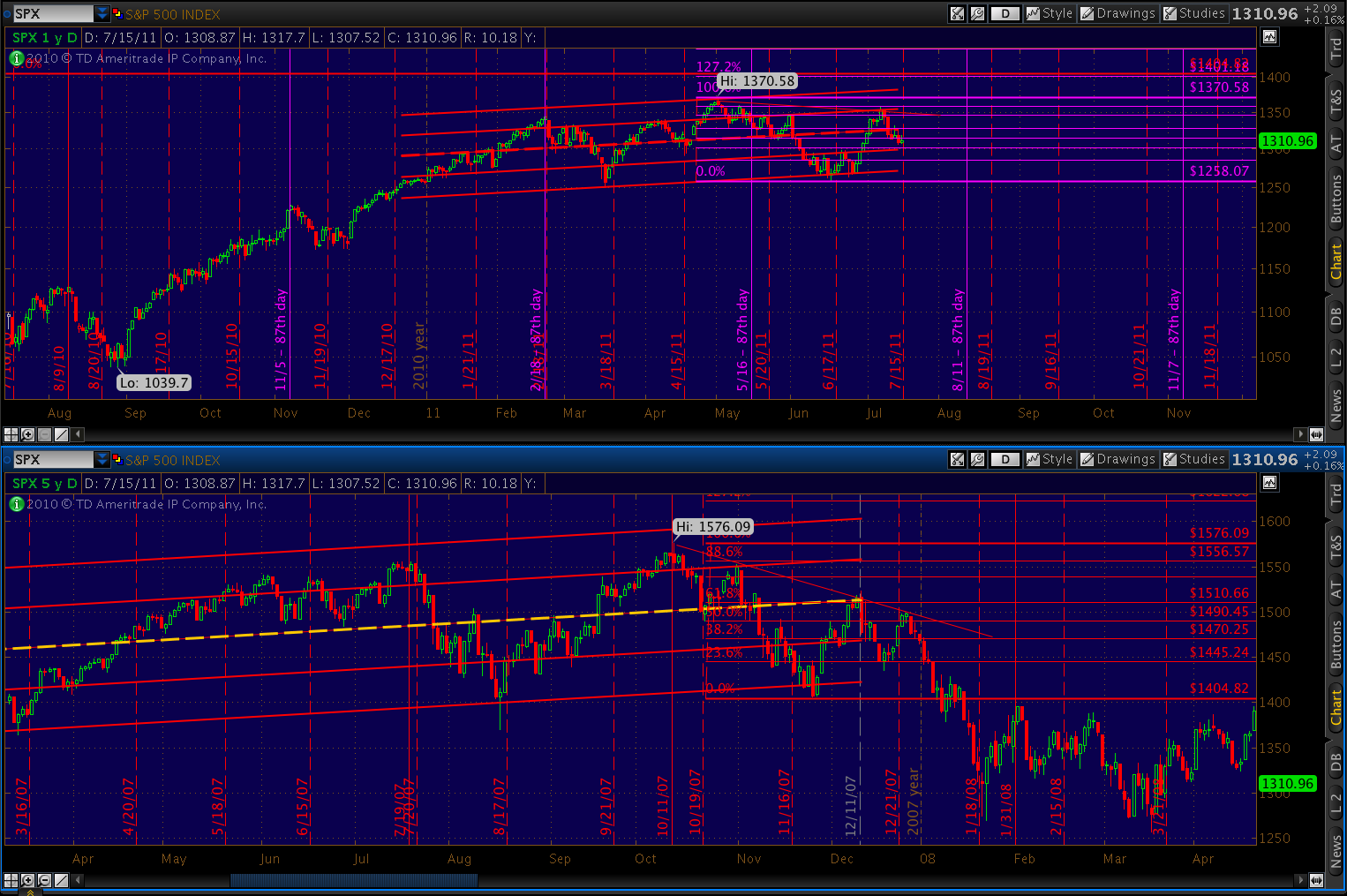
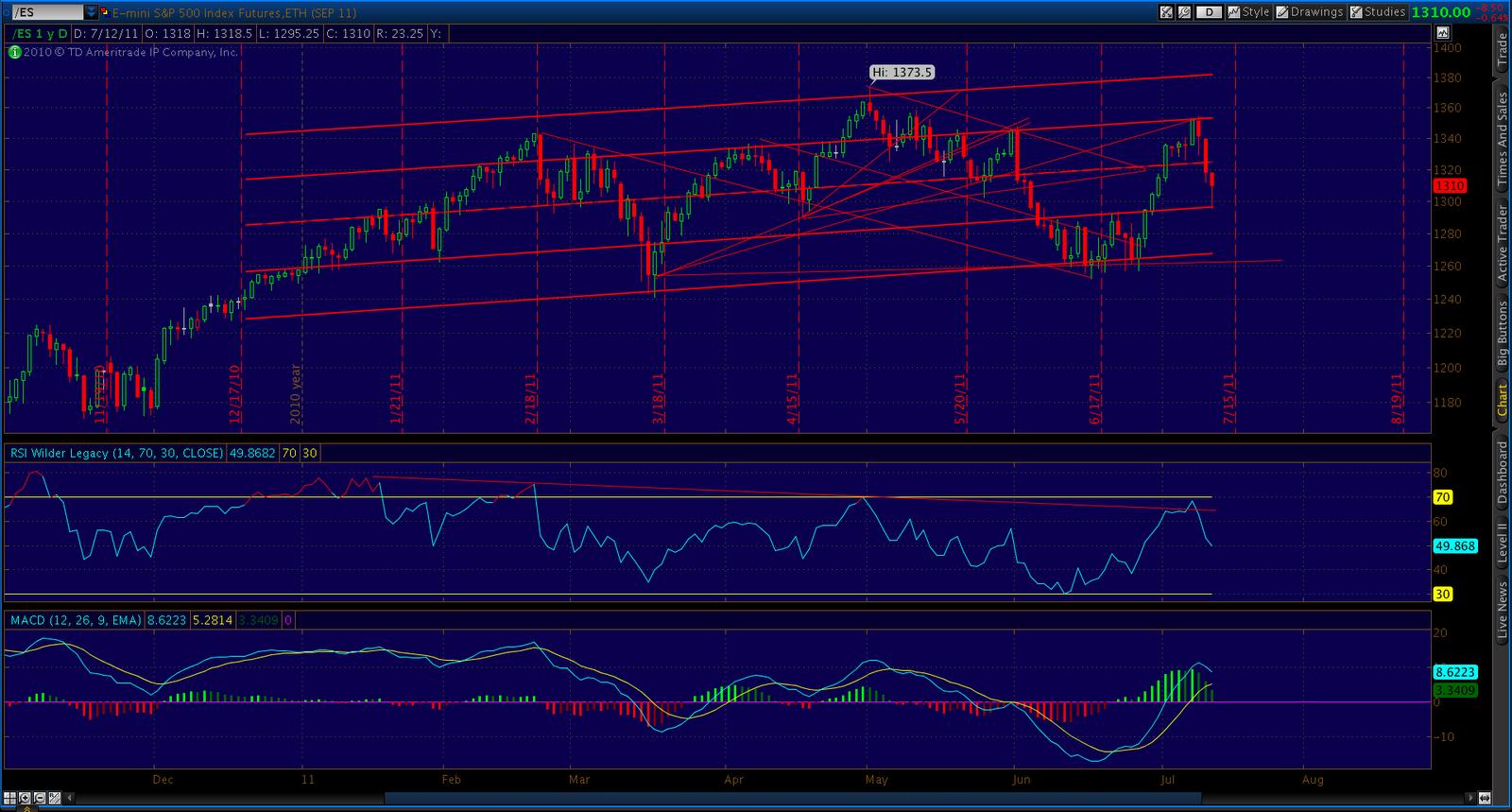
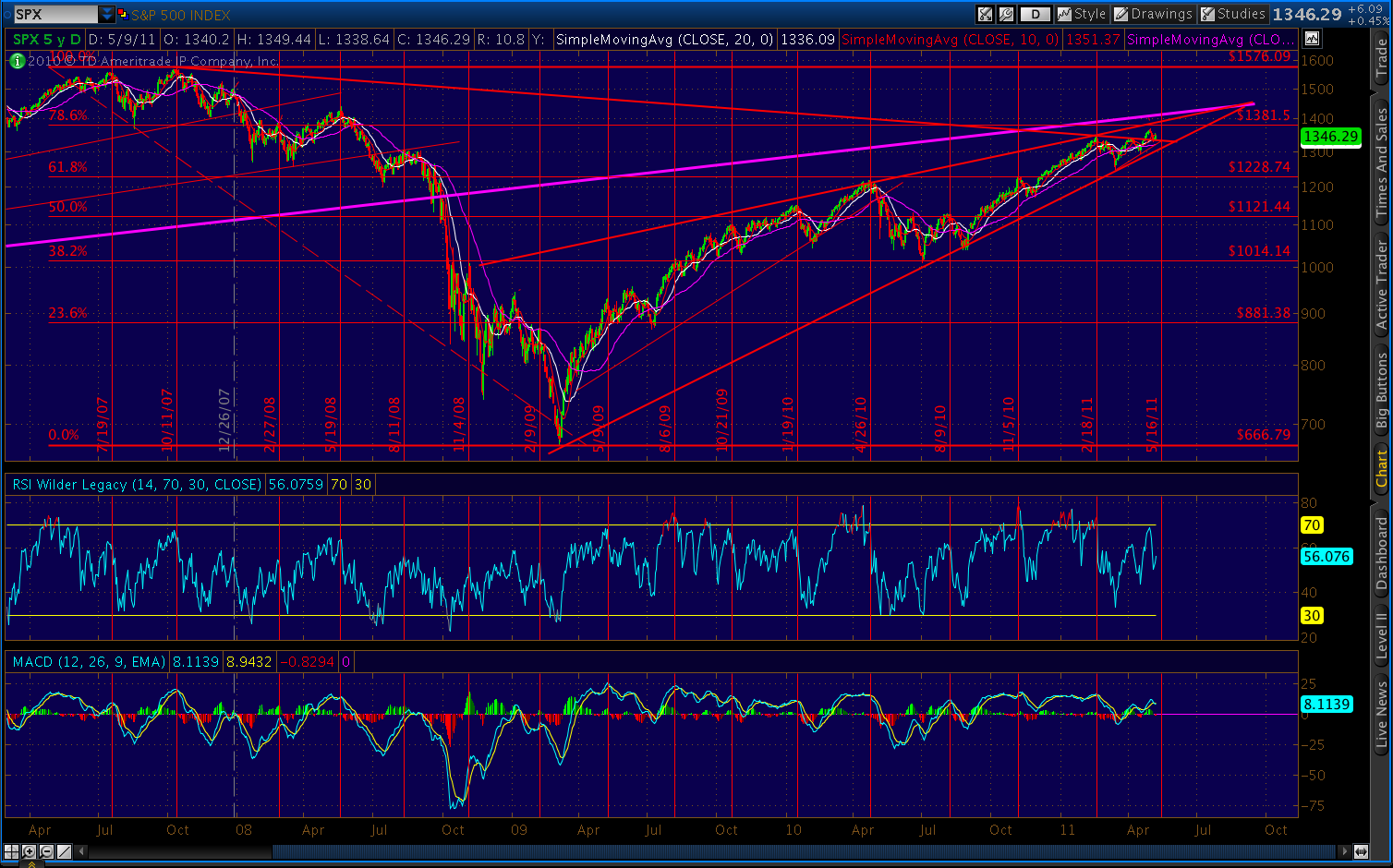
    We obviously dropped through the bottom of the rising wedge since Mar 2009 (log scale), signifying the beginning of the end for the bull market.  My 1261.90 bottom call came close; the recent low was 1258.

    Since then, we’ve made it just shy of 1299, so the Inverse H&S; worked out nicely.

    Yesterday’s pullback to 1286.79 is a tad lower than the 1287 I expected, but close enough for government work.  BTW, I consider this action merely a backtest of an important trendline — more on that below.

    VIX beat my 19.12 target, is close to my 17.30 target, touching 17.72 both yesterday and today.  More below on whether 15 is in the cards.

    What’s next?

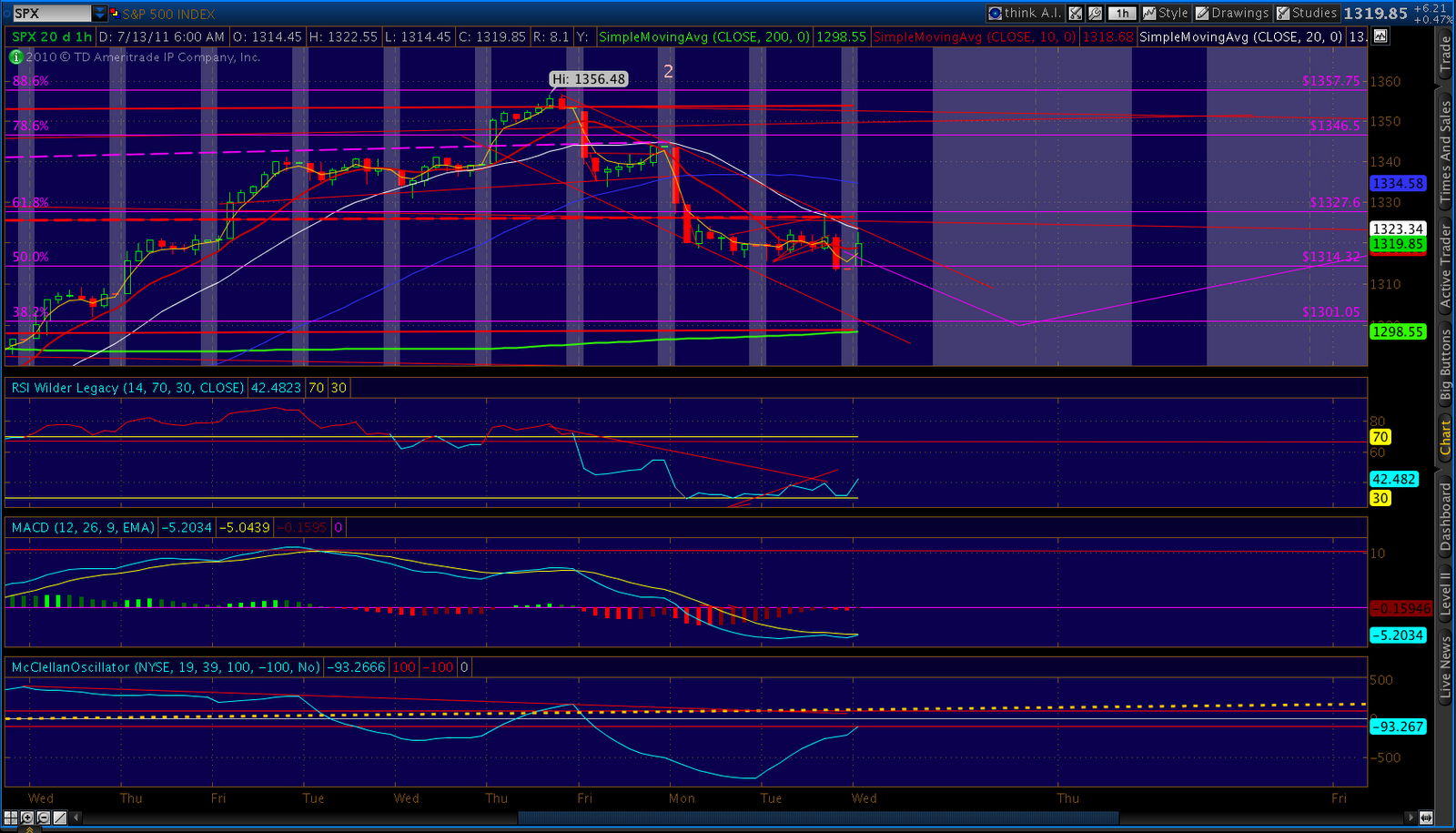
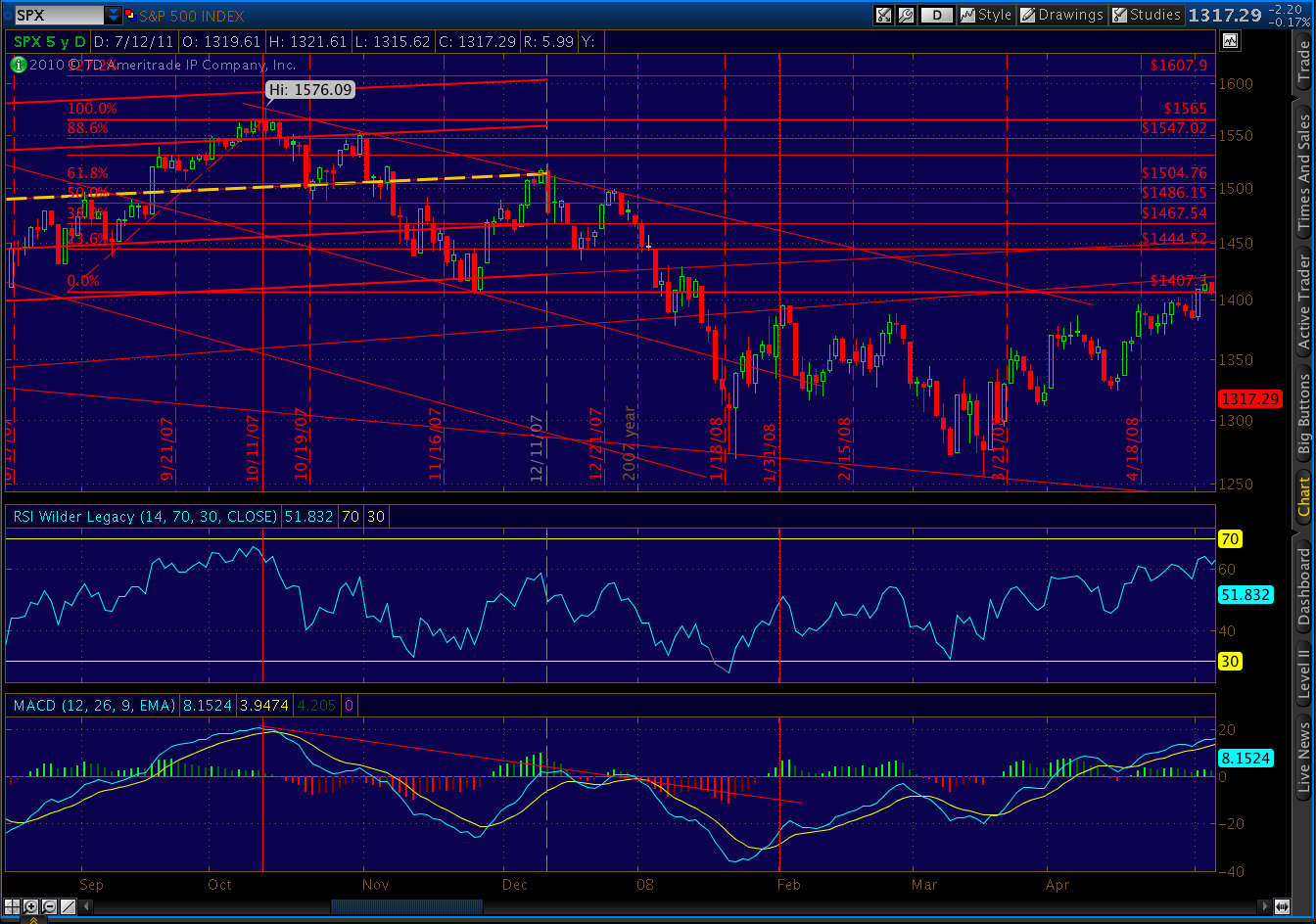
    The huge Crab Pattern discussed in Matryoshkas is still unfolding.  It targeted 1329, which is within spitting distance of my target.  The Inverse H&S; pattern I was tracking completed, and in so doing formed the head of another, larger IHS that’s in the works.  This one, also with a rising neckline (white, dashed line) indicates an upside of 1328.  I’m also watching a developing rising wedge, indicated below as the red dashed line. 

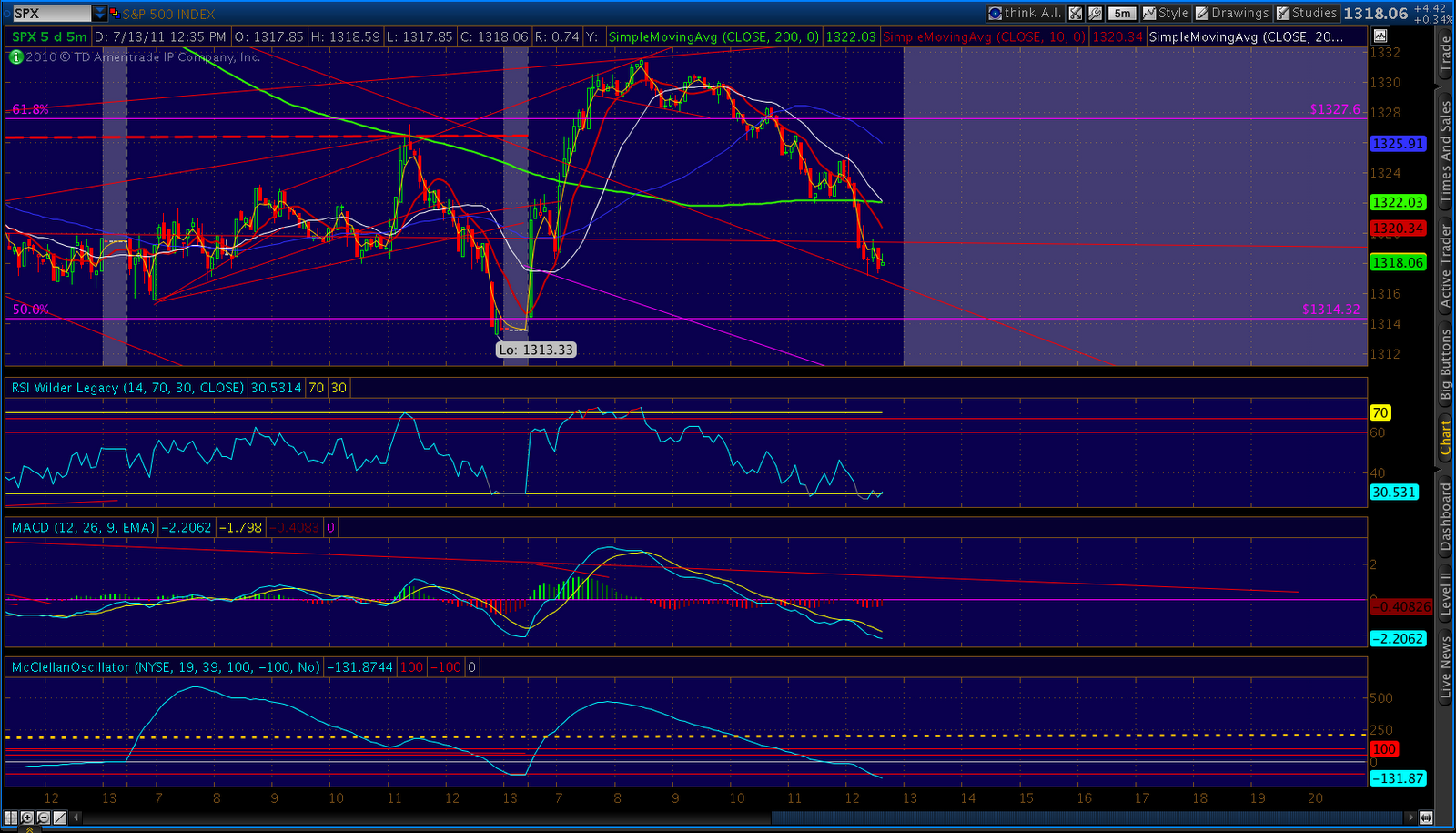
    From a technical standpoint, the daily MACD has turned positive and the histogram is back in the black.  The RSI is around 45, plenty of room for upside to run.  All the other indicators I watch (McClellan, bullish percentage, summation index, etc) are all turning bullish.

    I’m still expecting this pullback we saw today (and is continuing overnight) to be contained at 1287, meaning the futures will have to snap back before the open.  The hourly futures MACD looks like it’s bottoming (@ 12 am, PDT) and the histogram bottom is in.  The RSI is back to the mid 30’s.

    We reacted off the 20 SMA, but more importantly, we hit an important resistance line that I’ll discuss below.  The more important 50 SMA will be more problematic.  It currently stands around 1320, but should increase a few points over the next few days.

    Volume has been light, which indicates to me that the masses aren’t fully on board the rally just yet.  A strong push tomorrow should take care of that.

    If VIX bumps up at bit in the morning (possible given the futures’ action tonight), then a drop back to around 18 would complete another, larger H&S; (since 6/10) with an indicated downside of 11.  Not terribly likely, as we haven’t seen those prices since 2006; but, it’d sure get folks’ attention…

    From a fundamental standpoint, nothing in the FOMC announcement or BB’s press conference changed the expectations picture.  My biggest takeaway is that BB seemed particularly nervous.  His voice quavered like that of a child telling a whopper of a lie.  Makes sense, since he no doubt knows that things are much, much worse than anyone’s letting on.

    CBO, for instance, announced that our national debt will reach 101% of GDP in just ten years.  To put that in perspective: without any improvements, in 2021 we will be where Greece is today.  Scary thought, indeed.

    Tomorrow morning, we get initial claims and new home sales numbers.  I think they’ll either look good, or be spun as looking good.  Either way, expect happy, smiling faces on CNBC.

    Okay, this post is officially getting too long.  I’ll put up some interesting charts in the 2nd installment.

  • Intra-day: June 22, 2011

    The Bernanke managed to not send the markets down this time.  He struck as neutral a tone as possible, giving both the bulls and the bears something to hang their hats on.  Bottom line: no impact.  The climb to 1320+ should continue as planned.

    The current retreat, as discussed yesterday, should be contained at 1287-ish, the trend line that marked resistance on 6/7, 6/9 and 6/14.  That resistance is now support and should limit any further sell-off on the day.  That TL also coincides with a longer TL connecting the 4/8 high to the 4/20 gap and the 5/23-5/25 and 6/2 bottoms.  It runs parallel to the major fan lines of its big brothers from the 5/2 and 2/18 tops.

    These prices probably mark the last best chance for bulls to play this bounce to 1320 or so.  The short term technical indicators are all oversold, while the 1 hour and 30 minute now have sufficient room to make another run to the upside.

    We should see another pause around 1310, but there’s also a small chance that this .50 retracement of the 6/1 highs counts as the equivalent 10/31/2007 .618 retracement before that market’s final push to 1523.

  • A Different Perspective

    UPDATE: 11:25 AM PDT

    The market is currently around 1295, up big on the day as expected.  I’m expecting a brief pause here at the 20 SMA, with a possible pullback to the fan line at 1289 or 1290.  But, the trend is still up.

    There is a more significant correction coming, probably around 1311.  It should take us back to the fan line at 1287 before the final push up to 1320-1325.  There is still the possibility that we’ll continue beyond this range, but that’s in the hands of Bernanke and the sales job he’s able to do on Wednesday. I’ll be looking to snug up those stops as we approach 1320.

    I’ve updated the second chart below with expectations for the next couple of months.  Anyone who wants to throw an EW count against the wall based on these charts, have at it.

    ORIGINAL POST:  6:30 AM PDT

    There’s nothing about the economy, the employment picture, the global credit market, military conflicts breaking out everywhere,  etc. that I find promising.  Long term, we’re no doubt screwed.

    But, in looking at market tops all weekend long, I still can’t find a single instance of a market falling off a cliff without, first, some kind of retracement to the midline of its recent price action.   I’m staying with my June 16 call for a strong rebound this week.

    The target of 1320 looks good, depending on timing.  We just need to break through the fanline that’s been limiting us, currently around 1290.

    Next, we’ll pause around 1310, maybe retrace 5-10 points on our way to the trendline (A) off the 1370 top — the limiting factor to this whole rally.  It’s at 1327 today, but the target gets a little lower every day.   So, our upside is strictly a factor of how quickly we get there.

    I’ll put a prettier chart when I get the chance, but this is roughly what I have in mind.

    It’ll be important to keep some perspective.  As the rally unfolds, it’ll start to feel very bullish.  Many will call it the next Minor 5 up.  I don’t think it is.  I think we’ll be contained by that trendline and work our way down from there.  My plan is tight stops all along the way, taking into account the pause at 1305-1310.

    I imagine the massive head and shoulders pattern will be obvious by time we make our lower high around July 4th, and aside from some backtesting of the lower end of our channel, the market should plunge around mid-August to it’s first stop around 1200.

    Here’s the updated chart as of 11:25 AM PDT.  

    More later.

  • Intra-day: June 17, 2011

    9:35 PDT

    Watching the 5-minute on SPX.  If this little correction bounces here at 1269-1271.50, we’ll complete an inverted H&S; pattern and a bullish 5-0 pattern that could send SPX to 1300+.

    Also, keep an eye on VIX.  It’s possibly forming a H&S; pattern that could send it to 17.30.

  • Intra-day: Jun 16, 2011

    UPDATE 12:35 PDT

    The Gartley busted as the VIX took off for the moon.  Busted Gartley’s often become butterflies, which is exactly what happened here.  The .786/.786/1.272 pattern completed at 24.23.  The .618 reversal target is around 19.12.  Any extension, not uncommon in butterflies, could take VIX much lower.

    The 1.272 extension, for instance, would take it down below 15 — extremely bullish for stocks.    This is a large and well-formed pattern, dating back to Mar 18.  So, I take it very seriously.

    ORIGINAL POST:

    A bearish Gartley pattern just completed on the VIX since 3/21.  Should take it back around 17, bullish for stocks.

    Note: I revised the B point to 20.03 on May 23.  Missed it in all the excitement this morning.

  • You’ve Got a Fan in Me

    Last week I proposed a methodology for defining market tops in Channel Surfing and in the follow-up, Update: Channel Surfing.  I described it like this:


    …characterized by a multi-month pattern within a rising market that has at least two significant touches (of the index or its Bollinger Band) of at least 1.5 standard deviations on the upper and lower extremes of a regression channel commencing after a post-correction new high.  It’s capped off by a third touch on the lower boundary and subsequent return to at least the midline before a final plunge to new lows. 

    In playing around with the charts this weekend, I discovered another way of looking at these things.  First, look at the SPX over the long-term — something I don’t do often enough.

    Notice how the market has climbed pretty steadily since the depression (logarithmic scale.)  It frequently departs, rising up from the trendline, but always falls back to the long-term slope.  We see five touches (1932, 1944, 1949, 1974 and 1982) each marking the end of a significant correction/crash.

    Consider the first such departure: 1932 – 1942.   Follow along and we’ll play with some trendlines.

     Here, I’ve drawn three trendlines (A, B & C) coming up from the period low.  Each is drawn to a significant swing low, as is easily seen.  These are called fan lines.  You can probably see other spots that might justify one, but let’s go with these for now.  Notice how they act as support in two or more spots.  You can see that once the index finally drops through, these lines often act as resistance — they limit any further rebound.

    Next, we’ll add a few fan lines dropping down from the period high (D, E, F & G.)  Notice how they act opposite to the fan lines from down below.  That is, they act as resistance until the index drops through; they then act as support.

    Notice how many of the fan lines act as support to the index at one time, then turn around and act as resistance later on.  Now, let’s go crazy with them, and find all the other ones that seem “significant.”  One such line would be between D and E.  It’s an important low, although we wouldn’t know that until later.  I’ve drawn in a handful that kind of pop out.

    I’ve highlighted the areas of increased consolidation.  Note that they’re all contained within one or two fan line arcs:  1 & 2, 3 & A, 4 & 5 from the low,  6 & 7, 8 & F, 10 & G from the high.  I’ve highlighted these arcs and erased the rest.  I’ve also added a few horizontal trendlines that segment and capture horizontal support and resistance.  

    I see a lot of applications and implications.  But, first,  let’s focus on the topping pattern — since that’s the question of the day.  I’ve selected the 1935 – 1937 pattern.

    The pattern, seen here, looks a lot like the 2000 and 20007 regression channels, right?  Enters at the midpoint, two high touches, two low touches, a final rise to the midpoint, then goodnight Irene.   But, notice that the “regression channel” lines are actually trendlines that were drawn from significant points on the previous tops.

    The low line is connected to the previous high.  The high line is connected to the most significant high before that one.  The midline connects the apex of the high and low lines with the entry and exit points for the entire topping pattern.  The lower line has 5 significant touches; the top line has 3.

    Hmmm, where have I seen that before?  Let’s skip ahead a few years.

    The 2000 top, which I referred to as a regression channel before, could also be described as contained within 3 fan lines.  The bottom line connects the pattern’s lowest points with the previous significant high — just like in 1936.  The midline and the top line have nothing to connect to, but if I run them out to the left they intersect nicely, forming an apex with the bottom line.

    The 2007 top does the same.  The bottom fan line connects the pattern’s low points with the previous significant high, just like 2000 and 1936.  The top line connects the pattern’s high points to the next most significant high.  The midline, again, forms an apex with the both of them after they connect with significant highs in 2002, and significant lows in 2001 and 1998.  Hmmm…

    That brings us to 2011.  Notice the bottom fan line that connects the pattern’s low points with the previous significant high.  The top line doesn’t have any other highs to connect to, but does extend out to a few very significant lows in 2002 and 2003.  And, the midline connects nicely to the apex.

    The astute reader (with way too much time on their hands) might recall I pondered whether the current top was fully formed, or might expand as happened in 1999.  The first 3-4 months of that top looked very similar to the past several months of this pattern, then widened to a pattern that lasted another two years (see the 4th and 5th charts in Update: Channel Surfing.)

    I worried that the current top wasn’t large enough in size or time compared with the previous tops or with the previous summer 2010 correction.   With this new understanding, it’s easy to see how and why the top patterns expand.  The 100 point range of the past month would grow to 125 points by the middle of August [Sure it Works in Practice] and 165 points by the end of the year.

    So, is that what’s happening?   Trust me, I’m working on it.

    In the meantime, look again at the 2000 and 2007 tops.  Thanks to my fledgling understanding of fan lines,  it’s pretty clear to me that many of the patterns in the current topping pattern have been driven by fan lines from the 2007 top and the 2009 bottom.

    I drew the fan line from the 2007 top [The Trendline That Just Won’t Quit],  the trendline from the Mar ’09 bottom, the midline of this topping pattern, a trendline off the Nov 30 and Mar 16 lows and a trendline from the May 2 and Jun 1 highs.

    Interestingly, they all intersect around June 23 at about 1320.

    Now, I don’t know whether we’re in P[3] or Minor 4. I don’t know whether to be more worried about the Puetz window or Three Peaks and a Domed House or the Egg of Doom.  Those are issues for another post.  But, I have a pretty strong hunch that we’ll bump back up from these levels before anything else happens.

    Stay tuned.

  • Why I Love Harmonics

    UPDATE:  June 17, 2011

    The pattern indicated an upside to 97.42, which would be a possible turning point.  TLT closed yesterday at 97.38 and was as low as 96.70 this morning.  Let’s keep an eye on this one, if for no other reason than as an indicator.

    ORIGINAL POST:  June 15, 2011

    Posted yesterday midday, TLT was around 95.4 at the time.

    “For anyone trading TLT, it completed a pretty nice bullish butterfly at 95.5, indicates an upside of 96.67 at .618, 97.90 at 1.272 and 98.55 at 1.618 extensions. “

    Today, TLT is pushing 97, although at 97.42, it could start looking like a candidate to go the other way in a bearish pattern.


    But, as so often happens, the completion of a bearish pattern is the start of a bullish pattern, and vice versa.  If it reverses here or at 97.40, watch it as it approaches 94.83.  A stall there would be a potential setup for a bullish butterfly.

    From an equity standpoint, TLT is moving opposite SPX these days.  My bias is that we’re due for a rebound of more than 60 points in SPX; it would most likely arrive in an A-B-C pattern.  Hence, the above scenario in TLT could make a lot of sense.

  • Still Playing the Bounce

    I know… another round of horrid economic news, escalating unrest in Greece, etc., etc…

    Yes, the economy is still melting down.  No, there’s nothing we can do about it.   There’s still no miracle cure, no silver bullet and no pain-free long-term solution.  But, that doesn’t mean they won’t try.

    The two leading options right now are that we’re in a triangle ( expanding or running flat), trying to finish out minor 4 and launch 5 of C of P[2], or we’re in [iii] of minor 1 of P[3].  Yesterday, the triangle felt right.  Today, P[3].  I’ll talk later about which I’m expecting and why.

    But, either way, we should see more of a bounce than we got yesterday.  I’m calling this (1261.90) the bottom for now, looking for a rebound starting tomorrow.  My initial target is 1328 on June 21-23.

  • Matryoshkas

    If the SPX slide stops around here (ideally 1263), we would have a butterfly pattern (since the open, visible on the 5 minute) nestled inside another butterfly (also on 5 minute, since Friday’s low) nestled inside a crab (since 4/18 on the daily), nestled inside yet another crab (since 3/16 on daily.)  Think of them as four very bullish Russian nesting dolls, collectively indicating an upside of 1329 or better.

    Incidentally, 1329 is the midline of our 2-std dev regression channel we’ve been in for the past 4 months.  If this is the top, we always retrace to the midline after the 2nd touch of the negative 2 std dev line one last time before the plunge.  http://pebblewriter.blogspot.c…

    Not saying it has to happen… but VIX seems to be contained within the same channel it’s been in since April, and whatever the wave count, this isn’t feeling like a meltdown to me — just the rebound camp getting a little ahead of itself this morning.

    Here are the patterns.  The butterfly patterns are nestled at the end of the CD leg in the lower right corner.

    Two Crab Patterns

    Two Butterfly Patterns
  • Update: Channel Surfing

    Early results from reviewing a lot of market tops and would-be market tops…  I have yet to find an example of the model I suggested not working.  And, folks, this is kinda exciting stuff. 

    To recap, about a week ago I noticed [Watch for the Rebound] that the drop we were experiencing might set up an upward-trending channel that would embolden the bulls.  The channel could be seen by drawing a trendline off the 1344 and 1370 highs, and a parallel bottom between the 1249 low and the to-be-established low. 

    By this past Friday, it dawned on me [Channel Surfing] that what I had seen was actually a two-standard deviation regression channel.  The tops in 2000 and 2007 were very similar in the way that they entered into and behaved while within such a channel.  More importantly, the current market has behaved very similarly to those tops.

    I spent a few hours today dragging two-standard deviation regression channels around to various market tops and what looked like could be market tops.  Bottom line,  I’m fairly well convinced that not only have market tops all behaved similarly, but that the pattern observed is predictive of a market top.  In fact, I’m leaning towards calling this pattern a requirement of significant market tops.

    It’s characterized by a multi-month pattern within a rising market that has at least two significant touches (of the index or its Bollinger Band) of at least 1.5 standard deviations on the upper and lower extremes of a regression channel commencing after a post-correction new high.  It’s capped off by a third touch on the lower boundary and subsequent return to at least the midline before a final plunge to new lows.  Here’s the view of the 2000 and 2007 tops I posted last week.

    2000 TOP
    2007 TOP

    And, here’s where the market is now:

    2011 TOP?


    So, while I’m pretty confident about the next move (up, in the short term), is this THE top?

    Even though it’s predictive of a top, this pattern doesn’t in and of itself mean a major top is imminent.  Consider early 1999.  From March through May, the pattern displayed perfectly.  It featured a 100 point drop from May 13 through May 27, including 3 up and 3 down days of 20+ points off a 1375 high (hmmm… sounds familiar.)

    WHAT MIGHT HAVE BEEN

    Sure enough, after the 3rd touch of the bottom, the index rebounded to the midline at 1336.  As might be expected, it fell back — but only to 1287, from where it traced out five waves up over the next month to 1420!

    WHAT WAS

    In a turn of events that only a fractologist could love, it retraced the entire pattern on a much larger scale over the next 1 1/2 years before finally resulting in the crash we all knew and loved.  The initial, smaller scale channel can be seen in the far left of the much larger/longer pattern in the graph above.

    What’s an investor to do?  Look at the market’s behavior leading into the supposed top.  In 1999, the market had just experienced a 12-day, 180 point swoon.  So, a topping pattern that spanned only 100 points or so wasn’t at the same scale.

    In 2007, the last major correction was just over 100 points (May – August ’06.)  So, a topping pattern that spanned 200 or so points was completely in scale with the preceding action.

    What about today’s market?   So far, this channel is about 100 points.  We had a 50-point, 1-month correction last November, so that seems reasonable.  But, look back at the summer of 2010.  We had a 200-point correction that lasted 7 months.  The current topping pattern seems a little on the small side by comparison.

    And, what’s up with the November pattern looking suspiciously like the summer pattern?  Same thing happened with that fakeout in 1999 — a 65-point droop (also visible above) two months before the fun started that’s the spitting image of the 180-point one a few months before that.

    Besides, look at the time involved in the downturns preceding the pattern.  In each case, the larger correction was less than half the time span of the ultimate topping pattern.  Last summer’s correction lasted 7 months, but this topping pattern is only 4 months old.

    Could this be a head-fake, too?  Short answer: yes.  I have little doubt that we’re eventually going down after this week’s bounce back to the channel midline.  My inclination is that it’s sooner than later.  After all, we did lose the trendline of support that’s kept us going since Mar ’09 and the rising wedge since Oct ’10.  The economy is on life support.  And, ending QE2 is going to feel like cold turkey to this addicted market.

    But, just to be safe, I’ll wait for a breakout in one direction or the other to tell me whether or not a larger pattern is developing.  While I think it’s 50-50 at best, the possibility remains that this is a Minor 4 triangle, preparing the way for a Minor 5 push to 1370 or more.

    Upon nearing the midline, I’ll place stops to protect the downside, and not go short until/unless we break below the channel.  If the past is any guide (and isn’t it always?) the market would come back and backtest the channel before heading further south.  So, at most, it’s an opportunity loss of 50 points or so.  If this really is P[3], I’ll never miss those 50 points.

    I know what you’re thinking:  this is diametrically opposed to last week’s forecast (which seemed so great at the time!)  But, given that the original 87-day cycle date isn’t until August 11th, it would make sense if the plonger énorme were delayed a bit.  And, the leading candidate for the return to the midline isn’t until 6/29 or so.  We could bounce around a bit, I suppose.  But, how would we kill another six weeks if it isn’t by tracing out a (no doubt truncated) Minor 5?


    Just for the record, I think this market stinks.  I’m bearish.  Period.  There’s nothing happening in the world that gives me even the slightest confidence that we’ll come out of this looking good (okay, maybe the implosion of Newt’s campaign.)  Any move up, if it happens, would be the direct result of market manipulation on the grandest scale by the Fed — which, of course, is desperate to prevent P[3].  Would they do it?  In a heart beat.  Could they do it?  Maybe — at least temporarily.  Lots of economic reports coming out next week, most of which could be pushed one way or the other.  

    Or, given that the war is essentially lost anyway, why not blow the remaining ammunition on a last gasp effort to turn things around and announce QE3?  It would ultimately do more harm than good,  but it might buy some time.  Maybe call it something else, so people don’t catch on right away.  Qualitative Easing, anyone?

    Stay tuned.