Author: pebblewriter

  • Charts I’m Watching: October 4, 2011

    THE PATH TO 350:  Day 5

    Again… so far so good.

    And, a crack at the Minor 1 Elliott Wave count.  Note that (iii) amounts to a 1.618 multiple of both (i) and (v) — assuming we make it down to 1040.

    ORIGINAL POST: 11:00 AM

    I’m expecting internal trend lines to shape today’s price action.

    More later.

  • October 3, 2011: Path to 350

    THE PATH TO 350: Day 4.  So far, so good.

    Still looking for a descent to 1040 by next Friday the 14th.  Although, at this rate, we might well arrive before schedule.

    More later.

  • Charts I’m Watching: September 30, 2011

    THE PATH TO 350 – DAY 3

    So far, so good.  Have a great weekend, everyone!

    AND, THE REST…

    Don’t know for sure… but I’d bet dollars to donuts that we go through this point at 1117.50.  Fan lines are your friend.

    Will it wait till Monday, or is it ready to…

    A look at SPXU harmonics, in no particular order.  Lots of choices, here.  The smallest crab starting 8/22 that points to 26 looks doable under wave 5 down, unless I’m way off on direction and timing.

    The crab that started in Nov 10 points to 30, but that could take a little longer.   Keep in mind, I’m speculating here.  This is not investment advice.

    ****************
    NDX:  Rising Wedge, Gartley and H&S;

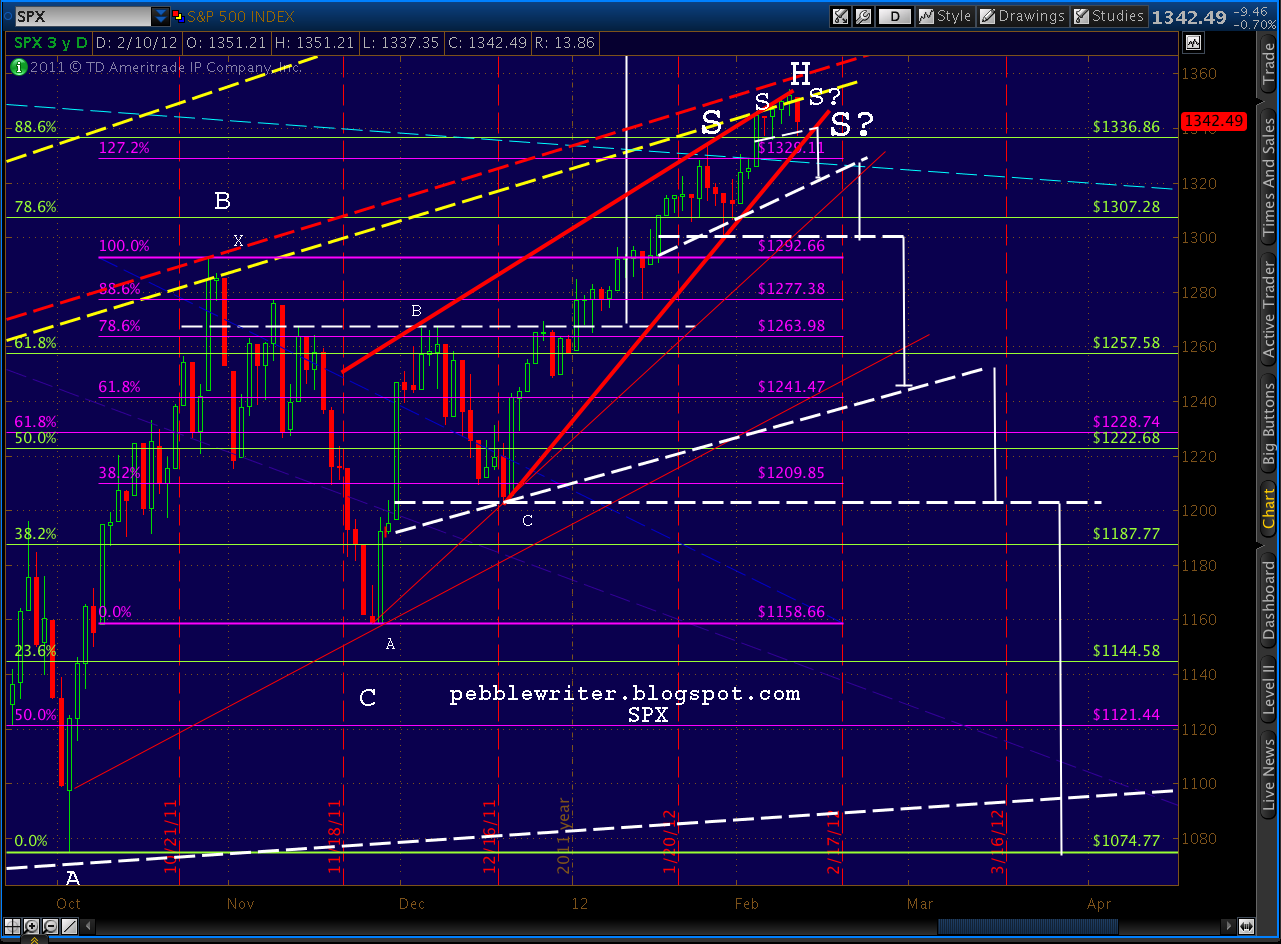
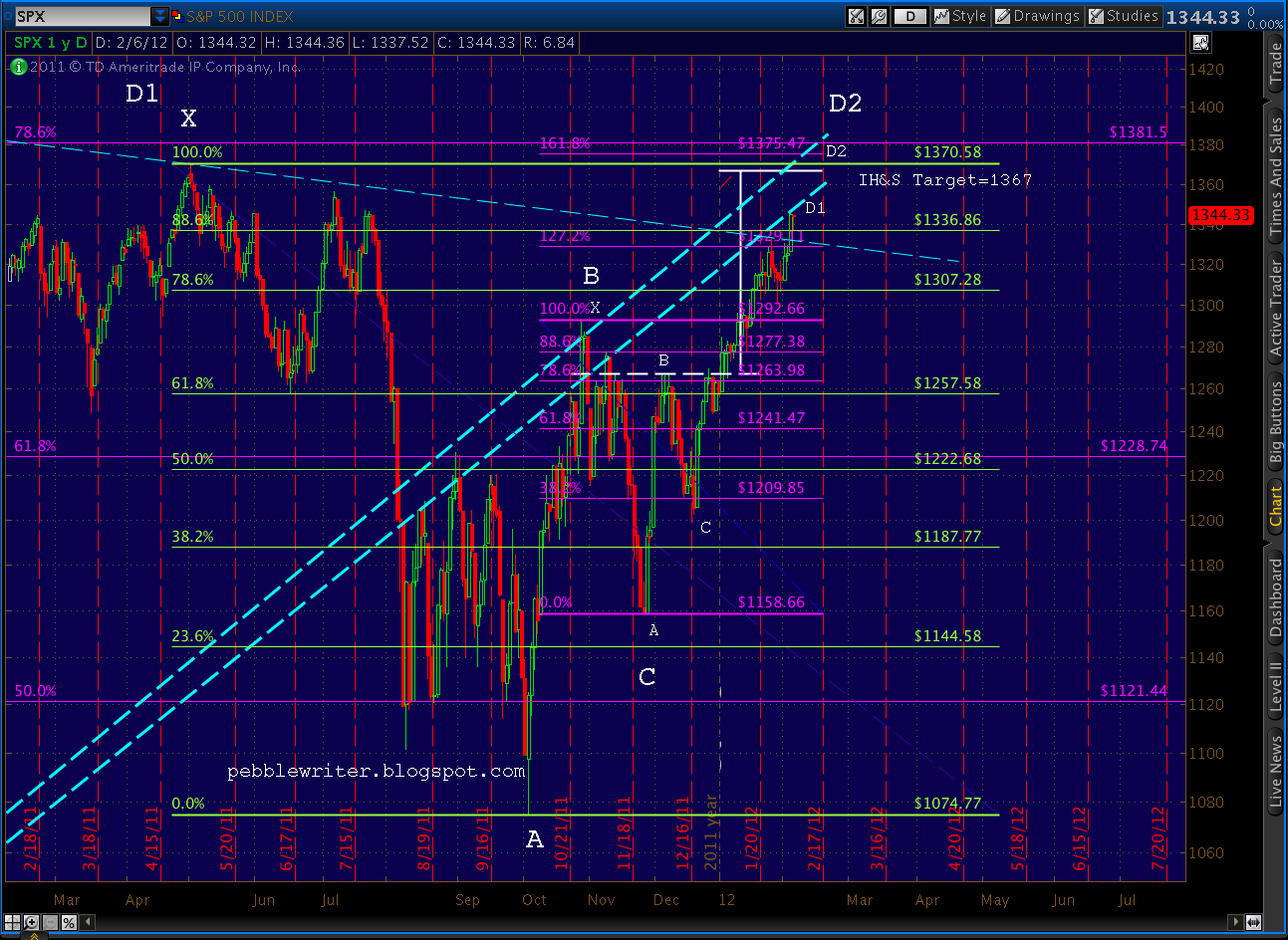
    NDX:  continuation H&S; pattern points to 1973, or you can look at it as a bear flag with potential to 1934.  Either way, could get ugly in a hurry.

    Remember that at the 2011 top, NDX made one more higher high as SPX was making its first lower high, two weeks later the market cracked and we fell 250 points.    Did the exact same thing in 2007/8.

    TZA: Bull Flag, backtested, breaking out

    TZA: IHS points to 64
     
    SPX RSI TL -Moment of Truth

  • The Forest and the Trees: September 29, 2011

    THIS JUST IN!  Did you see the headline?

    “Boston Consulting Group Concurs with Pebblewriter: Economy in Deep Doo-Doo”

    Okay, I made up the Pebblewriter part.  But, I did publish my 3-page opus a day earlier than their 15-pager (how did they cut and paste so quickly?)

    It’s worth a read, if only because their graphs and charts are prettier.  Enjoy.

    PATH TO 350 – DAY 2

    I think I’ll post the Path to 350 chart as the last chart each day, just to keep an eye on it.  If you missed the post and have an extra hour on your hands, here it is.

    If you read nothing else on this blog, this is the one — the Big Kahuna, Grand Poobah and Big Cheese all rolled into one.

    If someone you love is invested in stocks, send them the link.  If someone you despise is invested in stocks, send it to them too (they’ll never take your advice, and will hate you all the more after the crash!)

    And, the close up…

    Let’s see how many days in a row we can go without it being painfully obvious just how serious my dain bramage is.

    UPDATE:  7:55 PM

    Seeing a little divergence in the 2011 v 2008 analogy.  Might be OPEX issues, but in 2008, day 34 made a higher high from day 30; in 2011, 30 to 35 made a lower high.  We’ll see how it plays out over the next few days.

    Looking at the open interest in SPY puts, I would imagine market makers and dealers are pulling out all the stops to keep the markets at these levels.  Given the way things work these days, that probably means our “tax money at work” in the form of the Plunge Protection Team.  Certainly had that feel, today.

    The lines in the last few days of the 2011 chart, BTW, aren’t meant to convey a price objective — just tracking expected time and direction.

    UPDATE:  6:20 PM

    This is Pimco’s 25-yr zero coupon ETF, (ZROZ.)  I don’t follow it, but came across it today while researching something.  The Crab Pattern jumped out at me.  It reversed just above the 1.618 extension, and seemingly has further to fall — maybe on the order of 20% or so to just the .618.

    The portfolio’s duration is 27.79, so a 20% decline in prices would indicate a yield increase of 0.72%.  Anything could happen, but a .72% increase in long bond yields would hardly be beneficial to stocks.

    Of course, other factors can drive down prices — credit quality, for instance.  We are talking US treasuries, after all.  And, let’s not forget currency fluctuations.  A crash in the dollar wouldn’t do much for the value of long-duration dollar-denominated assets.

    Come to think of it, none of these events would be beneficial to stocks.  In an “all-the-same-market” scenario, bonds will tank right along with stocks and commodities.

    Wait, you say, didn’t the Fed just commit to a twist strategy that would boost long term bonds and lower rates?  Surely, that would allow bonds to continue their ascent?  Take a look at a cool SentimenTrader.com chart, which shows bond sentiment at extremes.  Nowhere to go but down.

    As discussed in yesterday’s The Path to 350, a rising interest rate environment would be the nail in the economy’s coffin.

    UPDATE:  11:10 AM

    Conjoined Head & Shoulders, anyone?

    ORIGINAL POST:  11:00 AM

    We all know the dollar needs to soar in order to get a decent stock dump, so how do we reconcile the dollar’s drop with SPX’s coming 5th wave down?

    The dollar (DX) has played out a beautiful little Crab Pattern over the past two months.  It reversed right at the 1.618 as expected.   It’s the pattern in yellow, below.

    But, note that that Crab Pattern takes place wholly within the C and D legs of a much larger Crab Pattern that began last January (seen in purple.)  Its 1.618 extension is at 87, a whopping 11.3% increase from here.

    It doesn’t have to be a Crab, by the way.  Bat Patterns also accommodate a Point B at the 50% retrace.  Instead of extending to 1.618, they reverse at the .886 retrace.  Even that, though, is 80.664 — a still healthy 3.2%.

    My guess is that we’ll see 80.6 with this wave 5 down, then a retrace while Minor 2 works itself out, followed by a rocket to 87 to coincide with Minor 3.

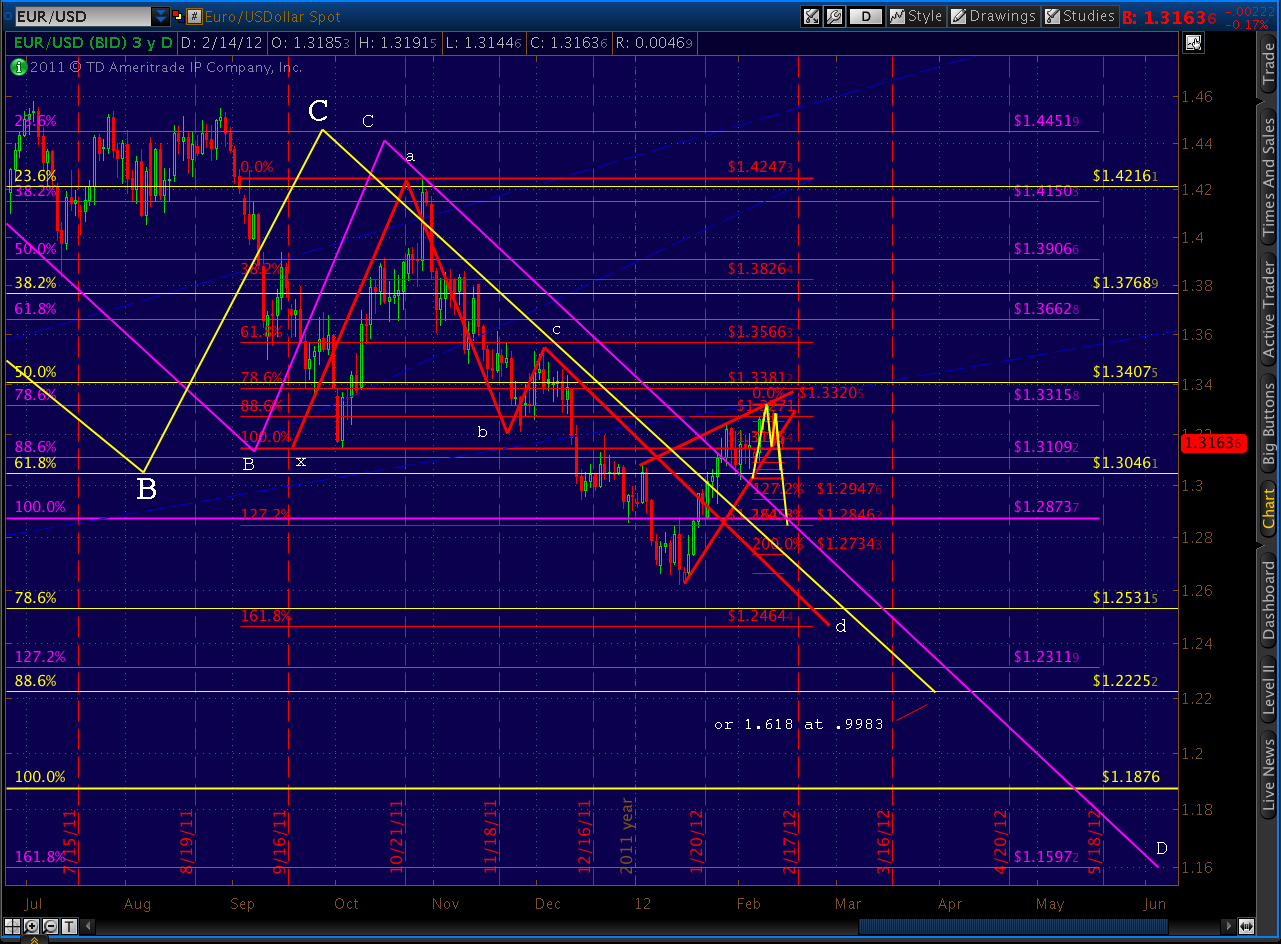
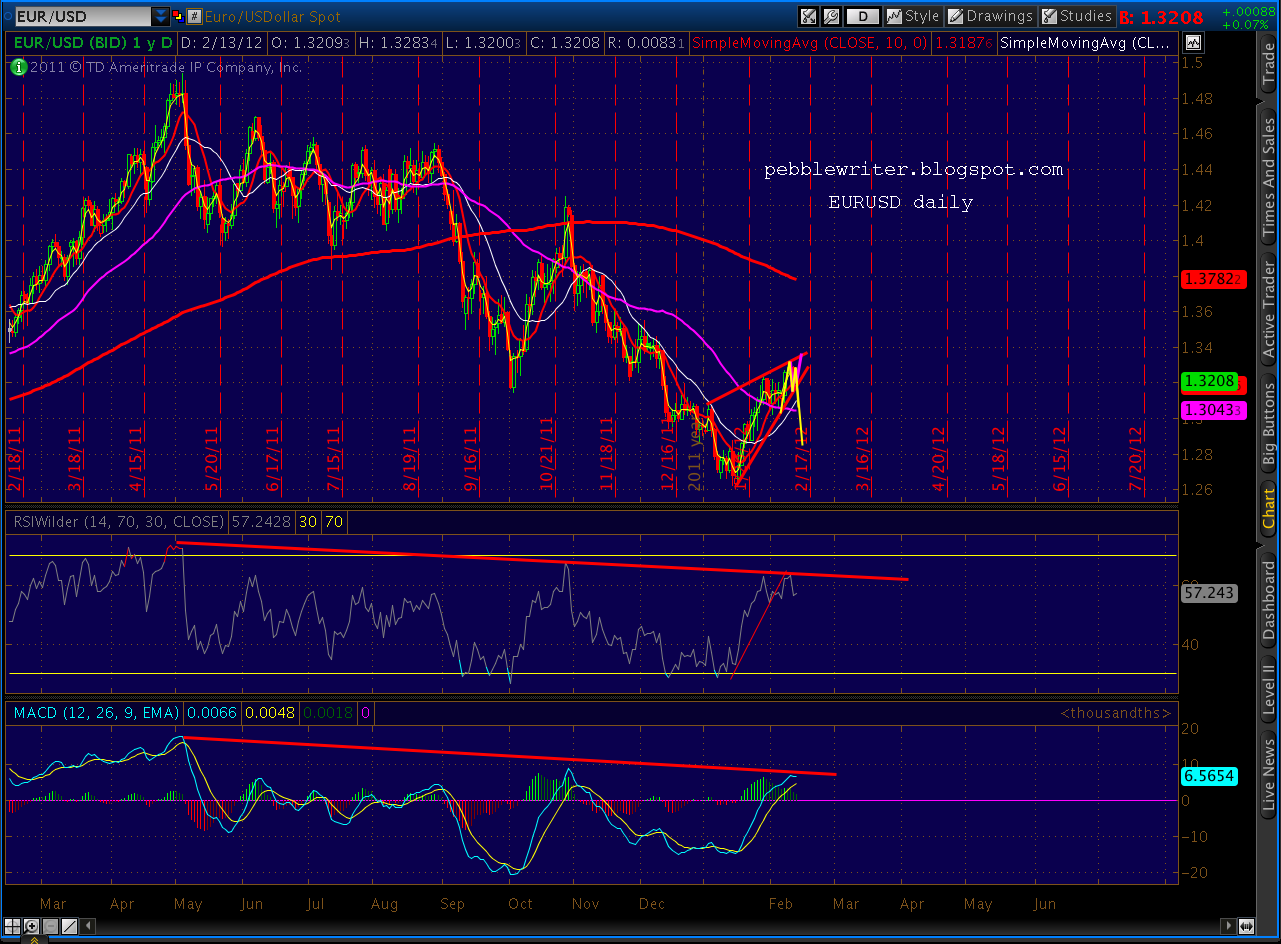
    EUR is in the same boat, BTW.

  • The Path to 350

    And, no, I’m not talking about Apple.  Although, come to think of it…

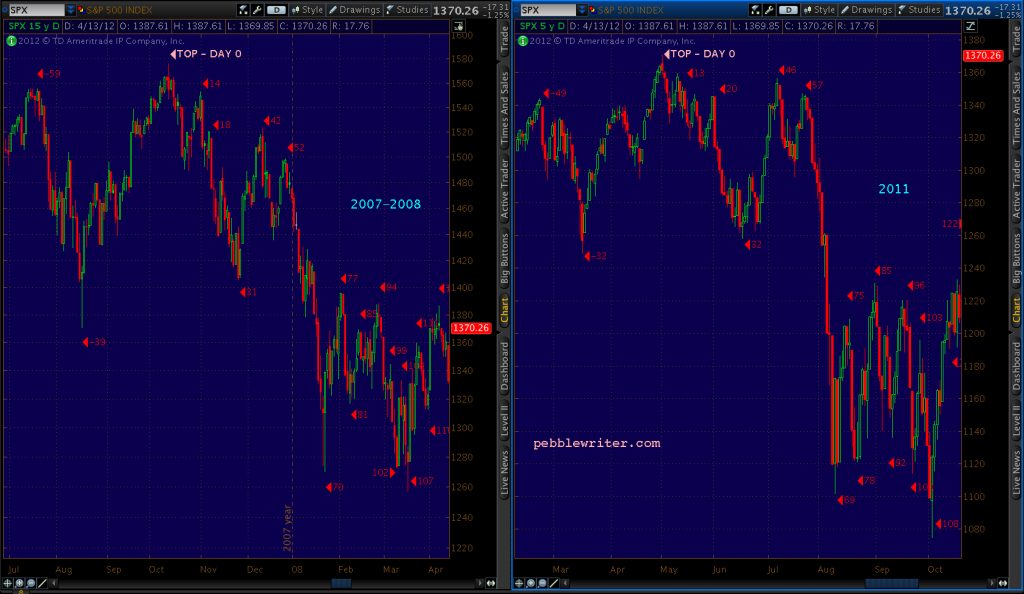
    At some point, the analogy I’ve been drawing since May between the 2007/8 and the 2011 market tops will fail.  In the meantime, the 2007/8 top has served as an amazingly accurate guide as to the current market’s direction.

    It might be helpful for some readers to get a feel for the bigger picture by integrating the fan lines, trend lines, channels, chart patterns and harmonics I think have a good chance of playing out.  My research indicates that some of these patterns and indicators are typical of all tops (one of these days I’ll get around to writing a proper research paper.)

    By utilizing the same methodology, anyone with the time and energy should be able to create these same charts and enjoy the same great returns that I have had this past year since I got serious about investing again.

    Speaking of time and energy, I plan to scale back on my blogging.  Another very profitable business interest that’s near and dear to my heart is ramping up, and I want to give it every opportunity to succeed.   I haven’t quite decided, but I’ll probably settle into a once or twice per week blogging schedule while doing a little consulting on the side.

    With that out of the way,  let’s start with the 2007/8 market top, already supplied with fan lines from the Mar 2003 bottom.  We have the benefit of hindsight, so I’ve added in an obvious downward-sloping channel from the top (the yellow lines) and two downward-sloping channels within that channel (the red lines.)

    I’ll label the major (yellow) channel lines A-1 and A-2, and the minor (red) channels B-1, B-2 and B-3.  Think or Swim’s basic charting package does an excellent job of creating parallel trend lines, so I don’t have to worry about allowing my bias to sneak into the mix.  I simply create a duplicate parallel TL and drag it to a place where it fits.

    If there is any doubt as to whether the minor channels are drawn correctly, I can create parallel duplicates and see if they fit as well.  By “fit” I simply mean whether they are significant and predictive.  That is, do they originate at important points in the pattern and, when followed forward in time, lead to other important points?  It’s pretty obvious that these parallel trend lines are a good fit.

    Now, let’s do the same thing for 2011/2 and label both the major and minor channels.  From here, it’s a matter of drawing in market moves that correlate to their 2008 equivalents.  With a modicum of care to respect obvious Elliott Wave rules and guidelines, we get something like this.

    Most of the moves are driven by the channel lines.  B-7, for instance, is the upper boundary of the channel that has guided the downside since July.  Its 2007/8 equivalent is B-2.

    The final wave 5 of Minor 1 has already started and should fall till it reaches B-6.  In 2008, however, the decline was arrested by the major channel (A-1 & A-2) before it could reach its potential.  I believe the same will happen this time, with A-3 stepping in to provide a floor at around 1040.

    Here, I’m speculating a bit.  I’ve based the target on completed H&S; and harmonics patterns as well as a similar move in 2008, when Minor 1 ended at parallel support from the W pattern in Jul 06.  The equivalent for the current market is the Apr-Sep 2010 swoon.

    Further, there’s a major fan line from the 2007 top that skips off the top of that pattern and lands squarely at 1040 when it intersects with A-3.

    In 2008, when Minor 1 completed, we had a rally that took prices out of that channel and created a new, parallel channel bounded by B-3.  I expect the 2011 equivalent (Minor 2) to retrace about 50% of the May – Sep decline, which would take it back to 1200 or so.

    From there, we begin Minor 3  — still of Intermediate 1, of course.  It’s worth noting that the distance of each leg down is, like all declines, a function of time and channel slope.  We can’t do much to change time, but 2011’s steeper channels (B-6 through B-10) translate each passing week into a greater decline than their 2008 equivalents.

    So, while 2008’s Minor 3 fell 700 points, 2012’s could be over 800.  It’s easy to see in hindsight that the 2008 channels did an excellent job of guiding the market moves all the way down.  B-4, for instance, came back into play over a year after it was forgotten.  It’s parallel cousin, B-5, eventually marked the Nov 08 and Mar 09 lows.

    I expect the 2011/2 channels to operate the same way, and have attempted to utilize the same movement between channels into my forecast.  Even so, I have a healthy degree of skepticism when viewing my own results.  Most investors would probably laugh if told the S&P; 500 will decline to 350 by the end of 2012.  And, that’s just Intermediate 1 of Primary 3!

    There is a possibility that the major channel I have in mind for 2011/2 is off.  It’s always a dicey business to draw long term channels with “only” eight months of market action to go from.  If I draw a TL parallel to A-1 and A-2, for instance, and drag it over to the current market, there’s an obvious place for it to land.  I’ll label it and its companion A-5 and A-6.

    There are a host of reasons I’m not as keen on this scenario, but the reality is we’ll know in the next couple of weeks.  Wave 5 will plunge to around 1075 instead of 1040 or lower.  And, Minor 2 might retrace to 1250 rather than 1200.  It’s easy enough to position oneself for either outcome.  And, in the end, we should fall from either major channel as we pursue the minor channels down to complete Intermediate 1.

    Chart patterns and harmonics corroborate most of this forecast. The bear flag pattern (Aug and Sep) target is 972, while the measured move target is 984 — both somewhere around the end of the second subwave of Minor 3.

    The large H&S; pattern we saw play out from Jan to Aug 11 played out with the drop to 1100.  The continuation H&S; pattern that’s been established over the past two months signals a move to 1040 (how ’bout them apples?)

    The large, sloped pattern we recently completed argues for 828, while the giant H&S; (shown below) that will complete with the decline to 1040 signals a downside of 710.  H&S; patterns don’t come with a time frame, but note that 828 and 710 are roughly where my forecasted Minor 3 intersects with the continuation of the 2008 channel lines A-1 and A-2.

    The harmonic pattern is also compelling.  Crab patterns are characterized by the 1.618 extension of their XA leg and an extreme extension of their BC leg.

    The big W pattern we made last summer was a textbook beginning of a Crab pattern.  The 1.618 XA extension signaled 1340, while the 3.618 BC extension signaled 1363.  As you will no doubt remember, the first crack in the bull market appeared on Feb 18 at 1344; and, the top was May 2 at 1370.  Pretty darned effective, no?

    Similarly, the Gartley Pattern traced out over four years from the Oct 07 high turned exactly at the required .618 Fib point B and indicated a high at the .786 level of 1381.  Of course, we came with 11 points.

    So, whether you’re a fan of Harmonics or not, these are patterns you shouldn’t ignore.  Now that they’ve both played out, what do they say about the future?  For Gartley’s, I look for at least a .618 Fib retracement of the AD leg, or 984.

    For Crabs, an initial target is the .618 Fib (at 934), but the more common target is the 1.618 extension of DA which, here, points to 802.  Other common targets are the 1.272 extension (at 919) and the 2.618 (at 464.)

    So, what could go wrong?  Lots of things, obviously.  For one, there is plenty of dissension in Elliott Wave ranks as to where we are in the grand scheme of things.  I’m operating under the assumption that we’re in Primary 3 down.  If wrong, things could go a little differently.  We might not be as likely, for starters, to repeat 2008’s fun and games.

    There is an endless list of social, economic, natural and political events that could bring about a radical departure from past patterns.  Although, it’s worth noting that these types of patterns have played out over many years in many different markets, accompanied by a stunning variety of social, economic and political backdrops.

    Sadly, the world seems incapable of going even a year with major wars, political upheaval, colossal financial failure, natural disasters, famine and disease.  Although we can always hope, there’s no reason to believe the coming years will be any different.

    This forecast is completely consistent with the onset of another Great Depression.  The current recession, whether you view it as a continuation of 2007 or the next edition, is obviously having a very difficult time ending.  Monetary authorities have nowhere near the ammunition they had in 2009 which, had it been spent on stimulating the economy rather than bailing out Wall Street, might have made a real difference.

    Several trillion in debt later, they’re still trying to figure out how to resolve the problem of too much debt by… issuing more debt.  The focus is on the Euro zone now, but it will soon return to the U.S., which apparently lacks the political will to deal with the $1.5 trillion annual deficit, let alone the $200 billion annual interest on the accumulated debt.

    Keep in mind, that’s with 2% 10-year treasury bonds.  If rates return to 2000’s 6%, the annual interest would rival what we spend today on Social Security, Medicare or the military.  At 1980’s rates, it would approach $1.5 trillion per year.

    Those figures, by the way, assume we miraculously and immediately stop spending more than we take in.  Since we currently take in about $2.1 trillion and spend $3.5 trillion, that would entail a 66% increase in tax receipts or a 40% drop in expenditures.  I don’t think either of those outcomes is even remotely possible.

    In the end, the only solution I can foresee is the one Greece, Italy, Spain, Ireland and Portugal will ultimately choose — the Big Red Reset Button.  Borrowers will cast off their debt and start over.  It will devastate not only their lenders and financial markets, but pensioners and workers, providers and users of public services, political parties and governments.

    But, as Argentina, Mexico, Russia and many others can attest, there is life after default.  Most of the Euro countries — including Germany (1923 and 1945) — have defaulted before.  It’s not the end of the world.  China, which is developing its own debt problems, will have to cope.  Primary 3 will eventually end, and the world will get a shot at redemption as Primary 4 kicks in. 

    I don’t intend this to be a message of doom and gloom.  It’s only a forecast — my best guess based on what I see going on in markets and the systems that influence them.  Most individual investors have the ability to protect themselves — even profit — from the events ahead.  My personal approach is to hope for the best, but prepare for the worst. 

    Feel free to comment.  I ask only that naysayers offer substantive support for their views.   A simple “you’re off your nut!” while it may be true, neither educates nor illuminates.   Links and data are always appreciated.  I’ll update this forecast as conditions warrant.

    Good luck to all.

  • Intra-day: September 27, 2011

    UPDATE:  1:20 PM

    The market’s hanging in there, in the face of increasing divergence.  Is a turn imminent?

    Take a look at TZA — the triple-leveraged inverse ETF on small caps.

    TZA peaked on Aug 8, back when the market last hit bottom.  Since then, it’s been bouncing back and forth in a descending channel.   It broke out of the channel on the 21st, and returned for a backtest.  The backtest has formed a falling wedge and a bullish Bat pattern with a reversal just ahead (the .886 Fib) at  42.81.

    UPDATE:  11:55 AM

    When it comes to Euro finances, it really is Deutschland über Alles.   Other countries may plot and scheme and hope and dream, but Wall Street’s latest miracle solution — the one that jeopardizes Germany’s AAA credit rating? — is a bunch of bullschnitzel.

    Straight from the horse’s mouth:

    Since this stick save was the only reason for this latest rally, it stands to reason the market is about to run out of juice.

    Note that even with today’s run up, SPX’s RSI has yet to break through its trend line.   The stochastic, even after three days of hooking back up, is still in negative territory.

    And, on the hourly chart, we’re clearly at an overbought level, with stochastic and RSI both looking like they’re at an inflection point.

    ORIGINAL POST:  11:15 AM

  • Intra-day: September 26, 2011

    UPDATE:  3:50 PM

    Big rally on light volume.  Sure seems like SPX wants to fill last Thursday’s gap at 1166.58.  

    UPDATE:  1:10 PM

    Talk about a party pooper…

    UPDATE:  12:55 PM

    The 60-min RSI still holding to its trend line. 

    UPDATE:  12:40 PM

    As has happened so often these past couple of months, we overshot the harmonic target.  However, it looks like just that, an overshoot, and nothing more.

    Taking a look at the bigger picture, the intersection of fan lines 5 and C should limit this to an intra-day spike that will leave a very bearish looking candle on the day.

    UPDATE:  11:25 AM

    Just about there…

    If I’m not mistaken, this should wave (iii) of [v] of Minor 1 down.

    Here’s a picture of the 60-min chart.  Note the RSI trend line, also calling for a reversal here.

    UPDATE:  10:55 AM

    We’ve touched the lower bound of the bear flag channel, officially completing the backtest.  But, we’ve also traced out 3/4 of a bat pattern, meaning we might go back up and bag 1144-1146 before heading down.  I show this morning’s 1148 to 1131 as a full five waves down, and the bump back up as A and B of the A-B-C, with C being the rebound to 1146.  That should be an excellent entry for the next leg down.

    UPDATE:  9:10 AM

    Backtest completed on SPX; should get going to the downside, now.

    ORIGINAL POST:  2:35 AM

    Starting out with a quick look at the tech picture on gold (GC.)

    First, check out the harmonic picture on the daily chart.  GC completed a crab pattern (purple, since 8/25) at the 1.618 extension of the XA leg.  The target was 1570.20, and we just overshot that by 12.

    However, there’s a larger bat pattern (in yellow) at work that started way back on July 1 at 1478.30.  It should extend to at least the .886 Fib level at 1528.40, although it could turn out to also be a crab with a 1.618 extension.  Either is possible with a .50 AB retrace (of the XA leg.)

    If I’m crazy enough to try and catch this falling knife (which I’m not) I can look at the RSI for confirmation.  Check the red trend line on the daily chart, just up ahead of the falling RSI.  It would certainly argue for a turn in the very near future.

    Here are the shorter term charts.  The 60 min and the 15 min look good for a reversal, and the 5-min actually shows a slight divergence.

    60-min
    15-min
    5-min

    Don’t usually get such a dynamic test of a theory…. It looks like we’re closing in on the .886 retrace, within 12 now.

    The point is that the RSI TL’s are confirming the idea of a GC bounce in the very near future.  The .886 at 1528 looks like it would fit well with that forecast.

    Naturally, I’d have to point out that the SMA 200 is just up ahead at 1522.  And, that we’d likely backtest the rising wedge we just departed (base at 700, ouch!)

    I see now we’re within 7 of our harmonic target and 13 of the SMA 200.  As I mentioned above, this could turn into a crab and go to the 161.8 XA extension at 1206.  At this rate, it probably will!

    But, the RSI gives me some confidence that we’re at or very near an interim reversal and that 1206 will have to wait for the time being.

    If I were interested, I might try to play a bounce to the next highest fib level or the wedge, from 1535 back to 1572 or 1585.  If I were looking to initiate a position but felt I had missed it, such a bounce might represent a good short entry point for the next leg down.

  • Doodling

    Some ideas I’m toying with this weekend… 

    Parallel lines that seem to do a pretty good job of correlating from one cycle to the next.  This series was established by drawing a trend line from the 2007 to the 2011 top, then copying it and dragging it elsewhere on the chart — keeping the line parallel.

    Astounding how often they play a similar role (to their initial role) years later, both in terms of support and resistance.  All drawings are in log scale, by the way.

    Let’s add some more trend lines, and see where this goes.  This first TL has always fascinated me.  It goes back several decades and does a great job of defining the last three tops.

    It marked the point of departure for the 2000 top, then caught its eventual collapse.  That catch was the point of departure for the 2007 top and ultimately limited the backtest that was the 2011 top.
     

    Now lets add some fan lines from the significant bottoms.   We’ll start with A, the point of departure (from the long term trend line) for the 2000 bull market.  Let’s call it a “point of origin” and extend yellow fan lines to subsequent significant bottoms.

    As you can see, it’s sort of a three strikes and you’re out proposition.    The initial fan line (a) stays close to and guides the advance.  The subsequent fan lines (b, c) arrest a decline, only to turn around and serve as resistance for the next backtest.

    The market reverses after the backtest, then falls 2-3 parallel lines — ultimately establishing a new major bottom.  In this case, the bottom occurs back at our original long term trend line, labelled Point B.

    We’ll construct the same fan lines from Point B and Point C, the 2009 bottom.   The last line for 2011 is pure conjecture, but the 2nd looks like a pretty safe bet.

    Now, let’s overlay the 2008 market move on the 2011 grid, just for grins.  It’s been working pretty darn well as an analog ever since I first suggested it in May.  It troubles me that Elliott Wave International recently latched onto it, as widespread recognition might just ruin its validity for the rest of it.  Oh, well.

    The result might be something like this.  There are many things I like about this chart, and a few that need to be worked out.  I’ll play with it more over the next few days and let you know how it turns out.

    More later.

  • Intra-day: September 23, 2011

    Seeing a little backtest of the fan line this morning, should be limited to 1141-1144.

  • Intra-day: September 22, 2011

    EOD:  2:20 AM

    The two fractals I’m watching:

    2011 vs 2007/8 suggests we’re 1/3 – 1/2 way to the Minor 5 low, so probably a new low early to mid next week, with a rally followed by the wave 5 low itself.

    And, the past two months versus the Feb – Jul 2011 top… it also argues for the new low sometime early to mid next week.

    UPDATE:  11:30 AM

    Also, looking ahead, we’ve completed 3 1/2 legs of a crab pattern.  We turned at the .886 and our target is the 1.618 extension at 1053.

    I feel confident of this number, since it also intersects with Fan Line E and is within 13 points of the 2010 lows.  Speculating here, but an educated guess is we’ll hit 1053, bounce back up to Fan Line D at 1080 or so before completing [v] of Minor 1 down at 1040 (the Aug 2010 low) or the H&S; target of 1020-1030.

    I’m currently looking for Minor 2 to backtest Fan Line 6, which by the end of the year should be up around 1150.  But this forecast is a work in progress.  I’ll probably do more over the weekend on it.

    See chart below for a better view.

    UPDATE:  11:15 AM

    Looking ahead, potential bounces at 1107, 1101 and 1088. 

    1107:  fan line 7 (just added this one)
    1101:  previous low Aug 9
    1086:  fan line D

    ORIGINAL POST:  10:55 AM

    Posts will be spotty while the market is jumping around like this.  Playing the downside, but also grabbing some profits on bounces.

    We’ve completed the big H&S; pattern, target = 1020-1030.  Measured move target = 980.

    Watch these fan/trend lines for bounce opportunities.  Just had one at fan line 6, bounced back to backtest the H&S; neckline (fan line 5) before heading on south.