
Author: pebblewriter

  • OPEC Day: Jun 22, 2018

    Oil and gas futures are higher as we await word on the deal being hammered out in Vienna.The latest reports are that we’ll get a 1MM barrel per day increase.  But, Iran is resisting any increase and is threatening to veto any deal that doesn’t include condemnation of the US’ withdrawal from the nuclear deal.

    continued for members(more…)

  • Shades of 2011

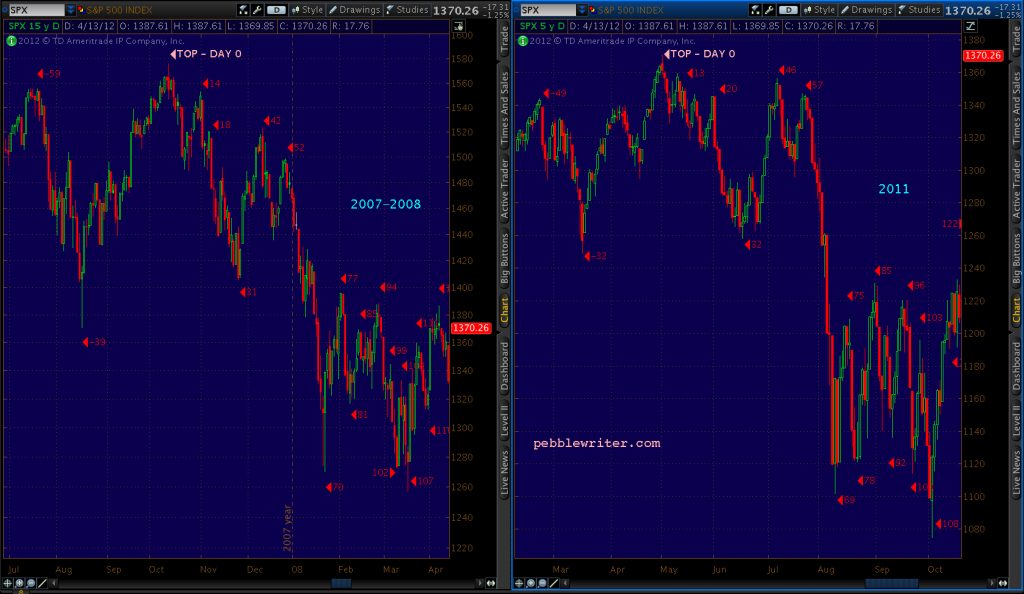
    We’re going to do sometime a little different today, and take a look back at 2011.  IMO, it’s an excellent analog for the current macro scene — particularly as it concerns inflation, interest rates, and oil and gas.

    For those who’d like a primer on the relationships between the above and equities, check out April’s Inflation, Oil & Gas, Inflation and Interest Rates: A Delicate Balance or Goal Seeking?

    We start with CPI — immensely understated, but the official measure of inflation that’s closest to reality.  CPI had turned negative during the GFC — bottoming shortly after stocks did.  But, it wasn’t stocks’ recovery that reignited inflation; it was rising oil and gas prices.The 2009 bounce was enough to get CPI back over +2%.  But, it wasn’t enough to keep it there.  A second leg up in 2010-2011 did the trick – but too well.  In April 2011, CPI topped 3% and by September it was nearing 4%.

    Needless to say, interest rates noticed.  The 10Y rose from 2.33 in Oct 2010 to 3.74 in Feb 2011.  Total federal debt had doubled in the past 7 years ($7.3T to $14.8T), so higher interest rates were a pretty obvious problem.  And, the lack of inflation had been an important rationale for the massive QE to date — so, it made the Fed’s argument for more QE sound downright silly.

    Having overshot 2% inflation and with rising interest expense becoming an obvious problem, it was time for oil and gas prices to come back down.  But, by now, the algos had come to recognize higher oil and gas prices as positive for stocks.

    In fact, SPX and WTI both hit their highs on the same day: May 2, 2011.  Could inflation (and, therefore, interest rates) be reduced to acceptable levels without derailing the bull market?  In a word, no.  Having peaked on the same day, SPX and WTI would also bottom on the same day: Oct 4, 2011.  WTI fell from 114.83 to 76.25, a 34% drop.  SPX shed 22% over the same period.So, what does this have to do with 2018?

    In 2011, with debt at $14.8 trillion and the average interest rate at 2.326%, interest expense was $454 billion

    Here in 2018, average interest rates are currently 2.421%.  With average debt of about $22 trillion this year, we’ll shell out somewhere around $532 billion — a 17% increase even though the 10Y is back below 3%.

    The chart below is from February [see: Why Rising Rates Are a Problem This Time] when average gas prices were $2.49 (a 12% YoY increase) and CPI was 2.2%.

    In May, the YoY increase in gas prices from May 2017 was 22% and CPI was 2.8%. Gas prices are currently $2.87, a 27% increase from June 2017.

    It’s not the sort of development that will bring interest rates back down to an acceptable level.  A quick glance at the chart below shows that gas prices, interest rates and inflation are joined at the hip, escalating in unison.

    Look, if you believe that oil and gas prices are driven strictly by supply and demand and that the government doesn’t intervene in order to achieve necessary economic goals, God bless you.  The world needs more wide-eyed innocents who won’t foul the interweb with cynical drivel such as you’ve wasted the past ten minutes on.

    If, on the other hand, you see the presidential tweets, congressional legislation, and backroom negotiations with Saudi Arabia and Russia as signs of something more deliberate or, dare we say, manipulative…  Well, now you understand why I’ve been uber-bearish on oil and gas prices for the past month.

     *  *  *

    Now, on to a recap of where things stand this morning.  Last night’s ramp was all about the USDJPY, which spiked through the SMA200 and broke out of a rising channel, only to tumble back to the SMA200 and channel bottom this morning.  It won’t hold.We know the breakout wasn’t meant to be simply because NKD still has some unfinished business: it’s SMA200 and channel backtest.  Look for yesterday’s rally to come undone — and more.Our focus, however, is on oil and gas – which were closing in on our next downside targets, but are needed for stock-propping purposes.

    continued for members(more…)

  • Misdirection

    A quick glance at VIX tells you all you need to know about the past two weeks.  VIX has steadily gained since Jun 7.  But, most of the gains have come in the after-hours, elevating VIX to a level from which it can make a meaningful plunge during the next day’s trading session.As ES once again pushes up against the TL connecting its highs of the past week, is it any surprise that VIX’s rising white channel is threatening to break down?

    This is a classic case of algorithmic misdirection.  While equities are dipping and recovering intraday on VIX’s dramatic plunges, oil and gas have fallen about 12% from their May 22 highs, emerging markets are having a very rough go of things, and the yield curve continues to flatten.

    It continues to remind me of 2011 in many ways.  Look for tomorrow’s post concerning oil and gas, inflation, interest rates and equities – then and now.

    continued for members(more…)

  • A Backtest, or More?

    The Nikkei 225 offers great perspective on today’s selloff.  One of the most heavily manipulated indices on the planet (the BoJ buys stocks outright), it was knee deep in a steeply falling channel from its January highs until Apr 30, when it tagged the top of the channel and the .618 Fib level.  It was a high probability reversal point.As usually happens, though, the yen carry trade kicked into high gear.  The USDJPY spiked through its SMA200, carrying NKD up and out of the falling channel.  A backtest two weeks later turned into a close call, with NKD closing back inside the channel for a few days — not exactly a clean backtest.

    But, after a strong USDJPY bounce, NKD was on its way again.  The critical day was Jun 12, when it failed to make a new high.  This failure spoke volumes, as it was in keeping with our expectation that, just like many major indices, it was simply marking time until its SMA200 emerged from the very bearish falling channel established earlier in the year.

    It’s a hallmark of the current bull market — slice through resistance when possible, then defend those levels like there’s no tomorrow.  With ES currently off 32 points, SPX and DJIA are in position to attempt the same maneuver – a day earlier than we had expected.

    continued for members(more…)

  • Charts I’m Watching: Jun 18, 2018

    Losses on the S&P futures reached 21 points early this morning, ostensibly on trade concerns.  But, it certainly didn’t help that WTI futures dipped below 64 and RB futures tagged our next lower target (the SMA100 at 2.0055) overnight.With scores of central bankers hitting the airwaves this week, housing starts and building permits coming out tomorrow, and the OPEC meeting coming up on Friday, we’re in for an interesting week.

    continued for members(more…)

  • “Trade Wars are Good, and Easy to Win”

    It’s been 15 weeks since Trump declared war on its major trading partners.

    “When a country (USA) is losing many billions of dollars on trade with virtually every country it does business with, trade wars are good, and easy to win,” Trump tweeted Friday morning. “When we are down $100 billion with a certain country and they get cute, don’t trade anymore – we win big. It’s easy!”

    We’re about to find out just how “good” trade wars are.  As a net importer, with CPI at 2.80% and PPI at 3.10%, the US will likely see inflation continue to leak beyond its comfort zone.

    Futures are currently off 14 points.continued for members(more…)

  • Update on EURUSD: June 14, 2018

    Back in January, with DXY having dropped from 95.15 to 92.51, we went full-on bear and reiterated a target [originally from May 1, 2017] of 88.423 on the index [see: Update on USDJPY]  This meant a huge jump for EURUSD, which at the time was trading at 1.19.  We targeted 1.2597 and crossed our fingers.The biggest question at the time was the top of the falling red channel. Would the pair zip on up to the channel top or wait until it aligned with the .618 Fib?

    By Feb 16, DXY had plunged to 88.253 and EURUSD had popped to 1.2555 — .0042 from our target.  The question remained, what about the channel top?  [see: Where to Next?]  We were kept in suspense until late April, when a consolidating triangle finally broke down instead of out.

    The midline of the rising white channel didn’t hold, and the pair continued to drop until May 29, when it finally reached the channel bottom.  Now, two weeks later, it’s testing the channel bottom again on Draghi’s latest verbal gymnastics.  Will it hold, or are we looking at another leg down for the pair?

    continued for members(more…)

  • Ciao Euro Growth

    Draghi’s press conference is wrapping up, and the upshot is a weaker economy going forward — but, one strong enough to get along without QE.  2018 GDP was lowered from 2.4 to 2.1%, with 2019 and 2020 remaining unchanged at 1.9% and 1.7%.  2018 inflation estimates were increased from 1.4% to 1.7%, where Draghi expects it to remain for the next several years.

    Not surprisingly, the euro is taking it on the chin.DXY, whose latest channel had broken down yesterday, was suddenly back in the black.Equity futures are loving the dollar resurgence which, combined with the threat of (what else is new?) another VIX breakdown, has ES pushing 18 points off its overnight lows.  For now, at least, the focus is off China’s economy, which is clearly weakening just in time for the imposition of US tariffs.

    continued for members(more…)

  • Inflation: Out of the Bag

    What a wonderful time to be a FOMC member.  You could raise rates to stave off spiking inflation, and in the process: (1) choke off the stock market and real estate meltups, (2) put more pressure on overleveraged consumers and businesses (3) increase the budget deficit, and (4) throw emerging markets under the bus.

    Alternatively, keep rates where they are and hope that inflation just goes away.

    Sure, the BLS lies about inflation.  Instead of the stated 2.8% CPI and 3.1% PPI, the actual numbers are closer to 6-10%.  Consumers experience the actual inflation rate when they buy groceries, rent an apartment or gas up the family truckster.  So, in a sense, the Fed faces the unenviable choice of penalizing consumers in order to “save” the market.

    And, make no mistake about it, saving the market has been their primary goal for the past decade.  They’ve had plenty of help, of course: the ECB, BoJ, BoE and SNB have all played an important role. Currencies, VIX, oil and gas — all are manipulated on a daily basis.

    Remember when the death cross was a “thing?”  The DMA-50 crossing below the DMA-200 was supposed to signal an impending nosedive.  After central bankers got into the stock propping business in the wake of the GFC, the death cross suddenly began signaling bottoms.Lately, stocks get an assist when the DMA-50 even approaches the DMA-200… …let alone an important Fib level or channel line.Although I rail sometimes about the lack of integrity in the markets, our focus is on making money.  Fortunately, the fact that the Fed has painted itself into this corner has been quite helpful in that regard.

    Oil and gas have sold off heavily since the inflation problem finally became apparent to central bankers and politicians [see: Once More With Feeling.]  USDJPY has bounced where/when we expected.  And, VIX has behaved scandalously, but predictably.Stocks typically ramp higher in the days leading up to FOMC announcements.  Depending on the decision, they either continue ramping or come unglued and backtest the former resistance through which they melted up.

    The biggest question, now, is what would it take to rattle investors the algos?

    continued for members(more…)

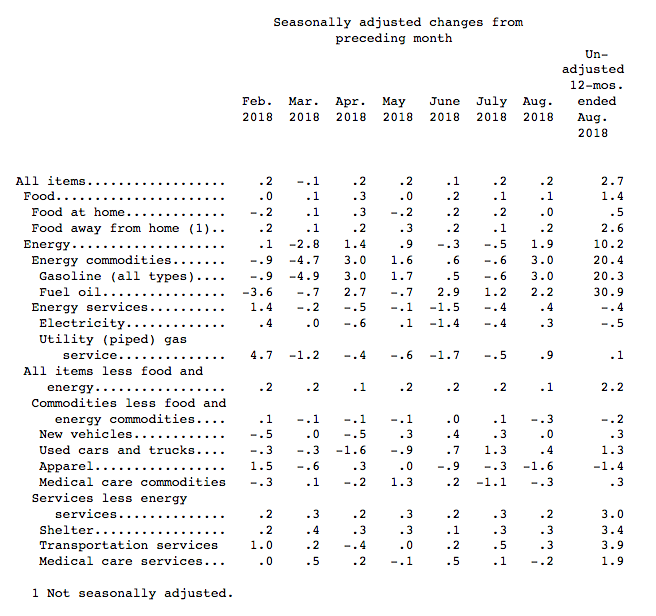
  • CPI: Highest Since Dec 2011

    As expected, the oil and gas breakout has pushed CPI to levels not seen since Dec 2011. So far, equities are taking the news in stride – with VIX and USDJPY well-positioned to help prop up futures – to a point.But, inflation at these levels has huge implications for oil and gas prices, the bond market, and equities.

    It’s now been 57 days since the 10s2s tagged the trend line connecting its previous lows (and stocks’ previous highs.)  At 2.96%, the 10Y is higher than during any FOMC meeting since June 21-22, 2011 — a few weeks before the US debt downgrade.

    At the time, CPI was 3.63% and WTI was $94. By Oct 4, 2011 SPX had plunged 17%, WTI had plunged 19%, and 10-year yields had collapsed 80% to to 1.72%. 

    CPI dropped below 3% in December and has remained below it ever since — despite a doubling of central bank balance sheets, $7 trillion in additional US gov’t debt, and the so-called “robust recovery.”

    We’ll revisit some of the charts which first illustrated the problem in the post Oil & Gas, Inflation and Interest Rates: A Delicate Balance or Goal Seeking?  The most important comparison to 2011, IMO, illustrates that interest expense is once again exploding as inflation drives rates higher — but, this time with $21 trillion instead of $14 trillion in debt.

    continued for members(more…)