Last night, I attended a very enjoyable holiday get-together at which I was probably the only technical analyst among a hundred or so quants. After solving the problems of nuclear proliferation and ensuring that the paintings in the room were perfectly level (who says finance guys don’t know how to party?) the discussion got down to forecasting.
 I greatly admire quants’ ability to chuck billions of data points into the Veg-o-Matic and spit out statistical relationships that baffle those of us with normal-sized brains. Who knew sunspot frequency mattered so much?
But, we humble chartists do have one advantage: our emphasis on visual perspective, which greatly facilitates pattern recognition and interpretation.
That’s a fancy way of saying we look at stuff and see patterns. It helps enormously if you’re slightly Aspergerry, like yours truly.
Now, if you’re one of those folks who believe markets follow a random walk and are free from interference, price fixing, manipulation, etc…well, God bless. Being a cynic, I look for explanations that go beyond the CNBC headlines.
So it was with our post this past April: Oil & Gas, Inflation and Interest Rates: A Delicate Balance or goal Seeking? In presenting dozens of tedious charts illustrating the historical relationships, I attempted to forecast the future path of, well, all that stuff.
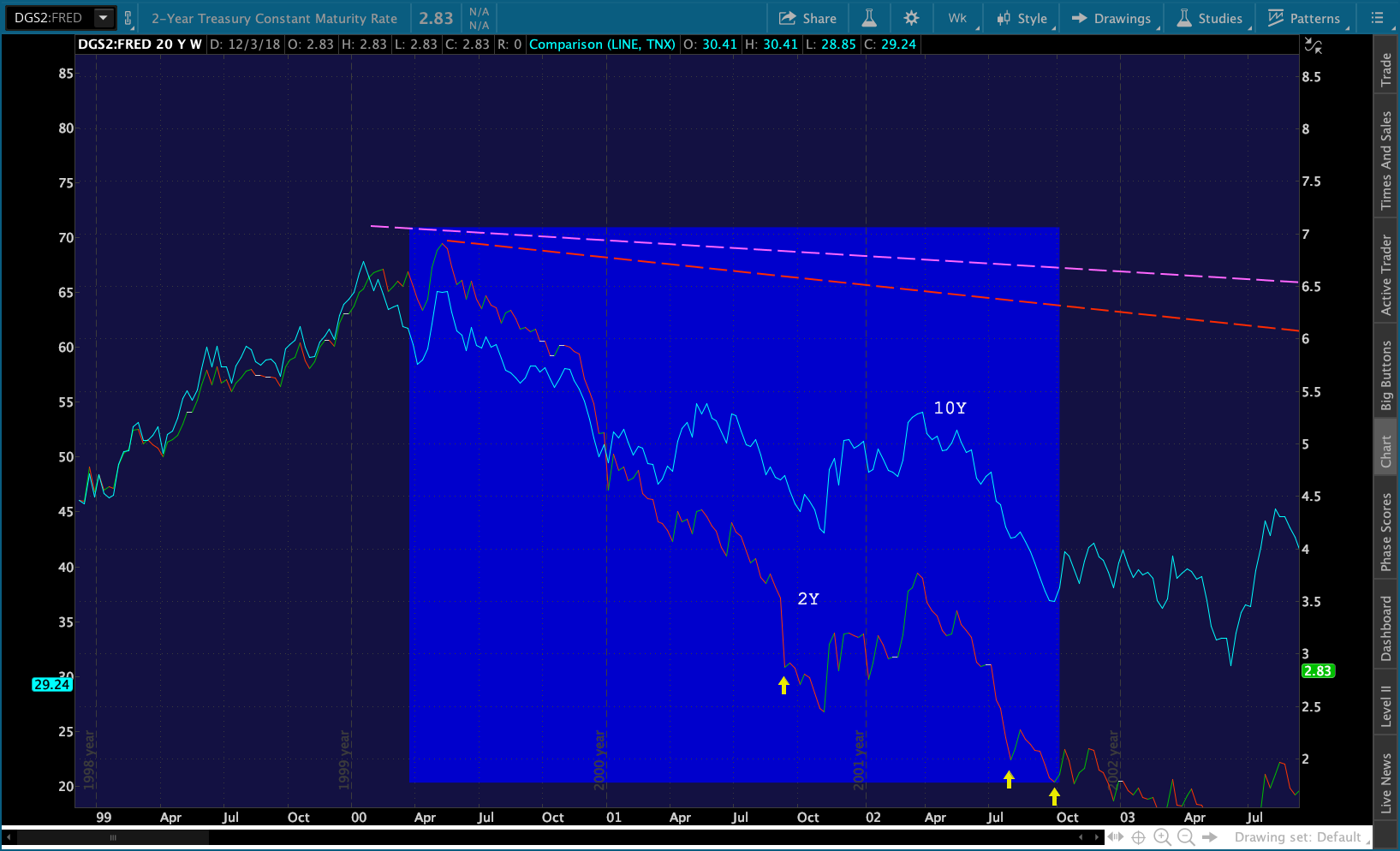
Our basic premise was that oil and gas prices were rising, which made equity algos happy but goosed inflation to the point that interest rates were becoming problematic. The 10Y had risen from a low of 1.34% in Jul 2016 to nearly 3%. The 2Y had risen from 0.56% to 2.56%. Interest-sensitive sectors were starting to feel the pain. The 2s10s, which had peaked near 290 bps in 2011, was screaming toward a negative number — which tends to signal recessions.
I suspected oil and gas prices would be driven down, one way or another. My suspicions were confirmed the very next day by Trump himself when he tweeted the first of his five missives on high oil prices.

The fastest and easiest way to bring interest rates back down would have been to ask the Fed to forget about that pesky inflation and put future rate hikes on hold. Mr Trump tried this…to no avail. After years of languishing below 2%, CPI was now pushing 3%.
The second fastest and easiest way was to bring inflation down. As the chart below shows, the fastest way to do this was to crash gas prices.
I know, those of my fundamental analysts friends whose feathers just got ruffled, that’s not how markets work. But, my friend Richard Fisher and I will just agree to disagree with you. We think that’s exactly how “markets” work when central bankers have their backs against the wall.
What the Fed did, and I was part of that group, is we front-loaded a tremendous market rally starting in March 2009. It was the Fed…the European Central Bank, the Japanese Central Bank… all quantitative driven by central bank activity. That’s not the way markets should be working… they were juiced up by central banks, including the Federal Reserve… I think you have to acknowledge reality.
Richard Fisher, former FOMC member
QE was an effective but expensive blunt instrument which saved stocks from ruin on many occasions. Buying stocks directly is also effective, but can leave you in an equity trap – right BoJ?
Nudging currencies, commodities and derivatives, which can trigger equity algos to go on a buying spree, is downright brilliant. It’s relatively cheap. And, with only 10% of trading volume attributable to fundamental, discretionary investors, these algorithmic nudges ripple out through index and quasi-index funds, ETFs and quantitative funds of all stripes.
With the mid-terms fast approaching and interest rates on the rise, fast action was necessary. But, Trump’s tweets were working. By October 3, oil prices had actually risen 10% since Trump’s first tweet. OPEC, led by Saudi Arabia, wasn’t listening.
Then, Trump was presented a gift. Saudi journalist and critic Jamal Khashoggi was butchered, apparently by Prince Mohammed bin Salman’s henchmen who flew in for the occasion from Saudi Arabia…as in leader of the OPEC pack Saudi Arabia.  The uproar created instant leverage for a certain politician who was, say, in a position to defend MBS.

Isn’t it fascinating that the very day these headlines hit the wires, oil and gas began a precipitous decline? As we illustrated in October in Coincidences and Consequences:, Khashoggi’s brutal murder top-ticked oil and gas prices and kicked off a 37% slide which hammered CPI, which had reached 2.95% in July, to November’s 2.18% announced today.
 The drop in inflation will only serve to bolster Trump’s argument that additional rate hikes are unnecessary and give the FOMC cover should they decide to sit on their hands next week.
 If higher interest rates are the problem for equities, are lower interest rates the solution? There, things get a little tricky.
On Monday, SPX reached the neckline of a large Head & Shoulders pattern we’ve been watching for the past couple of months. In the old days, when markets weren’t “juiced up by central banks,” completion of a H&S Pattern kicked off big declines. So did death crosses, the passage of the 50-day moving average below the 200-day as occurred last Thursday.
These days, a death cross and an arrival at a H&S neckline is much more likely to mark an important bottom — hence the 100-pt bounce in the past two sessions. But, can the US dollar continue to appreciate if the rate hike narrative crumbles? And, if the dollar declines, how would that affect equities? Time to hold on to your hat.
continued for members… (more…)

 An important test lies just ahead. With SPX and ES having closed below their Head & Shoulders necklines on Friday, the inference is that the bottom just dropped out. The real test will come, however, if COMP drops more than 1.6% to below 6801.75.
 And, now:
 Not exactly a very straight line — but, it got here, and pretty much on time.

 The EURUSD was virtually unmoved on Draghi’s press conference. In other words, nothing he said surprised or even resonated with investors.