
Month: January 2012

  • Butterflies and Crabapples: February 1, 2012

    UPDATE:  12:30PM

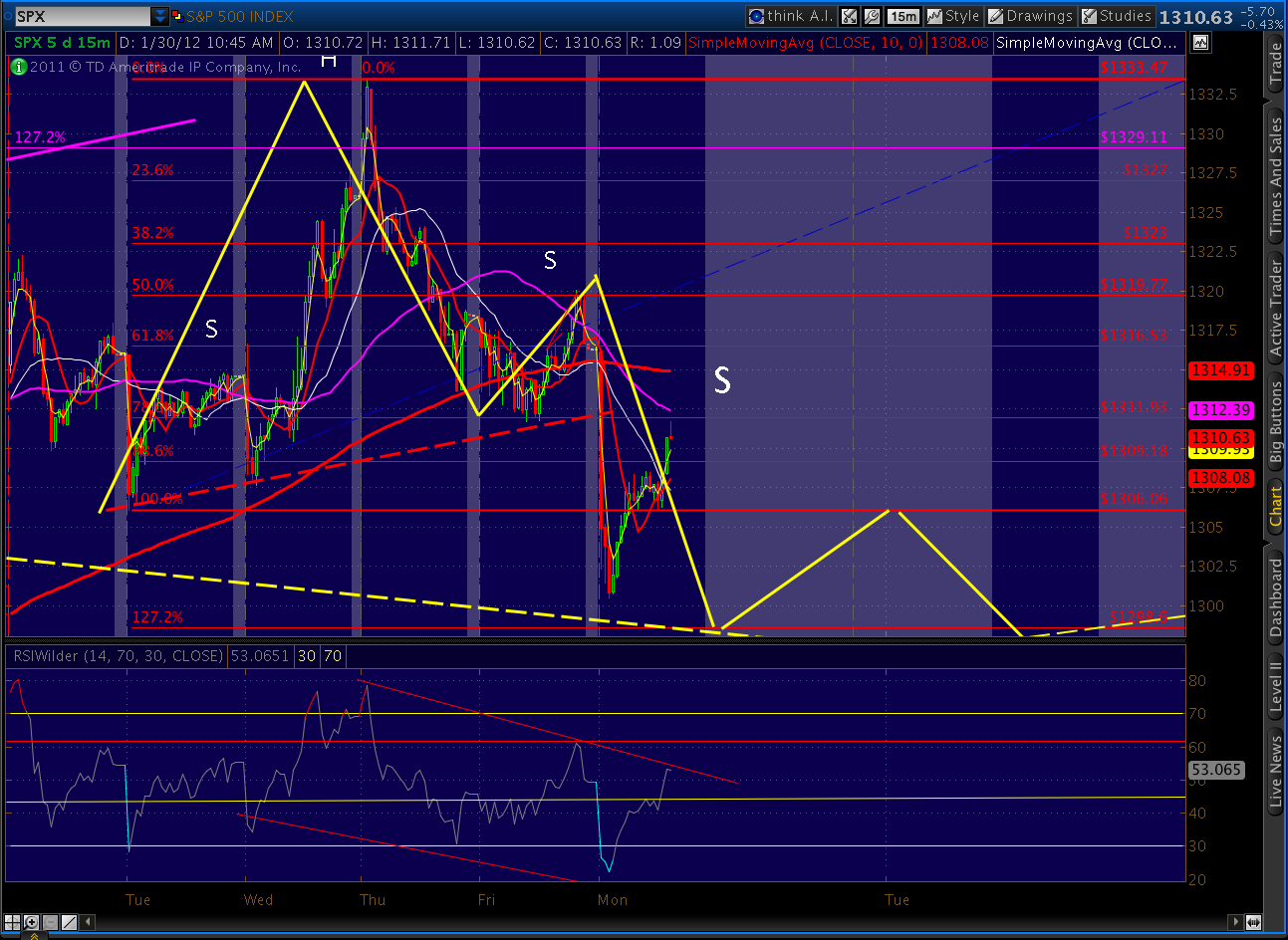
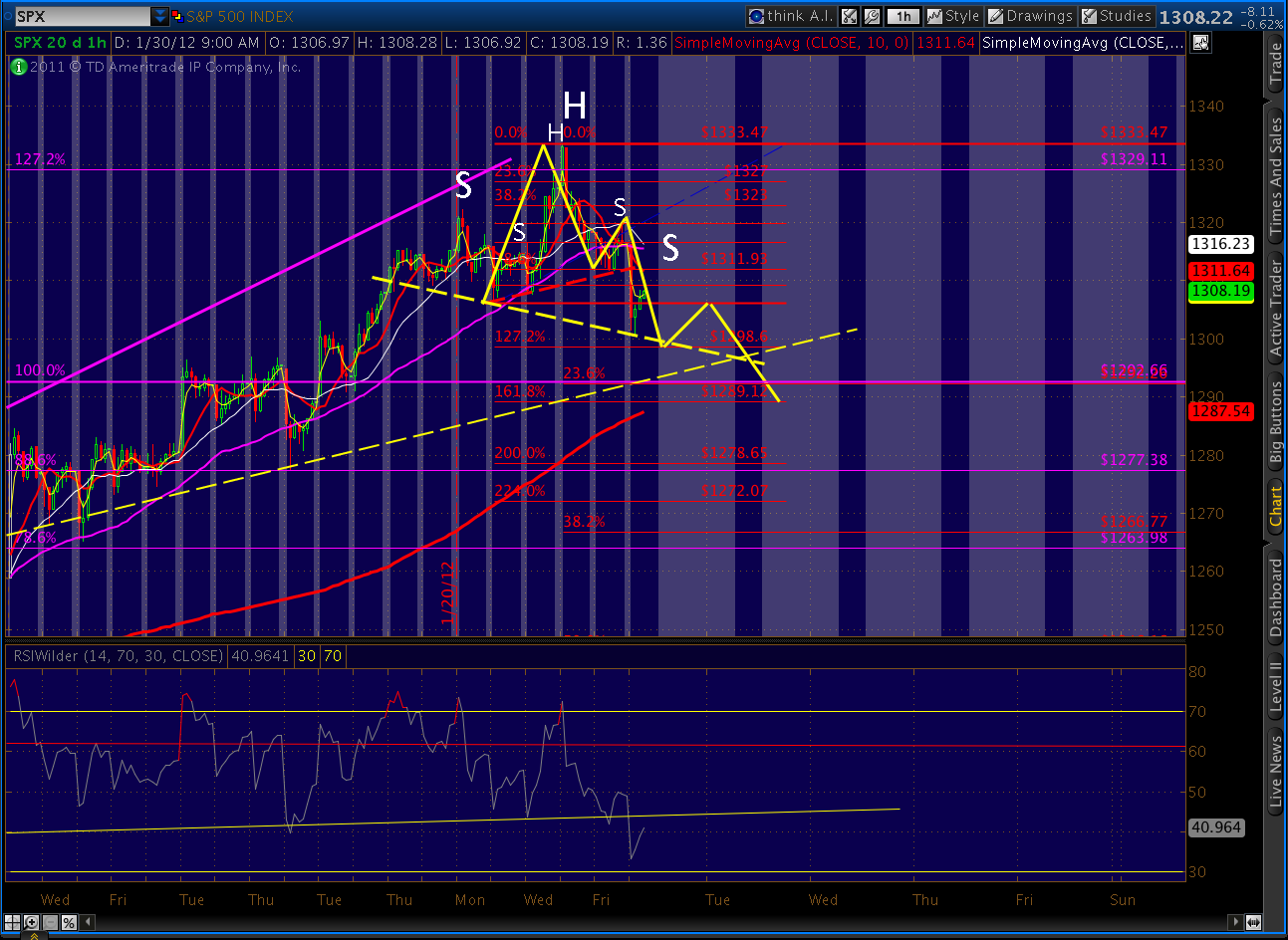
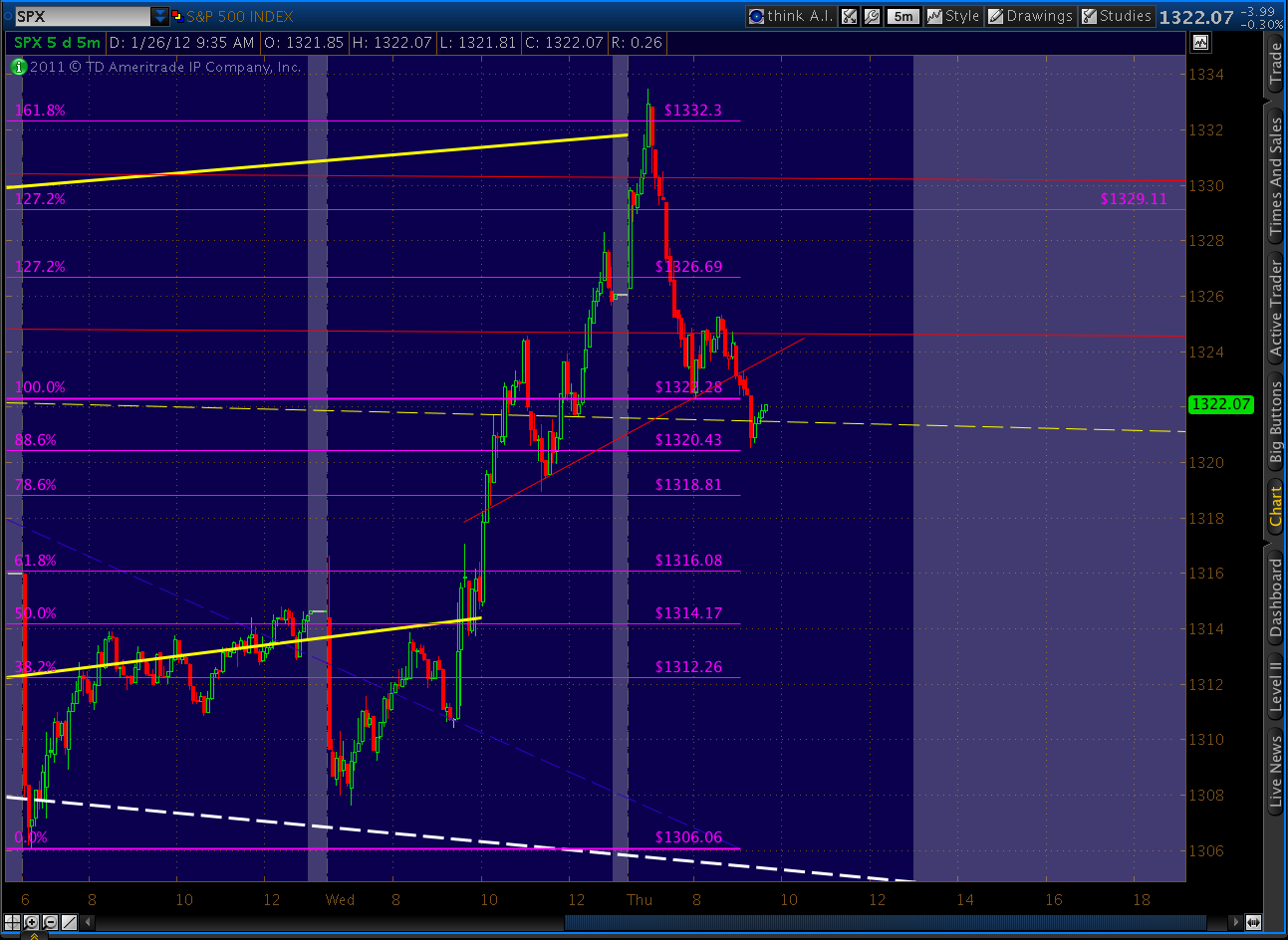
    We’ve popped up above the 1326.41 Gartley target, only to stop right at the 1.272 target (1329.11) of the much larger Butterfly.  It’s also a stone’s throw from the .886 (1329.71) of what I presumed was a Gartley pattern.  Remember, Gartley’s Point B is at the .618 Fib level — which was 1320.87.

    We hit 1321.41, which is generally close enough to work.  Gartley’s are also expected to reverse at their .786 Fib level, which was the 1326.41 level I posted this morning.  Prices dawdled at that level for three hours before popping up as high as 1329.1 a few minutes ago. 
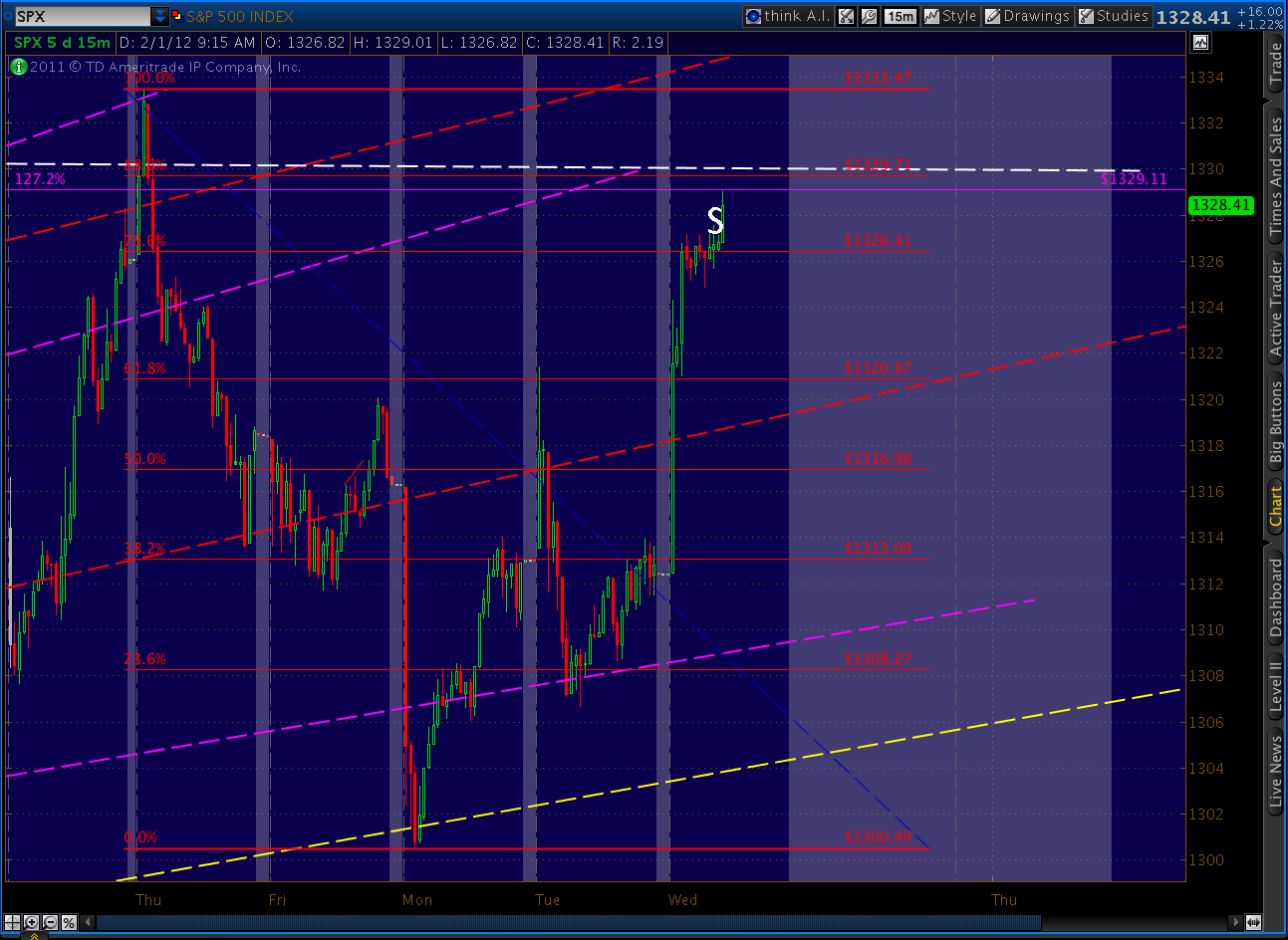
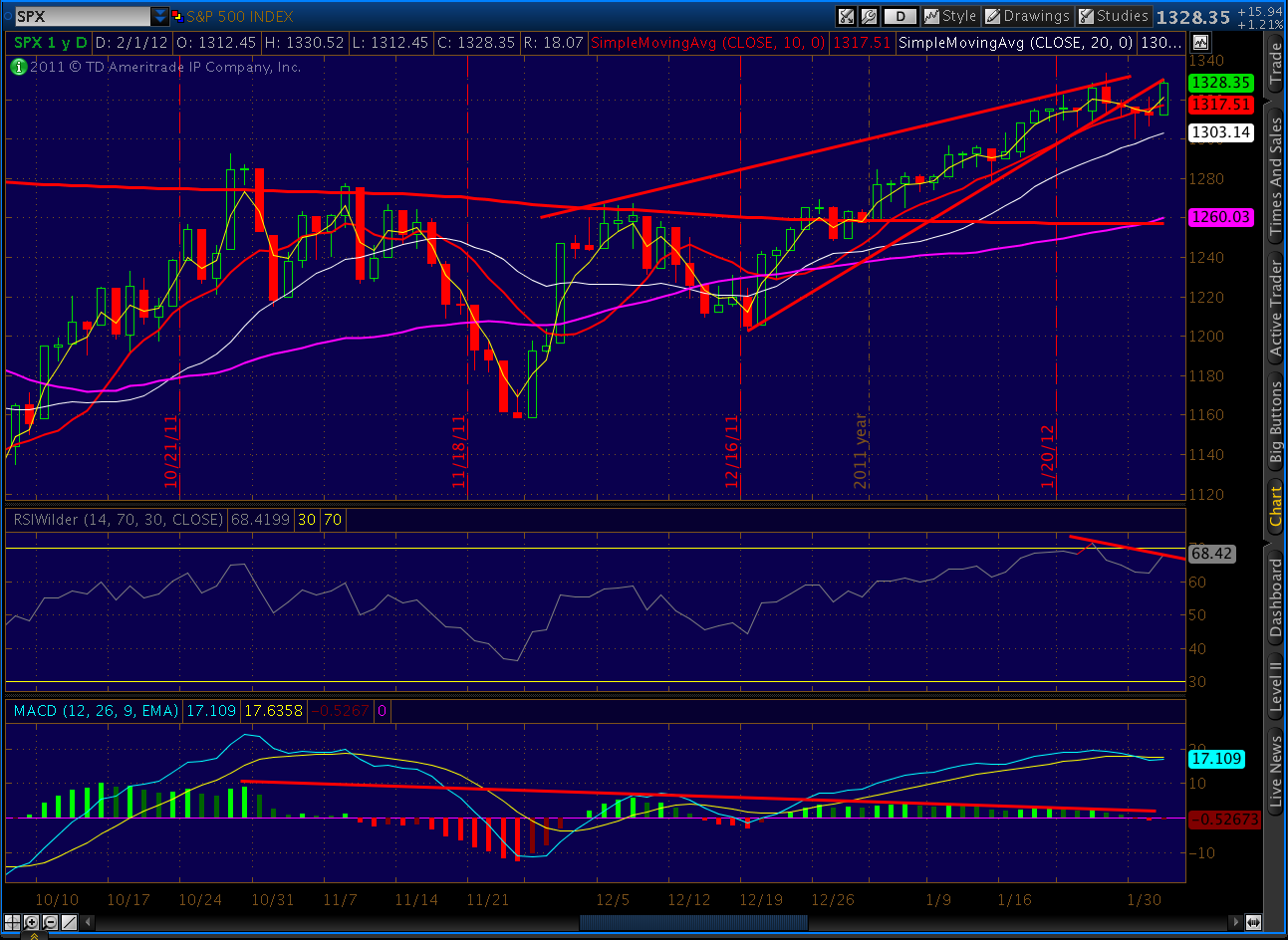
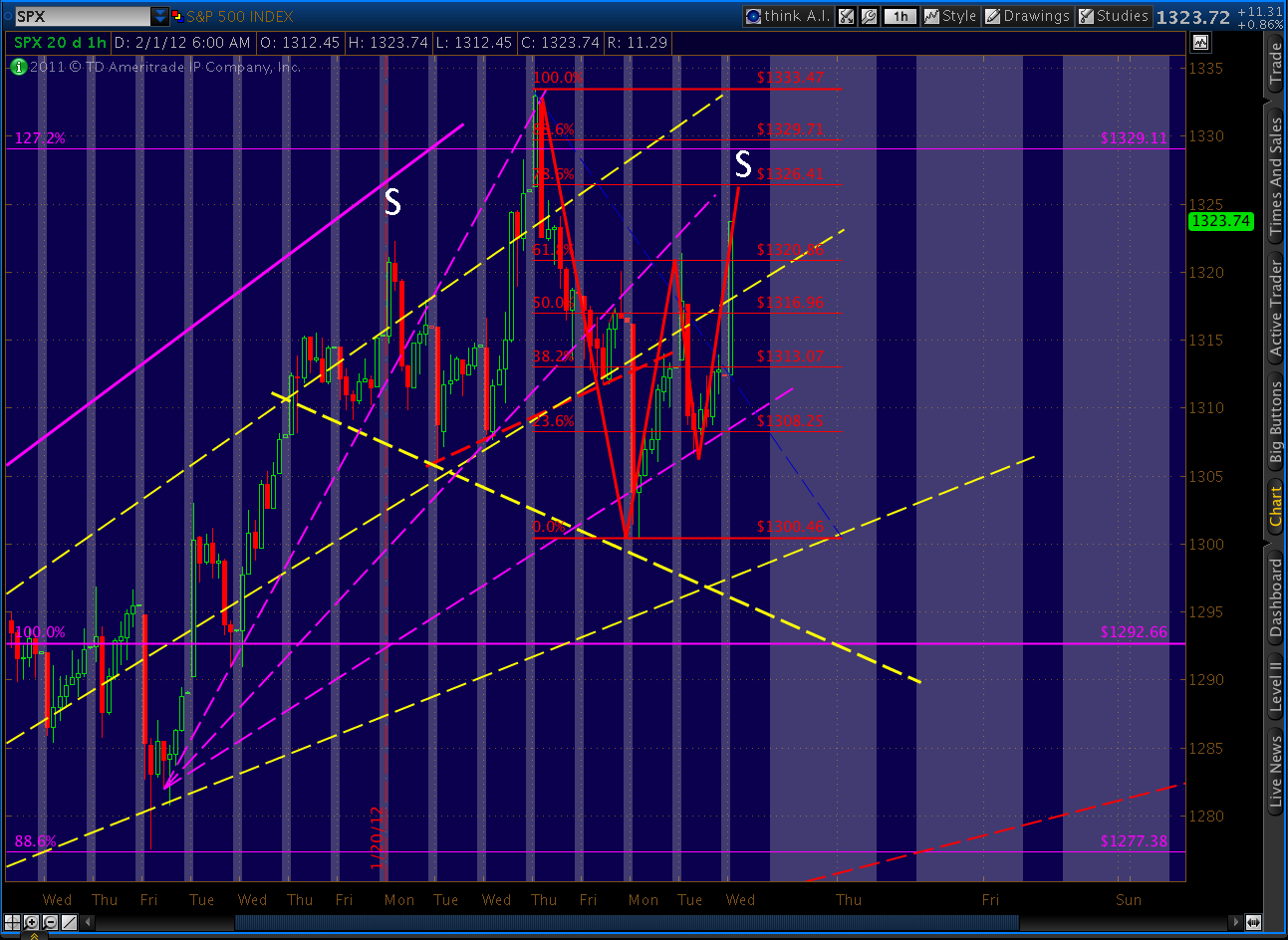
    The number we care most about, of course, is 1333.47.  It should present tough horizontal resistance, along with the Butterfly target (1329.11) and the Fan Line from 2007 which we just hit.  Here’s the updated big picture of our fan lines, trend lines, channels and harmonics.

    And, a close up…

    Recapping:  current prices are right at the fan line from 2007 and are at the completion of the bearish Butterfly pattern (1.272 of 1292 – 1158) and the .886 of both the 1370-1074 drop and the last significant move (1333 – 1300), not to mention back testing the rising wedge that recently broke.

    There’s also pretty decent negative divergence across the board.

    All in all,  an excellent case for 1333 as the top.  Does this guarantee it won’t go higher?  Absolutely not.  Experienced traders know that $&#@ happens.  That’s why they use stops — as I always, always recommend.  Even when I’m positive about a call, I still use stops.

    If you don’t, you will lose money to the x-factor stuff that always crops up when you least expect it.  If the past few months has taught us anything, it’s how precarious the markets are — whether you’re a bull, a bear or neutral.

    UPDATE:  10:10 AM

    The ISM Chicago’s PMI numbers aren’t bad — from 53.1 in Dec to 54.1 in Jan.  Only fly in the ointment is that production and employment show declines, and inventories show a slower rate of growth.  These are the indices you want to see accelerating if a recovery is really in the works.

    The inventory number is odd, because it shows a higher index but contracting direction and slowing rate of change.  This is especially troubling for the economy, since the lion’s share of GDP growth last quarter was in inventories.  I believe the real growth ex-inventories was only 0.8%.

    UPDATE:  9:35 AM

    This morning’s pop should not hold, as it is completing a bearish Gartley at 1326.41 that also back tests (for the third time) a fan line (dashed, purple.)  In my experience, rallies based on perennially inaccurate ADP numbers almost always fail.
    ORIGINAL POST:  1:20 AM

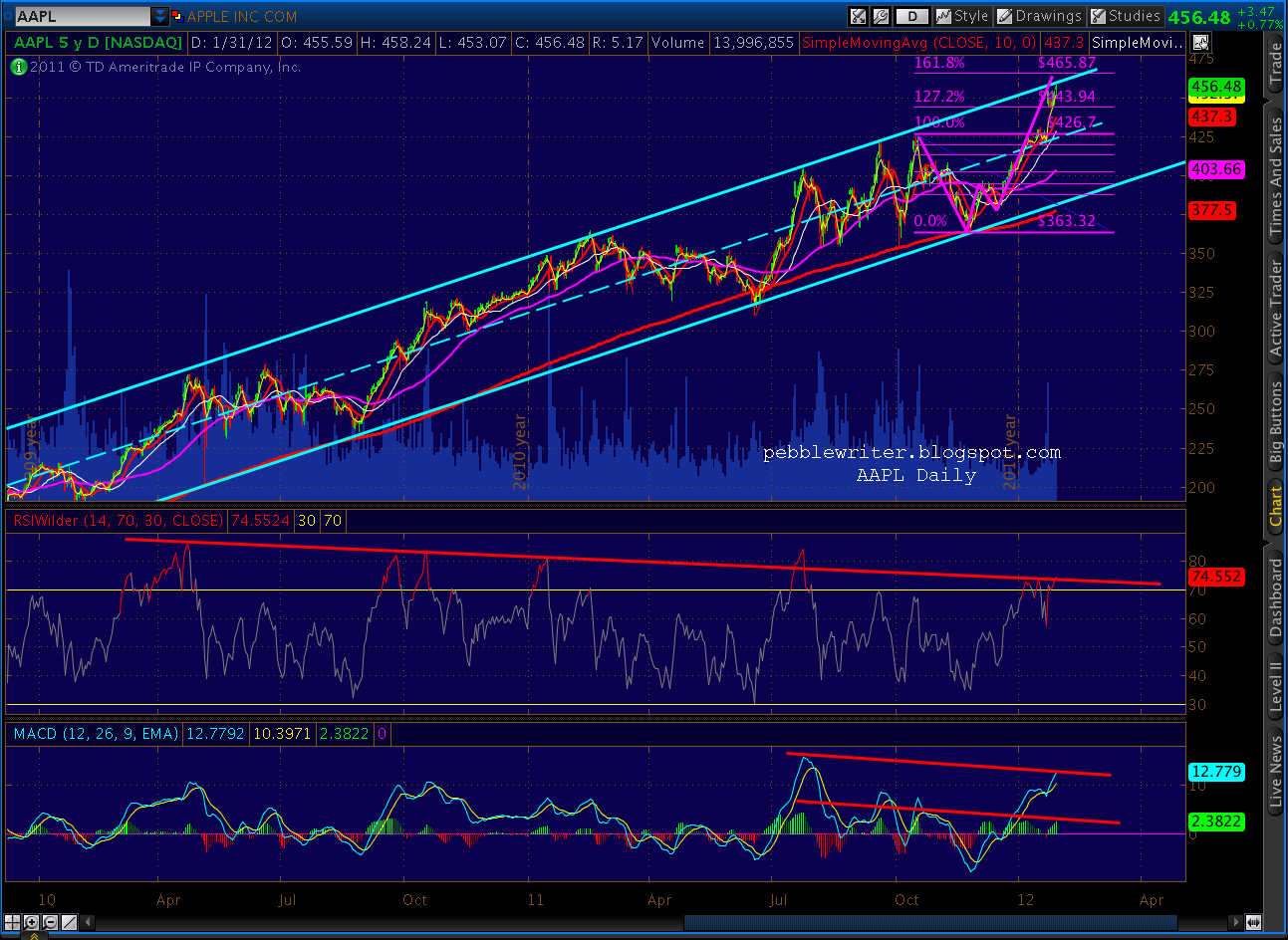
    Apple’s high yesterday was only 7.63 from completing a bearish Crab pattern at 465.87 — a price that would also exceed the channel that’s guided AAPL’s upside for many moons.  Check out the negative divergence on the hourly and daily charts.

    This makes eleventy-some-odd Crab patterns I’m following in different stocks, indices and currencies, but that’s another story.  Can the market (especially post AMZN earnings) keep it together long enough for the Facebook IPO to officially mark the top?

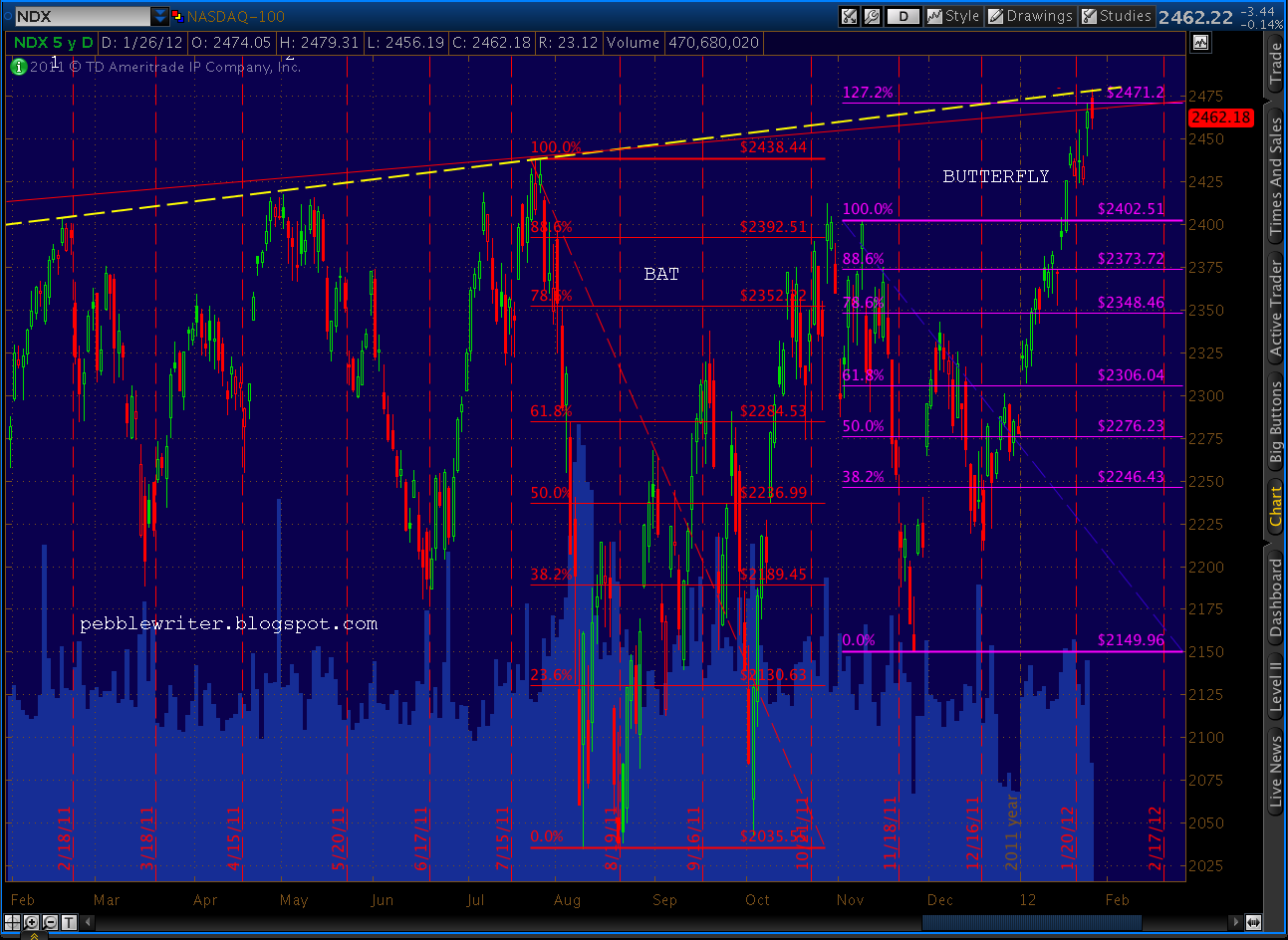
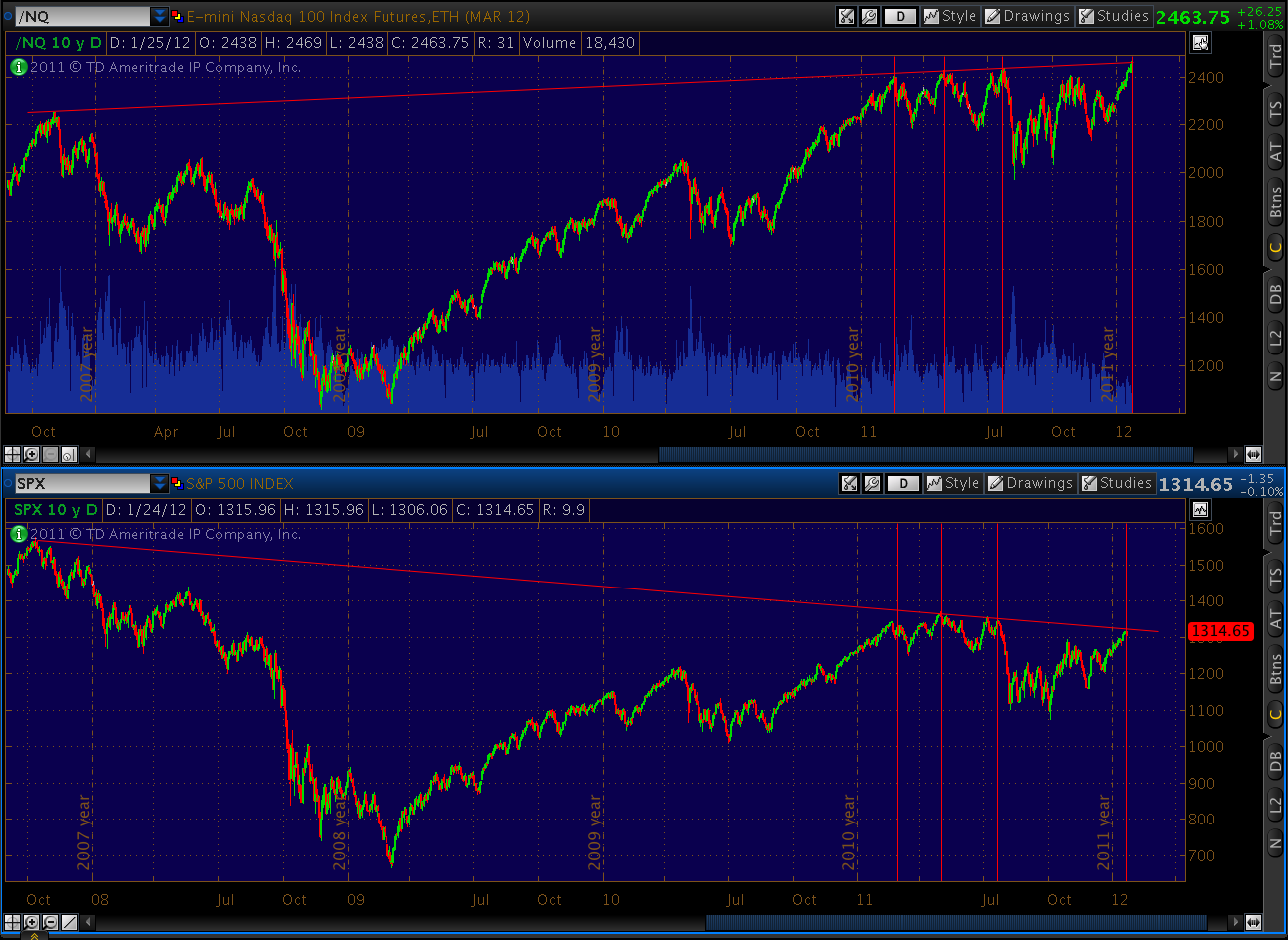
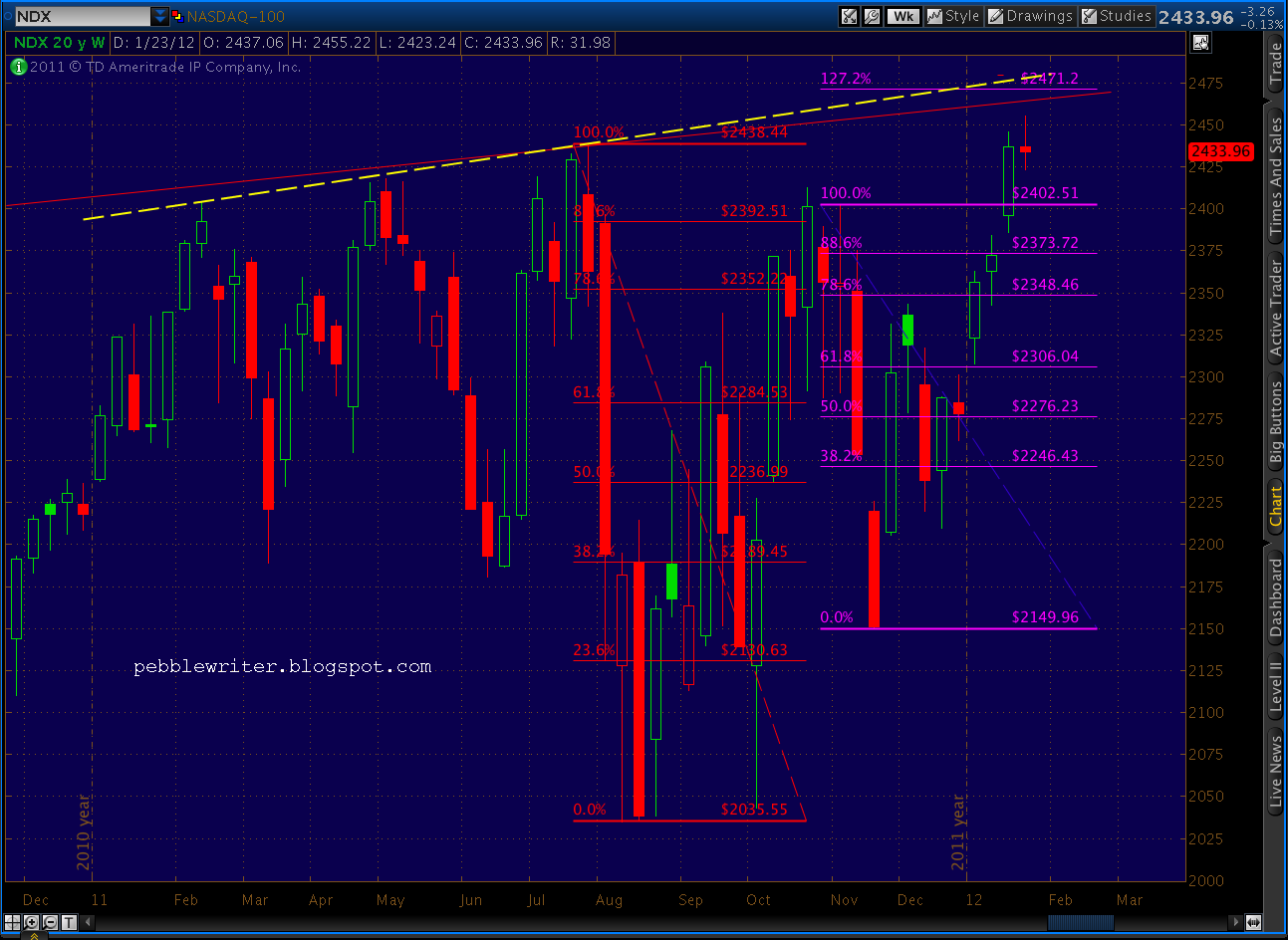
    Wait, you say, NDX is bulletproof!  It just made a new 12-year high!  Yes, but it also made its fourth touch on a trend line (also a fan line from Oct 07), the previous three touches of which resulted in 8.9%, 9.8% and 16.6% plunges (7.1%, 8.2% and 18.2% on SPX) respectively.

    NDX is also 2.22 away from completing a Butterfly pattern that calls for a sharp reversal.  The Bat completion on Oct 27 produced a 10.8% decline, and Butterflies usually reverse farther and faster.   And, lastly, Wave C up from Nov 08 has equaled Wave A in price and is barely over a Fibonacci .618 in time.

    It occurs to me we’ve had this kind of setup before.  On September 16, I noticed AAPL was completing a Crab pattern whilst SPX was completing a Bat pattern and NDX a Gartley.  All three were screaming REVERSAL at the top of their lungs, so I wrote about it [see: Bats and Crabapples.] 

    I didn’t know it at the time, but it was the day before Wave 5 really got going.  Apple tacked on 11 more points the next day… then collapsed 16%.  SPX plummeted 12% and NDX plunged 12.6% collapse.

    Technical analysts live for forecasts like that.  September was a very, very good month for my trading account — second only to July/August.  This interminable Wave 2 has been difficult, what with several false alarms.  Even with stops, it’s taken a toll both financially and emotionally.   I’m heartened to see we’re back in a position to reap some nice profits over the next few days.

    As always, good luck and keep the faith.

  • Charts I’m Watching: January 31, 2012

    UPDATE:  7:50 PM
    Charles Hugh Smith’s Of Two Minds blog is a delight.  Recently, I linked to his brilliant Dear USA: Your Account is Overdrawn.  Today, he tops himself by providing a sound argument for the incarceration of the most prolific counterfeiter in the world: the Federal Reserve.  Read more at: Counterfeit Money, Counterfeit Policy.

    UPDATE:  2:50 PM

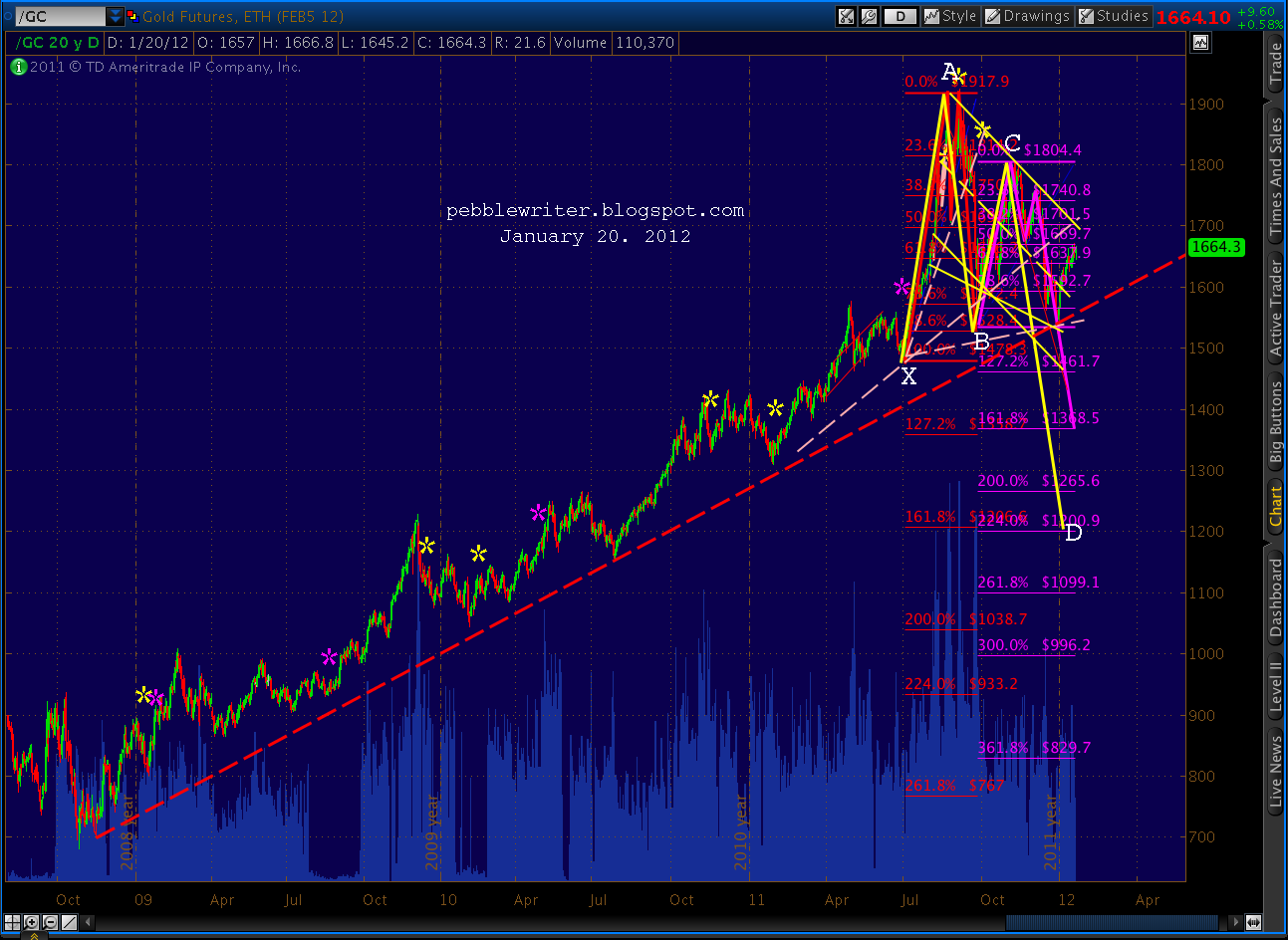
    Crickets.  So, let’s take a quick look at gold, which has exceeded the level the channel indicated.   Is the harmonic picture indicating more downside in danger?  Recall that we’re tracing out a Crab pattern marked below in purple. 

    B1 was a .886 retrace of XA, qualifying it as a potential Crab (although it would be a Butterfly if we throw out the extremely long tail.)  As a Crab, it should put in a Point C somewhere below Point A and then extend to the 1.618 level (or greater) at 1203.

    I would be perfectly at ease with that forecast — but for the recent strength that saw it break out of the channel.  Most forecasters I read are calling for continued strength, and there’s certainly some logic to that view.  On the other hand, we can view Point X as the vertex of recent fan lines that argue for further downside.

    Note how the break of Fan Line 1 led to a sharp drop, establishing B1 as the 2nd point for Fan Line 2.  A back test ensued, eventually setting up a H&S; pattern (FL 2 as neckline) that saw another drop to B2.  B2 became the 2nd point for Fan Line 3.  The back test of FL 2 is underway, and in fact has gone as far as it can without breaking through to the upside.

    The Crab pattern is perfectly fine as is as long as prices stay below C1.  If they should exceed it, but stay below A, the pattern is still intact — but with B2 (slightly lower than B1) and C2 as the turning points.  Note that B2 is also at the .886 retrace of XA, and thus points to a D at the same level of 1203.  This scenario is shown below.

    The red, dashed line is a TL that goes back to 2008, so it’s significant that it was recently broken (B2).  A drop back down to test FL 3 would obviously also break the long-term TL.

    Importantly, we’re currently sitting at a .786 retracement of the C1 to B2 drop and .886 of the decline from the latest high (1767 on Dec 2) to B2.  Although neither of these moves is in and of itself a harmonic pattern, these are significant Fib levels and, along with the fan line back test, are a good argument for a reversal.

    Bottom line, gold, just like equities, is pushing the limits of the patterns that normally guide price movements.  It’s overbought for sure, but I’ve learned the hard way that gold can go on being overbought for a long time after it should reverse.  I believe the short term bearish case is still intact, but have to temper that view due to the channel break.

    If prices should break the fan line in a significant way, I’ll be inclined to step out of the way and wait to see if prices reverse before Point A at 1924.  We should know in the day day or two.

    UPDATE:  10:20 AM

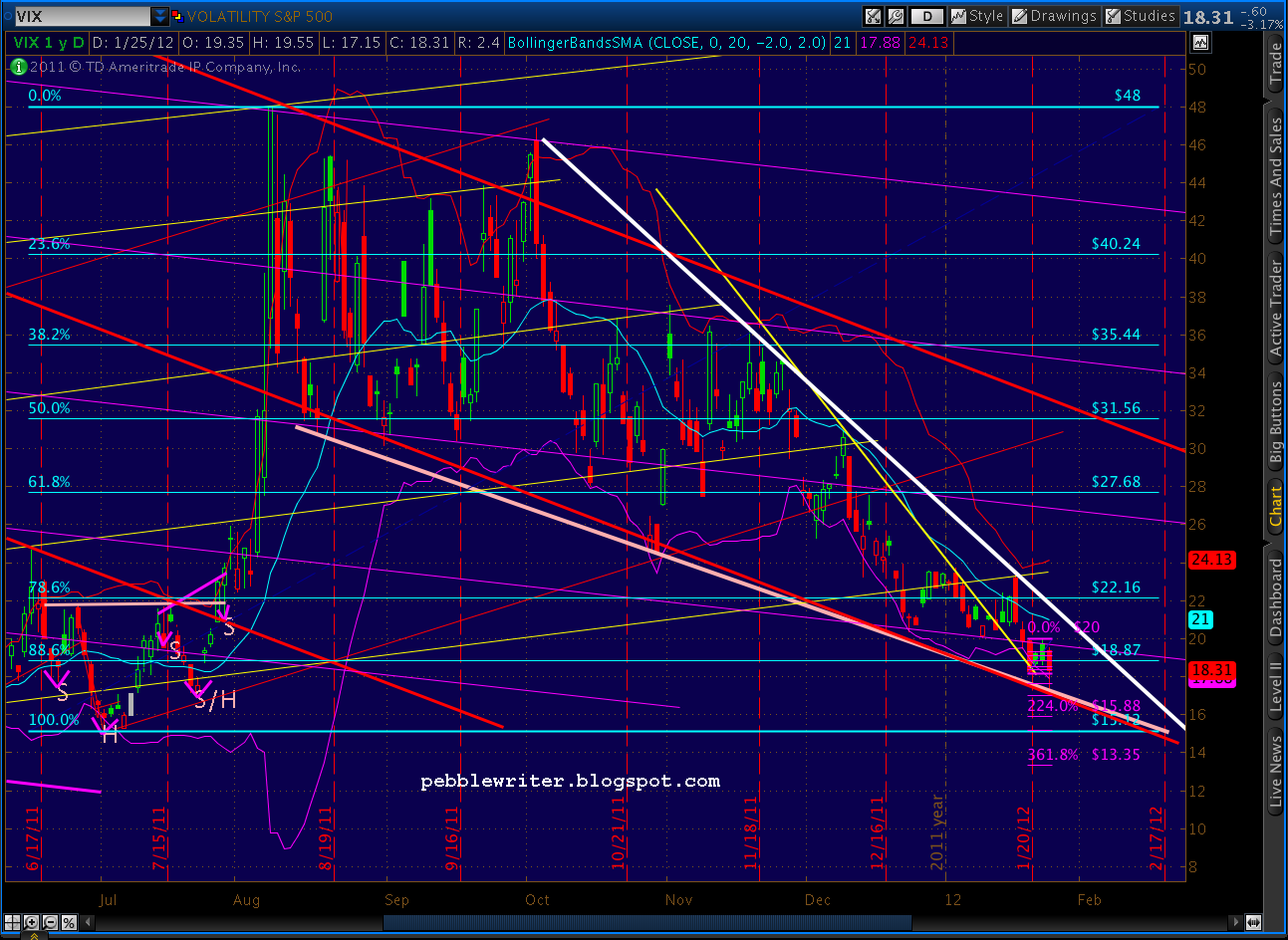
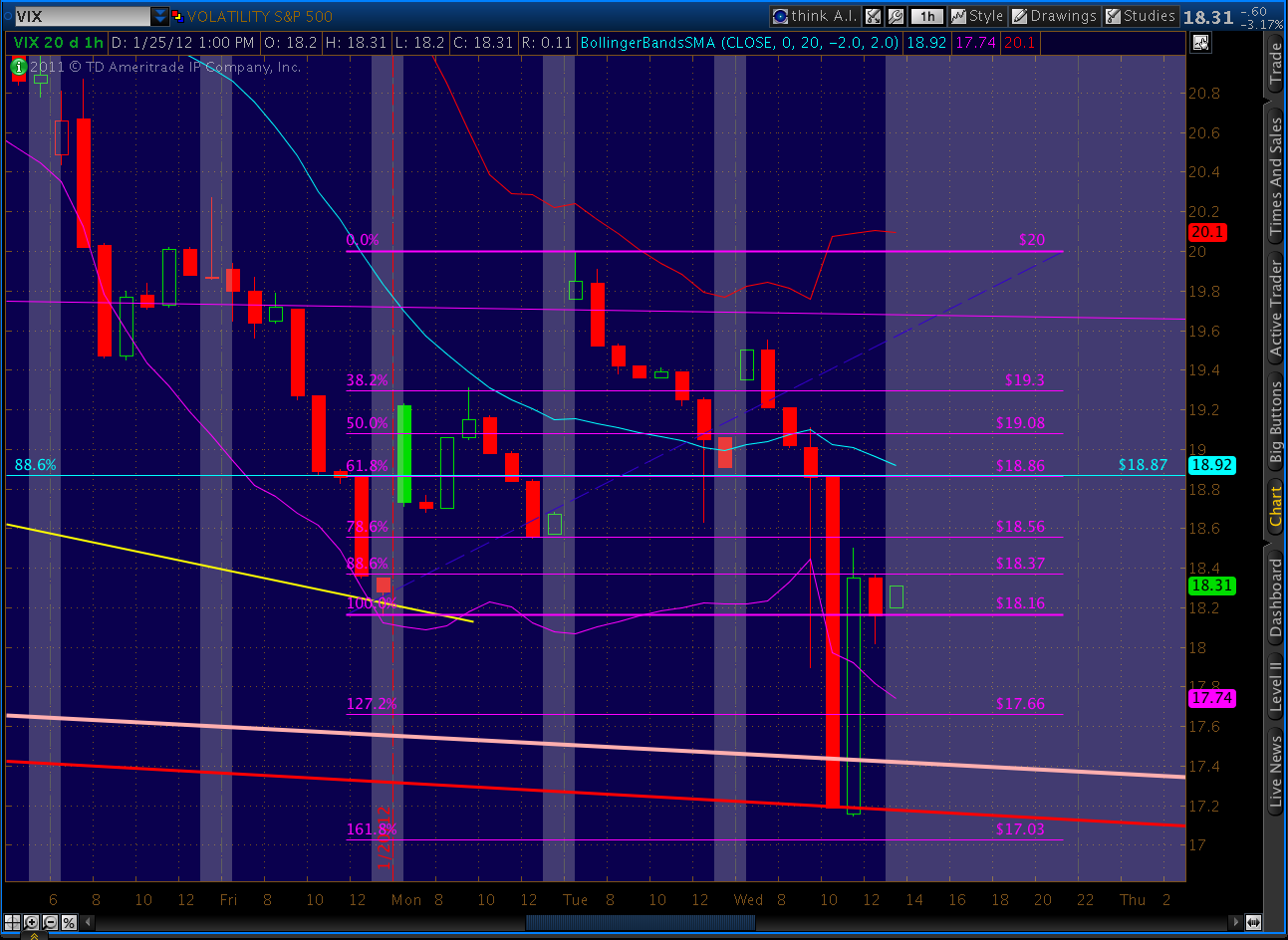
    VIX is rebounding strongly, about to test the falling wedge at 20.2 or so.  It’s in the early stages of forming a Bat or Crab, which would imply targets of at least 22.68.  It will also complete a little IHS at 20.4 with a target of 23.8.

    UPDATE:  9:50 AM

    Chicago PMI down from 62.2 to 60.2, the second decline in a row and greater than the drop expected to 61.5.  The improving economy story is getting a little harder to swallow.  Consumer confidence is up next.  UPDATE:  Consumer Confidence down from 64.8 to 61.1.  This should complete this morning’s bullish burp.  Case-Shiller came in at -1.3 for November, -3.7% for the year-on-year.  Total drop since 2006 is -32.9.  Wonder if that might shake Consumer Confidence just a tad.

    UPDATE:  9:40 AM

    In addition to the Crab pattern that completes at 1289, we’ve now formed most of a Gartley that points to the same level — shown below in purple.  Keep in mind that, because it’s just shy of the .618 reversal for Point B, it could also qualify as a Bat or a Crab — which would take it to the .886 (at 1283) or the 1.618 (at 1242) respectively.

    If the new H&S; pattern completes, it currently points to 1265ish.

    ORIGINAL POST

    The futures are flashing a 6-pt gain on “renewed optimism over the Greece situation.”   Gotta admit — it’s hard to even type those words given the number of times (all of them, so far) that the optimism has been just plain wrong. 

    This morning, we’ll see the Case Shiller 20 City Index, which should be negative, and consumer confidence (10am), which might continue to surprise to the upside.  Fellow Americans seem not to realize how deep is the puddle of stinky goop in which the country has stepped.  Chicago PMI is due out at 9:45am.

    We’ve filled all the gaps up to the upside, but there are plenty down below.  We closed yesterday below the SMA 10 for the first time in what feels like ages, saw the stochastic and MACD turn over, formed a bearish hanging man candle, and saw the EMA 3 and SMA 10 cross negative.  The put-call ratio remains overly bullish and the McClellan Oscillator is preparing to flash a sell signal.  In other words, most of the negative momentum indicators I watch are now negative.

    The case is growing for 1333 having been the Wave 2 top, but the door won’t be closed until we see a significant downturn that destroys the upside case — probably somewhere around 1270.  The SMA 50 has moved above the SMA 200 by 71 cents.  Watch VIX this morning.  It’s done a very good job of indicating major turns, and it’s currently positioned very near the apex of a huge falling wedge, having recently closed below its Bollinger Band.

    Now that we’re working on a new H&S; pattern, the key will be whether we can close below the new neckline.  It’s the downward sloping dashed yellow line below.

    more later.

  • Charting a Possible Top: January 30, 2012

    UPDATE:  1:55 PM

    We just hit 1311.71 on what looks like an A-B-C corrective wave, very close to the 1312 back test target discussed at 9:40 below (which, upon closer inspection, should top out around 1313.8)   We’ve also tagged the 15-min RSI TL, meaning we should turn back soon if this bounce is going to be limited to a back test.

    We’re sitting at the 10-period MA on the 60-min chart, and the 50-period MA on the 15-min chart — both of which should help contain any further upside.  The 10 day SMA on the daily chart is just above at 1313.37.

    UPDATE:  12:00 PM

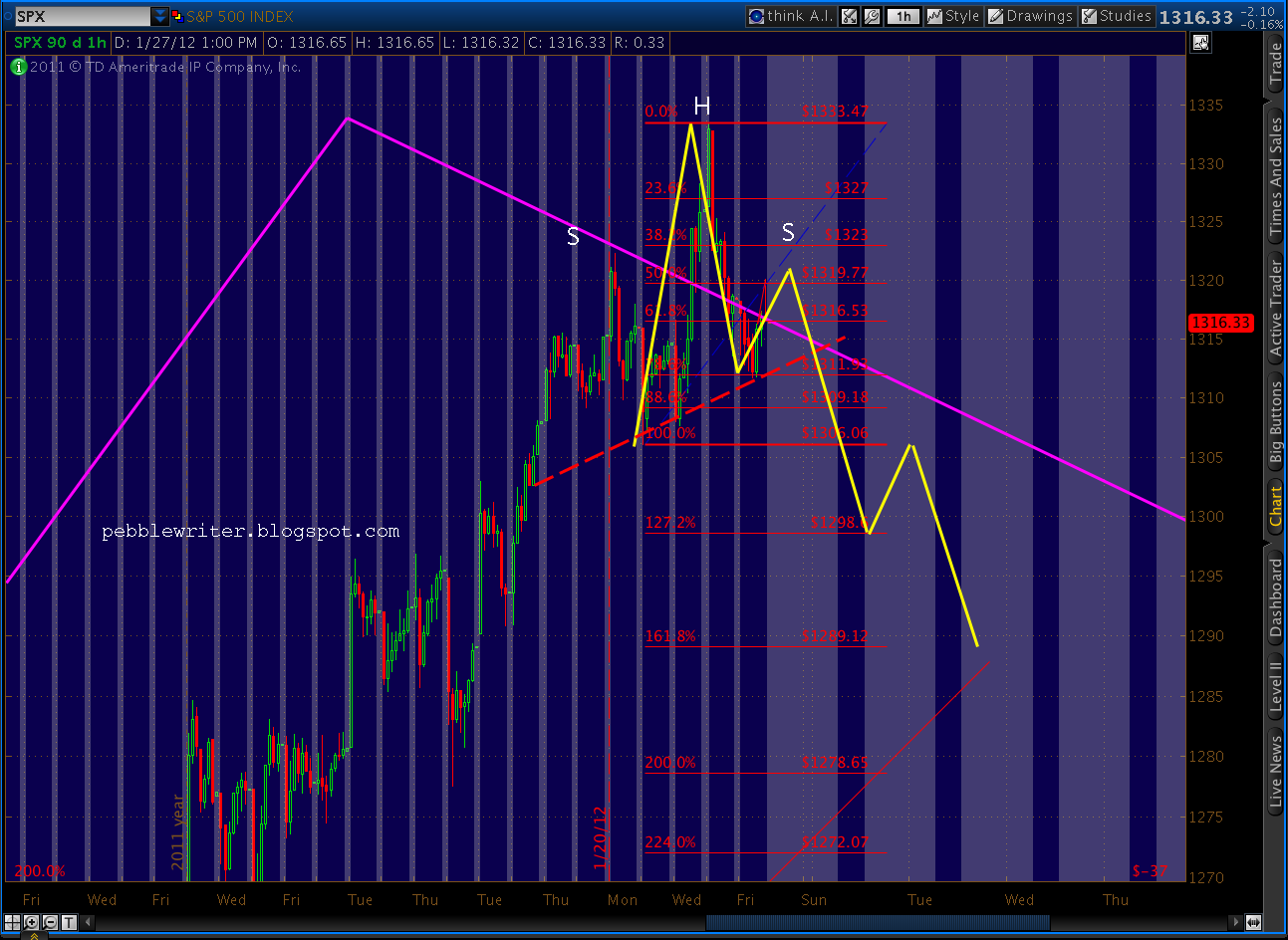
    The market bounced at 1300, one of the three levels we were watching, and is currently back testing the neckline of the little H&S; pattern that started everything (see first post below.)  The RSI TL is also being backtested, and should provide a clue as to when the back test will fizzle.

    If the neckline holds, the next H&S; pattern to play out should be tilted the other way — that is, the right shoulder will be lower than the left.  Interestingly, the neckline of this pattern would complete right around the TL discussed in my last update.

    The ability of the market to push through this TL would manifest in a strong decline.  In fact, the target of the new H&S; pattern is currently around 1264 — the .786 Fib level of the 1158 to 1333 move and the level of horizontal resistance from Dec 7 and Dec 27.

    UPDATE:  9:40 AM

    Nice clean break of the 60-min RSI TL.

    For this decline to really take off, we’ll want to see a break of the TL on the daily RSI.   Note the proximity of the 50 and 200 SMAs.  The only thing that could keep the 50 from peeking (and peaking) above the 200 would be a very sharp correction.

    If this decline sticks, it’ll be the first time we’ve closed below the SMA 10 since December 19.  The SMA 20 waits for us at 1297.30, very close to the 1.272 extension at 1298.60 — two of the three primary reasons I’ve drawn in a bounce at 1298.  

    The third is that 1300 should produce a “round number” bounce and, depending on the timing of the decline, might intersect with resistance from a couple of TL’s on the price chart.  We discussed this last week… it would be quite normal to see a pause at the yellow dashed TL that has investors scratching their heads, wondering whether this is a significant downturn or simply the fleshing out of a channel.

    The bounce, wherever it comes, will likely take the form of a back test of the H&S; neckline (red, dashed) — which means it could go as high as 1312 or so.  It would give bears another opportunity to add some shorts for the next leg down.  Place stops accordingly.

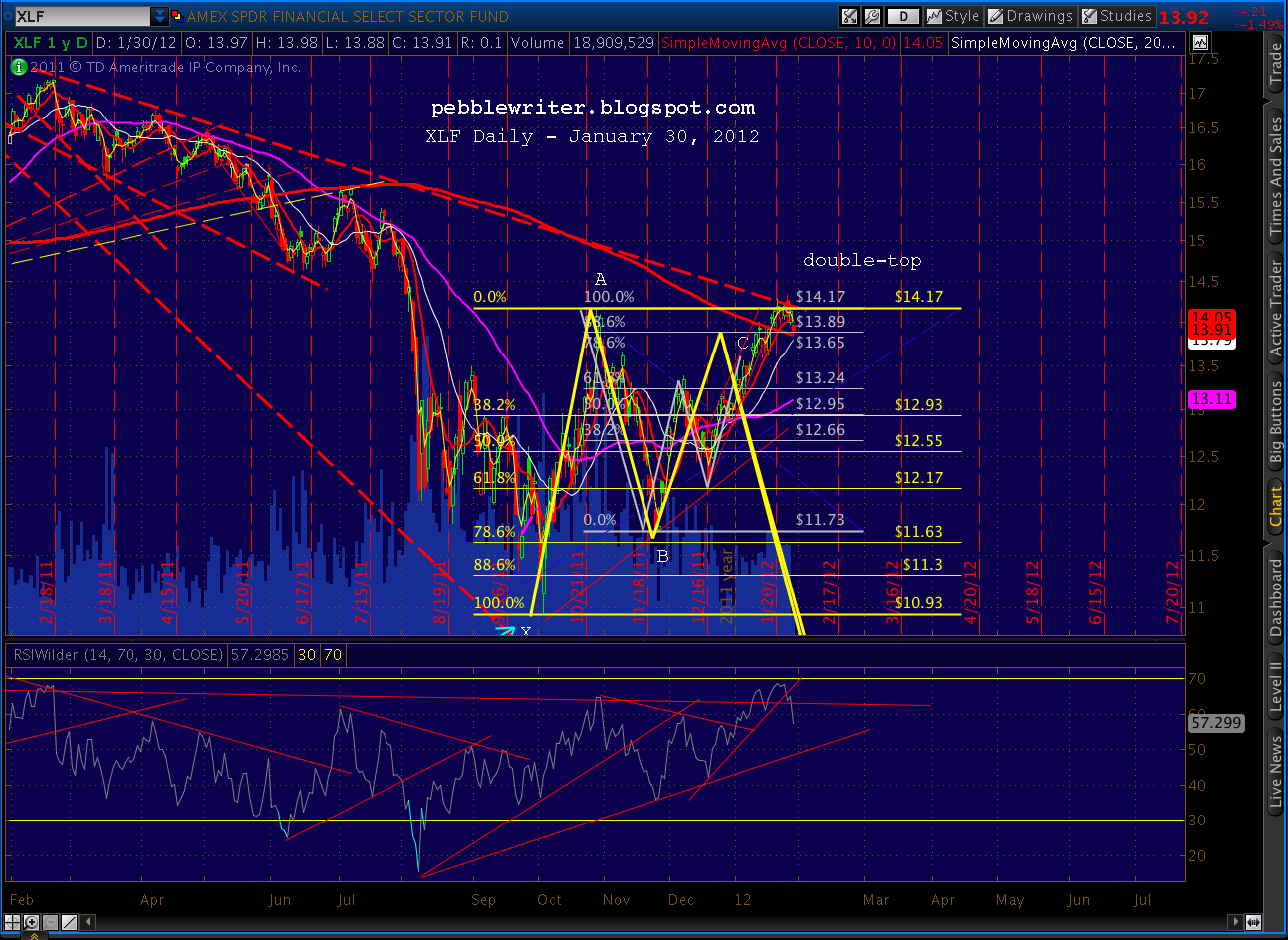
    Financials face a similar test.  XLF, which has spent nearly two weeks above its SMA 200, broke its 60-min RSI TL and the price channel it’s been in.  The real test will be to break back beneath the 200 and to break the daily RSI TL.

    ORIGINAL POST:  2:45 AM

    This is a continuation of several posts last week in which I suggest 1333 was the Wave 2 completion.  Taking into account negative divergence on most time frames, excessive bullishness, poor breadth, etc., I believe 1333 was at least at an important turning point.   Almost every indicator I watch is calling for a significant downturn just ahead.  A quick glance at the past few days confirms there’s a clear path lower.

    Recall that we just completed a Butterfly pattern (and Bat) that call for a sharp decline.  As we discussed over the weekend, the pattern targets 1010 or 1050.  The question arises as to how we get there.

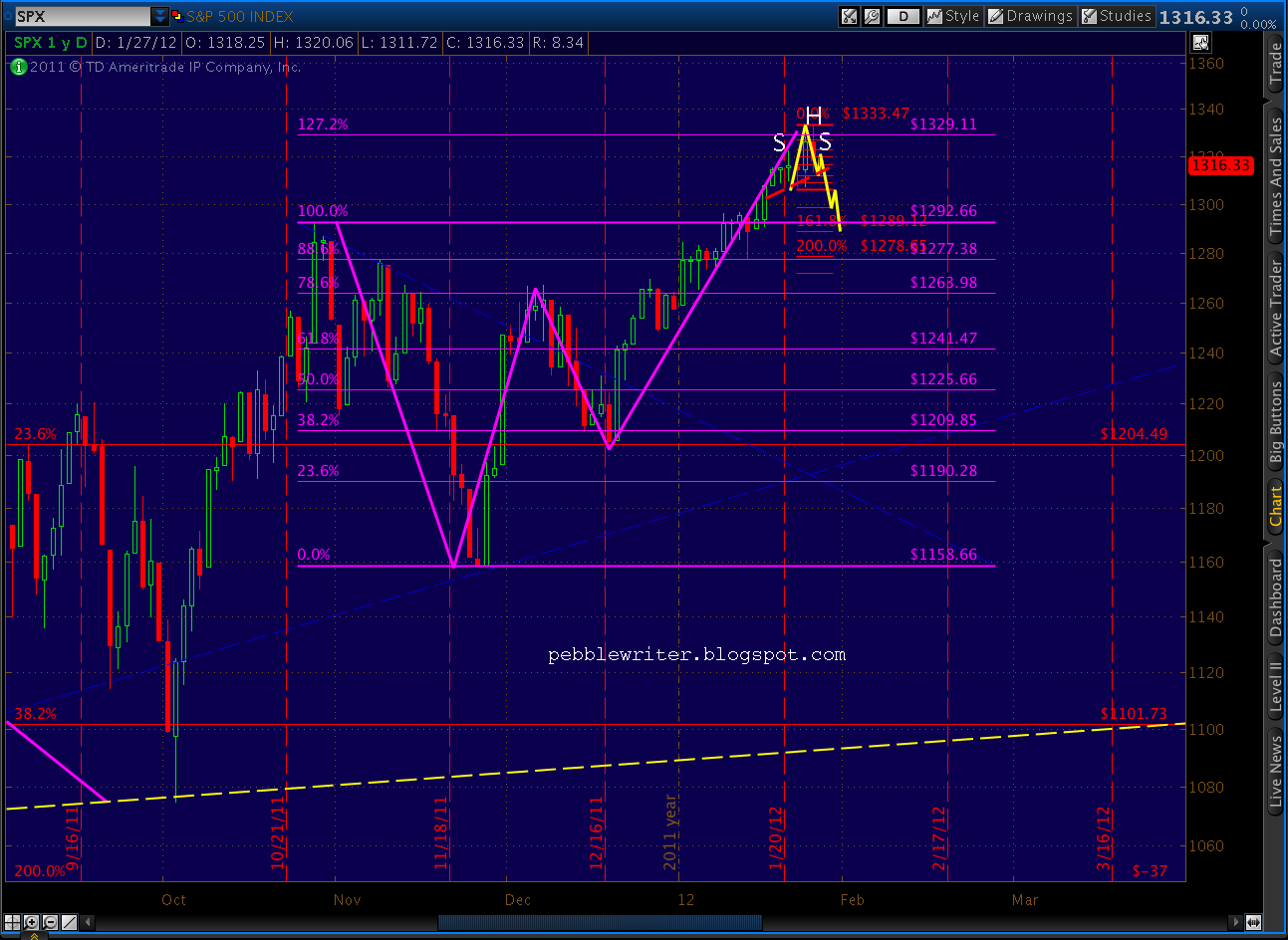
    We need one slightly lower price move in order to complete the H&S; pattern we’re tracing out.  And, the fact that Friday’s low came at .786 of the 1306 – 1333 move tells me we might be working on a Butterfly pattern.  These typically complete at the 1.272 or 1.618 extension (1298 and 1289, respectively) — which is pretty cool as the H&S; pattern completes at 1288.

    As mentioned earlier, we have a decent shot at some cascading H&S; patterns playing out on the downside.  It wouldn’t take much to build some momentum.

    ***

    BTW, I don’t have a lot of pet peeves, but it kills me (not literally) to see how often the word “literally” is grossly misused.   We’ve all heard someone say “his eyes literally popped out of his head” or “her butt is literally as big as a house.”

    Thankfully, the speaker usually means the word “figuratively” or “practically.”  Here’s a promo that popped up on the newswires this morning.  I’ll leave it to my astute readers to decide whether or not the Renaissance Orlando Resort just announced a Valentine’s weekend special for cannibals.

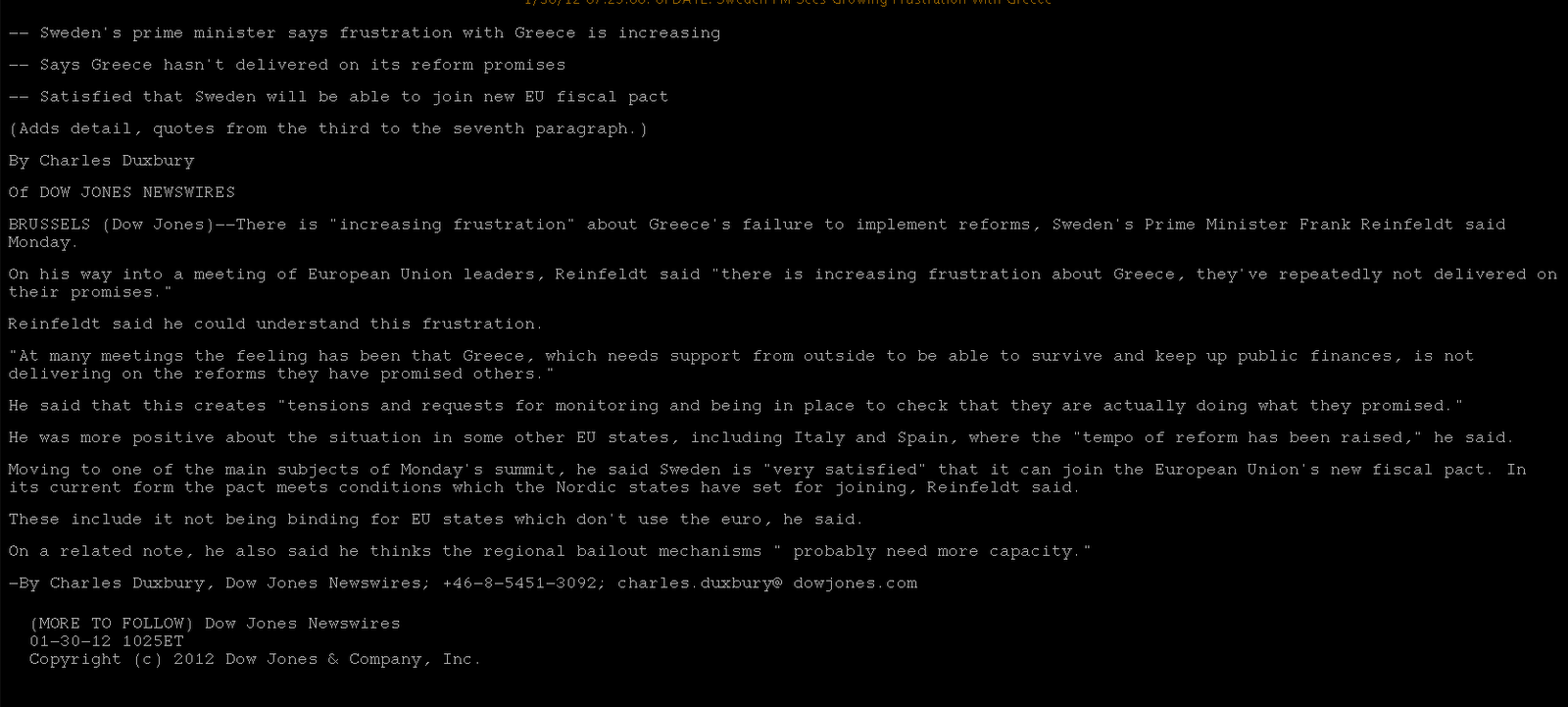
    Meanwhile, the Euro-mess continues to display strains between the haves and the have nots.

  • The Big Picture: January 27, 2012

    UPDATE:  3:10 PM

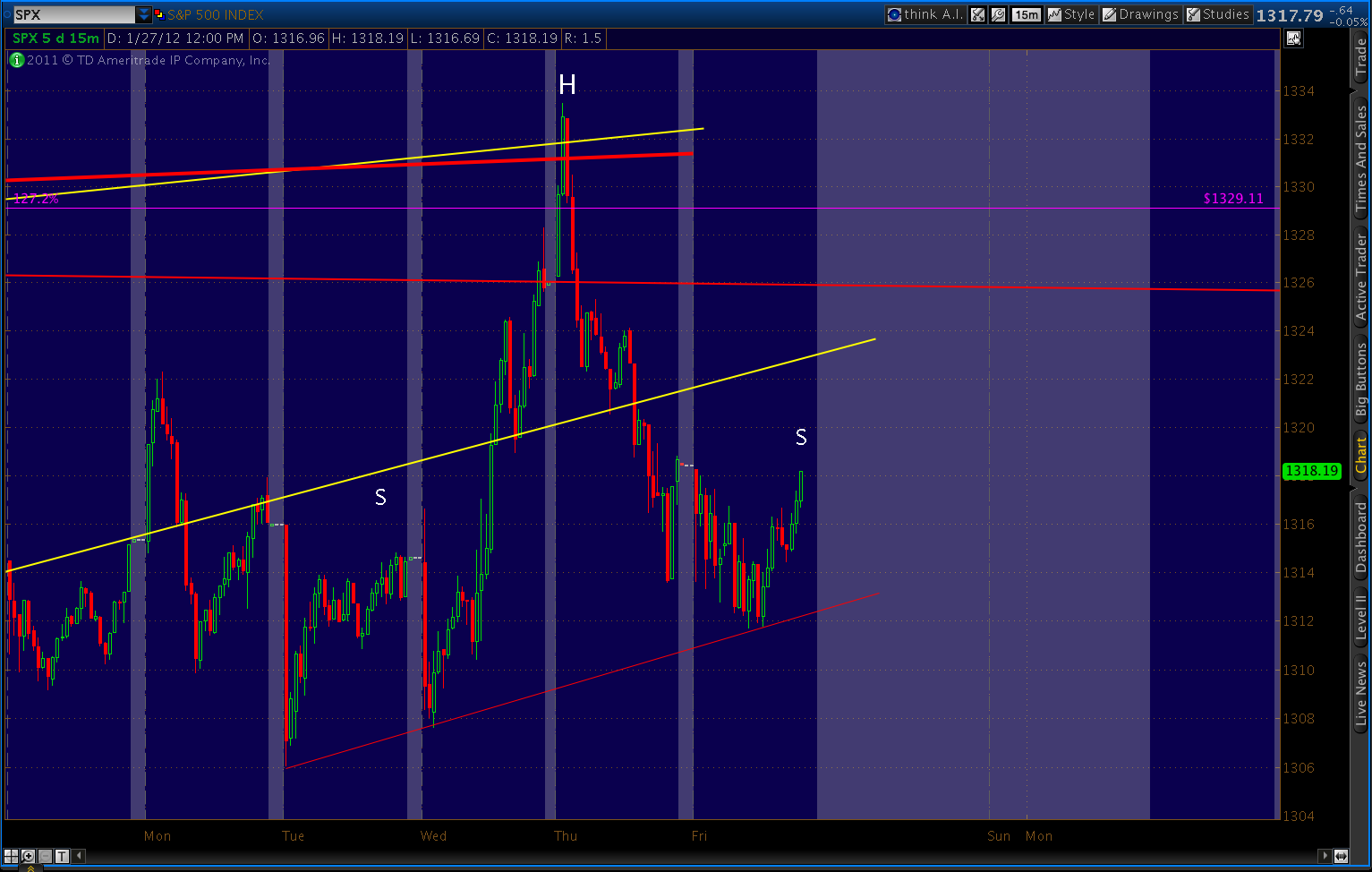
    SPX has completed most of a head & shoulder pattern that points to 1288ish.  The idealized right shoulder comes in around 1322, although it’s high enough to count as it is.

    ORIGINAL POST:

    Another quiet day price-wise, even though there’s been plenty of negative news.  Clearly, the bulls aren’t going to give up without a fight.

    There are a few different ways to view the past four months price action.  Generally speaking, we have a bearish Butterfly pattern that completed (1.272 ext) at the apex of a rising wedge (in yellow) within a rising wedge (in red.)

    I will consider 1333.47 the Wave 2 top until proven wrong.  There are a few scenarios that argue for a slightly higher price, say 1336-1339.  But, I don’t expect them to come to fruition.  Traders should maintain stops, just in case.

    The chart above also shows that we’ve violated and are back testing one of the trend lines (yellow, since Dec 19).  But, since we’ve cracked previous TLs on this advance, I don’t put much stock in it.  The more important TLs to break will be the purple line off Nov 28 and the red one off of Oct 4.

    But, rather than anguish over which TL will be critical, I suggest keeping an eye on the RSI trend lines.  The hourly RSI TLs (red, dashed) have seen some touches coinciding with instances of meaningful support.  A break of either line would signal a significant drop.  BTW, the yellow RSI TL is great evidence of the negative divergence we’re seeing.

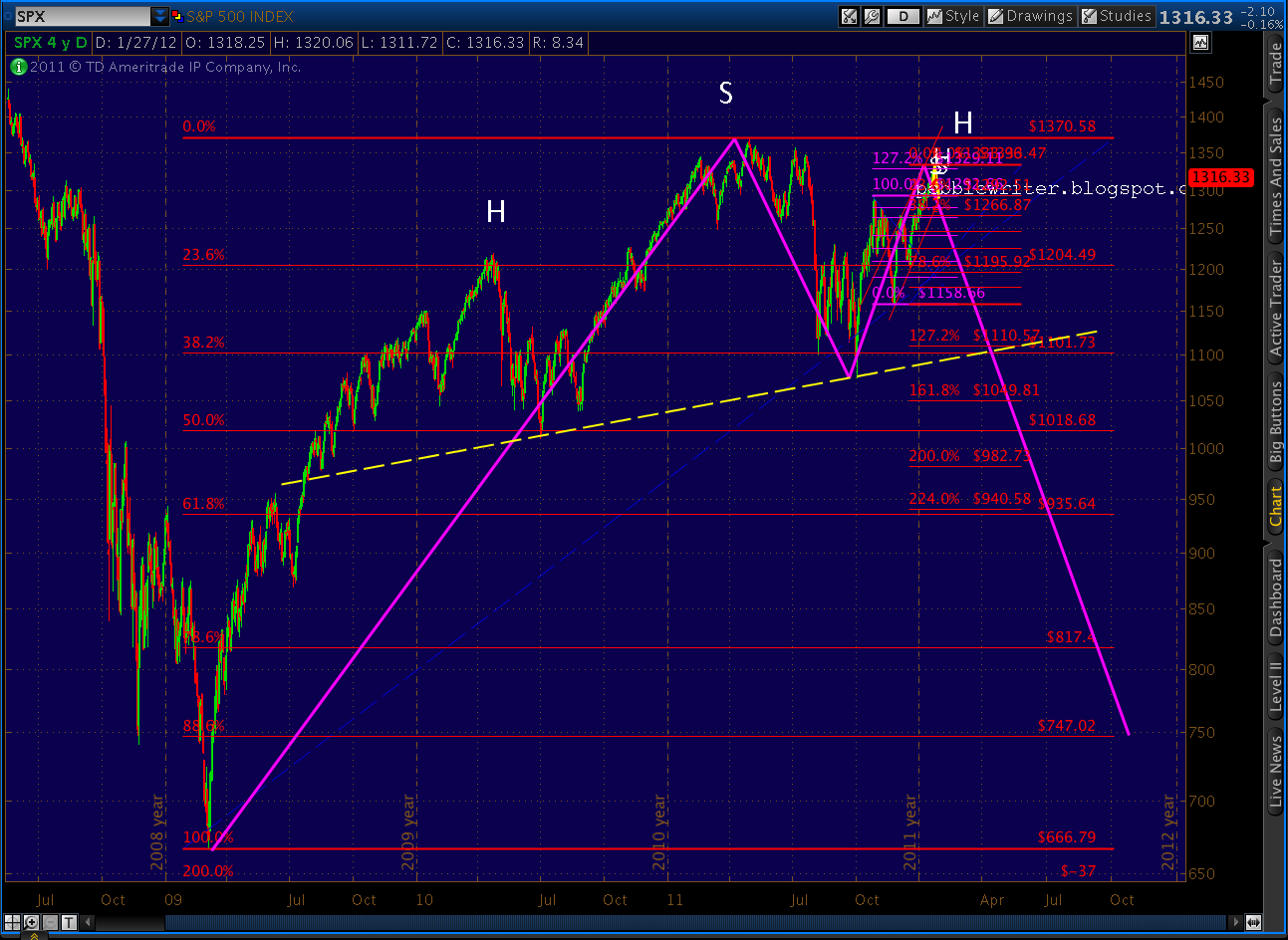
    Now, for the big picture.  May’s top at 1370 was 11 points from the .786 retracement of the 1576 to 666 decline.  That means we came back to within 11 points of recovering 78.6% of the loss from the original 1576 starting point.  This was a Gartley pattern — incredibly effective at signalling potential turning points.

    Once we top at 1370, we need to focus on Fibonacci level retracements of the 666 to 1370 rise.   The most common Fibonacci retracement levels are .236, .386, .500, .618, .786, .886 and 1.000.  We then go into extensions such as 1.272, 1.618, 2.0, 2.4, 2.618 etc.

    There’s a rule of thumb I use to determine post-pattern completion targets: 61.8% of the distance from A to D.  In this case, A is 666 and D is 1370; so, 61.8% of that distance is .618 x (1370-666) or 435.  Subtract 435 from 1370 and you arrive at 935 as the target for the reversal of the big Gartley pattern.  It’s shown on the above chart as the .618 level of the purple pattern.

    The big question is how to get there.  As mentioned above, we just completed both a medium-sized Bat and a Butterfly pattern.   Bats are similar to Gartley’s, but retrace .886 instead of .786 of the initial leg.  I use the same .618 reversal target, however, which in this case would yield around 1173.  Nice, but not quite 935.  Let’s look at the Butterfly.

    Extension patterns like Butterfly’s and Crabs complete beyond the point of origin — 1.272 or 1.618 being the most common.  So, I typically look for a larger reversal upon completion.   A 1.272 extension/reversal from 1333 gets us to 1110 (1.272) or 1050 (1.618) on the downside.  Closer.

    It’s fair to say that reaching 1110 or 1050 would probably involve completion of a H&S; pattern or two.  A casual glance at the chart reveals several potential left shoulders ready for action.  The price level around 1110 also looks like a great spot for a massive H&S; pattern to complete, with the Jun 2010 and Oct 2011 lows as potential neckline points.  Such a pattern would point to 790 or lower.

    Reaching 790 isn’t so far-fetched when you consider we’ve completed 3 of 4 legs for a huge Bat pattern that targets 747 as the .886 completion point.  It would work nicely with a H&S; pattern as that described above.

    I have about twenty other patterns currently under surveillance.  Let’s see how this week plays out, then I’ll try to string them together in a coherent fashion that also takes into account the other chart patterns at work.  Suffice it to say, there are plenty of ways to skin this bull.

  • Do or Die: January 26, 2012

    UPDATE:  3:00 PM

    The H&S; pattern we discussed this morning is “growing” as the decline continues.  The new nominal target is 1306, at which point we have more opportunities for it to expand further.  If this one plays out and if the next one does set up, it could target somewhere around 1280 – 1288.

    The nice thing about rapid ascents is they leave a trail of strong downside opportunities in their wake.

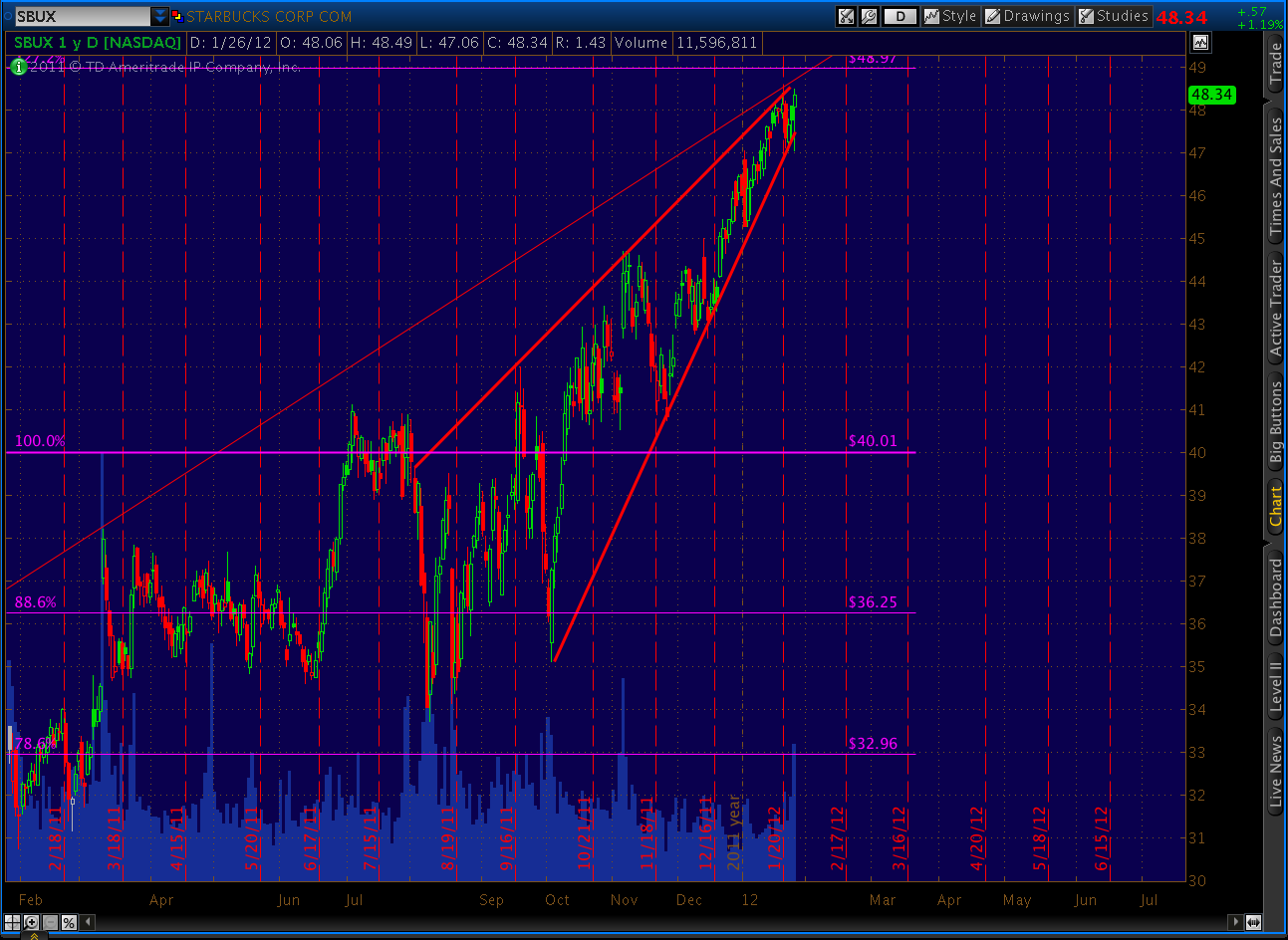
    BTW:  Starbucks reports after the close today.  I don’t follow the company at all, but this is not a bullish chart.  Working against the upside are the 1.272 harmonic level, a long-term trend line of resistance and a very well-formed rising wedge.

    UPDATE:  1:45 PM

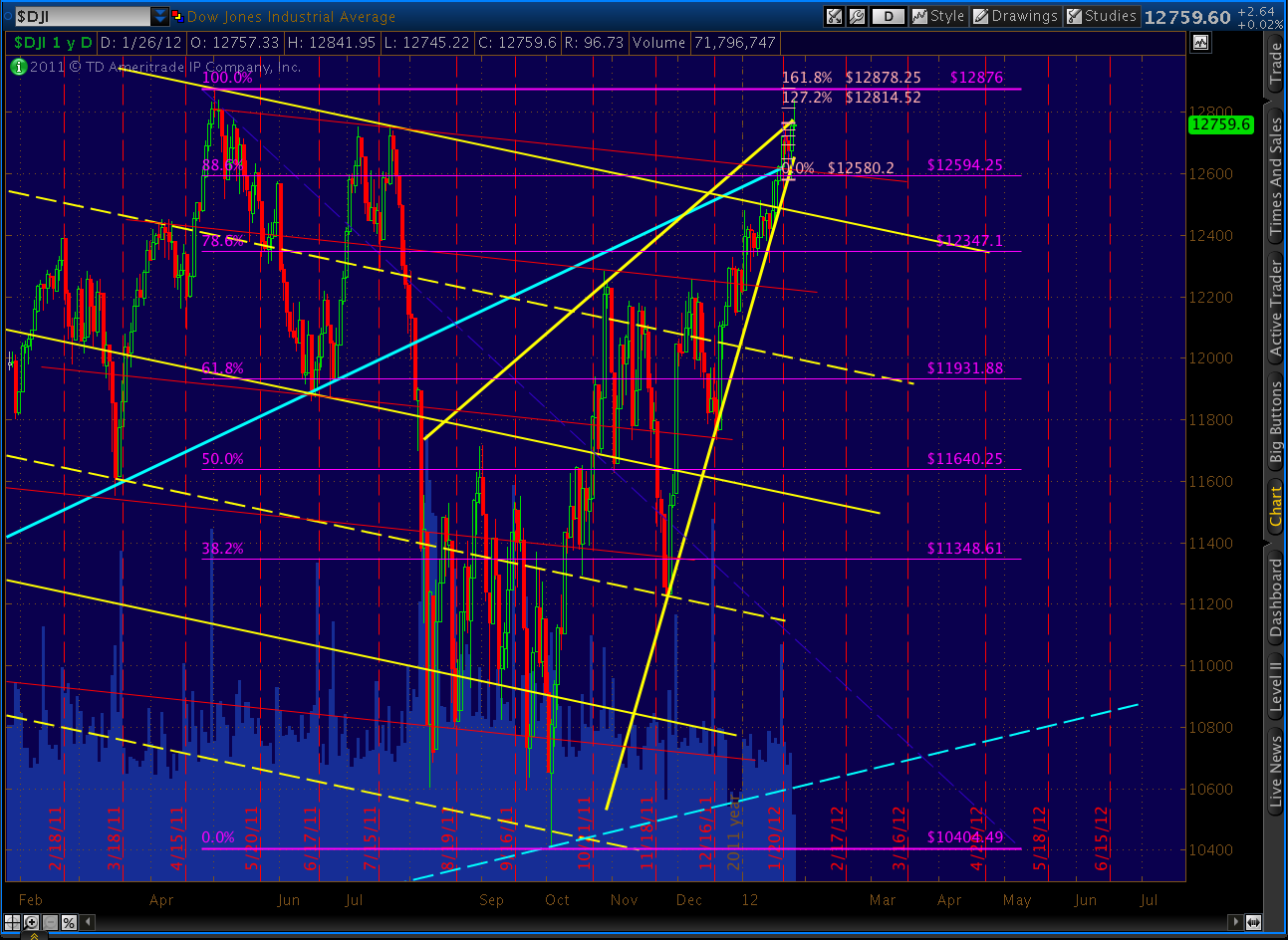
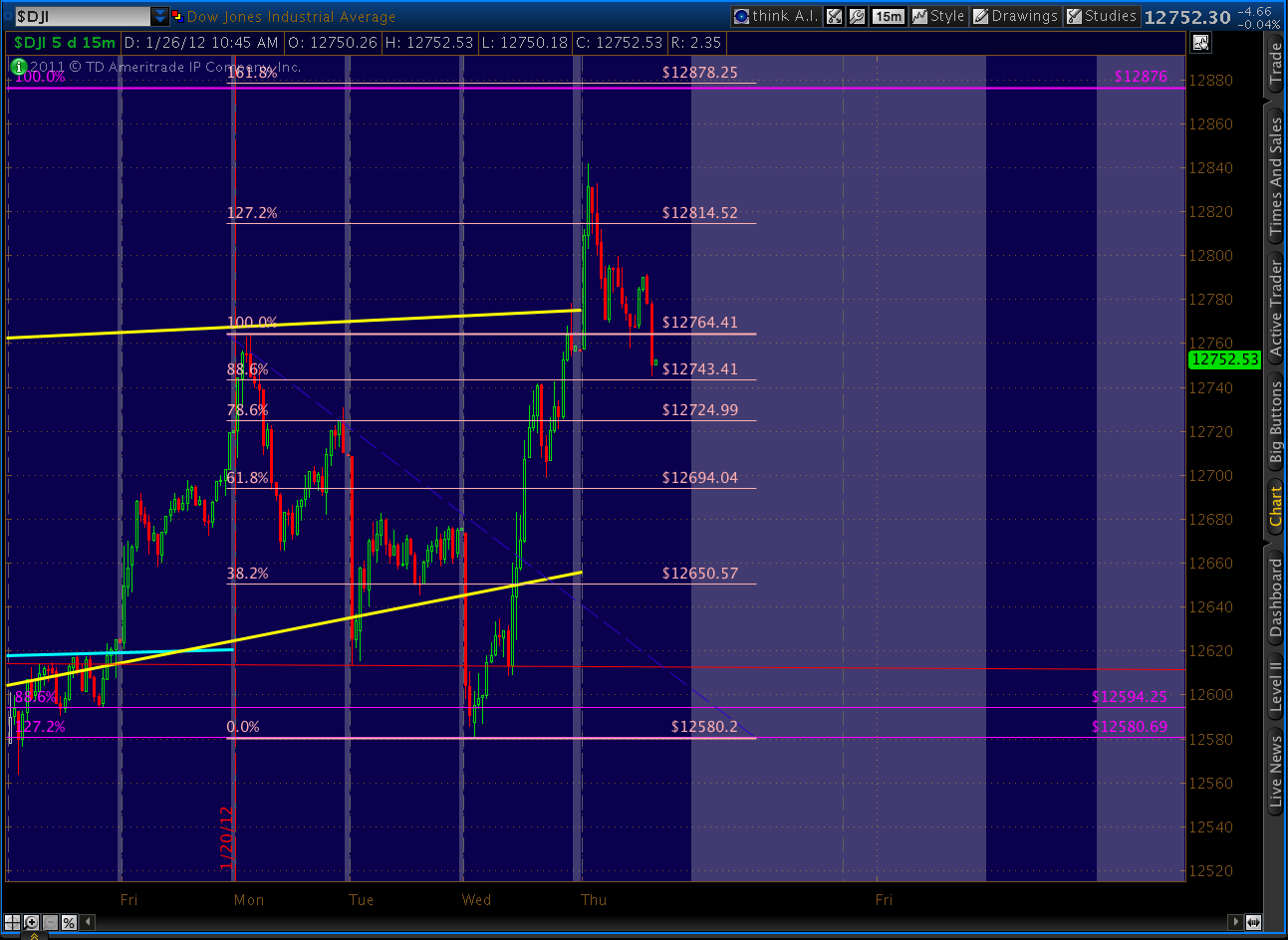
    I don’t focus much on the DJIA, but it’s getting a lot of attention right now, as it climbed within 35 points of its May highs earlier today.   It’s an important level, to be sure.  A climb past 12,876 invalidates a lot of wave counts.  A stop at 12,876 makes for a deliciously bearish double top.

    Check out the little Crab pattern setting up on the 15-min chart.  The 1.618 extension happens to be at 12,878.25.   At this point, the Dow is showing much better performance relative to the SPX than it should — a variety of divergence that should concern those betting on new DJIA highs.  Hmmm….

    UPDATE:  1:05 PM

    Here’s the NDX chart, showing the Butterfly pattern completion at the 1.272 extension.  Remember, this follows a Bat pattern that played out perfectly with a 10.9% decline in late October.  All things being equal, Butterfly patterns generally produce greater reversals.

    UPDATE:  12:40 PM

    Here’s the chart concerning the Baltic Dry Index I reference in the comments below.  It’s from InvestmentTools.com, who publishes some really cool charts with all those neat combos and ratios we love to watch.   This one speaks volumes:

    Check out the little H&S; setting up on SPX.  It targets 1311 in the short run and could set up some larger patterns if it plays out.

    ORIGINAL POST:

    More later.

  • Charts I’m Watching: January 25, 2012

    UPDATE:  11:35 PM

    No point in rehashing the Fed news today.  Bottom line, they continue to try to influence the markets with promises of QE.  Actually unleashing more QE is problematic from a lot of standpoints (political fallout, distorted credit markets, etc.)

    The bigger problem is that if the Fed whips out their biggest gun (QE3) and it produces even less benefit to the economy than the last two iterations, it would reveal: (1) just how desperate they are; and, (2) how limited are the alternatives.  Zerohedge has been running an interesting series on the race to the bottom between the Fed and the ECB — well worth your time if you’re into macro-econ.

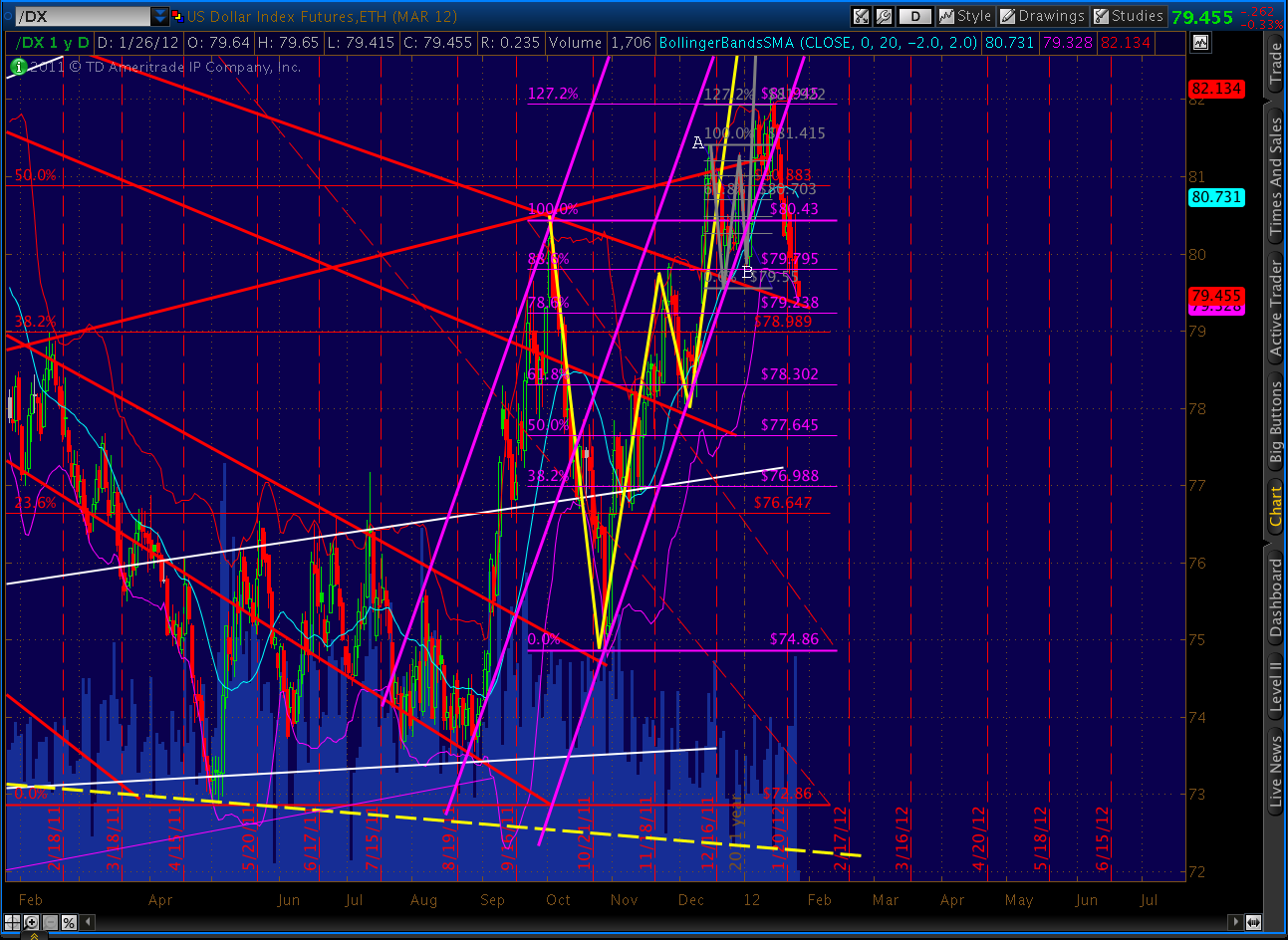
    It’s interesting to me that the USD’s weakness these past few days outweighs the Euro’s strength.  But, they’re both at a turning point based on harmonics, fan lines and channels.

    Gold was on a tear today, topping 1700 for the first time since Dec 12.  It’s possible it’s breaking off its run to 1357 (or 1200, see Fleeced); I’ve nudged the channel lines just about as far as I think is reasonable to capture today’s rise.

    Recall that we’re still north of a long term trend line that, until broken, points the way to a zillion by Christmas.  With today’s Fed action, there are plenty of folks who are more convinced than ever it’ll get there.

    But, there’s an interesting little fan line off Jan 2011 that provided the July, September and October bounces (white, dashed.)  We broke through in mid-December and have been beneath it for the past month.  Now, however, we’re tagging it from underneath — a back test — at the upper channel boundary.  GC is also showing negative divergence on every time frame of 60-min or shorter.
    (This is the exact same type of back test, by the way, as we’re seeing on BAC.)  If it is going to turn, it’ll need to do it pronto in order to salvage the harmonic patterns.  We’ll watch this one closely. 

    Stocks are likewise rapidly running out of fan line resistance options to halt their advance.   As we examined last week, there are a few different ways to draw these, depending on whether you include shadows or not.  Today, we bumped up against the highest of the four.

    We’re within .81 of the Butterfly completion at the 1.272 extension — the 1329 target I’ve been eyeing.  We’re also just a few points shy of the .886 retracement of the 1370 – 1074 drop (1336.)  Technically, Wave 2 isn’t toast unless we head higher than 1370.  At only 44 points away, the bear case is starting to run out of room.  The 50 day SMA is only 4.43 below the 200 SMA.

    But, many of our technical indicators continue to look bearish.  There’s negative divergence across the board, from 60-min on down.  VIX, which closed below its Bollinger Band yesterday, is also providing nice divergence and is at least 90% of the way towards a falling wedge apex.  It completed a bullish Crab pattern, filled a large gap and tagged the wedge’s lower bound yet again today.

    I see sign after sign of a top.  Whether the market chooses to follow those signs right now, however, is anyone’s guess.  But, we’re drawing very near to the point of “now or never.”  I might be a little early, but I opened some short positions today in anticipation of a turn (and, yes, I’m using fairly tight stops.)

    The first wave down should stop short of 1267 if it’s going to keep bulls’ hopes alive.  It’ll look bullish from a wave count perspective, and allow the channel promising more upside to take proper shape. 

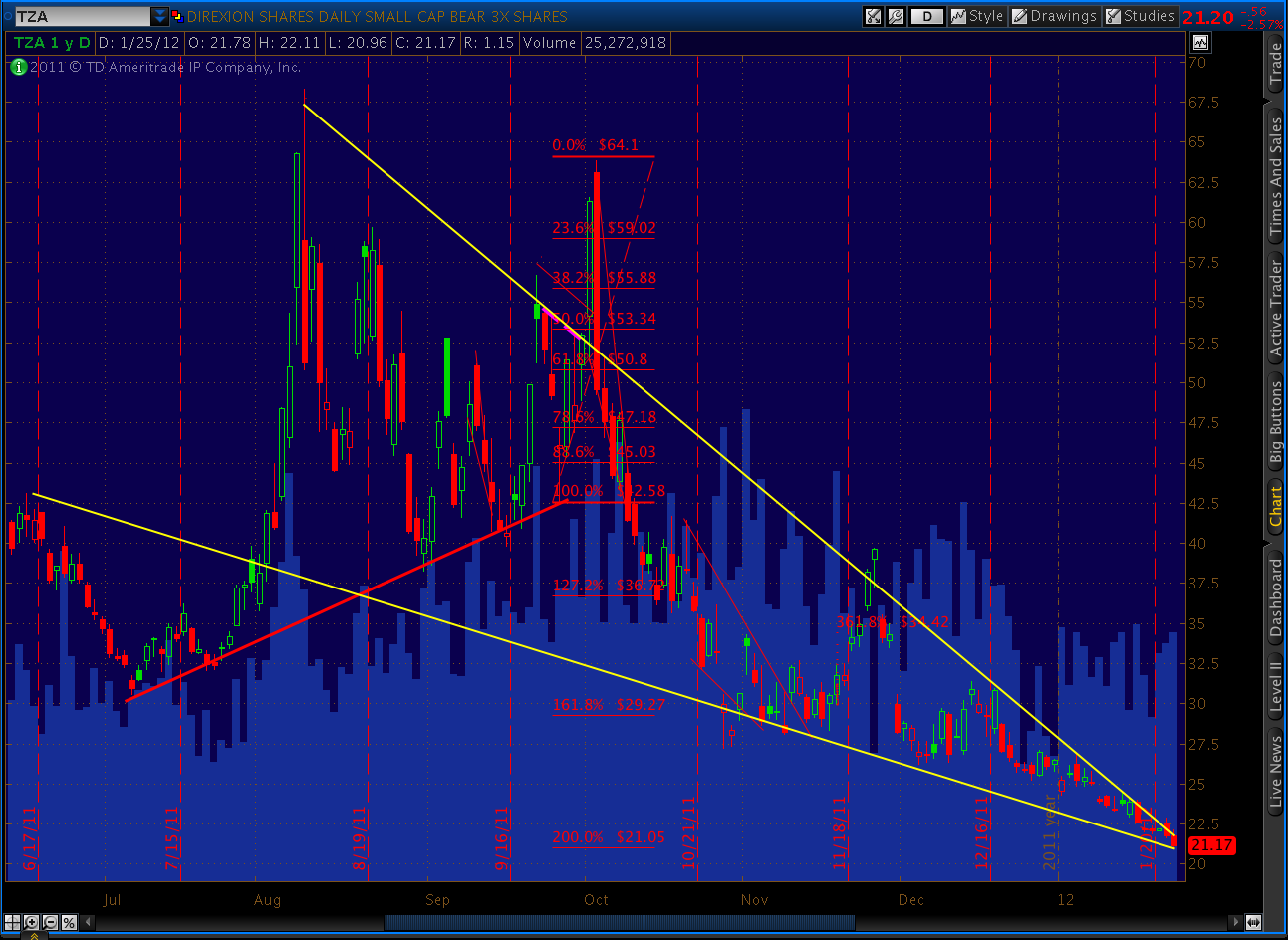
    I’ll leave you all with a chart that illustrates just how overextended this market is.  TZA, a leveraged inverse ETF on small cap stocks, has gone deeper into a falling wedge than I’ve ever seen.   Good luck to all.

    UPDATE:  12:15 PM

    It’s important to keep a close eye on the potential channels and wedges forming on SPX.   But, given the variety of legitimate interpretations, it might be more valuable to watch the RSI trend lines.  On the hourly chart below, two of the more obvious channels are the light blue and the yellow.  You could also easily form a rising wedge by combining the upper blue line with the lower yellow line.

    Rather than agonizing over the right interpretation, focus on the RSI trend line.  It’s repelled each of the dips pretty handily and will be the first sign of a meaningful break to the downside.  Likewise, we can watch for upside breakouts as well.   Consider the 5-min chart RSI:

    A breach of the solid yellow line would be a good warning sign.

    ORIGINAL POST:  1:50 AM

    The Nasdaq 100 futures look to have tagged the fan line off their Oct 2007 highs.  As reported last week and back in July, this has been a very good indicator of a top several times in a row.

    EURUSD looks like it’s completing a back test of the last diagonal as well as a trip across its channel.  

    There’s a Crab pattern completing on the 60-min chart at the 1.618 extension that should put the brakes on any further upside.

    And, gold is also completing a run to its channel boundary, depending on whether you include the shadows.

    I’ve probably written those same words (re the shadows) a dozen times in the past week — which, in itself, is probably a sign of how prices have been pushed to extremes.

    AAPL’s results might be the catalyst to get SPX up to 1329, completing the Butterfly pattern we’ve been watching.  Keep a close eye on this after the cash markets open, especially if we gap up a little on the open.

    More later.

  • Charts I’m Watching: January 24, 2012

    UPDATE:  6:55 PM

    Not much action during the day, but Apple’s making news after the close.  According to unconfirmed reports, Apple is purchasing the other 499 corporations comprising the S&P; 500.  Said CEO Tim Cook, “imagine my surprise when I learned there were other stocks out there; this will simplify things for everyone.”

    In after-hours trading, AAPL is indicating 452 after trading as high as 469.  The only FLi in the ointment is a bearish Crab pattern that completes around 465.87.  AAPL has been locked in a crazy steep channel since 2008, and 469 tomorrow would complete the Crab and take it north of the channel boundary.   Here, for your iZonely.

    It’ll be interesting to see if RSI tags along for the ramp, or whether it falls victim to its two year-old trend line.  If so, could get some nice negative divergence.

    This should also give NDX the last little push it needs to meet its bearish Butterfly target at the trend line we’ve been watching.   Almost there…

    ORIGINAL POST: 

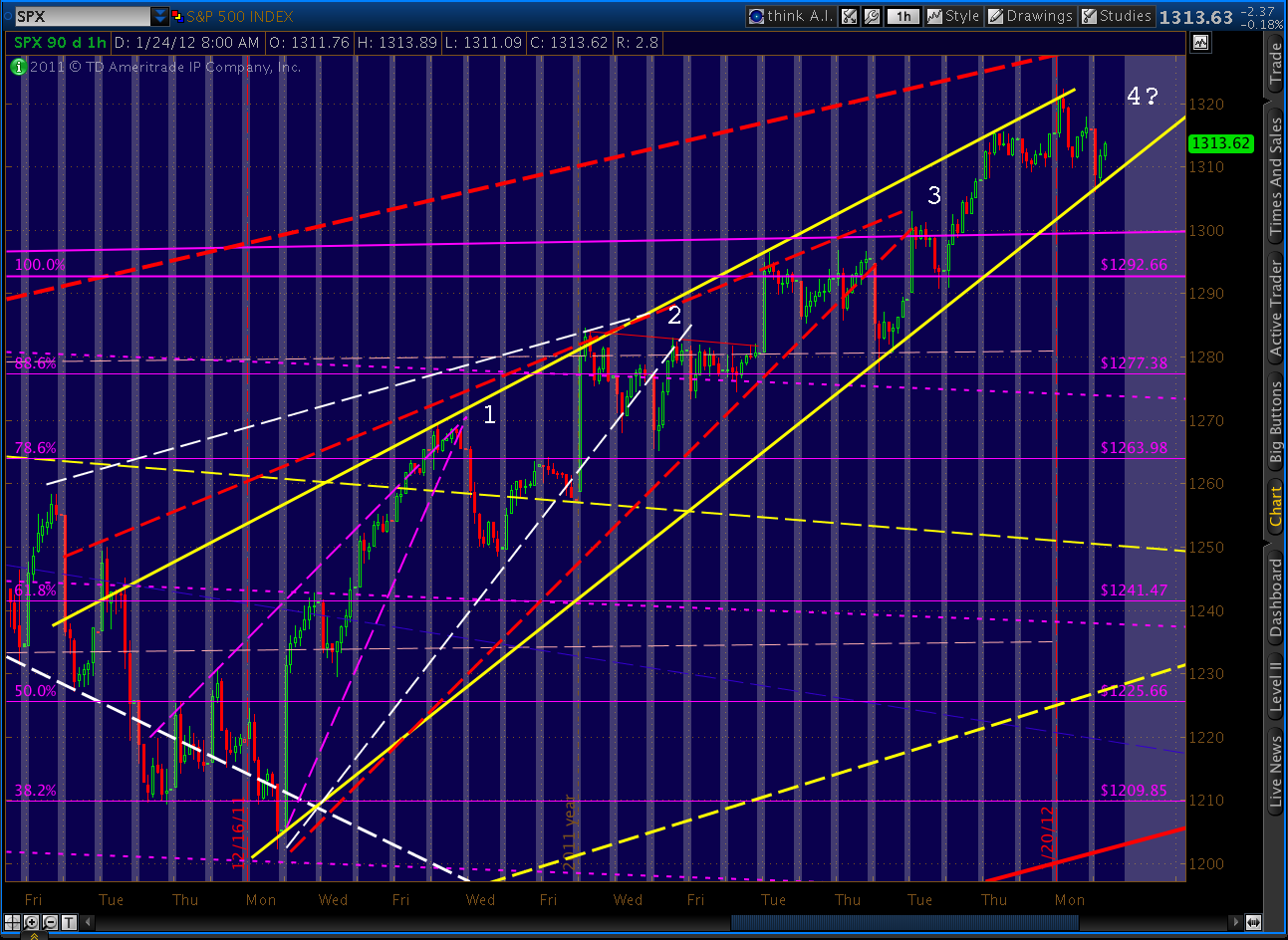
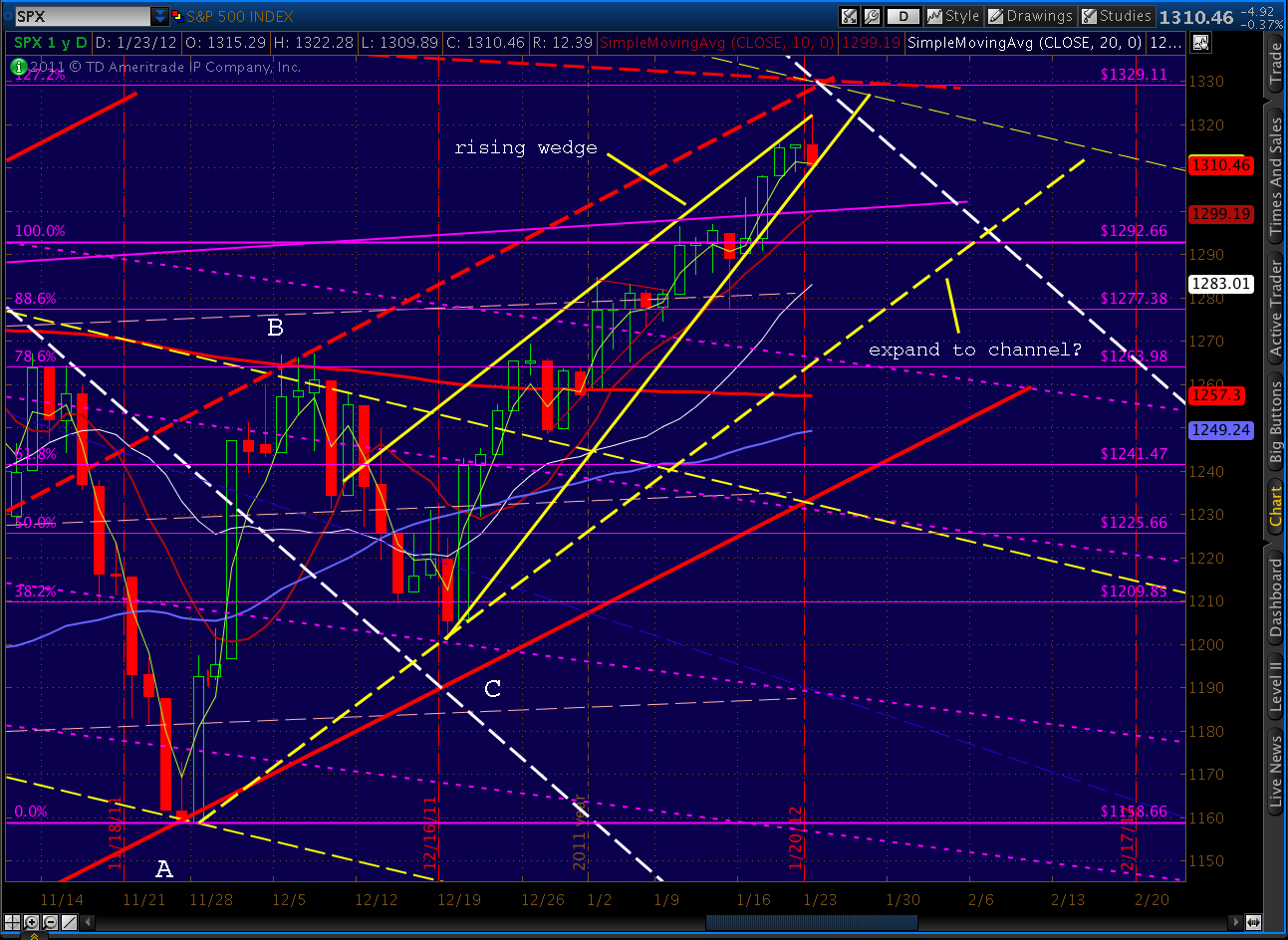
    Another day, another broadening of the rising wedge.  We’ve had three RW failures in a row, so it’s normal to be a little gun shy at this point.  For now, my target remains 1329.

    We completed a little H&S; pattern that points to 1297.60 — the broadening I was alluding to yesterday.  If it plays out,  though, it’ll be in line with the intra-day lows on 12/21 and 1/13 and look suspiciously like a channel.  It might also appear as a “back test” of the wave ending at 1292 — in other words, a corrective wave rather than an impulse down.

    Going out on a limb here, but I don’t think the MM’s are done jerking us around.   I’m watching a lot of indicators, but one that always speaks to me is RSI trend lines.  Check out the 60-min chart.

    The trend line connecting the RSI lows since November 21 has stopped every downturn since from becoming more serious.  I would think twice before loading up on shorts until at least that trend line is broken. 

    I would also tell anyone going long or short here to make careful use of stops.  The game is just about up, but there is plenty of danger in taking an unprotected stand one way or the other.

  • Charts I’m Watching: January 23, 2012

    UPDATE:  12:15 PM

    We’re seeing a little weakness on SPX, off 5 after topping out at 1322 earlier.  We got within 7 pts of the Crab objective and, depending very much on how you draw it, possibly tagged the Oct 2007 fan line.   Those who want to capture most of the move down are already short by now, while those who want to nail the top are probably scaling in.

    As always, we won’t know it was the top until after the fact.  But, my best guess is still 1329, with a possible dip on either side just to fatten out the rising wedge into a channel.  Here’s what I mean:

    We’ve been faked out multiple times on the way up playing rising wedges.  Every time we complete a perfect looking one, it expands into a channel and begins a new, less perfect wedge — the better to suck more bears into the game.  Right now, it’s looking pretty good.  And, we’re obviously approaching the fan line (however you want to draw it) and horizontal resistance.

    I think the MMs will likely allow a little dip just to excite those of us who are looking for a break down from the wedge, then reverse it at a point where it’ll take on more of a channel look.  Whether they do this before or after 1329 is anyone’s guess, but I think it’s coming.  The only positive is that it will very likely establish some nice, fat negative divergence — a signal that’s been AWOL on the daily chart.

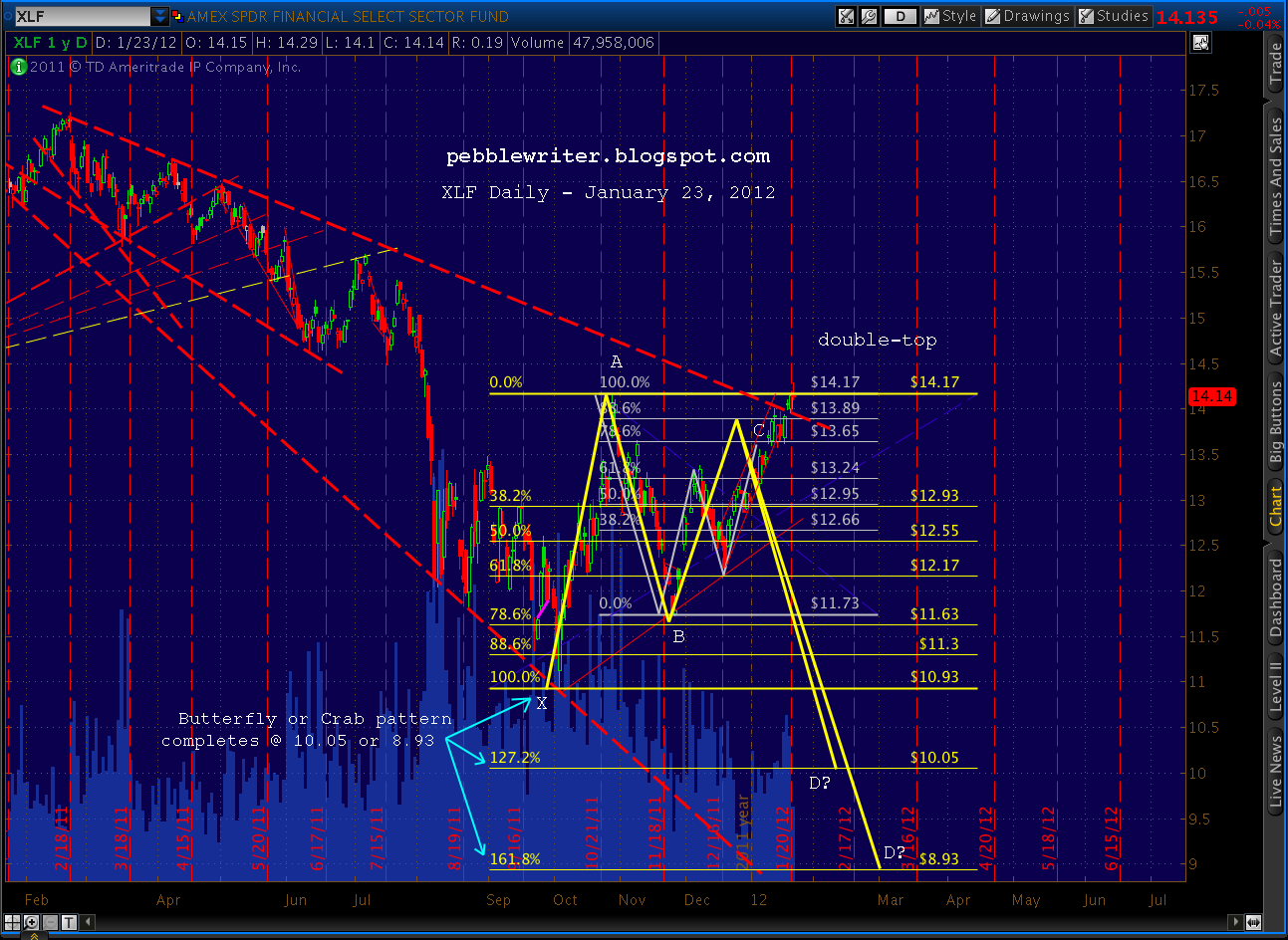
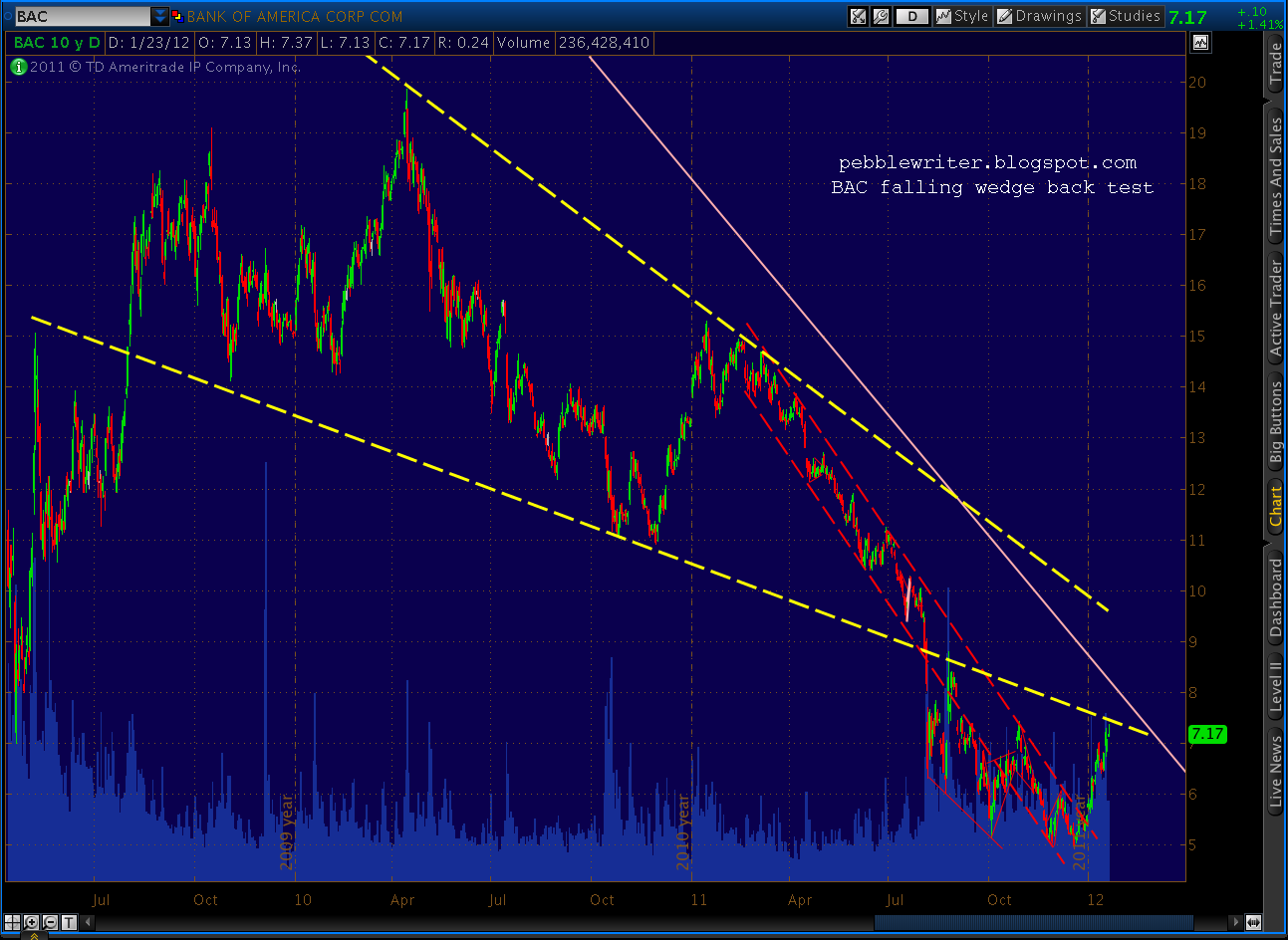
    BTW, XLF just busted one of the harmonic patterns we were watching.  By exceeding 14.17, we have a Point C higher than Point A on the Butterfly/Crab.  Although, as discussed last week, I’ll usually wait for a more sizable excess before calling it quits.  After all, 1.0 is a Fib level, and we only reached 1.037.  Could we reverse quickly?  Sure, take a look at BAC.

    I hate to kick a stock when it’s down, but in BAC’s case I’ll make an exception.  It’s forming a double top as it back tests a falling wedge and, so far, has failed to breach a TL from 2006.

    UPDATE:  11:35 AM

    AUDUSD has slightly overshot our Gartley and Crab pattern objectives and seems to be leveling off.   This should be it for the upside, but always remember to use appropriate stops.

    ORIGINAL POST:  10:20 AM

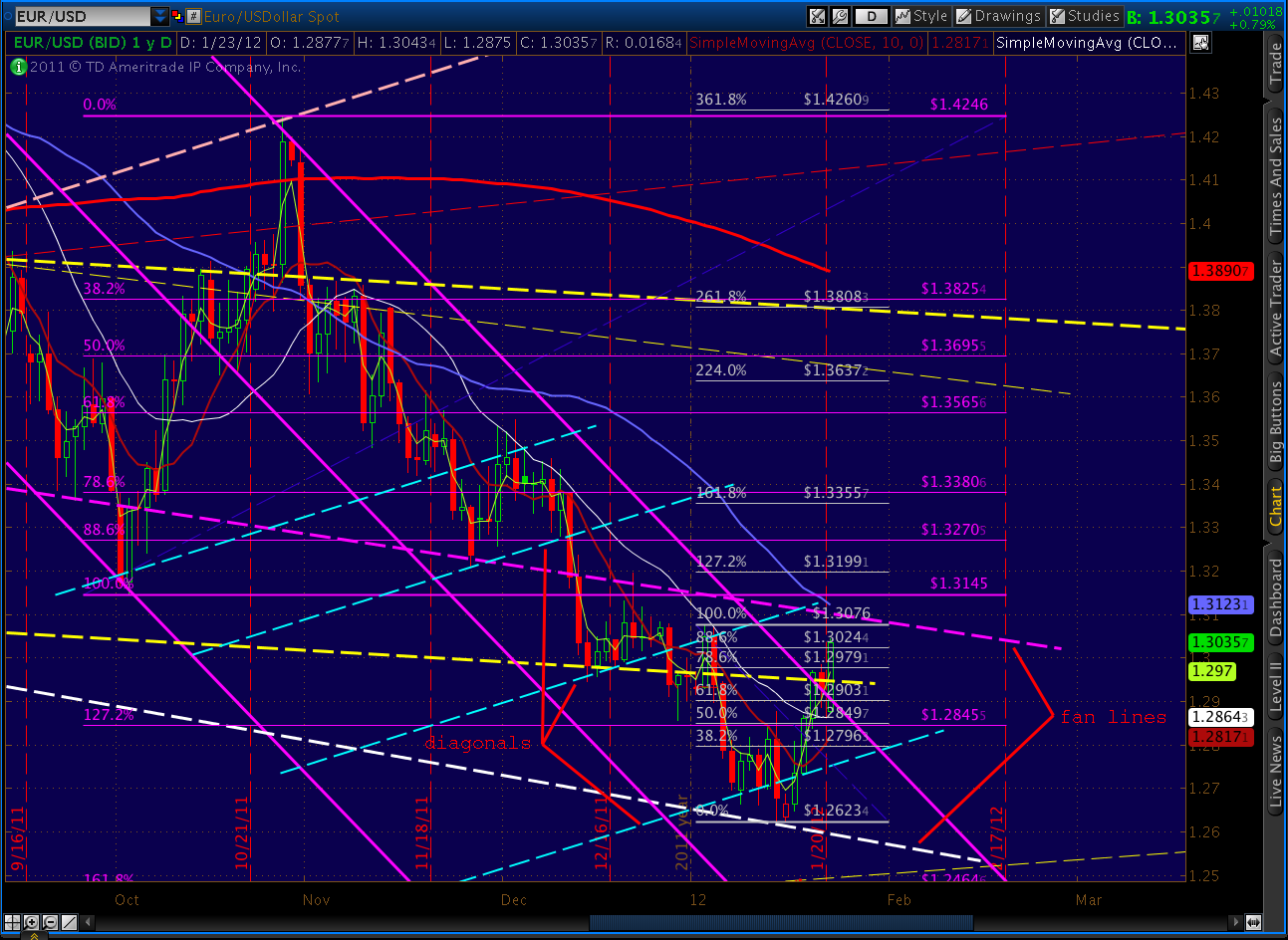
    EURUSD has broken out of the very tight channel it’s been in since mid-October.  I’ve adjusted the fan line from the July 08 high (highlighted in white) to reflect the turn at and am looking at the next fan line higher (highlighted in purple) and/or the previous wave low at 1.3145 to provide the next turn. 

    Note that this would complete a back test of the last diagonal on our stair step lower and probably tag the SMA 50, too.

    Any time we break out of a channel, it’s a good idea to reexamine the channel and any related underlying assumptions.   Initially, I wondered if we were seeing an expansion of the channel — much like occurred in Mar 2010 (in the middle of the middle impulsive channel (purple) below.

    I was disturbed that we were seeing a sizable bounce prior to reaching the fan line off the 2002 low.  I was also having trouble reconciling a breakout from an apparent falling wedge.  When we look at the same chart in log scale, however, we see a perfectly nice touch on the fan line (redrawn in solid red) and the channel is still very much intact (using the 2008 impulse channel slope as a guide.)

    Curiously, in log scale the last fan line provided a bounce on the downside but not the subsequent rise.  In arithmetic scale, it provided no bounce on the downside, but a big one on the way back up.  I can only surmise that the algo’s driving much of the EURUSD trading out there watches both.  So, I will too.

    I examined this with respect to the equities market in an earlier post [see: To Log or Not to Log] back in October, and determined that using log scale was part of the reason I was often early.  I think the best approach is to use log scale for longer term patterns (a 9-year fan line qualifies!) but confirm with the arith scale before doing anything crazy in the short run.  That still seems to be the scale most short(er) term equities traders use.  Here’s the daily chart close up with log:

    We still have a ways to go on our Crab pattern (Point D @ 1.2464) and, of course, there’s the gigantic flag pattern to complete somewhere around 1.13 (depending on timing.)  From 1.3145, 1.2464 would be over a 5% drop — a great way to kick start a nice equities correction.

    Some of you might recall we’re watching a fan line off the 2007 high on our SPX chart, too.  Again, using log vs arith scale can make a small difference.  Here are the two options, each showing a fan line off Oct 11, 2007 through the May 2, 2011 high – both with and without shadows.   Today’s values with log are 1333.90 and 1327.50; with arith they are at 1330.65 and 1324.40.

    More later.

  • Lightning Always Strikes Twice

    It was Saturday the 14th — the day after we normally expect the Universe to throw us a curve.  My brother-in-law and I were day-hiking Mt. Whitney.  It’s a 22-mile scramble from 8,360 up to 14,496 feet and back, not the most relaxing way to spent a day but (normally) a fun challenge.

    Before long, we came across two brothers and their best friend.  We took turns passing each other, sharing words of encouragement and speculating about how hot the waitresses serving margaritas at the summit would be.  At about 14,000 feet, my brother-in-law’s hypoxia forced us to rest while the others pushed ahead.  Unfortunately, none of us could see the huge thunderstorms racing in from the blind side of the mountain.

    That which has been is that which will be,
    And that which has been done is that which will be done.
    So there is nothing new under the sun.

    Ecclesiastes 1:9, 200 BCE

    The weather went from 50 degrees and sunny to sleet and snow mixed with lightning — lots and lots of lightning.  At that altitude, we were in the thunderhead.  Just above us on the summit, the others took refuge in a tin-roofed stone observation hut.  As the storm raged around them, one of the brothers tried to lighten the mood.   Don’t worry, he laughed, when he was young he was hit by lightning while boating. Everyone knows lightning never strikes twice.

    He had intimate knowledge of the dangers of lightning.   He knew not to be out in the open and exposed when a thunderstorm came along.  He was even in the company of several people trained in CPR and survival skills who would stop at nothing to save one another.  None of this changed the fact that they were nearly three miles high in the middle of a thunderstorm.

    The more things change, the more they stay the same.
    Alphonse Karr, 1849

    An average lightning bolt carries 30,000 amps and a trillion watts.  The oxygen in the air literally explodes as it’s heated to 36,000 degrees — three times that of the surface of the sun.  During this particular storm, hundreds of lightning bolts registered in a couple of hours.  There was nowhere to run, nowhere to hide.

    Moments later, the hut was struck by a bolt so massive that a ball of lightning appeared inside, floating around the ceiling for thirty seconds until it exploded, shocking everyone in the hut.  The brother who’d been joking went into cardiac arrest and, despite five hours of CPR by his brother and his best friend, died that day.  Despite his experience and a well-worn idiom, he could not avoid the inevitable.

    A short distance away, I was working on my brother-in-law, who had also gone into cardiac arrest when we were struck. After I finally got his heart beating again, we were struck a second time.  Yes, lightning had struck twice twice.

    The Federal Reserve is not currently forecasting a recession.
    Ben Bernanke, Jan 2008

    I think about that day from time to time, especially when contemplating our economic situation.  Our Fed Reserve chairman, a renowned expert on the Great Depression, has assured us that depressionary lightning won’t strike twice.  But, he’s the same guy who didn’t exactly nail it in 2008.

    In 1933, when Roosevelt took the US off the gold standard, loosened monetary policy and greatly expanded federal spending, markets soared.  Federal expenditures tripled, but GDP kept pace.  Federal debt to GDP maxed out around 40%.  Employment dropped below 20% and deflation abated.  The country turned the corner and sentiment improved, much as it appears today.

    In 1937, however, the wheels came off the recovery express.  Unemployment jumped from 14.3% to 19%; industrial production and the stock market both plunged over 30%.  The causes are subject to great debate.  Depending on whom you believe, monetary policy was either too accommodative or restrictive; taxes were excessive or regulation was too lax; spending was too high or not high enough.

    First comes spring and summer but then we have fall and winter.
    And then we get spring and summer again.

    Chauncey Gardiner, “Being There”

    Like storms, economic cycles have always been a fact of life.  We can try to prevent them with stimulative monetary policy, deregulation and lower tax policies.  But, we invariably overcorrect or undercorrect; we take wrong turns and run down blind alleys.  It’s hubris and human nature at it’s finest.  As anyone who’s ever ducked into a tin-roofed hut to escape lightning would tell you, unintended consequences can be a bitch.

    Witness the continuing fallout from overly lax real estate lending.  Despite Bernanke’s March 2007 analysis that “problems in the subprime market seem likely to be contained,” real estate went through a historic deflationary spiral.  Nearly five years later, amid a meltdown that saw his own boyhood home sold at foreclosure, prices are finally back to 2003 levels. Is the worst over?

    Personally, I’m not sure we’re out of the woods.  I think we’ve come to a cyclical clearing which could precede a denser, darker, scarier forest than anyone can remember.  I question whether issuing more debt can cure a debt problem any better than buying a guy a scotch can cure his alcoholism.  So, forgive me when I question Bernanke’s repeated assurances. To me, it sounds like a plan to reinflate all those bubbles that burst a few years ago.

    The national debt is currently around $16 trillion (equal to GDP) and we’re running a $1 trillion dollar deficit. At the current rate of growth, debt will top $20 trillion by 2017 and $25 trillion by 2020. Can the Fed continue to keep inflation and interest rates at levels that won’t sink the economy, essentially breaking the bond market a la Japan?

    Bernanke and his cheerleading counterparts at the Fed, the White House, Congress, the ECB, the BoJ, the IMF, the WSJ and CNBC all insist there’s nothing to worry about. Would they really tell us if we should be worrying?

    See, in my line of work you got to keep repeating things over and over
    again f
    or the truth to sink in, to kind of catapult the propaganda.
    George W. Bush, 2005

    As a wise man once said, question everything.

  • Charts I’m Watching: January 20, 2012

    UPDATE:  3:15 PM

    VIX slumped another point today, trading near its intraday lows of 18.75.  This is the kind of capitulation we want in order to see a top in stocks.  The small H&S; pattern we were watching has busted, and the Bat pattern has started looking off.  I’ve moved my Point X back to July 1.  Starting at 15.12 gives us a .886 of 18.87 — very close to current values.


    The falling wedge within the falling wedge (red TL) is technically being backtested, yet it’s been undercut by a few points so we should probably forget all about it. 

    Beware: the larger falling wedge is still very much intact, signalling a upcoming surge in volatility.  And, hat tip to SoulJester who correctly points out the Gartley on VXX, the VIX ETF.

    Checking in on XLF, it just scored a double top — coming within pennies of the Oct 27 high (last time the Greece problem was “solved.”)  It blows the smaller Bat pattern we were watching, but I’ll take a double top any day.

    UPDATE:  2:00 PM

    Quick update on Gold…   Note the long term trend line (red, dashed) underlying the rise from the past five years or so.  In July, we split off from the trend and started a formation that’s resulted in several fan lines (white, dashed) being formed, tested, and broken.

    The latest intersects with the Dec 29 low, at which point we saw a $145 bounce.  I expect the bounce to fail as prices back test the 2nd fan line somewhere south of its intersection with the channel that’s been guiding prices downward since August.  Currently, that would be around 1700.

    If we do get a reversal there, the latest Crab pattern (purple) should continue to play out to 1368 and eventually complete the even larger Crab pattern (yellow) to 1200.   For the first, that would mean a C leg down slightly longer than the A wave down from 1926.  For the latter, of course, it’s a 1.618 extension.

    My gut is that gold will accompany stocks down on this next little excursion to bear country, complete an A-B-C correction, then resume its bull market when the Fed takes action to “fix” things.

    The first line in the sand, of course, is the channel line at 1700.  If we can break out of the channel — only 37 away — then the next test is the previous high of 1804.  If we break either the fan line or, more importantly the red trend line, the correction is on.

    ORIGINAL POST:  9:10 AM

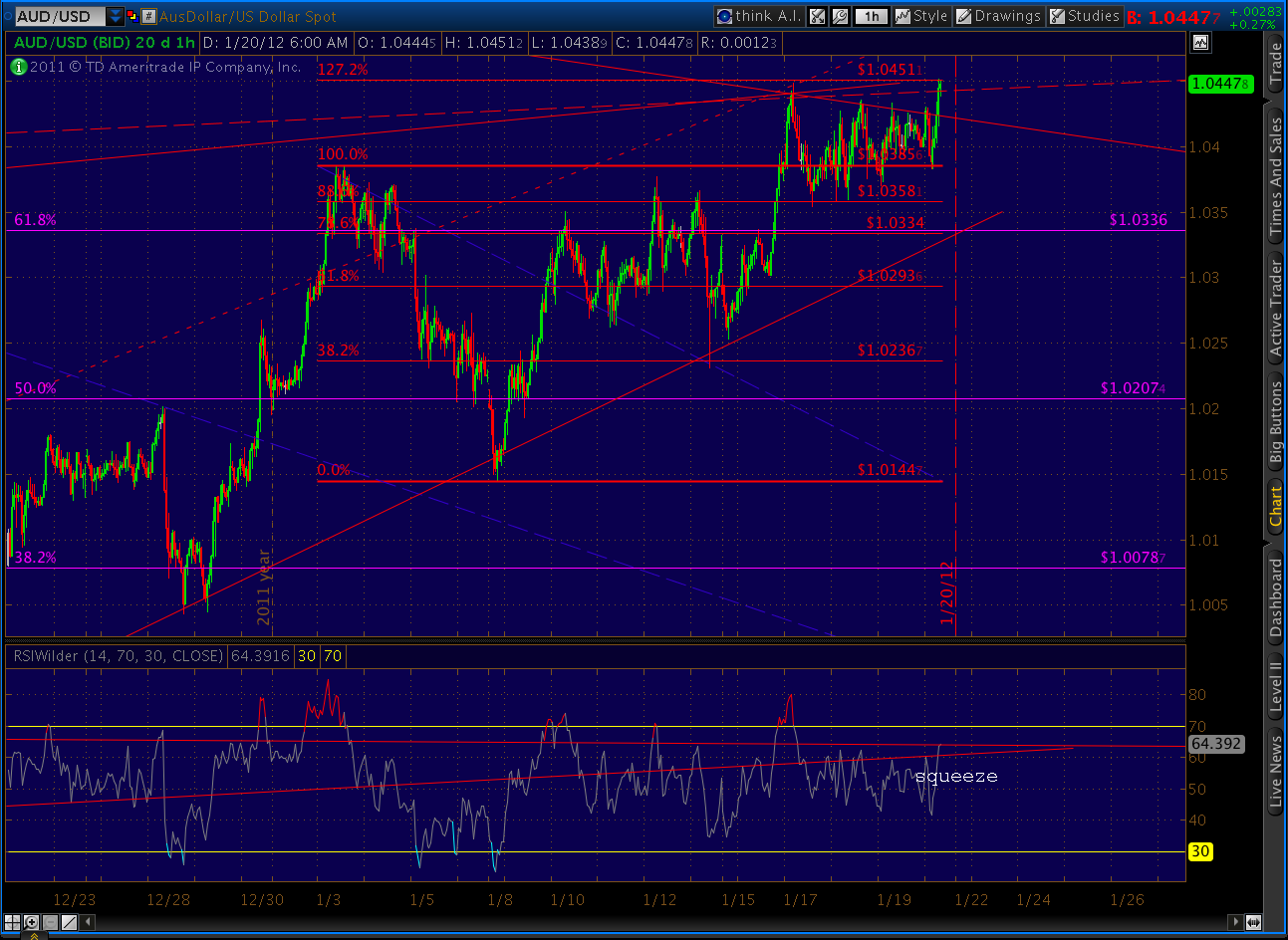
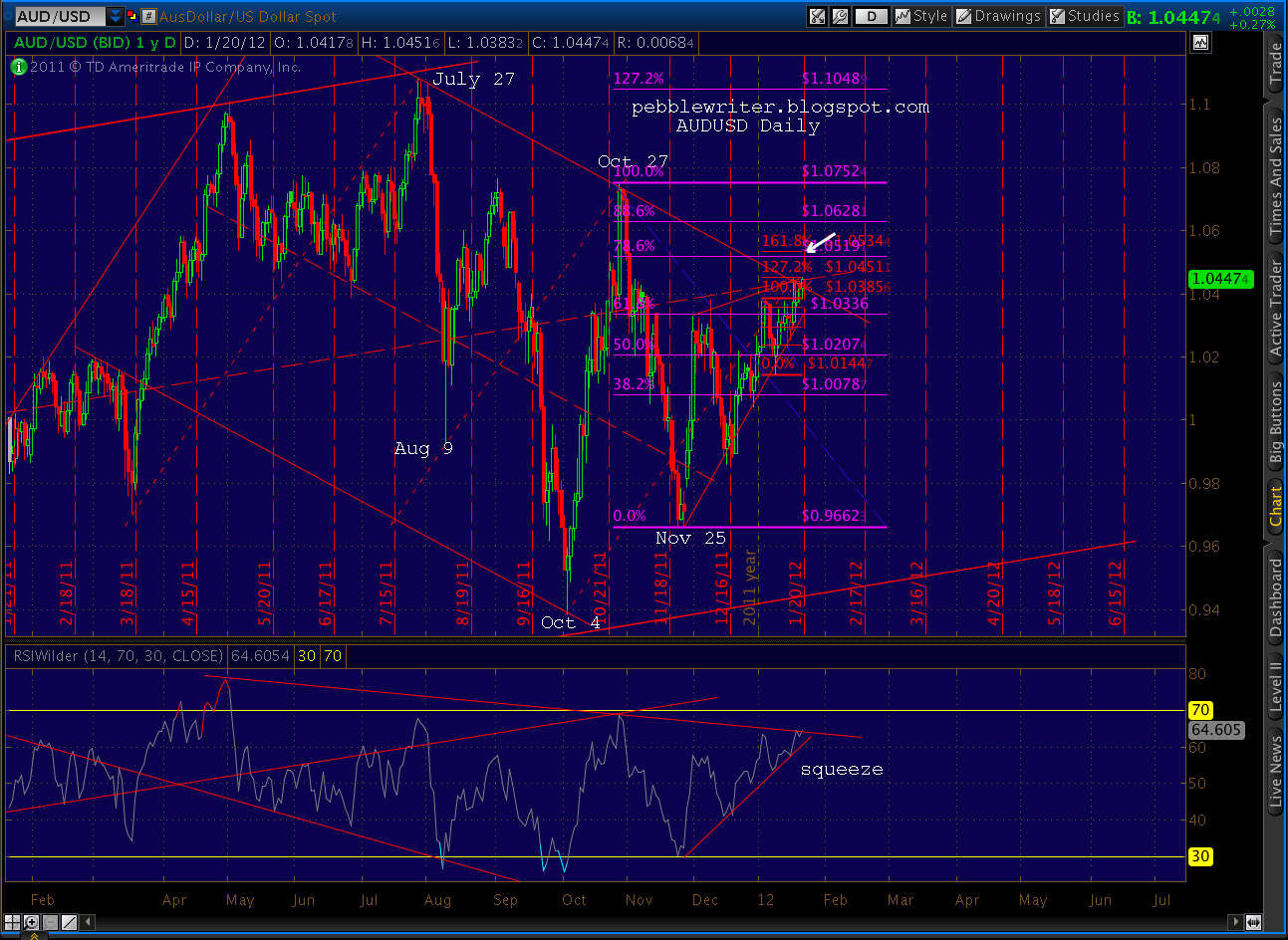
    AUDUSD has finally pushed above the channel line — even if just a little.  Recall we’re looking for a final push as high as 1.0519 – 1.0534 to complete both a large scale Gartley (shown in purple) and smaller scale Crab (red).  [see: Jan 18 post] Given the squeeze going on in its RSI, I would view the completion of these two patterns a blow off top of sorts, and if history is any guide, synchronous with a top in equities.

    Updated (1:30PM) daily charts on AUDUSD showing the Butterfly pattern and LT channels:

    We’ve seen the reaction we were expecting on EURUSD, a reversal off the two channel lines.  If the rumors about Greece are true, we’ll likely see a spike higher.  But, really; how many times have we been led down this path? 

    Though, it would fit nicely with the idea of a push slightly higher in stocks — the Butterfly completion at 1329 —  as would the AUDUSD pattern completion mentioned above.

    Stay tuned.