Tag: trend lines

  • Anatomy of a Top: 2000

    The 2000 top shows just how “messy” tops can be.  Here’s the finished picture in perfect hind-sight.  It’s a very crowded chart, but every single pattern had a say in how the top unfolded.

    SPX had zoomed from 442 to 1478 in about 5 years, a not-too-shabby 234% gain for an annually compounded 27%.

    Once SPX broke out of the falling purple channel, it had “permission” to pursue several harmonic patterns in the works.  SPX shot up 66 points in that one day — blowing through every Fib level between .618 and 1.000.

    It finally came to rest at 1458, completing a Bat Pattern at the purple .886.  But, the small white 1.272 was just above at 1477, as was the rising purple channel midline and the 1.272 from a much larger pattern seen below.  An IH&S target waited at 1497 – tantalizingly close to a nice round number of 1500.  And, the all-time high of 1478 from two months earlier beckoned.

    SPX got up to 1477.33 before reacting, falling to 1466 over the next two days.  Close, but not quite.  Someone watching closely might have noticed the Flag Pattern it constructed, targeting 1562.  Someone else probably pointed out the biggest Crab Pattern target of all — the 1.618 extension of the 13% correction from 1420 to 1233 from Jul-Oct 1999.

    On Mar 21, 2000 SPX shot up through the channel midline, the cluster of Fibs around 1477 and, importantly, the 1478 high and raced up toward those higher targets.

    On Mar 24, it reached 1552.87, which cleared the IH&S target at 1497, the purple 1.272 at 1519 and the last remaining Crab Pattern at 1535.  What ultimately stopped it?  The .75 line from the big purple channel dating back to Jul 1999 — almost to the penny.

    Total move: 17% and 227 points in 20 sessions.  Can it happen again?  Stay tuned.

  • Do or Die Time

    As we discussed yesterday, it’s do or die time for the equities markets.

    Keep an eye on the small rising wedge today.  A break down below 1560 is important to the bears’ case — while the bulls obviously have their sights set on the all-time high of 1576.

    As always, watch for a backtest after the wedge is broken.  Any such bounce should fail by 1562.80 or so.

    The US dollar reached our Mar 4 target [see: After the Funding’s Gone] and reversed sharply.  Note this was the confluence at the completion of a Crab Pattern (in purple below), a Bat Pattern (red) and two channel midlines.

    The channels can be better seen on a longer term chart.

    DX and SPX have become mildly positively correlated of late with the 25-day moving average at 0.59.  This is a huge shift from the high negative correlation we had all become used to: as the dollar as a safe haven during equity market sell-offs:

    This chart from Deutsche Bank showing the 1-year rolling correlation has been widely circulated.  It’s a week old, but shows that despite some huge swings over the past few years, correlation continues to become more and more negative.

    The last little blip up in the dark blue line represents a relative decrease in negative correlation, but it appears to have formed a channel since 2009.  In the absence of a breakout, one would expect the trend to continue…


    From a technical standpoint, whether the trend continues or not — and, where the dollar goes from here — couldn’t possibly be more important.

    The ebbs and flows of the relationship can best be seen in a long-term comparison.  Here, we can see long periods such as 1995-2000 when they moved in lock step.  Notably, when stocks faltered in Aug 2000, the dollar vacillated for a while before finally joining in in Jan 2002.

    But, when stocks finally bottomed in 2003, the dollar continued to sell off.  It got a big bounce in Dec 04 (the previous low) but didn’t bottom out until Apr 08 as SPX was about to fall off a cliff.

    When stocks bottomed in Mar 2009, the dollar peaked.  The next time the dollar bottomed was in May 2011, as the 2011 correction got underway.  It rallied again with the equity sell-offs in Apr 2012 and Sep 2012, but has so far failed to break the high established in July 2012.

    Why should equity investors care so much about the recent shift in the relationship between these two?  When we chart DX, we can see that equities often moved dramatically at fairly predictable key turning points.

    The most prominent chart pattern for DX is the falling channel shown above.  When DX dropped through the midline in 2003, it marked a bottom for equities.  They rallied strongly until the dollar finally approached the channel bottom and, as mentioned above, fell sharply after it bottomed.

    As DX raced up toward its midline, stocks plunged toward their 2009 low.  The dollar’s peak and stocks’ trough were almost simultaneous.  As DX fell away from the midline, stocks took off — not pausing again until DX’s next run at the midline in Apr 2010.  As soon as DX tagged the midline, stocks were off to the races again.

    In May 2011, the dollar bottomed again, enabling us to draw a little rising channel reflecting the strengthening trend since.

    Like its big brother, this smaller channel has proven pretty successful at indicating potential turning points — a breakout or breakdown — at its midline.  In general, each downturn from the midline meant the accompanying equity rally was nearing at end.

    Stocks didn’t actually reverse until DX bottomed at either the channel bottom or the .25 line as occurred with the May 2011, Apr 2012 and Sep 2012 corrections.

    Significantly, this last bounce off the .25 line in late January resulted in stocks going up.  The SPX has rallied 160 points or so, leaving us to wonder whether DX will head back down — which has always produced equity rallies — or break above the channel midline.

    The past several instances have produced large declines of 630 points (May 2008), 200 points (Apr 2010) and 160 points (Apr 2012.)

    In other words, a sudden strong rally in DX is highly likely to accompany a sudden and significant decline in stocks.  And, as we’ve seen in the past, prices that approach a midline are, by definition, poised to break out or break down.

    So, which will it be here for the dollar: a break out or a reversal?  Let’s set aside SPX’s recently completed bearish chart patterns for the moment, and focus on DX.

    Based on the larger of the white channels, we would have to conclude DX has much more upside.  Its midline is up around 86-87, which would clearly take DX beyond the smaller channel midline — tagged yesterday at 83.42.

    In addition to the small white midline, however, DX will need to break above the .75 line on another falling channel (purple below) in order to reach the larger midline.
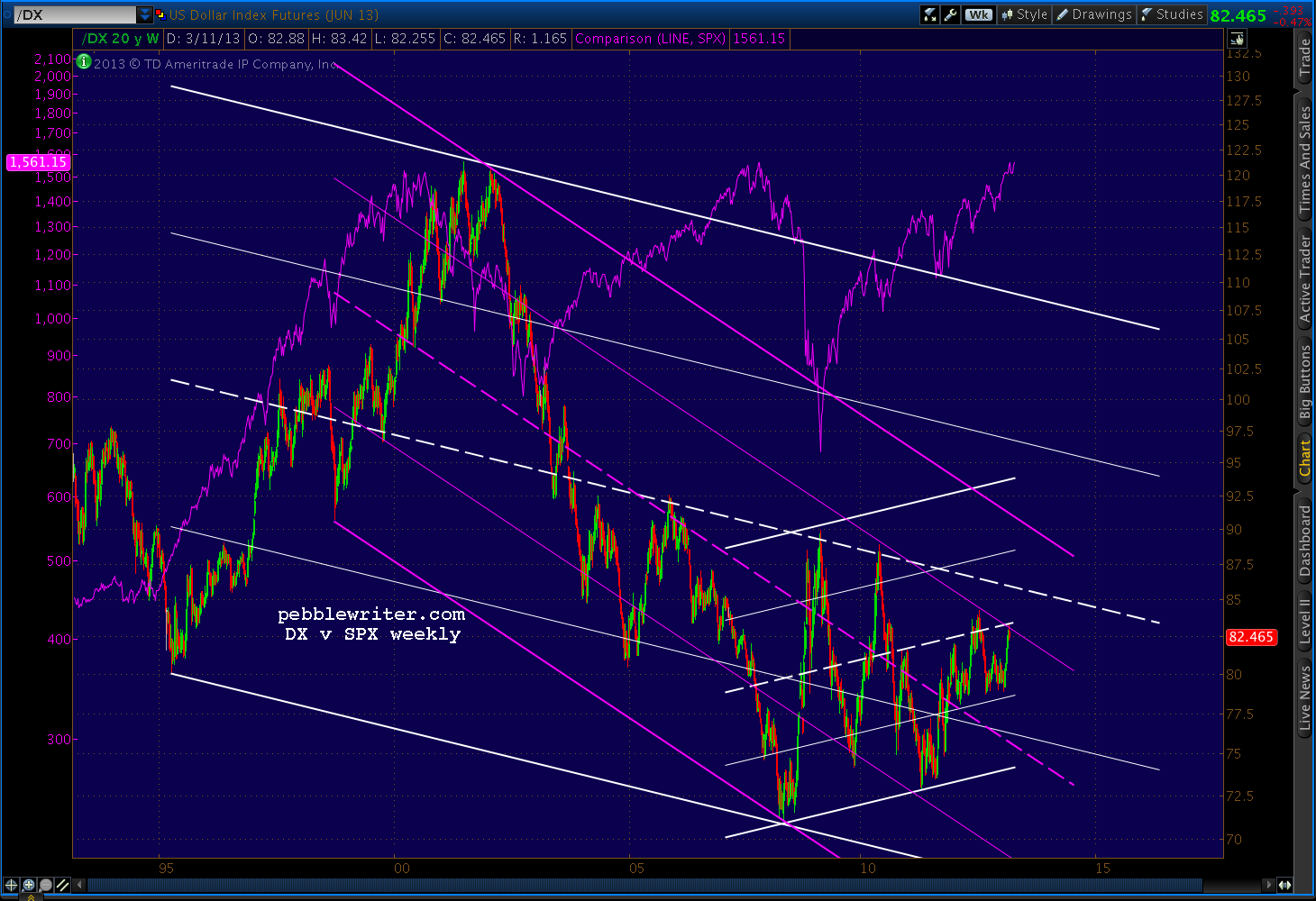
    But, it might not be all that difficult.  DX recently broke back above a trend line drawn from the Jan 2002 and Jun 2010 highs.  This TL looks fairly decent as a channel (yellow below), and reflects another breakout such as the one which occurred in Apr 2012.

    That DX channel breakout, of course, accompanied the SPX slide from 1422 to 1266.  It backtested nicely, then suddenly failed when the Fed announced QE3.  Prices fell back into the channel until the latest breakout in February.

    In keeping with the theme of sudden strong DX rallies being unhealthy for stocks, take a look at the Fibonacci Fan chart below.
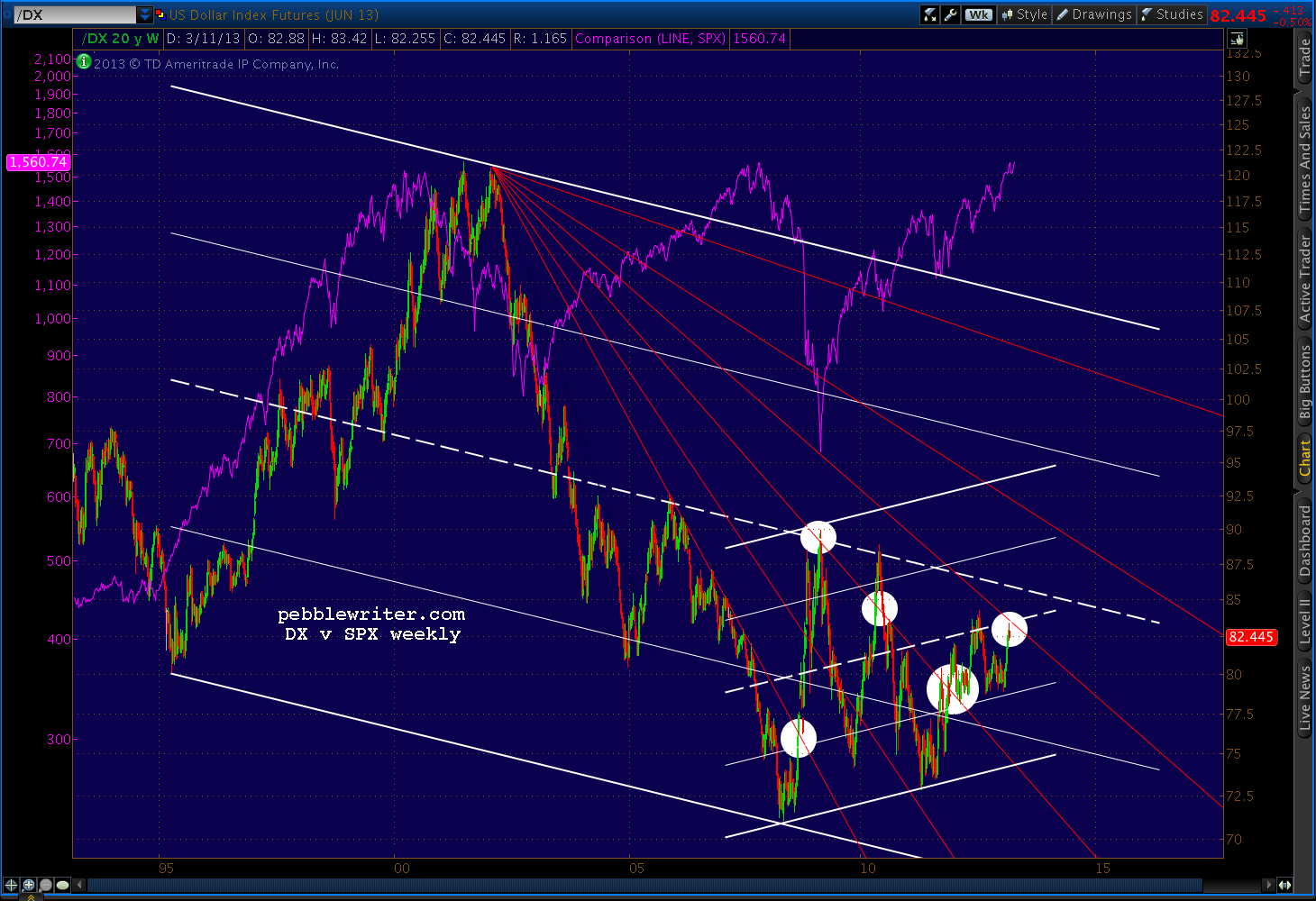
    Each time DX crossed one of those lines — even by just a little — SPX reacted.  DX has reached the latest line — the .707 — and is thus signalling either an equity breakout or breakdown depending on which way it goes.

    Weekly RSI mirrors the rising channel DX has been in since October 2007.  DX RSI recently broke out of the latest falling red channel and through the white channel midline.  After reacting against the purple .75 line, RSI is backtesting the white channel midline.

    If it’s more than a back test and RSI breaks back below the midline, this would confirm DX’s price reversal.  If, on the other hand, DX RSI survives the midline, it’s not hard to imagine a rally to the top of the purple channel or even the white channel .75.

    The daily RSI chart shows a similar situation.  RSI is finding support on the small white midline, the large white midline, and backtest of the red channel it just broke out of.

    A reversal here and a strong rally qualify would qualify as one of those sudden turns that isn’t terribly healthy for equities.

    I know, I know.  With eleventy zillion dollars being pumped into the markets every hour by Bernanke and friends, how in the Wide World of Sports could the dollar suddenly soar and the stock market flop?  The answer to that, of course, requires one more chart.

    I’ve marked some of the more obvious “sudden, strong rallies” in DX which, as discussed above, frequently coincide with sudden, strong declines in stocks.

    But, note how many of them occur as SPX is nearing one of its own channel lines drawn off the 2000 and 2007 tops.
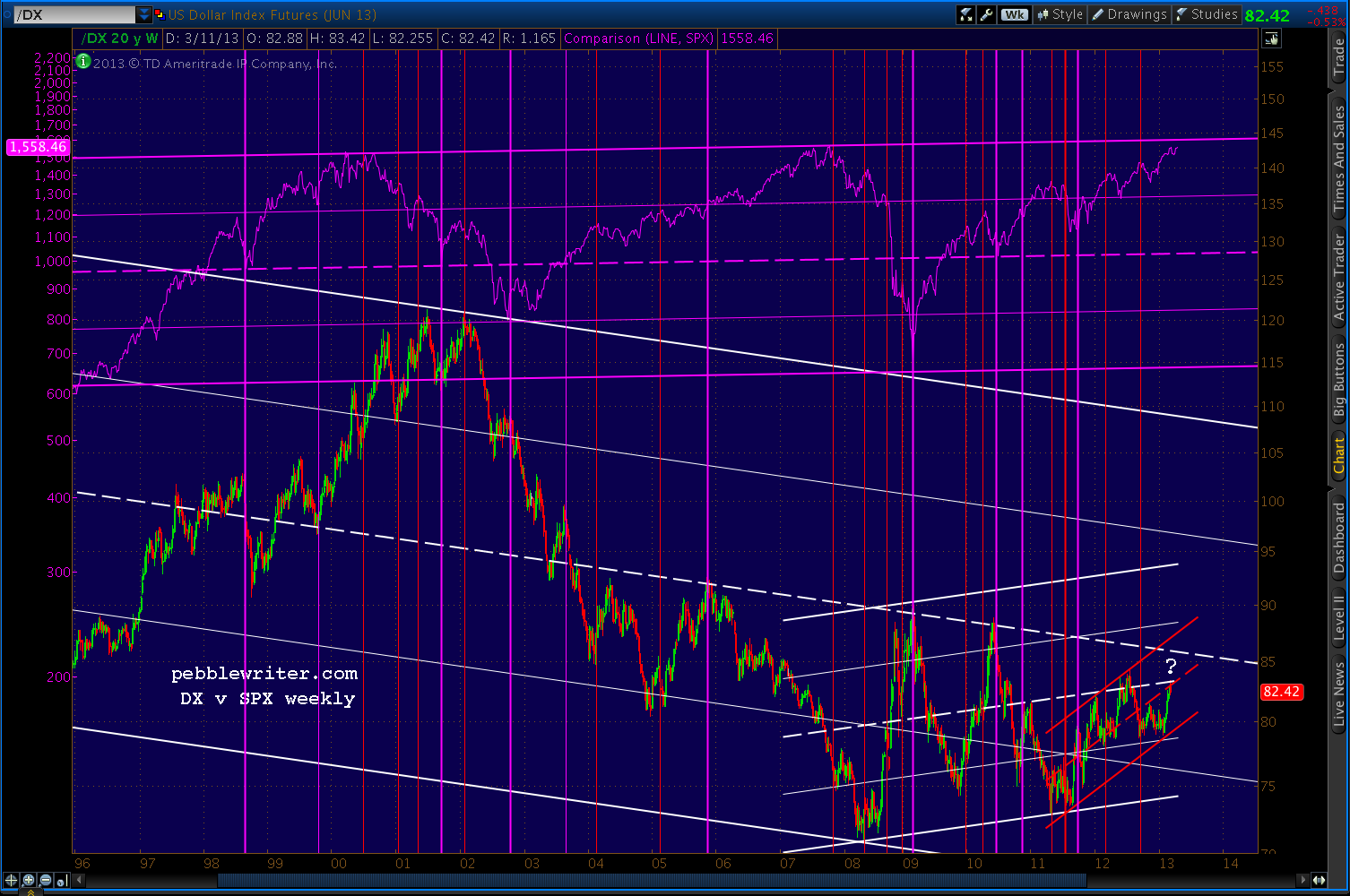
    We’ll get into that and other channels in the forecast coming up next. But, it’s fascinating that SPX is only a few points from a channel top dating back 13 years just as DX has arrived at the confluence of such important support and resistance lines.  For both, it truly is do or die time.

    I’ll continue with the forecast for members after a quick break.

    continued for members(more…)

  • Charts I’m Watching: Feb 1, 2013

    ORIGINAL POST:  9:15 AM

    E-mini futures are up big overnight, but have yet to exceed Wednesday’s high.

    A positive revision in BLS’s Nov and Dec employment numbers makes 2012 look better than it did, but I’m not sure how it helps today’s 12.3 million unemployed or 8 million underemployed or 2.4 million marginally attached…


    Markit Mfg PMI actually a little lower than Jan 24 flash numbers.

    Verdict: not chasing this ramp job unless it exceeds recent highs — which I don’t believe it will, at least not from this news.

    Remember, we have Reuters/U of Michigan Consumer Sentiment coming up at 9:55 and ISM’s Mfg Report on Business at 10:00.

    Watch the channel midline here…

    continued for members(more…)

  • When The Music Stops: Jan 31, 2013


    Lots more economic data out today.  Unemployment claims jumped 38,000 – much higher than expectations, but personal income also beat (thought to be explained by income shifting by those concerned about higher 2013 tax rates.)

    Real Consumer spending is probably the data set that best settles the conflict — up an anemic 0.2% in December (real) versus 0.6% in November.  So, either everyone did their Christmas shopping early this year, or retail sales fell off a cliff.

    Against this mixed picture, January Chicago PMI came out at 55.6 versus consensus of 50.5 and December’s 50.0 (revised down from 51.6.)  Employment and new orders shot up, but so did inventories (after contracting for several months).  While, deliveries, prices paid and backlogs continued to contract. In short, this looks like a rebound from the November slow down largely blamed on the fiscal cliff.

    Also, not that this is a regional, not national, survey.  It sometimes offers a somewhat, but not always, predictive view of the important national ISM Mfg Index due out tomorrow.  In fact, many of the other regional surveys have shown increasing weakness.  The Chicago vs the national data are compared below.

    The market sold off early following the employment data, but rebounded a bit as investors digest the PMI report.  All eyes are on the important data being released tomorrow:

    Markit Flash PMI (covering about 85% of respondents) released on Jan 24 showed an acceleration of output, new orders and employment, but a deceleration of export orders, backlogs  and purchases.  Output prices barely moved, and inventories actually increased.

    Remember, this is only a survey of purchasing managers.  So, it doesn’t, for instance, differentiate between an expansion based on overly optimistic expectations or one justified by an upturn in demand.  Thus, while it tracks mfg output (as reported by the Fed) in general, respondents’ perceptions are often more optimistic than was ultimately justified by actual outcomes.

    We’ll revisit the data tomorrow, but for now it has the appearance of series of lower highs and lower lows, i.e. a falling channel.

    There’s no telling what the economic data will look like tomorrow, let alone how the market will react.  But, it’s interesting that the last Flash PMI data, which was generally regarded as very positive, was good for an 8-pt rally on the opening (which was quickly negated for a flat close.)

    I’ll also be keeping an eye on construction spending, which has been trending down as shown in the Briefing.com charts below.  Spending on commercial construction has been increasing at a declining rate for some time, and recently began contracting.

    The rate of increase in residential construction also recently turned down, so it’ll be interesting to see if this is a trend in the making.

    The market has been relatively quiet this morning.  After reaching the lower end of our upside target range yesterday, SPX broke through the red trend line and the white channel midlines we discussed, back-testing the white channel as expected.

    Since then, it declined to test the next lower channel bound.  The pattern from here gets very interesting, especially when one considers the RSI channels.

     continued for members(more…)

  • Charts I’m Watching: Jan 29, 2013

    Currencies are relatively quiet this morning in the midst of a slew of earnings and economic data. The dollar looks like it could hit our downside target of 79.50 – 79.59 from Jan 25 [see: Update on DX] this morning if the yellow channel holds, but note that its midline intersects with the bottom of the white channel (support) just below current levels.

    EURUSD looks like a lock to tag the 1.618 at 1.3490 we’ve been tracking the past few days.

    This e-mini chart caught my eye this morning…

    With the overnight slide of 8 points, the e-minis give the impression of a broken channel and back test.   Now, it might be one of those dips from which we quickly recover as occurred on the 16th.  But, for those playing the intra-day moves, this bears watching.

    This ES channel equates to the small purple channel within the larger white one on SPX.  So, as yesterday, watch the channel midline for signs of something more significant.  It’s currently around 1498.30.

    The 15-min RSI should see a bounce at the red trend line if the trend is to remain on track.

    As we discussed yesterday, there is a great deal of economic data due out this week.  But, all pale in comparison to the FOMC announcements following their two-day meeting getting underway right about now.

    Last we heard, dissension was growing over how and when to throttle back on QE.  The language that alarmed the Dow 20,000 crowd:

    While almost all members thought that the asset purchase program begun in September had been effective and supportive of growth, they also generally saw that the benefits of ongoing purchases were uncertain and that the potential costs could rise as the size of the balance sheet increased. Various members stressed the importance of a continuing assessment of labor market developments and reviews of the program’s efficacy and costs at upcoming FOMC meetings. In considering the outlook for the labor market and the broader economy, a few members expressed the view that ongoing asset purchases would likely be warranted until about the end of 2013, while a few others emphasized the need for considerable policy accommodation but did not state a specific time frame or total for purchases. Several others thought that it would probably be appropriate to slow or to stop purchases well before the end of 2013, citing concerns about financial stability or the size of the balance sheet. One member viewed any additional purchases as unwarranted.

    Needless to say, an increase in hawkish rhetoric could really do a number on this rally.

    Odds are we’ll see another day like yesterday, with market makers shuckin’ and jivin’ to try and convince us a larger move is underway — the better to shake loose some of our hard-earned money.  But, I unless we see a huge miss on economic data or earnings, I don’t expect any fireworks until Bernanke steps up to the microphone (though much of the juicy stuff will have to wait for the minutes to be released.)

    UPDATE:  10:00 AM

    The Conference Board’s Consumer Confidence Index came in well below expectations: 58.6 vs expectations of 65 and Dec 2012’s 66.7.  Most of the rise in pessimism was the result of worsening job market conditions.  Those expecting more jobs in the months ahead dropped from 17.9% to 14.3%. Twenty-seven percent expect fewer jobs — unchanged from last month.  A full 22.9% (up from 19.1%) expect their incomes to decline.

    Briefing.com tracks the data and puts it in a nifty little chart (reflects data through December.)  There are a lot of potential interpretations here, but to me it comes down to “expectations coming back in line with reality.”

    And, though I don’t have the time to construct a chart, I’m pretty sure that expectations — the yellow line — have tagged the top of a descending broadening wedge (megaphone) while present conditions have formed a garden variety falling channel.  Both appear to be at or near their upper bounds, meaning a breakout or a fall is imminent.

    Global Economic Intersection posted an interesting article last month that showed the relationship between consumer confidence and past recessions.  Definitely worth a read for those who pay attention to such things.


    So far, the market is pretty much shaking it off, with a dip to the white channel midline the extent of the reaction.  If the midline holds yet again, there’s a good chance we’ll hit our upside target later today or tomorrow.

    continued for members(more…)

  • Trading with Harmonics

    The first of a two-part article on harmonics trading strategies.

    Part 1.  January 28, 2013

    Harmonics are a great source of information about the market, but they don’t tell you how or when to trade any more than do MACD crosses or breadth indicators.  So, how do you use them?  This discussion of the basic process might serve as a good starting place for beginners.

    I consider harmonics like trade alerts.  That is, every time we approach an important Fib level, I stop and consider whether the market is likely to react or not, then make a trade decision accordingly.

    There are pages for each specific pattern under the Learn>Harmonics tag on the Home Page.  But, they all relate to one another.  Let’s walk through a real world example.

    SPX has fallen from 1576 to 666 and seems to have bottomed (how to know it’s bottomed is the real trick.)  I draw a Fibonacci Retracement grid on the price range (100% for 1576, 0% for 666) and make sure every important level is showing as on the chart below.  For a discussion of Fibonacci levels, click here.


    ThinkorSwim makes this very easy with a built-in drawing tool, as do many other platforms.  If your platform doesn’t provide it, you might want to think about changing, or at least opening up a TOS account to facilitate your charting (and, no, they don’t pay me to say that.)  You can read about harmonics and study the charts I post, but there’s no substitute for doing your own charting.

    Back to our example: because we went long at the very bottom, we set our sights on the higher Fib levels.   All harmonic patterns are marked using the letters X, A, B, C and D.The inception point (high) is X, the low is A.  B is the first reversal, C is the next, and D is the completion. The location of the reversals relative to specific Fib levels tells us what kind of pattern we probably have.

    Suppose we’ve watched SPX climb all the way up to 956, where there’s a 9% correction down to 869.  Because this reversal occurred below the .618 Fib level, we might have a Bat Pattern on our hands.  Bat Patterns complete at the .886 (1472) so we’ll make a note of that for future purposes and consider 956 a potential Point B.

    We sail right through the .382 and .500 levels, then experience another 9% correction at just above the .500 (1150 to 1044.)  Again, it’s below .618, so it could be signalling a Bat Pattern.  But, it’s a relatively minor reaction, so we treat it as only a potential Point B.

    Now we’re approaching the .618 at 1228.74 — the most important of the Fib levels.  Because the two prior reversals were pretty tame, we might suspect more from this one. We begin to contemplate a short position, and look for other signs of a reversal.

    Because we’ve been watching closely, we notice a smaller Crab Pattern setting up as we approach the .618 (the purple pattern below.)  It features a Point D at 1215.93 — slightly below our .618 at 1228.74.  So, we feel pretty confident about this being a good trade entry.

    Are there other chart patterns such as a rising wedge, channel, fan line, etc. that also hint at a reversal?  In fact, there’s a nice channel that’s formed over the past 9 months, not to mention a broken RSI channel (in red) just shy of the Crab completion.  And, we’re nearing the 1240 target of the Inverted Head & Shoulders pattern completed at the 2009 bottom.

    These would all be good reasons to consider a short.  Taken together, they make for a pretty compelling argument.  Where, though?  Other traders are watching the same charts we are, so there’s a chance the reversal will come a little early.  We don’t wait to wait too long and miss the top.  But, of course, every point too early is a point of lost profit.

    In the end, timing is a judgement call based on many factors, including liquidity, risk tolerance, the type of instruments we’re trading, other positions in the portfolio, etc. and is worthy of its own article.

    Let’s assume we make the decision to open a short position around 1213 on the April 15 — in case SPX doesn’t make it all the way to 1215 or 1228.  We feel pretty good about our decision when SPX is down to 1186 the following day and 1183 the next.  That’s a 2.5% move in two days — not bad.

    On the third day, however, our plan is looking iffy.  SPX gaps up on the open and hits 1208.  Three days later, it pops above the Crab target of 1215.93 and tags 1217, seemingly in search of the .618 at 1228.74.

    Suddenly, we’re underwater by 15 points or 1.25%.  Is it time to bail?  Again, it depends on the type of investor you are.  Options traders might have closed their puts for large profits already, while swing traders might be happy as long as SPX doesn’t exceed 1230-1235.  Buy and hold types might have used the Fib level as a warning of a potential downturn and hedged or lightened up on their long positions.

    Checking our charts, we can see that neither the price nor the RSI channels have been broken to the upside.  In fact, the little red RSI channel which helped convince us of the downside potential shows the latest push higher came with a lower RSI score (negative divergence) and a pretty pathetic back test.  So, we’re inclined to hang in there.

    It turns out to be a great decision.  The following day, RSI plunges through the midline of the purple channel.  SPX plunges 38 points from its high, stabilizes for four days, then really starts falling apart.  On May 4, SPX reaches the white channel midline, a possible bounce spot.  We’ve already made 4.5% since shorting at 1213 less than 3 weeks ago.  Time to bolt?

    To be continued…

  • AAPL: Flirting with Disaster

    Not since the summer of 1666, as young Zack Newton sat pondering gravity, has so much attention been paid to a falling apple.

    Should we care about AAPL’s deteriorating powers of levitation?  The $200/share drop since its September highs, especially on the heels of a new dividend and share buyback program, has been unnerving.  But, if you invest based on fundamentals, it’s a solid company selling at 11 times earnings and a 62% 5-year CAGR — which happens to be on sale.

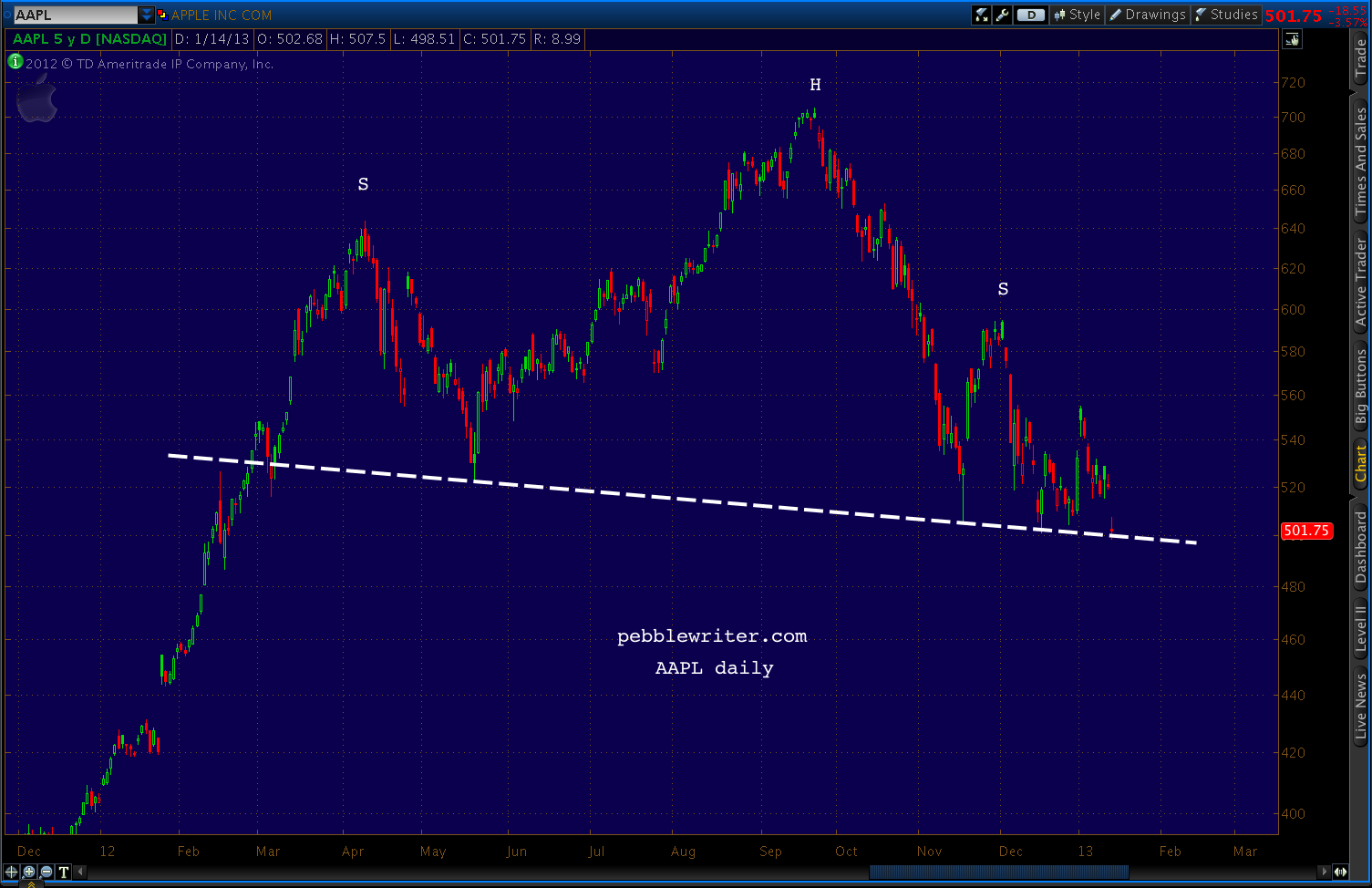
    If you pay attention to chart patterns, however, AAPL is flirting with disaster.  It’s a mere point or two from completing a Head & Shoulders pattern that targets the low 300’s. [To read about how H&S patterns work, click HERE.]

    Even if you don’t give a darn about chart patterns, know that many other investors do.  The four tags of the white trend line (the neckline) in the past month are ample proof.  So are the many previously completed patterns that weighed on AAPL.

    In January 2008, AAPL completed a H&S pattern that saw share prices drop from 200 to 115 in a few short weeks.

    Buyers at 115 were rewarded with a rebound to 190, then punished by a plunge to 78 as the rebound completed a right shoulder in a much larger H&S pattern.

    Not every pattern plays out, of course.  Consider the pattern below — a well-formed pattern that targeted much lower prices.

    Instead of a big drop off, AAPL found channel support before much damage was done.  Prices rebounded to new highs where they formed a new pattern (in white) which did play out.

    Like any other chart pattern, H&S patterns don’t occur in a vacuum.  Channels and harmonics often influence the ultimate outcome.

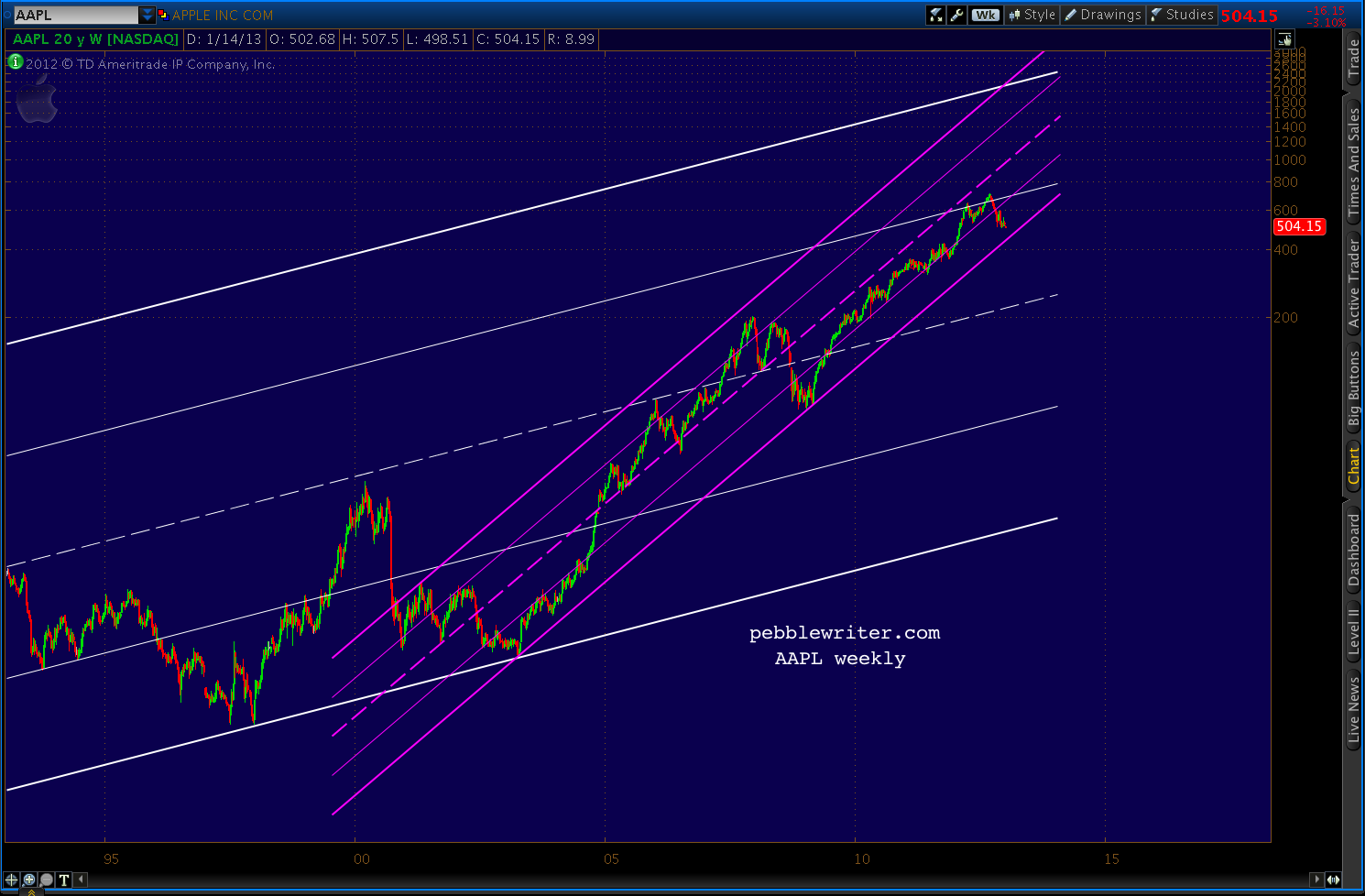
    The channel that saved the day in 1995 is still with us, though it most recently offered resistance to higher prices instead of a floor.  It’s the white channel in the chart below.

    The much smaller, steeply rising purple channel, on the other hand, has kept prices rising — putting AAPL back on track after two significant sell-offs.  It’s currently around 445 — within a few points of the Crab Pattern 1.618 extension of the failed mid-November rally.

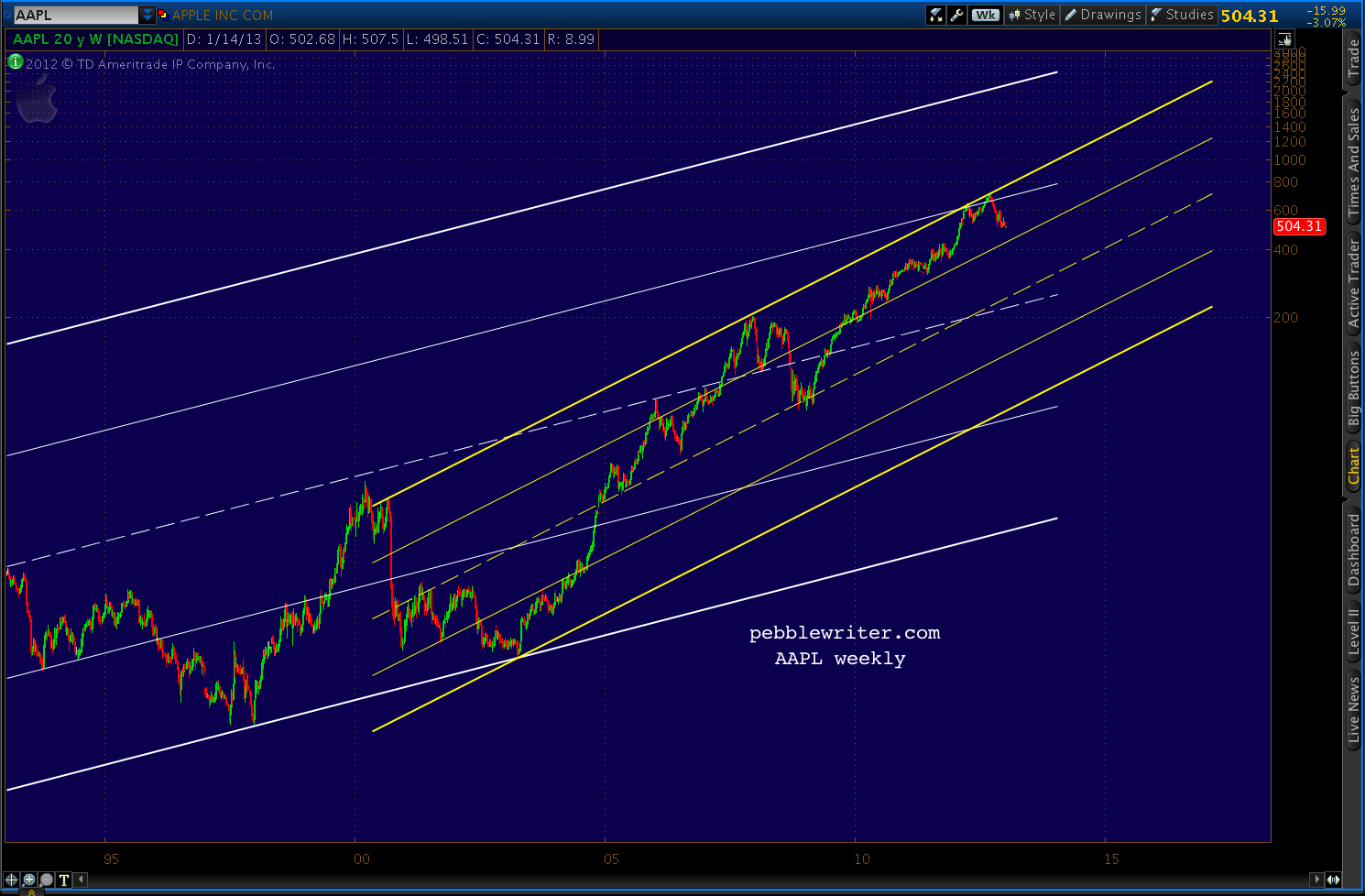
    If the current H&S pattern plays out and AAPL drops below the purple channel support, there’s another, less bullish channel that could come into play — seen in yellow below.

    The next lower channel line is in the vicinity of the purple line referenced above: 430 or so.  But, if gravity takes hold, mid-line support doesn’t show up until around 300.  Ouch.

    There are a dozen or more other patterns that could easily influence AAPL’s future (consider, for instance, the grey channel I’ve sketched in — the mid-line of which marked this morning’s lows.)  There are also many fundamental events that could strengthen the price.

    The company’s current share buyback scheme, for instance, is only $10 billion — about the average daily volume at $500/share.  But, with $120 billion in cash on the books and virtually no debt, the company could easily expand it to a more meaningful level.

    If this most widely held stock were to crash, could the rest of the market be far behind?  I think there’s little question it would. Such an outcome would spell disaster for the bullish story line that TPTB have been working so diligently to construct.

    Might they join company insiders in supporting the stock here at 500?  It would be a lot cheaper than another round of QE and, in the end, probably more effective.

    Stay tuned.

    UPDATE:  1:00 PM

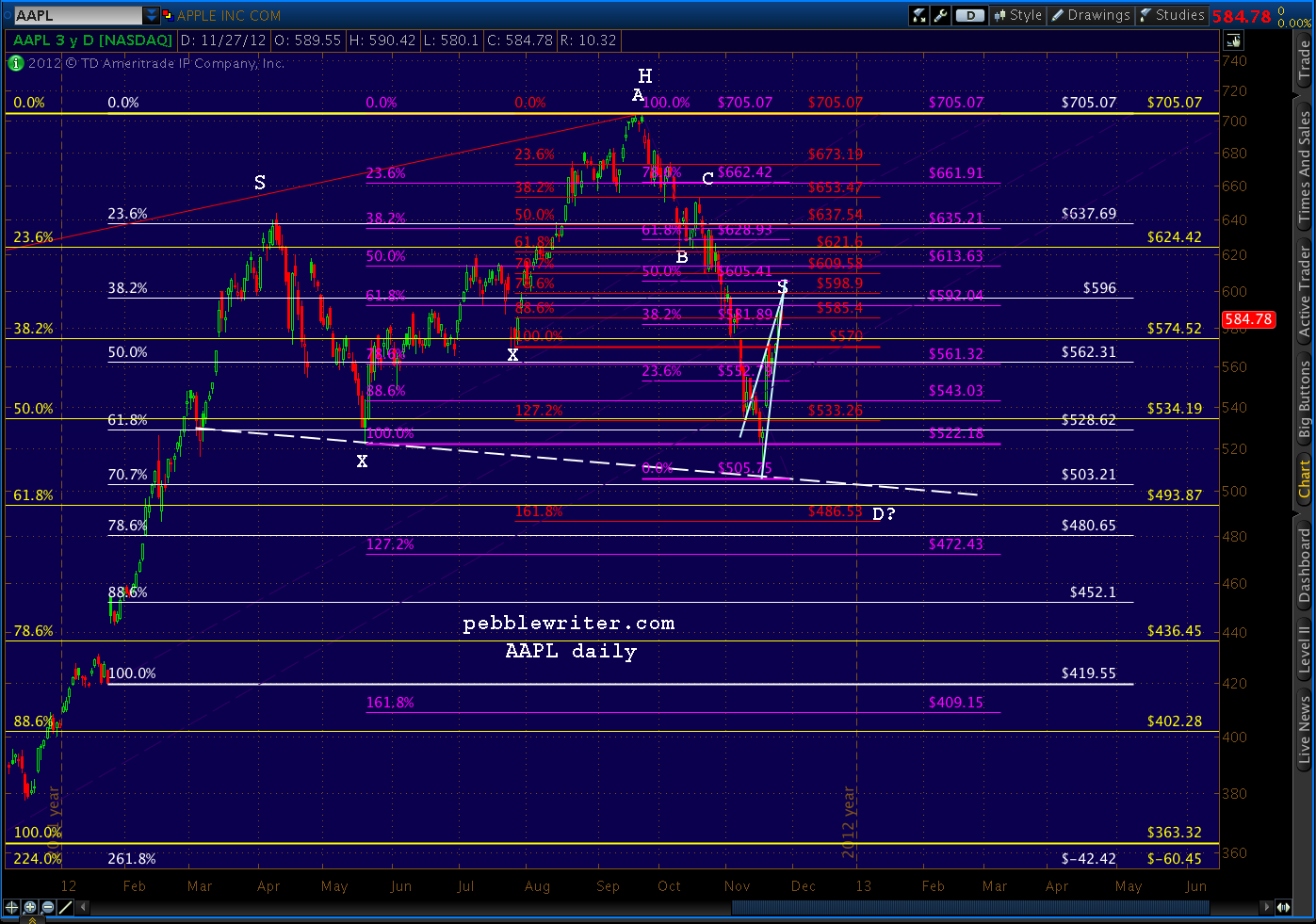
    This morning, AAPL reached the downside targets we identified back on November 27 [see: Update on AAPL: Nov 27, 2012.]   My thoughts at the time were that AAPL (then at 590) was about to reverse and retreat to the 500 area where we were likely to get a bounce before breaking down to 472-493, with 486 being the sweet spot.

    Here’s the chart I posted back then, showing 486 as the (Crab Pattern) 1.618 extension of the 570 – 705 rally between July and September.

    AAPL did, in fact, reverse at 594 a few sessions later — forming a now-obvious right shoulder.  It bounced not once but twice at 500ish before completing the Crab Pattern this morning.

    The chart below shows the actual price moves overlaid on that Nov 27 forecast.

    With this morning’s plunge, AAPL also tagged the .618 of the 354 – 705 rally (from the Oct 4, 2011 low) and the 1.272 of the small Butterfly pattern discussed above.  The fact that it did so without a comparable sell-off in the general markets is potentially significant.

    I certainly won’t discount the possibility of a bounce off the 1.272.  But, a close below 500 does significant damage to the upside case.

    continued for members(more…)

  • Moment of Truth

    SPX has been tracing out a channel over the past several months, but its RSI has clearly formed a rising wedge.  The divergence begs the question: “which will prevail?”

    Regular readers know I’m a fool for chart patterns in general and RSI chart patterns in particular.   But, that’s a solid channel that’s withstood some pretty nasty headlines.  And, as we’ll see below, it is exactly parallel to the channel that guided the Dec 2011 to May 2012 ramp.  We’ll see if we can find some corroborating evidence to guide our forecast.

    continued… (more…)

  • The Waiting Game: July 31, 2012

    ORIGINAL POST:  11:30 AM

    SPX might be tracing out either a flag or pennant pattern on the 15-min chart.  While either could portend higher prices (2/3 of the time), a flag would mean lower prices first — probably down into the mid 1370s.


    At first blush, the market seems to be respecting the last high of 1380.39 on July 19.  I suppose it makes for a more positive wave structure.

    But, I suspect the bigger worry for bulls is the Fib .786 at 1381.50 (in yellow).  This retracement from the 1576 to 666 plunge (Oct 2007 – Mar 2009) was only recently exceeded again, and a real, live bull market shouldn’t have any difficulty retaking and defending it.  Here’s the big picture, again:

    continued… (more…)

  • The VIX is In

    Earlier today [see: Close but no Cigarro], I opined as to how SPX wasn’t done back testing its IH&S because — among other reasons — VIX hadn’t even reached, let alone reacted off our target of 18.31 (the solid red line.)

    Never mind the “reached” part.  VIX nailed our June 12 forecast right at the close.  I don’t know about you, but I get all tingly inside when a 22% move comes in right on target like that.

    We’ve hit three bulls eyes in a row with VIX — including the interim top on April 10 [see: Bottom Fishing], calling the June 4 high of 27.12 back on April 18  [see: VIX at a Crossroads]  and, now this.  The fourth will be a little trickier.

    continued…

    (more…)