Tag: harmonics

  • Should We “Like” Facebook?

    The last time I posted about FB was October 24 [see: CIW Oct 24, 2012], when I happened to hear Donald Trump repeatedly mention the stock as he was being interviewed about something else all together.

    BTW, interesting chart on Facebook.  I knew something was up when I heard Donald Trump touting the stock on the radio.

    He…still managed to mention the large position he’d been buying about 5-6 times.  More likely he was going for the ol’ pump and dump.

    It’s hard to escape the power of channels.

    The channel in question had been stretched to the limit by the gap up from 19.5 to that day’s 24.5 high and looked like this:

    The channel de-friended FB, smacking it back down to below 19 within the next two weeks.  But, since then, the amazingly positive stock market to the moon has taken hold, trumping that falling channel.   The stock has retraced about half the losses since its 45 high (the white Fib levels below.)

    Unfortunately, it’s also traced out a Rising Wedge — not to mention a Bat Pattern from its June highs (the purple Fibs above.)  As such, it is likely to weaken considerably here — with a drop to at least the bottom of the rising wedge — currently at 27.75 or so.

    Judging from the charts, though, I’d say FB is a good candidate for a breakdown of its Rising Wedge.  Often, this results in a new channel that features a lower bound parallel to the upper bound of the wedge.

    The mid-line of the proposed channel is at 27 (a 10% drop from current prices), and the bottom is way down at 22.75.  The good news is that the channel is obviously rising, so these potential targets are also on the rise.

    The bad news, however, is that the charts indicate the trend may well have changed and the downturn could be more significant than just 10%.  4-hr MACD just crossed over yesterday (60-min is already negative.)

    And, the rising daily RSI channel is probably yielding to a falling channel — signalling a trend change to go with the obvious negative divergence.  Though, we won’t know for sure until RSI reaches the bottom of the white channel.

    Bottom line, the road ahead should be very bumpy.

    Stay tuned.

  • AAPL: Flirting with Disaster

    Not since the summer of 1666, as young Zack Newton sat pondering gravity, has so much attention been paid to a falling apple.

    Should we care about AAPL’s deteriorating powers of levitation?  The $200/share drop since its September highs, especially on the heels of a new dividend and share buyback program, has been unnerving.  But, if you invest based on fundamentals, it’s a solid company selling at 11 times earnings and a 62% 5-year CAGR — which happens to be on sale.

    If you pay attention to chart patterns, however, AAPL is flirting with disaster.  It’s a mere point or two from completing a Head & Shoulders pattern that targets the low 300’s. [To read about how H&S patterns work, click HERE.]
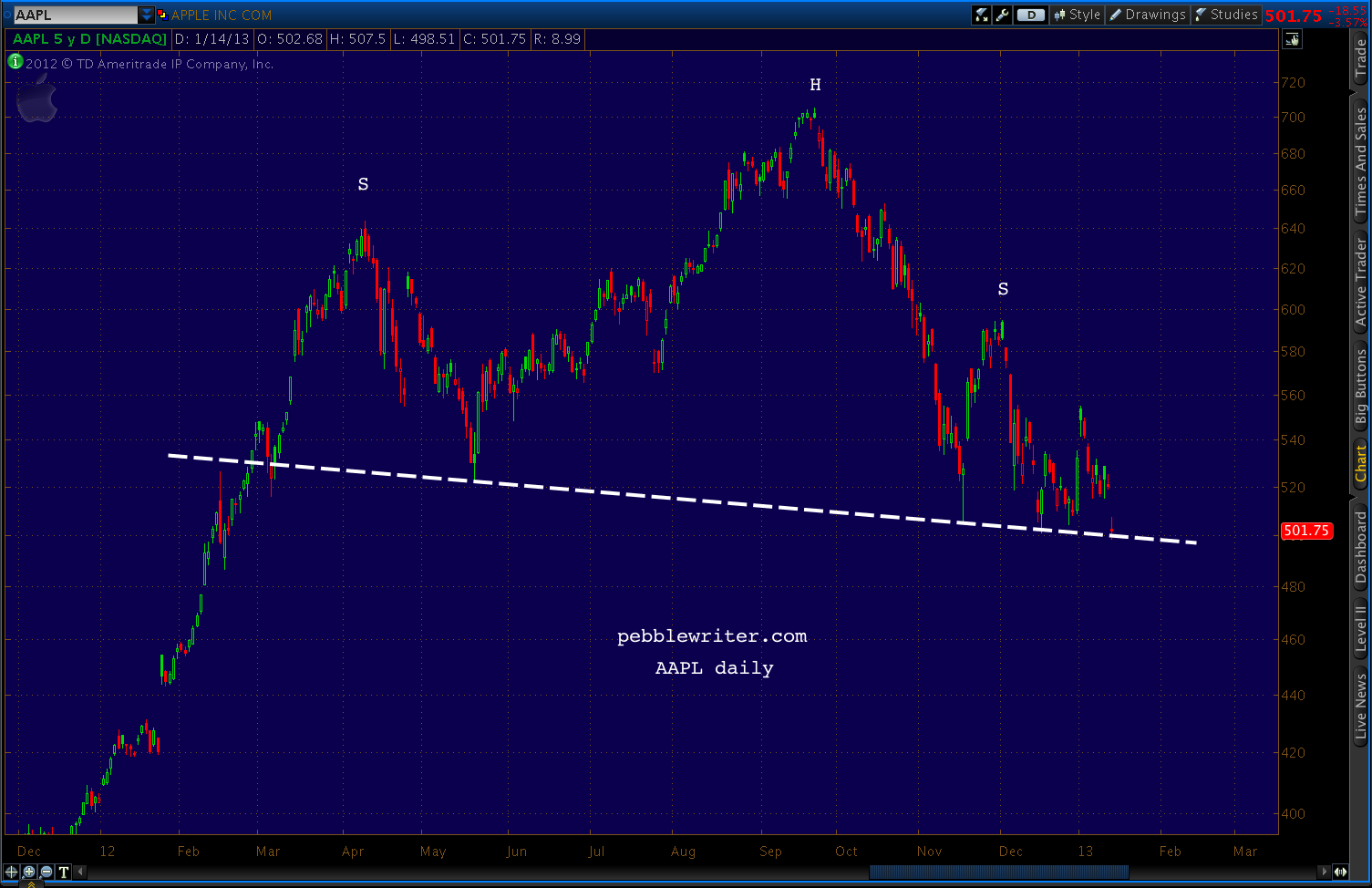
    Even if you don’t give a darn about chart patterns, know that many other investors do.  The four tags of the white trend line (the neckline) in the past month are ample proof.  So are the many previously completed patterns that weighed on AAPL.

    In January 2008, AAPL completed a H&S pattern that saw share prices drop from 200 to 115 in a few short weeks.

    Buyers at 115 were rewarded with a rebound to 190, then punished by a plunge to 78 as the rebound completed a right shoulder in a much larger H&S pattern.

    Not every pattern plays out, of course.  Consider the pattern below — a well-formed pattern that targeted much lower prices.

    Instead of a big drop off, AAPL found channel support before much damage was done.  Prices rebounded to new highs where they formed a new pattern (in white) which did play out.

    Like any other chart pattern, H&S patterns don’t occur in a vacuum.  Channels and harmonics often influence the ultimate outcome.

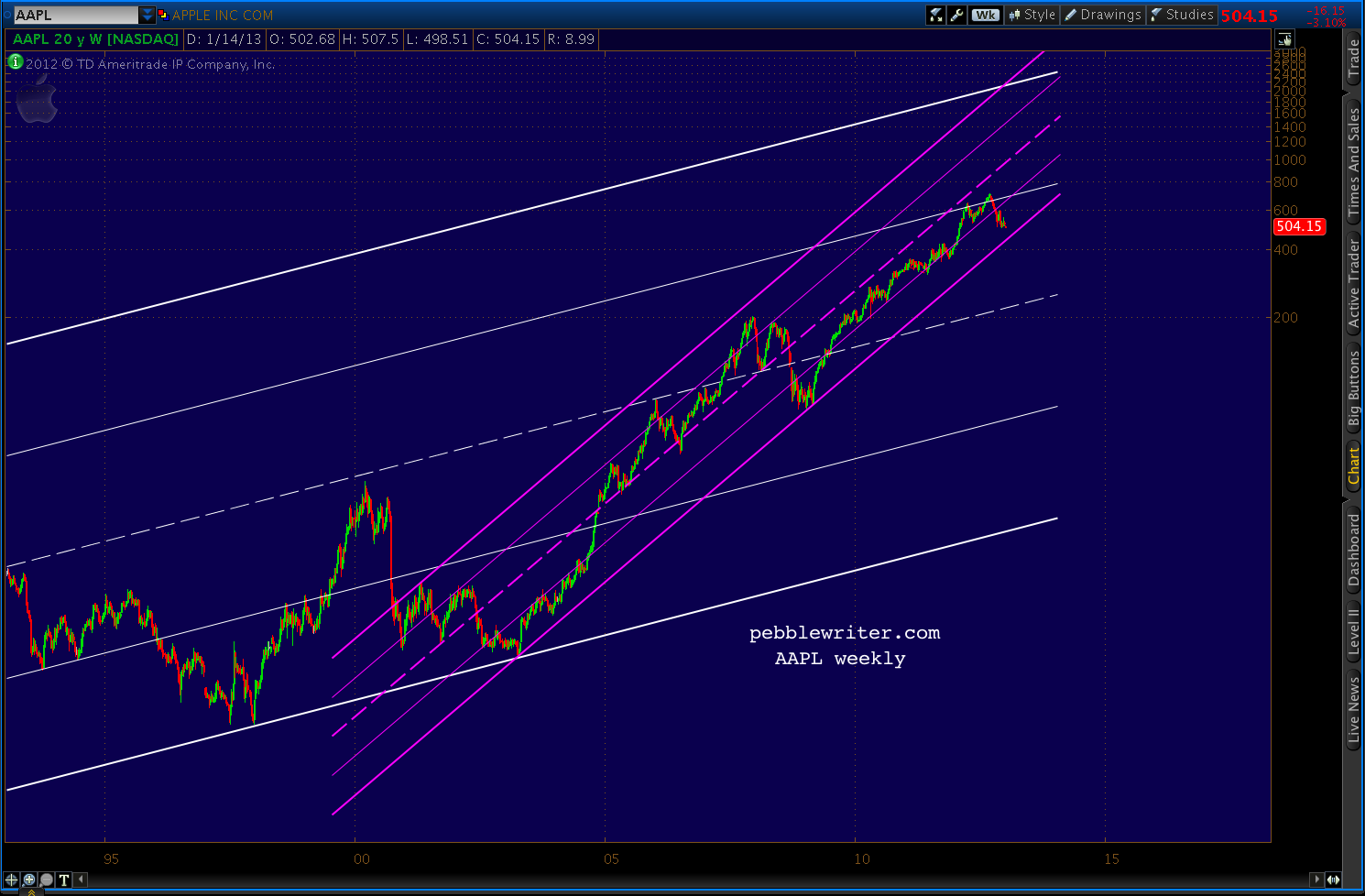
    The channel that saved the day in 1995 is still with us, though it most recently offered resistance to higher prices instead of a floor.  It’s the white channel in the chart below.

    The much smaller, steeply rising purple channel, on the other hand, has kept prices rising — putting AAPL back on track after two significant sell-offs.  It’s currently around 445 — within a few points of the Crab Pattern 1.618 extension of the failed mid-November rally.
    If the current H&S pattern plays out and AAPL drops below the purple channel support, there’s another, less bullish channel that could come into play — seen in yellow below.
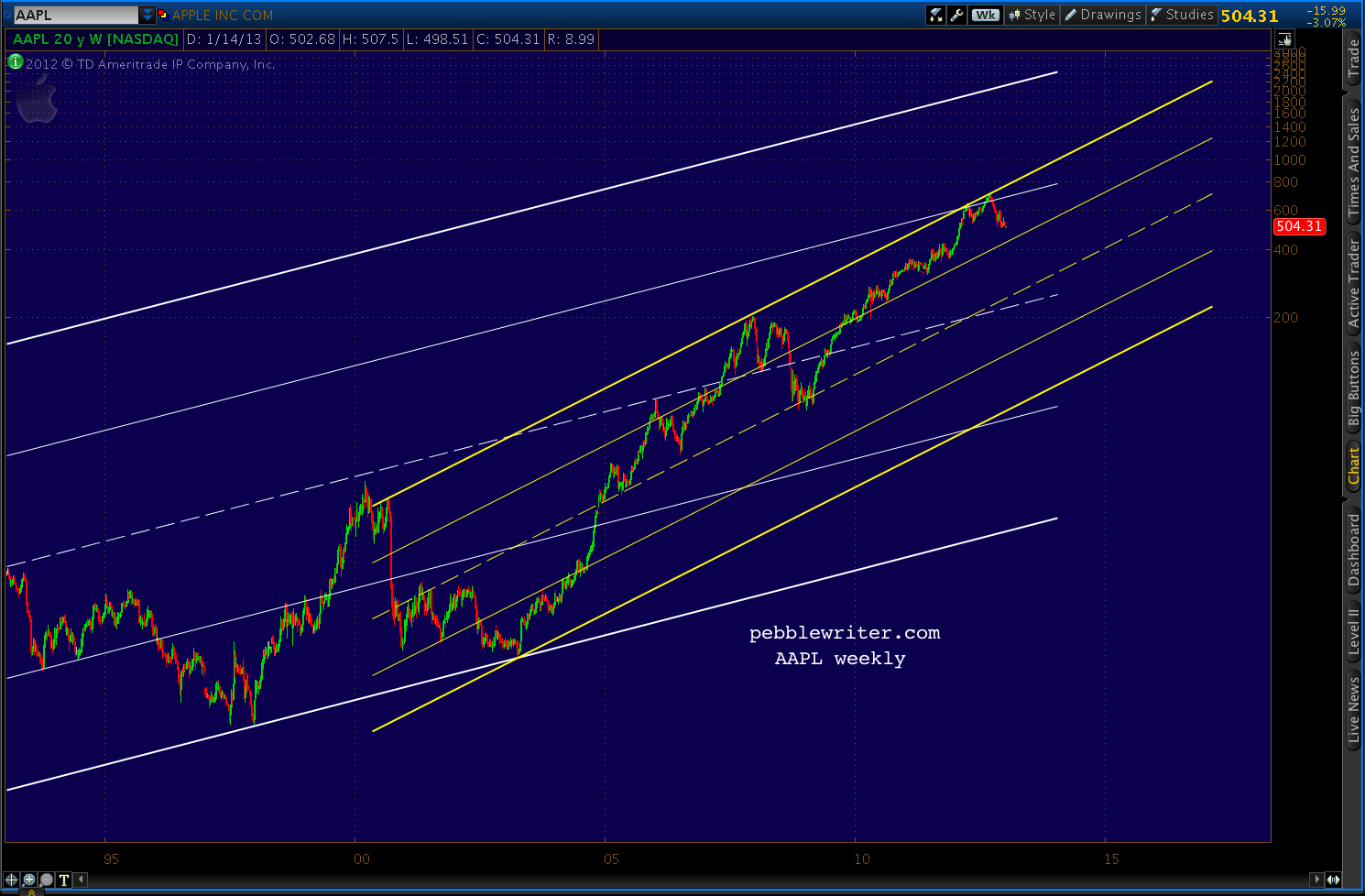
    The next lower channel line is in the vicinity of the purple line referenced above: 430 or so.  But, if gravity takes hold, mid-line support doesn’t show up until around 300.  Ouch.

    There are a dozen or more other patterns that could easily influence AAPL’s future (consider, for instance, the grey channel I’ve sketched in — the mid-line of which marked this morning’s lows.)  There are also many fundamental events that could strengthen the price.

    The company’s current share buyback scheme, for instance, is only $10 billion — about the average daily volume at $500/share.  But, with $120 billion in cash on the books and virtually no debt, the company could easily expand it to a more meaningful level.

    If this most widely held stock were to crash, could the rest of the market be far behind?  I think there’s little question it would. Such an outcome would spell disaster for the bullish story line that TPTB have been working so diligently to construct.

    Might they join company insiders in supporting the stock here at 500?  It would be a lot cheaper than another round of QE and, in the end, probably more effective.

    Stay tuned.

    UPDATE:  1:00 PM

    This morning, AAPL reached the downside targets we identified back on November 27 [see: Update on AAPL: Nov 27, 2012.]   My thoughts at the time were that AAPL (then at 590) was about to reverse and retreat to the 500 area where we were likely to get a bounce before breaking down to 472-493, with 486 being the sweet spot.

    Here’s the chart I posted back then, showing 486 as the (Crab Pattern) 1.618 extension of the 570 – 705 rally between July and September.
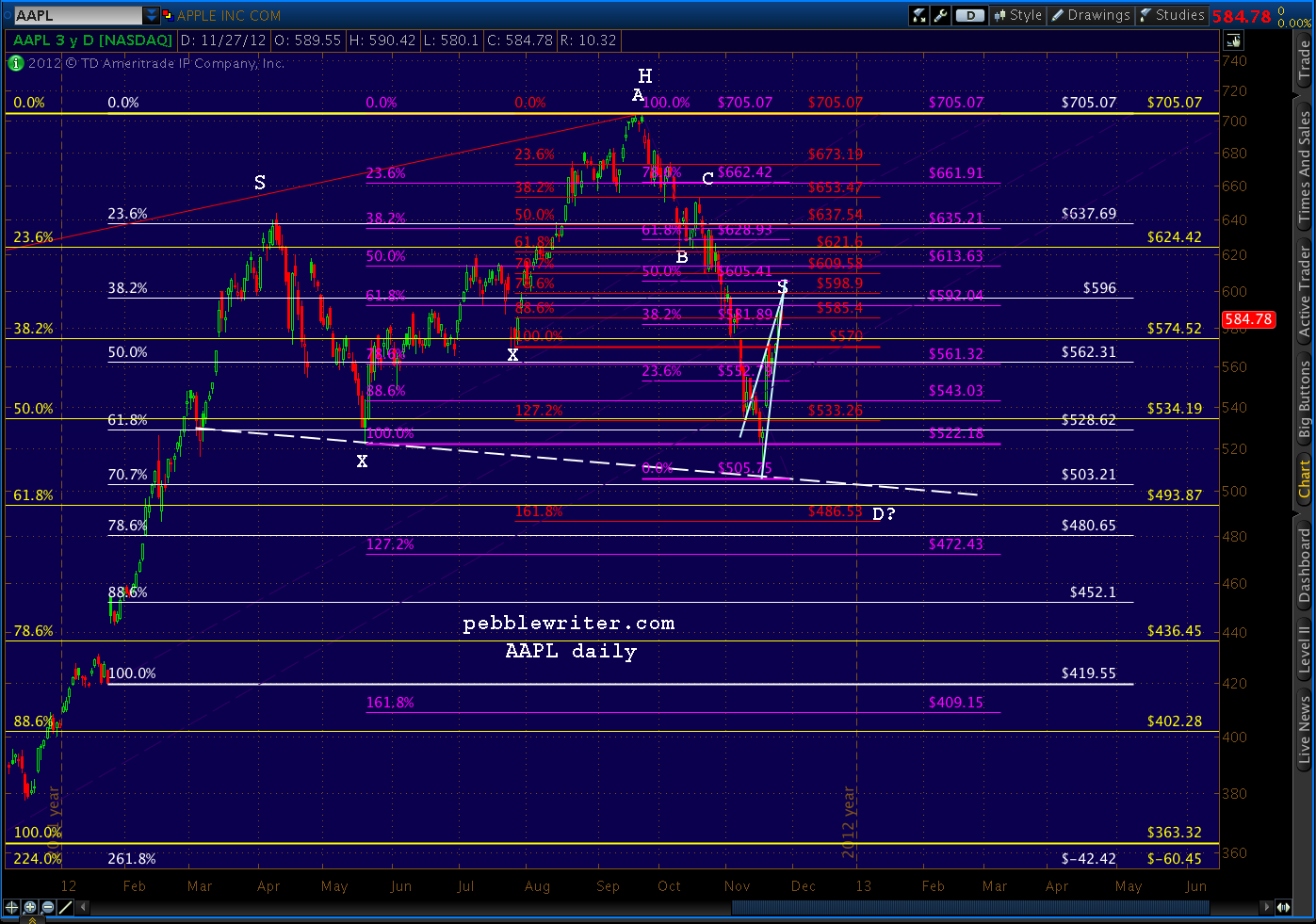
    AAPL did, in fact, reverse at 594 a few sessions later — forming a now-obvious right shoulder.  It bounced not once but twice at 500ish before completing the Crab Pattern this morning.

    The chart below shows the actual price moves overlaid on that Nov 27 forecast.

    With this morning’s plunge, AAPL also tagged the .618 of the 354 – 705 rally (from the Oct 4, 2011 low) and the 1.272 of the small Butterfly pattern discussed above.  The fact that it did so without a comparable sell-off in the general markets is potentially significant.

    I certainly won’t discount the possibility of a bounce off the 1.272.  But, a close below 500 does significant damage to the upside case.

    continued for members(more…)

  • Charts I’m Watching: Jan 14, 2013

    ORIGINAL POST:

    The dollar is making a stand at the upper end of the target range I charted Friday, but hasn’t yet broken out of the steep falling channel.  While there was a turn at the .618 Fib that would justify a .786 completion (a Gartley), the more obvious Point B was at the .382.

    In a perfect world, this would signal DX has further downside potential to the .886 for a Bat Pattern completion — though, obviously, not every corrective wave has to be a harmonic pattern.

    The EURUSD similarly reached a common turning point at the 1.272 extension of the latest move down from Dec 19 (or Jan 2, take your pick.)

    But, as can be seen, the rally from last week features no potential Point B whatsoever.   It’s hard to call this a Butterfly Pattern in the absence of an actual pattern.

    Furthermore, the tails on the daily candles offer an even more aggressive upper bound for the rising wedge we’ve been charting for the past several weeks.

    Equities are pointing to a soft opening, but nowhere near what one would normally expect with horrid AAPL news on the tape — much less the approaching budget showdown.

    Regular readers are well aware of the importance of the 500 price level for AAPL.  As we’ve discussed many times, the completion of the H&S pattern could have dire consequences for AAPL and the entire market.

    continued for members(more…)

  • Down the Rabbit Hole: Part 2

    Alice laughed: “There’s no use trying,” she said; “one can’t believe impossible things.”   “I daresay you haven’t had much practice,” said the Queen. “When I was younger, I always did it for half an hour a day. Why, sometimes I’ve believed as many as six impossible things before breakfast.”
                                        ― Lewis Carroll, Alice’s Adventures in Wonderland


    The market never ceases to amaze me.  Despite all the ingredients being in place for a sizable correction, it’s sailing along as though everything were copacetic.

    Negative divergence abounds.  The correlated currencies are all selling off.  Gold is down.  Silver is down.  Even AAPL is down. Numerous indices have completed bearish Harmonic or Chart Patterns.

    The Fed let slip yesterday that the adrenaline drip will soon be removed — leaving banks without a buyer for their underwater mortgages and the stock market without any downside protection.  They’ve finally admitted what we’ve all known for some time: QE’s effect is diminishing, and the risk is growing.

    The budget showdown is still ahead (the part of the fiscal cliff that really matters.)   The most fractured Congress in modern history, which utterly failed to resolve the important issues, will now turn the task over to an arguably more partisan Congress.

    The country’s AAA credit rating is hanging by a thread at both Moody’s and Fitch.  A downgrade by either would require massive selling by institutions which require at least two AAA ratings in order to comply with their investment policies (especially insurance companies.)

    Unemployment has reportedly declined, but only because we no longer count the dejected job seekers who are leaving the work force in droves.  Include them, and the actual picture is startlingly bleak. (source: Shadowstats.com)

    The EU is officially back in a recession (though it never really left.)  Its banks are being kept afloat by the ECB/ESM, which is exchanging (somehow AAA) paper backed by shaky sovereigns for junk sovereign debt as fast as it can.  Meanwhile, unemployment continues to soar.


    The big 2013 headline that isn’t (yet) is the global derivatives debacle:  $700 trillion — over 10 times the global economy — of unregulated, unpriced, unreported private contracts which have been sliced and diced so many times that no one has the slightest notion what the risk really is — except that it dwarfs the capital of the banks that hold it.

    In my opinion, the only things keeping the economy and the market afloat are the unrelenting screech of MSM fairy-tale “good news” and the Bernanke Put (the Fed’s money printing and plunge protection operations.)

    As long as these two factors can outweigh the negative fundamental picture, the market stands a good chance of rising.  Take one of them away, and the resulting crash will be swift and severe.

    That said, I’ve spent the past two days assessing the current state of our analog and forecast.  I’ve quantified it as best I can in an attempt to eliminate my admittedly negative bias.  I’ll lay it out over the next several hours, a few charts at a time.

    If you’d rather skip to the punchline, I’m still bearish.  In the absence of a push through 1474, I think we’re in for a sizable correction and remain short from 1462.  If 1474 is broken, everything changes.

    For members who enjoy getting their fingers dirty, stay tuned.

    *  *  *  *  *  *  *  *

    About an hour ago, we completed a Bat Pattern which is nestled inside of a Bat Pattern which is nestled inside of a Bat Pattern.


    UPDATE:  3:15 PM

    RSI channels show how much is riding on this moment.  A push through the top of the purple channel brings the red channel mid-line into play.  Could it correlate with 1474, or maybe just the next channel line on the intra-day?

    I’m not sure.  The intra-day 1.272 is 1468.17 and the 1.618 is 1471.61.  A double-top would be a real nut-buster.

    All I know is there’s still negative divergence across the board, so I don’t expect the red mid-line to be broken.

    My apologies for the delay in getting the forecast charts up.  They’ll have to wait until after the close.  I’ve been distracted by the melt-up, checking and re-checking my charts to see what I might be missing.

    continued for members(more…)

  • EURUSD Update: Jan 4, 2013

    EURUSD is approaching the critical bottom of a large rising wedge, after having maxed out at the .618 time Fib and .886 price Fib.

    Daily RSI indicates a break down of the wedge.  But, watch out for the mid-line of the forming white price channel.  It could put a floor under the pair’s decline around the .886 of the red grid.

  • USDJPY Update: Jan 4, 2013

    USDJPY reached the first of our two target areas [see: USDJPY Update.]  Back on Dec 18, we noted an upcoming channel midline that, if broken, could see a breakout to the trio of Fib levels represented by the first shaded rectangle.

    We got that channel break and tagged the target area.  The Japanese central planners have vowed to cheapen the Yen until the 牛 come home.  But, the charts indicate it’s time for a breather (while markets sell off.)

    Aside from those Fib levels, there’s a channel mid-line (white) and a channel upper bound (red) to contend with.

    And, the daily and weekly RSI’s show the pair is due for a significant reversal.  Daily RSI has run all the way into the apex of a rising wedge and has reached the second highest level in the past 20 years.

    Weekly RSI, at the highest level in 20 years, is in serious need of some recharging.

    Prices could move very slightly higher to the red 161.8 at 88.52.  But, I suspect we’ll first get a back-test of the broken white channel mid-line and/or the red mid-line down around 82-84 before zipping up to 92.76. As always, watch your stops.

    GLTA.


  • Down the Rabbit Hole

    “In another moment down went Alice after it, never once considering how in the world she was to get out again.”
    Lewis Carroll, Alice’s Adventures in Wonderland

    Not quite four months ago, the Fed guaranteed lower interest rates and higher stock prices forever.  At least that was the mainstream media’s take on QE3.  The market shot up about 40 points in a day, then did something rather curious.  It stopped.

    While the rest of the world took advantage of the pause to shift more money in AAPL, those who study harmonics loaded up on shorts in anticipation of the huge Bat Pattern that was completing [see: The World According to Ben.]

    After having reversed at the Fibonacci 61.8% of the 2007 to 2009 crash, SPX had reached the 88.6% level.  Would it be a huge reversal as occurred when the Gartley Pattern completed at the .786 (- 21.6%) or something more modest?

    The fact is, we don’t know yet.  After shedding 131 points (8.9%) from September to November, SPX has retraced 119 points — roughly 88.6% of them.

    This means that SPX has constructed another Bat Pattern over the past 4 months.

    It’s easier to see if we zoom in.

    Like the larger pattern that took place from 2007 to 2012, will this pattern deliver a big reversal or something more modest?  For help, we can examine how SPX reacted the last time it reached a major Fibonacci level — the Gartley Pattern at the .786 in May 2011.

    SPX lost 112 points to 1258.07 before regaining about 88.6% of them to complete a Bat Pattern (the light blue pattern.)  At that point, it did it all over again (the red pattern.)

    In retrospect, the move from 1370 to 1258 was the 1st wave.  The move back up to 1356 was the 2nd, corrective wave.  It was powerful and quick — taking only 14 sessions compared to the 1st wave’s 33.  This fooled a lot of investors into thinking it was a motive wave and was going to establish a new high.

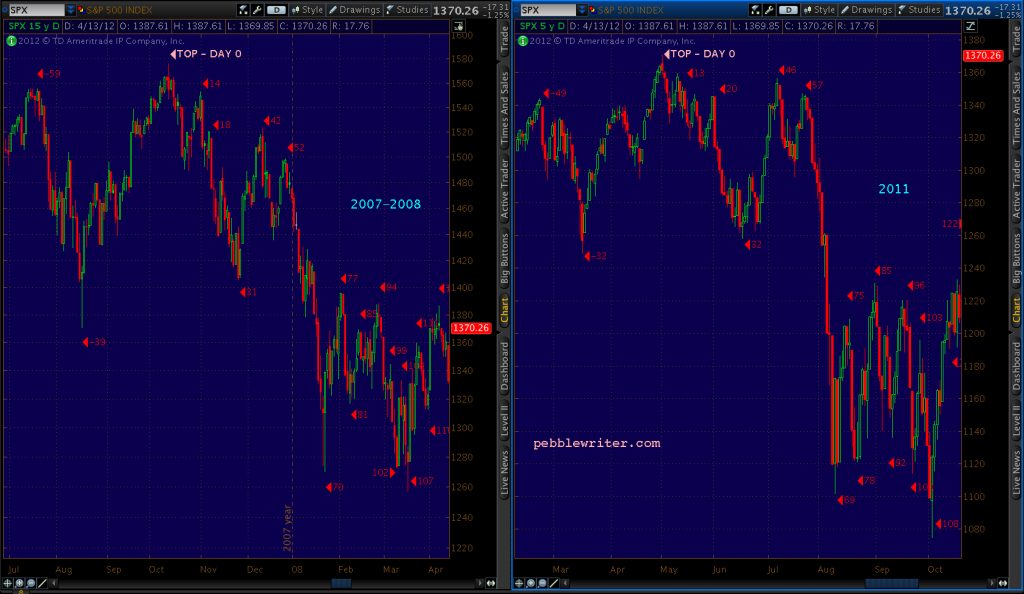
    Note: For those of us following an analog that compared the 2011 top to the 2007 top, it was a fabulously opportune time to start loading up on shorts [see: Why Do Analogs Work?]  Our gains over the next couple of weeks were nothing short of spectacular.

    The same thing happened a second time (the red pattern.)  The wave from 1356 to 1295 took 7 sessions, while the wave back up to 1347 took only 3.  Again, this suggested higher prices, not the powerful reversal that slashed 246 points in only 13 sessions.

    Are there any parallels between the market’s reversal at 1370 and its reversal at 1474?  As regular readers know, I am tracking a new analog [see: A New Old Analog] that suggests there are.  But, there’s a line in the sand at current price levels.

    We can argue all day about whether the pathetic fiscal cliff deal, combined with the latest QE incarnation, should mean higher prices.   But, if the latest Bat Pattern doesn’t hold, and prices ramp up past 1474, I’ll consider the analog broken and start charting upside targets.

    But, it won’t be because the Transportation Index just made a new high.  It simply completed a Crab Pattern (on negative divergence I might add), imbedded in the tail end of a large Bat Pattern that it’s been trying to complete since February.

    And, it won’t be because the Russell 2000 just made a new high — which can also be viewed as a quadruple top (dashed purple TL) that coincides with: (1) a Butterfly Pattern completion (in purple); (2) a Crab Pattern completion (in red); (3) a back-test of a well-formed rising wedge; and, (4) the .786 time fib of the wedge.  All of this, of course, is on negative divergence.

    It would be in spite of a dollar index that just broke out of a channel that dates back to May (red), after testing the bottom of a channel (in white) that dates back to Feb 2011.

    It broke out of and back-tested the latest channel on the hourly chart, too.

    I’ve always wondered what would happen when The Powers That Be threw everything they had at the market and it yawned.  Might that be a rabbit hole from which there is no easy escape?

    Between QE3, ESM, Congressional Kumbaya singing…the market should be hitting new highs.  So, why is it mired at the same point (metaphorically, at least) that preceded the last big correction?

    The market is currently frozen in headlights, wondering whether to respect the latest Bat Pattern or not.  So, I’m going to take the opportunity to review our analog and general forecast.

    To be continued…

  • Forecast Update: Dec 17, 2012

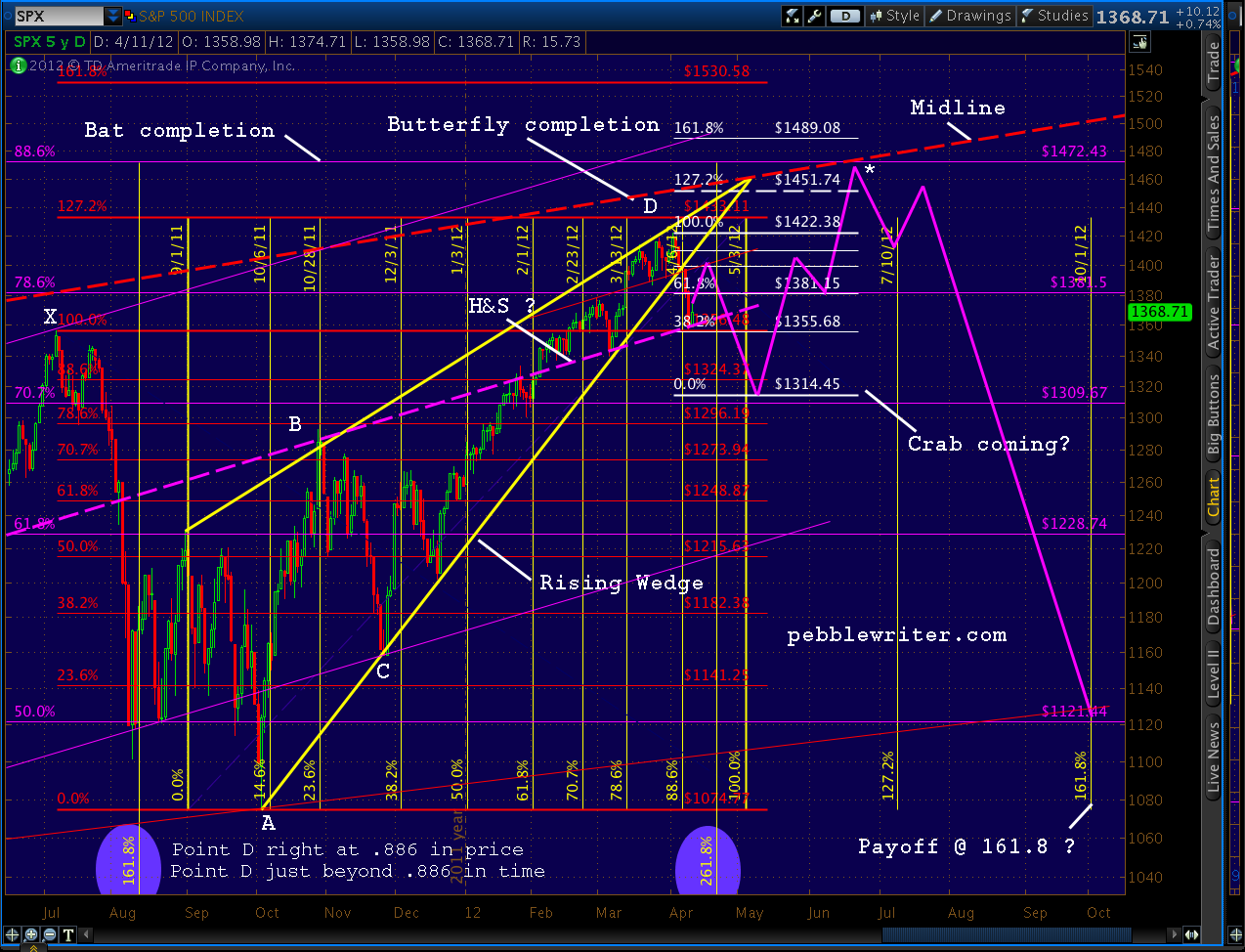
    April 11 seems like a long time ago.  It was then that I laid out my forecast for the top we’ve formed [see: New Analog I’m Watching.]  As regular readers know, it was based on a combination of channels, harmonic patterns in price and time, a huge rising wedge, and a promising-looking analog.

    I made several adjustments along the way — revising the 1314 downside target to 1295, for instance.  However, on June 1, when the SPX surprised me by dipping below 1292, I posted that the bottom was at hand — but that the analog was probably broken [see: Why I’m Buying.]

    SPX did indeed bottom the next day, but the chop over the remainder of June convinced me I was probably right about the analog being broken.  We saw no such chop in the comparison period of Mar-Apr 2011, which was a fairly orthodox A-B-C pattern higher to an unorthodox 1.272 extension of the previous decline.

    But, as SPX approached the key 1472 Fib level (88.6% of the 1576-666 2007-2009 decline), it occurred to me that:

    1. SPX would naturally reverse at this Bat Pattern completion [World According to Ben]
    2. This reversal would intersect with the 1.272 extension of the previous decline.

    Despite the huge differences in form between the Spring of 2011 and Summer of 2012, the ultimate price movement was shaping up to be the same.  And, it was happening without a Point B reversal at the .786, which is required of an ordinary Butterfly Pattern.

    This was enough to get me wondering if I’d given up on the forecast too soon.  Sure enough, we nailed the 1474 high on Sep 14 which, after nailing the Apr 1422 high and nearly so the June 4 1266 low, boosted performance to over 60% in less than six months.  The move down after 1474 played out very much according to plan.

    So, by the time I posted A New Old Analog on October 26, I had discovered why the forecast seemed off track in the first place.  It was a great help in forecasting the remainder of the year.  Here’s the forecast from that Oct 26 post, with alternative prices at each turn:

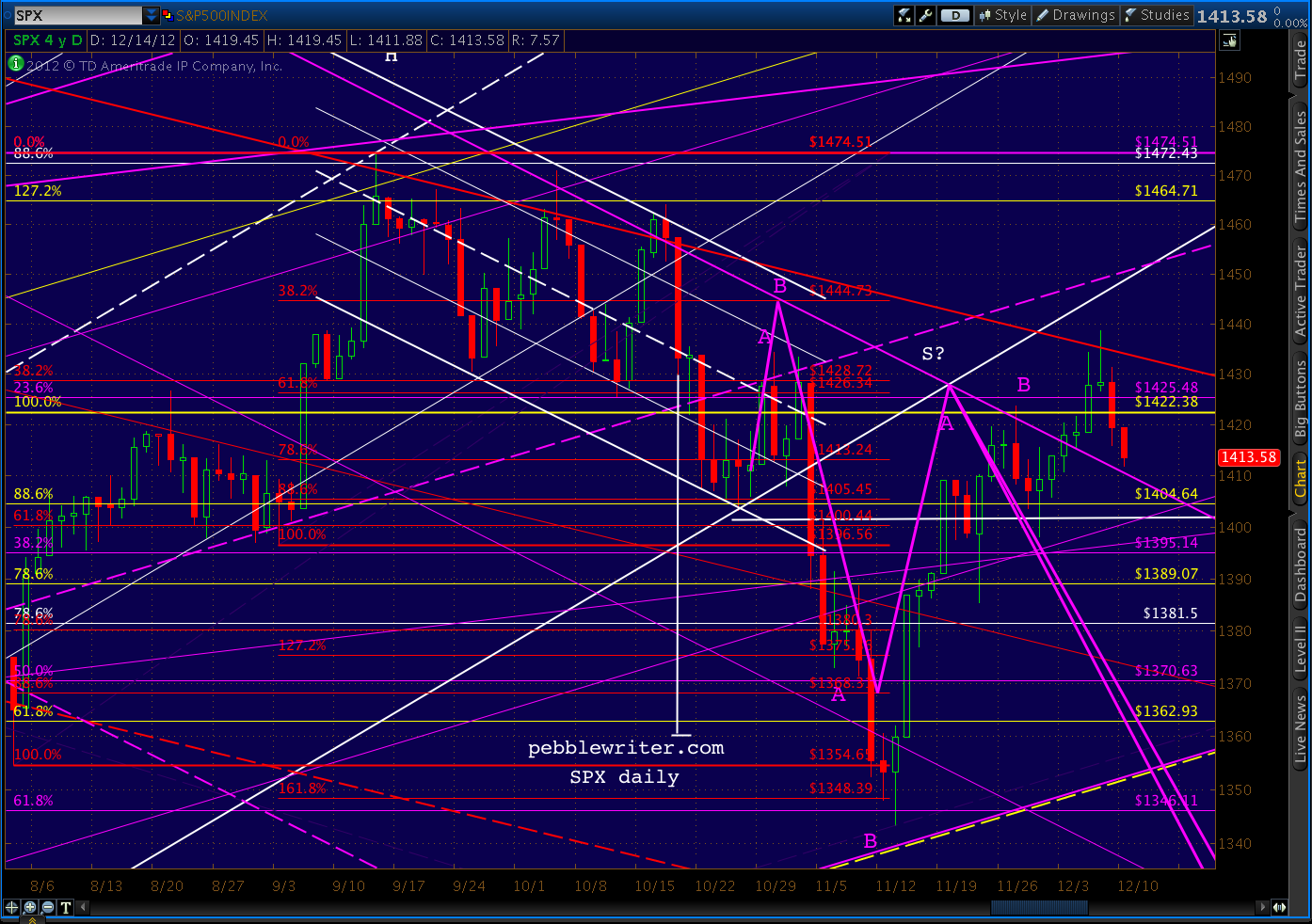
    And, here’s the actual price action overlaid on that same forecast.  We’ve tagged Point A of the first turn, Point B of the second, and overshot Point B by 10 points on the third.

    Does last week’s overshoot of the most recent target spell trouble for the forecast?

    continued for members(more…)

  • Stay Groovy

    “It was an expression used by small recon units and sniper teams in hostile terrain in Vietnam. They would tell one another to stay groovy when the danger level was so insanely high they popped amphetamines to stay awake and ready to rock twenty-four/ seven, because anything less would get them all killed. Stay groovy; take your pill. Stay groovy; safety off, finger on. Stay groovy; welcome to hell.”

     The Watchman, Robert Crais

    Those who have been following this blog or its predecessor for any length of time know I’m a big fan of analogs.  I was asked just yesterday why I thought they worked, and found myself fumbling for an answer.

    Like harmonics, I know that they do, because they’ve enabled us to make some nice calls that were accurate as to price and time such as the big downturn in April and the subsequent 1474 top in September.

    The big Kahuna, of course, was the July/August plunge in 2011 that mirrored that of Dec 07-Jan 08.  It’s just plain scary how well that turned out.

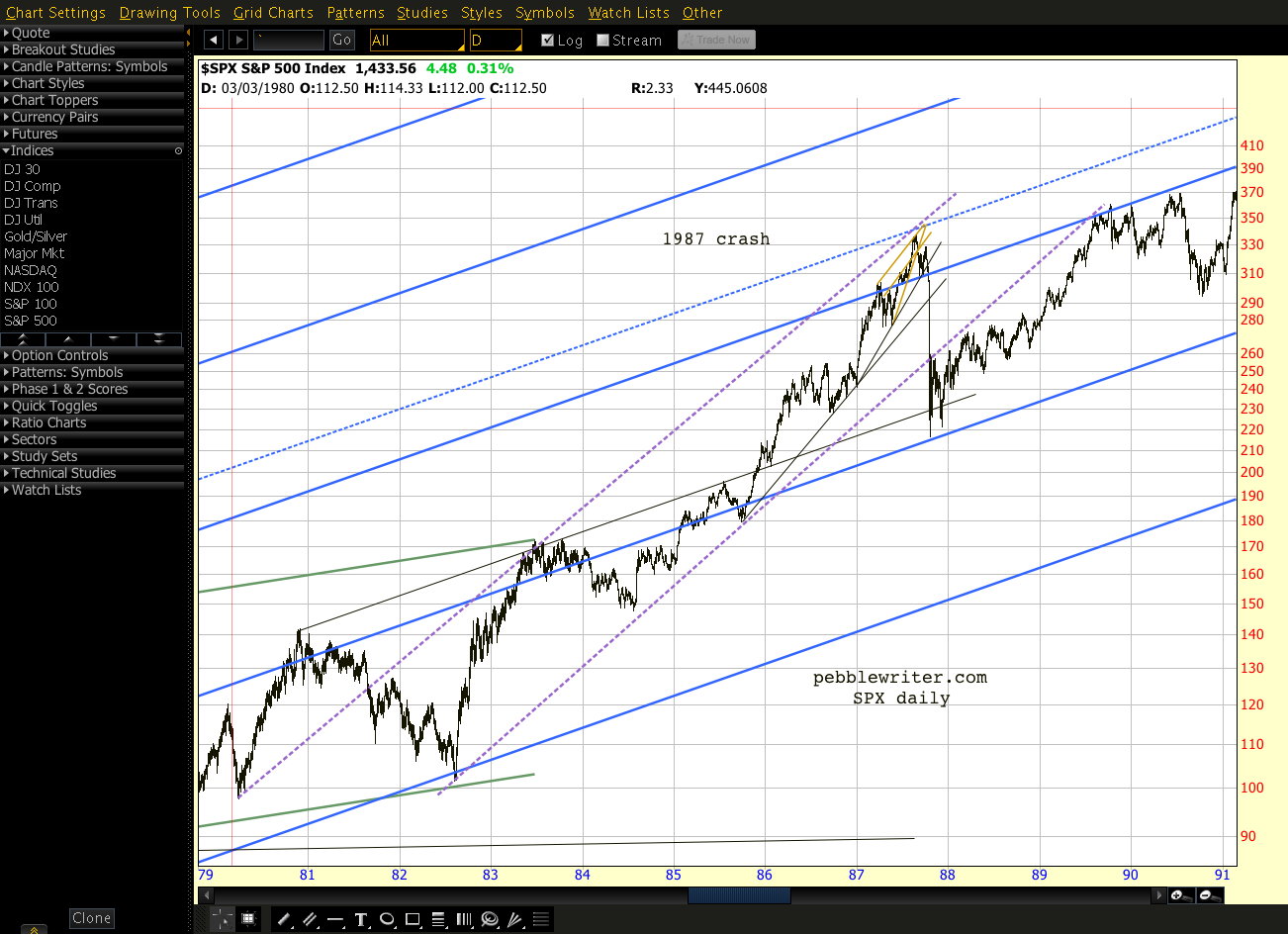
    I think analogs work mostly because of channels and harmonics.  In the simplest terms, channels keep prices pointed in a general direction for a noticeable period of time.  They can last for decades…

    a few years…

    or a few days.

    Regardless, I’ve found that most significant moves occur within or interact with channels.  Very often, as in the above chart, they’re channels within channels.  Even big channels that seem to generate their own atmosphere are usually aligned with other big channels.


    So, it’s not terribly surprising when moves that bring the market to the brink of disaster or reach ridiculously overbought levels react “just like it did last time!”

    Harmonics, likewise, are usually related.  The easiest example is the 2007-2009 plunge from 1576 to 666 which, when followed by an intial reversal at its .618 Fibonacci level, signaled both a Gartley Pattern reversal at its .786 retracement (the May 2011 high) and a Bat Pattern reversal at its .886 (Sep 2012 1474 high.)

    Combining the two, and tossing in some other chart patterns and traditional technical analysis, it’s easy to see why the market has done what it has most of the time.  If markets move in somewhat predictable and repeatable ways, then analogs can be viewed as a predictable aggregation of those predictable moves.

    Of course, its not always as simple as that sounds.  Even great analogs usually present alternatives. Over the past couple of months, the one we’re following now has hit our primary target at times and our secondary targets other times.

    And, some can be tough to get a handle on.  The one from this past April [see: New Analog I’m Watching] that very capably guided us from 1422 to 1266 and back up to 1474 (the top chart above) worked beautifully from a price standpoint, but was way off in terms of timing (since licked, I think.)

    And, last, there’s one truism that’s the bane of every analyst who charts analogs:

    Every analog works forever…until it doesn’t.

    Even as we’re counting down the last few points to the 10% downturn we charted all those months ago, a well-timed Bernanke comment or Hilsenrath article (is there really a difference?) could nudge the markets just enough to complete a Zweig Breadth Thrust event that ushers in a new high.

    If that happens, never mind.  End of the road.  It’s been a nice ride for the past nine months, but it’s time to change partners.  If it doesn’t, however, and we reverse in the next 10-15 points, it’s just about time for the song.


    UPDATE: 1:20 PM

    I’ve had several messages asking whether we’ve reached the target or not.  Frankly, I’m surprised.  The answer should be perfectly obvious to everyone:  maybe.

    continued for members… (more…)

  • Harmonics Are Your Friend

    It seems longer than seven weeks since we led with this chart on Sep 14 [see: The World According to Ben.]   QE3, the ECB’s latest stick save and the German Constitutional Court’s pro-ESM decision had all just been announced.  According to just about everyone, stocks were about to explode higher.

    To me, it was a long-awaited shorting opportunity.

    Meanwhile, SPX is nearing our 1472 target. I will ease some stops into the equation as we approach it, as I’d like to remain long for as long as possible.  This is a 35 point gain since we went long yesterday at 1437 with the Fed’s announcement.

    And, less than an hour later…

    Going ahead and pull the plug on my longs here at 1474.  The 5-min, 15-min and 60-min charts are all showing negative divergence.  I’ll place stops at 1475 or so, trailing lower as need be, just in case it makes another run higher.

    It wasn’t rocket science — just a big Bat Pattern that had finally completed.  Those who simply hung on to that short position scored 86 points for a nice 5.8% gain.  For buy and hold types, it’s been a great trade that is nearing an end.

    For us swing traders, it’s been a wild ride with (much) higher returns [Results] from anticipating the swings that had most analysts scratching their heads.  Yet, most of the swings were signaled by Harmonic Patterns and/or chart patterns that usually agreed.

    We were able, for instance, to short again just ahead of yesterday’s plunge — earning me some sympathetic private messages from well-meaning friends [“Are you sure, man?  This one seems kinda out there, especially without any election results yet.”  B.B.]

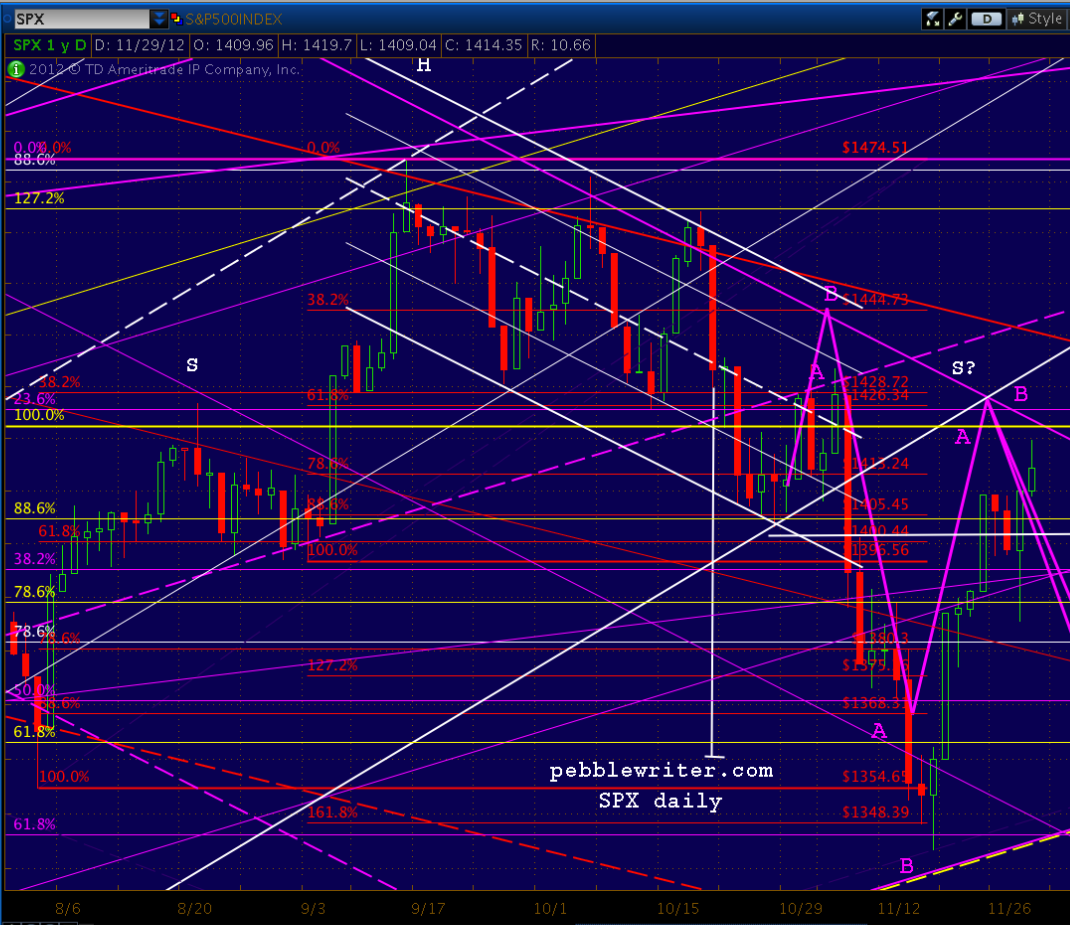
    This is essentially the same chart as above — seven weeks later.  We’re coming up on the next Fib level lower — the .786 retracement of the 1576 to 666 crash.  And, it just so happens that we’re nearing the SMA 200 at 1380.80.

    Not shown on this chart, there’s also a Crab Pattern completion at 1384.13, not to mention the .786 of the 1354 to 1474 run at 1380.30.  So, as the rest of the investing world is jumping on the bearish bandwagon, harmonics are signaling another important and unexpected turn.

    *   *   *   *   *   *   *   *

    BTW, did you know that generosity could also boost your investment returns?

    For anyone donating at least $100 to the Red Cross hurricane relief efforts, I’ll knock $200 off an $800 annual subscription to pebblewriter.com.  Kind of a no-brainer, really…

    1. Go to the Red Cross Website HERE.
    2. Contribute $100 or (preferably much) more.
    3. Wait about 30 seconds for them to email you a receipt.
    4. Forward a copy of the receipt to me at michael at pebblewriter dot com
    5. I’ll email you a PayPal invoice for $600.
    6. Save 25% while enjoying of the best investment blogs going.

    If you’re already a member, I’ll tag it onto your existing membership.

    Of course, you could always sign up for a monthly membership for $105 (auto-renew), but this way you get a whole year’s worth of great info for about half the price — all while doing good for some very needy folks.


    continued for members… (more…)