
Tag: fed

  • Does the Yield Curve Matter? A Closer Look

    I called a top in SPX on May 20, 2015 [see: The Last Big Butterfly] because it was about to reach the 1.618 Fib extension at 2138 — our upside target from way back in 2012.  SPX peaked the following day and fell over 300 points before it was all over.

    What I didn’t notice at the time was the bond market. We’ve focused on this from time to time, most recently on Dec 29 [see: Should You Fear the Yield Curve?]  We noted at the time that while the spread between 10Y and 2Y was dropping rapidly, it only represented a warning unless it bottomed out and rose rapidly.  From that post:

    …the above shows that while the potential is there for a recession, this is just an early warning at this time. If the yield curve bottoms out here and rapidly steepens, we’ll have a lot more to worry about.

    Two sessions later, the spread did bottom out, and has been on a tear ever since.  What does this mean?  Let’s look at how things unfolded in the past.

    The spread had been tightening since Dec 31, 2013.  It bottomed in Feb 2015 and began rising again.  In early May, it broke above a trend line (red, dashed) connecting its highs.

    About the same time that SPX was peaking, it backtested that TL and continued higher.  It broke trend (purple, dashed) around Jul 31, a few days before SPX fell off a cliff.  It broke down to new lows (the red, dotted line) in Jan 2016, about the same time that SPX bottomed out.What the yield curve said, then, in simple terms:

    – a breakout from the downtrend marked an equity top (bearish)
    – a breakdown of the subsequent uptrend was really bearish
    – a break to new lows represented a potential bottom (bullish)

    Before I go any further, I want to point out that there were four significant bottoms in 2015-2016.  The first two came close to backtesting the 1.272 Fib at 1823, but didn’t quite make it.  The second two did.Now, let’s look at the same period, but comparing the 10Y (TNX) itself to SPX.  Note that SPX peaked shortly after TNX reached the falling red TL, and began having trouble once TNX broke out.

    SPX fell off its cliff when TNX fell back through the rising purple TL, making bottoms each time TNX did. On Jan 20, 2016, TNX tested its Aug and Sep lows, at which point SPX bottomed at 1812.  A week later, TNX plunged below the previous bottoms and didn’t bounce until it reached the Jan 2015 lows (dashed, purple line.)

    The message delivered by TNX was slightly different from the 10Y2Y:

    – rising up to tag the falling trend line represents a bearish turning point
    – breaking out above it is okay, as long as the uptrend continues
    – a breakdown of the subsequent rebound is really bearish
    – stocks won’t bottom until TNX does

    If we look at the chart below, we can see that the 10Y tracked the 10Y2Y quite closely until it diverged in late 2015 in a failed effort to support stock prices.  It didn’t provide decisive support until it bottomed in Feb 2016 at its Feb 2015 lows.  For a few brief days, the divergence disappeared.Why is this even remotely interesting, you might ask?

    As in 2015, we have also experienced a huge divergence between the 10Y2Y and the 10Y itself.  This is noteworthy in and of itself.But, the comparison gets even more interesting.   As in 2015, we have had an extended slump (14 months vs 17 in 2015), a breakout above the falling red trend line, and a backtest of the trend line.The big differences, so far, are that the spread hasn’t gone on to new highs and that the (presumed) low came as spreads were peaking and only two weeks (versus 8 months) following the peak.

    But, so far, the lessons from 2015 are holding.  The breakout above the falling red TL definitely produced a drop in stocks.  The backtest of the red TL has occurred, but it hasn’t quite reached the purple TL.  As long as it continues bouncing and doesn’t drop back through that TL, stocks should be able to continue rising.  The day it drops back through it, things could get nasty.

    Next, let’s look at the current TNX chart.  We could look at the drop since the Mar 2017 highs, but it was rather short-lived and the subsequent rebound has resembled a moon shot.  Instead, let’s look at the big picture.

    A trend line from the 2008 highs connected with the 2010, 2011 and 2017 highs.  After reversing at each, TNX was accompanied by a large drop in stocks.  TNX’s reversal from its 2013 highs never produced a stock selloff; but, then again, it didn’t quite reach the TL.

    Zooming in a little, we can see that TNX reached this trend line a couple of times in 2017: first, in March, when its reversal accompanied by a mild 78-pt drop in SPX, and again on Dec 20 in a reversal which never gathered any steam.  TNX was back to and punched through the TL on Jan 8.  It reached another TL (gray) drawn through other recent highs on Jan 22 at 26.65.  This was a potential top, meaning the bond folks breathed a sigh of relief.

    On Jan 26, however, it popped up through the gray trend line.  Not so coincidentally, that was the day that SPX peaked.Remember our lessons from TNX in 2015:

    1. reversing off the falling trend line represents a bearish turning point – it didn’t reverse

    2. breaking out above it is okay, as long as the uptrend continues – it did, but as it approached 3%, folks started getting nervous.

    3. a breakdown of the subsequent rebound is really bearish – we got a potential reversal at 29.43, but it has a long ways to go before reaching the rebound trend line, currently at 24.40.

    Interestingly, that TL intersects the falling red TL at about 24.60 on Mar 13, the day that CPI for February is reported.

    And this is where it gets interesting.  If TNX continues to rally, bond folks and equity folks will get nervous (the fiscal fiasco.)

    If it were to fall to the rising purple trend line and backtest the red trend line at 24.60, it might be somewhat bearish unless: (a) it reflects a big drop in inflation (in keeping with my oil and gas forecast) and (b) it rebounds there.

    If it fell below 24.60, the TNX lessons suggest that SPX would be in big trouble.  With a Fed meeting a week later, we can assume Powell et al would be focused on preventing that from happening.  But, as our analog suggests, this preceeds an important inflection point by just a few weeks.

    If TNX falls through 24.60, remember lesson 4…

    4.  stocks won’t bottom until TNX does

     *  *  *

    Now, onto our analog update. In our initial post and follow up from Feb 6-7 [see: Analog Watch], we anticipated SPX would rebound from 2533 (our downside target) to 2765 by Feb 14 and 2812 by Feb 23.  Instead, it bounced from 2532.69 to 2742 on Feb 16 and to 2789 — 23 points short and 4 days late — by Feb 27.

    An adjustment was clearly necessary, given that SPX and ES bottomed on different days.  We’ll try to reconcile the two, along with some economic forecasts which are definitely outside the norm.

    continued for members(more…)

  • Why Rising Rates Are a Problem This Time

    A sharp drop in interest rates has traditionally been a negative for stocks.  The chart below shows that most significant declines in 10-year yields over the years were associated with steep drops in the S&P 500.  Usually, equity losses precipitated the drops in yield.  As stock declines accelerate, money flows into bonds — raising prices and depressing yields.  The crashes of 2000-2003 and 2007-2009 are striking examples.  So are the corrections of 2010, 2011, 2015 and 2016.

    There were several exceptions, when stocks were supported through carry trades and other algo-stroking forces: the 15% rise in SPX between Dec 2013 and Feb 2015, the minor 6.1% drop between Mar and Jul 2016, and the 2.5% rise between Mar and Sep 2017.

    But, significantly, not a single equity correction occurred without a concurrent and significant drop in yields.  This begs the question, then, of whether increases in yields are positive for stocks.

    In 2008, yields bottomed almost 2 months before stocks did in 2009.  But, in the 2000-2003 crash, yields bottomed 9 months after stocks.  Most other yield rallies from significant bottoms also lagged stocks: 4 months in Oct 2010, 9 months in Jul 2012, 3 months in Jan 2015, 5 months in Jul 2016.

    It would seem at least some bond buyers take a “show me” approach, waiting until the coast is clear in equities before shifting money back into bonds.  This analysis ignores the considerable influence that Fed purchases had on bond yields — an influence which the Fed maintains will diminish over the next few years.

    So, what are we to make of the latest spike in yields which began on Sep 7, 2017?  The 10Y rose from 2.03% to 2.94% through Feb 21.  SPX rallied along with it, up almost 17% by Jan 26 — then promptly did a gut wrenching 11.8% nosedive in only 2 weeks.

    Fortunately for the bulls, it got a strong bounce off its 200-day moving average and subsequently bounced to its 61.8% retracement. But, pundits seem fixated on the 10Y with rates nudging up against 3%.  Does it matter?

    In a word, yes.  Even though 3% is still well below historical yields, the level of debt has risen dramatically over the years.  The chart below shows the annual interest expense (the orange line) and the US’ rapidly growing pile of debt. Superimposed over each is the average interest rate (the black line) paid on that debt.

    Even though interest rates have flatlined since 2013, the expense of servicing the rapidly expanding debt has risen sharply — recently breaking out to all-time highs.

    Clearly, if rates were to normalize the interest expense would be unmanageable.  How unmanageable, you ask?

    Between 2000 and 2007, the average interest rate was 4.84%.  On the current $20.6 trillion balance, that would mean an annual interest expense of roughly $1 trillion.  And, we haven’t even begun to talk about the effect on consumer debt, the mortgage market, debt issued to fund corporate buybacks, etc.

    Obviously, an increase in the 10Y yield doesn’t immediately reprice the entire pile of debt.  But, it’s a clear step in the wrong direction.  And, investors are right to be concerned.  I imagine the Fed is also quite concerned — which is why I put a target of 2.85% on the 10Y back on Jan 10 [see: China – It’s Not Me, It’s You.]

    Not only did it represent channel and Fib resistance, but it seemed like a good tipping point for what I expected to be rising concern (one can hope) about our shaky fiscal situation.  TNX overshot it a little, which has been fairly common over the years (Feb 2011, Sep and Dec 2013, etc.)

    Those previous overshoots typically helped stocks get past resistance.  It might work this time, too.  But, judging from the mood out there, I don’t believe stocks will be led higher by higher interest yields this time.  And, I have trouble believing the Fed isn’t working to put a lid on long rates – yield curve be damned.

     *  *  *

    Related Posts:

    Where To Next?
    The End is (Probably) Near
    CPI: The Charade Continues
    Update on Bonds: Jan 29, 2018


  • The Rally That VIX Built

    As discussed yesterday, stocks spent the night building a cushion based on VIX (currently off 5.4%) in preparation for tomorrow’s FOMC announcement.  It started just before the close, yesterday, and has built to a 6-pt gain in the futures.Actually, it’s been less of a rally, lately, and more of an effort to maintain ES at levels above its IH&S Pattern target reached back on Jun1.  Remember the mantra “stay fully invested, because you never know when a sudden rally will appear out of nowhere and you can’t afford to miss it”?  These days, it’s the corrections that pass in a flash, like Friday’s 31-pt plunge which was reversed so quickly that it won’t even register on daily charts.

    But, I digress.  Today’s action is all about putting more distance in between SPX and the Support Below Which it Must Not Go in the wake of the FOMC meeting.

    continued for members(more…)
  • Fed Minutes: How Hawkish Are They?

    Markets tend to moves higher on Fed minutes days, even if the news isn’t all that positive.  It’s all about convincing investors that the FOMC has their best interests at heart — that all they’re worried about is making sure that stocks continue to rally.

    Today’s session is slightly complicated, then, by ADP employment which came in much higher than expected: 263K versus 175K.  Theoretically, this puts pressure on the FOMC to raise rates and/or trim their balance sheet faster than anticipated.  But, central banks have many tools at their disposal to ensure that the complication doesn’t become a problem.

    S&P 500 futures are up 6.5 points, but right to Fib resistance.  

    Can the Fed spin a hawkish set of minutes into something positive for stocks?

    continued for members(more…)

  • Betwixt and Between

    SPX and ES managed to hold key trend lines and channels yesterday, bouncing from just short of our downside targets to exactly where we expected.  All it took was an 18.3% hammering of VIX — no problem for the Masters of the Universe (real subtle, guys!)

    But, there was no breakout.  There wasn’t even an overnight ramp job.

    This somewhat validates our theory about the oil and USDJPY two-step, meaning we should be looking for a big, sudden move in the currency markets as soon as today.

    continued for members(more…)

  • Whistling Past the Graveyard

    Only a couple of years ago, central bankers became adept at repairing the damage done to stocks after big shocks.  That changed with Brexit, when the strategy shifted to pushing stocks as high as possible before the damage was done… and, still doing all the requisite ramping after the fact.

    They perfected the technique after the US election, turning a 5% overnight dump in the futures to a breakout above important resistance — where stocks remain, today.

    It made a bold statement — that the market was resilient enough to weather a sea change in the political landscape.  This week should be all about proving how resilient it is in a rising interest rate environment.  Judging from the mild drop over the past week, investors are quite unconcerned.

    Does this make sense, or are investors whistling past the graveyard?

    continued for members(more…)

  • Why the Market Didn’t Correct Today

    Hint: it’s the same reason the “market” hasn’t corrected much at all for the past six weeks.  And, no, there’s no free lunch involved.

    The day started with some tragic news out of Brussels.  ISIS terrorists attacked innocent civilians at the airport and a metro station, killing dozens and wounding hundreds.  Brussels is the de facto capitol of the EU, so the attack understandably sent investors scurrying for cover.  Only, it didn’t last — thanks to crude light (CL.)

    For those who weren’t watching, CL spiked almost 3% in about 90 minutes on absolutely no news whatsoever.  Why?  Because, stocks were selling off.  That’s it.  If you don’t believe me, read on.

    2016-03-22 CL 5 0807 SPX had dropped almost 10 points (0.5%) in the first 5 minutes of trading.  This took it directly to a trend line connecting the last two lows (3/16 and 3/22) seen below in red.  It dithered here for a few minutes, then broke through the TL and started lower — seemingly to backtest a rising channel line or the 200-day moving average.

    2016-03-22 SPX 5 0807But, at exactly the same time that SPX reached that trend line, CL swung into action.  It reversed higher, pushing up through its short-term moving averages and, ultimately, through two falling TLs of its own.  It didn’t stop until it had topped yesterday’s highs.

    This would normally be highly unusual, given that CL had just broken down through a TL (from Mar 15) and reversed at a key Fibonacci level (the white .618 at 41.42.)

    2016-03-22 CL 15 0837But, it is most decidedly not unusual for CL, which has taken over from USDJPY as the single most influential driver of equity algorithms.  Needless to say, SPX reversed back above its broken TL and went on to register new highs for the fifth session in a row.

    How it Works

    Want SPX to stop dropping, or even reverse higher?  How about popping up through important overhead resistance?  All it takes is a sudden spike higher by CL.  The chart below illustrates how commonplace it’s been in the last few sessions.2016-03-22 SPX 1 0837The first instance on the chart above was when CL gapped higher in order to get SPX up past its SMA200.  There were many other instances when CL either reversed or at least propped up SPX (the yellow arrows.)

    Occasionally, an intraday SPX backtest of a Fib is prompted by a CL drop.  But, for the most part, CL’s drops are limited to after-hours — when S&P 500 futures are easily propped up in the light volume.

    When the “market” reopens in the morning, CL has already been reset and is ready to spike higher all over again in order to support SPX for the next 6 1/2 hours.  It’s been going on for months.  But, it’s never been more obvious than since our bottom call on Feb 11 [see: USDJPY Finally Relents.]

    The Unbroken Broken Channel

    CL traced out a rapidly rising (white) channel from Feb 11 to Mar 14, at which point the channel broke down (the red arrow.)  Normally, this would portend a reversal of some significance.

    2016-03-22 CL v ES 5 0931This breakdown occurred as SPX had finally climbed back to its 200-day moving average — a 10.5% rally off its Feb 11 lows.  Again, normally we’d see a significant reversal upon reaching major overhead resistance such as this.  Combined with the CL channel breakdown, it looked like a sure thing.

    Instead, it was limited to a minuscule 13 points.  And, few traders would have had the nerve to participate.  It came on a gap lower following a 3-day, 54-pt rally that saw SPX slice through the SMA100 without blinking and close above the SMA200 two days in a row.2016-03-22 SPX 60 1500Why such a puny reaction?  First, CL not only cut short its decline, it pushed back above its SMA20, SMA100, a TL from June 2015 and the midline of a channel from Oct 2012.  Second, just for good measure, it even gapped right back into the channel from which it had broken down (the yellow arrow above.)

    After already spiking 49.6% (in the face of obviously deteriorating fundamentals) between Feb 11 and Mar 11, this latest CL spike amounted to another 18.2% off the Mar 15 lows.  In those five sessions, it lifted SPX a total of 51 points (2.54%), with each day seeing a new higher high.

    What Happened Today

    Though it’s not particularly unusual, today’s action clearly illustrates the manipulation going on.  Note that CL broke down again from its rising white channel this past Friday.  It seemed destined for a backtest of its 10-day moving average (at least) when it was pressed into duty to prop up SPX.

    2016-03-22 CL 5 1500It bounced around a bit while SPX found its feet, then zigzagged higher until SPX backtested a little H&S neckline (purple.)  When SPX faltered there, CL suddenly popped up through a TL that had connected its overnight highs.  With SPX threatening to reverse lower, CL suddenly broke out through a TL (white) that connected the highs made since last Friday.  This drove SPX up over the neckline.

    With SPX back on track, CL was free to fall back below the white TL.  And, it was time for USDJPY to take over. 2016-03-22 USDJPY 5 1500

    USDJPY had sprung to life just as SPX had reached the neckline, zooming back to the top of the channel whose bottom it had briefly broken as the terrorist attack hit the newswires.  It was a strong 1% move in about 10 hours, and involved USDJPY breaking out through a TL (red, dashed) it had established overnight, and again through a TL (white) connecting Monday’s highs.

    But, after reaching the top of the rising red channel, USDJPY had nowhere to go.  With oil prices having increased so much over the past month, the Japanese need a strong yen to compensate — hence USDJPY’s flatlining since Feb 11 (there’s that date again.)2016-03-22 USDJPY v SPX 5 1500SPX saw USDJPY’s predicament, and started back down — only to be rescued again by CL, which not so coincidentally maintained an uptrend until the close.  At that point, it was free to reset — which it did.  It’s not free to do it all over again tomorrow if TPTB deem it desirable. 2016-03-22 CL v SPX 5 1500

    What Now?

    Speaking of TPTB, who’s behind this daily manipulation?  Some blame the big banks, which have much at stake in the energy sector.  I favor the central banks themselves, especially the BoJ.  It has a huge equities portfolio.  By my calculations, it costs about 5-10 cents on the dollar to prop up SPX with CL — a bargain if there ever was one.

    I firmly believe that central banks colluded to crash oil in order to keep the yen carry trade alive.  But, it got out of hand.  Oil companies started suffering.  More importantly (to the central banks, anyway) the banking industry started to suffer.  There came a point (probably about Feb 10) that they decided it was time for prices to recover.

    This was tricky, because with a terribly devalued yen (sky-high USDJPY) higher oil prices were a burden Japan couldn’t bear.  This explains why USDJPY has repeatedly returned to the Feb 11 lows (a more valuable yen) while CL and, hence, SPX have soared.2016-03-22 USDJPY v ES 60 1500How long can this go on?  It pretty much depends on us.  The stock “market” has rallied nicely, which benefits those with substantial equity portfolios.  But, the 64% spike in CL since Feb 11 amounts to a tax on everyone else.  The average price of regular unleaded gas has risen over 18% since Feb, making a mockery of central banks’ relentless “we need more inflation!” mantra.

    When rising gas prices are again deemed a problem, or start to show up in official inflation data, CL’s run will be over — not a moment sooner.  At that point, look for the yen carry trade to return in all its glory.  Or, maybe by then, the ECB will have established the euro carry trade.  Or, maybe the whole steaming pile of crap will implode under its own weight.

    As always, there will be winners (the “haves”) and losers (the “have-nots.”)  Guess which constituency TPTB will bend over backwards to protect?


  • April 2013 Results

    April was the most grueling month I’ve experienced since starting pebblewriter.com. The month started only 6 points below the all-time high of 1576 and ended at the trend line connecting that high with the year 2000 high of 1552. Nearly every session begged the question: will SPX make a new all-time high?

    Seventeen of the 22 sessions in entire month saw trading within 10 points of at least one of the lines. What’s more, the average daily range was 16.5 points. About 60% of the sessions involved a change in direction. If it had been a basketball game, they’d have carried both teams off the court after reaching 180-179 in quadruple overtime.

    It was a blur of whipsaw days, sleepless nights and an almost embarrassing number of trades — about three per day. We had many sizable gains as well as our single biggest loss since inception: 1.59%. By the time all the dust settled, we were up 14.45% for the month versus 2.03% for the S&P 500 — our 3rd best month yet.

    LESSONS LEARNED

    All in all, it was a very instructional month — reinforcing some things I’ve been doing and arguing against others.  Two issues I’ve been studying are interim trades and holding positions overnight.

    The overnight ramp jobs and reversals were deadly.  It was only marginally beneficial to maintain a position overnight or over a weekend. And the whipsawing got so bad that I was a little paranoid by the end of the month.  Performance might have benefited from looser stops and going to cash overnight and over weekends.

    There were also days I should have stayed with the trend and ignored the bounces or “interim trades.” On the 18th, for example, I let a short trade run while playing short-term bounces to offset the losses.  By the time I covered the short on the 23rd, my three winning trades of +2.45% offset the 4 losing trades totaling -1.85%.  But, I could have earned 2.5% by simply switching sides when the short signal faltered.

    GOING FORWARD

    As we discussed last month, the trickiest part of Harmonic Patterns is the .886 – 1.000 range (once a Bat Pattern completes, will there be a new high?)  Now that the question of a new high is settled, we should see more directional moves and less chop in the market — reducing day trading and permitting more swing trades.

    The road ahead continues to look bumpy.  Sentiment is lousy as many market participants seem to feel stocks are overpriced, but are leering of abandoning BTFD. Corporate earnings look fine on an EPS basis, but have mostly missed on revenues and outlook.  The economic picture continues to be worrisome, with weakness across the board.

    All eyes will continue to be on the Fed, which seems to hold the market’s future in its hands.

    GLTA.

  • Charts I’m Watching: Mar 21, 2013

    ORIGINAL POST:  9:25 AM

    The EURUSD is still trying to change trajectories (purple channel to red), but hasn’t been able to break out yet.

    The dollar is similarly facing a change in direction if the red channel can hold.

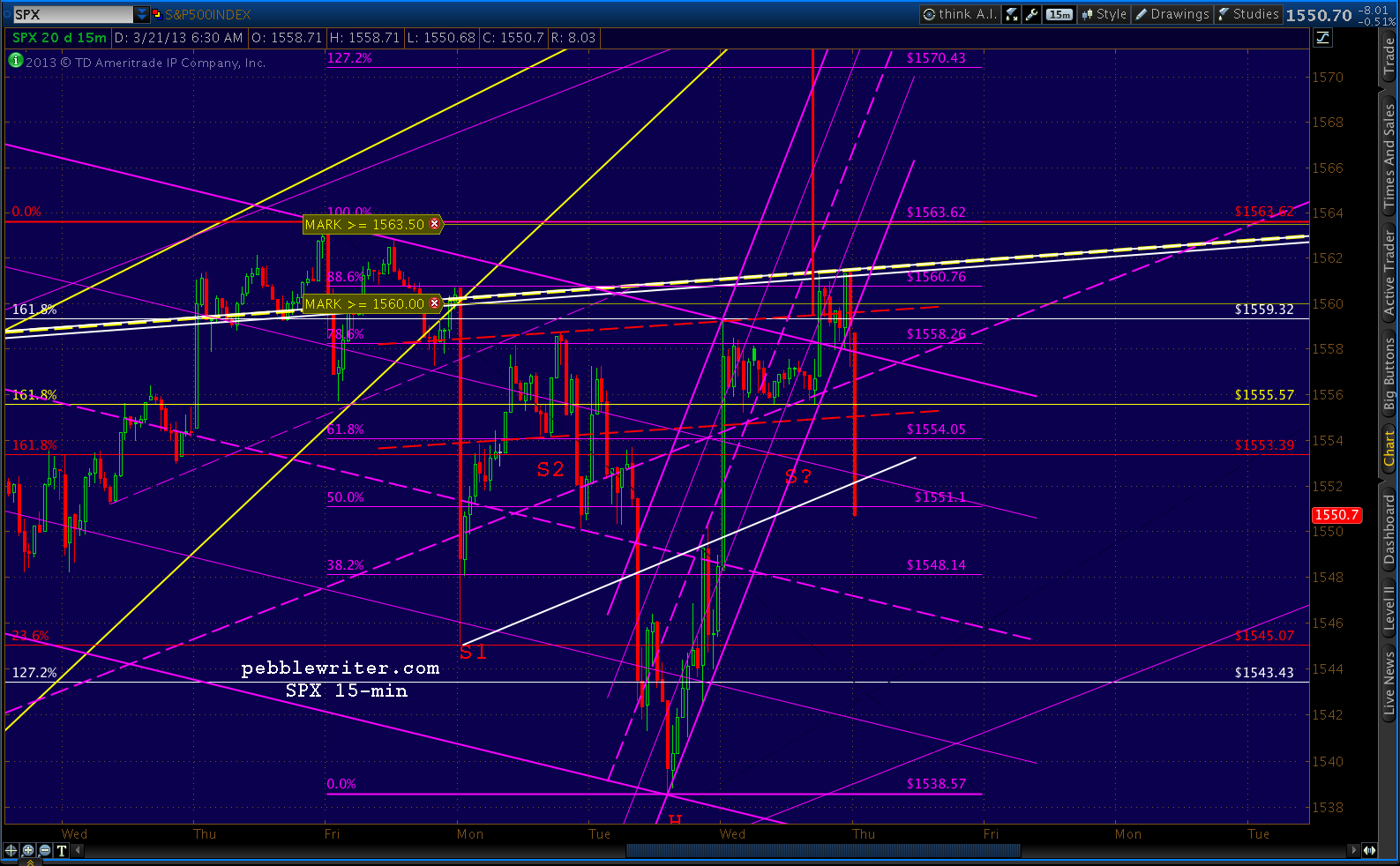
    Judging from the futures, SPX is set to react off the neckline and TL we’ve been talking about for several days. Though, daily RSI still shows a little more upside potential.

    I’ll play along on the downside, but will be looking to see if it gains support at the purple channel midline.

    UPDATE:  09:23 AM

    That should do it for the short side, going full long again here at 1550.7 with stops at 1548ish.  Always fun, trying to catch a falling knife…

    The 15 min RSI shows support with SPX here at the .500 Fib.

    Fresh charts in a few…

    UPDATE:  9:50 AM

    If SPX reverses here, it leaves a much nicer right shoulder for the IH&S we discussed yesterday.  And, the revised purple channel looks more sustainable.

    Existing home sales, Philly Fed and Leading Economic Indicators are due out at 10 EDT.

    UPDATE:  10:01 AM

    Data better than expected on Philly Fed and Conference Board Leading Indicators, a miss on NAR existing home sales.

    The leading indicators look a lot more positive than the current, which barely moved.

    No charts for the NAR, but sales came in at 4.98 million vs expectations of 5.0 million.  Inventory increased from 4.3 to 4.7 months, which flies in the face of the most commonly heard argument that a shortage of product was driving prices higher.

    There are no doubt pockets of actual product shortages, just as there are many with a huge excess.  But, the price increases have more to do with math than with supply and demand at the moment.

    The NAR, like everyone else, reports average (median) prices.  The entire market could remain at a standstill, but if the bottom 5-10% (in price) of houses are bid up, the average price increases.  It wouldn’t affect the average house, just the average price of all houses.

    That’s why many average homeowners remain underwater and unable to sell their houses for the asking price despite the “good news” from the NAR/MSM.  So, what’s happening to bid up prices on the low end?  Enter our friends at the Fed.

    As Bloomberg reported a few days ago, big institutional money is chasing single-family homes.  With the stock market at all-time highs, bonds at 2% and much of the rest of the world in questionable economic condition, the new bubblicious investment is housing.

    Blackstone, which put $3.5 billion to work buying 20,000 houses, just increased its credit line by another $1.5 billion.  Colony Capital owns 7,000 units and is raising another $2.2 billion.  American Homes-4-Rent owns 10,000, and is buying up more.

    Institutions represent a large percentage of the buyers in many markets which have rebounded the most:  Miami (30%), Phoenix (23%), Charlotte (21%), Las Vegas (19%.)   But, will the dead cat bounce translate into profits for investors?

    As fools rush in, rents are falling in many of the markets in play — making it tough to derive much cash flow.  Colony Capital will be buying another $2.2 billion worth of houses, even though their current portfolio occupancy is only 53%.  In an environment of 2% 10-year treasuries, the 4-5% cash-on-cash yield might look pretty good — especially coupled with some degree of inflation protection.

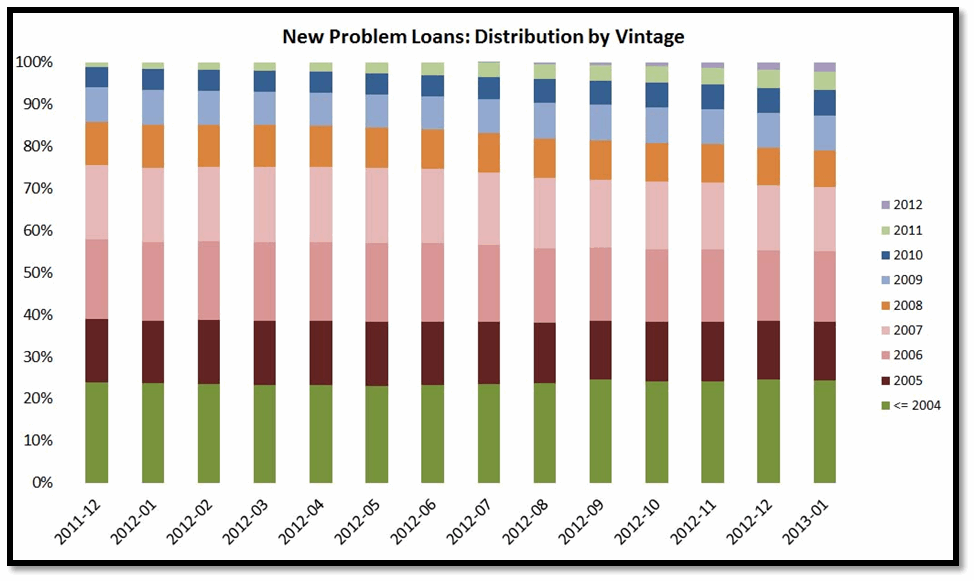
    I can’t help but think this is another big bubble in the making — courtesy of the Fed’s ZIRP.  Even after 5,000,000 foreclosures since the 2006 peak, new delinquencies continue to surface — including a steady contingent of older, more seasoned loans as this LPS chart shows:

    Global Economic Intersection ran a nice piece Tuesday posing a thought-provoking idea:

    “The housing market is therefore the hostage of economic growth and not the signal of economic growth.”

    The evidence of yet another liquidity-fueled, lack-of-any-better-alternatives bubble is here.  Investors must decide whether to button their chin straps and get in the game, or watch from the sidelines as the greater fools slug it out the red zone.  Stay tuned.

    UPDATE:  2:05 PM

    With the move down through 1548, I gave SPX a little more wiggle room to the .618 of the last move up at 1547.35.  It bounced, but couldn’t hold, prompting me to take a short-term short to cover my core long position.

    I’m closing the short here at the .786 of 1543.75 for a small gain.  More charts, revised channels coming up.

    The bullish case needs 1546.27 to hold firm.

    UPDATE:  2:30 PM

    Hard to keep up with charting this morning, with things moving rather quickly and dropping a little further than I expected.  Looks like the .786 will hold, but let’s make that the new stop.

    The 60 min RSI has found midline support at a potential falling channel (purple) and a rising channel which isn’t as convincing as I’d like (yellow.)

    UPDATE:  5:30 PM

    Weakness everywhere around the close.  I’m going to lay out the bullish and bearish scenarios, but from a chart pattern standpoint, this is a toss-up.

    Taking a look around the indices, I see a lot of indices at make or break points.  I just revisited RUT, a great case in point.  Drawn from the 98 and 02 lows, one channel makes a great case for the upside being done.

    The daily chart CU shows just how precisely we’ve tagged the top of that channel and the TL’s the make up the rising wedges.

    Drawing the channels off the 98 and 09 lows, however, shows RUT has already pushed above and backtested the channel top (in purple.)

    Throw in some Harmonic Patterns and things get really interesting…

    There was a big reversal at the .786 of the 2007-2009 crash, so we should expect a Butterfly Pattern to play out at the 1.272 of 996.26, right?

    But, look at all the TL’s of resistance we’d have to push through first…

    Besides the trend lines, the purple 1.618 hasn’t really caused a reaction yet.  The white 1.618 has, but not much of one.  And, note that the yellow pattern calls for a run to the 1.618 at 1033.  Mixed signals, to say the least.

    More in the morning…


  • Bernanke Speaks

    PLEASE NOTE THAT MEMBERSHIP RATES ARE SET TO INCREASE ON MARCH 4.

    *   *   *   *   *   *   *   *

    A new day, a new bounce.  As we discussed late yesterday, SPX has reached the bottom of the purple channel that’s guided it since 1343.  So, naturally, we’ll get some reaction — probably at least to the white midline at 1495.

    Whether it sticks or not is pretty much up to Ben.  Press conference at 10AM EST.

    The yellow channel on the 30-min RSI shows decent support here.  Looks like resistance at the purple midline, though, likely in conjunction with the white midline mentioned above.

    I’ll be surprised, though, if we don’t make it all the way back to 1497 for a proper back test of the H&S neckline – yellow dashed line.

    UPDATE:  09:40 AM

    That’s close enough for me.  I’m closing my ST long position taken yesterday (3:50PM update) at 1490 for a 6-pt gain and will let my core short position ride — for now.

    Many Bernanke pep rallies have left me feeling like a crash test dummy.  I’ve learned to keep my stops tight or stay on the sidelines all together.  For intrepid day traders, I suggest staying nimble.  A breakout or breakdown is to be expected.

    But, we did just complete a H&S Pattern, and that counts for something — as do the incomplete harmonic patterns.  We’ll take a look as soon as the Bearded One is done scolding Congress for messin’ up a good thing.

    UPDATE:  12:30 PM

    Equities are clinging to gains following Bernanke’s testimony — which was mostly a non-event.  IMO, he said nothing to help the bulls’ or bears’ case, which means Italy and the sequester will likely drive prices over the next several days.

    We should continue to see periodic bounces over the balance of the day, but the onus is on the bulls now to turn the trend.  We’ll keep an eye on the 5 and 15-min RSI charts to determine breakouts that merit an intra-day long, and revisit the daily charts to get a sense of intermediate-term possibilities.

    continued for members(more…)