
Harmony and me…we’re pretty good company. From the moment I first heard about Fibonacci, I was l hooked. A numerical sequence that produces mysterious and magical ratios that show up in everything from the design of pine cones and nautilus shells to the layout of pyramids of Giza and dimensions of the Parthenon? Sign me up.
When I heard these ratios could be applied to investing, it was music to this math geek’s ears. Most of my early efforts were focused on prices, but I’ve spent the past few months studying the application of Fibonacci ratios to time levels, as well.
Fibonacci time ratios are a trickier than price ratios. It’s pretty simple to eyeball a stock’s move from 10 to 20 and calculate a .618 retracement of the 10 points. Just make sure the starting and end points are significant, and check to make sure you’re considering all the alternatives, and Bob’s your uncle. Okay, so it’s a little more work than that, but not terribly complex.
Time series, on the other hand, deal with periods that can extend well beyond the standard computer monitor. It can be really, really tricky to find start and end points that provide a good fit for a set of ratios, not to mention a reliable long-term stream of market data.
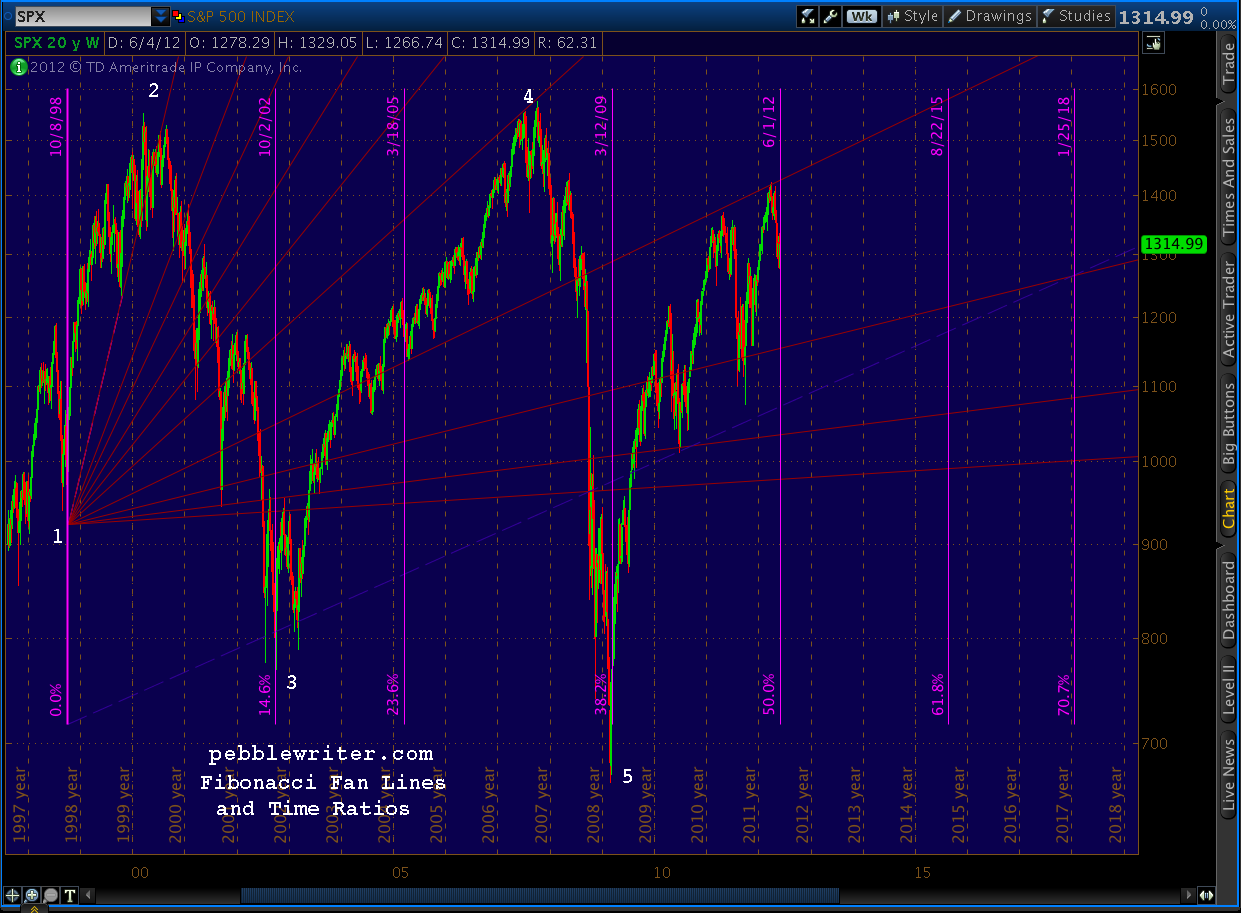
I’ve tried hundreds of combinations over the past few months, trying to find a set that fit the actual market results well, i.e. it captured the major moves with the primary Fibonacci ratios. And, I’ve found one that’s very interesting in that it fits the two market crashes in the past 10 years.
 October 8, 1998 represented the bottom of a 22% decline — the first 20%+ decline the market had seen since Black Friday in October of 1987. It’s been largely forgotten since the arrival of its two more dramatic siblings in 2002 and 2009.
Setting October 8 as the starting point, the October 10, 2002 bottom falls about a week from the .146 Fib level, and the March 6, 2009 bottom falls only a few days away from the .382 level.
And, as you might have noticed, the last Fib level of .500 occurred a week ago on June 1. Like the .236 level, it hasn’t been (so far) accompanied by a 50% drop in the markets. Does that mean we’re out of the woods?
continued…
I think so, at least in the short-term. For further support, I turned to Fibonacci fan lines. These charts get very crowded, very quickly, so I’ll add them one at a time starting with the oldest.
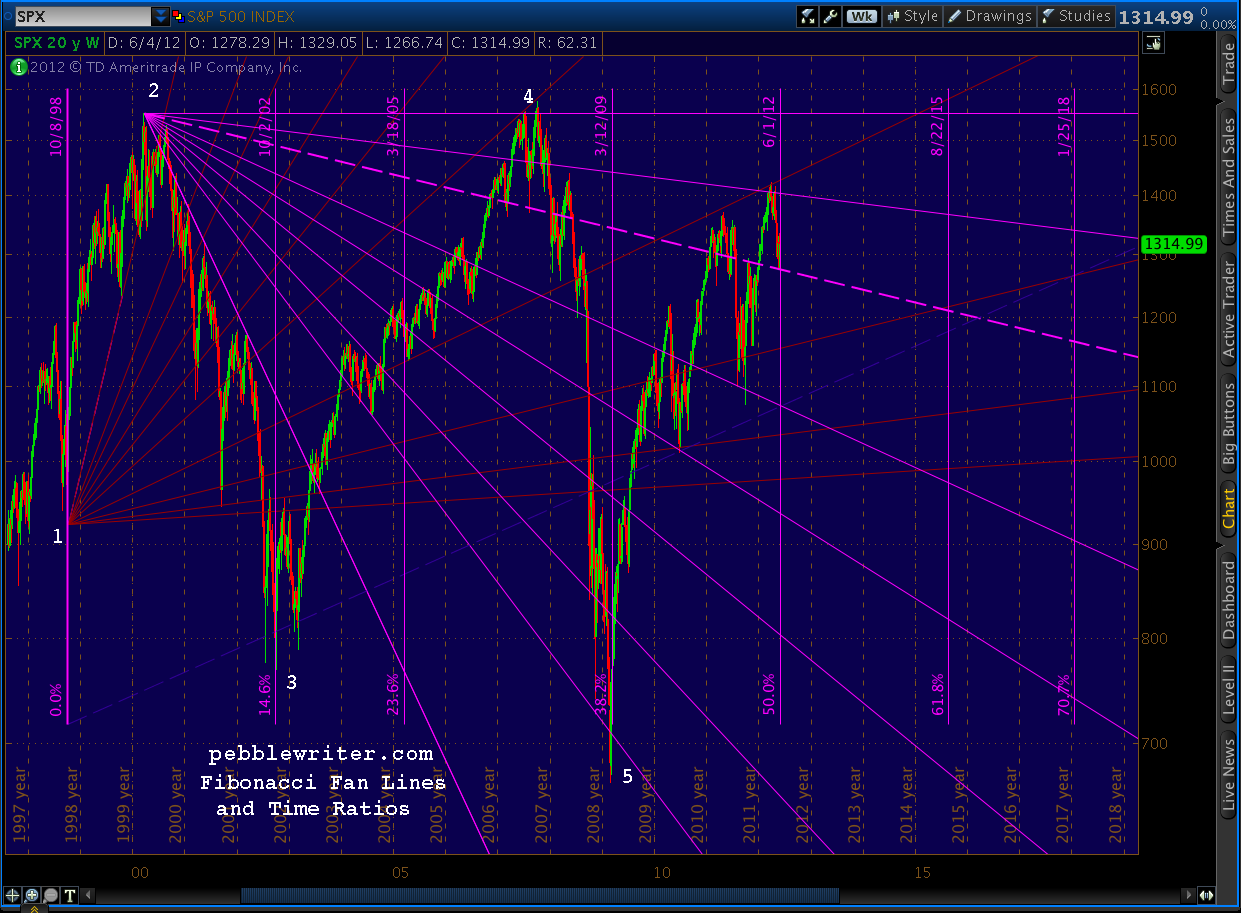
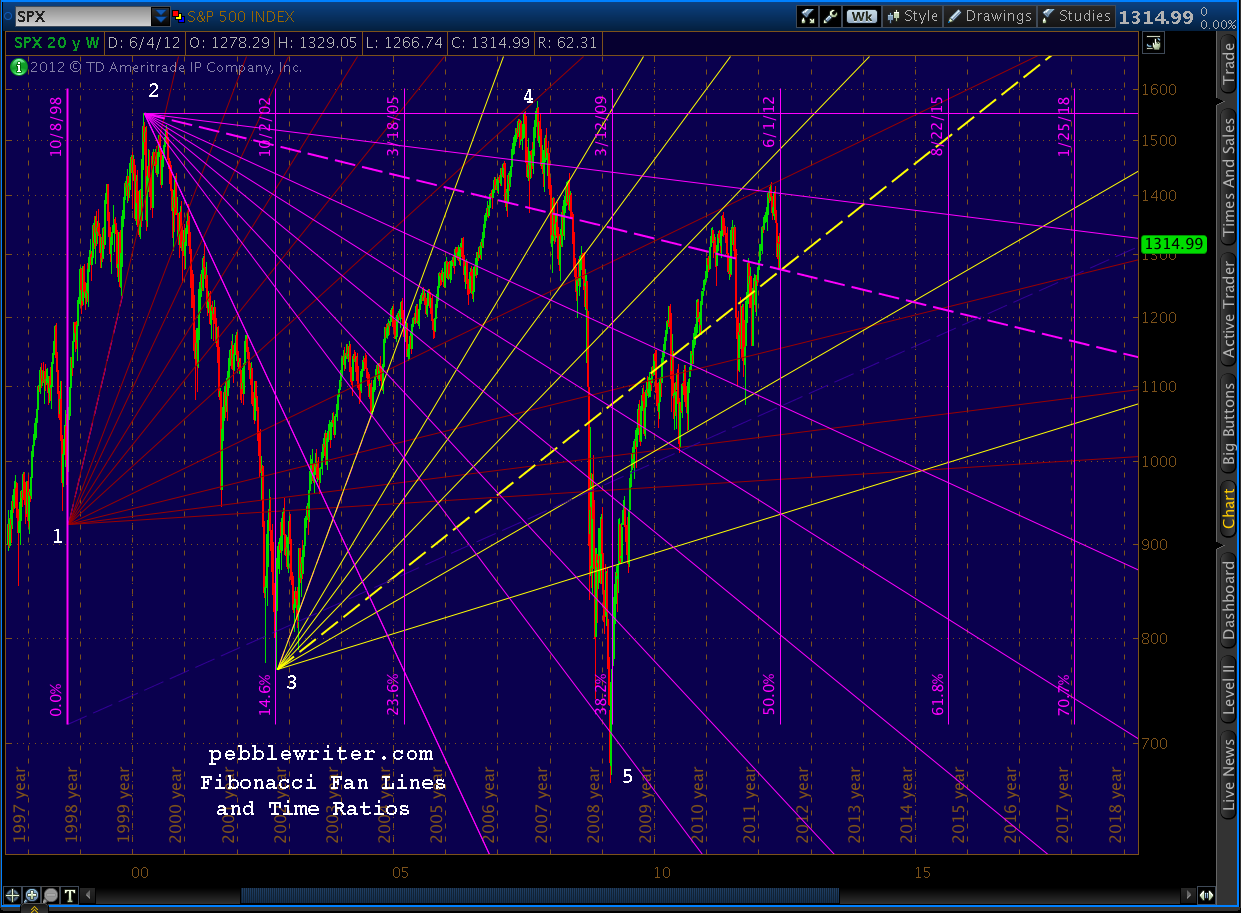
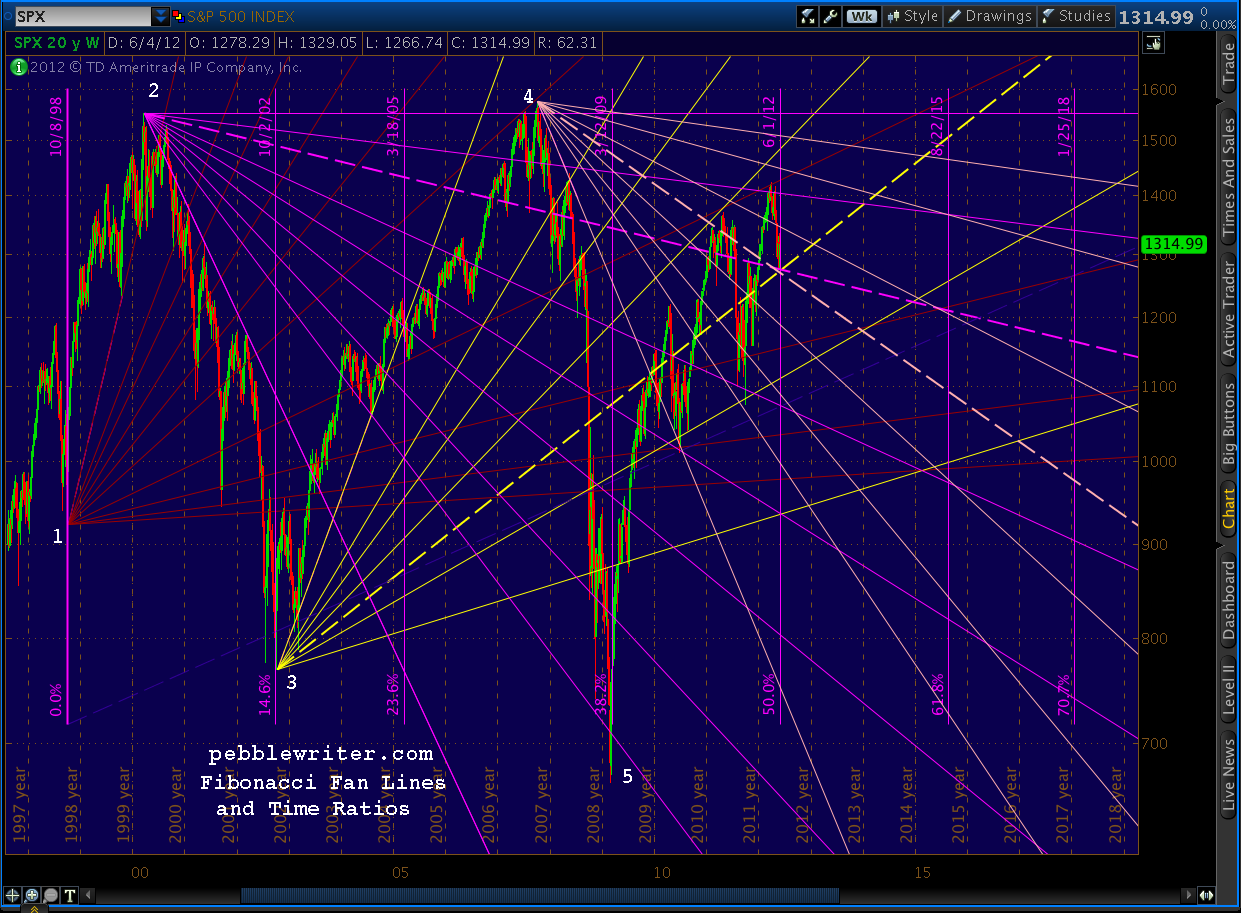
 Note that each has a legitimate and significant line running through last week’s 1266 bottom, within a few days of the .500 Fib level on June 11. That makes four different Fib fan lines running through the same time and price. There’s actually a fifth that doesn’t actually line up with a Fib ratio — at least one I’ve discovered yet. I’ve taken the liberty of drawing it in on the chart below — the solid white line.
 By now, more than a few of you are wondering about the .618, .707, .786 and .886 levels — not to mention the finish line. Here you go, shown on the monthly chart:
- .618 – August 21, 2015
- .707 – January 24, 2018
- .786 – March 22, 2020
- .886 – December 14, 2022
- 1.000 – January 24, 2026
 I have only a passing familiarity with it, but I know that 2026 is supposed to be the start of the 20th K-wave in Kondratieff Wave theory. In the hour or two of reading I’ve done so far, this theory has many parallels in economic, political and behavioral wave and harmonic theory. Guess that pretty well clarifies my weekend reading schedule.
But, I digress. I believe the fact that we’re essentially back testing five fan lines of support and have the Fibonacci time ratio to back us up (not to mention central planners around the world) greatly reduces the odds of a precipitous drop. I’ll post more on the shorter-term picture soon.
Stay tuned.
Comments
3 responses to “Harmony”
Hello PW, you listed “The End Game” article last Saturday and it implies the end game in financial world in about 6 months. A reset would result when that time comes.
Even without reading and believing “The End Game” article, the Euro mess is not going away. So far, central bankers are buying time. More debt to resolve the current debt. It may not be 6 months, but it is a matter of time.
Meanwhile, Fibonacci time ratios has next significant event in Aug 21st 2015 and Jan 24th 2018 (.618 – August 21, 2015 and .707 – January 24, 2018)
So, between now and Aug 21, 2015, there is a void in Fibonacci time ratio. But this void will be significant. For example, suppose Euro breaks up in 2013 or 2014.
Again, Thanks for the info.
How much weight do you give time clustering of the fib levels? I have been reading on price and time relationships that cluster based on different significant highs and lows. Just was wondering about your thoughts. I know you use fan lines to obtain intersections of the ratios. Thanks again for your work,
It makes me sit up and pay attention. If we’re moving towards a bunch of them clustered just overhead, I’m very wary of a top. Likewise, if we recently broke through a bunch and are back testing them, that’s a pretty good sign of a bottom. If they happen to intersect with a price and/or time fib level, icing on the cake.