
Tag: fan lines

  • Oil and Inflation

    WTI has reached our 200-day moving average target posted last month.This is a very significant move which, unfortunately, didn’t happen soon enough to affect June CPI or PPI.

    Long-time readers know that I’ve been harping on inflation for a long time. The reason is simple: math.

    Annual “headline” CPI, which is the one we all fret about, is based on the year-over-year increase in prices – which is why I started worry about inflation in March 2020 after oil and gas prices cratered.

    I did a deep dive on the historical relationship between oil and gas prices and inflation and quickly discovered that the incredibly strong correlation which we began writing about in 2018 was likely to produce some truly scary results.

    Up until late 2018, falling oil and gas prices had been responsible for CPI generally remaining below 2%. This chart from Jan 15, 2019 [see: The Big Picture] illustrated how every time inflation got a little out of control (over 2%) gas prices cratered enough to bring it back in line.

    Interest rates had risen right along with inflation until October 4, 2018 at which point I called a top in both [see: The 10Y Breaks Out.]  The fundamentals didn’t suggest it at all. In fact, more than a few observers questioned my sanity.  But, I reasoned that the recent breakout in rates from a 20-yr channel would prompt the usual response: a sharp decline in oil and gas prices as shown above.

    Trump had been tweeting up a storm with no effect…

    …until one day the Saudis handed him a gift. Journalist Jamal Khashoggi, a thorn in the side of the Saudi crown prince, was murdered and dismembered at what was obviously the direction of said prince. The world was pissed and MBS went from being the “cool Saudi” to an international pariah overnight. Trump suddenly had leverage.  From Coincidences and Consequences:

    Many considered my connecting the dots in this way a bit of a leap, but it was confirmed by Trump himself while being interviewed by Bob Woodward for his book Rage.Long story short, oil and gas nosedived – along with stocks – until they both bottomed out in December. CPI, which had been as high as 2.95% a few months prior, had dropped to 1.55% by Jan 2019.

    The story might have ended there, with oil and gas generally bouncing around as supply and demand and interest rate goal-seeking dictated, but the coronavirus had other ideas. By the time the dust had settled WTI had plunged below our 20 target and finally bottomed out below 0.This meant that year-over-year deltas would remain negative for quite a while. But, importantly, it also means that beginning in early 2021, year-over-year deltas would start soaring – which they did.

    In Mar 2021, we laid out the case for a sharp uptick in inflation and interest rates [see: Big Picture: Oil and Gas] and asked:

    Given that interest rates are close to zero and must remain near zero out of necessity and the dramatic increase in oil and gas prices since last April’s crash would result in at least a 40%+ YoY increase and CPI is very positively correlated with YoY increases in gas prices and interest rates are very positively correlated with CPI, will politicians and central bankers allow oil/gas prices to remain at these levels?

    At the time, I thought not. CPI had reached 2.6% and the 10Y had reached 1.75%. I thought it a likely point for a pause lest CPI pop up over 3.5%.

    But, the Fed — which had fallen under the spell of rapidly rising stock and housing prices — decided otherwise. They advised us to ignore what we could see with our own eyes and play along with their “transitory” fantasy.

    They doubled down and sold Wall Street on the wonders of the reflation trade (remember when that was a good thing?)  A month later, CPI topped 3%. Two months later, it topped 4%.  Tuesday, we learned that has now reached 9.1% – seemingly out of control.

    Many blame President Biden, arguing that his energy policies are responsible for the rise in oil prices and, thus, inflation. While it’s true that WTI rose from 53 to 93 in the first year of Biden’s presidency, the YoY delta in gas prices had peaked at 62% in Nov 2021 and was rapidly declining. By Feb 2022, it had fallen to 41% – historically commensurate with CPI around 5%.

    It didn’t play out that way for four primary reasons:

    1. Putin invaded Ukraine
    2. energy inflation spilled over into most other categories
    3. the Fed was inexplicably still pumping $120 billion into the markets every month
    4. a shortage of journalists willing to be chopped up into little pieces by a Saudi despot

    Reasons 2-4 might indeed have been transitory. We’ll never know. But, it was Putin’s invasion of Ukraine that spoiled the Fed’s plans. Instead of reversing at a very logical Fibonacci level which coincided with the top of an obvious price channel, CL popped up and tagged a target on Mar 7 that we hadn’t expected to be reached until the end of the year.

    Had prices even stabilized at January’s levels, inflation likely would have fallen as the YoY delta fell back to under 20%.

    Even if prices had continued to rise at the 1.73% per month average seen in the first year of Biden’s presidency, it seems likely that CPI would have fallen.Take away the Fed’s profligate QE and Putin’s monumental miscalculation and we might never have seen 6%. Instead, we’ve got this.

    The Fed is finally on the case, raising interest rates and trimming back their balance sheet. But, it’s hard to know how large a decline in stock values they can stomach before at least signaling a pause.

    It’s also difficult to know how deep a recession to expect. I believe we’re already in one. But, how far will the economy fall? Various sentiment surveys and the Atlanta Fed’s research indicate that the decline is gaining momentum.

    Will it spill over into real estate as in 2008-2009? Will rapid wage inflation morph into rising unemployment prints? I think so, but suspect the Fed will blink at some point. The first test will likely be when stocks decline to pre-COVID levels – about 30% from the January highs.

    Last, I’ve no clue when/if/how the war in Ukraine will end – just that it will eventually will. But, God knows how much damage will be done in the interim. Europe is in for a very tough 2022, with inflation spiraling higher thanks to surging energy costs, the plunging euro, and no wiggle room in a slowing economy to preemptively raise rates.

    A broader war with Russia seems increasingly near-fetched.  If they’re really lucky, they’ll merely experience a quarter or two of stagflation. If not, we could be looking at Great Financial Crisis II, with bank failures and spiraling interest rates thrown in for good measure.

    And, don’t think for a moment that it wouldn’t affect the US. The Fed is gambling on a soft landing with nearly full employment. But, it never seems to work out that way, does it? And, would we even want that?

    A soft landing would probably mean energy prices never get to clear. That the proverbial can gets kicked down the road for the next administration/Congress to not handle. I live in California, where gas prices are still well above $6/gallon. I’m okay paying that if it means forcing Putin to back down. It might even accelerate the development of alternative energy so my grandchildren will inherit a planet worth living in.

    But, I’m well aware that I’m in the minority. So, the guys behind the curtain are going to need to come up with some pretty fancy footwork: a plan that keeps energy prices falling, inflation back under 4% and the 10Y back under 2.5% – all without bringing on a recession that sends stocks down 50% and real estate down 20%.

    Personally, I don’t think it’s possible. I think the recession and falling asset prices are not only inevitable, but necessary.  It’s also what our analog suggests.  To that end, here are our expectations for the very exciting next few days.

    continued for members(more…)

  • Update on Gold: May 15, 2013

    Our last update [Apr 15] devoted to gold came in the midst of a huge meltdown.  Gold had lost channel support, horizontal support at the psychologically important level of 1500 and was dropping like a rock through 1335.

    Never one to shy away from an opportunity to embarrass myself, I gave my best guess:

    we [should] get a nice bounce between here [1337] and 1309 and a backtest of one of the broken channel lines — say the white midline around 1410 or even the 1450 level.

    GC shed another 14 points to 1321 the very next day, then rebounded strongly to 1404. Another two weeks on, GC nearly reached 1500 before fading once again.

    Now, at 1373, it has reached a critical juncture that should result in either a sharp rally to 1560 or a plunge to 1141 in the coming month or so.  If that sounds like an impossibly wide margin of error, there is a way to invest without getting fleeced.

    GC has risen via the giant red channel since 1999. The plunge to 1321 took it to the brink of another $200 breakdown.

    It bounced at the channel bottom, though, and made a nice comeback… until May 3, that is.  At that point — having retraced a Fibonacci 61.8% of the damage done by the fall from 1590 — it did another about face.  It’s now only $11 from tagging the .786 retracement (1357) of the rise off the 1321 bottom.

    The Harmonic Pattern could go either way.  The 1487 high on May 3 came at the .618, so a Gartley, Bat, Butterfly or Crab Pattern could result in a climb back to 1532 – 1756.   Though, that would mean a breakout of the falling channel its been in since last September (in white, above.)

    Long positions could be played from the .786 (1357) or .886 (1340) as long as stops are watched very carefully and updated frequently.

    The downside case is probably stronger.  If the current plunge continues past 1321, there are only a few key levels of support before things get really nasty:

    • horizontal support at 1302-1309
    • potential Fib targets of 1276 (the 1.272) or 1219 (1.618)
    • Fib support at 1141-1157
    • Fib support at 947

    I don’t have a dog in this fight.  But, if I did, I’d be watching very closely to see if GC can catch a bounce north of 1300.  If not, it might easily form an inverted cup and handle and continue to be a great shorting opportunity.

    If that should happen, look for the large white channel to influence the drop. The white .618 at 1155 is tantalizingly close to the bottom of the channel in mid-July.

    GLTA.

  • Moment of Truth

    SPX has been tracing out a channel over the past several months, but its RSI has clearly formed a rising wedge.  The divergence begs the question: “which will prevail?”

    Regular readers know I’m a fool for chart patterns in general and RSI chart patterns in particular.   But, that’s a solid channel that’s withstood some pretty nasty headlines.  And, as we’ll see below, it is exactly parallel to the channel that guided the Dec 2011 to May 2012 ramp.  We’ll see if we can find some corroborating evidence to guide our forecast.

    continued… (more…)

  • The Waiting Game: July 31, 2012

    ORIGINAL POST:  11:30 AM

    SPX might be tracing out either a flag or pennant pattern on the 15-min chart.  While either could portend higher prices (2/3 of the time), a flag would mean lower prices first — probably down into the mid 1370s.


    At first blush, the market seems to be respecting the last high of 1380.39 on July 19.  I suppose it makes for a more positive wave structure.

    But, I suspect the bigger worry for bulls is the Fib .786 at 1381.50 (in yellow).  This retracement from the 1576 to 666 plunge (Oct 2007 – Mar 2009) was only recently exceeded again, and a real, live bull market shouldn’t have any difficulty retaking and defending it.  Here’s the big picture, again:

    continued… (more…)

  • Big Picture: June 11, 2012

    This morning’s hunch to fade the futures’ ramp was a good one [see: Mixed Signals.]

    “There’s a channel line just overhead at 1337.30 or so that should limit the current rally.  Given the way the futures behaved overnight in equities, the dollar and the euro, I’m going to fade this ramped up opening and see if it settles back down.”

    The market not only reversed within minutes of the open, but it got all the way back down to our target range of 1303.47-1308.88, putting in a low of 1307.73 and closing at 1308.93.  Mind you, I hadn’t expected it to happen only six hours later, but I’ll take it thank-you-very-much.

    Although we got to the right trade in time, it was the result of a great deal of brain-racking and teeth-gnashing.  Had I bothered to look at the emini’s, the decision would have taken all of five seconds.

    All-together, SPX reversed over 28 points.  But, that was dwarfed by the e-minis reversal from +19 points to -23 points — a daily range of 42.25 points.  This was the single biggest red candle since 2011’s crash.

    As noted in last night’s update on the dollar [The Dollar: Currents, See?]:

    “I suspect the euphoria over the Spanish bailout will be relatively short-lived.   Putting the rest of the eurozone in harm’s way seems like a better way to get them downgraded than it does Spain upgraded.”

    Sure enough, there was plenty of talk about downgrades today — as doomers got the upper hand for a change.  The argument — a good one — is that there simply isn’t enough firepower in the ES, ESFS and IMF to bolster the creditworthiness of all the countries currently circling the drain — let alone those that aren’t yet in the headlines (Italy and France are on deck.)

    In the end, it will be up to Germany, the US and China to decide how much to contribute — a matter for another post.  Returning to the markets, there are several important take-aways from the ES chart above.

    continued…

    (more…)

  • Harmony

    Harmony and me…we’re pretty good company.  From the moment I first heard about Fibonacci, I was l hooked.  A numerical sequence that produces mysterious and magical ratios that show up in everything from the design of pine cones and nautilus shells to the layout of pyramids of Giza and dimensions of the Parthenon?  Sign me up.

    When I heard these ratios could be applied to investing, it was music to this math geek’s ears.  Most of my early efforts were focused on prices, but I’ve spent the past few months studying the application of Fibonacci ratios to time levels, as well.

    Fibonacci time ratios are a trickier than price ratios.  It’s pretty simple to eyeball a stock’s move from 10 to 20 and calculate a .618 retracement of the 10 points.  Just make sure the starting and end points are significant, and check to make sure you’re considering all the alternatives, and Bob’s your uncle.  Okay, so it’s a little more work than that, but not terribly complex.

    Time series, on the other hand, deal with periods that can extend well beyond the standard computer monitor.  It can be really, really tricky to find start and end points that provide a good fit for a set of ratios,  not to mention a reliable long-term stream of market data.

    I’ve tried hundreds of combinations over the past few months, trying to find a set that fit the actual market results well, i.e. it captured the major moves with the primary Fibonacci ratios.  And, I’ve found one that’s very interesting in that it fits the two market crashes in the past 10 years.

    October 8, 1998 represented the bottom of a 22% decline — the first 20%+ decline the market had seen since Black Friday in October of 1987.  It’s been largely forgotten since the arrival of its two more dramatic siblings in 2002 and 2009.

    Setting October 8 as the starting point, the October 10, 2002 bottom falls about a week from the .146 Fib level, and the March 6, 2009 bottom falls only a few days away from the .382 level.

    And, as you might have noticed, the last Fib level of .500 occurred a week ago on June 1.  Like the .236 level, it hasn’t been (so far) accompanied by a 50% drop in the markets.  Does that mean we’re out of the woods?

    continued…

    (more…)

  • Oil’s Balancing Act

    Many readers have been asking about oil.  It’s not that I haven’t been interested, it’s just been a real bear to analyze.  Here, after a dozen hours of racking my brain, is where I see it.

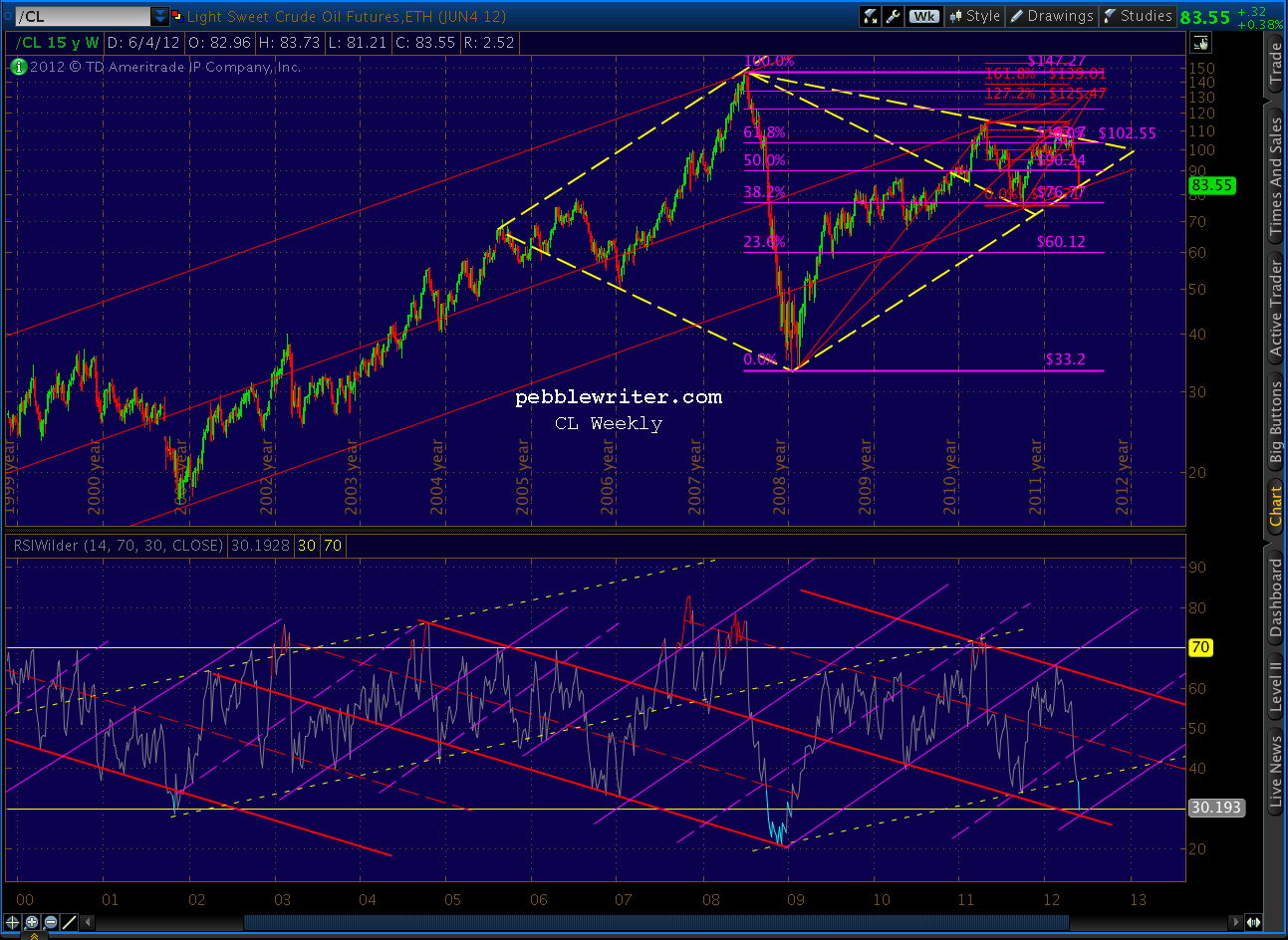
    Like many stock indices and currencies, Crude Light (CL) is at a critical stage.  It reached 114.83 after breaking out of a diamond pattern in April 2011, only to back test the diamond six months later at 74.95.  It then retraced .886 of that plunge, setting a lower high of 110.55 in February before plummeting once again as low as this morning’s 81.21 (the .886 is just below at 79.01.)

    CL now balances on a precipice, where a move in either direction is likely to be huge.  We’ll examine why, and which course is more likely.

    continued…

    (more…)

  • NYA Update – June 3, 2012

    The May 8 forecast for NYA was for the index to plunge from 7815 to 7340.  The forecast worked out well, as Friday’s low was 7286 (a quick 7% return, yay!)  As noted in that update, 7340 doesn’t really match up with any particular Fibonacci levels.  And, it doesn’t intersect with the rising wedge until early August (the highlighted oval.)

    I didn’t really see it taking that long to play out, and the market obliged for a change.  It also obliged by precisely tagging the fan line I had drawn off the Oct 2007 top (yellow, dashed) and one of the parallel horizontal channel lines (redrawn as red, dashed line E for emphasis.)

    We still haven’t landed exactly on a Fib level, so we either just overshot the .500 or haven’t yet reached the .618 target of  7145.  Deciding which it is presents some interesting questions.

    continued…

    (more…)

  • SPX: The View from 30,000 Feet

    Our charts have grown fairly “busy” lately, what with harmonic patterns, chart patterns, fan lines, channels, etc.  I find it helpful every now and then to take a step back and examine those elements that have had the biggest impact in recent years — and are likely to continue doing so.

    In my opinion, the two patterns that have influenced prices more than any other are Fibonacci levels (primarily related to the 1576-666 decline) and fan lines.

    Note how strongly prices reacted to each of the Fib lines off the Mar 09 lows.  Every Fib level played an important role in providing support and/or resistance at pivotal points.  The .236 didn’t slow the advance much, but it provided much needed support after a 9% decline.  A tag of the .618 touched off a 17% correction (caught by the .382) and set the stage for the Gartley pattern completion at the .786 a year later.

    (more…)

  • Update on FTSE: May 15, 2012

    ORIGINAL POST:

    In response to several requests from readers across the pond, I’m taking a crack at the FTSE 100.  For some reason, Think or Swim (my trading platform) doesn’t quote the FTSE itself, but does the FTSE 100 mini — 1/10 of FTSE’s value — that goes by the symbol UKX.

    UKX had retraced a little over .786 of its 2007-2009 plunge when it topped in February 2011 at 609.58 (.786 is the normal completion point for a Gartley.)  It subsequently fell 20% to 486.86 last July, then retracing about .886 to reach its recent high of 598.67 in March.

    The April 2010 drop came at the Fib .707, which isn’t a legitimate Point B for a Gartley.  The harmonic implications of a .707 Point B are a Bat pattern that completes at .886 (635.84) or a Crab that completes at the 1.618 (874.90.)   We’ll put a pin in 635.84, because its not that far from the current reality, and see if it lines up with any other indicators.

    Besides the harmonics, a couple of patterns are worth examining.  First, fan lines from the 2007 top (yellow) and 2009 bottom (purple) have been pretty effective at guiding prices.  At present, there’s a purple fan line that — if it holds — should help support prices.  If it fails, watch out for a 10%+ drop.

    Secondly, the faint red channel lines that have provided a lot of support and resistance in between the fan lines are indicating possible support at the same spot.

    Third, the weekly RSI chart shows support at these levels (the dashed yellow line above.)  Breaking this line is a virtual guarantee of 8-10% more downside, but it did a pretty good job of supporting previous slides, even without the added benefit of a fan line.

    Likewise, the daily RSI should offer support.  Even though RSI has fallen in a pretty steep channel over the past 7 months, there are two internal trend lines (purple and yellow above) that intersect with current values that could be supportive.

    Don’t get me wrong: I am not bullish on the FTSE.  But, it’s important to recognize that it has reached a critical level of support according to several different measures.  The economic picture is bleak, so any little nudge could send it tumbling into the abyss.  In fact, I view the entirety of the euro zone as only one press release away from financial disaster.

    But, if it’s able to hold on, we could see a decent rebound. Holding on no doubt means cranking up the printing presses — a game that is doomed long term, but one which TPTB have shown they have reservations about playing.

    When faced with situations like this, I usually punt.  There’s not a compelling enough reason for me to place hard-earned cash at risk until the picture is a little clearer.  But, we’ll keep an eye on it, and see if the picture clarifies in the coming days.