
Looking at the markets these past few days, I’m reminded of the prize that comes in a box of Cracker Jacks. Not a real prize, mind you — but one of those cheap little pictures where the image changes as you shift the angle from which you’re viewing it. It’s called a lenticular image.
Despite the uncanny accuracy of our forecasts these past couple of months, the road ahead seems to shift a little with every fresh look. I can’t remember the last time I agonized over a forecast for an entire three-day weekend.
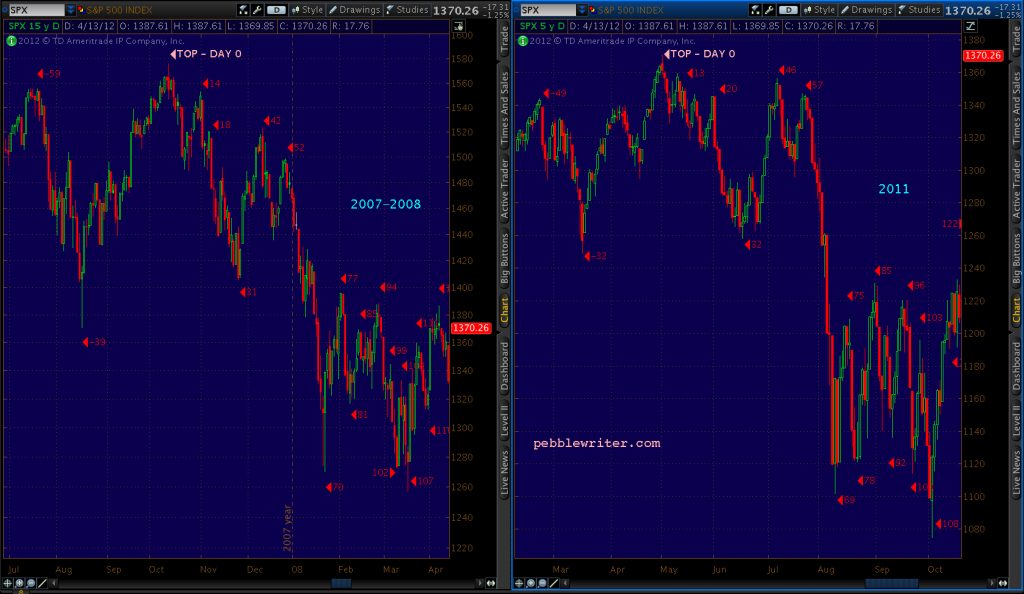
While our analog has done a bang up job, there are so many financial trip wires ahead that it’s almost impossible to imagine a 150-pt SPX rally over the next few weeks. By the same token, it is impossible to imagine the Fed and the ECB sitting back and letting the whole mess slide over the cliff without at least trying to reel it back in.
Consequently, this post will ignore the looming economic disasters — any one of which could usher in a repeat of 2008. It’s not that I think they should be ignored; but, I’m going to set them aside so we can focus instead of what our charts say. We’ll start with currencies.
The Dollar
The dollar just hit a brick wall — namely, a channel that dates back 13-15 years. Not only has DX bumped up against the upper bound of this huge channel, it just reached the .618 (yellow pattern) of its most recent drop and is tagging a fan line off its 71.05 low.
 Because anything looks great compared to the euro (which is the largest component of DX), we’ll look at the USDCHF, too. The 20-yr weekly chart shows the USD is running into resistance on two different TLs.

EURUSD
But, as we recently learned from the EURUSD, long-term channels and fan lines are not impervious to a well-mounted challenge.
 The pair sliced through the fan line from the 2000 lows like a hot knife through βούτυρο. It completed a back test and is threatening to head straight to 1.12.
Notice that each of the two prior times EURUSD broke one of those big, red dashed fan lines from 2000, the subsequent drop was rapid (highlighted in the ovals.) Prices fell to the bottom of the big purple, dashed channel in only 7-8 weeks.
 If the same thing occurs this time, we’re looking at between July 15-30 — meaning prices fall within the little purple channel which is parallel to the two previous plunges. So, watch to see whether prices follow that channel or stay with red dashed channel which bottoms out after Dec 6.
 Note that the small solid purple channel intersects the large dashed purple channel at the .618 retracement of the .82 to 1.60 rise — normally good for a very decent bounce.
In the end, I think the RSI gives the best hint as to the future. EURUSD appears to have hit the midline of the little red channel, as well as the midline of the larger yellow channel and a fan line off the May 2010 RSI low.

Summary
An immediate and rapid plunge in EURUSD would likely mean DX blasts through its limiting channel and equities take a major hit. But, I think it’s more likely that DX bounces off its .618 — or at least takes a breather — while the euro does its level best to stay alive.
A 2-3 week respite for the euro would fit in nicely from a time standpoint with an equities rally. It’s what happened in 2011 (our analog) and I can see it happening here. I feel just confident enough to continue playing the upside in stocks, but will keep a close eye on the escape hatch just in case.
S&P 500:
For starters, I don’t see a huge decline setting up on equities without more significant divergence. Compare the daily RSI of the 2000 and 2007 market tops with that of the most recent high. Negative divergence arises during periods of distribution, and we’ve seen precious little of it just yet.
 Th weekly RSI can be charted with a sizable variety of trend lines and channels and lends credence to the idea of strong support here — although there is a parallel TL that makes a case for a downturn. I know this is a rat’s nest, but follow along if you can.
 There are three separate TLs of support — each of which helped establish previous key bottoms — and only one TL of resistance.
The daily RSI is the one we’ve been watching for weeks. RSI is back testing a broken trend line (a-5). The top case is we go up and tag the pink oval; an alternative is the purple oval that would require a more vigorous back test. In either case, we’ve retaken the midline and are are likely to stay north of it going forward.
 More in the morning.
UPDATE: 10:05 AM
Conference Board May consumer confidence came in well below consensus of 69.7:
The Conference Board Consumer Confidence Index®, which had declined slightly in April, fell further in May. The Index now stands at 64.9 (1985=100), down from 68.7 in April. The Expectations Index declined to 77.6 from 80.4, while the Present Situation Index decreased to 45.9 from 51.2 last month.
This is the lowest reading in eight months and makes for a more menacing-looking trend.
 Meanwhile, the Case-Shiller Home Price Index also came in slightly better than expectations. Consensus was for -2.8% y-o-y for the 20-city index. Actual came in at -2.6%. In other words, housing is still losing value — just not as fast as it was.
Nationwide and in the 20-City Composite, housing values are back to late 2002 levels. The 10-City composite is back to early 2003 levels.

 And, the Dallas Fed released its Manufacturing Outlook Survey this morning. The General Business Activity index came in at -5.1% versus consensus of +3%. And, the index of future General Business Activity dropped precipitously, from 15.7 to 4.3. Production held steady, but respondents reported increasing raw materials costs in a flat pricing environment and increasing capacity utilization.
The percentage of respondents reporting a worsening in current conditions or future outlook continues to grow.
 Naturally, the markets are up strongly on all this cheery economic news.