Actually, it’s the 5th test in the past 10 sessions of this internal trend line that, by all rights, shouldn’t be very important. If the market weren’t so fragile, I’m sure we would have seen new highs somewhere along the way.
Even with VIX hammered by 35% since the Aug 5 lows, however, ES has continued to struggle with this trend line — which makes it a very important test.
Our analog suggests is will hold one last time before Jackson Hole silliness grips the market over the next few days. Stay tuned.
Futures weren’t able to push through resistance yesterday despite several algo-goosing efforts by the administration. This leaves an opportunity for one more downturn before Jackson Hole gets rolling.
Our analog remains on track, with the two session bounce currently testing the same trend line resistance that shut down the two previous bounces.The next session or two should help fine tune our timing.
While stocks are causing whiplash for investors everywhere, bonds continue their predictable ways — begrudgingly getting the respect they deserve.
Yesterday, the 10Y tagged our 15.54 target set late last year [see: Dec 26 Update on Bonds.] It now sits at critical support, seemingly holding the fate of equities in its hands.
SPX plunged 86 points yesterday to 2839.64, 4 points below the Day 13 optimized price target indicated by our analog [see: Analog Watch July 15] when last updated on Aug 5.
The dilemma that target posed is that SPX already tagged it on Aug 5. It was unclear, therefore, whether we’d get a slightly lower low or closing low on August 14 before the strong bounce ensued. I posted a slightly lower secondary target at 2816.47 that would accommodate the analog and another at the SMA200, now at 2795.73.
The other dilemma is that SPX peaked two sessions early. I adjusted each turning point forward by two days but, as we discussed at the time, an adjustment wasn’t necessarily appropriate. We’ll only know for sure when the next bounce commences.
Several hours ago, it looked as though the 2816 target would get tagged. Futures reached 2817.75 around 3:30 ET (yes, I was watching…I lead a very exciting life.)
It didn’t last, however. So, anyone holding short for the idealized target in the cash market could face the same dilemma as on Aug 5 when futures tagged an important downside target (the SMA200) after hours and bounced before SPX had a chance to follow suit.
Regardless of whether or not SPX makes it down to 2816.47 (probably) or 2795.73 (possibly) yesterday’s collapse was an excellent test for our analog. It is very clearly on track.
Speaking of things going as planned, DB just tested its Jun 3 lows. It has a long tradition (thanks to a very generous Uncle Mario) of bouncing at horizontal support — sometimes for years. So, I’d take profits here and only re-short on a drop through 6.49. The charts indicate lower prices ahead — though it’s always possible the ECB will come up with a better solution than lowering rates and increasing QE.
While we’re on the topic of easing…anyone happen to catch this morning’s economic data? Retail sales and labor costs hardly support a rate cut, let along multiple rate cuts. From Briefing.com:
In Seinfeld lore, the Soup Nazi was notorious for denying soup to those who didn’t follow a strict regimen and express proper reverence when ordering his amazing soup. Even a minor infraction would elicit a fierce “no soup for you!”
In a recent conversation with a friend who went to Wall Street when I did (100 years ago), he correctly observed that macro forecasts had become incredibly difficult since a simple presidential tweet or Fed president gaff could exact enormous swings in the markets.
Frequently, these swings are sharp rallies such as yesterday’s — occasionally sharp plunges. Rarely do they represent an important shift in the economic landscape. But algorithms’ swelling importance means the repercussions can be way out of line with the new “information” and markets reverse the following day — as will be the case today.
There’s an important lesson to be drawn from this frequent detachment from fundamentals: don’t put all your eggs in the fundamental basket. Sometimes, as has been the case lately, they do a very poor job of providing direction.
Technical analysis and chart patterns, on the other hand, have done a masterful job of accurately forecasting turning points. The latest example: forecasting the recent top (within 0.6% of the forecast peak) and the subsequent selloff weeks in advance [see: Analog Watch, July 15.]
Today’s reversal will hopefully confirm the accuracy of this analog posted a month ago. If confirmed, it forecasts another 20+ large (think 10%) swings over the next 9 months. Ideally, we’ll hit ES 2817 or even 2793 by the end of the day. SPX will shed over 100 points at its lows.Today’s minor infraction, of course, is that the 2s10s has officially inverted. Will investors care? Should they?
The last time this happened was May 2, 2007. Stocks yawned, as it was one of a series of inversions that began in December 2005. Following that initial inversion, SPX shrugged it off and continued rallying in fits and starts for another 5 1/2 months when it dipped all of 8% into mid-June 2006 before rallying 29% to the Oct 2007 top.As we’ve discussed many times, it’s not inversions that trigger a correction/crash. It’s the sharp unwinding of an inversion. When 2s10s spiked higher — the result of the 2Y plunging faster than the 10Y — the Great Financial Crisis had arrived.
Following that last inversion in May 2007, SPX barely paused on its way from 1313 to a new high at 1576. But, once the 2s10s topped 20 bps, SPX quickly ran out of upside.There are both similarities and differences between now and then. For instance, when 2s10s began spiking higher, the 10Y was around 4.8% and the 2Y was around 4.6%. There was plenty of room for rates to decline.
With the 2Y and 10Y currently at 1.6%, it’s a very different backdrop which presents very different challenges to central bankers.
Core CPI excludes the volatile food and energy component. We’ve heard that expression countless times. It’s intended to calm everybody down — inflation isn’t as bad as it seems if we back out rapidly rising prices in food and energy.
The BLS is even conditioned to explain the monthly data in the same way every month. From this morning’s report:
Increases in the indexes for gasoline and shelter were the major factors in the seasonally adjusted all items monthly increase. The energy index rose in July as the gasoline and electricity indexes increased…
BLS’ underlying data shows a 2.5% MoM increase in gasoline prices and a 3.3% decline YoY. But, does this look like rapidly rising energy prices? Inflation has been ticking higher even though the trend is clearly to the downside.
As we can clearly see, Core CPI has been outpacing CPI that includes food and energy ever since Nov 2018 — the result of an administration trying desperately to keep inflation, and thus interest rates, low enough to keep the bull market going (at least until election day.)
The 2s10s plunged on the news to .0329 — the lowest level since Jun 2007. And, the futures are struggling with the realization that a rate cut is going to be difficult to justify with inflation that exceeds the long-held target.
Our analog remains on course, with tomorrow being a critical day in determining any adjustments which need to be made.
It’s now been almost a month since we posted our analog-based forecast [see: Analog Watch July 15.] If it’s valid, we should see a sharp selloff over the next few days which ushers in 9-12 months of increased volatility and losses. From that post:
Ideally, an analog provides exceptionally accurate forecasts of a very significant move. I think this could be one of those and that stocks are on the cusp of the biggest drop since the Great Financial Crisis.
With currencies and VIX on board, all we need is for oil’s bounce to fizzle in order for the bears’ party to get started.Next up…lower lows?If it’s not valid, we’ll know very soon.
Core PPI fell in July for the first time since early 2017, registering a 0.1% decline versus a 0.1% consensus gain. The annual rate was 2.1%, also the lowest since 2017.
Stripping out trade services as well, the index fell (-0.1%) for the first time since 2015. The annual rate was 1.7% versus +2.1% in June.
Adding in food and energy, PPI gained 0.2% MoM, even though oil prices fell in July. To complicate things, the cost of goods rose 0.4% in July.
Bottom line, these data are not reflective of a strong economy, let alone the “greatest economy in the history of America.” This is an economy which is struggling despite historically low interest rates.
In our last update [see: June 17 Update on Gold] we looked at GC’s latest assault on the horizontal resistance at 1370 — the target we established when resuming a long position in May. It had tested this resistance multiple times since 2016 — and failed. Given that DXY was overextended, this time seemed different.
History says GC will be rebuffed somewhere between today’s highs and 1380.90 and will retreat to around 1224-1241.60. But, as long as GC can remain above 1346.70, it makes sense to remain long with stops back around 1345. Maybe this will be the time it finally breaks out.
In fact, this time was different. GC popped through 1370 with little fanfare and, after some hemming and hawing, tagged our next upside target at 1484 earlier this week.
This begs the question we’ve been asking for several years, now: what will happen if gold ever completes the gigantic Inverted Head & Shoulders pattern?
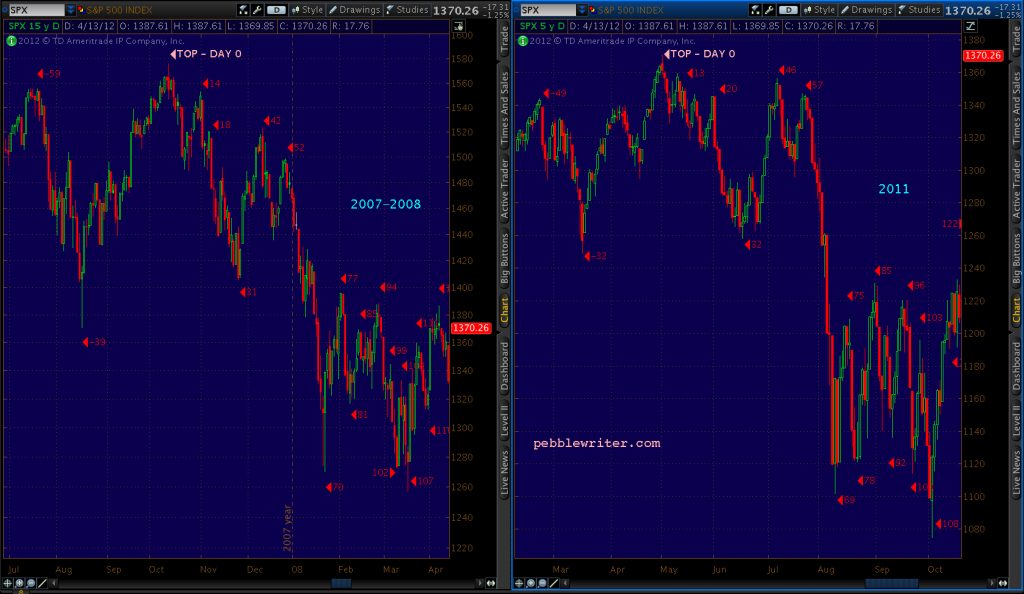

 Our analog suggests is will hold one last time before Jackson Hole silliness grips the market over the next few days. Stay tuned.


