I called a top in SPX on May 20, 2015 [see: The Last Big Butterfly] because it was about to reach the 1.618 Fib extension at 2138 — our upside target from way back in 2012. SPX peaked the following day and fell over 300 points before it was all over.
What I didn’t notice at the time was the bond market. We’ve focused on this from time to time, most recently on Dec 29 [see: Should You Fear the Yield Curve?] We noted at the time that while the spread between 10Y and 2Y was dropping rapidly, it only represented a warning unless it bottomed out and rose rapidly. From that post:
…the above shows that while the potential is there for a recession, this is just an early warning at this time. If the yield curve bottoms out here and rapidly steepens, we’ll have a lot more to worry about.
Two sessions later, the spread did bottom out, and has been on a tear ever since. What does this mean? Let’s look at how things unfolded in the past.
The spread had been tightening since Dec 31, 2013. It bottomed in Feb 2015 and began rising again. In early May, it broke above a trend line (red, dashed) connecting its highs.
About the same time that SPX was peaking, it backtested that TL and continued higher. It broke trend (purple, dashed) around Jul 31, a few days before SPX fell off a cliff. It broke down to new lows (the red, dotted line) in Jan 2016, about the same time that SPX bottomed out. What the yield curve said, then, in simple terms:
– a breakout from the downtrend marked an equity top (bearish)
– a breakdown of the subsequent uptrend was really bearish
– a break to new lows represented a potential bottom (bullish)
Before I go any further, I want to point out that there were four significant bottoms in 2015-2016. The first two came close to backtesting the 1.272 Fib at 1823, but didn’t quite make it. The second two did. Now, let’s look at the same period, but comparing the 10Y (TNX) itself to SPX. Note that SPX peaked shortly after TNX reached the falling red TL, and began having trouble once TNX broke out.
SPX fell off its cliff when TNX fell back through the rising purple TL, making bottoms each time TNX did. On Jan 20, 2016, TNX tested its Aug and Sep lows, at which point SPX bottomed at 1812. A week later, TNX plunged below the previous bottoms and didn’t bounce until it reached the Jan 2015 lows (dashed, purple line.)
 The message delivered by TNX was slightly different from the 10Y2Y:
– rising up to tag the falling trend line represents a bearish turning point
– breaking out above it is okay, as long as the uptrend continues
– a breakdown of the subsequent rebound is really bearish
– stocks won’t bottom until TNX does
If we look at the chart below, we can see that the 10Y tracked the 10Y2Y quite closely until it diverged in late 2015 in a failed effort to support stock prices. It didn’t provide decisive support until it bottomed in Feb 2016 at its Feb 2015 lows. For a few brief days, the divergence disappeared. Why is this even remotely interesting, you might ask?
As in 2015, we have also experienced a huge divergence between the 10Y2Y and the 10Y itself. This is noteworthy in and of itself. But, the comparison gets even more interesting. As in 2015, we have had an extended slump (14 months vs 17 in 2015), a breakout above the falling red trend line, and a backtest of the trend line.
 The big differences, so far, are that the spread hasn’t gone on to new highs and that the (presumed) low came as spreads were peaking and only two weeks (versus 8 months) following the peak.
But, so far, the lessons from 2015 are holding. The breakout above the falling red TL definitely produced a drop in stocks. The backtest of the red TL has occurred, but it hasn’t quite reached the purple TL. As long as it continues bouncing and doesn’t drop back through that TL, stocks should be able to continue rising. The day it drops back through it, things could get nasty.
Next, let’s look at the current TNX chart. We could look at the drop since the Mar 2017 highs, but it was rather short-lived and the subsequent rebound has resembled a moon shot. Instead, let’s look at the big picture.
A trend line from the 2008 highs connected with the 2010, 2011 and 2017 highs. After reversing at each, TNX was accompanied by a large drop in stocks. TNX’s reversal from its 2013 highs never produced a stock selloff; but, then again, it didn’t quite reach the TL.
 Zooming in a little, we can see that TNX reached this trend line a couple of times in 2017: first, in March, when its reversal accompanied by a mild 78-pt drop in SPX, and again on Dec 20 in a reversal which never gathered any steam.
  TNX was back to and punched through the TL on Jan 8. It reached another TL (gray) drawn through other recent highs on Jan 22 at 26.65. This was a potential top, meaning the bond folks breathed a sigh of relief.
On Jan 26, however, it popped up through the gray trend line. Not so coincidentally, that was the day that SPX peaked. Remember our lessons from TNX in 2015:
1. reversing off the falling trend line represents a bearish turning point – it didn’t reverse
2. breaking out above it is okay, as long as the uptrend continues – it did, but as it approached 3%, folks started getting nervous.
3. a breakdown of the subsequent rebound is really bearish – we got a potential reversal at 29.43, but it has a long ways to go before reaching the rebound trend line, currently at 24.40.
Interestingly, that TL intersects the falling red TL at about 24.60 on Mar 13, the day that CPI for February is reported.
And this is where it gets interesting. If TNX continues to rally, bond folks and equity folks will get nervous (the fiscal fiasco.)
If it were to fall to the rising purple trend line and backtest the red trend line at 24.60, it might be somewhat bearish unless: (a) it reflects a big drop in inflation (in keeping with my oil and gas forecast) and (b) it rebounds there.
If it fell below 24.60, the TNX lessons suggest that SPX would be in big trouble. With a Fed meeting a week later, we can assume Powell et al would be focused on preventing that from happening. But, as our analog suggests, this preceeds an important inflection point by just a few weeks.
If TNX falls through 24.60, remember lesson 4…
4. stocks won’t bottom until TNX does
* * *
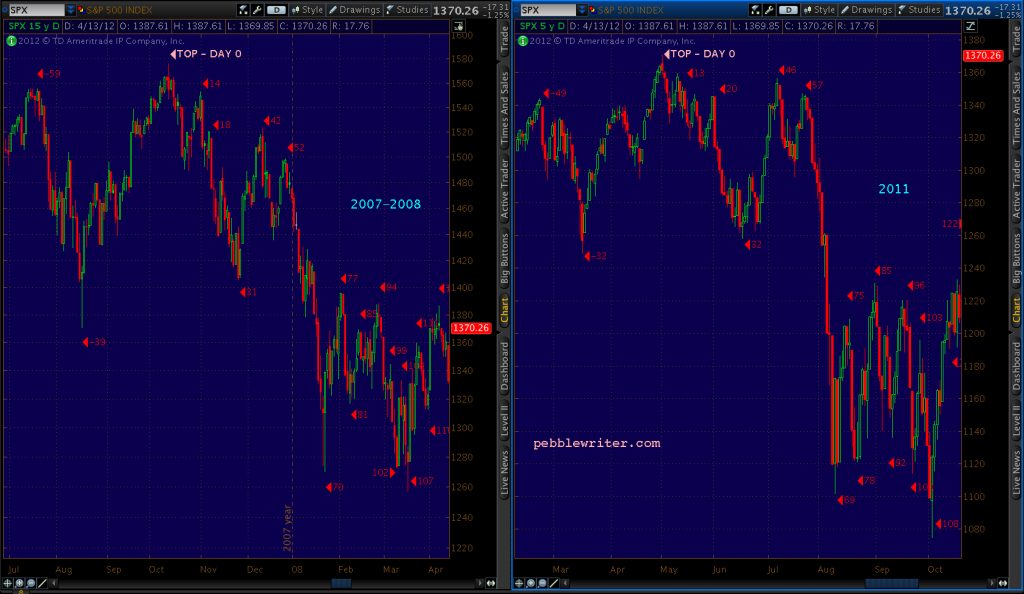
Now, onto our analog update. In our initial post and follow up from Feb 6-7 [see: Analog Watch], we anticipated SPX would rebound from 2533 (our downside target) to 2765 by Feb 14 and 2812 by Feb 23. Instead, it bounced from 2532.69 to 2742 on Feb 16 and to 2789 — 23 points short and 4 days late — by Feb 27.
An adjustment was clearly necessary, given that SPX and ES bottomed on different days. We’ll try to reconcile the two, along with some economic forecasts which are definitely outside the norm.
continued for members… (more…)

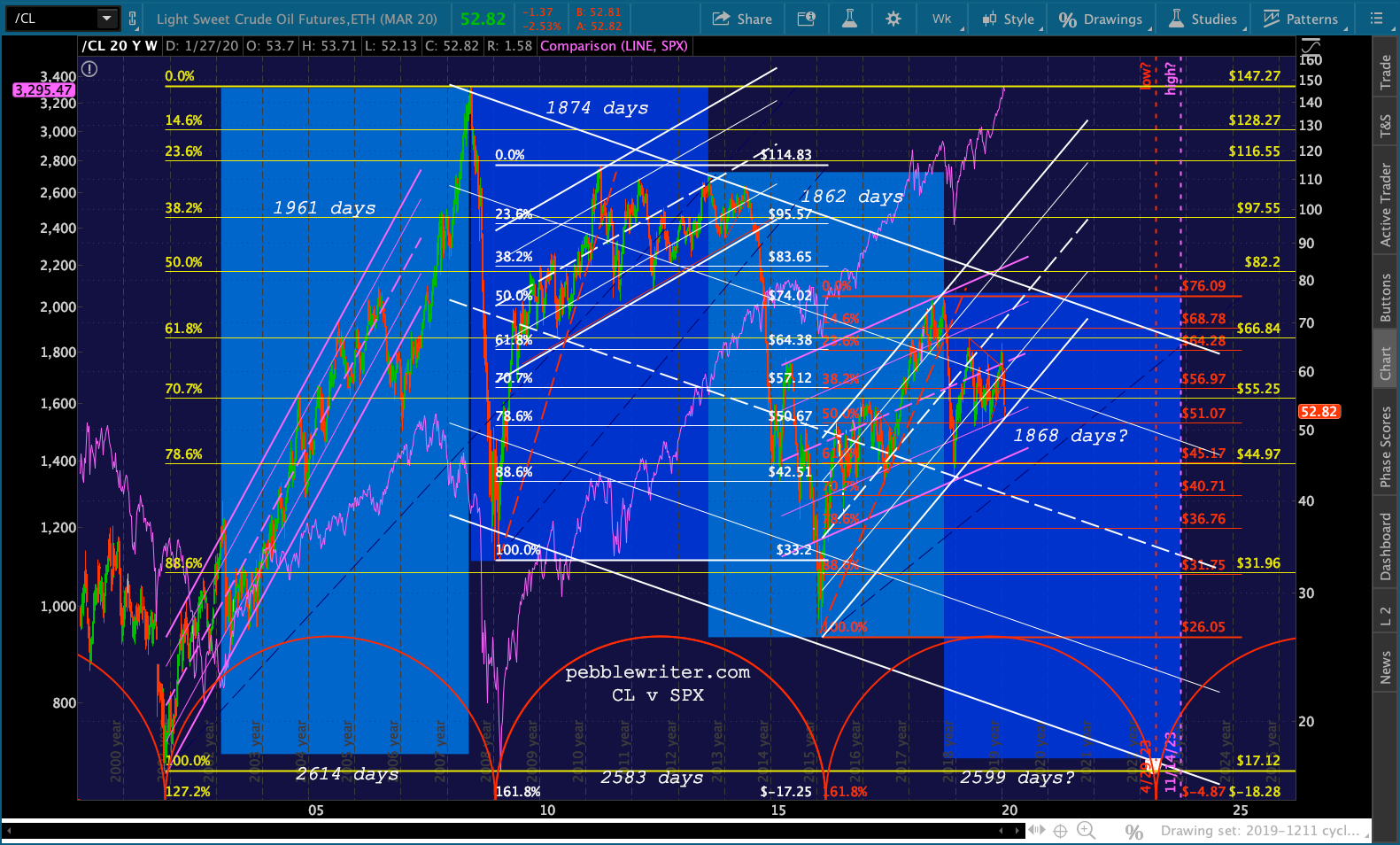
 As members know, these are critical support levels. A breakdown would be devastating to oil and gas and present stocks with very strong headwinds.
 Futures, now at 3260, are headed straight for our next downside target at 3200.
 Yes, the coronavirus is potentially a very big deal. But, this decline in oil and gas was baked into the markets over a year ago and is a strong endorsement for our inflation model.


