It was October 1989 and the stock market was in trouble. Two years after crashing 36% (including 20% in a single session) the S&P 500 had made a comeback and had climbed back to new all-time highs. But high inflation, slipping junk bond prices and failing S&Ls were in the headlines daily. On October 13, stocks slid nearly 7% – back below the 1987 highs. It was time for action.
 Two weeks later, recently-retired Fed Governor Robert Heller penned an op-ed in the Wall Street Journal that advocated a more active approach than simply tinkering with money supply and interest rates.
The Fed, which “already play[ed] an important indirect role in the stock market”…”could buy the broad market composites in the futures market. The increased demand would normalize trading and stabilize prices. Stabilizing the derivative markets would tend to stabilize the primary market.”
The Fed apparently didn’t take his advice, as it continued to whipsaw for another 15 months before finally breaking above the 1987 highs to stay, relying on an barrage of rate cuts, crashing oil prices, aggressively bullish Fedspeak, and a cut in capital gains taxes. Thirty years on, there is much circumstantial evidence that the Fed has bought into Heller’s suggestions. JPMorgan estimates that “fundamental discretionary traders” account for only about 10 percent of trading volume in stocks. This means that 90% of trading either keys off of quantitative techniques or is passive (i.e. follows the quants’ lead.)
The upshot? Triggering a few big quant managers to buy stocks can cause an avalanche of buying by index funds, ETFs, smart beta funds, etc. Picture a $50 billion tail wagging a $30 trillion dog.
If it seems complicated, I assure you it’s not. It often occurs overnight, when low-volume equity markets readily respond to, say, sharp declines in VIX futures or a spike in the USDJPY — tried and true signals that rarely fail to ignite rallies. We had a prime example today in the wake of Iran’s attack on US air bases in Iraq [see: We’ve Seen This Movie Before.]
VIX, which closed flat yesterday, rose sharply after the close until 7:41PM ET, at which point S&P 500 futures reached an important level of technical support. From there, VIX began an orderly decline, spurring ES to new all-time highs when it dropped below its recent lows. We’ll never know whether the Fed itself is triggering algorithms to buy until it accedes to being audited. Unlike the Bank of Japan or the Swiss National Bank, the Fed doesn’t share its trading activity. The instigator could very well be another central bank, a proxie, or just a large quantitative player caught too far out over their skis when markets got dicey.
I’m not sure it matters all that much. The fact is that it’s happening, and happening more and more frequently — which smacks of a very directionally-biased player with access to plenty of cheap capital [of course, central banks sporting negative interest rates actually get paid to prop up stocks.]
Heller recognized the risks in such an approach, arguing that “the Fed’s stock market role ought not to be very ambitious. It should seek only to maintain the functioning of markets — not to prop up the Dow Jones or New York Stock Exchange averages at a particular level.”
Perhaps he didn’t appreciate, however, just how addictive support can become to both markets and politicians who rely on them for reelection. Consider how often stocks have rallied to new all-time highs on the breathless announcement of a breakthrough in the China trade wars.
As Dallas Fed President Richard Fisher said about QE in 2016, “the Fed front-loaded an enormous market rally in order to create a wealth effect… We injected cocaine and heroin into the system…and now we are maintaining it with Ritalin.” Central bankers would do well to remember that although addictions are tough to kick, they can be fatal if left untreated.
No one knows how much bigger the latest equity balloon can be blown. But, when markets lose their ability to fairly reflect the risk inherent in speculative investments, it’s time to start paying very close attention.
Here, in all its glory, is Heller’s op-ed from 1989. The highlights are mine.
* * *
Have Fed Support Stock Market, Too
By Robert Heller
27 October 1989
The Wall Street Journal
(Copyright (c) 1989, Dow Jones & Co., Inc.)
The stock market correction of Oct. 13, 1989, was a grim reminder of the Oct. 19, 1987 market collapse. Since, like earthquakes, stock market disturbances will always be with us, it is prudent to take all possible precautions against another such market collapse.
In general, markets function well and adjust smoothly to changing economic and financial circumstances. But there are times when they seize up, and panicky sellers cannot find buyers. That’s just what happened in the October 1987 crash. As the market tumbled, disorderly market conditions prevailed: The margins between buying bids and selling bids widened; trading in many stocks was suspended; orders took unduly long to be executed; and many specialists stopped trading altogether.
These failures in turn contributed to the fall in the market averages: Uncertainty extracted an extra risk premium and margin-calls triggered additional selling pressures.
The situation was like that of a skier who is thrown slightly off balance by an unexpected bump on the slope. His skis spread farther and farther apart — just as buy-sell spreads widen during a financial panic — and soon he is out of control. Unable to stop his accelerating descent, he crashes.
After the 1987 crash, and as a result of the recommendations of many studies, “circuit breakers” were devised to allow market participants to regroup and restore orderly market conditions. It’s doubtful, though, whether circuit breakers do any real good. In the additional time they provide even more order imbalances might pile up, as would-be sellers finally get their broker on the phone.
Instead, an appropriate institution should be charged with the job of preventing chaos in the market: the Federal Reserve. The availability of timely assistance — of a backstop — can help markets retain their resilience. The Fed already buys and sells foreign exchange to prevent disorderly conditions in foreign-exchange markets. The Fed has assumed a similar responsibility in the market for government securities. The stock market is the only major market without a market-maker of unchallenged liquidity or a buyer of last resort.
This does not mean that the Federal Reserve does not already play an important indirect role in the stock market. In 1987, it pumped billions into the markets through open market operations and the discount window. It lent money to banks and encouraged them to make funds available to brokerage houses. They, in turn, lent money to their customers — who were supposed to recognize the opportunity to make a profit in the turmoil and buy shares.
The Fed also has the power to set margin requirements. But wouldn’t it be more efficient and effective to supply such support to the stock market directly? Instead of flooding the entire economy with liquidity, and thereby increasing the danger of inflation, the Fed could support the stock market directly by buying market averages in the futures market, thus stabilizing the market as a whole.
The stock market is certainly not too big for the Fed to handle. The foreign-exchange and government securities markets are vastly larger. Daily trading volume in the New York foreign exchange market is $130 billion. The daily volume for Treasury Securities is about $110 billion.
The combined value of daily equity trading on the New York Exchange, the American Stock Exchange and the NASDAQ over-the-counter market ranges between $7 billion and $10 billion. The $13 billion the Fed injected into the money markets after the 1987 crash is more than enough to buy all the stocks traded on a typical day. More carefully targeted intervention might actually reduce the need for government action. And taking more direct action has the advantage of avoiding sharp increases in the money supply, such as happened in October 1987.
The Fed’s stock market role ought not to be very ambitious. It should seek only to maintain the functioning of markets — not to prop up the Dow Jones or New York Stock Exchange averages at a particular level. The Fed should guard against systemic risk, but not against the risks inherent in individual stocks. It would be inappropriate for the government or the central bank to buy or sell IBM or General Motors shares. Instead, the Fed could buy the broad market composites in the futures market. The increased demand would normalize trading and stabilize prices. Stabilizing the derivative markets would tend to stabilize the primary market. The Fed would eliminate the cause of the potential panic rather than attempting to treat the symptom — the liquidity of the banks.
Disorderly market conditions could be observed quite frequently in foreign exchange markets in the 1960s and 1970s. But since the member countries of the International Monetary Fund agreed to the “Guidelines to Floating” in 1974, such difficulties have been avoided. I cannot recall any disorder in currency markets since the 1974 guidelines were adopted. Thus, the mere existence of a market-stabilizing agency helps to avoid panic in emergencies.
The old saying advises: “If it ain’t broke, don’t fix it.” But this could be a case where we all might go broke if it isn’t fixed.
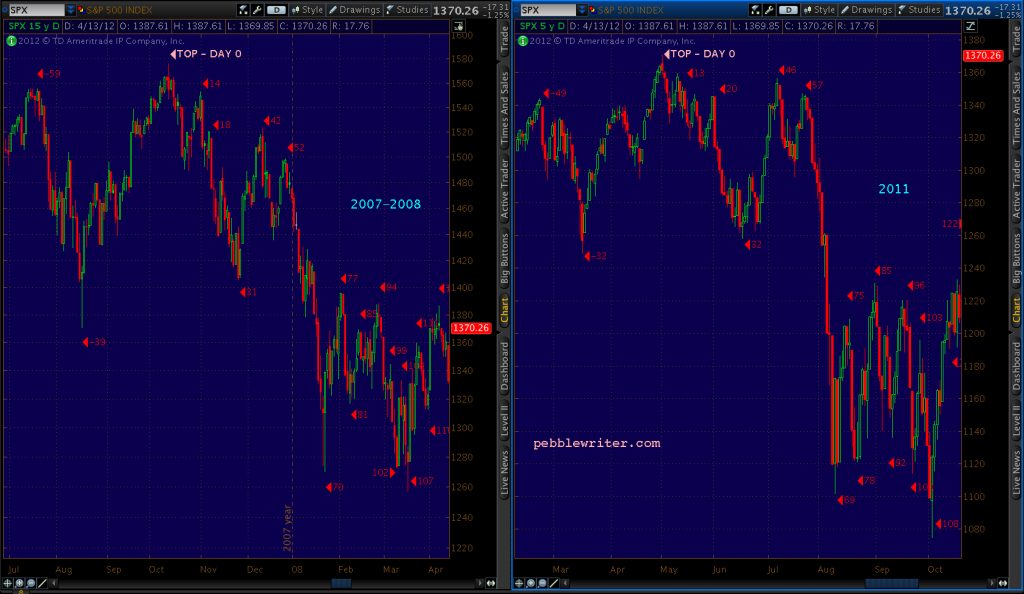

 The other one was the SPX arithmetic (as opposed to log) chart, which stopped on a dime at the channel bottom.
 The bleeding continued well past the Fed’s ineffectual $1.5 trillion injection and had to wait until the low-volume aftermarket to be staunched. At that point, central bankers went to work – pumping oil and gas, the dollar, interest rates and currencies in order to