Tag: SPX

  • Brave New World?

    I updated the charts for NDX, NYA, DJIA, RUT and COMP in the past few days.  The picture is mixed at best, with RUT, for instance, looking quite overripe, and COMP looking like it’s seriously considering 3343.  The DJI is happy as a lark making new highs, while NDX is coming up on all kinds of resistance at 2834.

    I suspect they’re all taking their cues from SPX right now.  And, SPX is still intent on joining the new all-time high club at 1576.10.  I see no reason why it can’t reach it, though we went to cash over the 3-day weekend just in case.

    The world didn’t come to an end over the weekend, so I’ll stay cautiously long with tight stops during the trading day and hope SPX doesn’t close at 1576.08.

    UPDATE:  10:03 AM

    The ISM’s Mfg PMI just came out and it’s a stinker.  SPX just backtested the yellow TL and quickly caught itself.

    Employment growing faster, while new orders and production are off?  No problem there.

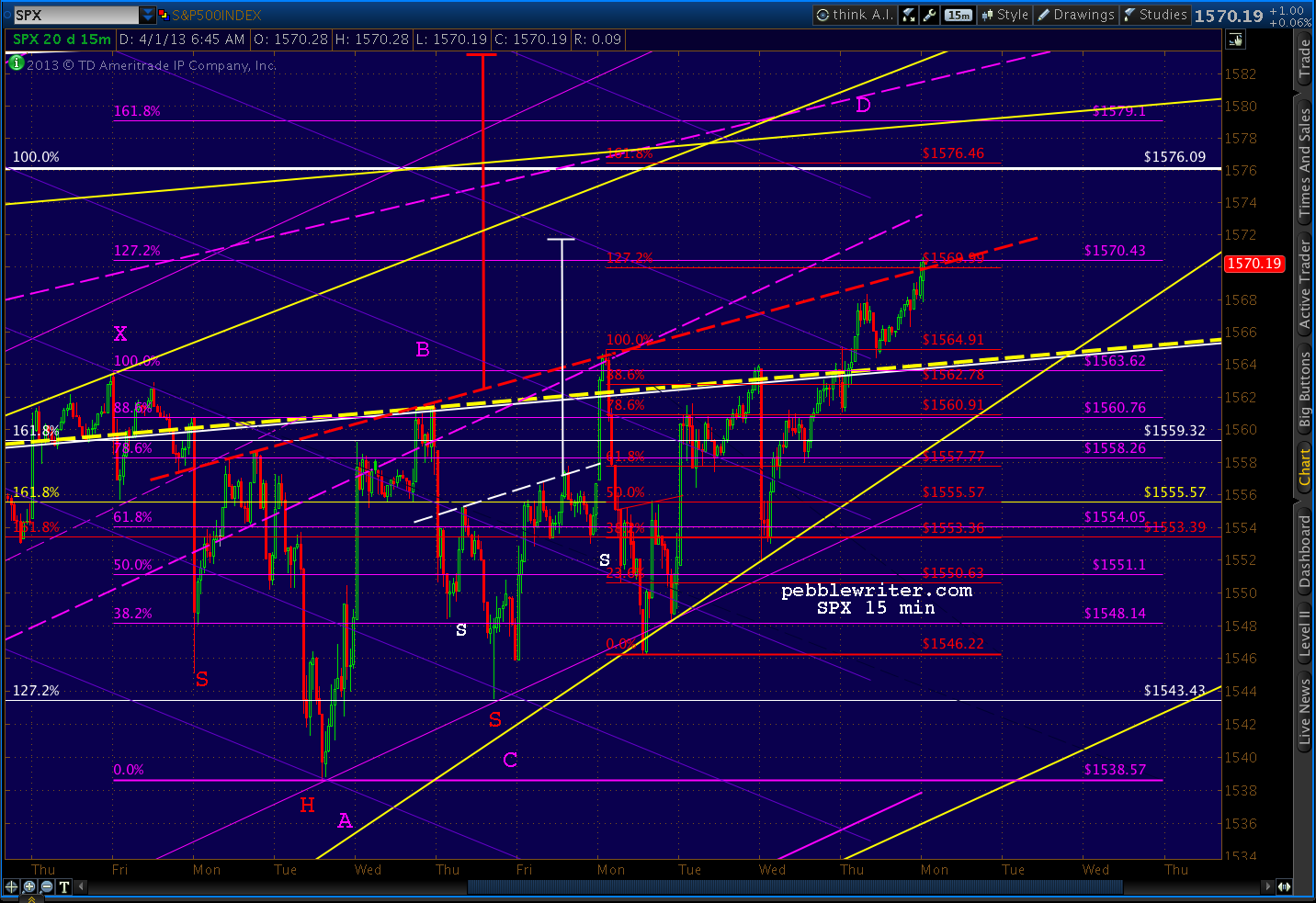
    The small red Crab Pattern targeting 1576.46 is very much intact, so I see no reason to panic now.  Eye on the prize, eye on the prize…

    UPDATE:  10:40 AM

    Pretty sure this is an effort to shake out the longs, but a drop through 1564 means 1555-1560 is in the cards, so I’m switching sides here.  Charts in a few…

    UPDATE:  10:50 AM

    Here’s the bulls’ short-term problem…though it’s not insurmountable.  Note the loss of momentum (white channel) on the 30-min RSI…

    …and 60-min RSI…

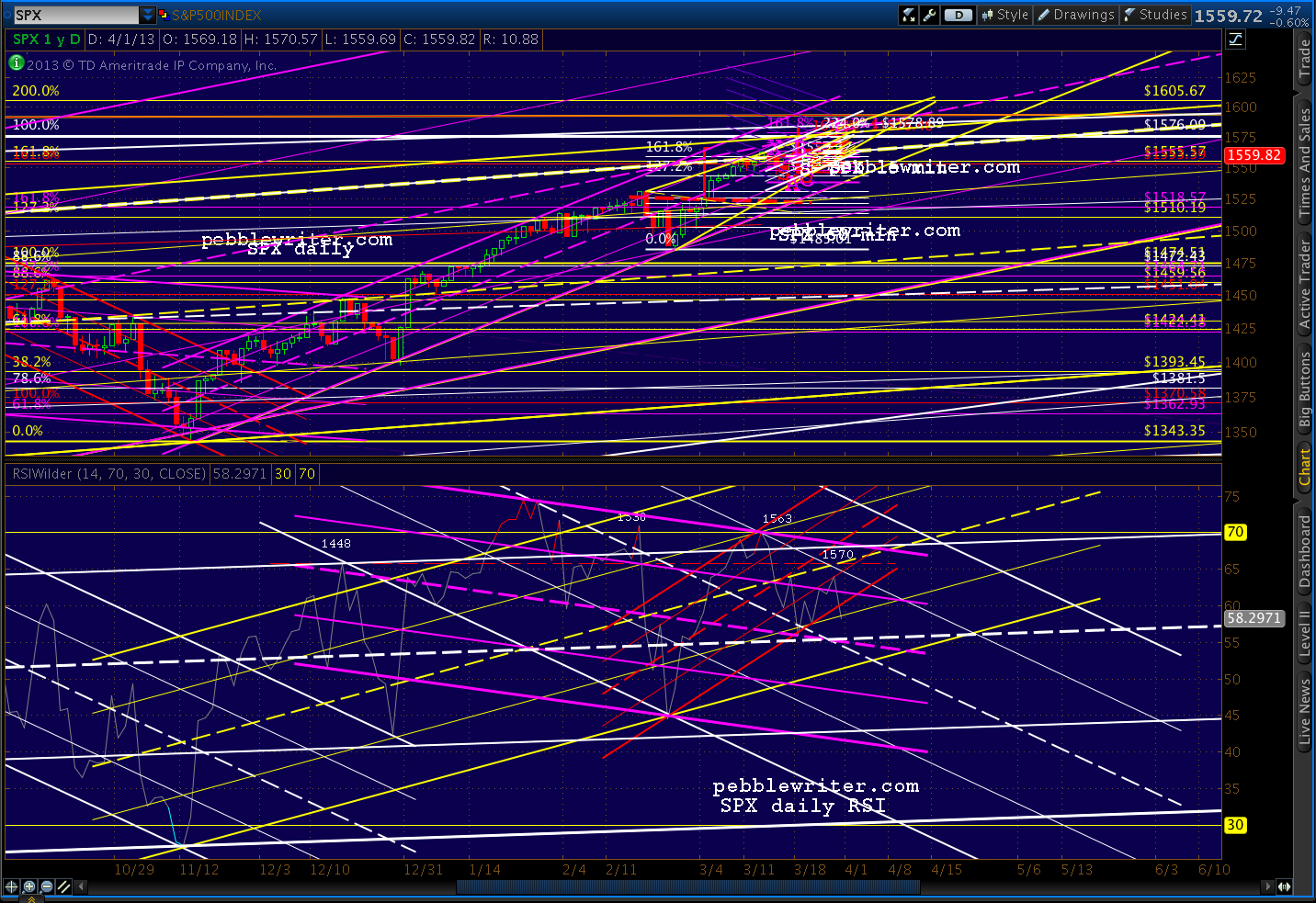
    The daily RSI also lost the purple .75 line and the bottom of the little red channel.  But, the .25 of the yellow channel dating back to the Nov bottom is right here around 1560 and could provide a floor.  If not, the white  midline is just below.

    We obviously have negative divergence on the daily chart, but that’s been going on since Jan 25.  It’s hard to ignore, however, the potential for the purple channel to take over from the yellow, and that could mean increased odds for downside here to the intersecting white/purple midlines at 55ish.

    From a price standpoint, SPX could find support at the white 1.618 of 1559.32, but the stronger support is at the .25 purple channel line at 1555-1556 — also the vicinity of the 1.618 extensions of the much larger Crab Patterns at 1553.39 and 1555.57.

    Bottom line, while the chop that began several weeks ago continues, SPX is growing technically stronger with these tiny little pullbacks that reset RSI.  It doesn’t mean we will top 1576, but it continues the theme of TPTB being very, very careful to lay all the necessary groundwork.

    The alternative, a sloppy, enthusiastic ramp like last September’s 2-day post QE3 rally to 1474, is less sustainable to be sure.

    UPDATE:  3:10 PM

    SPX got as low as the upper end of our target range from earlier, and has since melted back up to just below the 1564 trigger point.

    continued for members(more…)

  • Charts I’m Watching: Mar 25, 2013

    With Cyprus saved, the sanctity of the EU intact, and a US budget deal passed, we can all go back to watching the market ratchet up 10 points/day, right?

    Here’s the fundamental problem.

    continued for members(more…)

  • Anatomy of a Top: 2000

    The 2000 top shows just how “messy” tops can be.  Here’s the finished picture in perfect hind-sight.  It’s a very crowded chart, but every single pattern had a say in how the top unfolded.

    SPX had zoomed from 442 to 1478 in about 5 years, a not-too-shabby 234% gain for an annually compounded 27%.

    Once SPX broke out of the falling purple channel, it had “permission” to pursue several harmonic patterns in the works.  SPX shot up 66 points in that one day — blowing through every Fib level between .618 and 1.000.

    It finally came to rest at 1458, completing a Bat Pattern at the purple .886.  But, the small white 1.272 was just above at 1477, as was the rising purple channel midline and the 1.272 from a much larger pattern seen below.  An IH&S target waited at 1497 – tantalizingly close to a nice round number of 1500.  And, the all-time high of 1478 from two months earlier beckoned.

    SPX got up to 1477.33 before reacting, falling to 1466 over the next two days.  Close, but not quite.  Someone watching closely might have noticed the Flag Pattern it constructed, targeting 1562.  Someone else probably pointed out the biggest Crab Pattern target of all — the 1.618 extension of the 13% correction from 1420 to 1233 from Jul-Oct 1999.

    On Mar 21, 2000 SPX shot up through the channel midline, the cluster of Fibs around 1477 and, importantly, the 1478 high and raced up toward those higher targets.

    On Mar 24, it reached 1552.87, which cleared the IH&S target at 1497, the purple 1.272 at 1519 and the last remaining Crab Pattern at 1535.  What ultimately stopped it?  The .75 line from the big purple channel dating back to Jul 1999 — almost to the penny.

    Total move: 17% and 227 points in 20 sessions.  Can it happen again?  Stay tuned.

  • Charts I’m Watching: Mar 21, 2013

    ORIGINAL POST:  9:25 AM

    The EURUSD is still trying to change trajectories (purple channel to red), but hasn’t been able to break out yet.

    The dollar is similarly facing a change in direction if the red channel can hold.

    Judging from the futures, SPX is set to react off the neckline and TL we’ve been talking about for several days. Though, daily RSI still shows a little more upside potential.

    I’ll play along on the downside, but will be looking to see if it gains support at the purple channel midline.

    UPDATE:  09:23 AM

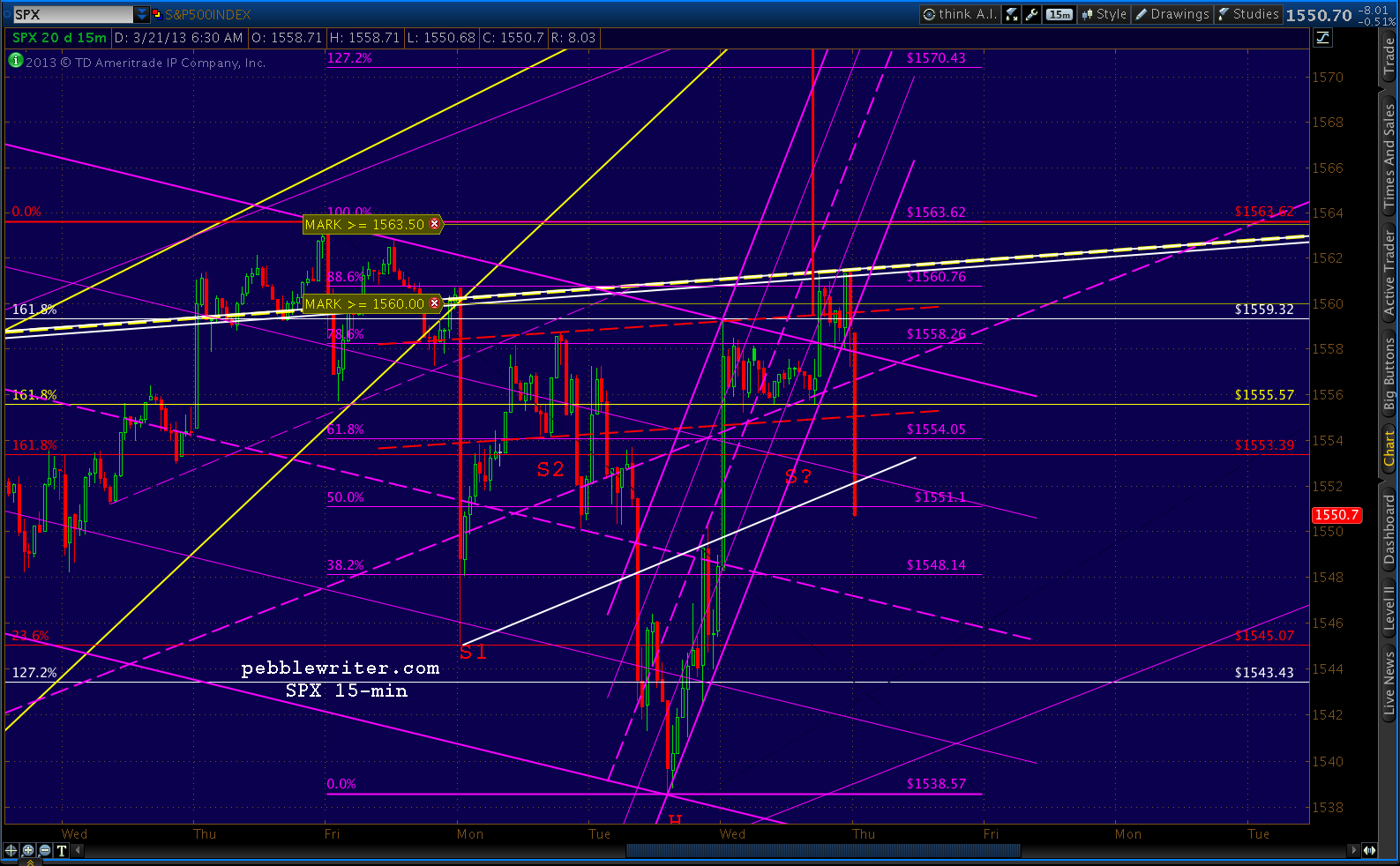
    That should do it for the short side, going full long again here at 1550.7 with stops at 1548ish.  Always fun, trying to catch a falling knife…

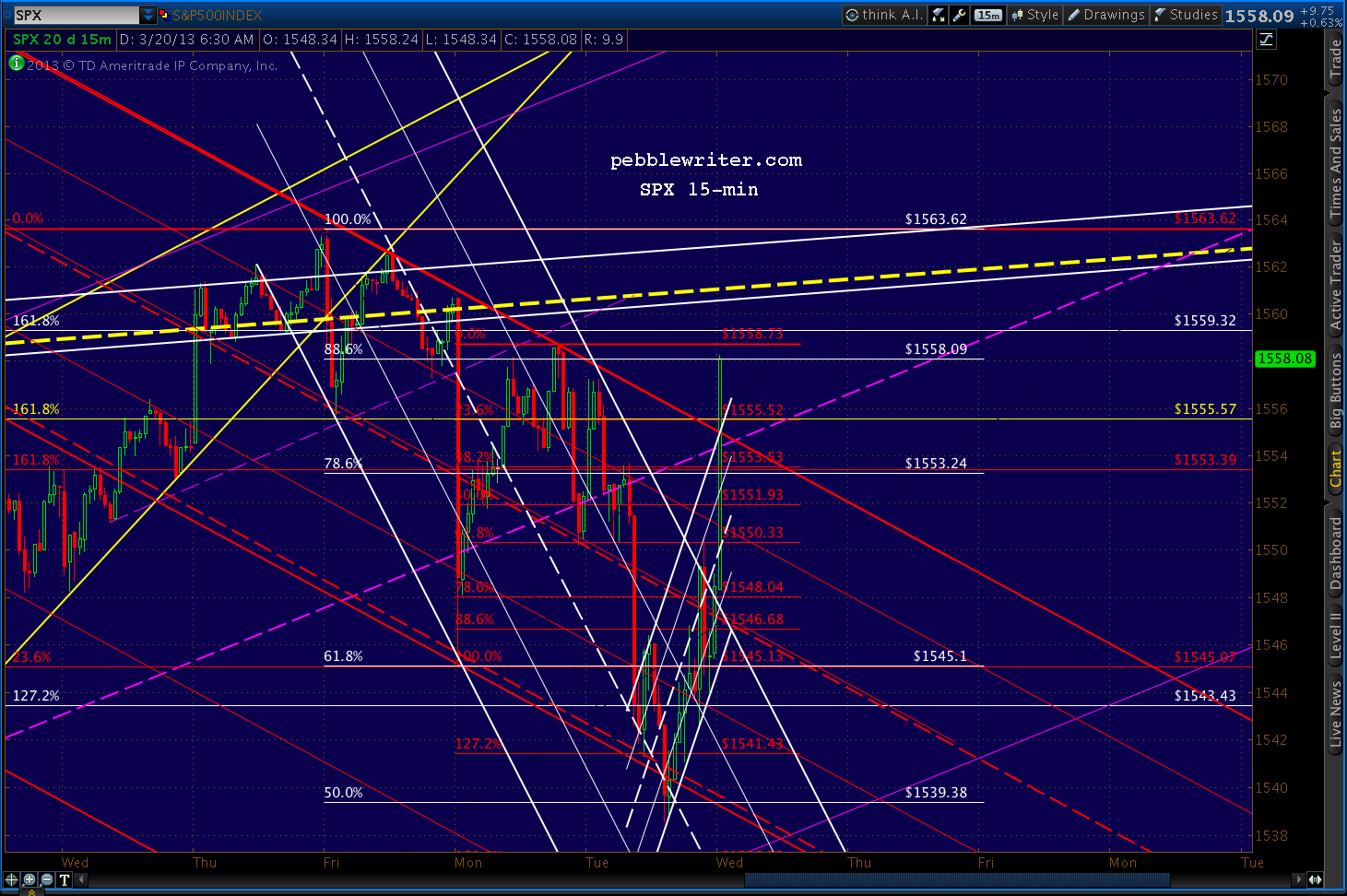
    The 15 min RSI shows support with SPX here at the .500 Fib.

    Fresh charts in a few…

    UPDATE:  9:50 AM

    If SPX reverses here, it leaves a much nicer right shoulder for the IH&S we discussed yesterday.  And, the revised purple channel looks more sustainable.

    Existing home sales, Philly Fed and Leading Economic Indicators are due out at 10 EDT.

    UPDATE:  10:01 AM

    Data better than expected on Philly Fed and Conference Board Leading Indicators, a miss on NAR existing home sales.

    The leading indicators look a lot more positive than the current, which barely moved.

    No charts for the NAR, but sales came in at 4.98 million vs expectations of 5.0 million.  Inventory increased from 4.3 to 4.7 months, which flies in the face of the most commonly heard argument that a shortage of product was driving prices higher.

    There are no doubt pockets of actual product shortages, just as there are many with a huge excess.  But, the price increases have more to do with math than with supply and demand at the moment.

    The NAR, like everyone else, reports average (median) prices.  The entire market could remain at a standstill, but if the bottom 5-10% (in price) of houses are bid up, the average price increases.  It wouldn’t affect the average house, just the average price of all houses.

    That’s why many average homeowners remain underwater and unable to sell their houses for the asking price despite the “good news” from the NAR/MSM.  So, what’s happening to bid up prices on the low end?  Enter our friends at the Fed.

    As Bloomberg reported a few days ago, big institutional money is chasing single-family homes.  With the stock market at all-time highs, bonds at 2% and much of the rest of the world in questionable economic condition, the new bubblicious investment is housing.

    Blackstone, which put $3.5 billion to work buying 20,000 houses, just increased its credit line by another $1.5 billion.  Colony Capital owns 7,000 units and is raising another $2.2 billion.  American Homes-4-Rent owns 10,000, and is buying up more.

    Institutions represent a large percentage of the buyers in many markets which have rebounded the most:  Miami (30%), Phoenix (23%), Charlotte (21%), Las Vegas (19%.)   But, will the dead cat bounce translate into profits for investors?

    As fools rush in, rents are falling in many of the markets in play — making it tough to derive much cash flow.  Colony Capital will be buying another $2.2 billion worth of houses, even though their current portfolio occupancy is only 53%.  In an environment of 2% 10-year treasuries, the 4-5% cash-on-cash yield might look pretty good — especially coupled with some degree of inflation protection.

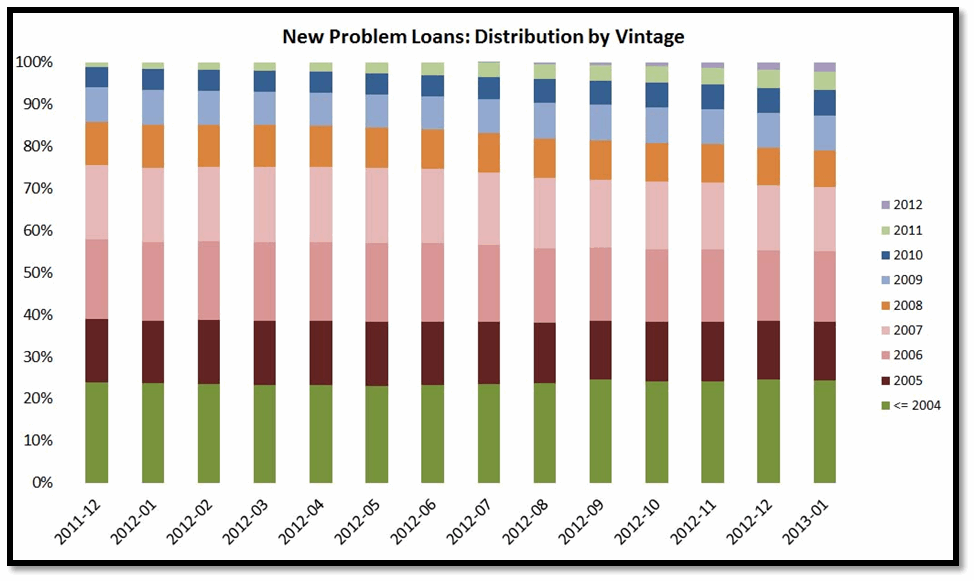
    I can’t help but think this is another big bubble in the making — courtesy of the Fed’s ZIRP.  Even after 5,000,000 foreclosures since the 2006 peak, new delinquencies continue to surface — including a steady contingent of older, more seasoned loans as this LPS chart shows:

    Global Economic Intersection ran a nice piece Tuesday posing a thought-provoking idea:

    “The housing market is therefore the hostage of economic growth and not the signal of economic growth.”

    The evidence of yet another liquidity-fueled, lack-of-any-better-alternatives bubble is here.  Investors must decide whether to button their chin straps and get in the game, or watch from the sidelines as the greater fools slug it out the red zone.  Stay tuned.

    UPDATE:  2:05 PM

    With the move down through 1548, I gave SPX a little more wiggle room to the .618 of the last move up at 1547.35.  It bounced, but couldn’t hold, prompting me to take a short-term short to cover my core long position.

    I’m closing the short here at the .786 of 1543.75 for a small gain.  More charts, revised channels coming up.

    The bullish case needs 1546.27 to hold firm.

    UPDATE:  2:30 PM

    Hard to keep up with charting this morning, with things moving rather quickly and dropping a little further than I expected.  Looks like the .786 will hold, but let’s make that the new stop.

    The 60 min RSI has found midline support at a potential falling channel (purple) and a rising channel which isn’t as convincing as I’d like (yellow.)

    UPDATE:  5:30 PM

    Weakness everywhere around the close.  I’m going to lay out the bullish and bearish scenarios, but from a chart pattern standpoint, this is a toss-up.

    Taking a look around the indices, I see a lot of indices at make or break points.  I just revisited RUT, a great case in point.  Drawn from the 98 and 02 lows, one channel makes a great case for the upside being done.

    The daily chart CU shows just how precisely we’ve tagged the top of that channel and the TL’s the make up the rising wedges.

    Drawing the channels off the 98 and 09 lows, however, shows RUT has already pushed above and backtested the channel top (in purple.)

    Throw in some Harmonic Patterns and things get really interesting…

    There was a big reversal at the .786 of the 2007-2009 crash, so we should expect a Butterfly Pattern to play out at the 1.272 of 996.26, right?

    But, look at all the TL’s of resistance we’d have to push through first…

    Besides the trend lines, the purple 1.618 hasn’t really caused a reaction yet.  The white 1.618 has, but not much of one.  And, note that the yellow pattern calls for a run to the 1.618 at 1033.  Mixed signals, to say the least.

    More in the morning…


  • Charts I’m Watching: Mar 20, 2012

    The ECB will do “whatever it takes”, which I guess now translates into strong-arming the Russians into bailing out Cyprus.  Still no break out on the EURUSD, though.

    It makes sense to play along with the upside, but keep stops close.  It’s questionable whether this rally will have any legs. The dollar looks like it’s finding support here.

    UPDATE:  09:33 AM

    Looks like a pop and drop by SPX standards.  That was the .786 of the move down from 1563.62 (purple) and the .886 of our proposed path to 1576 (white.)  Full short again, stops at 1561ish.  Revised charts in a few minutes…

    UPDATE:  09:55 AM

    The daily chart tells the picture well.  I need to redraw some channels, but the prominent features are:

    • large 1474-1343 Crab Pattern completion at 1555.57 (yellow)
    • large 1370-1074 Crab Pattern completion at 1553.39 (red)
    • small 1530-1485 Crab Pattern completion at 1559.32 (white)
    • small rising wedge broken at 1563 top
    • long-term TL and channel top at 1560

    UPDATE:  11:10 AM

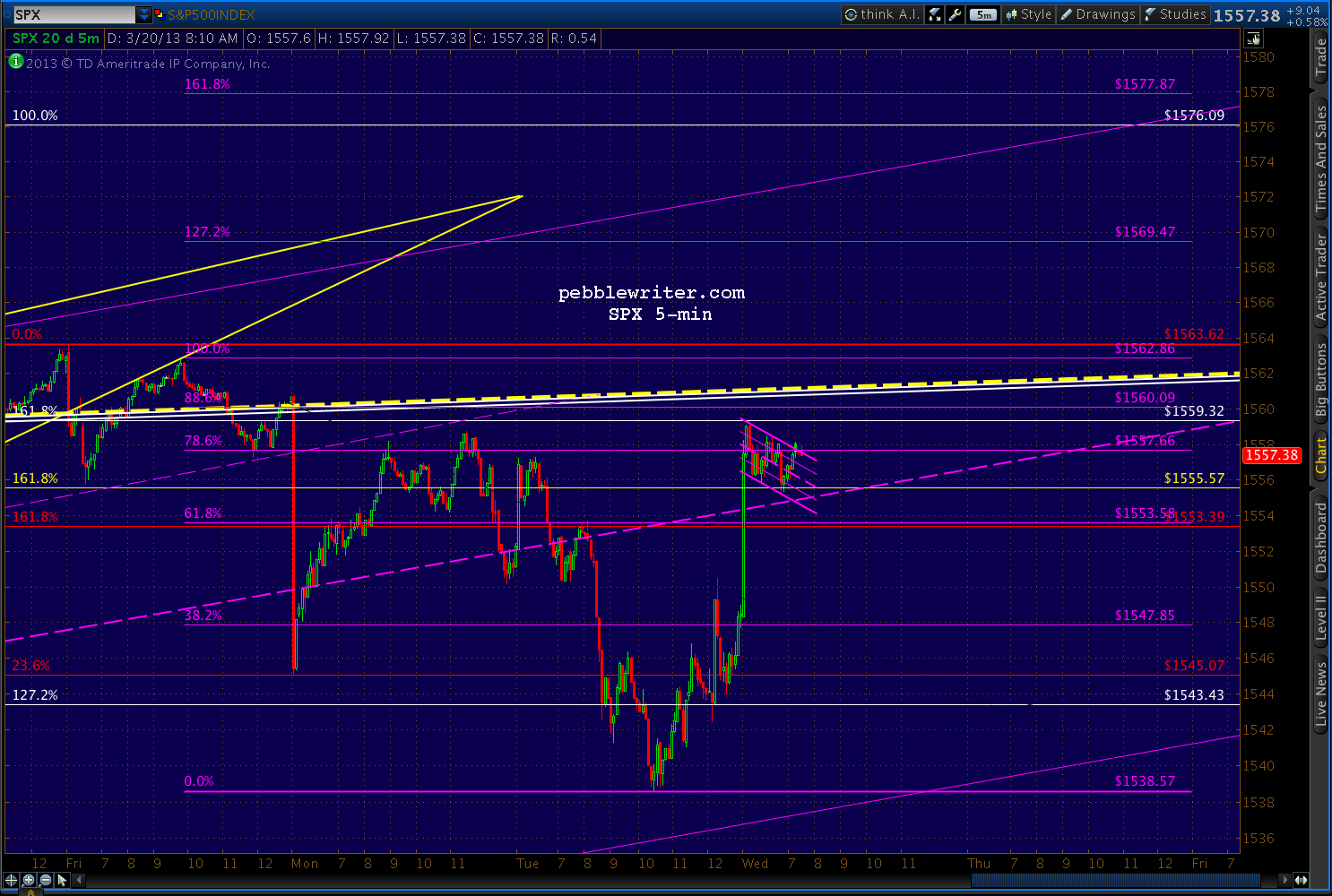
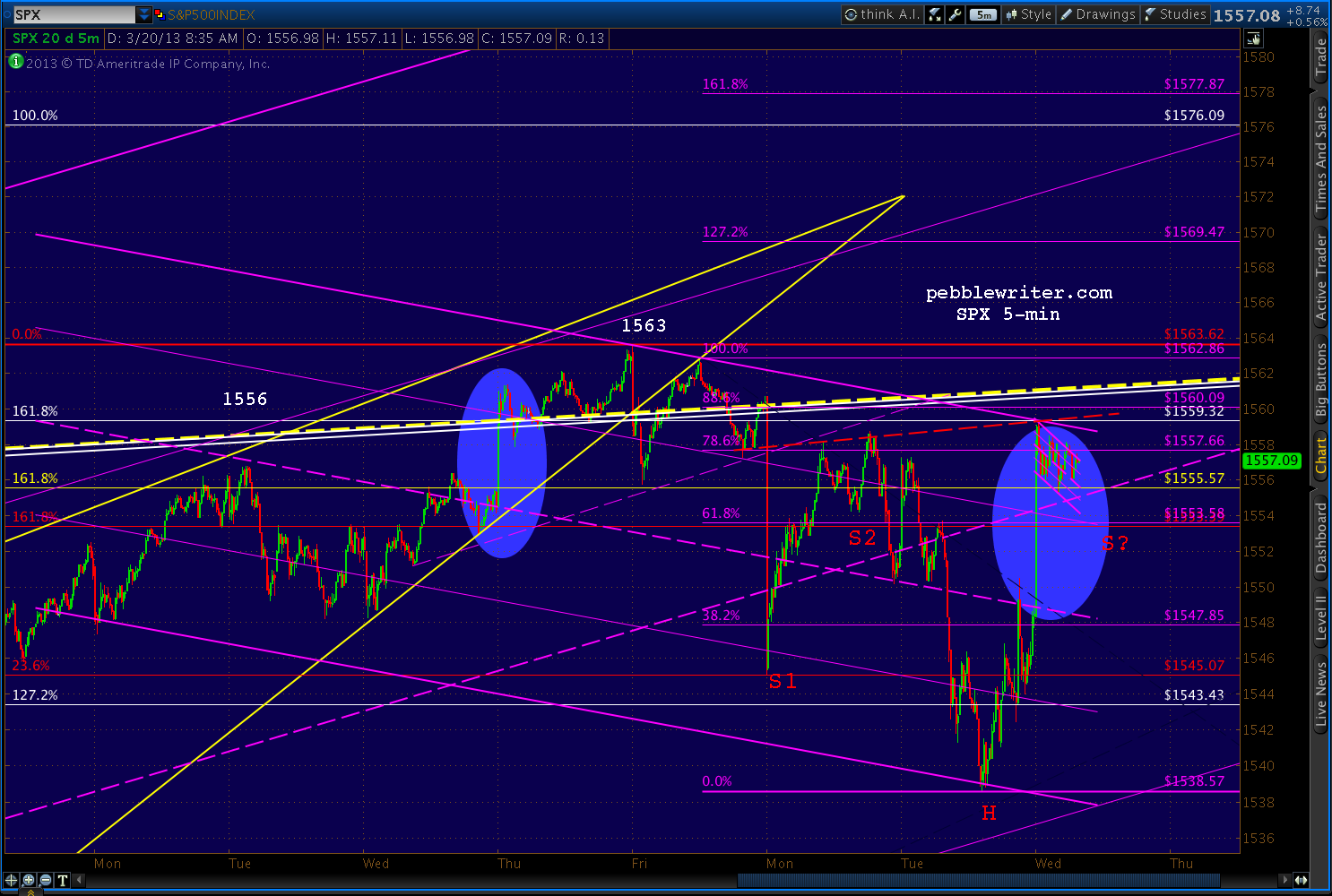
    SPX continues to position itself for a run at 1576.  The 5-min chart shows a small potential Crab Pattern with a 1.618 at 1577 and a Flag Pattern targeting 1576.

    It has broken back above and backtested the purple channel midline and retraced nearly .886 of its drop from 1562 and a little more than .786 of the drop from 1563.62.

    While it’s positioned for 1576, there is no more certainty than when we first broke 1555 on the Mar 14 overnight ramp job.  The large, bearish patterns listed above have still not produced the kind of sell-off they normally do.

    And, it’s all because of the cheerleaders’ determination to be able to tout a new all-time high for the S&P 500.

    In addition to the little Crab Pattern (purple) that targets 1577 and the flag pattern targeting 1576, there’s an obvious effort to construct an IH&S pattern targeting 1580.  It could benefit from a lower right shoulder, but bulls must beware of crossing back beneath the purple channel midline.

    The S2 shoulder isn’t quite legit, BTW, as the neckline doesn’t quite connect on the left side.  But, the S1 shoulder is quite a ways down there.  So, if the pattern plays out, be prepared for some serious chop.

    UPDATE:  1:00 PM

    With the FOMC announcement a little over an hour away, let’s resume our chat about the big picture.  If it seems like we’re “lost in the reeds” as one reader so aptly put it, it’s because we are.

    The large Crab Pattern completions promised a good-sized dump last week at 1553/1555.  Instead we’ve inched higher.  Why?  These patterns completed in the middle of harmonic no-man’s land: the gap between an .886 retracement and a double-top.

    The .886 retracement (of the 1576-666 crash) produced a 9% reversal back on Sep 14.  Since then, SPX came screaming back to retake the 1576 all-time high — but slammed into the Crab Patterns and a very important channel line along the way.

    Now, it doesn’t know what to do.

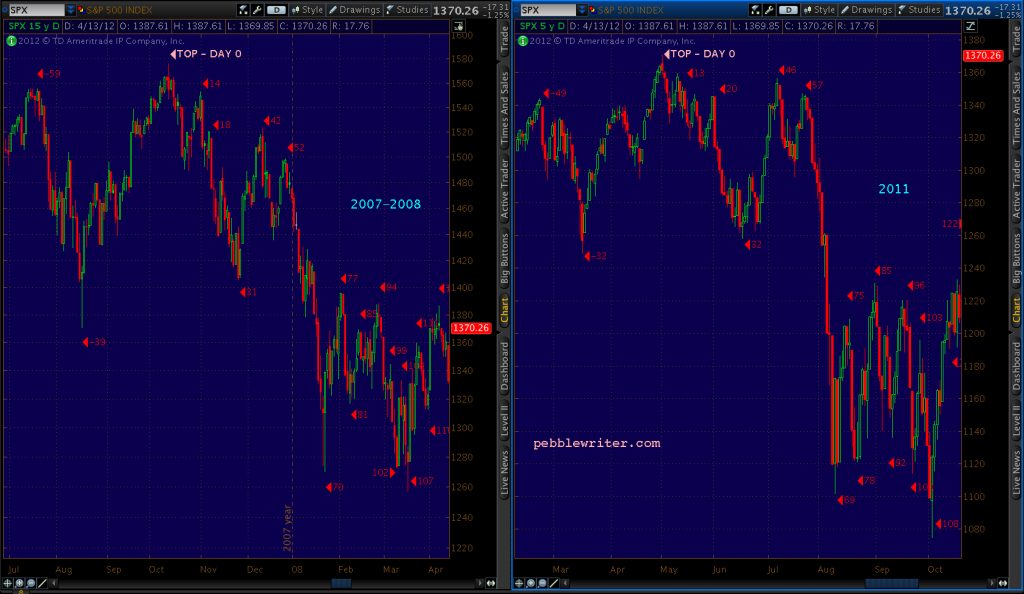
    Double tops usually produce reversals, too — sometimes meaningful ones as we found out on October 11, 2007, when SPX scooted up past the 1552 top from 2000 by a whopping 24 points before dropping 58%.

    The 2000 top itself shows just how “messy” tops can be.  Here’s the finished picture in perfect hind-sight.  It’s a very crowded chart, but every pattern on there had a say in how the top unfolded.

    Once SPX broke out of the falling purple channel, it had “permission” to pursue several harmonic patterns in the works.  SPX shot up 66 points in that one day — blowing through every Fib level between .618 and 1.000.

    It finally came to rest at 1458, completing a Bat Pattern at the purple .886.  But, the small white 1.272 was just above at 1477, as was the rising purple channel midline and the 1.272 from a much larger pattern seen below.  An IH&S target waited at 1497 – tantalizingly close to a nice round number of 1500.  The all-time high of 1478 from two months earlier beckoned.

    SPX got up to 1477.33 before reacting, falling to 1466 over the next two days.  Close, but not quite.  Someone watching closely might have noticed the Flag Pattern it constructed, targeting 1562.  Someone else probably pointed out the biggest Crab Pattern target of all — the 1.618 extension of the 13% correction from 1420 to 1233 from Jul-Oct 1999.

    I don’t know what the catalyst was, but on Mar 21, 2000 (that date sounds awfully familiar) SPX shot up through the channel midline, the cluster of Fibs around 1477 and, importantly, the 1478 high and raced up toward those higher targets.

    On Mar 24, it reached 1552.87, which cleared the IH&S target at 1497, the purple 1.272 at 1519 and the last remaining Crab Pattern at 1535.  What ultimately stopped it?  The .75 line from the big purple channel dating back to Jul 1999 — almost to the penny.

    Total move: 17% and 227 points in 20 sessions.  Could it happen again?

    continued for members(more…)

  • Do or Die Time

    As we discussed yesterday, it’s do or die time for the equities markets.

    Keep an eye on the small rising wedge today.  A break down below 1560 is important to the bears’ case — while the bulls obviously have their sights set on the all-time high of 1576.

    As always, watch for a backtest after the wedge is broken.  Any such bounce should fail by 1562.80 or so.

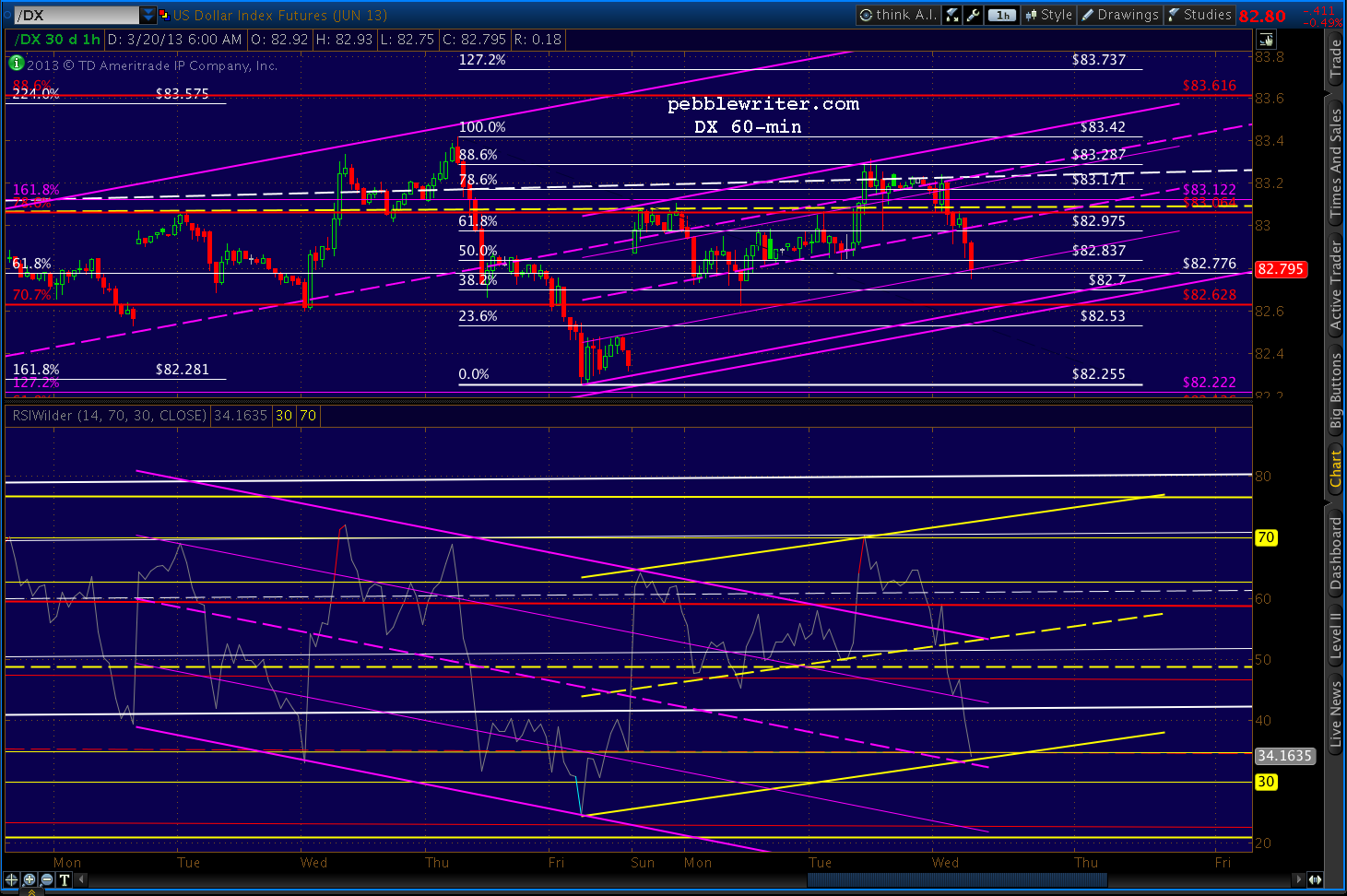
    The US dollar reached our Mar 4 target [see: After the Funding’s Gone] and reversed sharply.  Note this was the confluence at the completion of a Crab Pattern (in purple below), a Bat Pattern (red) and two channel midlines.

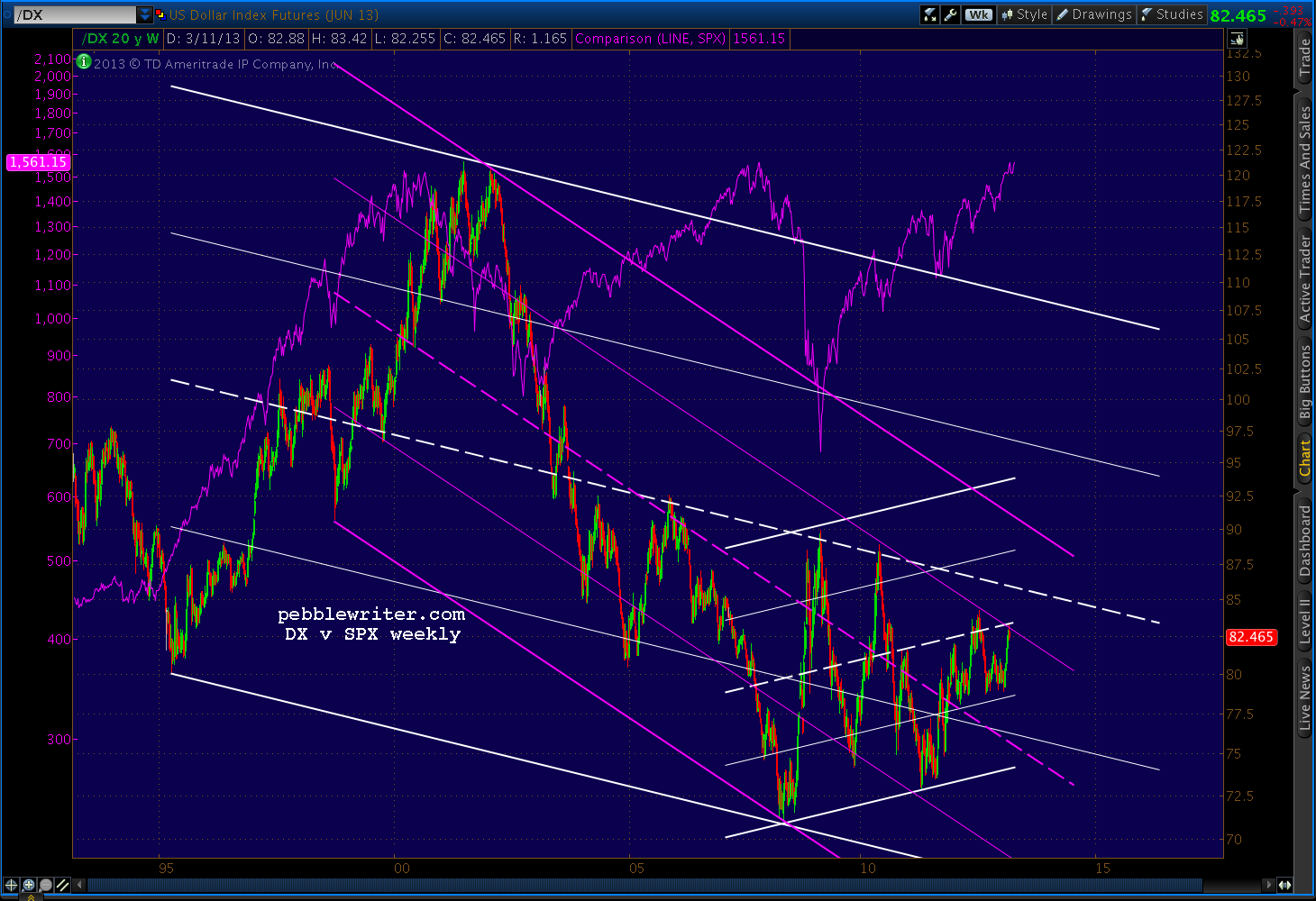
    The channels can be better seen on a longer term chart.

    DX and SPX have become mildly positively correlated of late with the 25-day moving average at 0.59.  This is a huge shift from the high negative correlation we had all become used to: as the dollar as a safe haven during equity market sell-offs:

    This chart from Deutsche Bank showing the 1-year rolling correlation has been widely circulated.  It’s a week old, but shows that despite some huge swings over the past few years, correlation continues to become more and more negative.

    The last little blip up in the dark blue line represents a relative decrease in negative correlation, but it appears to have formed a channel since 2009.  In the absence of a breakout, one would expect the trend to continue…


    From a technical standpoint, whether the trend continues or not — and, where the dollar goes from here — couldn’t possibly be more important.

    The ebbs and flows of the relationship can best be seen in a long-term comparison.  Here, we can see long periods such as 1995-2000 when they moved in lock step.  Notably, when stocks faltered in Aug 2000, the dollar vacillated for a while before finally joining in in Jan 2002.

    But, when stocks finally bottomed in 2003, the dollar continued to sell off.  It got a big bounce in Dec 04 (the previous low) but didn’t bottom out until Apr 08 as SPX was about to fall off a cliff.

    When stocks bottomed in Mar 2009, the dollar peaked.  The next time the dollar bottomed was in May 2011, as the 2011 correction got underway.  It rallied again with the equity sell-offs in Apr 2012 and Sep 2012, but has so far failed to break the high established in July 2012.

    Why should equity investors care so much about the recent shift in the relationship between these two?  When we chart DX, we can see that equities often moved dramatically at fairly predictable key turning points.

    The most prominent chart pattern for DX is the falling channel shown above.  When DX dropped through the midline in 2003, it marked a bottom for equities.  They rallied strongly until the dollar finally approached the channel bottom and, as mentioned above, fell sharply after it bottomed.

    As DX raced up toward its midline, stocks plunged toward their 2009 low.  The dollar’s peak and stocks’ trough were almost simultaneous.  As DX fell away from the midline, stocks took off — not pausing again until DX’s next run at the midline in Apr 2010.  As soon as DX tagged the midline, stocks were off to the races again.

    In May 2011, the dollar bottomed again, enabling us to draw a little rising channel reflecting the strengthening trend since.

    Like its big brother, this smaller channel has proven pretty successful at indicating potential turning points — a breakout or breakdown — at its midline.  In general, each downturn from the midline meant the accompanying equity rally was nearing at end.

    Stocks didn’t actually reverse until DX bottomed at either the channel bottom or the .25 line as occurred with the May 2011, Apr 2012 and Sep 2012 corrections.

    Significantly, this last bounce off the .25 line in late January resulted in stocks going up.  The SPX has rallied 160 points or so, leaving us to wonder whether DX will head back down — which has always produced equity rallies — or break above the channel midline.

    The past several instances have produced large declines of 630 points (May 2008), 200 points (Apr 2010) and 160 points (Apr 2012.)

    In other words, a sudden strong rally in DX is highly likely to accompany a sudden and significant decline in stocks.  And, as we’ve seen in the past, prices that approach a midline are, by definition, poised to break out or break down.

    So, which will it be here for the dollar: a break out or a reversal?  Let’s set aside SPX’s recently completed bearish chart patterns for the moment, and focus on DX.

    Based on the larger of the white channels, we would have to conclude DX has much more upside.  Its midline is up around 86-87, which would clearly take DX beyond the smaller channel midline — tagged yesterday at 83.42.

    In addition to the small white midline, however, DX will need to break above the .75 line on another falling channel (purple below) in order to reach the larger midline.
    But, it might not be all that difficult.  DX recently broke back above a trend line drawn from the Jan 2002 and Jun 2010 highs.  This TL looks fairly decent as a channel (yellow below), and reflects another breakout such as the one which occurred in Apr 2012.

    That DX channel breakout, of course, accompanied the SPX slide from 1422 to 1266.  It backtested nicely, then suddenly failed when the Fed announced QE3.  Prices fell back into the channel until the latest breakout in February.

    In keeping with the theme of sudden strong DX rallies being unhealthy for stocks, take a look at the Fibonacci Fan chart below.
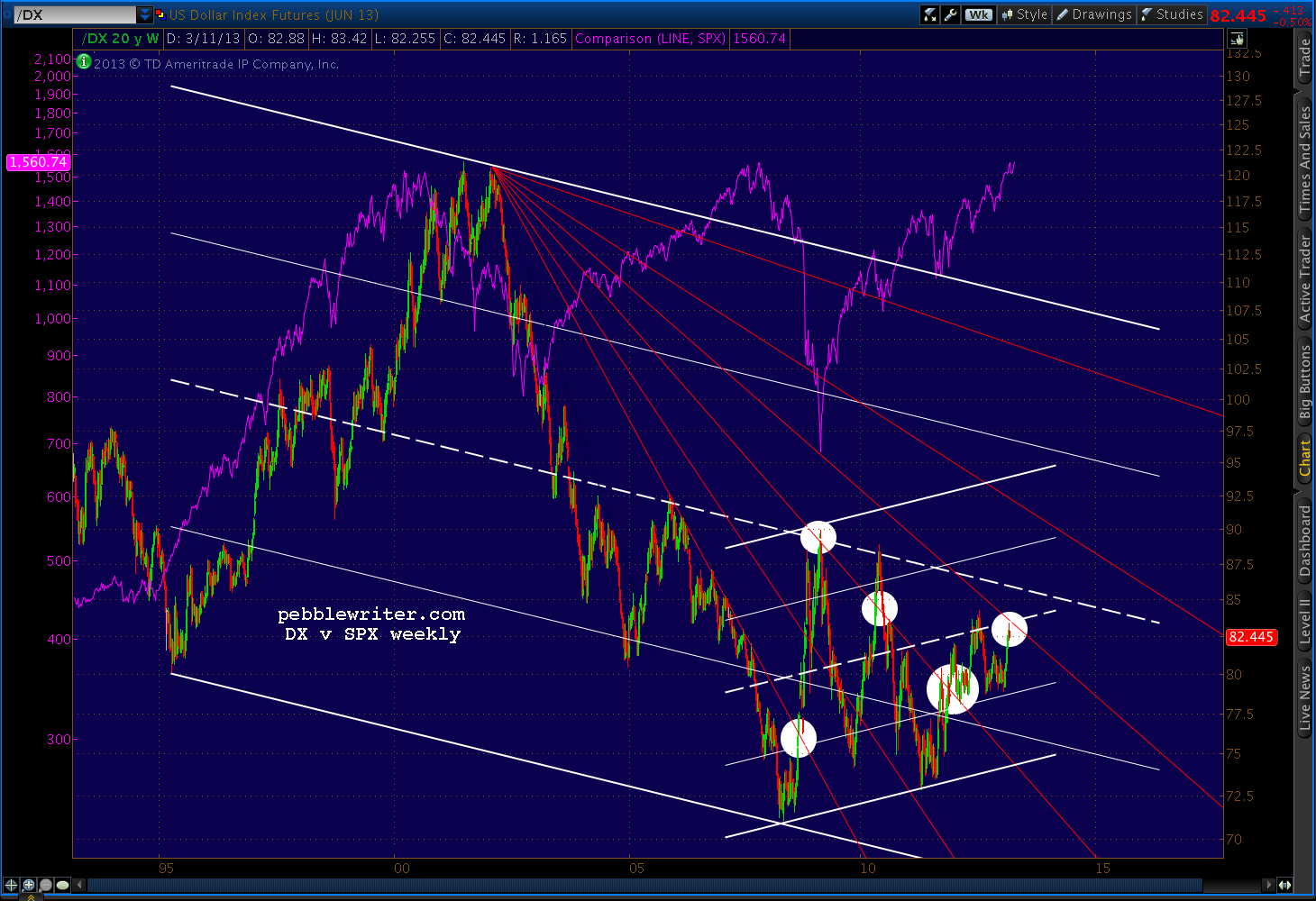
    Each time DX crossed one of those lines — even by just a little — SPX reacted.  DX has reached the latest line — the .707 — and is thus signalling either an equity breakout or breakdown depending on which way it goes.

    Weekly RSI mirrors the rising channel DX has been in since October 2007.  DX RSI recently broke out of the latest falling red channel and through the white channel midline.  After reacting against the purple .75 line, RSI is backtesting the white channel midline.

    If it’s more than a back test and RSI breaks back below the midline, this would confirm DX’s price reversal.  If, on the other hand, DX RSI survives the midline, it’s not hard to imagine a rally to the top of the purple channel or even the white channel .75.

    The daily RSI chart shows a similar situation.  RSI is finding support on the small white midline, the large white midline, and backtest of the red channel it just broke out of.

    A reversal here and a strong rally qualify would qualify as one of those sudden turns that isn’t terribly healthy for equities.

    I know, I know.  With eleventy zillion dollars being pumped into the markets every hour by Bernanke and friends, how in the Wide World of Sports could the dollar suddenly soar and the stock market flop?  The answer to that, of course, requires one more chart.

    I’ve marked some of the more obvious “sudden, strong rallies” in DX which, as discussed above, frequently coincide with sudden, strong declines in stocks.

    But, note how many of them occur as SPX is nearing one of its own channel lines drawn off the 2000 and 2007 tops.
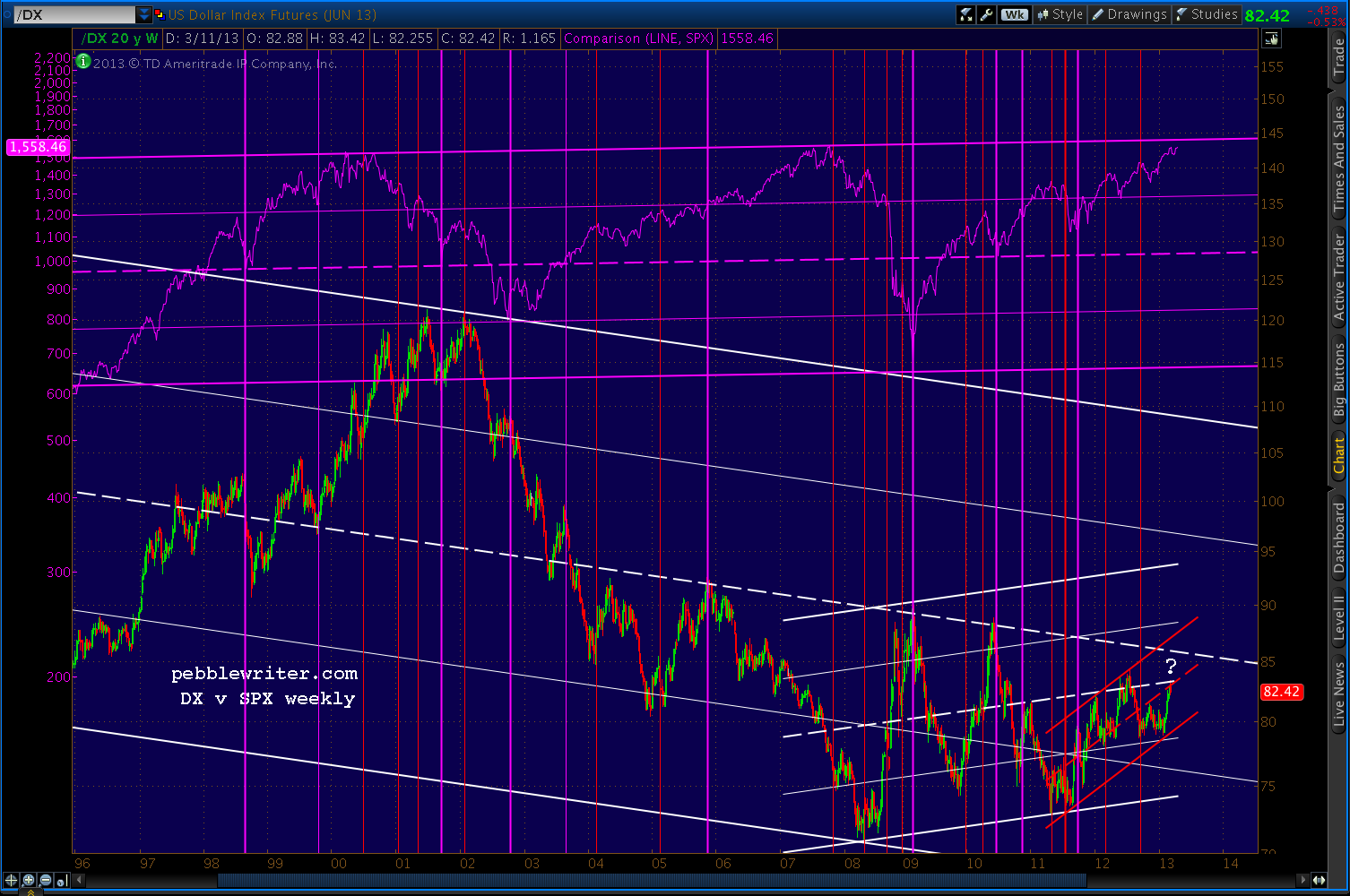
    We’ll get into that and other channels in the forecast coming up next. But, it’s fascinating that SPX is only a few points from a channel top dating back 13 years just as DX has arrived at the confluence of such important support and resistance lines.  For both, it truly is do or die time.

    I’ll continue with the forecast for members after a quick break.

    continued for members(more…)

  • Results: Feb 28, 2013

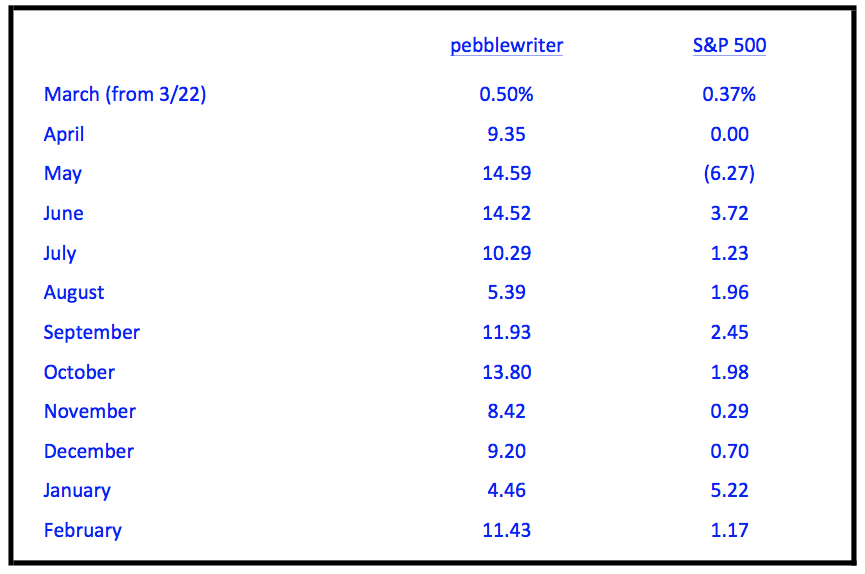
    The S&P 500 gained about 6% between the last update (Dec 20, 2012) and the Feb 19 highs of 1530.94.   The index gave back half of the gains over the subsequent week, then retraced 88.6% of those losses over the next two sessions for a total move through Feb 28 of about 11%.  Our calls accomplished approximately 19% over the same period.

    December, 2012

    December 2012 wrapped at +9.20%, leaving us with a total return for 2012 (since inception on Mar 22) of 97.99%. The S&P 500 was up 2.36% over the same period (excluding dividends) and the average hedge fund earned 7.32%.2

    I had anticipated a significant reversal in mid-December at SPX 1346, and the market accommodated with a 3.3% decline into the year’s end based on an analog that served us very well since April, 2012.

    January 2013

    Even though Congress failed (as expected) to really resolve the fiscal cliff dilemma, the market saw the resolution as “good enough” and pushed higher during the low-volume New Year’s holiday week.

    The next two weeks were spent in harmonic pattern limbo, deliberating whether a double-top or a new high was in the works.  Finally the question was settled by a push past the Sep 2012 highs — right into the next harmonic target range. With only 9 sessions left in the month, there was little time left in which to accomplish much.

    At +4.46%, January was the first month in which our numbers lagged the S&P 500.  I realize that 4.46% is nothing to sneeze at; but, in retrospect, I should have exercised more caution around big news days, used tighter stops and perhaps traded a bit more frequently.

    February 2013

    At +11.43%, February was a much more rewarding month — but, not without its challenges.  Prices fluctuated by 10 or more points in a full two-thirds of the trading sessions.  But, volatility creates trading opportunities, so I took full advantage.

    It seemed at the time that I traded too frequently (33 times, including 14 intra-day trades that added 5.50%.)3  Looking back, however, SPX gained only one point between the Feb 1 close and the Feb 28 close.  In other words, it was the kind of month where day traders are rewarded, and buy-and-hold types should have gone skiing.

    If nothing else, February convinced me that a managed fund could deliver added value for pebblewriter subscribers who have neither the time nor the inclination to sit by their computers waiting for the next trade signal.

    Even for those who do, there is the problem of time lag.  Under the best of circumstances, it can take several minutes to transmit a newly hatched idea — more if charting or explanation are involved.

    By the time a member receives, reads and acts on the information, prices can move appreciably — potentially reducing returns and/or increasing risk.  A fund should, at the very least, eliminate the lag.  I am currently working with advisors and will announce details as soon as possible.

    Summary

    As of Feb 28, we’re up 113.08% since inception for an average monthly return of about 10.05% — on track with our Dec 20 report.  I’ll continue to work on finding the right balance between trade frequency and risk-adjusted returns.

    The road ahead looks no less bumpy.  Will QEn sustain uninterrupted new highs, or will this market — like every one before it — soon reveal its Achilles heel?  Interest rates are on the rise, while a whole host of economic indicators and corporate earnings are flagging.

    Personal income is slumping, employment isn’t much better, the euro zone is officially back in a recession, China is faltering and central banks the world over are racing to devalue their currencies as debt continues to skyrocket.  Where’s the upside in that scenario?

    The day will come when money printing and accounting gimmicks alone won’t be enough to levitate the stock market.  At the end of the day, real profits require that someone, somewhere, buys something.  A bull market that rallies to new highs while ignoring that basic premise is, in my opinion, not long for this world.

    Stay tuned…


    Notes:

    1 According to this Barron’s article, only one of the hedge funds tracked by HSBC earned over 40% in 2012; another 7 earned 30% or more. The average fund earned 7.32% and about one third lost money.

    2 Remember, our “performance” is based on a theoretical unleveraged portfolio utilizing only long and short positions in SPX based on the tops and bottoms identified on pebblewriter.com.  Trading expenses are not included.  Your mileage will vary.

    3 Late last year, I began experimenting with leaving a core long or short position in place while placing short-term or intra-day trades.  The jury is still out on the effectiveness of this strategy.

  • Picking up Pennies

    Just about every other index has reached an important harmonic and/or chart pattern target. Given the NFP print, this could be the day SPX finally reaches 1553-1555.  Best to be long on the opening, and ready to re-short fairly quickly.

    The dollar isn’t waiting, surging nearly 1% on the day and resolving the question as to which channel to watch.

    DX is very near a tag of the red .786 (83.064) and the purple 1.618 (83.179).  But, more importantly, it is coming up to the intersection of the midlines of two important channels.

    Look for heavy resistance at these levels — until the equity sell-off begins in earnest.

    Likewise, the EURUSD is off over 1% and approaching the white .786/yellow .500 — also the scene of an important channel line.

    Will the currencies react first to the equity strength, or are they positioning ahead of what they know will be an equity pop and drop?  As the grown-ups in the room, I believe currencies are doing the latter.

    Our premise called for a back test of the channel line or TL off the July 2011 & Sep 2012 highs, but the market is eager to go ahead and get there.  Who am I to stand in the way?

    UPDATE:  9:35 AM

    Got to 1551.65, only 1.74 away from the white 1.618 – which is close enough for me.   I have nothing against staying in until the actual tag; just watch your stops in the event it turns quickly.

    I’ll pick it back up if we get a second push through 1551, as it would not be unusual to see a bit of an overshoot — somewhere between 1553 and 1560.  Likewise, a drop through the yellow TL down around 1535.50 probably signals “game over.”

    Remember, this completes a Crab Pattern from the 2011 crash from 1370 to 1074.  Are we guaranteed a big sell-off here?  Of course not.  But, odds are it will be substantial.

    UPDATE:  10:08 AM

    If SPX is going to bounce higher, it should do so by 1543 — the 1.272 Fib on the small white harmonic grid and the bottom of the tiny channel SPX hung out in for the past several days.  For anyone who missed the last six points because of the gap open, this is your second chance.

    UPDATE:  10:27 AM

    SPX getting the bounce here at 1543… will take another crack at 1553-1560.

    In the meantime, let’s take a look at how we got here.  If you had asked me at the end of 2011 which upside scenario looked most likely, I would have suggested the Crab Pattern that started at 1370 in May 2011 and put in a bottom at 1074 in October (in white, below.)

    There were three potential Point X’s in a row: 1370.58 on May 2 (in white above), 1347 on July 21 (in red) and 1356.48 on Jul 7 (not shown.)  And, 1370.58, the high following the 1576 to 666 sell off from 2007 to 2009, was the most prominent.

    My reservation was that it reversed at the .707 Fib level rather than the more common .618, .786 or .886.  The .707 is the red-headed stepchild of the Fibonacci ratios.  It’s the square root of .500, which itself doesn’t get much respect as a Fib ratio.  Geeks and wannabe’s CLICK HERE for details…

    When SPX finally pushed above 1370 in March 2012 and started approaching the 1.272 Fib levels between 1422 and 1451, we had to choose from among the three possibilities for a Butterfly Pattern completion [see: All the Pretty Butterflies.]

    I went with the red pattern because of its more precise tag on the .786 and was rewarded with 20%+ gains from a perfectly-timed short.  And, I assumed the red pattern would continue to drive future harmonic swings.

    As we approached the red 1.618 at 1515.24, I noted that it intersected with the purple 1.618 (1518.57) and the yellow 1.272 (1510.19) — not to mention the yellow trend line running very precisely through the July 2011, April 2012 and Sept 2012 highs.  To me, this was a very solid conclusion based on very reliable patterns.

    We got the sell-off.  In fact, we got three sell-offs, one from each of those Fib levels.  On the final tag at 1518.57, we got a little overshoot to 1530 (a smaller harmonic pattern completion) before beginning a correction all the way to…1485.  Yep, not even a lousy 3%.

    In harmonics, it’s not usually the tops that bother me, it’s the 2nd waves.  The rebound from 1485 went to 1525 (a healthy .886 retracement) and even sold off nicely — before zipping back up to complete an IH&S, take out the 1530 high and…well, here we are.

    Harmonics are great.  They offer concrete turning points at which the market usually reverses.  If it doesn’t, you’ve either picked the wrong Point X (1347 instead of 1370) or the wrong pattern.  In other words, there’s a solid decision matrix; you know when it’s time to go to Plan B.

    Fundamental analysis isn’t anywhere near as precise — especially in the short to medium term.  And, as we’ve seen this past year, there’s plenty of money to be made by going long at bottoms and short at tops.  You just have to be prepared to switch gears when your assumption — no matter how well thought out — turns out to be wrong.

    If SPX exceeds the Fibs at 1553/1555 and/or the IH&S target at 1465, there’s not much more in the way of targets other than the previous high of 1576 (October 2007.)  Many other indices have made new highs, so maybe TPTB will feel it necessary for SPX to do so as well.

    more later…

    UPDATE:  1:55 PM

    The bounce off 1543 still going strong.  15-min RSI just broke out of a falling channel from this morning’s rally.  A move back to the white RSI channel midline might permit 1553/1555 or slightly higher.

    continued for members(more…)

  • Charts I’m Watching: Mar 1, 2013

    Getting a nice sell-off following the completion of the Bat Pattern we were tracking yesterday.  Shown below on the eminis…

    The downside path is clear.  But, bulls will probably go for the obvious IH&S with what should be a decent bounce somewhere around 1495-1500.

    The dollar reached our 82.136-82.281 target from several days ago, and the EURUSD has lost another important level of support: 1.30.

    More in a few…

    UPDATE:  09:40 AM

    SPX opening down sharply…Note that it turned yesterday at 1525.34, only 36 cents from one of the two targets we identified just before it opened at 1515.99.

    The market didn’t fall out of bed overnight, so I’ll take a long position on the open this morning in anticipation of tagging the .786/.886 combo at 1521.11/1521.19 or the .886 at 1525.70.

    I remain full short from 1525.34 (the 2:20 update for members) but will play any bounces as mentioned above.

    The key level today is 1496 – the bottom of the purple channel.  If this is broken, lots more downside where that came from — especially if the previous low at 1485 is taken out.

    UPDATE:  10:00 AM

    Nice post on Zerohedge earlier: You Rarely Know You’re in a Recession Until it’s Too Late.

    Referring to an ECRI report, ZH makes the following points:

    1) Think back to 2008, a couple of days before the Lehman failure. Looking at the data in hand, you would see GDP growth at about 1% in Q1 and 3% in Q2. More specifically, Q2 GDP growth had just been revised up on August 28 from 1.9% to 3.3%, sparking a 212-point Dow rally that day. http://www.nytimes.com/2008/08/29/business/29econ.html?_r=0

    2) In March 2001, 95% of economists thought there would not be a recession, but one had already begun.

    3) No economist predicted the 1990-91 recession beforehand.

    4) Hardly any economists recognized the severe 1973-75 recession until almost a year after it started. Indeed, that recession began with the ISM at 68.1, and payroll jobs growth did not turn negative for eight months.

    5) In 1970, unaware that the economy was nine months into recession, none other than Paul Samuelson said that the NBER had worked itself out of a job, meaning that improved policy expertise had made recessions very unlikely.

    6) In three of the last 15 recessions – specifically, in 1980, 1945, and 1926-27 during the Roaring Twenties – stock prices remained in a cyclical upturn.

    ECRI has caught a lot of crap for their recession call last Fall.  I know the feeling, as most economists I know (yes, I travel in exciting circles) think the worst is over.  I wish I shared their optimism.

    I mention this because of the positive ISM Mfg Report released this morning.  It’s being cited as proof of expanding activity.  Remember, the PMI is a survey of purchasing managers’ opinions about their business.

    They read the same newspapers and websites, watch the same TV, and are subject to the same MSM brainwashing as the rest of us.  A better than expected snapshot in time of their opinions does not mean the economy is just fine.

    UPDATE:  10:35 AM

    We got a bounce off 1501 — pretty close to the 1495-1500 range where we expected it.

    Any push back into green territory would be cause for an intraday long with tight stops, but not for giving up shorts.

    We just hit the .500 Fib of this morning’s decline, and the .618 is at 1516.63.  The top of the white channel is up ahead at 1518.50.  Any of these would take the index positive on the day.

    Would that mean the correction is over?

    continued for members... (more…)

  • Charts I’m Watching: Feb 28, 2013

    Yesterday was a great example of the beauty of Harmonics.  In conjunction with my RSI work and channel work, we were able to rack up 23 points on a day when the big picture is still fairly negative (remember Italy, the sequester, negative GDP, retailers’ horrid guidance?)

    By drawing important Fibonacci lines in the sand, we made the market prove to us it had more upside by crossing those lines. As we’ve discussed many times before, Harmonic Patterns don’t, by themselves, always tell you what the market is going to do in a particular time frame.

    But, they do an excellent job of “if-then” forecasting, such as “if the market reverses at Point A, we can be very confident of reaching Point B.”  Again, combining this information with other fairly reliable patterns, we can capture most of the points most of the time

    The market didn’t fall out of bed overnight, so I’ll take a long position on the open this morning in anticipation of tagging the .786/.886 combo at 1521.11/1521.19 or the .886 at 1525.70.

    Fresh charts in a few…

    UPDATE:  9:45 AM

    The channel placement is still somewhat speculative.  But, again, in a volatile situation like this, the market will show us whether it has more potential or not.

    We are nearing the .786 retracement of the move down from 1530, and the .886 of the move down from 1525.  They’re on top of one another, lending added validity.  So, all else being equal, we can expect a reversal here — especially given the 60-min RSI chart.

    Note we’re taking a 2nd crack at breaking out of the yellow channel at 61 — the range in which most moves fail.  Stay tuned.

    UPDATE:  9:50 AM

    Just tagged our target level, so I’m booking the 5 points from this morning here at 1521.29.

    A strong move back up through 1521 opens up 1526.  The immediate downside target is around 1510 a combination of Fib levels and the next lower purple channel line (the 25%.)  If that doesn’t hold, the bottom of the purple channel is currently down at around 1494.

    BTW, I’ve had a number of questions about the new fund in the works and the changes it might bring for this website.  I think the past few days are an excellent example of why a fund makes a lot of sense.  Yesterday, I was in and out of the market (on these pages) six times for a total of 23 points:

    1. Bought at 1497
    2. sold at 1507 (+10)
    3. bought at 1507
    4. sold at 1514 (+7)
    5. bought at 1514
    6. sold at 1520 (+6)

    Twenty-three points on 1497 is a little over 1.5% — a decent day, especially given that it occurred on a bounce in the midst of a downturn, which are generally tricky.  Twenty or thirty of those in a year would be a great year for most investment advisors.

    Given that it takes a few minutes to identify a situation, a few more to chart it, a few more to make the chart readable for members, and more still to post it online and compose a cogent comment or two, it’s challenging to get that information out to readers fast enough so that you can capture every single point that I do.

    Then there’s the issue of how to trade the information.  I just shorted SPX at 1521 with the expectation of an initial 10-point drop.  Suppose it pops up to 1525 60-seconds later?  Were you stopped out?  Do you hold on?   Wait, now it just dropped 20 points!  You refresh the screen…where’s the update!?

    While you’re anxiously refreshing the webpage, I’m looking at RSI channels (in multiple time frames), various chart patterns, checking the dollar/euro/bonds/VIX, looking for any news just out, etc.  I make a determination and either trade on it or sit pat.

    I then start the process of updating the chart and posting it online with supporting comments.  Best case…3-5 minutes.  Worst case, all hell is breaking loose and it takes 10-15 minutes or more.

    This is why I like the idea of a fund.  For better or worse, it’s the quickest, most efficient way to transfer value from my noggin into your net worth.  Investors can go on with their business meeting/golf game/ski run and leave all the sweating it out to me.

    BTW, I know a fund isn’t for everyone. For the rest of us, the website will continue to provide the exact same kind of information it always has.  But, it will evolve, ideally becoming more efficient with streamlined delivery accompanying the charts for the pebblewriter.com veterans and investment professionals who want to go it alone.

    For example, those who have been around for a while would completely understand a comment like “hit .786/.886 combo at 1521, Gartley/Bat or Butterfly Point B?  Charts later.”   That way, I could cut down on the time it takes to convey the essence of the post.  I’m also looking into ways to post the information on a chat-like platform, which might also eliminate email and log-in problems.

    The trick with investment advisor clients is finding a way to deliver timely information at a reasonable price without giving away the secret sauce to potential competitors.  It will mean substantially higher fees for future subscribers ($2,500 on Mar 4), but won’t affect current members who have taken advantage of the current membership offer.

    Have you locked in your subscription price yet? CLICK HERE

    More shortly

    UPDATE:  12:50 PM

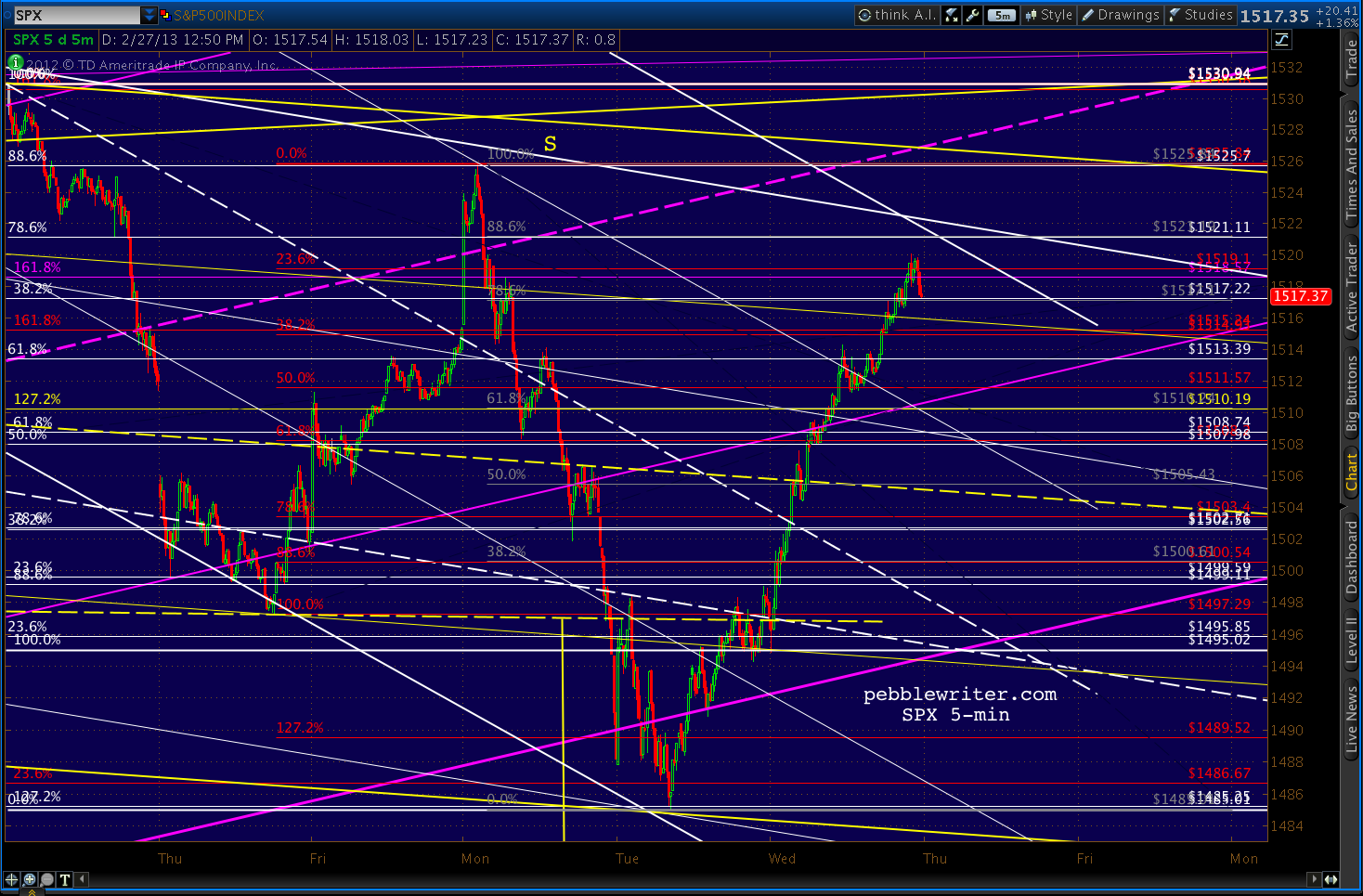
    SPX won’t go down without a fight.  It has retraced almost .886 of its declines from 1521.37, meaning it’s about to reverse at 1520.65 and head lower (a Bat Pattern) or is destined for the 1.618 at 1525.29 — also the .886 retracement of the 1530-1485 decline (1525.70) and the level of the last high on the 25th.

    As noted earlier, a push through 1521 opens up 1526.  SPX has till about 1:30 EST to decide: push up through 1521 or a channel breakdown.

    Note the close proximity of the white channel line, which will always, always offer support… until it doesn’t.

    The RSI picture is mixed at present, so we’ll stay focused on harmonics and channels.  Looking at other indicators, the dollar is hanging in there in its own rising channel.

    It recovered its midline just before equities opened this morning, and broke out of its a channel on its 15-min RSI.  It tagged 82, but hasn’t yet been able to break above — much less reach its short-term target of 82.136-82.281.

    UPDATE:  1:20 PM

    There’s our answer, a breakout above the .786/.886 Fib at 1521.11.

    Playing the long side again, with initial target of 1525.70, trailing stops starting at 1521.

    Charts in a few…

    UPDATE:  2:05 PM

    Getting pretty close, now.  This should also be a tag on the large purple channel midline and the proposed yellow channel top.

    UPDATE:  2:20 PM

    Let’s review the implications to our forecast of tagging 1525.70.  We started into this yesterday, but got interrupted by a pretty wild intra-day ride.

    continued for members(more…)