It was a beautiful weekend here on the central California coast. Seems like everyone was out surfing, golfing, taking walks on the beach — at least that’s what I heard. I spent the weekend poring over ECRI’s Weekly Leading Indicators for the past 30 years.
Okay, in the interest of fair disclosure, Friday night was the annual Father-Daughter dance at my 10-year-old’s elementary, and I needed a couple quiet days off my feet. If you’ve ever been in a room full of screaming prepubescent girls for two hours of JB and 1D, you know what I mean.
Bottom line, the WLI research bolstered my confidence that our current position is the right one — whether or not the US economy is still in a recession, about to double dip, or is on the mend. The key takeaway is this chart, showing the QE-fueled market continuing to pull away from the underlying economy (as measured by the WLI.) Check out the article HERE.
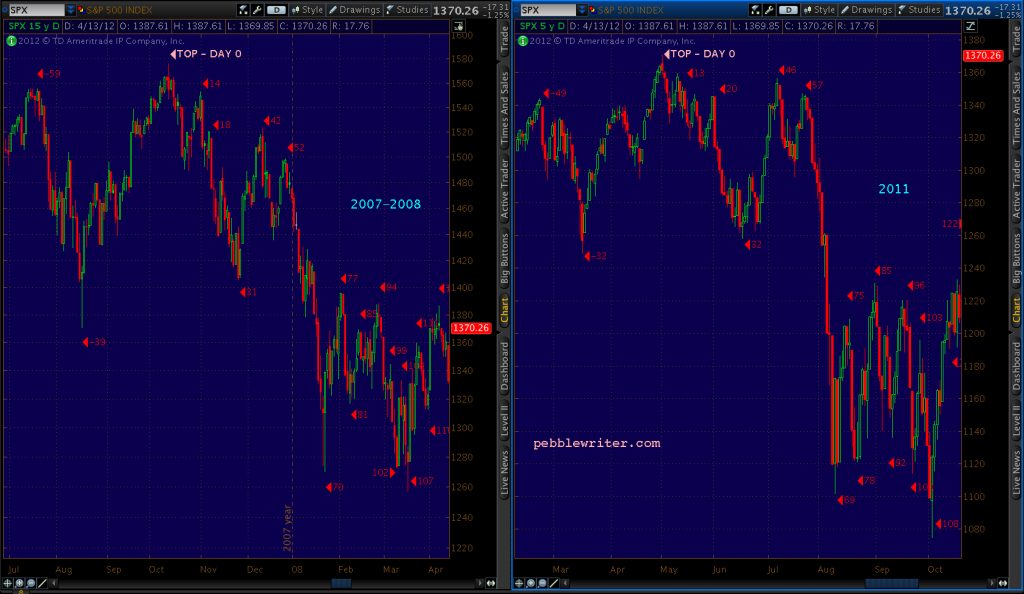
This morning, I’m hearing more and more talk about the market being frothy. This is somewhat reassuring, as shorting at tops based on Harmonics often leaves one feeling very lonely. I mentioned that SPX 1518 was at least an interim top to several other dads at the dance (guys who are in the biz) and they looked at me like I’d had too much fruit punch.
I could have talked for hours about how applying derivations of a golden ratio based on 2,400-year-old mathematics enables effective market timing, but for some reason they had a sudden urge to go find their daughters and dance. Funny how that always happens, and just when I’m getting to the good part…
Of course, frothiness is what leads to overbought conditions — which, of course, is what you want when you short the S&P 500. So far, the market is behaving itself — selling off a little while trying to sort out economic data, quantitative easing, currency wars and the upcoming sequester battle.
ECRI’s Weekly Leading Indicator (WLI) came out Friday at 130.2 — up from 129.6 the week before. Further, they reported that the index’s annualized growth rate increased from 8.2 the previous week to 8.9% — the highest since May 2010. I wondered: are they retracting their Sep 2011 recession forecast? Are things really getting better?
CAN’T WE ALL JUST GET ALONG?
There’s currently an argument raging between various economists and analysts as to whether the US is still in/dipping back into a recession or is on the mend. ECRI is pretty sure we’re in one, while folks like Doug Short and, of course, the mainstream media think not.
There’s no question that we’ve seen an uptick in several economic measures. My own thesis is that most of these have been not secular, but cyclical swings. In other words, I don’t yet see evidence of a sustainable trend change, only natural swings from one side of a channel or wedge to the other.
Here’s an example I posted last week. Total Confidence has traced out a pretty solid-looking channel, while the Present and Expectations indices have formed expanding wedges (and are nowhere near their upper bounds, especially given the recent downturns.)
underlying chart from briefing.com
Hardly a day goes by when I don’t second guess myself. Is all the “good news” just one big, well-coordinated head fake or am I missing something? I spent much of the weekend studying ECRI’s historical WLI (who says technical analysts don’t live exciting lives!?) and found a lot to think about. First, a brief primer on Harmonics.
HARMONICS
Regular readers of pebblewriter.com (heck, even the irregular ones) know all about Harmonics and that the corrections experienced in April 2010, May 2011 and Sep 2012 correspond to the important Fib levels of 61.8%, 78.6% and 88.6%.
For the uninitiated, measure the drop from SPX 1576 (Oct 2007) to 666 (Mar 2009) and multiply it by a Fibonacci 61.8% and you get 1228.74. SPX reached 1219.80 in April 2010 (within 10 points) and promptly sold off by 17% over the next three months.
In May 2011, SPX peaked about 10 points away from the 78.6% Fib level (completing a Gartley Pattern) and plunged 21.6%. And, in September 2012, SPX reached the 88.6% Fib level (completing a Bat Pattern) and corrected by almost 9%.
Those of us who follow Harmonics were well aware of each of these downturns well in advance [see: HERE, HERE and HERE] and profited nicely from the market’s plunges. Those who rely solely on fundamentals or [involuntary shudder] the mainstream media…not so much.
THINGS THAT MAKE YOU GO “COOL!”
While I had noticed the WLI’s channel-like general decline before, I never noticed that it also complied with the rules of Harmonics. From its all-time high of 143.73 in Jun 2007, the WLI plunged to a low of 105.40 in Mar 2009.
Like SPX, it found its footing (thanks to QE1) and started higher. Its first big pause was in Oct 2009 at the 61.8% Fib level. It paused again in Jan 2010 near the 70.7% Fib, and eventually reached the 78.6% level in April — completing a Gartley Pattern as SPX had finally retraced 61.8% of its drop.
One could infer from the mismatched Fib levels that the economy — as measured by ECRI’s leading indicators — was ahead of the market at this point. The WLI had retraced 78.6% of its drop, while SPX had only retraced 61.8%. In any case, they both suffered from the removal of the QE drip – SPX shedding 17% and WLI 11%.
When the Fed realized their patient would flatline without more QE, they were back with QE2. The market took off, reaching the 78.6% Fib in May 2011. This also completed a Crab Pattern, a 161.8% extension of the amount of the Apr-Jul 2010 slide.
The WLI, however, retraced only 78.6% of its slide since its 2010 high. In other words, the market was now officially ahead of the economy.
Following the expiration of QE2, SPX plunged 21.6% to 1074 through October 2011, while WLI gave up 8.9%. From there, SPX climbed to 1474 primarily on Fed jawboning and promise of more QE — which it finally delivered the day before the 1474 high.
The timing was no doubt an effort to send the SPX soaring right through the 88.6% Fib retracement of the 1576 – 666 crash. I seriously doubt that “two points over” was what they had in mind (the market sold off anyway, correcting a respectable 8.8% to 1343.)
The WLI, in the meantime, topped out at 127.77 — only an 88.6% retracement of its decline from its previous high in 2011. Again, the market was outpacing the economy.
IS IT OR ISN’T IT?
The world of market prognosticators is, as always, divided. There are those who believe the economy is improving, and the market – as a leading indicator itself – is all the proof we need. Then, there are those who believe the market is priced well in excess of levels justified by the underlying economy — which remains in or is dipping back into a recession.
Whether QE has “saved” the economy or not, I don’t know of any respected economist or technician who doubts that it has significantly goosed (i.e. “manipulated”) the markets. And, we should pay attention to the disconnect between the markets and the economy as evidenced by the SPX/WLI comparison.
The WLI just hit an important Fib level (88.6%) after demonstrating that it does, indeed, pay attention to such things. This occurred at the same time that the S&P 500 hit several important Fib levels and is thus, by my reckoning at least, poised to correct [see: Satisfaction.]
We all know the old truism “the market isn’t the economy.” However, another quarter of negative GDP following the tax hikes recently enacted and spending cuts in the works would certainly remind investors that the market and economy are, indeed, joined at the hip.
I care about the economy because I have children. The Fed’s unprecedented experiment in QE will quite possibly end very badly for the country, for my children and for yours. But, there ain’t much We the People can do to influence Fed policy. They don’t answer to us or our political “leaders.” So, we play the cards we’re dealt.
As an investor, my goal is to capitalize on whatever the market throws at us — regardless of how manipulated it might be, and regardless of what economists call the current business cycle. If depression or hyper-inflation come along, we’ll hopefully see it coming and be well-positioned.
Are we still in or dipping back into a recession? Will the current QE4-ever result in another 2009-2011 run, or does the market’s yawn last September signal the end of QE’s effectiveness? We’ll find out in time. In the meantime, we have some very good tools at our disposal that have provided excellent returns in a very difficult market. I’ll continue to call it as I see it, and appreciate having you all along for the journey.
Will the sixth try be the charm? SPX has futzed around in our target area for six sessions in a row. Today, we should finally get some satisfaction.
The dollar has broken out of and is back-testing the yellow triangle. Lots of juicy Fib levels ahead, starting with the cluster at 80.758-80.883.
RSI appears poised to break out of the red channel and explore the upper half of the white.
While the EURUSD looks like it’s ready to tumble. The test I’ll be watching closest is the intersection of channels around 1.3253. But, merely popping back down below those falling white channel lines would be a great start.
If I’m right, the falling white and/or yellow channels will take it from here. Note the negative divergence represented by the last two spikes up to the top of the yellow channel. The flatish red channel dates back to the fall of 2008, and every sustained push below its midline — currently around 50.51 — has been accompanied by a nice sell-off in EURUSD.
Japanese finance minister Taro Aso is frantically searching for the “off switch” on the yen-cinerator. In a chat with a legislative budget committee, he admitted: “it seems that the government’s policies have fueled expectations and the yen weakened more than we intended in the move to around 90 from 78.”
The 7 sessions in (and slightly above) our target area are looking tenuous. A dip to the bottom of the white channel could take the pair back to 90.82.
And a fall from the white channel could easily see a back-test of the midline from the purple channel dating back to 2000.
Nice little intra-day sell-off again yesterday, culminating in a last minute positive close — another shake-and-bake by your friendly neighborhood market makers to separate you from your hard-earned money. Look for more of the same today.
Today’s news is all about currencies. Draghi’s comments are successfully taking some of the bloom off euro’s today. The euro is up 11% since Draghi’s “whatever it takes” speech last July 26. What has it gained them?
Oil got a little cheaper — at least through the end of the year. Germany might not care, but Spain, Italy and France exporters are feeling the pinch at a time when they can ill afford it.
IMHO, this will set up a battle of political wills between the haves and have nots in the EZ. Bucking the global trend and trying to achieve nominal growth without more accommodative monetary policy is doomed from the get-go.
The EURUSD chart shows how the market feels this will ultimately be resolved.
Though the pair will likely find support right about here — an important Fib line (red .618) and the intersection of two prominent channel lines.
The top of the big falling white channel is still out there as an upside target. Timing would determine price, of course, since the channel features a fairly steep slope. But, the range currently includes the red .886 at 1.3995 (the top of the purple channel), the white .500 at 1.3956 and the purple .618 at 1.3832 (the purple midline.)
SPX isn’t enjoying the plunge in the EURUSD. I’m taking an intra-day short position with the channel line cross at 1508 with a target of 1497.29 – 1499.29 — the .886/.786 of the latest run up. Charts in a few.
60-min RSI shows likely downside to at least the red midline and white channel bottom. This likely translates into the .886 at 1497.29, but the purple midline is way down at 1492, so I’ll give it some rope (and reconsider our upside target) if SPX dips below 1495.
The dollar is taking a breather after a strong reversal off the latest .886 and channel bottom, but appears ready to break out.
The EURUSD back-tested the broken channel line and rising wedge lower bound, and is likely about done.
SPX fell 19-pts after we shorted last Friday. We positioned for an intra-day bounce, but SPX added only 4 points before falling back to complete a little H&S pattern at the close.
The US dollar bounced off the .886 of its Sep – Nov 2012 run…again. This is the fourth time it has found support in the 78.725 – 79 range, though each subsequent bounce has been lower than the previous one.
The result is a descending triangle that arrives at the bottom of an uptrend (the white channel below) and a 2nd back-test of the latest channel (red) that was originally broken out of on Jan 2.
The primary driver has been euro zone weakness, with the EURUSD back-testing the midline of the white channel after a bull run that equaled that of this past Aug-Sep.
Though, the yen is also pitching in — reaching our secondary price target well in advance of the forecasted date range.
SPX was off over 10 points this morning, making our decision to short Friday at 1514 appear to have been the right move. SPX is heading toward the next lower purple channel line, where it will likely get at least a bounce in the 1500-1501 range or the .886 Fib at 1498.77.
The question is whether the market is just taking a breather or beginning something more significant. I’ll spend the next hour or so examining the road ahead.
E-mini futures are up big overnight, but have yet to exceed Wednesday’s high.
A positive revision in BLS’s Nov and Dec employment numbers makes 2012 look better than it did, but I’m not sure how it helps today’s 12.3 million unemployed or 8 million underemployed or 2.4 million marginally attached…
Markit Mfg PMI actually a little lower than Jan 24 flash numbers.
Verdict: not chasing this ramp job unless it exceeds recent highs — which I don’t believe it will, at least not from this news.
Lots more economic data out today. Unemployment claims jumped 38,000 – much higher than expectations, but personal income also beat (thought to be explained by income shifting by those concerned about higher 2013 tax rates.)
Real Consumer spending is probably the data set that best settles the conflict — up an anemic 0.2% in December (real) versus 0.6% in November. So, either everyone did their Christmas shopping early this year, or retail sales fell off a cliff.
Against this mixed picture, January Chicago PMI came out at 55.6 versus consensus of 50.5 and December’s 50.0 (revised down from 51.6.) Employment and new orders shot up, but so did inventories (after contracting for several months). While, deliveries, prices paid and backlogs continued to contract. In short, this looks like a rebound from the November slow down largely blamed on the fiscal cliff.
Also, not that this is a regional, not national, survey. It sometimes offers a somewhat, but not always, predictive view of the important national ISM Mfg Index due out tomorrow. In fact, many of the other regional surveys have shown increasing weakness. The Chicago vs the national data are compared below.
The market sold off early following the employment data, but rebounded a bit as investors digest the PMI report. All eyes are on the important data being released tomorrow:
Markit Flash PMI (covering about 85% of respondents) released on Jan 24 showed an acceleration of output, new orders and employment, but a deceleration of export orders, backlogs and purchases. Output prices barely moved, and inventories actually increased.
Remember, this is only a survey of purchasing managers. So, it doesn’t, for instance, differentiate between an expansion based on overly optimistic expectations or one justified by an upturn in demand. Thus, while it tracks mfg output (as reported by the Fed) in general, respondents’ perceptions are often more optimistic than was ultimately justified by actual outcomes.
We’ll revisit the data tomorrow, but for now it has the appearance of series of lower highs and lower lows, i.e. a falling channel.
There’s no telling what the economic data will look like tomorrow, let alone how the market will react. But, it’s interesting that the last Flash PMI data, which was generally regarded as very positive, was good for an 8-pt rally on the opening (which was quickly negated for a flat close.)
I’ll also be keeping an eye on construction spending, which has been trending down as shown in the Briefing.com charts below. Spending on commercial construction has been increasing at a declining rate for some time, and recently began contracting.
The rate of increase in residential construction also recently turned down, so it’ll be interesting to see if this is a trend in the making.
The market has been relatively quiet this morning. After reaching the lower end of our upside target range yesterday, SPX broke through the red trend line and the white channel midlines we discussed, back-testing the white channel as expected.
Since then, it declined to test the next lower channel bound. The pattern from here gets very interesting, especially when one considers the RSI channels.
In my younger days I played Rubgy, a drinking party with a little sport thrown in to make it legit. I don’t know if it’s still so, but back in those days, when the parties (always with the opposing side, much more civilized than American football) reached a certain level of inebriation, someone would start up with some limericks. Who knows why…
They were always off color, often hilarious, and sometimes even made sense in spite of the fact that the guy delivering it was, by then, completely arseholed. There were no less than a dozen variations on the Longfellow poem There Was a Little Girl.
There was a little girl, Who had a little curl, Right in the middle of her forehead. When she was good, She was very good indeed, But when she was bad she was horrid.
One of the cleaner variations finished with “and when she was bad she was incredible.”
As I watched the news roll in over the past 12 hours, I couldn’t get that poem out of my head. Got an economic boo-boo? Not to worry, the Fed will kiss it and make it all better. We’re all so conditioned to that idea that no one bats an eye when it’s reported like as did CNBC:
Frankly, I’m surprised they even threw in the word “possibly.” It’s probably only because, as Cramer assures us, this enormous GDP contraction from the previous quarter was a “one-off” event.
More details on the report — the first negative quarter since 2009 — shortly. But, the chart from Briefing.com clearly illustrates a lower low to go with the Q3 lower high. Sorry, folks, but that’s a trend that points downward — especially when you layer in a sequestration and tax increase coming up next quarter.
Of course, this horrid economic news pales in comparison to the importance of the Blackberry 10 launch. Which, of course, will hopefully distract our attention from the craptastic AMZN earnings report — which, almost got the stock back to where it was two days ago…imagine if they’d had two positive footnotes in there! — and Boeing, the future of which is sitting on tarmacs in the form of fifty 110,000 kg paperweights (with another 800 on order.)
The market’s reaction to all this? Off a whopping 3 points on SPX and 20 on the Dow. Oh, well, I suppose it could be up 10. I’m taking on odds on how many minutes it takes for the BB-10 launch to replace the GDP headlines on CNBC.com…
Currencies are relatively quiet this morning in the midst of a slew of earnings and economic data. The dollar looks like it could hit our downside target of 79.50 – 79.59 from Jan 25 [see: Update on DX] this morning if the yellow channel holds, but note that its midline intersects with the bottom of the white channel (support) just below current levels.
EURUSD looks like a lock to tag the 1.618 at 1.3490 we’ve been tracking the past few days.
This e-mini chart caught my eye this morning…
With the overnight slide of 8 points, the e-minis give the impression of a broken channel and back test. Now, it might be one of those dips from which we quickly recover as occurred on the 16th. But, for those playing the intra-day moves, this bears watching.
This ES channel equates to the small purple channel within the larger white one on SPX. So, as yesterday, watch the channel midline for signs of something more significant. It’s currently around 1498.30.
The 15-min RSI should see a bounce at the red trend line if the trend is to remain on track.
As we discussed yesterday, there is a great deal of economic data due out this week. But, all pale in comparison to the FOMC announcements following their two-day meeting getting underway right about now.
Last we heard, dissension was growing over how and when to throttle back on QE. The language that alarmed the Dow 20,000 crowd:
While almost all members thought that the asset purchase program begun in September had been effective and supportive of growth, they also generally saw that the benefits of ongoing purchases were uncertain and that the potential costs could rise as the size of the balance sheet increased. Various members stressed the importance of a continuing assessment of labor market developments and reviews of the program’s efficacy and costs at upcoming FOMC meetings. In considering the outlook for the labor market and the broader economy, a few members expressed the view that ongoing asset purchases would likely be warranted until about the end of 2013, while a few others emphasized the need for considerable policy accommodation but did not state a specific time frame or total for purchases. Several others thought that it would probably be appropriate to slow or to stop purchases well before the end of 2013, citing concerns about financial stability or the size of the balance sheet. One member viewed any additional purchases as unwarranted.
Needless to say, an increase in hawkish rhetoric could really do a number on this rally.
Odds are we’ll see another day like yesterday, with market makers shuckin’ and jivin’ to try and convince us a larger move is underway — the better to shake loose some of our hard-earned money. But, I unless we see a huge miss on economic data or earnings, I don’t expect any fireworks until Bernanke steps up to the microphone (though much of the juicy stuff will have to wait for the minutes to be released.)
UPDATE: 10:00 AM
The Conference Board’s Consumer Confidence Index came in well below expectations: 58.6 vs expectations of 65 and Dec 2012’s 66.7. Most of the rise in pessimism was the result of worsening job market conditions. Those expecting more jobs in the months ahead dropped from 17.9% to 14.3%. Twenty-seven percent expect fewer jobs — unchanged from last month. A full 22.9% (up from 19.1%) expect their incomes to decline.
Briefing.com tracks the data and puts it in a nifty little chart (reflects data through December.) There are a lot of potential interpretations here, but to me it comes down to “expectations coming back in line with reality.”
And, though I don’t have the time to construct a chart, I’m pretty sure that expectations — the yellow line — have tagged the top of a descending broadening wedge (megaphone) while present conditions have formed a garden variety falling channel. Both appear to be at or near their upper bounds, meaning a breakout or a fall is imminent.
Global Economic Intersection posted an interesting article last month that showed the relationship between consumer confidence and past recessions. Definitely worth a read for those who pay attention to such things.
So far, the market is pretty much shaking it off, with a dip to the white channel midline the extent of the reaction. If the midline holds yet again, there’s a good chance we’ll hit our upside target later today or tomorrow.

 This morning, I’m hearing more and more talk about the market being frothy. This is somewhat reassuring, as shorting at tops based on Harmonics often leaves one feeling very lonely. I mentioned that SPX 1518 was at least an interim top to several other dads at the dance (guys who are in the biz) and they looked at me like I’d had too much fruit punch.
 continued for members… (more…)


