Tag: SPX

  • Goal-Line Stand

    SUBSCRIBERS:  Just updated our forecast page, including RB, CL, DXY, USDJPY, EURUSD, SPX/ES, Gold, VIX, COMP, DJIA, AAPL and bonds.  Check it out HERE.

     *  *  *

    Rumbling toward the end zone, the bears ran into the bulls’ best defender: VIX.  As ES tagged our channel-line target a day ahead of schedule (and, therefore at a lower price)… …VIX took the opportunity to plunge back below its 200-DMA. Fortunately, we saw it coming a mile away courtesy of DJIA, which signaled the end of the decline with a precisely executed (random walk, my ass) tag of its 200-DMA.  As usual, the refs pretend not to notice when the bulls are caught cheating…This sent SPX back above its 2.24 Fib at 2703 just in time for the close.  All things considered, it was a successful goal-line stand.

    Unfortunately for the bulls, however, VIX couldn’t hold its stance overnight and is back above the 200-DMA as ES tests yesterday’s lows. And, rates are itching to tag our next downside target — a headwind for stocks.

    The algos will have their work cut out for them today.

    continued for members(more…)

  • Trick Play

    With the overconfident bulls emboldened by the 200-day moving average looming just above, the bears have run a trick play and have the goal line in sight.To be sure, there are half a dozen defenders in between here and a score – starting with 380-lb All-Pro VIX.  Its 200-DMA at 16.54 is now resistance, and it has a reputation for cheap shots.Thanks to exhaustive scouting, though, our yield curve model suggests there’s a weakness in the defense that offers bears a clear path to the end zone — if they don’t fumble the ball.

    continued for members(more…)

  • Delay of Game

    Nothing much has changed since yesterday.  SPX bounced around in our target zone, coming within a few points of its SMA200 as VIX went nowhere.

    The one notable exception was AAPL, which after tagging our downside target on Jan 3 $from last November [see: AAPL Discovers Gravity] reached our upside target yesterday. We originally charted this upside target on Jan 3 [see: Update on AAPL, Jan 3] and the IH&S pattern reinforced it three weeks later.  Had AAPL not reversed, the additional downside potential was substantial.

    continued for members(more…)

  • Manipulation is Nothing New

    Yesterday, former SEC attorney Teresa Goody joined those calling for an investigation into the market action on December 24.

    It was hardly the biggest move we’ve seen over the past year. But, it resulted in new lows that ruffled a few feathers.

    Click the image to watch the interview, or just keep reading.

    Goody: …when you have these wide swings in the market, 400, 500, 600 points, 2 to 3 percent, I think that’s a clear indication that there is some sort of a market structure issue, so the SEC will have to investigate, I think, and also FSOC look into why there’s this volatility because it’s not fair to everyday investors, it’s not fair to all investors, really. And it really goes to the fair and efficient markets that we have.

    Melissa Lee and Kelly Evans of CNBC could have left it there. But, to my surprise and to their great credit, they challenged Goody’s statement — eliciting a nonsensical stream-of-consciousness response that rivaled one of the best deer-in-headlights word salads ever.

    Lee: Would, [by] the same token, the SEC investigate big up days?

    Goody: [long pause] I think that big up days are a little different from down days…

    Lee: Why? Doesn’t that speak to market structure as well? If you have the same circumstances that lead to a rise in the Dow of 3% on thin volume, why wouldn’t you investigate that?  If it’s really on the basis of market structural issues, why wouldn’t you investigate that?

    Goody: Well, for one thing, it’s about market loss and investor loss.  And, so, while I think that that’s important to look at too, it’s more important to look at the loss because you have things like the high frequency traders, for example, and, so, once there’s a massive sell off, you have the ability for people in the market like high frequency traders to get out early. And, then, once the market starts coming around, to come up and buy in low, so they sell high buy low.  And, then, the average investor is going to act less quickly than the high frequency trader for example, and they’re going to lose money. And, then, with this volatility everyday investors are very confused by that. They hear “oh Apple’s doing very poorly, or Apple’s doing very well and so maybe I should buy or sell.”  And, the average investor is going to act more quickly to, uh, minimize loss than they are to get a gain.

    Evans: Teresa, I don’t quite follow that.  If they’re front running, they’re front running. Whether they’re shorting or they’re on the long side, either way if you’re front running the public, and that’s a market structure issue, we talked about this a couple of years ago…it’s one thing for investors to…lose money, as you said, but if you also can’t buy something because it’s artificially moved up 10%, you’ve also lost out. So, it’s gotta go both ways or it doesn’t hold water, right?

    Goody: I agree with you.  And, I think that the bigger concern is when investors are losing a lot of money. But, I completely agree that there’s also an issue when investors can’t get in because it’s artificially high.  And, this goes to your point, too, is that what we’re trying to find is the real valuation.  So, anything that negates the integrity of the real valuation of a stock is something that has an impact on the market integrity and the market structure. And, so I agree, it’s big ups and big downs.

    But the SEC and, I think regulators, is more concerned with everyday investors losing a lot of money rather than not being able to get money and the gains because there’s more of an impact there, especially when its 500 or 600 points decrease.  But, I think they need to look into both and this way, also, when you’re looking at a decline, whether there’s front running, whether you know, some traders are able to sell high and start a sell off, and anticipate a big sell or a big purchase, and then they can get in front of that too, so those are issues where you can get more of the manipulation and the fraud.

    On that holiday-shortened trading day, the S&P 500 opened down 16 points and closed down 49 points. It’s highlighted in blue in the chart below.I couldn’t agree more that an investigation is warranted.  In fact, it’s high time the SEC investigate the rampant market manipulation that occurs on a regular basis.  Let’s start, though, with the much more frequent instances where the manipulation results in huge gains in the markets.

    On the 24th, members will remember, Mnuchin called in the Plunge Protection Team — which aptly manipulated markets into a sharp recovery by crushing VIX to the tune of 50%.This is a common occurrence as we saw again last night.  After five sessions of declines, ES broke out overnight and is currently showing a 25-pt gain.The primary reason?  Again, VIX — which was slammed by over 5% overnight and 23% since Wednesday.By all means, let’s investigate market manipulation.  But, if we really care about market integrity, let’s investigate those manipulating it in both directions.

    continued for members(more…)

  • Backtest Accomplished

    Members, remember to request access to @pebbletrades if you’d like intraday notices of important updates.  Only about 20% of you are currently signed up, and I’d like to use it more often to signal when important target tags or changes to a forecast occur. If your identity isn’t discernible from your Twitter handle, drop us a line so we’ll know to approve you.

     *  *  *

    SPX/ES backtested their necklines in dramatic fashion yesterday.  As we discussed, they had their choice of a gentle sloping path (which stretched to Wednesday or Thursday) or a sharp plunge.

    SPX opend off 13 points and never looked back.  The losses accelerated until it reached our downside target and VIX reached our 21 target — also a backtest.

    The swift recovery in the closing hour and the overnight ramp job send the message that the worst is over for now.  But, of course, we’ll want to see some follow through for confirmation.

    continued for members(more…)

  • Update on Gold: Dec 26, 2018

    Back on August 15, we noted that gold was nearing an important downside target.  From Charts I’m Watching: Aug 15, 2018:

    [Gold] has reached triple support –the .618, yellow TL off the 2011 highs, and the red TL from 2010.  We’ve targeted 1173.60 since the yellow TL broke down in May and gray channel broke down in June.  I strongly suspect it will bounce here.

    GC dipped slightly lower, bottoming out at 1167.10 the following day, then began an arduous climb that reached our 1268.30 target last week.

    As it threatens a breakout, we’ll take a fresh look at the road ahead.

    continued for members

    (more…)

  • AAPL Discovers Gravity

    A quick update on AAPL, which has reached two of our downside targets today…

    As we discussed prior to AAPL’s earnings report [see: All Eyes on AAPL] the stock had a gap to close and 200 DMA to backtest.  The danger in reaching both targets was that AAPL would have to descend below the triangle top above which it broke out in August [see: Focus on the FAANGs.]  But, as we discussed, this wouldn’t necessarily be all that alarming.

    A drop to 200 or so wouldn’t do much to dent bulls’ enthusiasm. Even a drop to the SMA200, currently at 192.17, could be passed off as a base-building exercise.

    It’s been almost two weeks since AAPL posted earnings, and it just reached its SMA200, (one day after closing the gap) posting a low today of 191.45 — an 18% drop from its Oct 3 highs.  Needless to say, some bulls are getting nervous.

    A quick glance at the weekly chart shows why.  If the rising red channel from 2016 doesn’t hold, it’s quite a ways to the first serious support down at the purple channel midline.  Maybe it’s time to expand the company’s stock repurchase plan.Don’t own any AAPL? Wondering why you should care?  Drops through AAPL’s 200-DMA have been a trap door to some big swoons for the overall market.

    With our yield curve model and oil/gas charts screaming “short!” I’d give better than even odds that AAPL’s channel and the overall market are headed lower.  If AAPL closes below its SMA200, I’d say it almost certain.Stay tuned.

    UPDATE:  Nov 14, 2018 – 3:45 PM

    AAPL closed below its SMA200 and its red channel is failing.  As we noted a couple of weeks ago, the nearest significant support is now the .618 Fib at 144.48. (more…)

  • Charts I’m Watching: Nov 5, 2018

    Futures are back to flat, having bounced a bit on the Iran sanction news as it provided a modest (so far) bounce for oil and gas prices.The market has a wait and see feel to it this morning, with AAPL breaking down further……but, the algos all but ignoring it, focusing instead on dollar strength (TNX is higher again) and oil’s potential recovery.  AAPL is now off almost 14% and is nearing our channel target [see: All Eyes on AAPL] with the gap close target of 195.96 and SMA200 target (currently 192.44) looking better all the time.

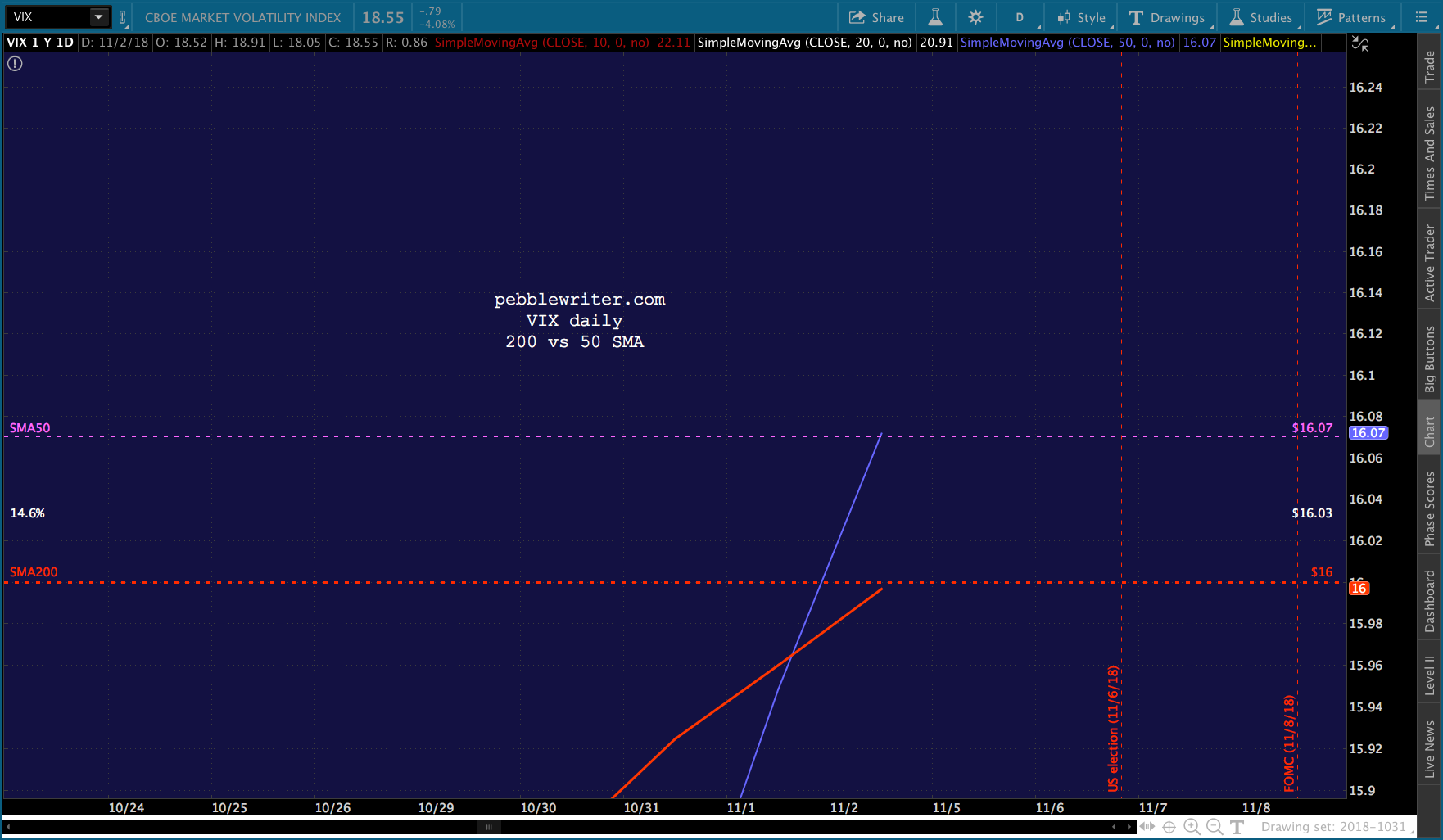
    Members might wish to revisit last week’s post on VIX [see: VIX’s Warning] in which we discussed the bearish implications of the impending 50/200 cross.  This morning, it’s alive and well.continued for members

    (more…)

  • Mixed Messages

    The headlines have been coming fast and furious over the last 24 hours.  First, Trump’s tweet yesterday morning regarding trade negotiations with China touched off a rumor, declared false this morning, that a trade deal was imminent. But, SPX soared yesterday anyway.

    Then AAPL’s earnings came out.  The numbers were underwhelming; and, the company’s announcement that they’d no longer report unit data was very poorly received.

    The chart we put up yesterday prior to the close [see: All Eyes on AAPL] showed substantial downside potential… …which after-hours trading is confirming.Then there was this morning’s payrolls data: a 250K increase with a 3.1% increase in average hourly earnings.  While no doubt  It’s exactly the sort of data the Fed needs to justify further rate increases in the face of the collapse in oil and gas prices — the last piece of the puzzle.

    Gasoline has now fallen over 20% since our Oct 3 short call and tagged another downside target yesterday.Oil is off over 16% and just broke beneath horizontal and channel support.  To be sure, it will keep October’s CPI low and will delight voters driving to the polls on Tuesday.  But, like the employment data, there are repercussions.By the way, I have updated our oil and gas forecasting results, available at the links below.

    Oil Results
    Gas Results

    I hope to post currencies, VIX and gold later today or this weekend.

    Futures melted up to backtest the SMA200 early this morning and have since fallen 16 points to the algo-darling SMA5 200.  It remains to be seen how the mixed messages being sent up from Washington and Cupertino will play out.  But, for now, I’m leaving our targets in place.For the moment, at least, VIX’s 50/200 cross is on again.continued for members(more…)

  • Coincidences and Consequences

    It’s interesting how Khashoggi’s murder top-ticked oil and gas prices…

    …and, so soon after Trump’s latest demand that OPEC lower oil prices.

    I’m certainly not insinuating that Trump had anything to do with Khashoggi’s murder.

    But, OPEC ignored Trump’s Sep 20 demand.  Two weeks later, oil prices had spiked 10% higher.  Since Oct 3, the day of the murder, WTI has fallen 14.5% and RBOB has fallen 16.7%.

    As Churchill famously said, “never let a good crisis go to waste.”

     *  *  *

    Sometimes it’s quite difficult to anticipate a major market move.  You’ve got hundreds of companies, all with their own earnings, outlooks, and market-moving headlines.  Then, there’s the economic news of the day, both domestic and foreign.  And, of course, there are geopolitical developments such as who’s dismembering or cozying up to whom?

    And, sometimes it’s not so difficult at all. It can be as simple as the VIX chart we’ve discussed all week.  From Time to Panic on Tuesday:

    Note that VIX need only break the purple TL [for SPX to bounce.] If VIX doesn’t break down, this should be the end of the line for this bounce.

    It didn’t bounce.  SPX plunged.  Next?

    Or it can be slightly more complex, but still fairly straightforward — such as is the case with oil and gas.

    As we all know, central bank support (low interest rates, among other accommodations) has been critical to stock prices since 2009.  Low interest rates, of course, rely on low inflation.  And, low inflation relies to a great extent on low oil and gas prices (more accurately, low MoM and YoY increases in those prices.

    From last April in Oil & Gas, Inflation and Interest Rates: A Delicate Balance or Goal Seeking?

    The complicating factor, of course, is that oil and gas prices took over the job of stimulating algos (chief among the 90% of all trading activity which is conducted by machines) to drive stocks higher.

    Most recently, oil, gas and SPX all bottomed on Feb 11, 2016 and oil and gas prices played an integral role in stimulating the subsequent rally.  The most important nudge was in December 2017, when oil and gas prices broke out of an already rising channel.

    To chartists, and to algos, this is a very bullish maneuver.  It also has the effect of driving inflation and interest rates higher. CPI rose from 2.11% in December 2017 to 2.95 in July 2018.  The 10Y rose from 2.31% in December to 3.24% just a few weeks ago.

    The Fed told us they were okay with this, that they were going to let the economy and inflation “run hot.”  I was among the many doubters, citing the damage that higher rates would inflict on our already alarming budget deficit, but darned if they didn’t do it anyway. I suppose that, at the end of the day, a temporary increase in the rate at which the debt and interest expense are expanding was less important than having a higher perch from which to crash rates during the next GFC.

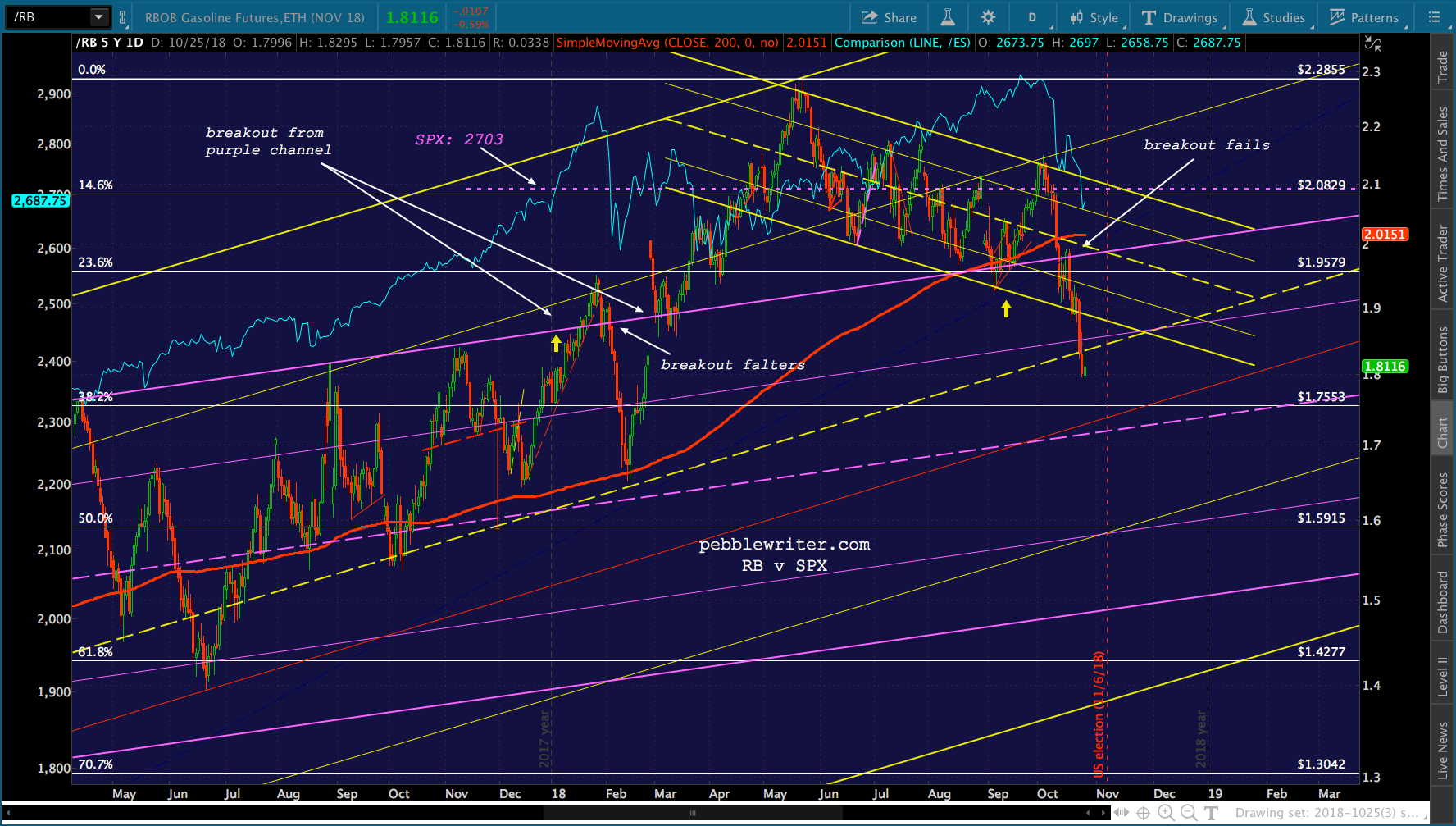
    Stocks ignored the implications for a while, happy to play follow the leader with oil and gas prices.  The day that RBOB popped out of the rising purple channel was the day that SPX popped above its 2.24 Fibonacci extension at 2703 – a level which might otherwise have provided serious overhead resistance.  It can be seen as the horizontal, purple trend line on the chart below. In early February, though, RBOB’s breakout faltered.  No surprise, but SPX followed along, suffering its biggest and sharpest decline in years.  Like magic, RB quickly popped back above the purple channel top – rescuing SPX and helping it back above 2703.

    Note that SPX went on to new all-time highs in September, only after RB backtested the purple channel and bounced higher.

    And this lovely little correction we’re enjoying?  SPX topped the day that RB failed to break out of the falling yellow channel (also the day of Khashoggi’s murder.)  SPX fell through its 200-day moving average on the day that RB plunged back below the purple channel top.  And, SPX plunged below 2703 on the day that RB fell out of the falling yellow channel.

    With the elections less than two weeks away, I’m not expecting a sharp rebound in oil and gas prices any time soon.  So, the algos will have to rely on other tools — such as VIX, which has now shed 12.5% since tagged our 26 target yesterday.

    So far, VIX’s decline has produced a pretty nifty bounce.  Is it enough to offset weakness in oil and gas and a hawkish Fed which has been browbeaten by a “low-interest rate president?

    continued for members... (more…)