Tag: investing

  • INTC: Coulda Seen it Coming

    If you knew absolutely nothing about the company Intel, but knew just the basics of chart patterns and Fibonacci patterns, today’s sharp pullback would have come as no surprise. In fact, you could say the same thing about the past 25 years.

    Note that 69.29 was only 75 cents away from an 88.6% retracement (a bat pattern) and occurred at the top of an eleven year-old channel. Easy pickings.

    The subsequent drop would normally be to a lower Fib level which, in this case, was the 50% retracement. It also lined up with the bottom of the white channel. Also, easy pickings.

    The rebound back to the 88.6% retracement was only slightly tricky. It was in essence a double top, which are usually hard to anticipate. In any case, once the double top occurred, the subsequent drop was almost exactly to the 78.6% Fib retracement (not shown.)

    The rebound from there to its recent highs, however, was almost exactly a 61.8% retracement (44 cents off, again easy pickings.)

    Volumes have been written about how/why chart patterns and Fibonacci patterns work. It makes for interesting reading. But, for those who don’t care how the watch works and just want to know what time it is, it’s good info to have.

    Speaking of which, if INTC doesn’t recover to at least the bottom of the little purple channel below (45.50ish), things could get much worse.

    Stay tuned…

  • Crude Carnage

    May WTI futures are off almost 35% since Friday’s close.  This drops it below the 17.12 target we first identified in March 2019 when, at 59.32, CL had completed a rising wedge and tagged multiple channel lines.

    Members might recall the 17.12 target was originally set for April 2023 in keeping with a March 2019 cycle study [see: Macro Factor Cycles and Regime Shifts.] The chart patterns and Fib levels fit nicely with the concept of a recurring 2600-day cycle for significant lows.We’ve reiterated the 17.12 target many times, including last December as CL finished on a high note after plunging 45% in the wake of Jamal Khashoggi’s Oct 2018 murder (when the US achieved maximum leverage over the Saudis – see: Coincidences and Consequences.) The last significant bounce accommodated both the Aramco IPO and the year-end equity ramp.

    Oil has been a favorite tool of not only the Saudis but also central bankers and politicians.  In fact, understanding the relationship between oil/gas and inflation, interest rates and equity valuations has made it possible to accurately forecast most of its major moves over the years.

    At times, this has meant ignoring the frequently misleading supply/demand data, OPEC deliberations, and presidential tweets and focusing instead on where central bankers needed oil/gas to go in order to achieve a particular inflation and interest rate goals.

    As interest rates rose over the past few years, for instance, it became obvious that inflation would need to moderate to relieve the building budgetary pressure.

    One major theme on which we’ve focused since calling the top on interest rates in October 2018 [see: Suddenly Interest Rates Matter] has been the relationship between CPI and the YoY delta in gas prices. By “managing” the price of RBOB, CPI and, thus, interest rates could be managed higher or lower as needed.This was a very reliable theme for most of 2018, 2019, and early 2020 – when the focus shifted to oil’s strong correlation to stock prices.

    Oil has long been a major factor in triggering algos to bid up stocks. So, when oil’s major channel from 2016 broke down in February, we knew stocks were in deep trouble.

    With CL dropping through its 2001 lows and approaching its 1998 lows, what might we expect from oil and what are the implications for stocks? As we discussed last week:

    A drop through 19.27 would be reason enough to revert to short with 17.12 and 10.65 the only support between here and zero.

    continued for members(more…)

  • We’ve Seen This Movie Before

    I’ve seen one particular assessment over and over in the financial news this morning: The market’s rebound following Iran’s missile strikes last night was “surprising.”

    No, it is most certainly not surprising! Not even a little bit. Anyone who pays the least bit of attention to charts could have seen this coming a mile away. It’s the same response we’ve seen countless times over the past several years and is a product of the way the market works these days.

    The chart below shows a red channel which S&P 500 futures have followed religiously since stocks broke out of a downturn when Phase One was falsely declared a done deal on Oct 11. Since then, ES has fallen substantially only when significant overhead resistance could be backtested [previously resistance, it would now provide support.]

    Ever since ES first broke out of the rising purple channel on Dec 12, we have been waiting for a backtest of that channel. A backtest is the market’s way of saying it’s done with prices that are any lower.

    Yesterday morning, I posted this chart – placing a downside target at the top of the rising purple channel around 3180. Only if the backtest didn’t hold would any of the lower targets come into play. VIX, which spent the past week being smacked back below its 200-day moving average, began to creep higher as soon as the cash market closed.  At exactly 7:41PM ET, it topped out and began a steady drop back to its former lows.

    Why 7:41? Because that’s exactly when ES completed its backtest of the purple channel top.  There was no other news, no announcements, no tweets – just completion of the backtest.Yes, it could have waited until Monday when the purple channel top and falling white channel bottom intersected. But, that would have meant a more substantial intraday drop below the bottom of the rising red channel.

    Remember, the rising red channel is the one that bulls are hell-bent on preserving – the path out of the rising purple channel which promised gains of only 1.4% annually.By now, readers know that when I say “bulls” I’m not really referring to fundamentally-oriented portfolio managers and analysts who suss through news and data and draw conclusions about the likely impact on markets. They are in the minority, now that quantitative and passive trading are responsible for 90% of all volume.

    I just finished Gregory Zuckerman’s excellent treatise on quantitative investing: The Man Who Solved the Market: How Jim Simons Launched the Quant Revolution. It’s a great reminder that central bankers and their proxies have been enabled, incentivized and prompted to exert great control over stock prices.

    continued for members(more…)

  • Put Up or Shut Up

    It’s now been almost a month since we posted our analog-based forecast [see: Analog Watch July 15.]  If it’s valid, we should see a sharp selloff over the next few days which ushers in 9-12 months of increased volatility and losses. From that post:

    Ideally, an analog provides exceptionally accurate forecasts of a very significant move. I think this could be one of those and that stocks are on the cusp of the biggest drop since the Great Financial Crisis.

    With currencies and VIX on board, all we need is for oil’s bounce to fizzle in order for the bears’ party to get started.Next up…lower lows?If it’s not valid, we’ll know very soon.

    continued for members(more…)

  • Update on DJIA: Jul 29, 2019

    In our last dedicated post six months ago, we discussed the critical resistance DJIA faced: the neckline of a large H&S Pattern.

    …it’s important to note that like SPX and COMP, [DJIA] is backtesting a point of potentially strong resistance — the neckline of a large Head & Shoulder Pattern that never completely paid off.

    DJIA’s reversal had occurred 500 points short of the indicated target and was thus susceptible to another leg down following the backtest that, ideally, would align with a significant channel line or Fib level.

    But, the White House had other ideas. Mnuchin planted a story with the Journal that the China tariffs might be lifted.  Combined with the ongoing beatdown on VIX, DJIA sliced through the neckline like it wasn’t even there.  Of course, it was careful to observe the neckline in the midst of a backtest once it was recast as support (which involved a second busted H&S.)

    Since then, DJIA has ignored a potential triple top and pushed to new highs which just so happen to mark two significant points of overhead resistance.  I know, I know…fool me once and all that.But, this time might just be different.  We’ve been following an analog for the past two weeks which has been quite accurate so far.  If it plays out, DJIA might have already peaked and could be facing a significant decline.

    continued for members(more…)

  • Stranger Things at Netflix

    First, a confession.  In 2004 I sat next to a guy at a Sundance Film Fesitval screening who was very excited about his company that would someday be able to play movies on your computer or even your cell phone.  “Why won’t this guy shut up?” I asked myself as I scanned the theater for an empty chair.

    Netflix: Looking for more subscribers?

    The “guy,” of course, was Reed Hastings. At the time, they were barely profitable, having just posted their first net profit ever (a whopping $7 million in 2003.)  The stock was hovering around $5/share.

    I couldn’t, for the life of me, figure out how they’d ever compete against Blockbuster — which had turned down an offer to acquire the company for $50 million a few years earlier.

    The 2004 annual report cover, to the left, illustrated the problem. Why wait for a movie to arrive in the mail when you could run down to the local Blockbuster and grab a copy (along with some tasty Goobers) right now?

    Reed was obviously on to something and soon figured out online delivery — though he still hasn’t cracked the eGoober challenge.  A $10,000 investment in the common at that time would be worth around $1 million now.  Live and learn, right?

     *  *  *

    The stock is under pressure this morning as subscriber growth fell short of Street expectations and the company’s guidance. But, I’ll leave that to my fundamental brethren to suss out. My concern is that the stock will test critical support.

    Last year we took a look at the chart and noted that at 400.48, it looked particularly vulnerable.  From Netflix: Watch It! on July 16, 2018:

    A quick glance at NFLX’s daily chart shows it has significant downside potential. The most obvious downside target is the 100-DMA at 338.73. But, the 200-DMA is approaching the white channel midline and should cross it at around 298-300 on or about August 6. It makes for a nice downside target if the SMA100 doesn’t hold.  Should the SMA200 and channel midline fail, the bottom of the white channel is currently around 200 and (obviously) rising.

    The stock soon tested then failed at the 100-DMA, but bounced just before reaching the midline and popped out of the falling white channel.  It thus postponed the midline/200-DMA test until October 11 where it bounced yet again before plunging through to the channel bottom which, by then, was up to 230.

    There are a lot of things that could happen to the stock, which has traded as low as 313 in after-hours.  But, the critical level to watch is 295-300 where it would drop through the 200-DMA and test the channel bottom as well as backtest the broadening wedge (aka megaphone pattern.)

    Anything lower would be very problematic for a stock which has been locked in the same rising channel for 6 1/2 years.

    One note to those focused on the fundamentals. The observations I made last year still apply:

    As an aside… I’ve been mystified as to the value ascribed to the company based on its ability to produce original content.  What about the risk?  Anyone who has worked in film or television can tell you that most productions don’t turn a profit.

    I don’t want to get into production. There are passionate, talented filmmakers out there and I would pollute the craft.

    Reed Hastings, Inc Magazine: Dec 1, 2005

    Netflix has clearly hit some home runs with House of Cards, Stranger Things, etc.  And, theoretically, producing content in-house can lower acquisition cost and diversify revenues.

    But, extrapolating an unending string of popular and profitable productions is just plain silly.  Some would say borrowing $1.8 billion to fund said productions is downright reckless.

    Think New Line, which followed up the hugely successful Lord of the Rings trilogy with the expensive flop The Golden Compass.  Investors would do well to remember that beta works in both directions.

     *  *  *

    It’s been ages since we offered a discount on memberships.  For the next several days, quarterly subscriptions – normally $399 – will be discounted to only $299 for the first quarter. That’s 3 months for less than the price of two on a monthly subscription. 

    Click here to join now.

    Update for members… (more…)

  • The Slope of Nope

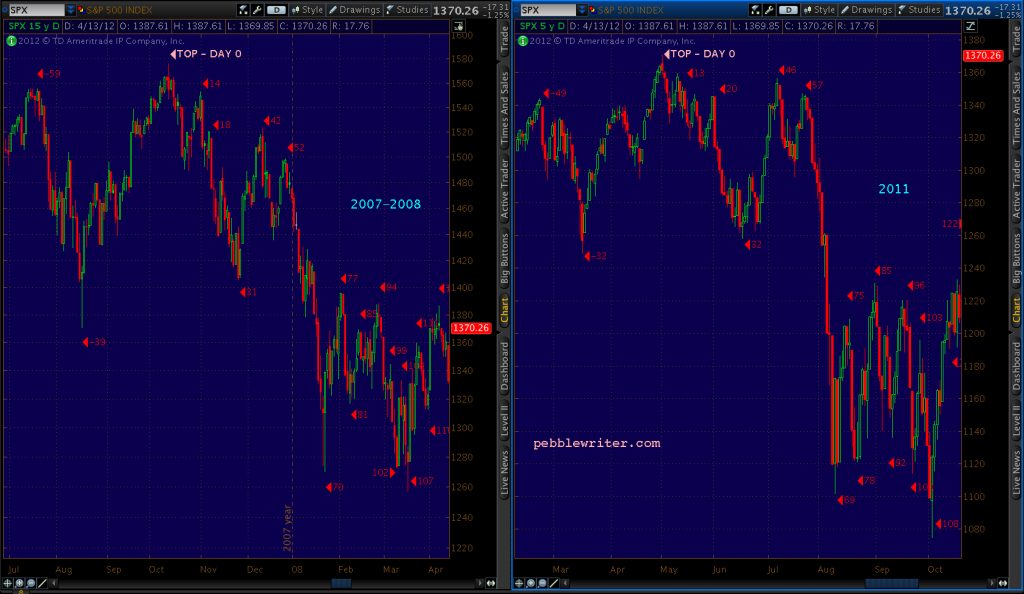
    As a chartist, I’m often struck by how similarly the stock market acts at important tops and bottoms.  By “important tops” I’m speaking of those which precede large corrections or even crashes.  So, with apologies to Tim Knight’s excellent Slope of Hope

    In 2000, SPX retraced a Fibonacci 88.6% of its initial drop before falling off a cliff.  If you were to draw a trend line (TL) between the two tops, it would take on the slope of the yellow line below.The 2007 top was completely different: no big retracement, no place for a trend line with a similar shallow a slope to connect, just a setup for a gag featuring a roadrunner and a coyote.

    But, in 2011, we saw the pattern all over again: an 88.6% retracement and a very similar TL.What many didn’t realize at the time was that the TL from 2007 TL was simply making a return appearance.Isn’t it interesting, then, that the slope of the line between the Sep 21, 2018 high and today’s high (and passes through the 88.6% Fib retracement) is exactly the same?The Big Picture…

    Is it possible that all the bad economic and earnings news we’ve had these past few months is just…bad news?

  • Manipulation is Nothing New

    Yesterday, former SEC attorney Teresa Goody joined those calling for an investigation into the market action on December 24.

    It was hardly the biggest move we’ve seen over the past year. But, it resulted in new lows that ruffled a few feathers.

    Click the image to watch the interview, or just keep reading.

    Goody: …when you have these wide swings in the market, 400, 500, 600 points, 2 to 3 percent, I think that’s a clear indication that there is some sort of a market structure issue, so the SEC will have to investigate, I think, and also FSOC look into why there’s this volatility because it’s not fair to everyday investors, it’s not fair to all investors, really. And it really goes to the fair and efficient markets that we have.

    Melissa Lee and Kelly Evans of CNBC could have left it there. But, to my surprise and to their great credit, they challenged Goody’s statement — eliciting a nonsensical stream-of-consciousness response that rivaled one of the best deer-in-headlights word salads ever.

    Lee: Would, [by] the same token, the SEC investigate big up days?

    Goody: [long pause] I think that big up days are a little different from down days…

    Lee: Why? Doesn’t that speak to market structure as well? If you have the same circumstances that lead to a rise in the Dow of 3% on thin volume, why wouldn’t you investigate that?  If it’s really on the basis of market structural issues, why wouldn’t you investigate that?

    Goody: Well, for one thing, it’s about market loss and investor loss.  And, so, while I think that that’s important to look at too, it’s more important to look at the loss because you have things like the high frequency traders, for example, and, so, once there’s a massive sell off, you have the ability for people in the market like high frequency traders to get out early. And, then, once the market starts coming around, to come up and buy in low, so they sell high buy low.  And, then, the average investor is going to act less quickly than the high frequency trader for example, and they’re going to lose money. And, then, with this volatility everyday investors are very confused by that. They hear “oh Apple’s doing very poorly, or Apple’s doing very well and so maybe I should buy or sell.”  And, the average investor is going to act more quickly to, uh, minimize loss than they are to get a gain.

    Evans: Teresa, I don’t quite follow that.  If they’re front running, they’re front running. Whether they’re shorting or they’re on the long side, either way if you’re front running the public, and that’s a market structure issue, we talked about this a couple of years ago…it’s one thing for investors to…lose money, as you said, but if you also can’t buy something because it’s artificially moved up 10%, you’ve also lost out. So, it’s gotta go both ways or it doesn’t hold water, right?

    Goody: I agree with you.  And, I think that the bigger concern is when investors are losing a lot of money. But, I completely agree that there’s also an issue when investors can’t get in because it’s artificially high.  And, this goes to your point, too, is that what we’re trying to find is the real valuation.  So, anything that negates the integrity of the real valuation of a stock is something that has an impact on the market integrity and the market structure. And, so I agree, it’s big ups and big downs.

    But the SEC and, I think regulators, is more concerned with everyday investors losing a lot of money rather than not being able to get money and the gains because there’s more of an impact there, especially when its 500 or 600 points decrease.  But, I think they need to look into both and this way, also, when you’re looking at a decline, whether there’s front running, whether you know, some traders are able to sell high and start a sell off, and anticipate a big sell or a big purchase, and then they can get in front of that too, so those are issues where you can get more of the manipulation and the fraud.

    On that holiday-shortened trading day, the S&P 500 opened down 16 points and closed down 49 points. It’s highlighted in blue in the chart below.I couldn’t agree more that an investigation is warranted.  In fact, it’s high time the SEC investigate the rampant market manipulation that occurs on a regular basis.  Let’s start, though, with the much more frequent instances where the manipulation results in huge gains in the markets.

    On the 24th, members will remember, Mnuchin called in the Plunge Protection Team — which aptly manipulated markets into a sharp recovery by crushing VIX to the tune of 50%.This is a common occurrence as we saw again last night.  After five sessions of declines, ES broke out overnight and is currently showing a 25-pt gain.The primary reason?  Again, VIX — which was slammed by over 5% overnight and 23% since Wednesday.By all means, let’s investigate market manipulation.  But, if we really care about market integrity, let’s investigate those manipulating it in both directions.

    continued for members(more…)

  • Where’s Warren?

    The biggest surprise from today’s meltdown?  No Warren.

    As in Buffett.  It seems like every time the market pulls a scary reversal as it did today, Warren makes an appearance on CNBC or Bloomberg or gives a hasty interview with the WSJ, Forbes, etc. He helps bring calm to the markets. Investors like him and trust him.

    It’s not only good for the market.  But, it’s good for Berkshire Hathaway stock too.  Looking at the past year, Warren made an appearance every single time (the yellow arrows) BRK/B was in trouble or needed help breaking out.The biggest breakout was on July 18 when the stock gapped 5% higher after the board removed a cap from its buyback program.

    So, why no Warren today?  Simple.  It isn’t yet time to panic.  If the past is any guide, there’s about 7-8 points of downside left before Buffett needs to report to makeup.

    Stay tuned.