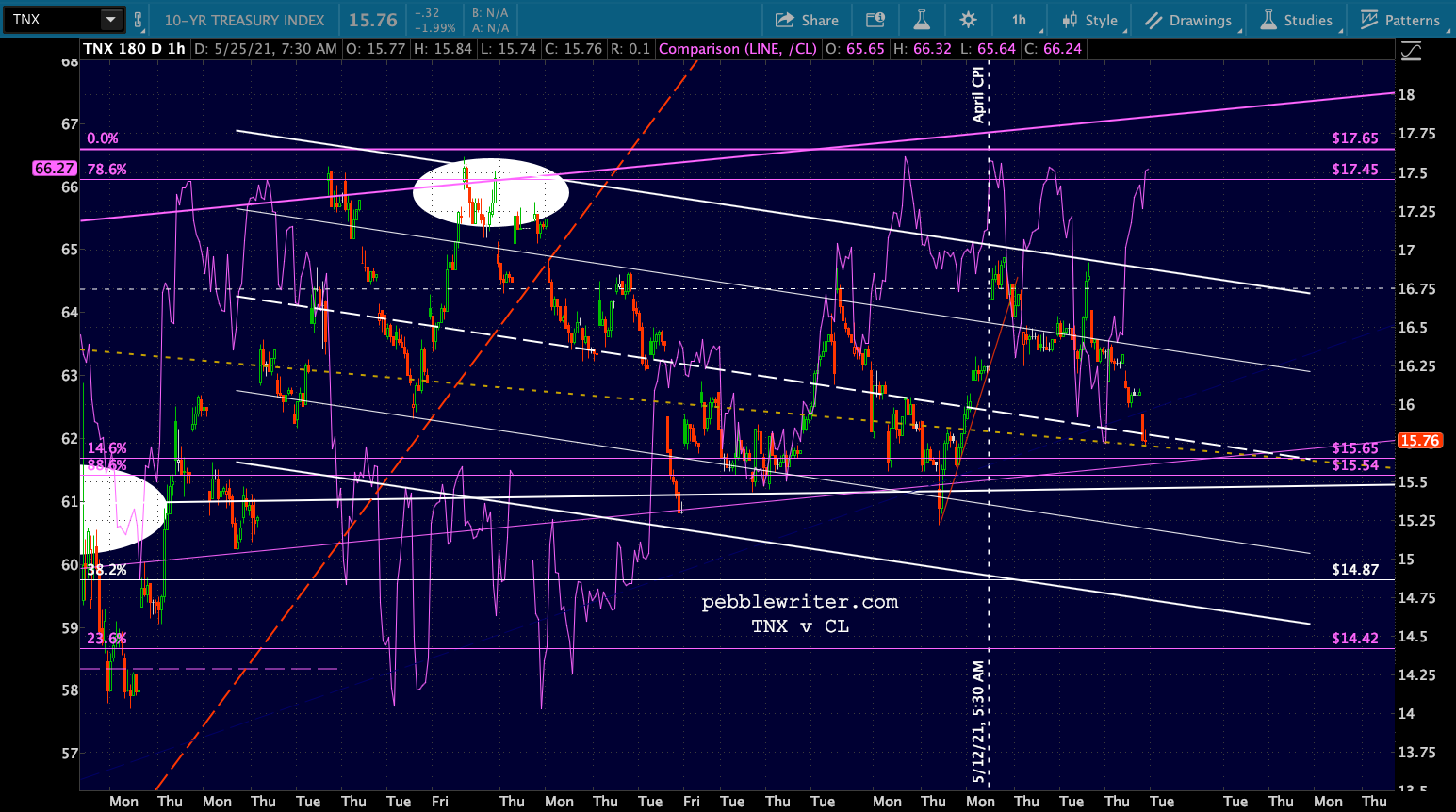
Tag: interest rates

  • Charts I’m Watching: Jun 21, 2021

    ES came within 9 points of our next downside target before getting a nice bounce motivated primarily by USDJPY, which was working flat out to save the NKD from a scary, and long overdue dive to its SMA200.

    This bounce will be quite important to the bulls, who are no doubt hoping to avoid a bearish 10/20 cross.

    continued for members(more…)

  • Bullard: Wait, Did I Say That?

    Not that futures needed any help melting down this morning, but Jim Bullard just poured gas on the fire. Yes, Jim Bullard! The Fed president who never had a hawkish thought in his life.

    Then, he trashed the Fed’s most nonsensical policy: throwing $40 billion per month into the mortgage market when mortgage rates are already at all-time lows.

    Bulls better hope that ES can bounce at our next downside target: the 50-day moving average currently at 4174.

    It appears that algos are finally being given the green light to (drumroll please) decline.

    continued for members

    (more…)

  • The Fed’s Big Day

    We’ve pretty much beat the inflation horse to death on these pages over the past six months. Bottom line, It’s too high and potentially out of control.

    So far, however, the Fed’s been able to hoodwink investors and algos and commandeer the bond market. Aside from making things much more difficult for the little guy – who they claim to care about – there have been few negative repercussions.

    But people are starting to talk. At first it was just fringe strategists like yours truly. Lately, it’s financial pundits, important bankers and hedge fund managers. Has the trance been broken? And, if so, will the market care? Today, we’ll finally find out how clever the Fed can be.

    Two years ago, before any of us had ever heard of COVID-19, our charts already called for some pretty dramatic outcomes.  We were pretty sure the 10Y, having reversed right on target at 3.25% in October 2018, was headed for at least 1.55%…

    …a target that was adjusted to 0.15% — 1.33% on January 13 at which point Wuhan City had reported only 40 suspected cases and one death.  On March 8, it reached 0.398% – well ahead of schedule thanks to COVID-19. Its rebound has been impressive – aided by a sharp rebound in inflation due primarily to the even more impressive recovery in oil prices.

    Ah, oil… We became convinced in March 2018 that oil was headed for a major breakdown, noting important cycles in its peaks and troughs. At the time, our model showed WTI (then at $62) dropping below $20 in early 2023.

    On Jan 3, 2020 we got more specific, pinpointing $17.12 on April 23, 2023.

    Of course, it dropped much lower and much faster than that. And, it’s recovery has been higher and faster than anyone imagined (or the fundamentals would support.)Interest rates and oil prices are irrefragably joined at the hip.  Gasoline prices are especially highly correlated with inflation… …which has traditionally been highly correlated with interest rates.   But, that all changed in the last couple of months when, thanks to the Fed’s ability to control interest rates, the bond market stopped caring about inflation.

    The stock market was elated as short rates flatlined while the 10Y marched higher…

    …leading to the first time in 20 years that a rapidly rising 2s10s didn’t lead to a market crash.The Fed has pulled off a pretty masterful reinflation of the everything bubble. Are they clever enough to avoid the inevitable pop?

    continued for members(more…)

  • Charts I’m Watching: Jun 2, 2021

    Futures are slightly higher ahead of the open, propped up by the usual pre-opening VIX plunge and WTI ramp job.

    continued for members(more…)

  • Why Bonds Are Still Important

    I had an great question yesterday regarding the bond market: “Is it possible the fear of pandemic in spring 2020 affected the behavior of 2yr and 10 yr and then indirectly triggered the crash?”

    Pebblewriter longhaulers will recall that our bond cycle model forecast a severe plunge in interest rates long before anyone was talking about a pandemic. In August 2019, for example, we were already anticipating a drop to near or below zero around December 2020.It’s what the charts suggested, as we posted in April 2018 [see: Bonds – a Buying Opportunity]…

    …and it’s what was necessary in order to keep America’s books balanced.  Annual debt growth was averaging 5%, and debt:GDP had topped 100% for the past five years.

    As we pointed out in July 2019 [see: Why Interest Rates Must Not Rise] the only way to keep debt service from overwhelming other federal expenses had been to crash interest rates.

    The trick was how to force interest rates lower without alarming us economist types. Past maneuvers had involved adjusting Fed policy (not terribly effective for medium and long-term rates) and forcing inflation lower by forcing oil and gas prices lower as occurred in 2014-2016 and late 2018 (detrimental to stock prices.)

    CPI, which had spent most of 2018 above 2%, had declined to a more manageable 1.7% by September 2019. But, the year-end ramp job in oil prices sent CPI up to a troubling 2.3% by December. The 10Y rose from 1.43% in September to 1.95% in December and, as the chart below shows, threatened to break out.  Something, as they say, had to give.

    As the big brains at the Eccles Building were spitballing potential solutions, the most extreme case of deus ex machina imaginable landed in their laps.  COVID-19 did the Fed a solid – albeit one which went way overboard.

    Oil prices, inflation and the 10Y were suddenly in a race to zero (oil won) and the Fed suddenly faced a slightly bigger problem: how to prevent Armageddon. They needed higher oil prices, interest rates and inflation just to talk equity investors (well, algos) off of window ledges.It worked so spectacularly well that they painted themselves back into a corner very similar to the December 2019 one: rapidly rising inflation and interest rates thanks largely to spiking oil and gas prices – exactly what our models predicted would happen. YoY gas price increases and CPI have been so highly correlated that they are now literally on top of one another.

    For the past few thousand years, this would have been a serious problem.  Everybody knows interest rates spike when inflation spikes. Since the Fed essentially took over the bond market, however, they’ve been able to convince bond investors (well, algos) that spiking inflation isn’t a problem and, even if it is, it’s transitory.

    Want proof? Rates have actually declined since April’s 4.2% CPI print and are nearly back to the same level as before the bomb was dropped.If I walked up to you on a cloudless day and insisted that shaking my rain stick will make it pour, you’d probably double over with laughter. If I had a secret accomplice spray water from a garden hose all over us from an undisclosed location, you might begin to wonder if I was right.

    That’s what’s happening with interest rates right now. Except the rain stick is the Fed’s prognostications and the garden hose is actually a low-flying supertanker carrying 20,000 gallons.

    Of course bond investors care about spiking inflation. But, with the Fed pumping billions of dollars into the bond market every day (more on days with alarming economic data) to force interest rates lower, they can claim that said inflation (“did we mention it’s transitory?”) is obviously not a problem.  And the dopes in the financial press eat it up because, by God, they’re soaking wet.

    Instead of rising, interest rates decline, proving to all (especially the algos) that the Fed must know what they’re talking about or — to us more cynical types — that they’ve completely destroyed the bond market’s price discovery mechanism.

    So, did fear of the pandemic affect bond behavior and, thus, cause the crash? Absolutely – though it’s a bit of a chicken and egg situation. Everything unraveled at about the same time in the mother of all negative feedback loops.

    The irony is that it accomplished what the Fed needed to happen in the bond market — though to excess. The Fed can now use the pandemic as their excuse for the most rapid expansion of monetary supply in history– even as spiraling inflation crushes the disadvantaged whom the Fed claims it’s desperate to help.

    Now, on to the markets.  No surprise, but futures managed to ramp higher again overnight – creating the illusion, at least, that the downside case is off the table. It’s not.

    continuing(more…)

  • Update on XLF: Nov 17, 2020

    After being stuck in a textbook triangle pattern for almost six months, XLF finally broke out last week.

    We noted its having reached overhead resistance a few weeks ago [see: Yield Curve Model – Correction Imminent.] At the time, the 2s10s was threatening a breakout which, per our model, suggested a downturn for equities in general and XLF in particular.The 10Y did, in fact, reverse as expected and XLF dutifully tumbled – but, to a higher low. By Oct 30, a triangle was very well established and we were again facing a break out vs break down decision. Note that XLF had dropped through its SMA200 and was in a bearish SMA10/20 alignment. Had interest rates continued falling, I have no doubt that the triangle would have broken down and XLF would have reached the .618 Fib at 21.06. Instead, the 10Y popped back above its SMA200 (the yellow arrow)……and XLF got a much-needed bounce back to the top of the triangle. Yes, again. This time, however, TPTB were ready. After bumping into the top of the triangle on Nov 5 and 6, XLF received a fabulous gift.

    The 10Y gapped sharply higher, again breaking above the SMA200 it had fallen below and even above the top of the rising white channel. It was a massive move from 74.8 bps to 97.5 bps (point 6 in the chart above) in just two sessions thanks to the announcement of a vaccine from Pfizer and better than expected employment data [see: Vaccine!]

    As a result, the 2s10s broke above overhead resistance. A steeper yield curve is theoretically the solution to the banks’ woes. Though, historically, major breakouts in the 2s10s have led to equity crashes. Even for XLF. We’ll see if this time is any different.

    In the meantime, XLF has backtested the midline of the rising white channel from its 2009 lows… …following its very obvious failure to break out to new highs in February which resulted in its 44% crash. Note that a failure to push above the midline means at least a backtest of the triangle top around 25.26. Much will depend on some very fancy footwork by the Fed.The Fed’s exercise in ZIRP, which served as a lifeline to many sectors of the economy – not to mention the stock market, is a weight around the neck of the financial sector.

    Rising rates and a steeper yield curve might be okay with $7-8 trillion in debt. But, at $28 trillion, it’s a tad scary.Can the Fed find a way out of the corner into which they’ve painted themselves? Can they maintain the disconnect between the S&P 500 and the pandemic-stricken real world in which 30% of Americans are expected to be infected and another 200K are expected to die?

    “We’ll spend the next three months probably infecting another 15% and get to 30%, maybe more,” [former FDA Commissioner Scott] Gottlieb, now a CNBC contributor, said on “Squawk Box.” “Thirty percent assumes the current run rate if things don’t get any worse.”

    Stay tuned.

  • Retail Sales’ Last Hurrah?

    September retail sales sharply beat estimates, coming in at +1.9% versus 0.8% expected. With enhanced unemployment and virtually all other stimulus having dried up, however, this could be retail’s last hurrah.

    But, it’s enough to boost stock prices on this OPEX Friday 2 1/2 weeks before a presidential election.

    continued for members(more…)

  • Oil Spikes on Iran War Worries

    WTI futures spiked nearly 5% overnight in the wake of a US drone strike on Baghdad Airport which killed Iranian military commander Qasem Soleimani.  It is a dangerous escalation in the US conflict with Iran which broadened when Trump alarmed US allies by pulling out of the Iran nuclear deal last May.

    We argued at the time, as did many, that Trump’s actions put the US on the path to a potential shooting war. The assassination of Soleimani clearly amplifies the risks. So far, oil prices have pushed only slightly above the levels reached after the nuclear deal pullout and the Saudi Aramco plant was attacked in September.  But, this is obviously a more serious geopolitical development. From an economic standpoint, a sharp rise in the price of oil further complicates the already thorny inflation problem facing markets – setting up a showdown between Fed hawks and doves in January.

    continued for members(more…)

  • Update on Gold: Jan 2, 2020

    In our Aug 28, 2019 Update on Gold I noted that although GC had just reached our 1560 target, ZN had also reached our 132’100 target.  The picture was further muddled by the fact that DXY and GC had been moving in unison – an unusual occurrence, to say the least.

    ZN’s resistance could put the brakes on, meaning rates would rise and GC would theoretically fall.  But…I expect ZN’s pullback to be modest — possibly only 3-4% — suggesting GC’s pullback would also be fairly modest.

    As it turned out, GC and ZN both reversed.  Although DXY made a half-hearted effort to break out, it was limited to 1.5% and GC’s reversal was limited to 1446.

    DXY’s rally stopped making any sense at all once FOMC members began hinting at additional rate cuts. When the Fed resumed QE (QE-not as we like to call it), the market knew what to do: DXY has been steadily selling off and GC has climbed back to within $30 of its August highs.

    Does this mean more upside ahead?

    continued for members(more…)

  • Why Interest Rates Must Not Rise

    In May 2014 many of us were shocked by a report that Ben Bernanke, who had recently departed the Fed, told a group of wealthy investors that he did “not expect the federal funds rate…to rise back to its long-term average of around 4%” in his lifetime.

    I remember feeling Bernanke’s statement represented both extraordinary hubris and wishful thinking. Surely, the trillions being pumped into the financial system would drive inflation to levels that would produce higher rates.  After all, I reasoned, the bond market isn’t as easily manipulated as is the stock market.

    Last year, I called attention to the fact that the cost of servicing the US debt had broken out to new highs [see: Why Rising Rates are a Problem This Time.]  Even though interest rates had fallen dramatically, the spiraling debt had send annual interest expense on that debt to roughly $450 billion in FY 2017.

    Bernanke’s 2014 words came back to me as I did the math.

    Clearly, if rates were to normalize the interest expense would be unmanageable… Between 2000 and 2007, the average interest rate was 4.84%.  On the current $20.6 trillion balance, that would mean an annual interest expense of roughly $1 trillion.

    Of course he was confident in his prediction!  He understood that rates could never be allowed to rise.  A return to normalcy — and, I don’t believe this to be an exaggeration — would absolutely destroy the economy.

    I had always found the Treasury’s increasing dependence on short-term, floating rate and inflation-indexed borrowings a bit unsettling. Why not lock in a boatload of 30-yr bonds at 2.1%?  Now we know.

    In their wisdom (or desperation…time will tell) the central bankers and those maxing out America’s Gold Card have bet our very futures that Bernanke was right — that everything will be okay in the end…as long as the end never gets here.

    By the way, here’s an update of the above chart…which has been appropriately renamed.