Tag: crab

  • That All Ya’ Got?

    AAPL soars, market soars.  AAPL plunges, market yawns.  Sure, makes sense to me.  One can only guess as to how much effort went into propping up the markets this morning in the wake of the earnings miss.

    Have you ever heard so many laudatory comments about the stock everyone loved to hate only months ago: NFLX?  Gotta love it.

    Regardless, AAPL has gone exploring spelunking lower Fib levels and the rest of the market is up, which presumably means we’re presently on the right side of the market.

    AAPL should firm at 450.85 this morning — the 1.618 of the Crab pattern dating back to Nov 16 at 505.75 (light blue.) Personally, I’m an enthusiastic buyer at these levels (with stops, of course.)  I previously set the large white pattern Point X at 354 on Oct 4, 2011.

    But, moving it to the June 20, 2011 310.50 level (just as legitimate, if not more) means AAPL just tagged the .618 retracement of the 310-705 move.


    But, the biggest reason of all to be short-term bullish on AAPL is the purple channel — the bottom of which AAPL just tagged. The stock could certainly fall below it, but this sucker dates back to the year 2000.  I have a hard time believing the channel will fall after what amounts to a minor estimate miss.

    Does the company have problems?  Sure.  I worry about the obvious decline in customer service and a slowing product cycle.  But, it also has the means, the manpower and the motivation to fix what’s ailing the stock price.

    Stay tuned.

    UPDATE: 1:15 PM

    The markets have sold off from their highs, but seem to be finding RSI support.  APPL is, doing the same.  For those who find the bounce idea compelling, here’s another chance.


    UPDATE:  1:50 PM

    Watching to make sure the price channel and RSI channel both hold on SPX…

  • Now What?

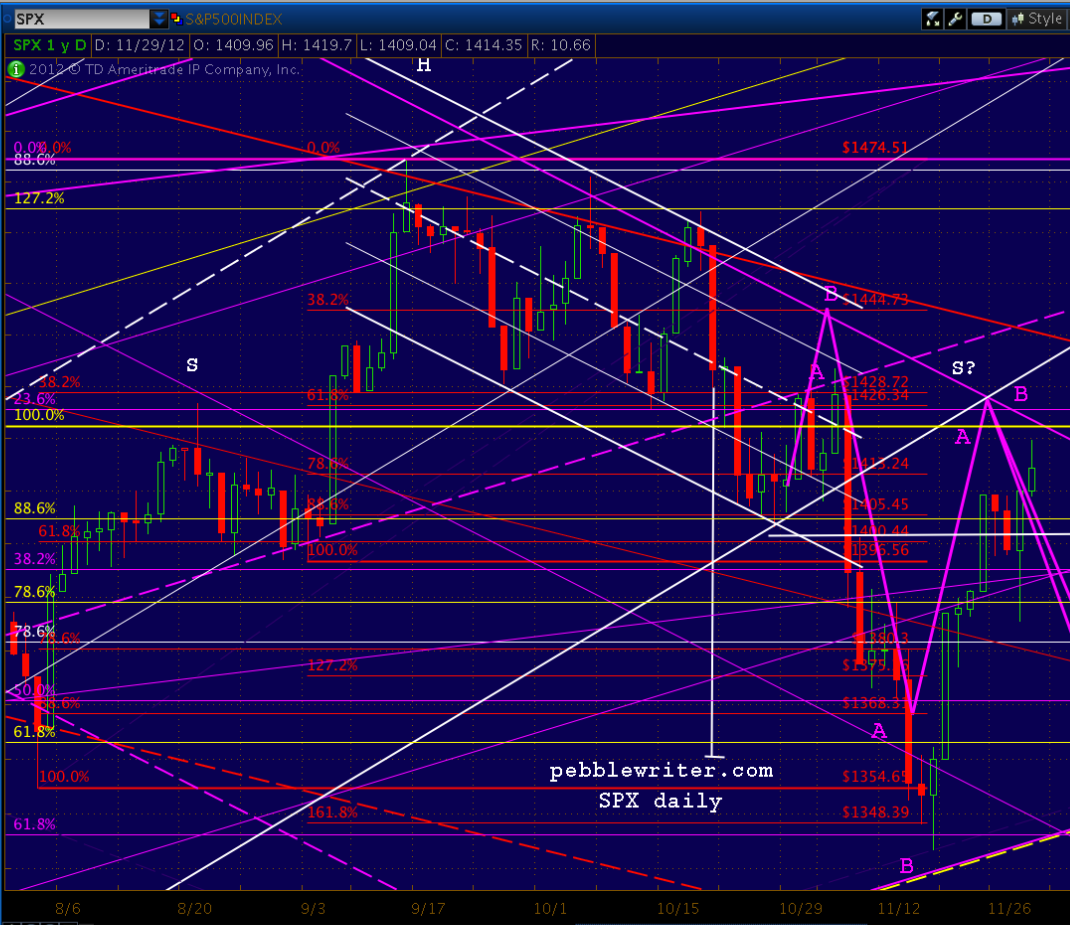
    First, a quick overview…

    The dollar got clobbered overnight, knocking it temporarily out of the white channel that’s guided it since Jan 11.
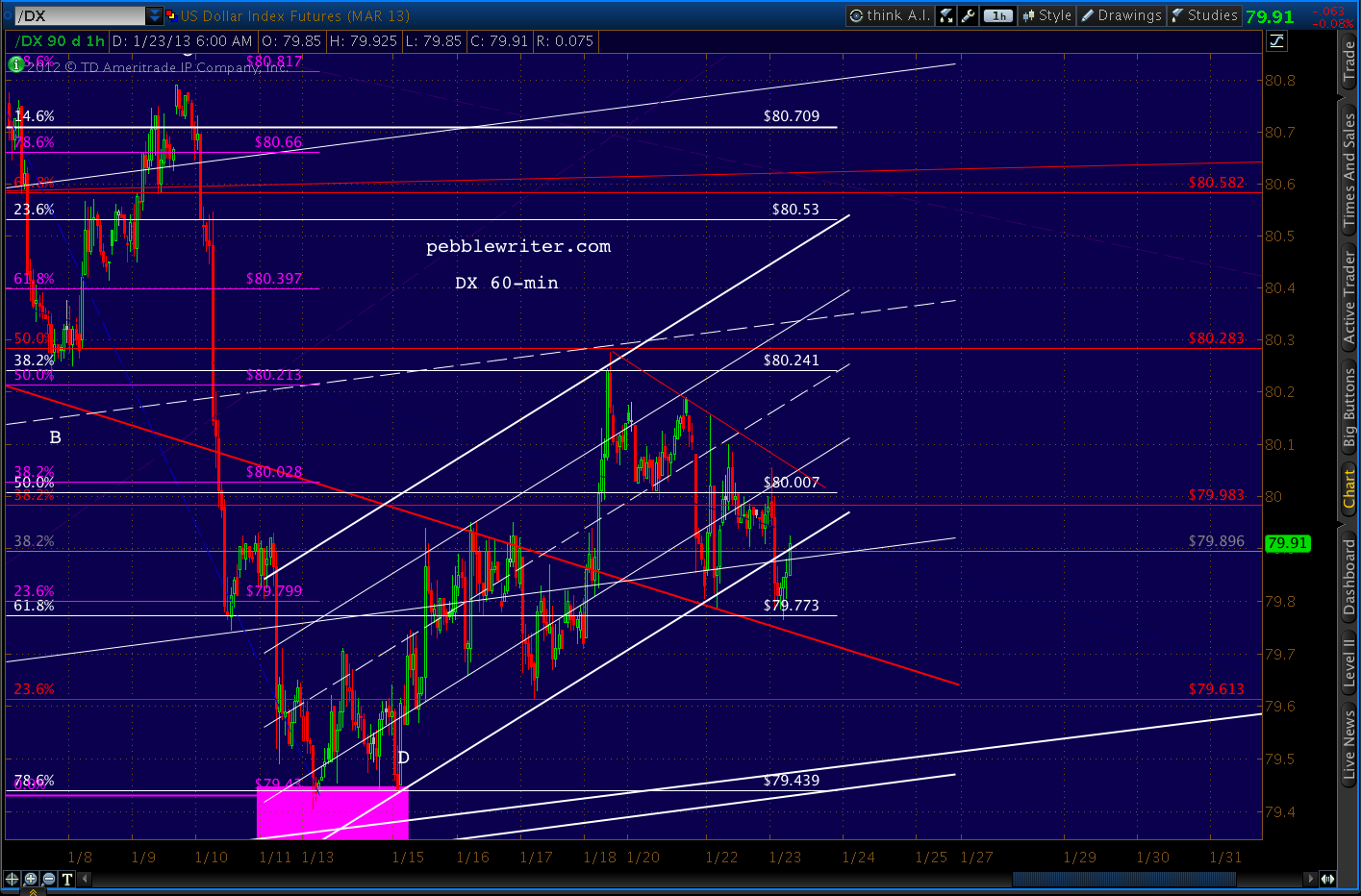
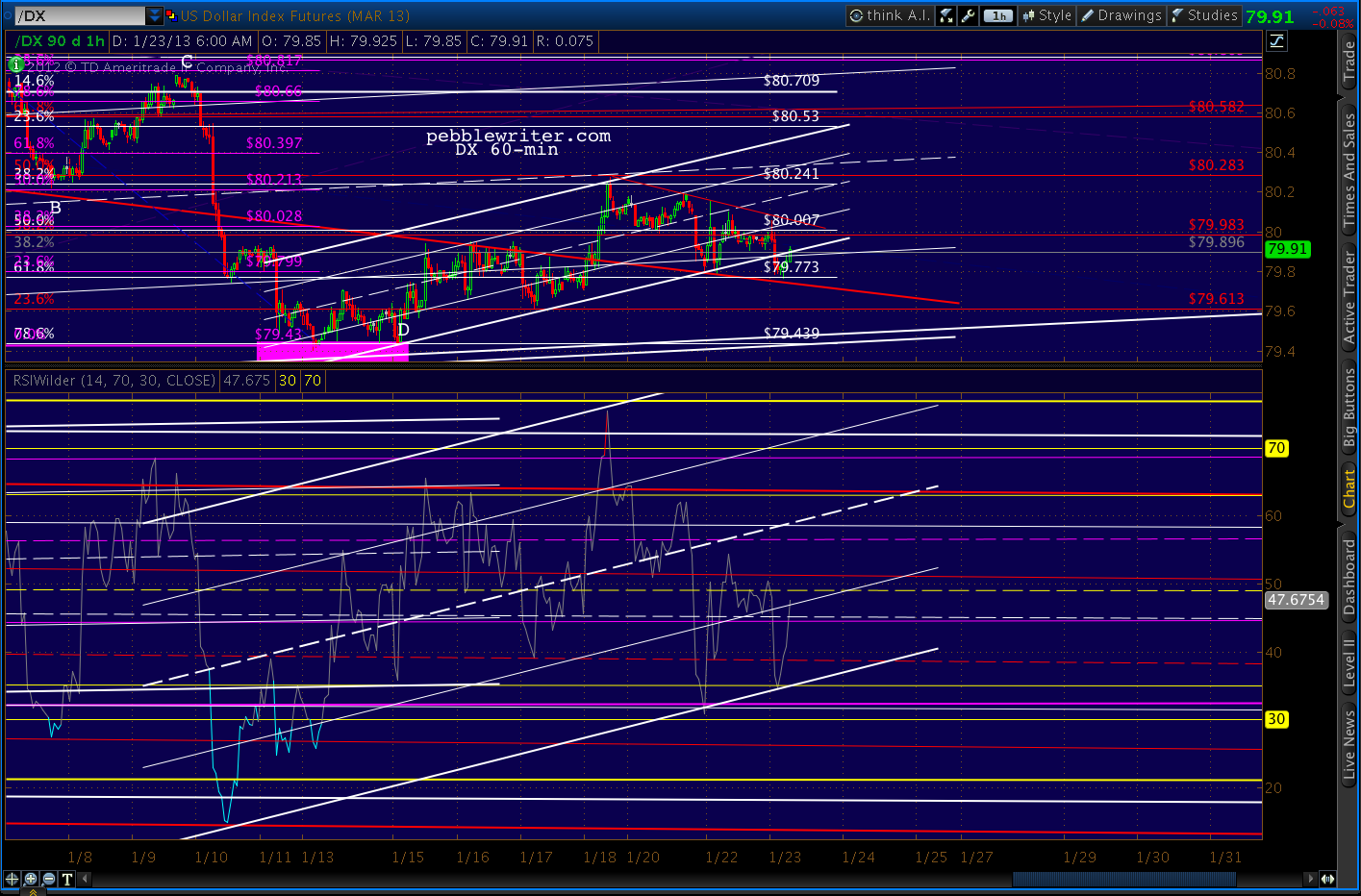
    But, interestingly, its RSI channel is doing just fine, thank you.
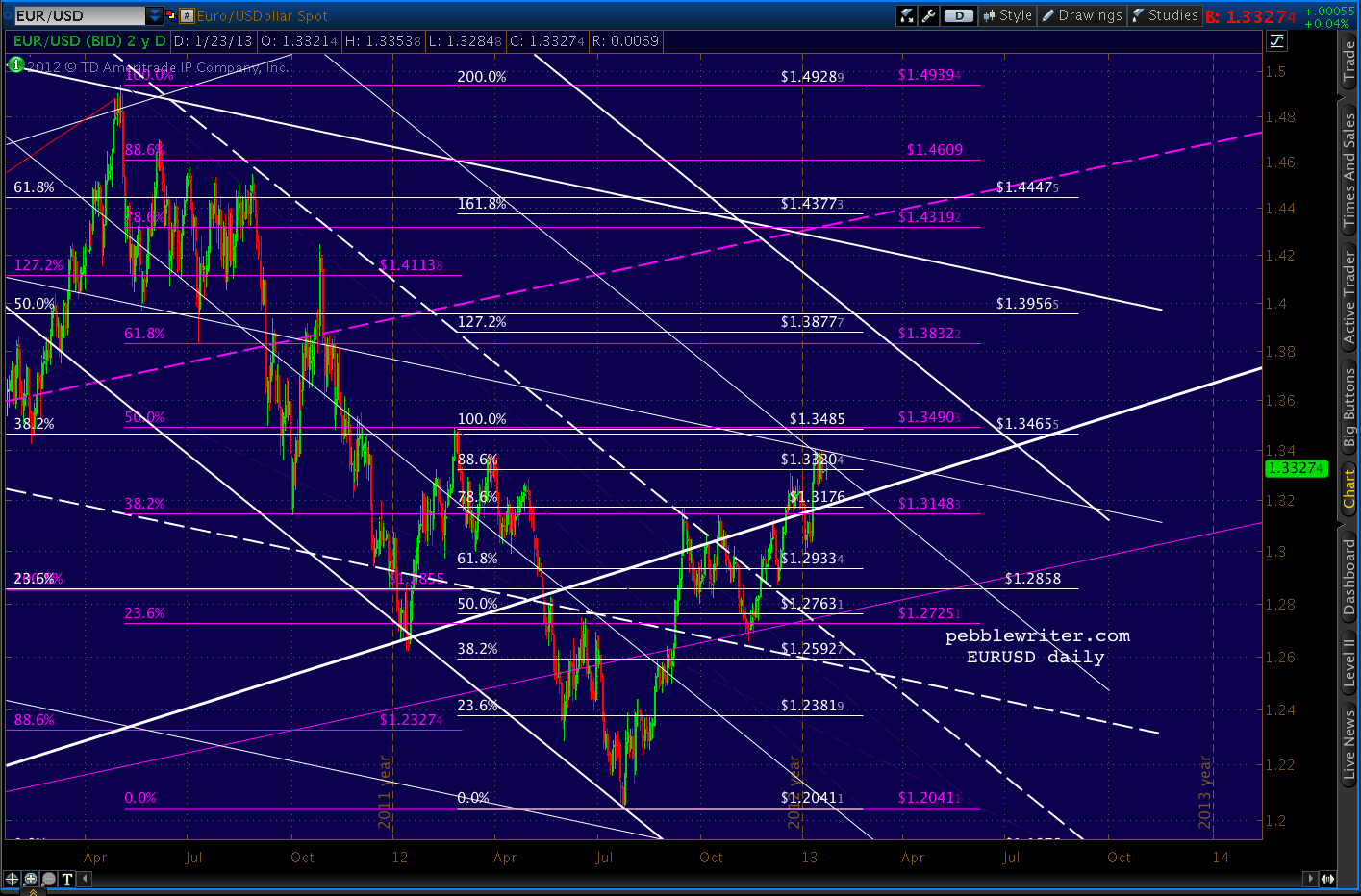
    The EURUSD continues to levitate, but still hasn’t broken the last important interim top put in on Feb 24.  It is also bumping up against two 25% channel lines, so could very well stall out here at the .886.
    There is still ample negative divergence regardless of which channel ultimately wins out.
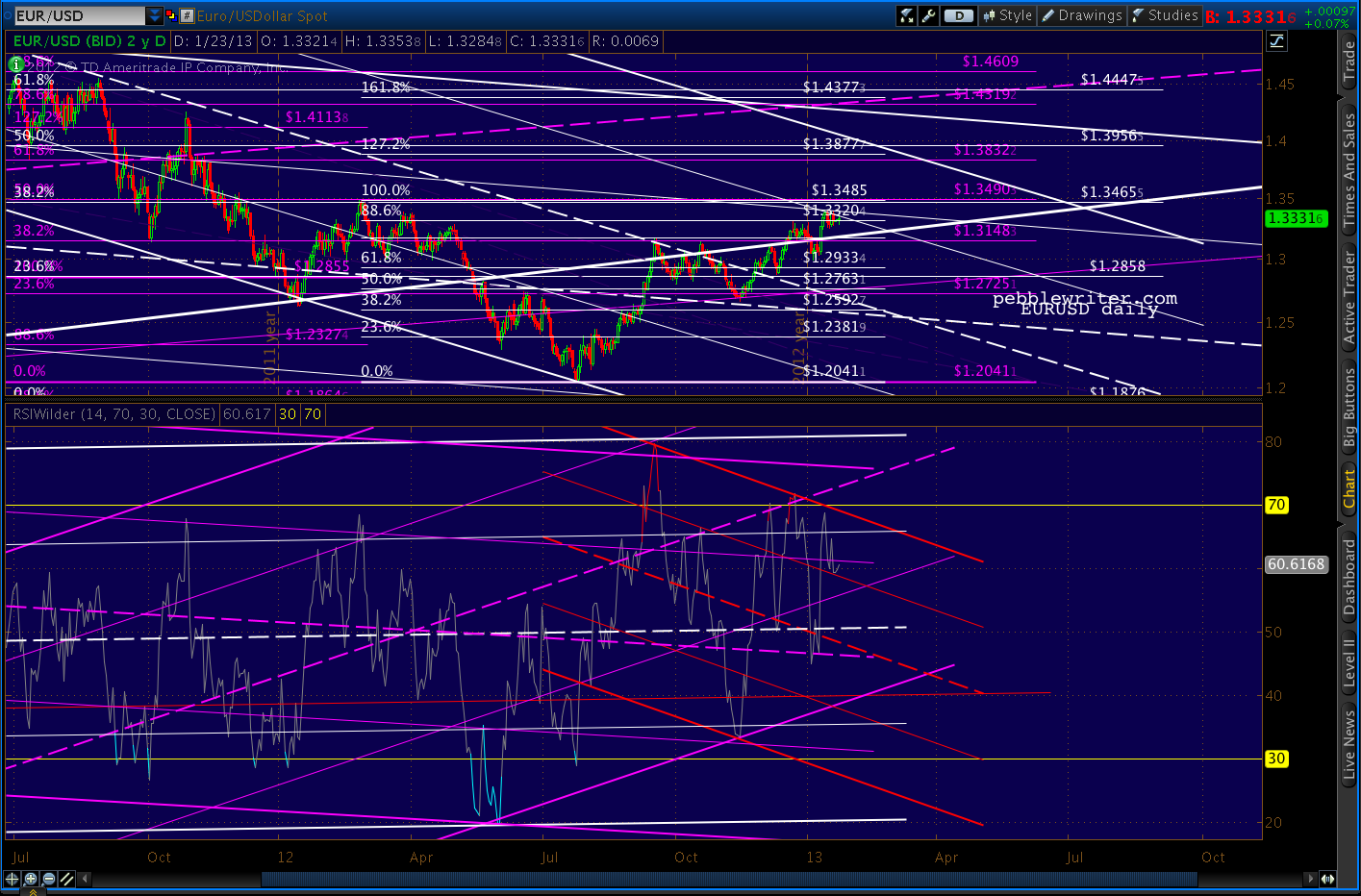
     

    With the market exceeding the recent 1474 highs, the analog that did so well for us since last April is officially dead.  This begs the question: “now what?”  I see three big issues hanging over the market right now:

      1. earnings season —  AAPL in particular
      2. the US budget/debt ceiling imbroglio
      3. new highs justified?

    Earnings

    GOOG and IBM both gapped up this morning, but the earnings that can really move the market — AAPL — comes after the close.  We’ll take a fresh look at the AAPL chart later today.

    Budget/Debt-Ceiling

    In a few hours, the House will probably pass a measure to postpone the debt ceiling debate until May.  Reid and Obama have both said they’re on board, so this appears to be a done deal.  If House Republicans don’t fall in line, as occurred with “Plan B,” the market will sell off precipitously.

    New Highs

    The market’s strength has caught many off guard, including yours truly.  Many are calling for new all-time highs for SPX. The 2007 high of 1576 is now only 84 points away, so a few good sessions could do it.

    We’ll take a fresh look, focusing on the harmonic and chart pattern picture as well as the establishment agenda.  “What’s that?” you say.  Say all you want about random walks, CAPM, dividend discount models and Dow Theory.  Like any government-managed enterprise, the market is subject to the policy goals and needs of those who attempt to control it.

    Even to my cynical ears, this sounds a bit like rants from the tin-foil hat crowd.  But, consider the news on Egan-Jones yesterday.  This is one of the biggest stories of the month, yet predictably earned only this from WSJ/Marketwatch:
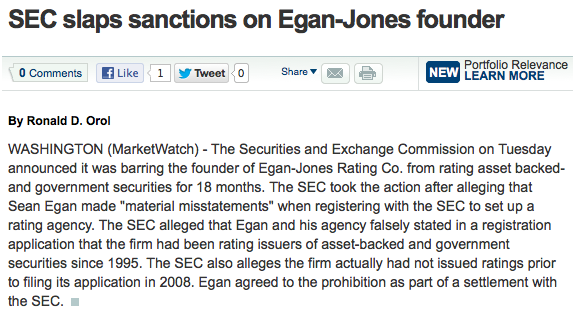
    CNBC was slightly more generous, yet still presented only the SEC’s side of the story.  It’s a story that deserves to be told because it speaks volumes about the degree to which the market is presently being controlled.  And, I’m not just talking about quantitative easing, though I suppose we’d have to consider QE exhibit #1.

    Last summer the market crashed 22%.  It was an analog (replay) of the 2007 top, so we saw it coming in plenty of time to profit quite handsomely.  But, it was a huge wake-up call for The Powers That Be (TPTB) or Plunge Protection Team, Wall Street Cabal — whatever you want to call it.

    With virtually unlimited power and unlimited resources, why couldn’t they prevent something like that from happening?  More importantly, if the top was a replay of the 2007 top, might the rest of 2011 play out like 2008-2009?

    It didn’t, because they learned from the crash of July-August.  First, they tweaked the markets just enough to bust important chart patterns that were playing out.  Second, they tweaked the rules to provide for more time to contain any damage which might otherwise occur (circuit breakers, etc.)  Third, they attacked those who had “caused” the crash.

    S&P CEO Deven Sharma was one of the first victims.  In the wake of the 2007 financial crisis, S&P was rightly pilloried for having pulled its punches — particularly on mortgage and banking related debt.  This was no surprise to anyone who’s ever worked on Wall Street — which pays for these supposedly unbiased views.

    An infamous exchange between two S&P analysts in April 2007 aptly illustrates:

    “BTW, that deal is ridiculous.”

    “I know, right . . . model def(initely) does not capture half the risk.”

    “We should not be rating it.”

    “We rate every deal. It could be structured by cows and we would rate it.”

    Imagine if Hollywood studios funded the reviews of their movies.  Would you care if they received thumbs up or down?  So, in August 2011 S&P found religion and bravely downgraded US debt.  Seventeen days later, Sharma was fired and replaced with the COO of Citibank, the bank whose existence relies on the absence of any future downgrades.

    Egan-Jones beat S&P to the punch, downgrading US debt on July 16.   Two days later, the SEC’s Office of Compliance Inspections and Examinations called looking for information on the downgrade.

    On October 12, Egan Jones was formally notified of a Wells Notice — they were being investigated.  On April 24, the SEC filed a cease and desist order against Egan-Jones — the only rating firm not on the take — stating the action was “necessary for the protection of investors and in the public interest.”

    The financial establishment’s interests, sure.  But, to frame this obvious smack down as “in the public interest” is laughable alarming.  Egan-Jones was the one rating firm with the balls to point out the country’s crumbling financial condition and stick to their guns.  Now they’ve been branded as deceitful, dangerous.  George Orwell spoke the truth in 1984:

    “In a time of universal deceit, telling the truth is a revolutionary act.”

    That other deep thinker, Jim Morrison, provided a similarly profound observation:

    “Whoever controls the media controls the mind.”

    The extent to which the market has been manipulated is deserving of its own post.  But, this Zerohedge article, forwarded by a member, is a great preview.

    Okay, so I know what you’re thinking: if the market is so heavily manipulated (and, presumably, insulated from downturns) why bother trying to beat it?  Simple.

    1. Chaos theory tells us they won’t have enough fingers to plug every hole in the dike (TPTB have similar “never again” strategy sessions after every crash.)
    2. Even when things do run as programmed, we can still effectively capture enough significant swings in the markets enough of the time to boost returns and, more importantly, try to avoid huge downdrafts.

    Over the very long-term, stocks return 8-10% — depending on the time frame examined.  But, sadly, most of us are limited to 40-60 years of investing.  And, a 60% crash right before starting a business, buying a home or beginning retirement could be devastating.

    So, we’ll keep plugging away, letting the markets tell us where they want to go…while trying to get there first.

    So, the question is “Now What?”  We’ll start by looking at the harmonic picture.  As detailed in our last review of all the previous tops, harmonic patterns are very likely to come into play.  So, we’ll start with the charts, then move on to the agenda question and, last take a look at AAPL.
    Since we’ve exceeded the range at which this rally could be considered a double top, we’re probably going higher still. So, we’ll examine the 1.272 and 1.618 extensions.

    In terms of a trading strategy, I’d be comfortable going long here at 1491.  But, disappointing AAPL earnings could knock the stuffing out of the market.  So, those with weak hearts should probably stay on the sidelines until tomorrow morning.

    The most recent patterns show a few possibilities, some of which are clumped together in fairly narrow ranges.  The largest of the patterns — the yellow grid — shows a 1.272 Butterfly Pattern extension at 1510.19 that intersects with the 2.24 extension of the decline (purple grid) from 1448 – 1343.

    A Butterfly Pattern is a good bet, as the Dec 18 reversal at 1448 pretty much nailed the .786 Fib level Point B (1446.44) which Butterfly Patterns require.
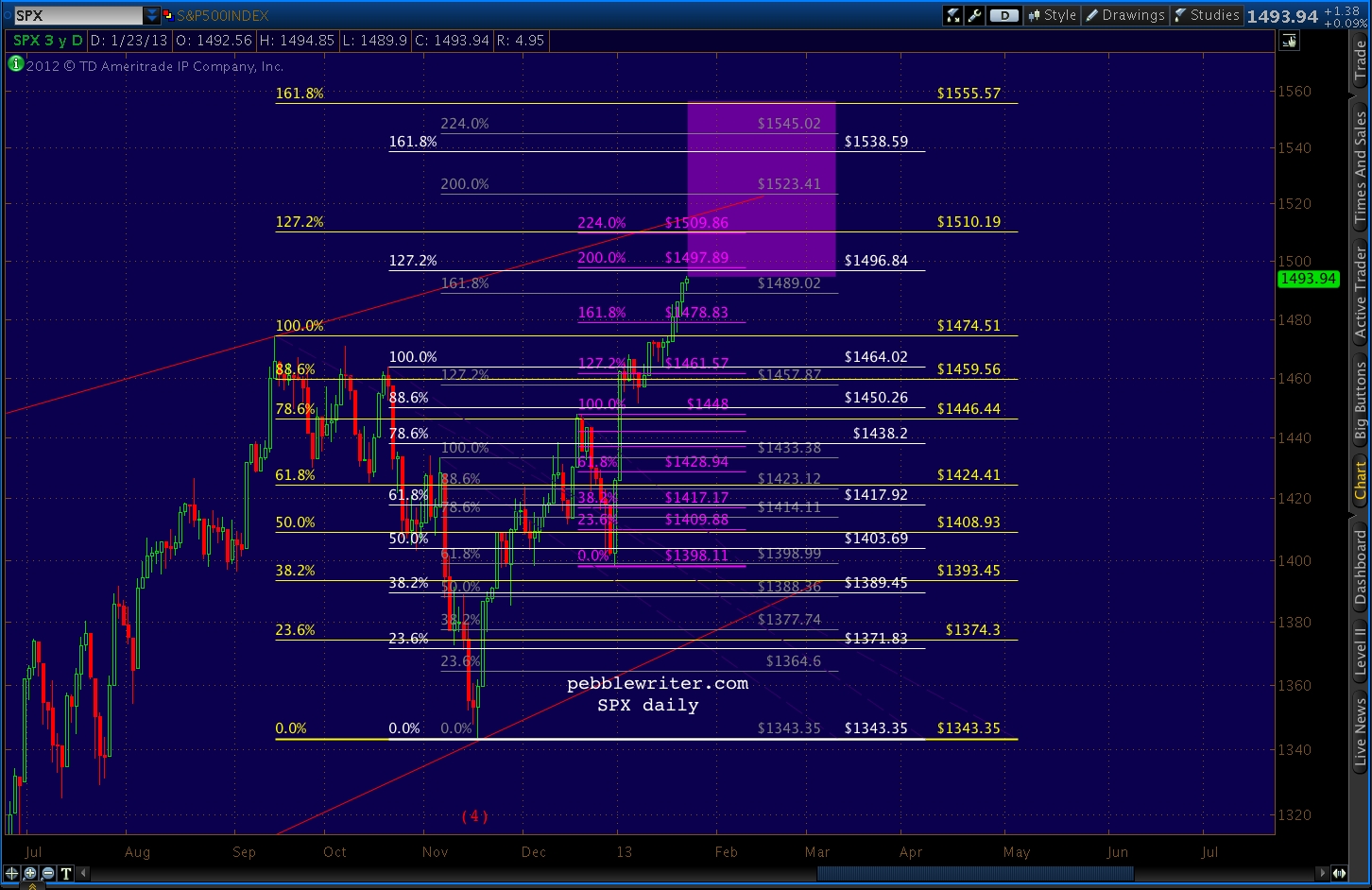
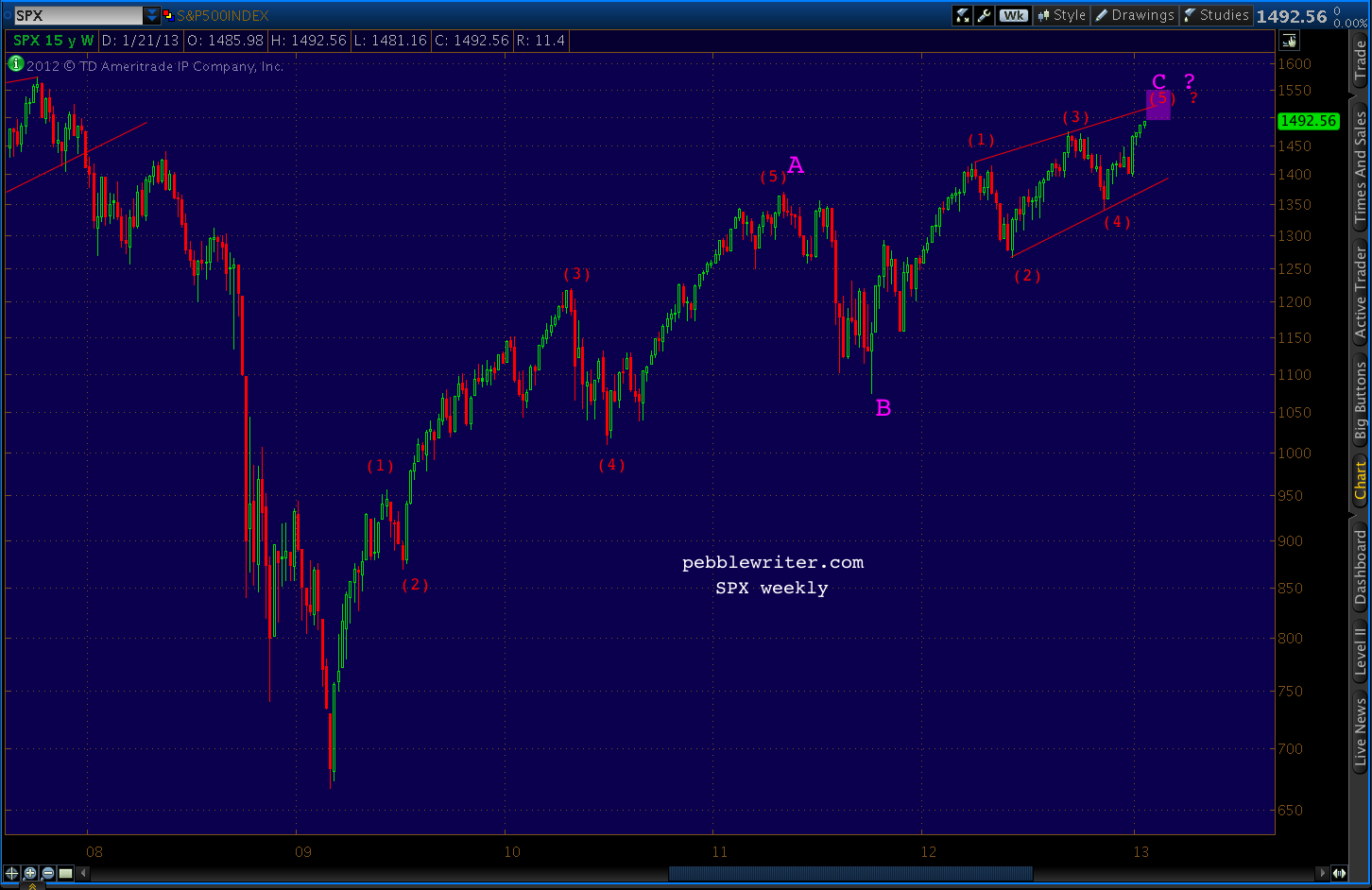
    1510.19 also falls within the confines of the thin red line — the TL connecting the Apr 2 and Sep 14 highs that would probably satisfy the EW requirements of an ending diagonal.  I know you’re out there, my Waver friends.  Please weigh in, as I know only enough EW theory to be dangerous.
    The white pattern is appealing enough, but I would have to consider it secondary in importance to the yellow since it began at a less momentous point X.  Ditto for the grey pattern.

    Although it should be noted that we faced a similar dilemma when choosing between the Point X’s for the Butterfly patterns beginning in 2011 [see: All the Pretty Butterflies.] In the end, it was a point similar to the white pattern 1.0 Fib at 1464.02 that determined the April 2 turn.  It featured a Point B closest to the .786 Fib.

    Zooming out, we can see that the 2011 highs could very well still influence the outcome of the current top.  The chart that includes everything is a little busy…
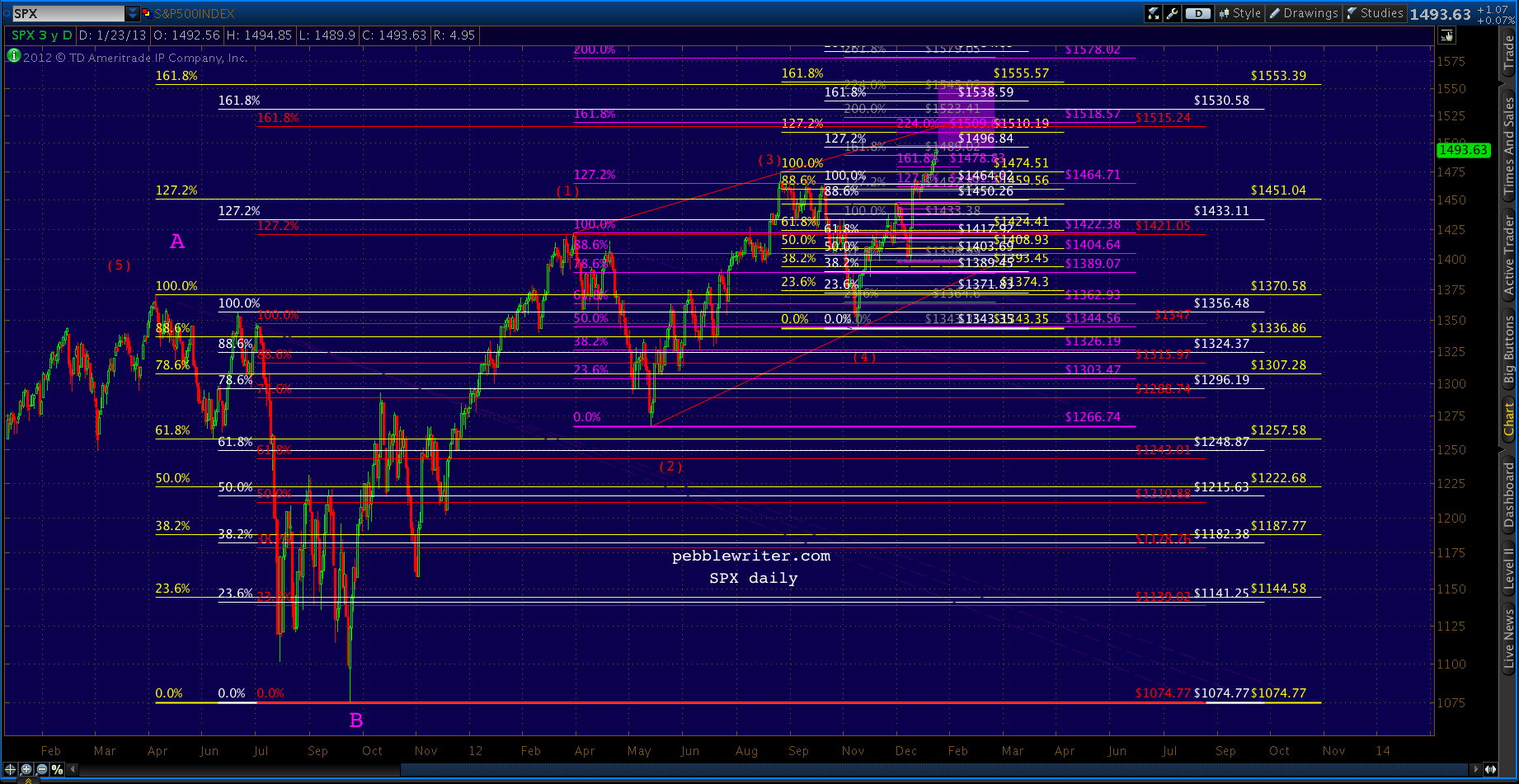
    …so I’ll clean it up by eliminating the interior retracement levels and switching to weekly.
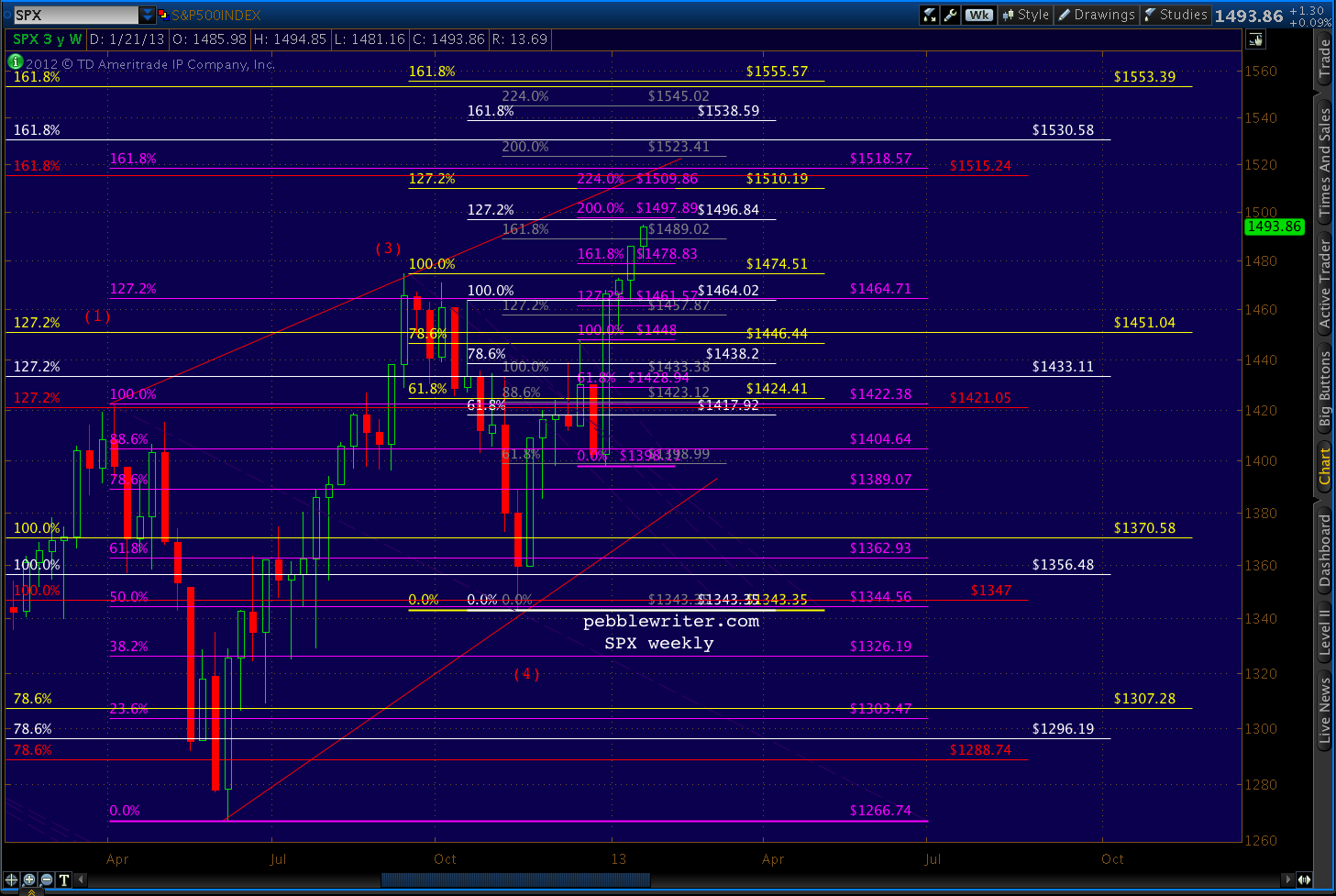
    The target areas can be more easily seen in this close up.
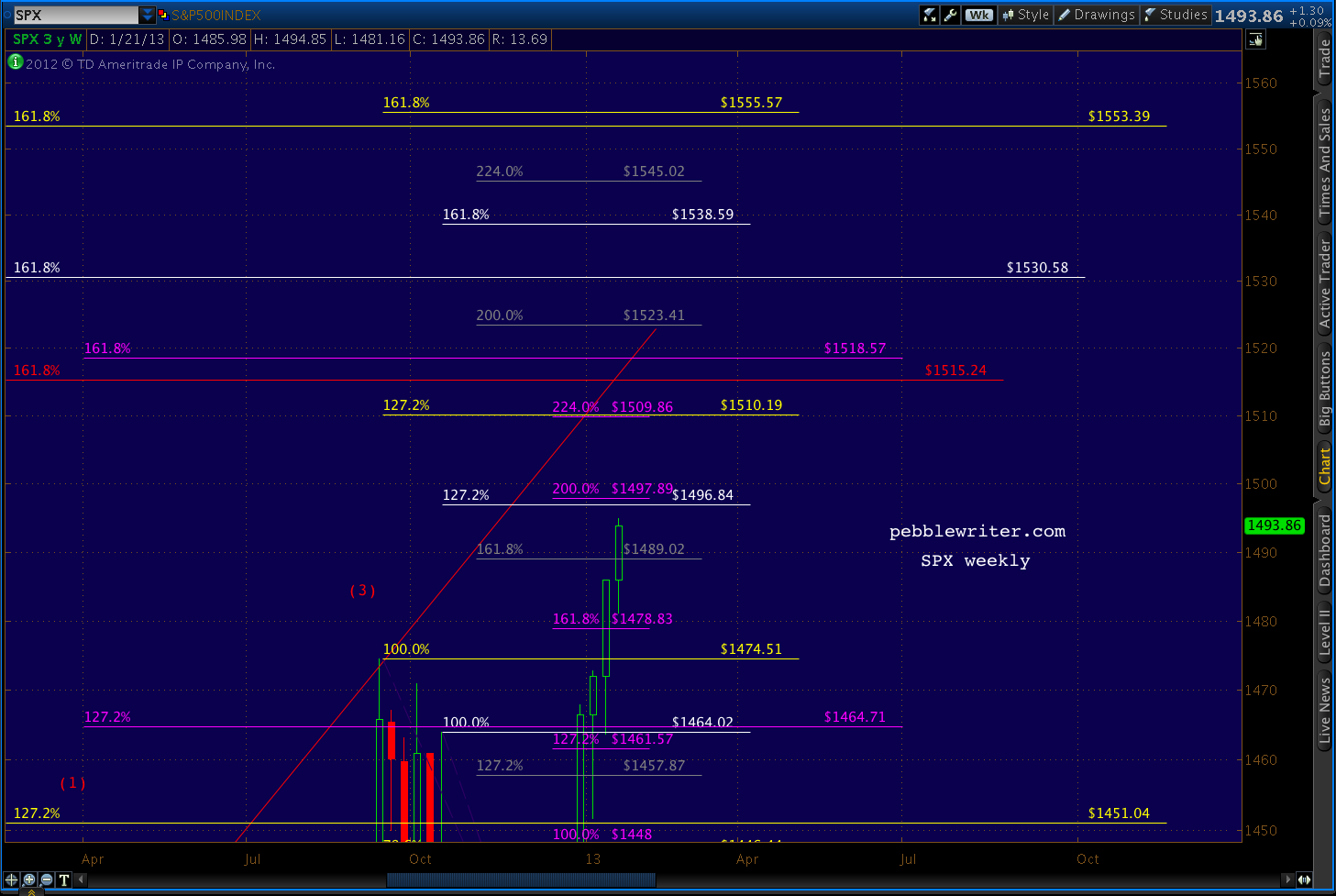
    Note that the large red pattern, the one whose 1.272 extension helped me accurately forecast the April top, comes into play at its 1.618 extension of 1515 – only a few points away from the 1509-1510 level discussed above.

    This is promising, as patterns that influence markets once (that was an 11% correction, after all!) are more likely to do so again.  And, patterns that the market completely ignores — such as the yellow and white patterns from May and July 2011 — are less likely to suddenly leap into a position of authority.

    And, there’s also a purple 1.618 extension (set up by the 1422 – 1266 decline) at 1518.57.  Again, this is close enough to be considered significant.

    If 1520 is exceeded, then we’ll look at the next higher grouping: 1553-1555.  This “group” is basically the two yellow 1.618’s.  Again, the larger pattern’s 1.272 had no influence on the market.  The smaller pattern’s 1.272 is the one coming up at 1519.

    Summary

    My leading harmonic forecast is for 1509-1515.  I can’t imagine getting this close to 1500 and not snagging it for the trophy case.  And, I like the idea of dancing with the harmonic patterns that brung us.

    My secondary goal is slightly higher at 1553-1555, so there should be opportunities to jump back in and capture most of any upside above 1520 if/when appropriate.  Such a move would likely follow a reversal from 1509-1515 back down to 1474ish and would constitute a fifth wave rather than the ending diagonal suggested above.

    If AAPL’s earnings stink up the joint after the closing bell, going long won’t have looked very smart.  But, judging from the steadily appreciating share values, I’m guessing that a relatively positive result is already being leaked.

    Chart Patterns

    I won’t rehash the stuff already posted in the past couple of weeks.  Just take a look at the rising wedge that would be confirmed by a reversal at 1510 as early as tomorrow.  The target would come at the .886 of the base to apex price range and .618 of the time range (almost too good to be true.)
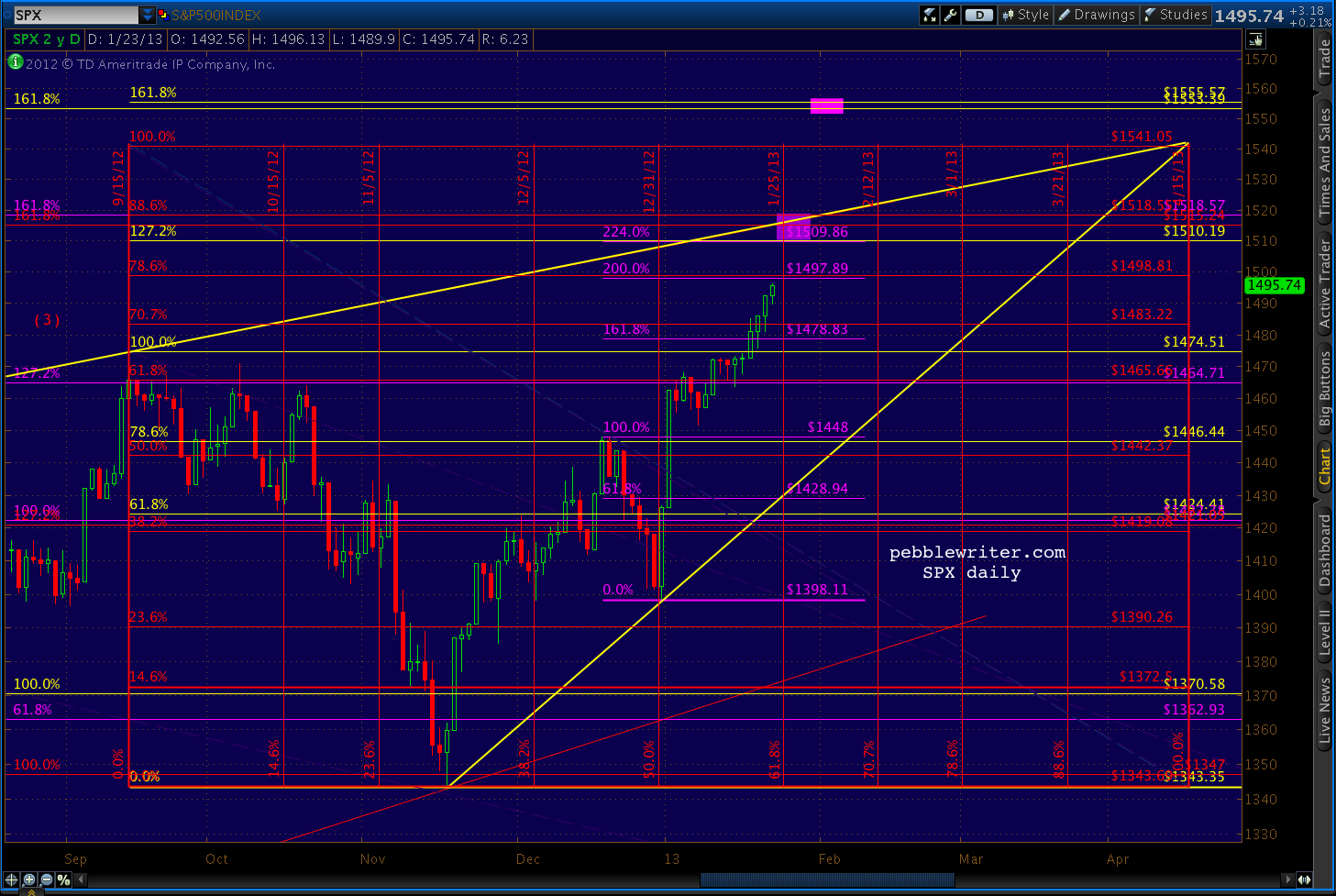
    We’re currently very close to the .786 of 1498, which tells me there’s a decent chance of a run up to 1500ish into the close.

    UPDATE:  3:45 PM

    AAPL is up almost 9 points at the moment.  A rally past 1426 would take it up out of the falling white channel it’s been in since last August.
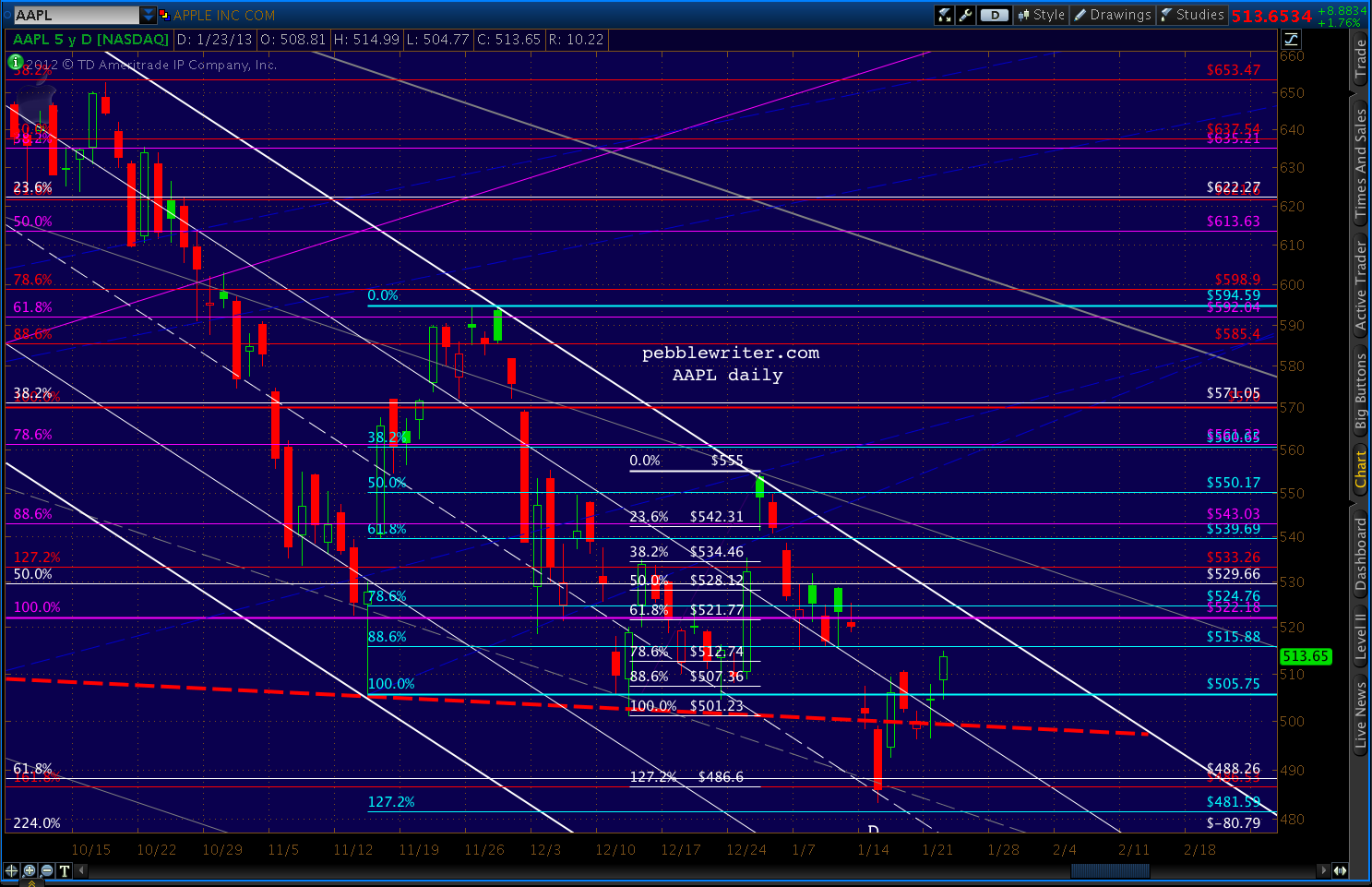
    Anything over 515 would take RSI above the white and purple RSI channel midlines.   So, as expected, much is riding on the earnings report and how it’s perceived.
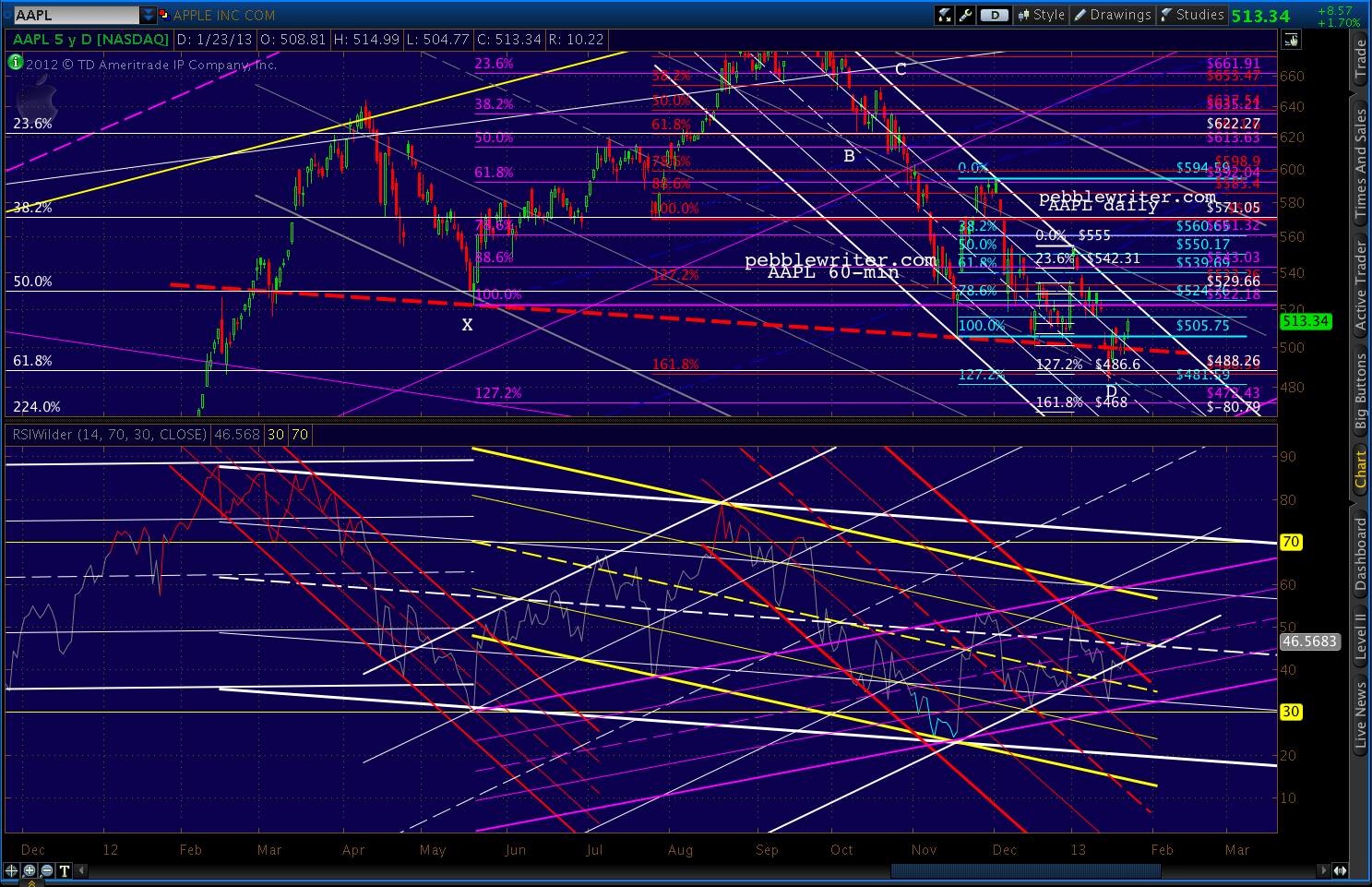
    We’ll watch these RSI channels, though. A return to the top of the yellow (and, especially the white) channel would surely spell a reversal.

    The Agenda

    I think it’s pretty straight-forward — bag an important new high, but without setting the bar so high that expectations can’t be managed.  At 1510, SPX clears 1500 but buys some time before the pressure of “will it exceed 1576?” comes to bear (no pun intended.)

    Then, get through the budget mess (or, more kicking of the can) and see where we are.  If we get a sequester, so be it.  The establishment will be well positioned ahead of time and the correction will be managed.

    After the shock of it wears off and prices have firmed in the 1200-1300’s, time to establish the next leg higher.

    Now, the big question is whether TPTB can engineer such a move without it getting out of hand — as it often does.

    Stay tuned.
  • Charts I’m Watching: Jan 14, 2013

    ORIGINAL POST:

    The dollar is making a stand at the upper end of the target range I charted Friday, but hasn’t yet broken out of the steep falling channel.  While there was a turn at the .618 Fib that would justify a .786 completion (a Gartley), the more obvious Point B was at the .382.

    In a perfect world, this would signal DX has further downside potential to the .886 for a Bat Pattern completion — though, obviously, not every corrective wave has to be a harmonic pattern.

    The EURUSD similarly reached a common turning point at the 1.272 extension of the latest move down from Dec 19 (or Jan 2, take your pick.)

    But, as can be seen, the rally from last week features no potential Point B whatsoever.   It’s hard to call this a Butterfly Pattern in the absence of an actual pattern.

    Furthermore, the tails on the daily candles offer an even more aggressive upper bound for the rising wedge we’ve been charting for the past several weeks.

    Equities are pointing to a soft opening, but nowhere near what one would normally expect with horrid AAPL news on the tape — much less the approaching budget showdown.

    Regular readers are well aware of the importance of the 500 price level for AAPL.  As we’ve discussed many times, the completion of the H&S pattern could have dire consequences for AAPL and the entire market.

    continued for members(more…)

  • The Morning After

    What a disaster for Boehner & Co. last night.   Did we really need another warring faction?  What are we — Greece!? Wait, don’t answer that!  The markets will not take kindly to this additional complication.

    Today’s theme song: Maureen McGovern’s song from the 1972 Poseidon Adventure.   Don’t laugh, it won an Academy Award!

    What sold me were the movie clips that Brendan Thompson matched up to the song on YouTube.  Perfect metaphor for our current situation.

    It opens with Larry Kudlow studying the charts: “obviously a buying opportunity!” as the bulls party like it’s 1999 with Bernanke (Hackman) leading the cheering.

    0:18 – In a cameo, Yours Truly sounded the warning, but it was left on the cutting room floor.

    0:30 – Things are suddenly not on an even keel.  Quick, call the Plunge Protection Team!

    0:47 – Boehner’s motion is “tabled.”

    1:06 – Things have stabilized; experts encourage investors to “hold on.”

    1:12 – Bernanke leaps into action.  It’s a crappy job, but he’s just the man “in the end.”

    1:16 – A private conference between Merkel and Draghi:  “I thought we were in trouble!”

    1:18 – Harry Reid restrains a screaming Eric Cantor: “This is what they wanted all along!” as Pelosi dives over the cliff.

    1:30 Boehner makes another brief appearance.

    1:53 – Pelosi caucuses with one of the last remaining moderate Republicans. Together, they hatch a risky plan — find a political middle ground that will preserve the country’s future.

    2:16 – Obama is there to announce that disaster has been averted, since…

    2:18 – Everything’s fine, now that Helicopter Ben has arrived.

    In terms of the current markets, I’d put us somewhere around the 0:35 mark.  Enjoy!


    Note: has to be opened on YouTube due to copyright considerations.

    *  *  *  *  *  *  *  *  *  *  *  *

    All I can say is “thank God for Congress.”  They make life so much more…predictable.  While the PPT swings into action, trying to clean up the mess, Boehner reiterates just how far apart the two (how many?) parties remain.  Thanks to the failed House action last night, we now know just how divided are the Republican ranks.

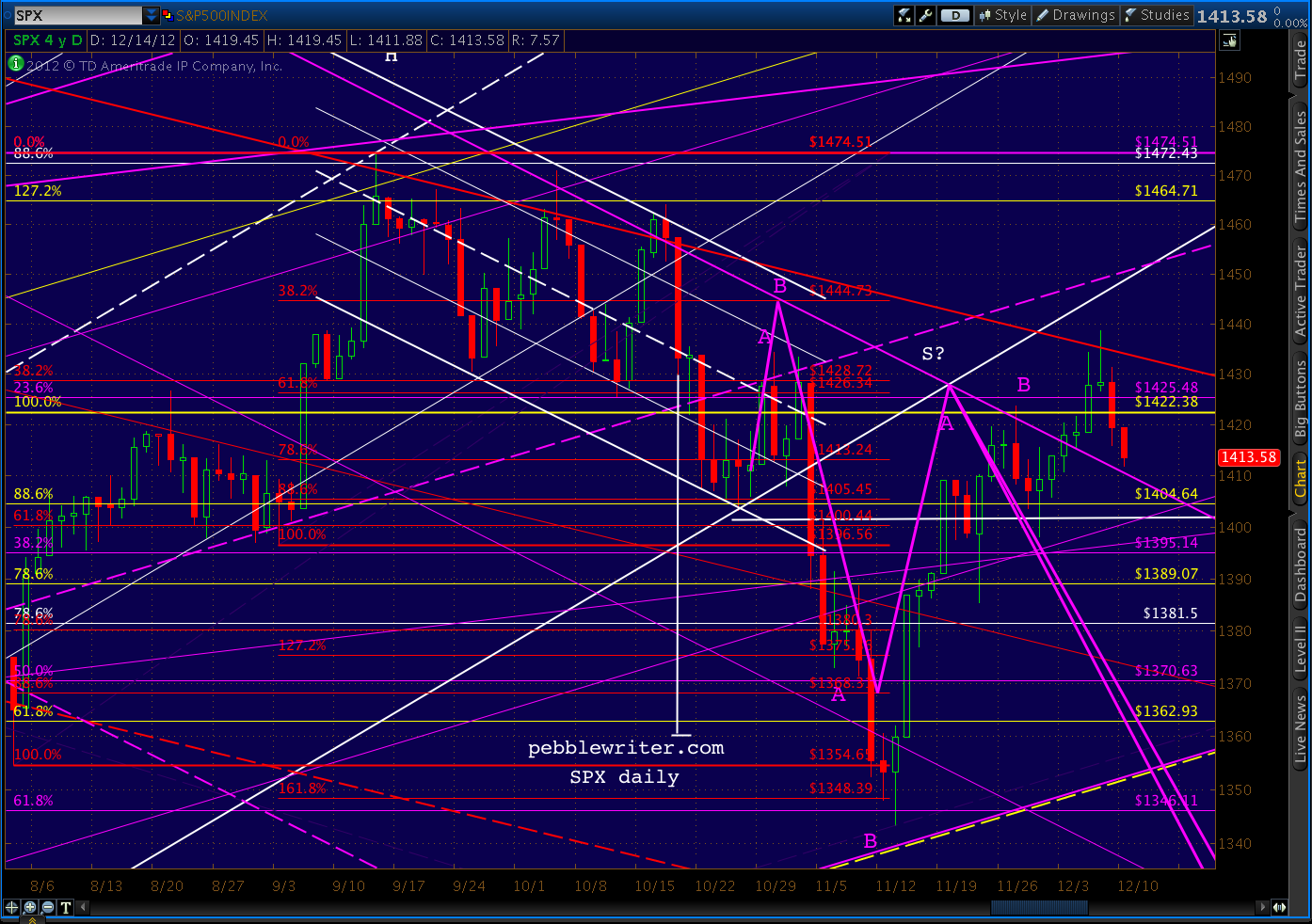
    First test: the channel up from 1343, which coincides with a Crab Pattern completion — not to mention a nauseating diatribe from the MSM as to why this is a buying opportunity.   I remain short from 1447 on the 18th [see: CIW – 1:10PM Update.]

    SPX would have tagged the .618 at 1425.68, but that would have been a pretty obvious breakdown of the channel.

    DX completed the small Crab Pattern we’ve been tracking.  Expect a pause, but not much more.  The currency markets are harder to control than the equity.

    I think it’s safe to say our forecast continues to be on track.  Downside targets coming up.

    continued for members(more…)

  • Charts I’m Watching: Dec 17, 2012

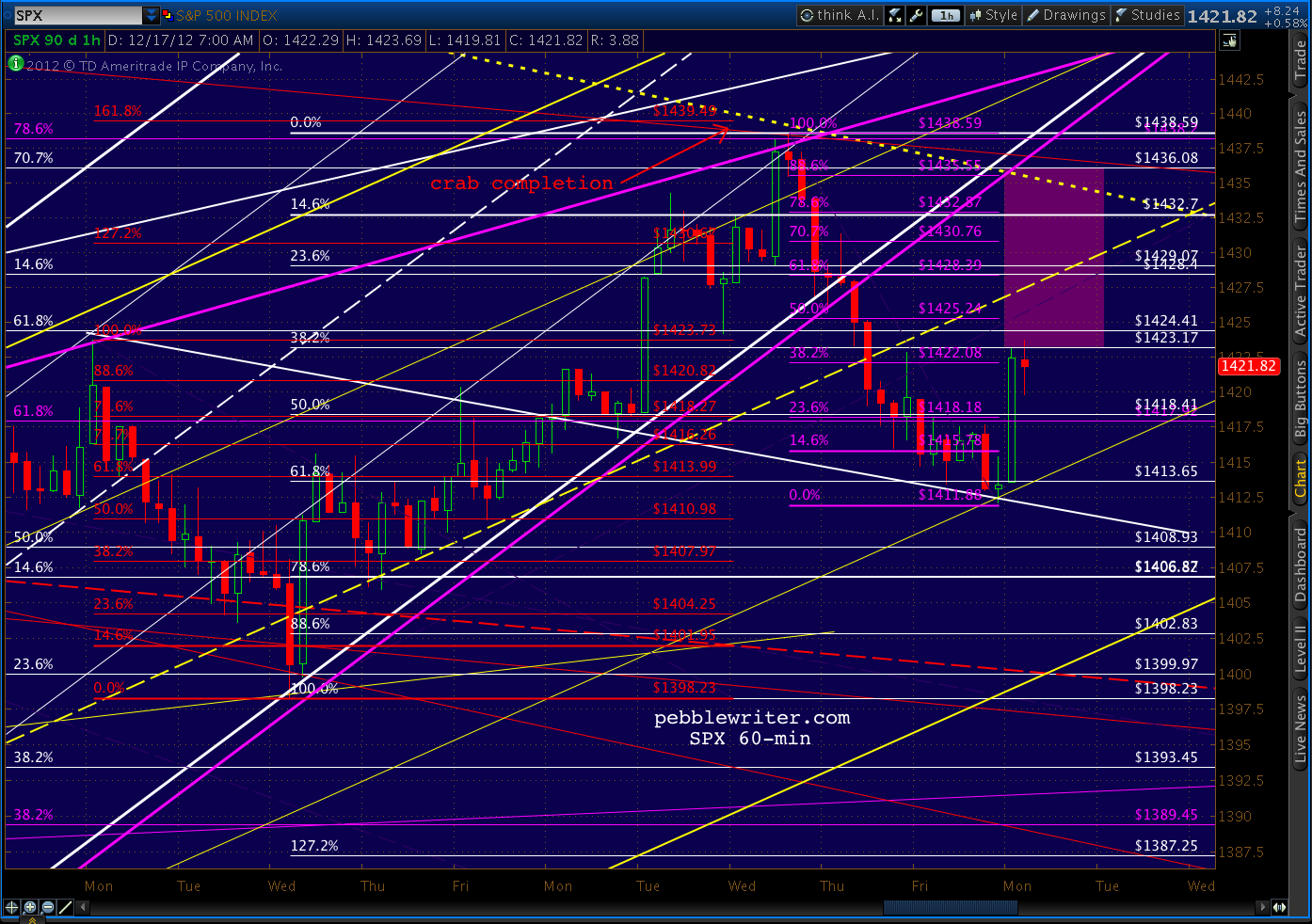
    We got the bounce we talked about Friday afternoon, coming at the .618 of the last move up (the Crab completed Wednesday, in red) as well as the last wave down (in white, below.)

    We discussed not playing this bounce until SPX has cleared 1420, which it did this morning.  Even so, I would be cautious in chasing after it.  While the potential is to 1429-1435, as detailed Friday, this is almost certainly just a bounce — nothing more.  And, the next wave down will be swift and severe — particularly if AAPL continues to show weakness this morning.

    For those who opened a small protective position as we discussed Friday, the two most likely upside targets are a yellow channel line or a significant Fib retracement of the last wave down.

    The tightest version of the yellow channel is shown below.  This version ignores the last 10 points of the mid-November plunge.  A stop at the 25% channel line would mean a bounce to only around 1423 — not much of a back-test for the just broken white channel or rising wedge (in purple, below.)

    But a better fit, IMO, would mean including all of the mid-November bottom.  Under this scenario, the yellow channel midline at around 1428 (the purple .618) would be the more likely lower end of the range for the bounce — with a full .786 or .886 (1432-1435) retracement representing the upper end of the range.

    If AAPL gets a bounce at 500 this morning, look for this scenario to play out — with SPX’s bounce forming a nice A-B-C wave into the shaded area below.  A stop in the shaded target area would get the downside going, with the next stop around the white .886 around 1402.

    continued for members(more…)

  • Forecast Update: Dec 17, 2012

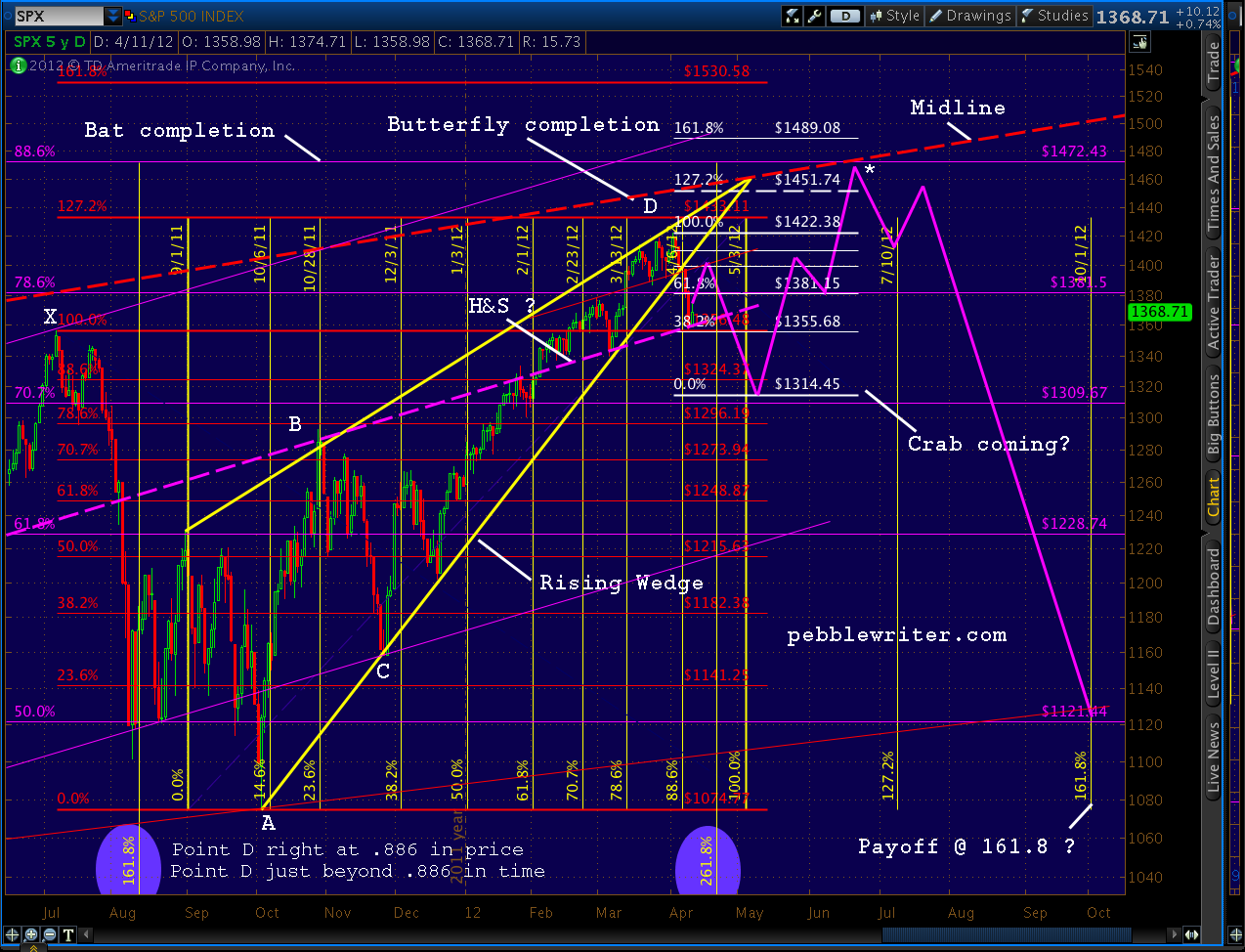
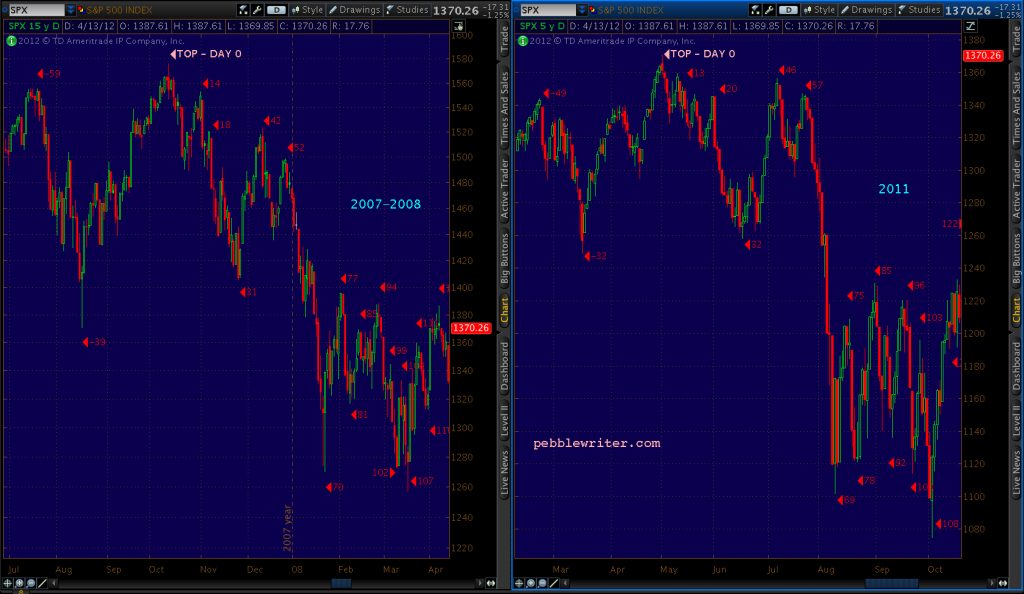
    April 11 seems like a long time ago.  It was then that I laid out my forecast for the top we’ve formed [see: New Analog I’m Watching.]  As regular readers know, it was based on a combination of channels, harmonic patterns in price and time, a huge rising wedge, and a promising-looking analog.

    I made several adjustments along the way — revising the 1314 downside target to 1295, for instance.  However, on June 1, when the SPX surprised me by dipping below 1292, I posted that the bottom was at hand — but that the analog was probably broken [see: Why I’m Buying.]

    SPX did indeed bottom the next day, but the chop over the remainder of June convinced me I was probably right about the analog being broken.  We saw no such chop in the comparison period of Mar-Apr 2011, which was a fairly orthodox A-B-C pattern higher to an unorthodox 1.272 extension of the previous decline.

    But, as SPX approached the key 1472 Fib level (88.6% of the 1576-666 2007-2009 decline), it occurred to me that:

    1. SPX would naturally reverse at this Bat Pattern completion [World According to Ben]
    2. This reversal would intersect with the 1.272 extension of the previous decline.

    Despite the huge differences in form between the Spring of 2011 and Summer of 2012, the ultimate price movement was shaping up to be the same.  And, it was happening without a Point B reversal at the .786, which is required of an ordinary Butterfly Pattern.

    This was enough to get me wondering if I’d given up on the forecast too soon.  Sure enough, we nailed the 1474 high on Sep 14 which, after nailing the Apr 1422 high and nearly so the June 4 1266 low, boosted performance to over 60% in less than six months.  The move down after 1474 played out very much according to plan.

    So, by the time I posted A New Old Analog on October 26, I had discovered why the forecast seemed off track in the first place.  It was a great help in forecasting the remainder of the year.  Here’s the forecast from that Oct 26 post, with alternative prices at each turn:

    And, here’s the actual price action overlaid on that same forecast.  We’ve tagged Point A of the first turn, Point B of the second, and overshot Point B by 10 points on the third.

    Does last week’s overshoot of the most recent target spell trouble for the forecast?

    continued for members(more…)

  • Stay Groovy

    “It was an expression used by small recon units and sniper teams in hostile terrain in Vietnam. They would tell one another to stay groovy when the danger level was so insanely high they popped amphetamines to stay awake and ready to rock twenty-four/ seven, because anything less would get them all killed. Stay groovy; take your pill. Stay groovy; safety off, finger on. Stay groovy; welcome to hell.”

     The Watchman, Robert Crais

    Those who have been following this blog or its predecessor for any length of time know I’m a big fan of analogs.  I was asked just yesterday why I thought they worked, and found myself fumbling for an answer.

    Like harmonics, I know that they do, because they’ve enabled us to make some nice calls that were accurate as to price and time such as the big downturn in April and the subsequent 1474 top in September.

    The big Kahuna, of course, was the July/August plunge in 2011 that mirrored that of Dec 07-Jan 08.  It’s just plain scary how well that turned out.

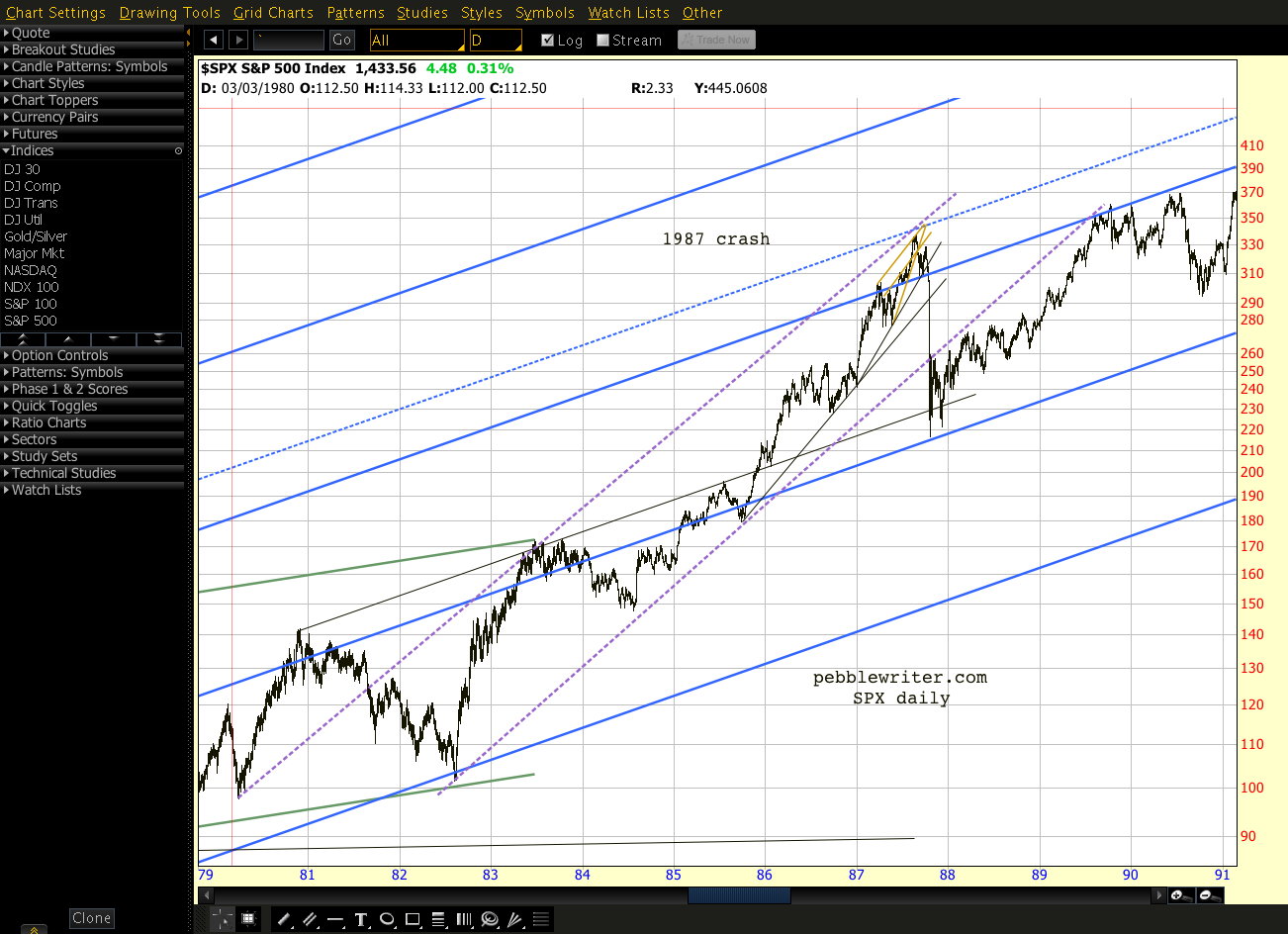
    I think analogs work mostly because of channels and harmonics.  In the simplest terms, channels keep prices pointed in a general direction for a noticeable period of time.  They can last for decades…

    a few years…

    or a few days.

    Regardless, I’ve found that most significant moves occur within or interact with channels.  Very often, as in the above chart, they’re channels within channels.  Even big channels that seem to generate their own atmosphere are usually aligned with other big channels.


    So, it’s not terribly surprising when moves that bring the market to the brink of disaster or reach ridiculously overbought levels react “just like it did last time!”

    Harmonics, likewise, are usually related.  The easiest example is the 2007-2009 plunge from 1576 to 666 which, when followed by an intial reversal at its .618 Fibonacci level, signaled both a Gartley Pattern reversal at its .786 retracement (the May 2011 high) and a Bat Pattern reversal at its .886 (Sep 2012 1474 high.)

    Combining the two, and tossing in some other chart patterns and traditional technical analysis, it’s easy to see why the market has done what it has most of the time.  If markets move in somewhat predictable and repeatable ways, then analogs can be viewed as a predictable aggregation of those predictable moves.

    Of course, its not always as simple as that sounds.  Even great analogs usually present alternatives. Over the past couple of months, the one we’re following now has hit our primary target at times and our secondary targets other times.

    And, some can be tough to get a handle on.  The one from this past April [see: New Analog I’m Watching] that very capably guided us from 1422 to 1266 and back up to 1474 (the top chart above) worked beautifully from a price standpoint, but was way off in terms of timing (since licked, I think.)

    And, last, there’s one truism that’s the bane of every analyst who charts analogs:

    Every analog works forever…until it doesn’t.

    Even as we’re counting down the last few points to the 10% downturn we charted all those months ago, a well-timed Bernanke comment or Hilsenrath article (is there really a difference?) could nudge the markets just enough to complete a Zweig Breadth Thrust event that ushers in a new high.

    If that happens, never mind.  End of the road.  It’s been a nice ride for the past nine months, but it’s time to change partners.  If it doesn’t, however, and we reverse in the next 10-15 points, it’s just about time for the song.


    UPDATE: 1:20 PM

    I’ve had several messages asking whether we’ve reached the target or not.  Frankly, I’m surprised.  The answer should be perfectly obvious to everyone:  maybe.

    continued for members… (more…)

  • EURUSD Update: Nov 20, 2012

    Good morning, all.  The markets should get no help from across the pond today.  Though Moodys’ downgrade of France was not exactly news, it should serve to remind investors of the structural issues facing the euro-mess.

    The EURUSD completed a well-formed Gartley Pattern early this morning, reacting off the .786 of the latest move down.  More importantly, though, the pair is bumping up against three significant channel lines.  The Gartley is visible here as the small pattern in purple.

    The dashed, yellow line is the midline of one channel, and the solid purple line is the 25% line of another channel.  They’re both easier to see from further out, and are basically two different ways of viewing the rally from this past July (which happens to exactly parallel the last one from earlier in the year.)

    Note that the pair has also come back to its Point X of a recently completed Crab Pattern that came up a little short of the 1.618 (or overshot the 1.272.)  It’s the small red pattern on the above charts.

    The third channel I referred to above is the daily RSI channel.  The pair broke down from the rising purple channel around Nov 1 while establishing another falling white channel parallel to the last one from Feb-May.

    It’s now back-testing the purple channel — which should ultimately provide resistance that should send the pair down by no later than December 5.  Note this time frame fits with the intersecting price channels as well.

    Bottom line, while the rally could extend a little further after this interim resistance, the next big leg is down.  My money’s on the white .886 at 1.2169 around the end of the year in a plunge reminiscent of the May 2012 move.

    In the meantime, keep an eye on the rising wedge and RSI channels on the 60-min chart.  While the wedge hasn’t yet broken, the yellow RSI channel has.  After a back-test, there is  downside exposure with the falling white channel.

    The Big Picture:

    EURUSD completed a Bat Pattern (purple D) at its .886 in July — also the bottom of the falling purple channel.  This was also a Crab Pattern completion (the small purple grid.)  Many times Bat Patterns go on to become Crabs, meaning the ultimate target of this decline could be .9982.  But, my intermediate-term target is 1.10-1.13 by May of 2013.

    • bottom of the big red channel
    • intersection of the red and purple channels
    • white Crab Pattern completion at 1.618 (1.1342)
    • .618 tag of largest white pattern
    • bottom of large rising yellow and purple channels


  • Charts I’m Watching: Sep 24, 2012

    The rising wedge we were watching Friday broke overnight and has carried into this morning’s session, with an initial drop to 1452.06.

    This completed a Bat Pattern at the .886 retracement of the 1474 to 1449 drop (also a small Crab Pattern.)  We should thus get a sizable bounce from 1452 — probably at least to the white channel midline of 1456.51 — also the .618 of the small red pattern.

    UPDATE:  10:10 AM

    This morning’s drop to the .886 suggests some interesting moves.  Remember that the .886 not only represents the completion of a Bat Pattern, it is also the Point B of a potential Crab Pattern.

    continued… (more…)

  • Charts I’m Watching: Sep 20, 2012

    ORIGINAL POST:  10:00

    The logjam finally broke.  We slightly exceeded yesterday’s 1464.50 target — topping out at 1465.15.  This morning’s action reached the downside target “A” we established on Monday [see: The Hangover.]

    We got a bounce at the bottom of the red channel — which should reach the 1454-1455 area — the recently broken red channel line and the midline of the white channel. But, I don’t think this move is finished (keeping in mind tomorrow is OPEX.)  More in a few minutes.

    continued… (more…)