
Category: Charts I’m Watching

  • The Turd in the Cocoa Puffs

    Long term, financials have a dim future (XLF will be the sector wearing a name tag when it grows up.)

    Back on May 3, I noticed XLF was running into heavy resistance at 16.40 and started looking for a drop to the mid-15s.  XLF fell to 15.67 by the 17th, a decent 4 1/2% return for 2 weeks.

    XLF did a little pirouette, then sold off even more with the rest of the market.  It hit 15.39 this morning.  Which is great…right?

    The only turd in the bears’ cocoa puffs is it’s now fallen enough to have formed a nice big harmonic pattern: a bullish Bat.  A valid Point D could be at the current .618 retrace (15.44) or the .786  retrace (14.96).

    Best seen on the daily chart, it could potentially take prices back above 17.  Of course, harmonic patterns sometimes fail.  The sell off might continue and XLF could be flipping burgers by next Friday.

    Long-term investors probably need not worry, but traders might consider taking profits or, at the very least, placing tight stops until the near-term picture is clearer.

  • Skating on Thin Ice

    Putting together the harmonics with important support and resistance levels, I’m looking for the Apr 20 gap to be filled, then a strong rebound, reaching the 1350 area in the next few days.  I still have a target of 1380 as the end of P[2], but am looking at the possibility of a truncated fifth at 1350-1355, depending on how the next few days play out.

    If we rebound off the 1312.70 gap low, it would appear that the 1370 high from May 2 was the 87-day cycle high, with a 4.2% decline — at the low end but within the range established over the past 4 years.  But, the cycle’s declines average 11.4% within the first 30 days, so it’s also possible we’ll see further declines within 30 days (by June 2) that could reach the theoretical target of 1214. 

    I’m watching the primary rising wedge very closely.  The end of May marks 2/3 of the time span from 2/18 (when the rising wedge began tightening) to its apex in late July/early August.  Today, it intersects with the channel from the May 2 top.

    A close above 1319 today keeps us within the channel and the rising wedge, and should result first in a rebound to the upper end of the channel (1339), then potentially the wedge (1372.)  With so many anticipating the .786 fib target of 1381.50, and the overwhelming bullishness that would accompany a strong rebound from this scare, I would not be surprised if we ultimately fell short of it.

    But, eventually we will.  The wedge’s range began at 530 points in Mar ’09, diminishing to 270 by Apr ’10, 100 by this past February and currently stands around 50-60 points.  By comparison, the range of the rising wedge that produced the Oct 2007 high started at 265 points in Mar ’03, shrinking to 210 by Jul ’06, 120 by Jul ’07 and 100 just before the market crashed.  Over 4 years of gains were wiped out in 17 months.

    You can almost feel the market tugging at the constraints.  Today is only the 7th time in the past 3 months that the daily range has exceeded 20 points.  In the 3 months leading up to the 2007 highs, there were 28 such days.

    In comparison to 2007, we’re skating on very thin ice.  The further out we go, the greater the risk.  The Fed will do everything in its power to keep us skating, but is running out of magic tricks.  Once we plunge through, even a ruinous QE3 wouldn’t be able to save us.

    Significant numbers:

    Support

    Bottom of the primary rising wedge from Mar ’09:  1319
    Bottom of secondary rising wedge from Mar 18th:  1322
    Bottom of channel from May 2 top: 1310.60
    Gap from Apr 20:  1319.12 – 1312.70
    Previous low on May 17:  1318.51
    Next major prev low from Apr 15: 1294.70
    50 day EMA: 1328.46
    200 day EMA: 1256.48

    Resistance

    Channel from May 2 top:  1339
    Top of primary rising wedge from Mar ’09:  1372
    Previous high on May 19: 1346.82
    Next prev highs (past three weeks): 1351, 1359, 1370
    Trendline from Oct ’07 high:  1328.7
    Exhaustion gap from May 11: 1351.19 – 1356.19
    Apex of the primary rising wedge: late July – early August at 1390-1400
    Intersection of rising wedge with supercycle line:  8/31 at 1430
    10 day EMA: 1336.56

    Harmonics

    Bullish SPX Gartley 4/15 – 5/17 targets 1388 this week.
    Bearish SPX Gartley from Oct ’07 targets a high of 1381.50 before P[3] (near term)
    Bullish SPX Gartley 5/17 – 5/22 targets 1352 (poss invalid with today’s open)
    Bullish VIX Gartley 4/28 – 5/19 targeted 20.50 this week

    Other

    Inverse H&S; from May 10 targets 1370 (poss invalid w/ today’s open)
    Inverse H&S; from 2/18 targets 1436
    Hourly RSI and MACD: bottoming?  Daily and weekly declining
    Yesterday’s OPEX study suggests an up day, closing above 1334
    Memorial Day effect:  week before has been up 4 of last 6 years

  • Does OPEX Matter?

    This past Friday morning, with SPX down about 9 1/2, I made a crazy call based on some indicators I’ve been watching [more later tonight or tomorrow.]  They said the market would not only stop falling, but would completely reverse itself and open up, leaving a nice bullish hammer going into the weekend and thus, portending a big up day Monday.

    Indeed, SPX fell a little more, then made a spectacular comeback with well-formed 5-3 patterns all the way… until an hour and 15 minutes before the close.  When THEY screwed with my plan. You know who I mean.  The evil OPEX manipulators — thrashing my portfolio (and worse,  my pride) for the umpteenth time.

    Is it me, or are they really out to get us?  I did a quick little bit of research, and found out… “maybe.”  I studied the last 42 OPEX cycles since 11/16/07, dividing them into positive (21), negative (13) and neutral (8) cycles based solely on net price movement during the cycle.  I then compared performance on the day of option expiration with the day after expiration for each cycle.  The results are intriguing.

    • When the OPEX cycle was up, OPEX day was positive 62% of the time.  When the cycle was negative, OPEX day was also positive 69% of the time.  Neutral cycles were even.
    • In positive OPEX cycles, OPEX was usually followed by a reversal — regardless of whether OPEX day was positive or negative.  Negative OPEX days produced positive reversals 100% of the time; positive OPEX days produced negative reversals 62% of the time.
    • In negative OPEX cycles, negative OPEX days were always followed by another negative day (100%), while positive OPEX days usually produced negative reversals (67%).  
    • When the cycle was neutral, the day after OPEX reversed 75% of the time, regardless of whether OPEX was up or down.
    • In general, negative OPEX days were followed by positive days (69%), unless in the midst of a negative OPEX cycle.  And, positive OPEX days were followed by negative days (69%).

    I also looked at the size of the day to day moves.   In general, most negative OPEX days produced similarly-sized positive reversals — regardless of the cycle trend.  But, positive days in positive OPEX cycles produced outsized (2.14X) reversals, as did positive days in neutral OPEX cycles 1.63X).

    There are limitations to a study like this.  For one thing, I generalized when characterizing the OPEX cycle trend.  Many would say the recent trend has been down, although SPX rose between 4/15 and 5/20 — thus qualifying it as an up cycle.  Also, there wasn’t a single instance of a positive cycle with a negative OPEX day until after the market bottomed in Mar ’09 (and, yes, 5 of the 16 cycles during the bear decline were positive.)

    I also didn’t measure the gain or loss on the days studied, but focused instead on the total range and whether SPX was positive or negative on the day.  So, a big decline that reversed to close slightly positive was an up day; if it closed slightly negative it was a down day.

    There’s no particular justification for such methodology; it simply fit my desire to identify what trading opportunities, if any, OPEX might produce.  Has it?

    This past cycle was positive (although, again, open to interpretation) and Friday was down 10.33.  Despite what the futures currently indicate (down 5.50), the model would suggest an up day with a range of 11 1/2 or so.   On the actual 8 similar days (down OPEX in up cycle), the 5 bigger OPEX declines averaged 10.6 and were followed by 12.1 point rallies (smallest was 5 points.)  The smaller 3 declines averaged .8 points and were followed by average 10.3 point gains (smallest was 7 points), so size of the OPEX decline didn’t seem to matter much.

    Also, the 3 days following the reversals were mostly down (5 of 8), although the trend for the remainder of the next OPEX cycle was up (5 of 8 times.)

    Do I know any more than before I sat down to study all this?  Perhaps.  One of my favorite analysts put a huge red candle on one of his SPX charts for Monday that, I’ll admit, scared the crap out of me because it wasn’t at all what I expected (he put a bullish alternative up, too.)  Although medium and long-term bearish, I’m one of those looking for one last push up.

    Regardless of what Monday brings, it’s pretty clear to me that OPEX does matter.  The preponderance of reversals indicates to me that OPEX moves are “unnatural” in the sense that the subsequent market action “undoes” what the market makers did.  As someone always on the lookout for contrarian opportunities, this is useful information.

    In the future, I’ll look for trading opportunities on reversals (especially in up markets) and have a better idea what to expect.  And, when I’m itching to capitalize on the action unfolding in that last hour on an OPEX Friday, I’ll take a quick look at the historical data.  It could be that THEY really are out to get us.

    *******************************************

    NOTE:  Monday, May 23  1:15am

    The futures are down 6.50 to 1321.25.  If we were to close down tomorrow, it would be only the 6th time in over 5 years when a negative OPEX Friday was followed by a negative Monday.  Three of the previous five were in the midst of the 2008-2009 bear markets.

  • Takes Me Back to ’99

    John Dvorak writes a great piece on the LinkedIn IPO.  Could this be yet another sign of the top?

  • Zombie Snacks in the Making

    In a couple of 5/3 posts [Short the Banks and Follow Up on Financials] I suggested XLF — then at 16.40 — was due for a drop to the mid-15s.  It hit 15.67 on the 17th and has been in a what I think is a rally in a ongoing bear market for financials.  Those who didn’t take profits a few days ago may be wondering whether the worst is over.

    Short answer is NO.  The banks are dead meat; they just don’t know it yet.  Rising interest rates, investors and cash-strapped governments looking to win the legal lottery, ugly balance sheets (their most craptastic assets not even listed), worsening credit quality — take your pick.  That’s an oncoming train, not a light at the end of the tunnel.

    IF they can arrest today’s decline, they MIGHT rally up to 16.05-16.10 before the bears take control again, driving XLF down to 15.50 in short order.  But, that’s just the start.  From there, we finally lose the channel altogether and head for single digits.

    Financials led off the last market crash; I believe their collapse in the next week or two will be the final straw for this market, too.  I wonder if it’s too soon for Vikram to renegotiate his contract?

  • Ridiculously Long Shot Call of the Day

    If a pattern I’m studying plays out, the SPX should reverse its (currently) 9 1/2 point drop and close positive on the day, leaving a big, fat bullish hammer candle going into the weekend.

    Will be working on it throughout the day… more later.

    UPDATE at 11:45am

     SPX fell as low as 1330.67 and appears to have bottomed out just above The Trendline That Just Won’t Quit and is rebounding.  In the process, it completed another half-baked bullish Gartley that indicates an upside to 1360.  Not looking for all of that today, just 1342 or better — setting up a big Monday.   VIX is backing down and should close at 16 or so.

    UPDATE at 3:15pm

    SPX recovered to its daily high of 1342, is now at 1335.50.  It’s now caught in the OPEX tractor beam.  Easy call would be 1335, but I think we get one last bump to 1340 on the day.  A nice recovery designed to shake out anxious bears before Monday’s 10 point advance.

  • Worthless Lottery Ticket Idea for the Month

    JNK, the junk bond ETF.  In the crash, it fell from 48 to 28 in a month.  It’s been rebounding with the rising market and lower rates, but has barely moved in the past 6 months.  Except… that it’s crawling along in a little rising wedge that’s about to play out. 
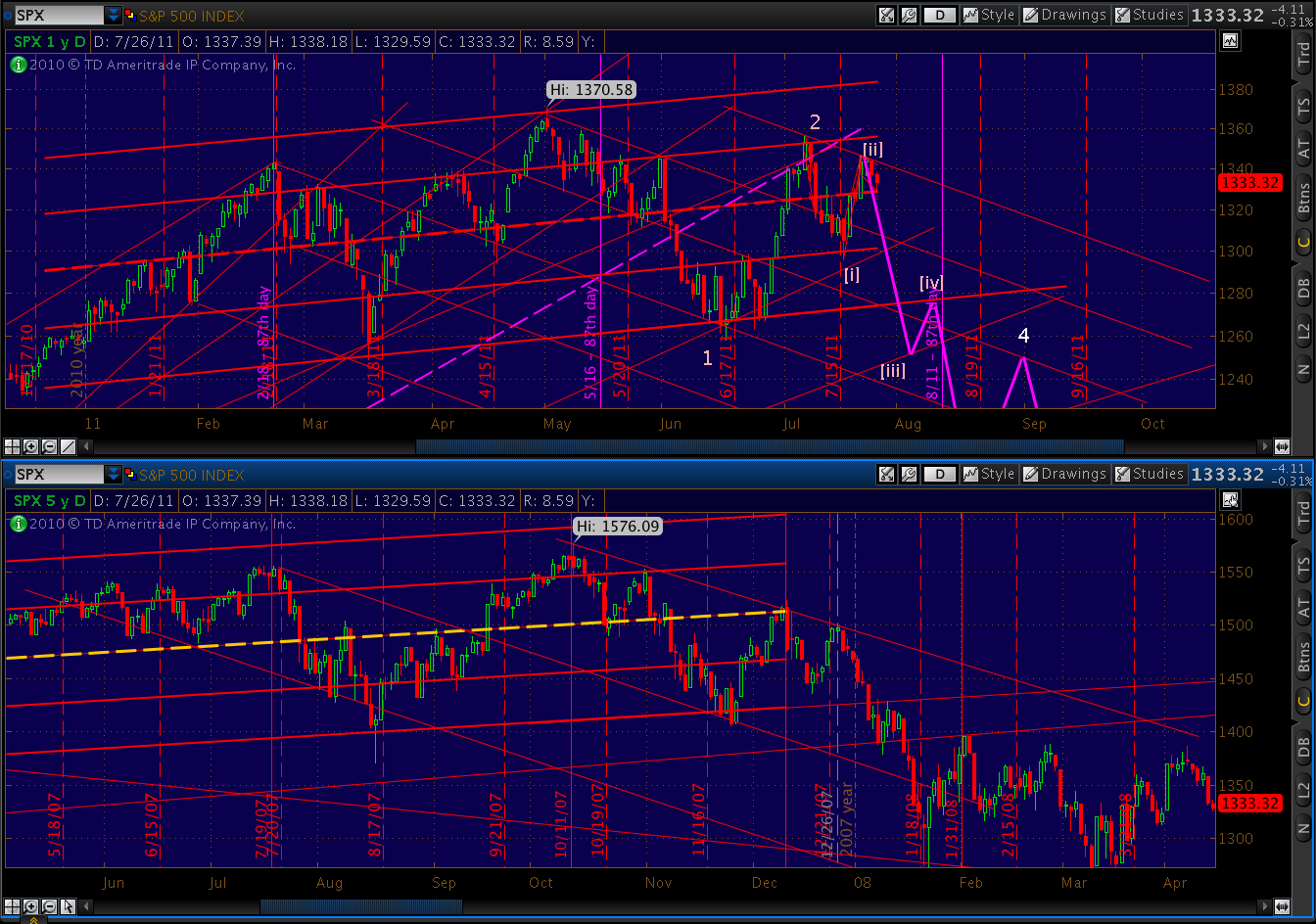
    I don’t know anything about this particular ETF.  But, it’s trading at 40.85, a measly buck from where it crashed.  Since I expect a big selloff, a credit crunch and rising interest rates — not necessarily in that order — this could be a decent way to participate.  The June 39 puts are trading for .10, Sept for a little more.

  • So Far So Good…

    Quick update before the open…

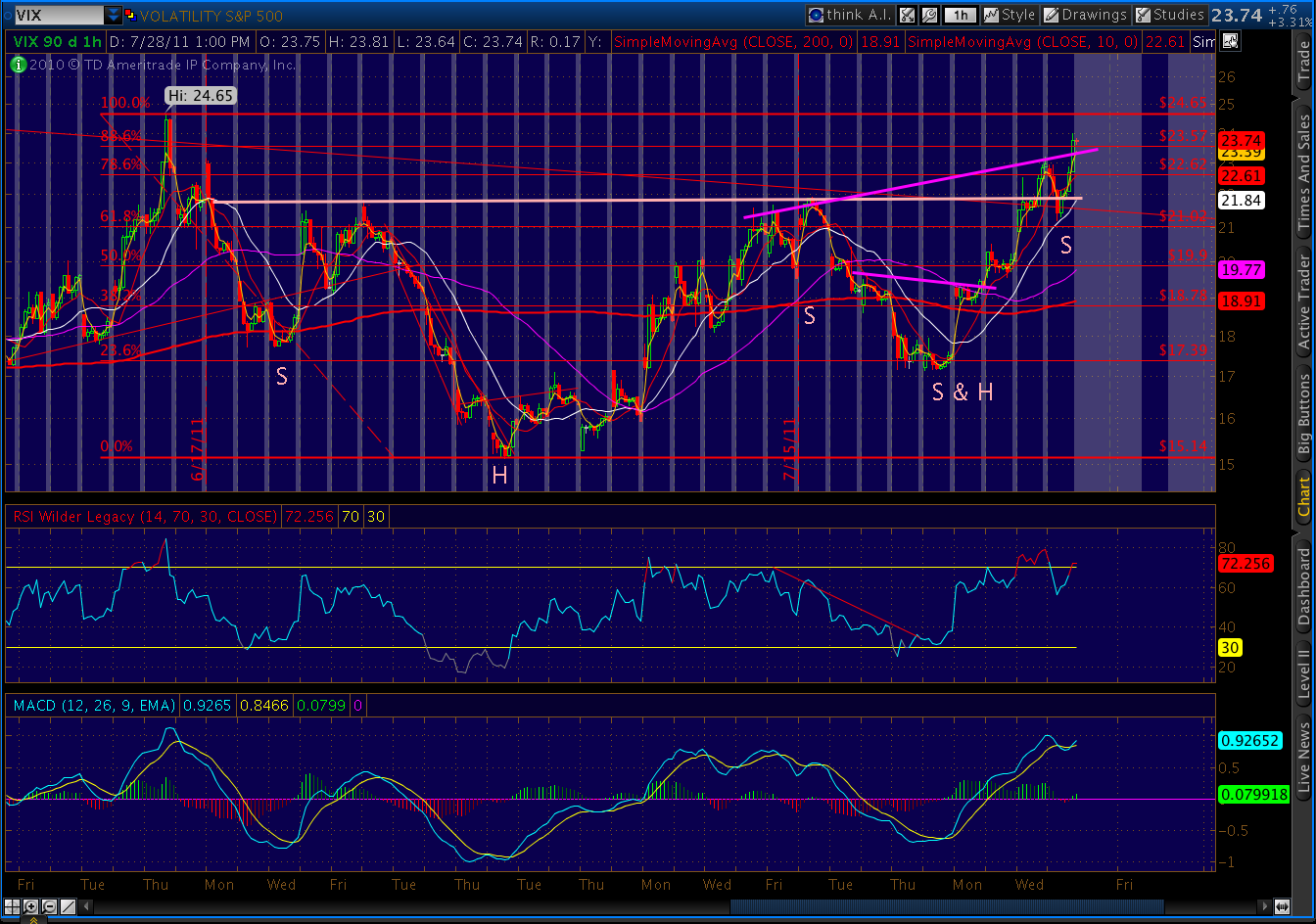
    VIX call per the bearish Gartley was dead on.  VIX fell another 8% since the call, closing at 16.23  — down from 19.09.  The hourly charts confirm a continued fall over the near term.  My original target of 15.10 looking safe for the moment.  Very bullish for a continued rally in stocks.

    SPX performed even better than expected per the falling wedge and the bullish Gartley, up strongly yesterday with scant pauses.  We should get one this morning after a few points on the open.

    If we continue to trade at the fib levels, we should open at 1345, run up to 1348-1350, then pull back to around 1338-1340.  Good level to buy in, IMO.  If there’s enough time left in the day, we should resume climbing past 1350, backtest that trendline for a few, then onward and upward.

    My original target remains 1381.50.  But, a note of caution is in order.  Anytime you’re dancing on a razor’s edge, as is this market, the slightest slip could be disastrous.  We’ve had many unforeseen disasters over the past few months, each of which sent the bulls scurrying.  And, Gartley patterns don’t always reach their targets.

    We could see a major top within the next 10 days.  My inclination is that the 3% pullback we got last week wasn’t THE 87-day cycle low; a larger one awaits.  If we can reach 1381 (or the vicinity) before the end of May, we still have time within the 105 day window to start a  10% or more correction.

    Tight stops are essential as we continue on.  Raincoat and umbrella time.

  • Are We There Yet?

    While it would be easy to jump on the P[3] bandwagon right about now (and it wouldn’t take much convincing) a note of caution is in order.

    A pullback that stalls in the low 1320’s on SPX would leave a pretty well-formed bullish Gartley Pattern (Point B should be 4 points lower, allowing a fuller CD extension to .786, but these things are rarely perfectly formed.)

    Why should we care?  A bearish Gartley Pattern accurately forecast the 80 point drop starting March 4 — after the market had nearly recovered from the action of the previous 8 days.  It’s estimated to ‘work’ about 70% of the time — house odds, if you will.

    A bullish Gartley Pattern that plays out successfully from 1321 could be expected to boost the SPX by a quick 24 points to 1345, with an ultimate target of 1391.  I don’t believe in coincidences (unless CNBC tells me to), but 1391 also marks the upper bound of the rising wedge from Mar ’09.

    It’s also only 10 points north of the .786 Fibonacci (off the Mar ’09 lows) levels at 1381.50.   If we don’t turn down from here, I expect P[2] to finally die between 1380 – 1390 sometime in the next 10 trading days.  It coincides perfectly with my 87-day cycle of downturns, but these cycles have taken up to 105 days, so it could be as late as June 3.

    Could a decline stall at 1321?   1321 is the level of the trendline beginning on 8/27/10 at 1039.70.  Haven’t talked much about it, but this is a big, bad trendline of support that stopped single-day freefalls of 30 points (3/16) and 20 points (4/18) cold in their tracks.

    But, for now, it appears that the “trendline that just won’t quit” from the Oct ’07 1576 level will continue to support the market.  Today, it stands at 1333 and seems to have rebuffed today’s running of the bears. 

    If the decline resumes, however, keep an eye on the low 1320’s.  Any stall there is likely to begin a very strong rebound and will catch many off guard.

    Next post: the Gartley Pattern that REALLY matters.

    Happy Trading!

  • When You’re a Hammer…

    …  “everything looks like a nail” is the old saying.

    Harmonic patterns aren’t too hard to spot.  Look for a big W, right side up or upside down, where each leg is a partial retracement of the previous one except for the last, which extends the previous leg but ends as a retracement of the first.  The retracements should be in accordance with harmonic numbers (usually .382, .5, .618, .786.)  http://www.investopedia.com/terms/g/gartley.asp

    The good news is, they work pretty darned well — indicating a significant reversal with 70% certainty.  The bad news (besides the 30% wrong calls) is that once you start looking, they’re everywhere. And, because they’re harmonic they often nest inside one another in different degree, even morphing into one another where a CD leg feeds into a XA leg, etc.

    As a (slightly autistic) guy who sees patterns everywhere, I get excited when they confirm other harmonic patterns and technical analysis.  I believe that’s the situation we’re now facing.

    Among Elliott Wavers, there is some disagreement as to whether we’ve finished P[2] or not.  There are “problems” with various counts.  My favorite analyst and blogger, Daneric, remains open to alternative counts.  He’s been doing this forever, so that’s good enough for me.  One road leads to SPX 1380, the other to 1200.

    So, what’s an investor to believe?  For me, that’s where Harmonics come in.  I’m following three patterns:

    (1) a bullish pattern on SPX indicating a short-term upside of 1380 (the next week or so.)  The alternative is that the decline has already started (see below.)

    (2)  a bearish pattern on VIX, also indicating a short-term rise in stocks  (VIX collapsed 8% after this chart was printed at 9am this morning.)

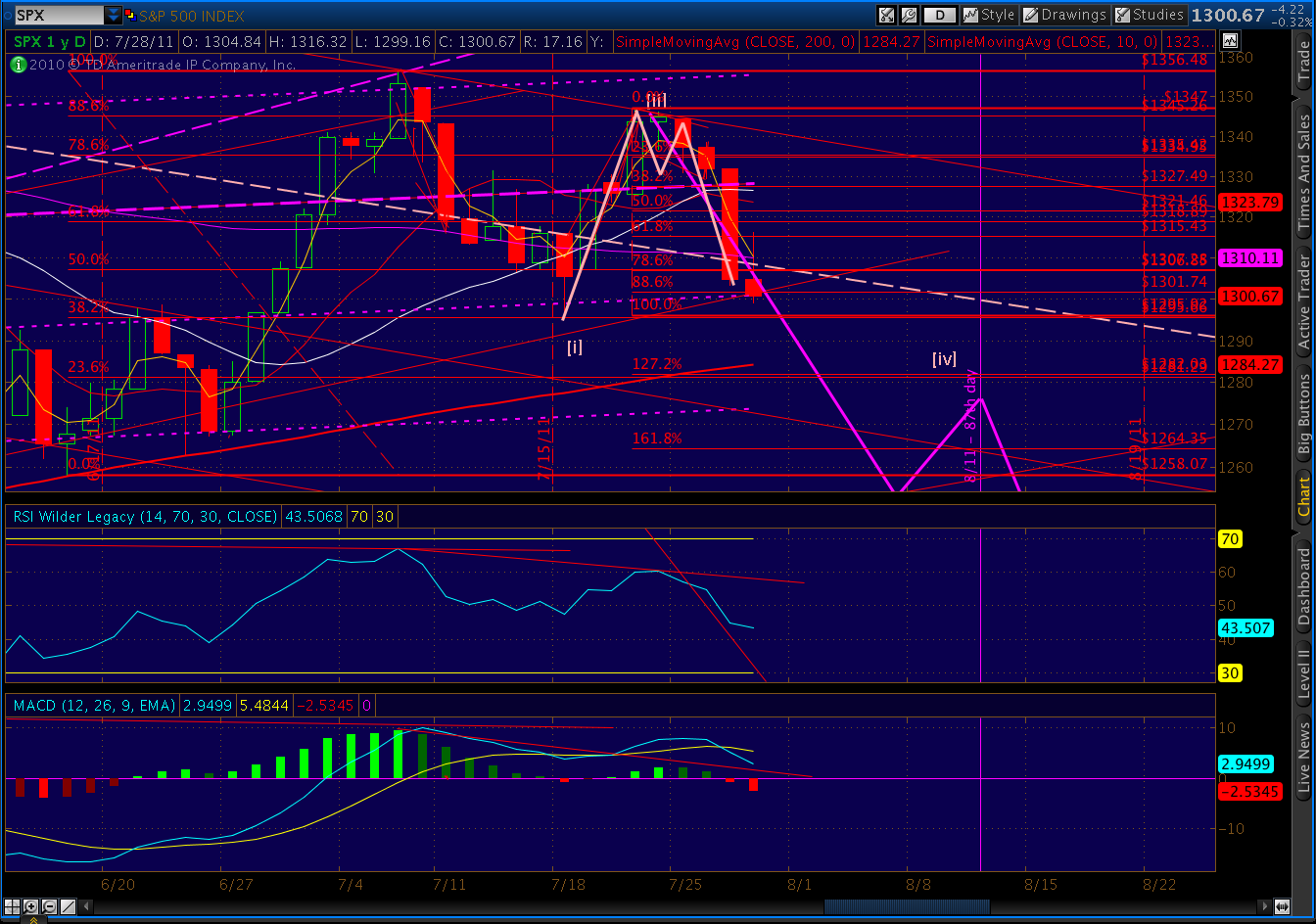
    (3) a long-term bearish Gartley pattern on SPX indicating 1281 is the end of our road after rebounding from the Mar ’09 lows.  This chart shows the 87-day cycle lines as well.

    The SPX daily chart ties everything together pretty well.  Note the rising wedge, overhead resistance with the Supercycle line and the .786 Fib, and the 87-day cycle date of May 16 (past cycles have varied by up to 15 days, or June 3.)

    I’m clueless about the wave count.  But, I wouldn’t be surprised if we bounce off the RISING WEDGE (chart 3) to complete the ST BULLISH GARTLEY (chart 1), thereby completing the LT BEARISH GARTLEY (chart 2) at around SPX 1380 sometime before June 3 (105 days on the 87-day cycle.)   The falling VIX is icing on the cake.

    Once caveat: it may have already started.  At 1318 earlier today, the SPX was off 3.8% from its highs.  It’s not much, but it could easily be the 87-day cycle decline in progress — or even the whole enchilada.  But, the Gartley patterns on VIX and SPX tell me we have one last bump up before it’s time to stick a fork in this thing.

    Bottom line, I’m not going to heap on the puts if we drop a little in the morning.  I’ll see if we bounce off the rising wedge and start back up.  If we break decisively through 1310…forget I said anything.