
Category: Charts I’m Watching

  • I’d Rather be Lucky…

    Yeah, it’s appropriate here.

    At 11:00 am yesterday [Shoulda, Coulda, Woulda], in a shameless attempt to save face after my first gutless post of the day, I stated:

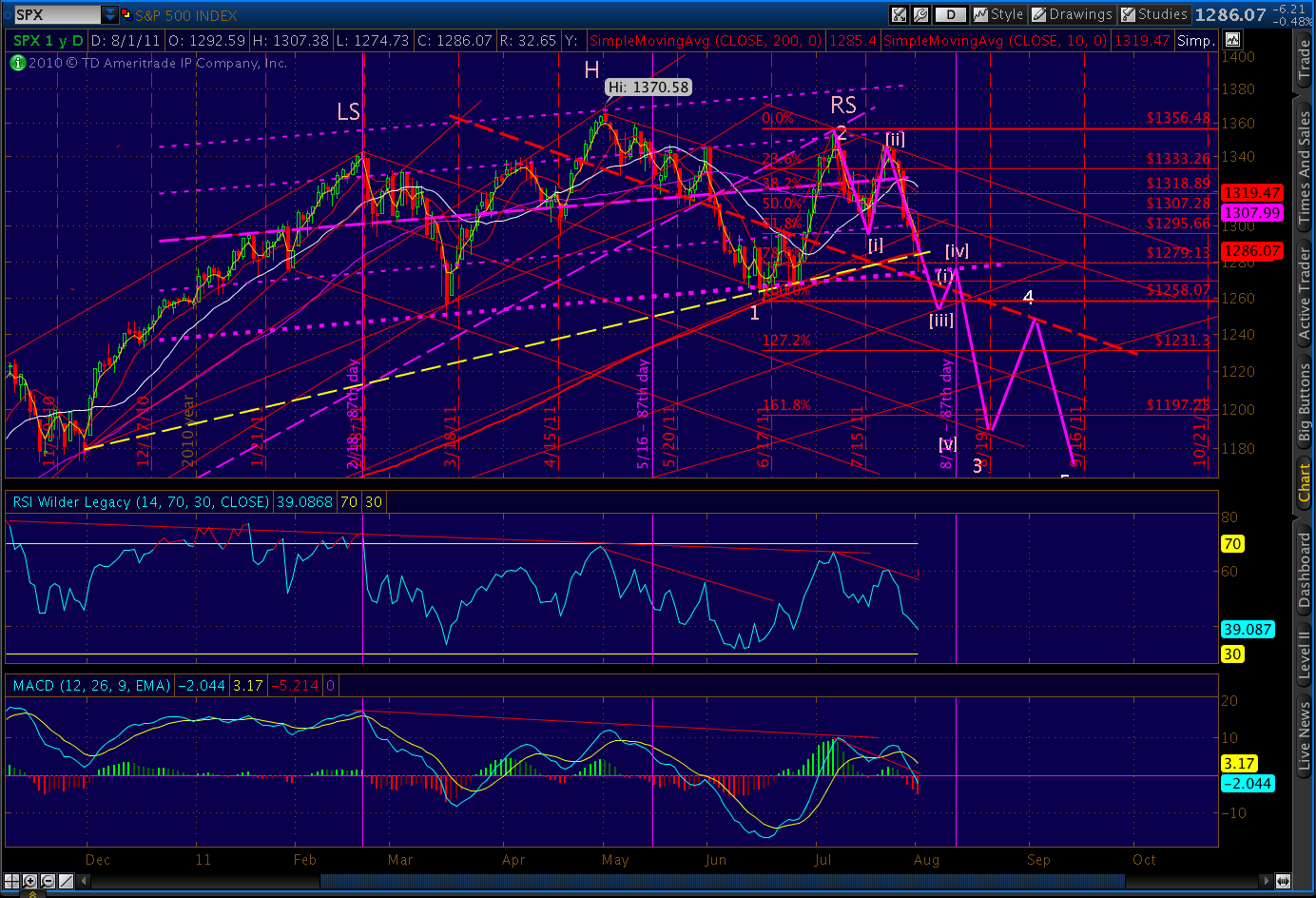
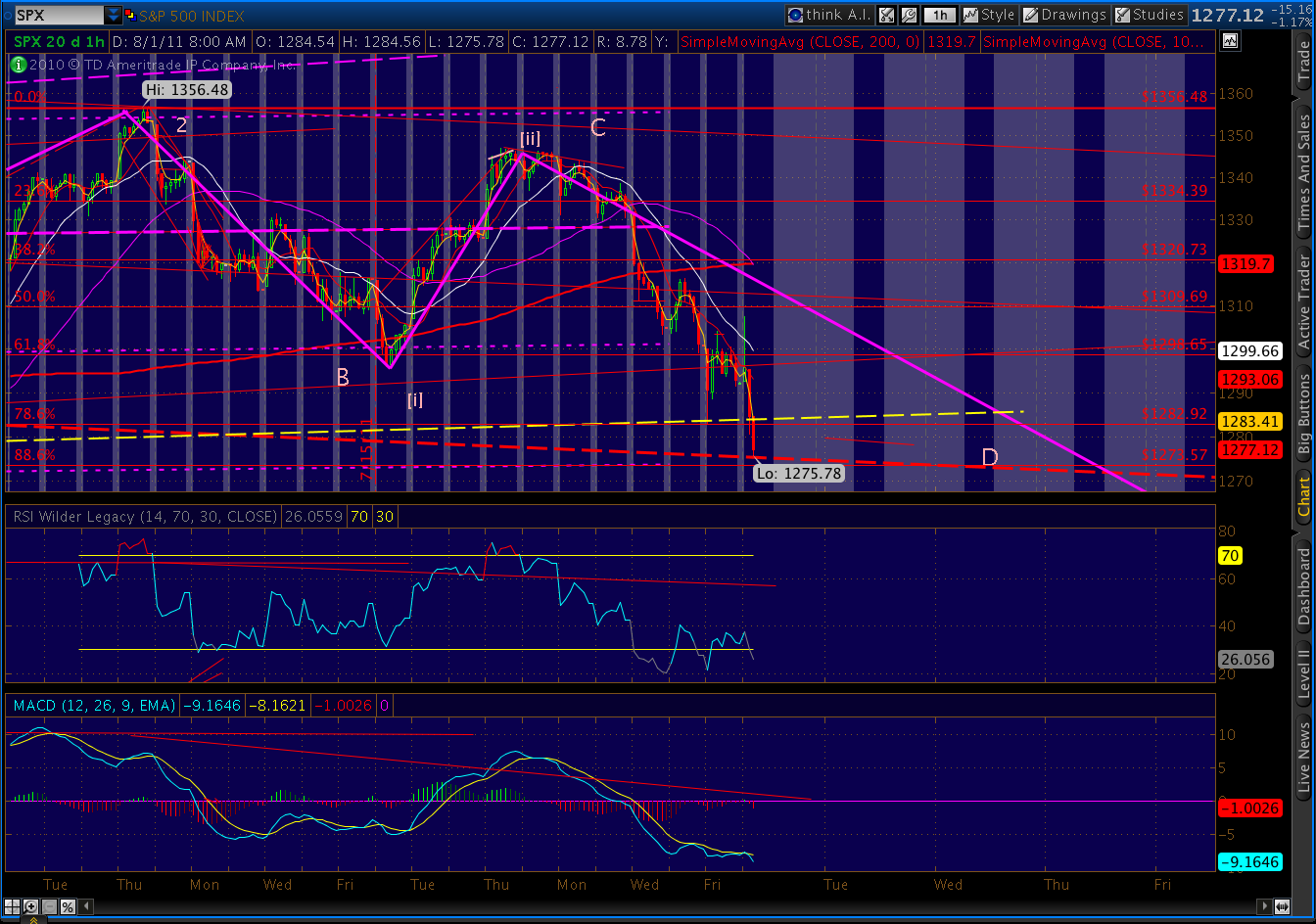
    We’re taking a breather, as expected.  Interesting that the pullback occurred right at a trendline (the dashed line below) drawn off the 3/16 and 4/18 lows.  We could look at the action since the recent lows as a backtest of that line.

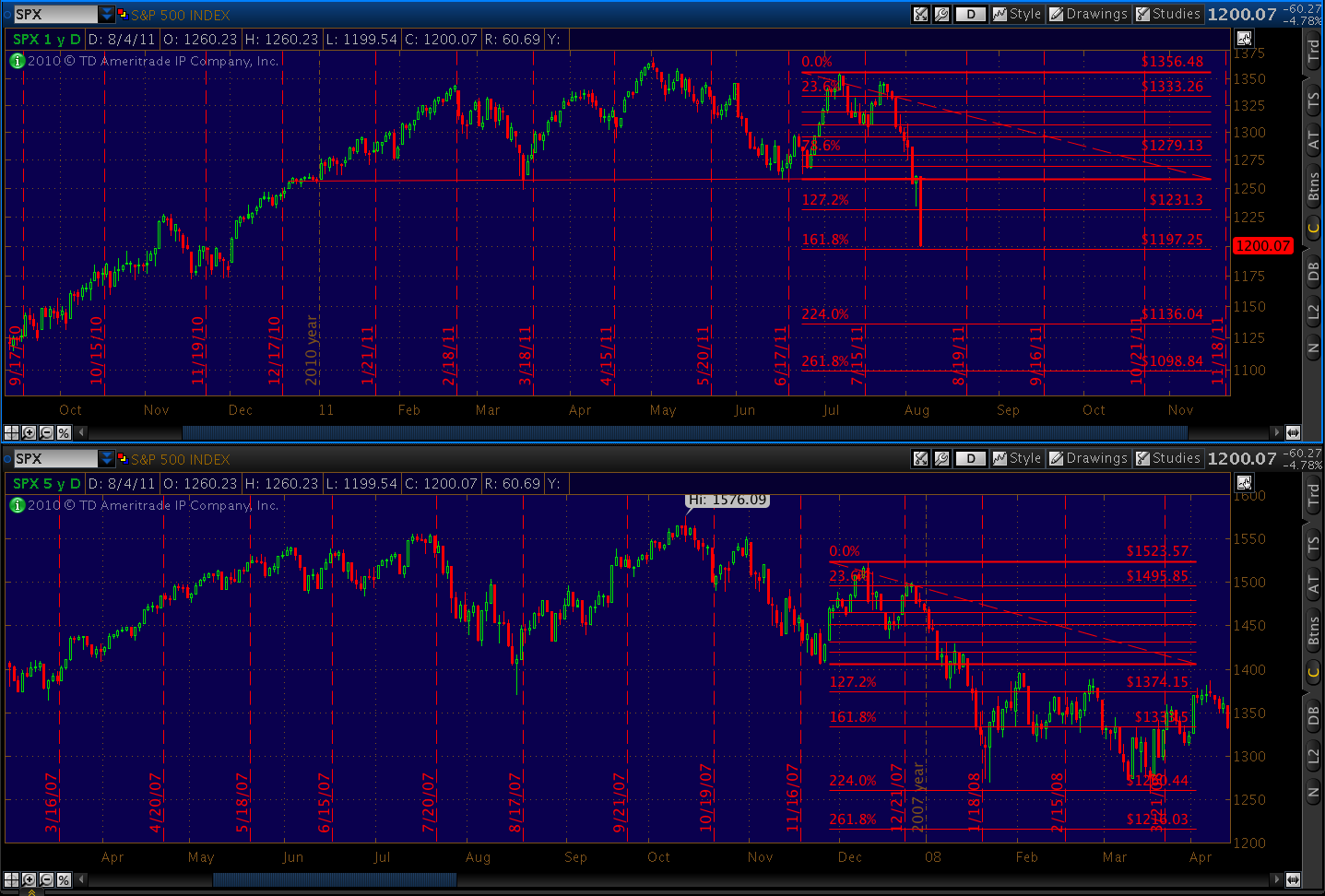
    Quite often, these backtests (off trendlines established by important pivot points) are the last up move before a substantial drop.  If we bounce hard and head back down, we will at least test the Oct ’07 trendline, as noted above, and possibly even the rising wedge at 1316.

    A likely scenario at that juncture would be an broadening wedge, governed by the dashed trendline above and either the Oct ’07 trendline or rising wedge below.   Again, failure to hold the wedge would be disastrous for the bulls.

    What do we get today?  A huge red candle that ranges from the dashed trendline to the rising wedge.  Almost like the market gods were listening, or something.


    What I was watching, but didn’t feel confident enough to share, was a bearish butterfly pattern (5/23-5/31 on hourly).  The bottom of it was kinda squirrely, and the entry wasn’t very clean, but I’ll mention them anyway in the future.

    We’re now faced with two big questions:

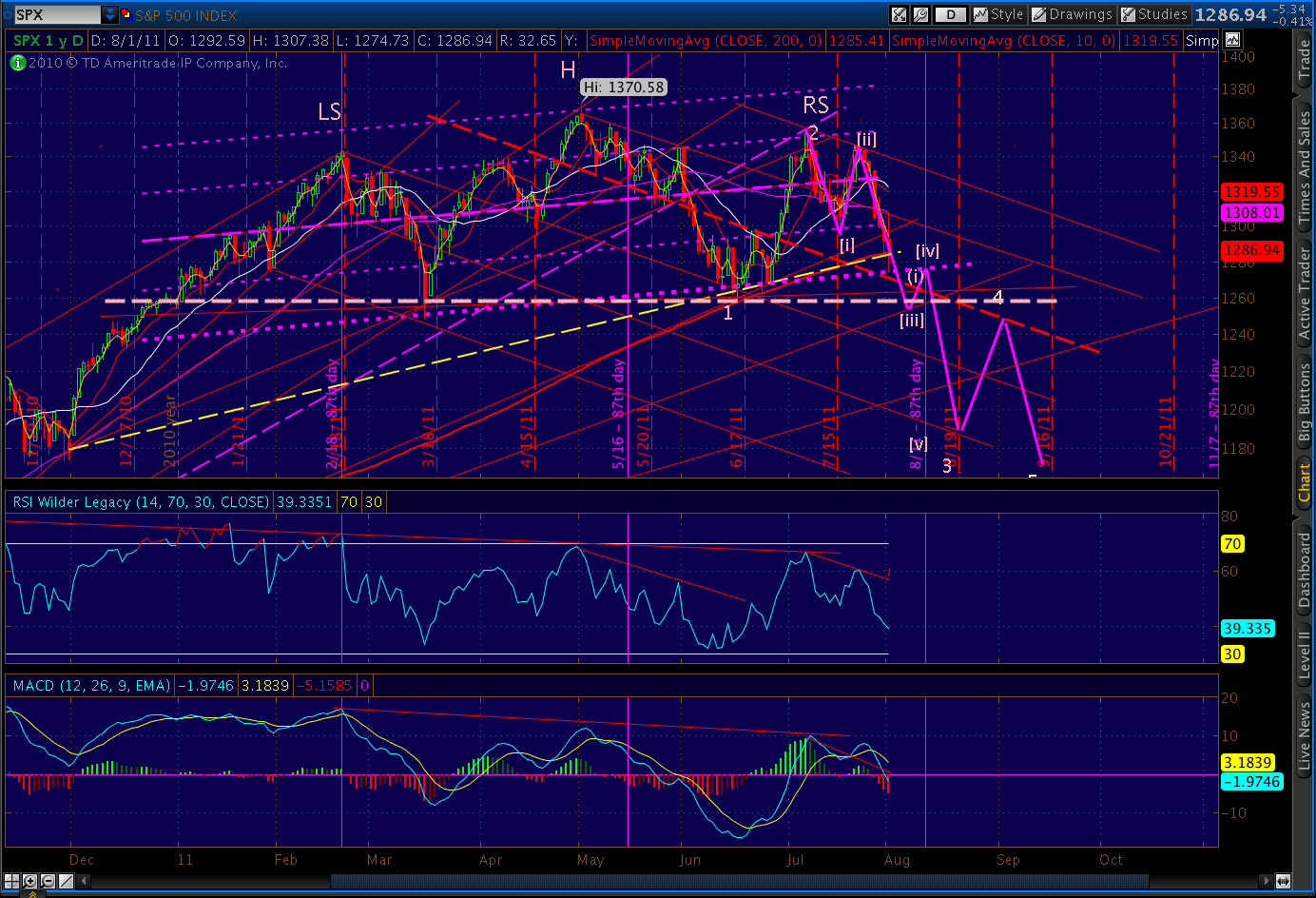
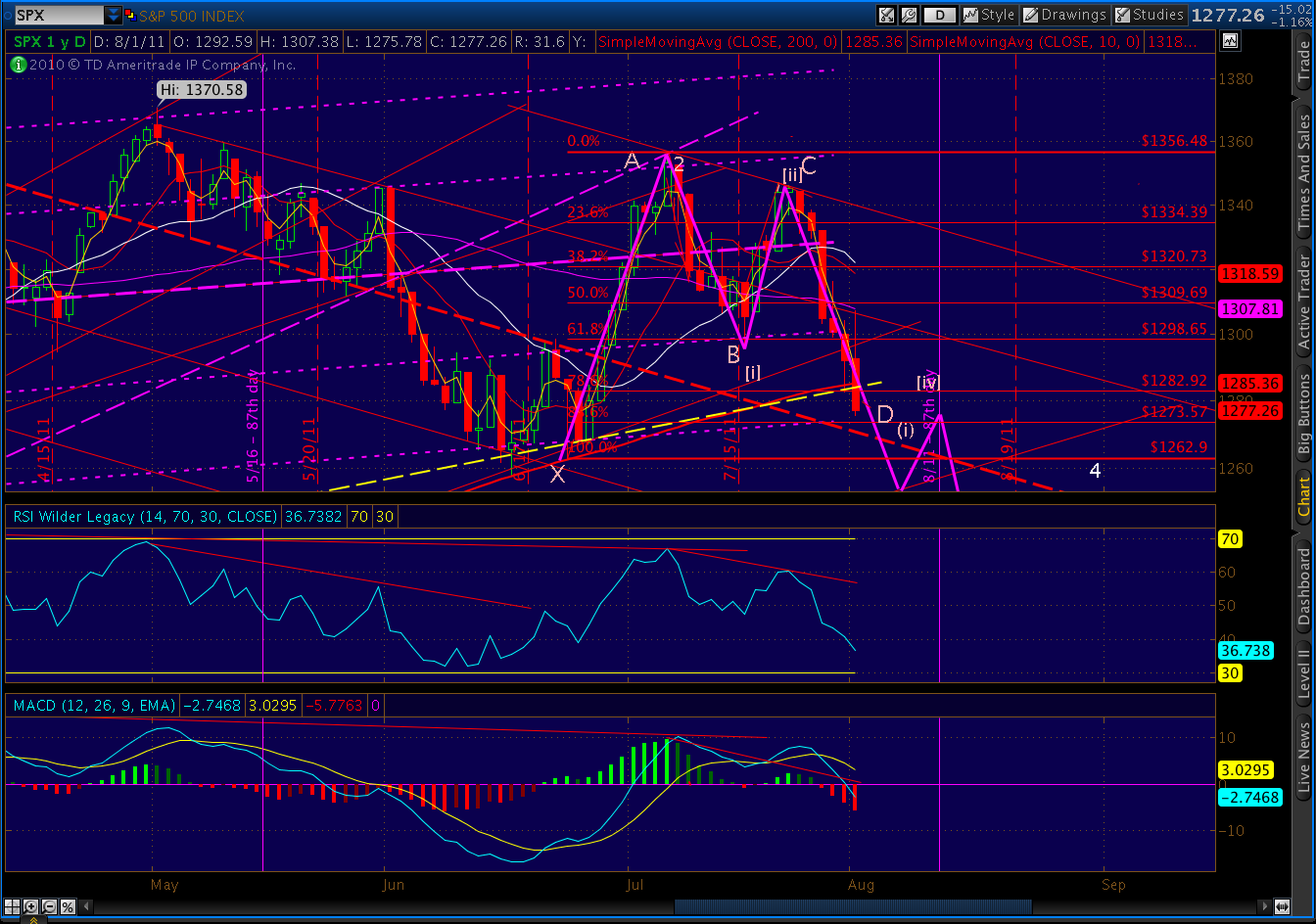
    (1)  did we top at 1370 and this is B of an A-B-C correction after the first wave down over the past few weeks?

    (2) if so, will the Fed come to the rescue?


    We’ll know tomorrow (or overnight) whether there’s any follow-through potential on the downside.  My expectation is that we’ll bounce back as high as the Oct ’07 trendline at 1330.  It would make a nice C wave for the next move down.  Again, the key is the bottom of the rising wedge — currently around 1311-1312.

    If we break down below it, we might backtest a few times, but the game is over for the bulls.  Our next target would likely be 1295, and after that 1280.

    If we rebound past 1330 (and I’m not holding my breath), look for the next major resistance at the channel top at 1342.  Any move above here, if it survives backtesting, would target the 1358 level yet again.  I don’t see any harmonics that are screaming for a particular direction, but I’ll look more later.

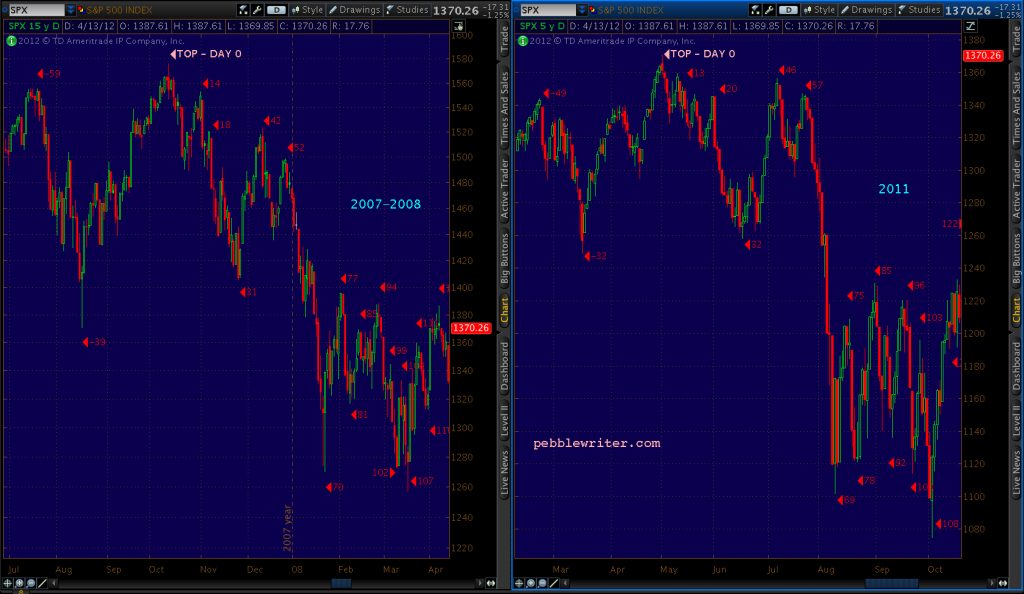
    Again, I don’t see a lot of value in declaring “bull” or “bear” right here.  If the market’s heading down, there will be plenty of downside left in which to score some major profits.  Just check the 2007 “top.”  LOTS of entry points.  Calling a top is good for the ego, but I intend to let the market tell us which way it’s going, then invest accordingly.

    Re question 2, heck if I know.  It’s obvious that another round of QE would just make things worse in the medium and long term.  It might even make things worse in the short run, if they run that up the flagpole but no one salutes.  Kiss whatever shreds of confidence the market has left good-bye.

    On the other hand, I can’t imagine they’ve no further tricks up their sleeves.  Who among us would be surprised to see additional bogus “announcements” or some other more tangible manipulation now that backs are up against the wall.  And, I don’t trust Congress to argue for the greater good here.  IMHO, these are desperate times that will likely produce desperate measures.    Stay groovy.
  • Stay Groovy

    “It was an expression used by small recon units and sniper teams in hostile terrain in Vietnam. They would tell one another to stay groovy when the danger level was so insanely high they popped amphetamines to stay awake and ready to rock twenty-four/ seven, because anything less would get them all killed. Stay groovy; take your pill. Stay groovy; safety off, finger on. Stay groovy; welcome to hell.”

     The Watchman, Robert Crais

    Did we break out of the channel yesterday?  I thought so, but took a fresh look last night and, well, see for yourself…


    It all comes down to whether you include shadows or not.  Which is right?  In general, we don’t when looking at longer term trends and but do in the short run.  Although, everyone has their own definitions of long and short term.

    As discussed yesterday, I am still looking for a retreat to the 1330-1332 level before we can advance any more.  Yesterday’s little dip was close, but didn’t really do it for me.  The flash back up in the waning minutes was also suspect.

    If we are to advance in another wave up, I would still want to see a proper corrective wave with some definition.  In the meantime, we should close down today.  As mentioned yesterday, we haven’t had 5 up days in a row since the Feb 18 top.

    There are plenty of tripwires ahead in the economic data due out this week.  Will they blow up the market, or simply result in another QE airstrike?   May as well call your bookie and bet on whether QE3 is coming.  I’m presently on the sidelines, as I don’t have enough conviction about the next few days to take a position either way. While I think there’s some upside potentially to the 1380 level, I wouldn’t bet the farm — especially from these levels.  I remain much more concerned about the downside.  Stay groovy.
  • 3 Peaks & Domed House

    Are we going from point 26 at 1311 to point 27 at 1358, before heading down to 28. 

    27 should be near top of 15, right edge of 1sst story roof.  28 bottoms near point 10.  27-28 decline should be equiv to 14-15.  rise from 20-21 balances 25-26 decline.

    see Carl Futia’s blog:  http://carlfutia.blogspot.com/2011/05/guesstimates-on-may-6-2011.html
    and: http://thepatternsite.com/3peaksdome.html

  • Why P[3] is My Top Bear Count

    First, props to one of my favorite Daneric participants, Souljester, for the suggestion.

    It got me to thinking — sometimes a dangerous thing, but always worth the effort.  Here’s why I think P[3] is happening by mid-September at the very latest and before SPX hits 1436.

    First, we all know the big picture.  We’re nearing the .786 retrace (1381.50) of the Oct ’07 highs.   A turn there would satisfy both Fibonacci and create a big, beautiful bearish Gartley pattern.

    But, so what?  Couldn’t we blow through there on the way to a .886 retrace?  Or extend to a gigantic Butterfly pattern at 1800?

    I don’t think so, and here’s why.

    First, the rising wedge that started forming in Mar ’09.  It really firmed up in April 2010 and has been a reliable guide to daily swings ever since.  It’s apex is around September 12 at 1436.   The last two multi-year rising wedges were 1998-2000 and 2003-2007.  They broke for 730 and 910 points respectively.  And, they didn’t get anywhere near as close to their apexes as we now stand.

    To paraphrase, “rising wedges been bery, bery good to me.”  I know they’re not foolproof, but I’ve yet to be let down by one in all my years of investing.  According to my Handbook of Wedgology, when we break it, we return to GO —  at 1010 or 667.

    Second, there’s the trendline that goes way back to the 1990’s, seen on my very first blog on May 2.  It currently stands around 1408. Guess where it is on September 12?  Yep, 1436.  Coincidence? I think not.

    Third,  the underlying economic picture.  I know, I know.  The stock market isn’t the economy.  But, on a long enough time frame it correlates pretty darn well (as any 80 year-old would attest.)  I don’t think anyone but a press secretary or a Fed governor would argue the economy’s looking up.

    Last, there’s my own little concoction, the 87-day cycle.  We’re not completely out of the May 16th woods, yet.  The 105th day is Thursday.  And, 105 was the longest period we’ve gone in the past 4 years without a good-sized drop (75 was the shortest.)  If it doesn’t happen by Monday, then the drop from May 2 was IT.  At 73 days it would be on the short side, and at 4.3% it would be on the puny side.

    Keep in mind that the study measured the 30 calendar days after each peak, so there’s  a few days left to go if May 2 was it.  And, sometimes the study caught one peak, but there was a bigger one starting a few weeks later (such as May ’09).

    But, if May 2 wasn’t IT, then the next 87th day is August 11 ( the 75-105 day range would be July 27th through August 28th.)  Again, this is in the waning days of the rising wedge.  It would dovetail nicely with those indicators.

    There are other little niceties.  Remember the giant inverted H&S; pattern?  It indicated an upside of 1436 — hmmm, there’s that number again…  I’ve also noticed significant similarities between the past few months and the tops in 2007 and 2000.  More posts on that to follow.

    Bottom line, I feel strongly that the next 3 months will mark a major top — although it could be as soon as this week.  Rarely do rising wedges grow this long in the tooth before the eventual decline; and, like I said, we’re not out of the May 2 woods just yet.

    We probably won’t be able to characterize the drop as P[3] until after the fact.  Until then, it might be another significant correction on the way to QE-infused infinity.  But, it should be enough of a move so that wily traders can amass enough dough/gold/farmland to survive what I expect to be very difficult times.

  • Shoulda, Coulda, Woulda…

    As the harmonics suggested last Tuesday, we broke out of the channel and are up 12 points this morning.  But, we need a breather after this morning’s skinning of the bears.  Short term, the market’s technically overbought.

    We will need to digest a bit of the rise, pausing to retrace probably somewhere between the .618 fib of 1348 and a trendline found at 1350.  We’ve set up a small bat pattern that could take prices back to 1330 (our trendline from Oct ’07) or 1332 (the .618 fib off the recent lows.)  This level also marks the 10 and 50 day moving averages and should provide good support.

    Tight stops are essential, as we’re within a mere 40 points of what could be the P[2] high of 1381.50 (although, who would be surprised if the 5th wave truncated?)  We’re also still bouncing around within a wedge that dates back to Mar ’09 and currently ranges from 1316 to 1392 — a mere 76 points. Any misstep that drives us out of the wedge would spell the end of the bull market.

    Anyone playing the upside here would do well to consider the metaphor: “picking up pennies in front of a steamroller.”

    UPDATED: 11:00AM

    We’re taking a breather, as expected.  Interesting that the pullback occurred right at a trendline (the dashed line below) drawn off the 3/16 and 4/18 lows.  We could look at the action since the recent lows as a backtest of that line.

    Quite often, these backtests (off trendlines established by important pivot points) are the last up move before a substantial drop.  If we bounce hard and head back down, we will at least test the Oct ’07 trendline, as noted above, and possibly even the rising wedge at 1316.

    A likely scenario at that juncture would be an broadening wedge, governed by the dashed trendline above and either the Oct ’07 trendline or rising wedge below.   Again, failure to hold the wedge would be disastrous for the bulls.

    If, ultimately, we advance beyond the trendline and successfully backtest it, that could give us a base from which to advance to our 1381 target.   But, I don’t think that’s in the cards in the next few days.  If we close up today, it would be the 4th day in a row.  And,  we haven’t had more than 4 up days in a row since the 2/18 top. 

  • Remembering…

            Michael J. Novosel was only 19 when Pearl Harbor was attacked. Determined to fly for the Army Air Corps, he was too short to pass the flight medical. His friends carried him around on a stretcher for several days in the mistaken belief that he might grow a little if spared the effects of gravity. It didn’t work. But a flight surgeon, swayed by Mike’s patriotism and enthusiasm, fibbed on Mike’s physical so long as he promised to grow another quarter inch.


            Mike flew bombers over the Pacific during World War II, eventually commanding a B-29 squadron on the island of Tinian before he’d even earned a drivers license. He carried two cushions, sitting on one in order to see over the instrument panel and placing the other behind him in order to reach the pedals. He participated in the bombings of Tokyo, and later flew over the surrender ceremony on the Missouri.

            After Korea, Mike was RIF’d out of the Air Force – a victim of peacetime supply and demand.  He stayed active in the reserve, but focused on his growing family and a successful airline career.  He was moved when JFK encouraged Americans to “ask not what your country can do for you…”  And when Kennedy was assassinated, Mike watched as John Jr saluted his father’s caisson. The bravery of that three year-old – the same age as Mike’s youngest son, also named John – convinced him to request a return to active duty. The Vietnam war was heating up, and Mike couldn’t sit idly by while others risked their lives.

            But the Air Force determined that Mike, at 43, was too old to fly. Undaunted, Mike asked the Army if they could use someone with his experience. They welcomed him with open arms – and a paycut. Joining the army meant resigning his Lieutenant Colonel commission (and pension) in the Air Force. He would have to enter as a warrant officer – the same grade as guys half his age.

            After brushing up on helicopter flying, Mike was sent to Vietnam and joined a new unit known as Dustoff. Before Dustoff, wounded men were treated in the field – less than ideal conditions for a traumatic amputation or a sucking chest wound. Dustoff’s Hueys fanned out across Vietnam and rescued seriously injured soldiers and civilians – both allies and enemies – resulting in a 97% survival rate for the 900,000 who were saved.


             Flying these Huey’s was unbelievably harrowing. Crews’ only protection from constant hostile fire was a quarter-inch thick, plexiglass windscreen and aircraft skin the same thickness as a soda can’s. They had little armor and no weapons. Strapped in tight, they had no way to duck or dodge incoming fire. Their only defenses were their flying abilities and the efforts of the grunts who came to know the “whoop-whoop-whoop” of an incoming Huey as the sound of life.

            Mike distinguished himself as a pilot and a leader. He taught FNGs how to avoid being shot down and how to fly via instruments (not a part of helicopter training at the time.) Along the way, he also gained new perspective on the realities of war. He had gone from flying bombers high over a target to being in the thick of a brutal, bloody war – constantly being shot at, witnessing horrific injuries, hosing blood and body parts out of his Huey after each mission. The contrast could not have been greater.

            By then, Mike’s son Mike Jr had grown up, joined the army and become a pilot. As anyone who’s seen Saving Private Ryan knows, brothers can’t serve together. However, the army sensed a public relations opportunity in having father and son fly together – the first time in US aviation history. So Mike Jr joined his dad’s Dustoff unit in Vietnam.

            A father’s worst fears were realized when, several months later, Mike Jr was shot down (one of six times.) He was rescued, of course, by his father. A week later, Mike Sr was shot down and rescued by Mike Jr.   In all, Mike Sr flew 2,543 missions and rescued 5,589 wounded. He was later awarded the Congressional Medal of Honor for flying fifteen times, without air cover, into an enemy training facility to rescue 29 South Vietnamese soldiers who were pinned down by enemy fire.

            When Mike retired in 1984 – from the Army this time – he was the last former World War II pilot still on active flying duty – the last Eagle. When I first met him, he didn’t strike me as much of a hawk as war heroes go. After getting to know him, I understood. Unlike many Americans whose perception of war is shaped by CNN or Fox – a puff of smoke, viewed from five miles high – Mike saw the victims’ faces, heard their screams and was soaked with their blood. As a result, he understood war was a last resort, when all else had failed.


            At the time of his retirement, Mike’s awards and decorations included The Medal of Honor, Distinguished Service Cross, Distinguished Flying Cross with two Oak Leaf Clusters, Bronze Star Medal with two Oak Leaf Clusters, Air Medal with “V” Device and 60 Oak Leaf Clusters and the Purple Heart Medal.  He was proud to have been awarded the Medal of Honor for saving, rather than taking, lives.  But, he considered his greatest awards the countless simple nods of thanks he received from men who would otherwise have died in battle.
         
            Mike Jr. went on to an illustrious aviation career as well.  He inherited his father’s call sign “Dustoff 88” and his determination to make a difference.  During his tour, he flew 1,736 missions, earned 37 air medals and rescued more than 2,500 allied airmen, sailors, soldiers and civilians — also exemplifying the motto “no man left behind.”
     
            Mike Sr. passed away in 2006 after a tough fight with colon cancer.  He was laid to rest a stone’s throw away from JFK at Arlington National Cemetery.  Mike Jr. passed away in 2009, a few days after receiving his father’s Medal of Honor flag in a ceremony at his home in Florida.  Those fortunate to have known them will miss their fearlessness, their compassion and their uncommon wisdom.

    Mike Sr. is awarded the Medal of Honor as Mike Jr. (far right) looks on

    Michael J Novosel’s Medal of Honor citation

    Wikipedia page

    The Novosel Foundation

  • Margin Debt Highest Since the Crash

    Margin debt in April reached $320 billion, the highest level seen since February 2008, one of the most unfortunate cases of BTFD in recent memory.

    Margin debt topped $381.4 billion in July 2007, just before the market peaked in October.  The S&P; 500 plunged 58% over the next 17 months.

    Source: NYXdata.com

    Why the $5 billion increase from March to April?  Could it be investors have bought the notion that the Fed won‘t let the market go down? 

    Let’s hope they don’t all rush the exits at once when someone finally notices the inferno into which the Fed has been sQErting lighter fluid. 

  • Credit Default Swaps Hint at the Next Casualty

    Short term US Government credit default swaps have more than tripled since April.  If this were solely the result of debt ceiling debate, I wouldn’t be so worried.

    http://blogs.wsj.com/marketbeat/2011/05/25/us-short-term-cds-spreads-sharply-wider/

    I suspect it has more to do with the fact that US debt is forecast to exceed 155% of GDP by 2035 (see the report from the Peterson Institute for International Economics, or read about it here.)  Even though the Peterson Institute’s solution is gutting Social Security and Medicare, I imagine their prediction is accurate.

    Can’t be, you say?  Those numbers are worse than Greece (102%) and Ireland (112%)!!! 

    Okay, I admit I shaded the truth a bit.  Those are the best case data.  The Peterson folks suggest the debt might actually climb to over 300% of GDP.

  • Who’ll Stop the Reign?

    “BOSTON (MarketWatch) — It‘s cost $600 billion of your money. And it was supposed to rescue the economy. But has Ben Bernanke’s huge financial stimulus package, known as “Quantitative Easing 2,” actually worked as planned? … Turns out the program has created maybe 700,000 full-time jobs — at a cost of around $850,000 each.  House prices are lower than before QE2 was launched. Economic growth is slower. Inflation is higher… Yes, it’s sparked a massive boom on the stock market… But even the stock market boom hasn’t been what it appears. An analysis shows that most of the rise in the Standard & Poor’s 500 Index under QE2 has simply been a result of the decline in the dollar in which shares are measured.  The truth? QE2 has created a massive new bubble in dollar-based financial assets, from stocks to gold. Meanwhile, it has had zero visible effect on the real economy.”

     http://www.marketwatch.com/story/qe2-was-a-bust-2011-05-21

    Most investors I know are bullish simply because the Fed has implicitly assured them they can’t lose.  If the economy improves, the market goes up.  If the economy tanks, order up another round of QE, and the market…goes up.   It will come tumbling down eventually, but meanwhile they’re happy picking up pennies in front of the steamroller.

    I used to think the Fed was simply misguided (Hanlon’s razor:  never attribute to malice that which is adequately explained by stupidity.)  Now, I believe it’s equal measures of greed (helping out their Wall Street homies) and last-ditch desperation.  How else to explain QE policies that lead the country further into crushing debt, rising inflation and reinflated bubbles — all without benefiting the marginalized? 

    If the greatest beneficiaries of QE (think Wall Street) reinvested even a fraction of their profits to the recession’s worst victims, I suppose you could say there has been a net “voodoo” economic benefit.  But, judging from the foreclosures, bankruptcies, folks raiding their 401(k) to pay the bills — it ain’t happening.

    We rant about China’s currency manipulation, but we set the standard — even though devaluing the buck only delays the inevitable.  Congress cheers on the Fed, because politicians serve at the pleasure of their bankster johns  (politicians, after all, declared everything was fine even as banksters stuffed no-doc loan solicitations into mailboxes like peep show hawkers in Times Square.)  Anyone who objects will be back in the private sector faster than you can stop payment on a campaign contribution.

    Obama was supposed to stand up to these bozos we bailed out by the billions, but has proven himself inept at best or, worse, in cahoots.  He tries to reassure us, but the folks buying $4 gas and $3 bread know better, as do those whose unemployment benefits have long since run out.  Optimism only gets you so far, and right now we’re running on fumes.  We have more to fear than fear itself.

    The list of once-peaceful countries wrecked by protests in the streets grows longer by the day.  At what point do Americans decide the rich are rich enough?  That bailing out an inner-city clinic is at least as important as AIG?  That students are more deserving than for-profit diploma mills, and homeowners deserve a fair shake from the banks that created this mess?  Will we work ourselves up to a little righteous indignation, if not full-blown riots?

    With apologies to CCR, “who’ll stop the reign?”

  • You Say Potato…

    Tuesday’s declines had an impact on the harmonic picture, but not exactly how I expected.

    The large bullish Gartley that has been forming since 4/18 was completed at the lows (* on the chart).  The smaller 5/17 – 5/22 bullish Gartley targeting 1352 failed due to the extension of the CD leg; but, thanks to Wednesday morning’s action, became a Butterfly pattern with a near-term target of 1355.  Meanwhile, the 4/18 Gartley becomes a Crab — now targeting 1358 at the .618 retrace.

     I have no clue as to the correct EW count and,  judging from the debates going on, only half the people do.  The other half are dead wrong.  Whether we bounce from here or not is anyone’s guess.

    But, if the decline stalls, look for a big rebound to at least the .618 XA retrace to 1358 on the larger Bat pattern, egged on by the smaller Butterfly pattern — with targets ranging from 1328 at its .618 retrace to 1358 at its 1.618 extension. 

    There’s plenty of overhead resistance all the way up — starting with 1332, the .50 fib and top of the channel that’s taken us down to these levels.   But, now we have a quantifiable motive for a sizable rebound, whether it’s the start of Minor 5, a 3rd of a 3rd, or whatever.

    Backing up a bit, we can see the market trying to establish a higher low from the 4/18 low of 1318.  If we go up from here, as I expect, the decline from 1370 will prove to be corrective — some form of wave 4 that drives us to a higher high.  Market Sentiment on the chart below would support that view.

    If prices hold up, we should also see a bullish engulfing candle on the day, adding fuel to the short-term bullish case made by harmonics.

    The large bearish pattern set up off the Mar ’09 lows is unchanged, still indicating 1381.50 near term and much, much lower long term.