
Author: pebblewriter

  • All That Glitters: Follow Up

    Gold had a couple of pretty strong reversals yesterday and today.  Recall we saw a rising wedge and bearish butterfly pattern completed on the daily chart that indicated GC might have run out of steam [original post here].

    Since then, it blew through the proposed D point of 1646.80 on the way to 1684.90.  But, this morning, it fell sharply, tagging 1642.20 intra-day.  It’s also set up some striking divergence on the 60-minute chart.

    I have no idea what the cosmos has in store for gold long-term.  But, this pattern is a recipe for at least a short-term correction.  It is likely falling in sympathy to the equities markets, but all those nasty margin calls have to paid somehow.  And, it’s psychologically easier to sell positions in which you have huge gains.

    Given that many of my fellow doomers have defensive positions in gold, it’s worth at least taking a look at protection.

    **************

    Charts from original post:  AUG 2, 2011

  • Cycle Still Working…

    Back in May, I posted a study [see:  Sure, It Works in Practice] that found a 87-day cycle that did a pretty good job of predicting significant downturns.

    I haven’t posted the chart in a while, so here it is again for anyone who’s been watching.  The predicted 30-trade day low of 1197 happens to correspond with where I think we might find the next level of support.

    Keep in mind, that figure is based solely on achieving the average 11.03% decline that the study has found.   This one could be better or worse.

    I’ll add to this post after the close today.

  • Intra-day: August 4, 2011

    UPDATE:  2:15 PM EDT

    Something’s gotta give…  We’re in a falling wedge within an expanding wedge, with loads of divergence and retesting the earlier lows.

    UPDATE:  12:15 AM EDT

    Market seems to have found support here.  Only influence I can see is the Nov 5 2010 high of 1227.  We’ve made a new bullish falling wedge…a few times, now.  Have had a backtest and are possibly retracing, but risk still off the charts.   If it plays out, could take us back to 1245+.

    UPDATE:  11:50 AM EDT:

    Next major support isn’t till 1200.

    ORIGINAL POST:  10:30 AM EDT

    The rising wedge seems to have paid off nicely, with prices falling back to the base as per the script.  Like yesterday, the trend line off the Feb 18 high saved the day (so far.)  It’s the orange dashed line on the daily chart below.

    The big question is whether this is “b” of a corrective wave, or the next impulse subwave.  We did make a new low, so caution is warranted.

    We’re still due a [iv] wave sometime soon.  My original thought (as of a couple of weeks ago) was August 11 (the purple line.)  This was based largely on the 87-day cycle — it should mark an important high.  But, it also dovetails nicely with the 2007 topping pattern.

  • Anatomy of a Short – Day 9

    BAC reached the bottom of its rising wedge this morning.  It tagged 9.32, even better than the 9.40 I was looking for.  I sold my remaining August 11 puts at 1.65 for an 83% gain in 9 days.

    At 8.89, it would complete a bullish crab pattern that would also coincide with the bottom of its channel. Might take another look at playing the upside, but doubtful.

    First, I don’t expect the market to make any serious advances anytime soon.  Second, if I changed my mind, I wouldn’t play the upside with BAC.

  • Intra-day: August 3, 2011

    ADDENDUM:  10:35 PM EDT:

    Thanks to ewtnewbie for this question on Daneric’s excellent EW blog:

    Pebble, love your stuff.  I’m glad you cleaned up your Fib chart–it was getting hard to read.  I haven’t redrawn mine yet, but are you thinking today as ‘a’ up, with ‘b’ and ‘c’ to come to get to 1270ish–or time to add to shorts here at 1260 for sub-1230?

    Your comparison chart shows that the topping action in 2007 had a multi-day retest of the neckline, but only wicks above it, no closes. If that holds true this time, we not see 1270 on a closing basis. Just something to think about. 

    Sorry, sometimes I go a little overboard with the TLs.  But, sometimes I think one is done affecting anything and delete it.  Then, surprise!, right back in the soup. 

    Gotta tell you, the question re a-b-c is my biggest challenge with EW (aside from the dain bramage.)  I’m always wrong with the size/scale of corrective waves, thus leave labeling to those much more capable.  In fact, it’s probably why I dove headfirst into chart patterns, TL’s and harmonics…no labeling!   With that disclaimer out there, my guess is today was the whole enchilada.  Probably not “big” enough, but that’s pretty much what happened in 2007 so it’s good enough for me.

    As far as 1270, you’re probably right.  I looked at this a little closer after reading your question.  Bottom line, we’ve extended almost exactly the same from the 6/16 to 7/7 move as we did the equivalent 2007 move (11/26 to 12/11.)  The bounce in 2007 was to the .786 level.  Today, that would equate to about 1279.

    Looking at the 5/2 to 6/16 move… the equivalent 2007 span (10/11 to 11/26) extension was right about 115%.  The fib retrace was about .85.   Now, we’re just a smidge past 115% down, and .85 would take us up to around 1273.

    I can’t really argue with 1273 or 1279, as that’s where I’ve shown the bounce going to for the past two weeks.  It’s also where my regression channel -2 std dev line is.  But, I’m a little troubled by the idea of that big a bounce.

    Hence, the only reason I’m not completely committed on the short side just now — and the reason I took the trouble to play the bounce today.  I can see the bounce stopping right here and now, or tagging that line on the backtest.  But, seeing as how it’s a difference of only 20 pts in the scheme of a 100+ point swing, I can live with the ambiguity.

    END OF DAY:  8:45 PM EDT:

    Trying really hard not to get distracted by the intermittent noise.

    Standing firm,
    weathering the storm,
    sticking to the plan,
    staying the course,
    keeping the faith…

    UPDATE:  3:40  PM EDT:

    Tagged the 1260 IHS target, a little over the 1258 resistance.  Watching a rising wedge getting close to its apex of around 1265 (the other IHS target, hmmm…)

    Also seeing a divergence between price and RSI/histogram.  Time to add to shorts.

    Looking at the candle we’re likely to leave on the day.  Hammer is a popular candle, but not always a good indicator.  Bulkowski has a good discussion.

    UPDATE:  1:45 PM EDT:

    Getting awfully close to 1258.  Will go ahead and close out the longs I was playing the bounce with and start scaling in some shorts.  It might indeed go higher in the short run, but I’m fairly certain it’s going lower in the medium/longer term. 

    UPDATE:  12:45 PM EDT:

    Two little inverse head & shoulders patterns setting up on the 1-min chart.  Might be the boost we need to do a proper c leg of the a-b-c here.  Targets are 1260 and 1266.  I’m watching for a break above 1252 on the upside or 1240 on the downside before adding more to any positions.

    Although, it’s likely 1258.07, now that it’s been broken as support, will act as resistance to any further bounce (see below.)

    UPDATE:  11:00 AM EDT:

    Playing the bounce off the crab here.  Initial target 1257, then 1270.

    UPDATE:  10:30 AM EDT:

    Market down 12, looks like more to come.  Next logical place to pause is TL and completion of bullish crab at 1233.

    UPDATE:  10:05 AM EDT:

    ISM not as bad as it could have been..  Index fell from 54.6 to 53.3.

    Factory orders came in at a 0.8% decrease instead of -1.0%.  briefing.com does a great job of graphing the trends.   Here’s the report, available here.

    UPDATE:  9:50 AM EDT:

    Reached the important 1249.50 level of support; this would be the logical place for support to come back in if it’s going to. I imagine any bump we get will be limited to 1268 or so.

    The factory orders and ISM non-manufacturing data is due to be released at 10.  Factory orders are durable goods (got it last week – bad) and non-durable goods like food.  Given the food inflation we’ve had, the non-durable aspect of factory orders might compare positively to expectations of -1.0%.

    We saw the  ISM manufacturing numbers come in barely positive last week.  I don’t expect services to be any better, especially given the reported layoffs in the financial sector.  The market’s looking for 52.

    ORIGINAL POST:  9:25 AM EDT

    The Swiss cut rates to 0%, trying to halt CHF meteoric rise…

    And, the rest of the currencies vs S&P; futures…

    More later.
  • All That Glitters

    I don’t really follow gold, per se.  But, seeing that it made a new high today (1646.80), it seems like a good time to take a look at the technical picture.

    Gold has been in a rising wedge for over three years — a long time, in technical analysis-land.

    A couple of other things can be seen from this chart.  First, there is apparent divergence between price and technical indicators.  Notice that RSI, MACD and histogram all sloping downward while prices have continued to advance.

    Also, at today’s high, GC completed a bearish Butterfly Pattern.  These sometimes extend beyond the 161% level, but that’s the most common D point target.

    Also common in Butterflies is a rather strong reversal.   The initial target would indicate a drop to the .618 level of 1533.  But, Butterfly patterns frequently correct to a 1.618 extension of the XA leg, meaning a downside to 1350.  The “middle ground” 127.2 extension target is 1413.

    Placing a bearish trade in a red hot market takes a lot of nerve — and tight stops.  And, gold has acquired an elevated status lately — given the US debt issues.  But, the harmonics patterns have been very accurate the past several months across markets.   We’ll see how this one plays out.

  • Intra-day: August 2, 2011

    UPDATE:  1:00 AM EDT

    Posting this pretty late at night, only because I needed a long walk on the beach after a day like this.  Don’t know about you, but my head’s still spinning.

    We got exactly the move I was looking for; just didn’t expect it all at once like that.  The goal was 1250 by Friday, as has been indicated on my charts for the past 2 weeks.   This could mean there’s more momentum here than expected, which might indicate a deeper drop.  On the other hand, it could mean we’ve achieved the capitulation that’s typical of a short term bottom and bounce (sorry… temporary cessation of crash-like behavior).

    We saw a good amount of divergence toward the end of trading, especially on the 60 minute chart.  And, we’re just 5 points away from horizontal support from the Mar 16 low.  We also nearly tagged the TL I’ve been expecting to bring a pause to the decline.  And, last,  S&P; surprised no one by caving (see the 1:40 post below) on their downgrade threat.

    Add that all up, and I made the decision to take some profits on almost 1/2 of my positions — a little bit at the 1265 level (my H&S; target) and a bit more at 1258 (the Jun 16 low.)  I thought we’d get more of a bounce at 1258, and I’d have a chance to buy back in a little cheaper.  Instead, I’ll be looking for a good spot in the morning, maybe around 1268 or so.

    If I’m wrong, and we get no bounce at all, I’ll likely chase after it like a drunken fool with about half the funds I pulled out today (leaving the rest on the sidelines just in case.)

    I know we’re technically oversold.  I know there are others who see this as a huge buying opportunity.  I know the put-call ratio is probably through the roof (not even looking tonight.) 

    But, I am fairly well convinced our economic goose is cooked.  Has been for a while…but the secret’s out.  And, now that our own little crisis is averted for another 15 minutes, we can start worrying about the train wreck across the pond.  So, yes, I’m as bearish as ever… at least until further notice.

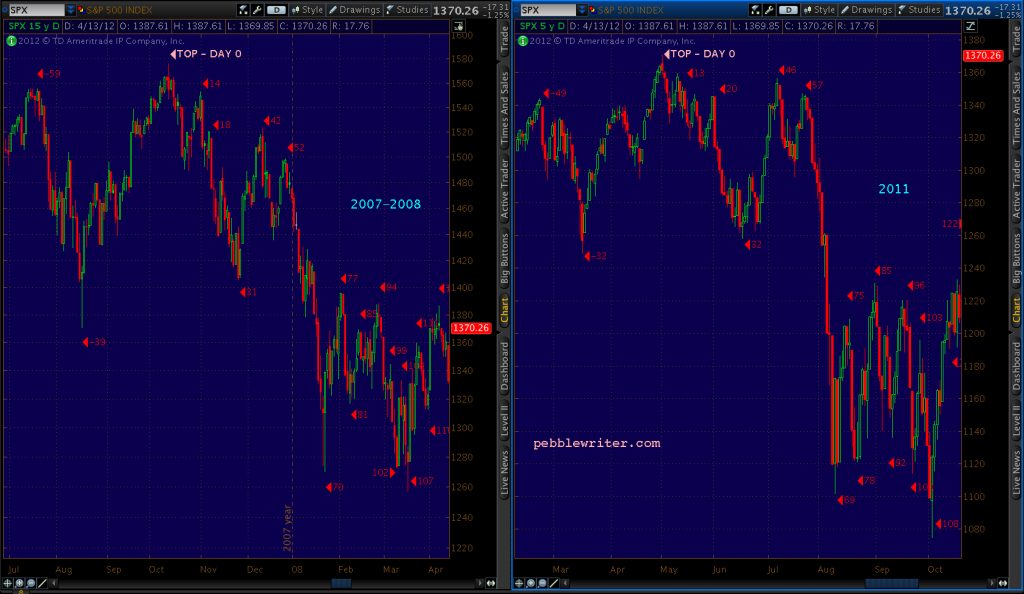
    Bottom line, I’m gonna “dance with the one what brung me.”  The 2007 pattern has worked beautifully till now, and I see no reason to abandon it at this stage.

    UPDATE:  1:40 PM EDT

    We hit our H&S; 1267 target (see below), bouncing at 1265.59 just a bit ago.  Whether the bounce has any more juice in it or not is unclear to me.  But, I did take profits on a small percentage of my portfolio.

    My best guess at this point is we close somewhere between 1269 and 1274 today, then trade in a range of 1250 and 1275 through the end of next week before turning down in earnest.  But, as we near a potential turning point, the exact time and place of the turn gets a little murkier.

    I’m not really looking for a bounce any higher than that unless: (1) unemployment numbers are miraculously better, or (2) S&P; and Moody’s follow Fitch’s lead and leave the credit rating alone.  We can only imagine the level of pressure they’re getting from Washington.  And, who would be surprised if they caved?

    UPDATE:  11:00 AM EDT

    The H&S; pattern is playing out nicely so far, with SPX down to 1275 and gaining momentum.  We might run into some resistance at the -2 std dev line of our regression channel, which is also yesterday’s low (bottom purple dashed line.)

    If we can break through, the dashed red trend line has offered fairly strong resistance in the past, but will fail — either today or in the near future.

    For those wondering when/where/how big the bounce…. the comparison with 2007 suggests it will be limited to a 38.2% Fib retrace.  Based on yesterday’s low of 1274.73, that would mean 1301.91.

    That’s also where the regression channel  -1 std dev line is now, and where the 50 day SMA will be in a couple of days.  There’s also a pretty good trend line intersection at that same level.    It’s anyone’s guess whether it’ll reach that high, but I’d put it at 50-50 if a bounce began right now.

    Naturally, the .382 level changes if we make new, lower lows.

    UPDATE:  10:40 AM EDT

    SPX continues to slip and slide, reaching 1279 — near its opening low.  In so doing, it has completed a little head & shoulders pattern, indicating a downside of 1267.  Should play out in the next 15-20 minutes.

    ORIGINAL POST:  10:15 AM EDT

    Still watching the ES vs USD/CHF relationship, which does a great job of showing how well equities and the dollar continue to correlate.

    I show the Swiss Franc because it has performed the best relative to the dollar and is as strong a currency as there is.

    Here it is, compared with the DX, which is a basket of non-USD currencies — primarily the Euro (58.6%) but also including the Yen (12.6%), Pound Sterling (11.9), Canadian Dollar (9.1%), Swedish Krona (4.2%) and Swiss Franc (3.6%).

    The chart suggests that, while the USD continues to slide vs the CHF, it seems to have bottomed relative to everything else — particularly the euro.

  • Intra-day: August 1, 2011

    UPDATE:  3:00 PM EDT

    In coming back to the -2 std deviation line of our regression channel at today’s low of 1274.73, we’ve finally completed one of the H&S; patterns I’ve been following.  This one has a sloping neckline (blue, dotted), and is the 2nd cousin to the one everyone’s been watching.  Here’s a peek:

    The other, better-known but equally valid pattern has a flat neckline and completes at 1258.07.

    The only practical difference between them is the price objective, which is established by the distance between the pattern high and its corresponding neckline value — about 112 points.

    The first pattern objective, therefore, would be 1163, and the second would be 1146.  Either will help get us to the new lows coming later this week.

    In terms of targets and timelines, we’re still following the 2007 script.  The direction and speed has been spot on, as the purple line above indicates.  This is the exact same trend line drawn 10 days ago and has done a remarkable job of showing us the way.

    We might get another pop up when the debt deal is finally done, but the anti-deal sentiment is so strong now, it’s hard to imagine more than 20-30 points if that.  It’s more likely we go down and test the 1258 lows before any meaningful bounce occurs, probably to backtest the -2 std dev line (purple dotted) before beginning the next wave down.

    UPDATE:  12:40 PM EDT

    Thought for the day… The argument has been made that US stocks are able to advance in the face of a crummy US economy because “the stock market isn’t the economy.”  How many times have we heard that refrain?  US companies are global now, and conduct 40% of their business in other countries where everything is hunky dory.

    With PMI confirming a pretty ugly global economic picture (see below), it seems that argument isn’t quite as compelling.

    UPDATE:  11:45 AM EDT

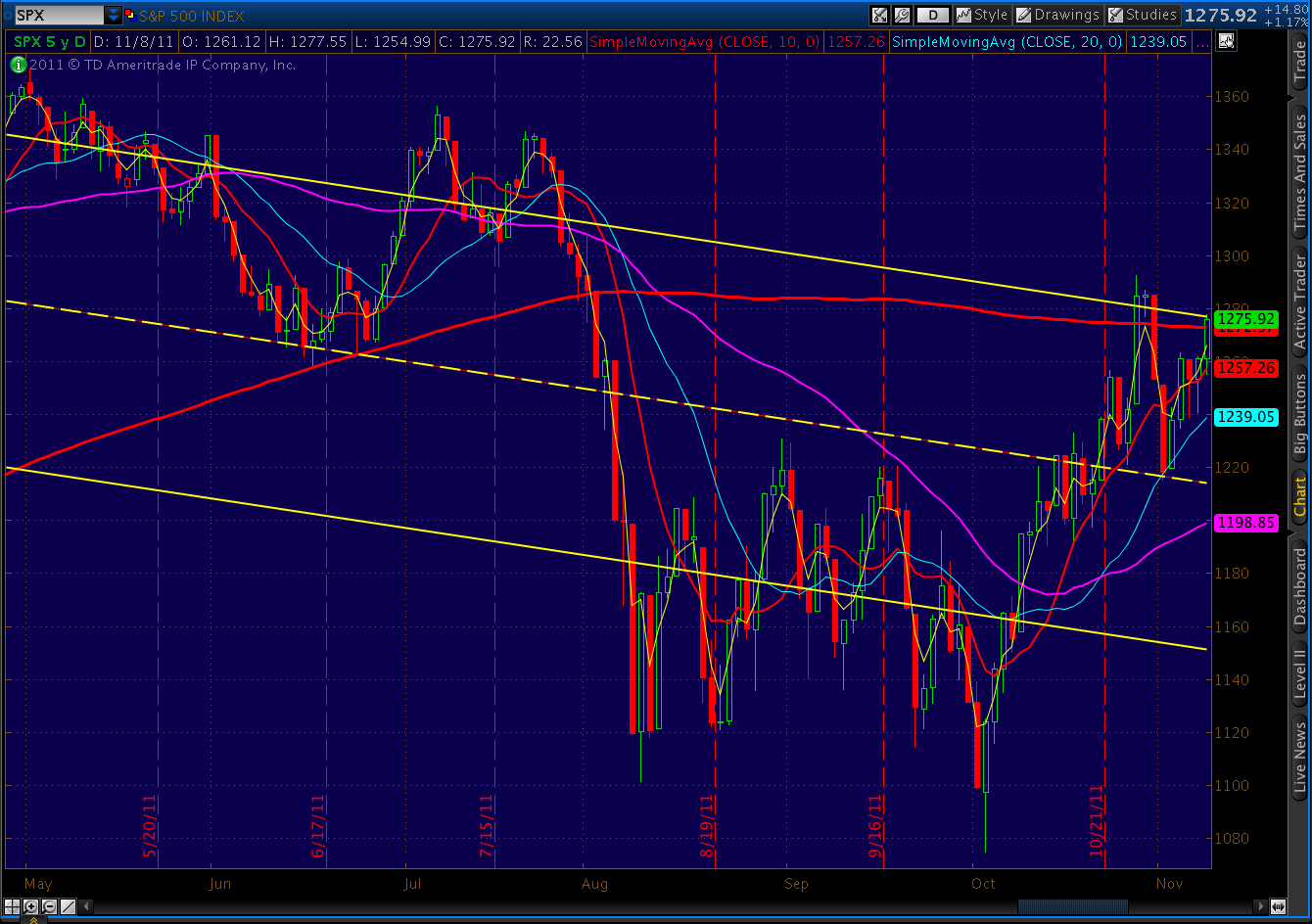
    SPX thought about respecting the Gartley .786 retrace and TL at 1282.92, but it looks like the economic news is just too overwhelming.  Here’s the daily chart.  Note we’ve broken through the trend line from the last lows I mentioned in yesterday’s post (yellow dashed line).

    Next up is the TL from the Apr 21 gap (orange dashed line.)  It’s stopped plenty of declines before, but its days are probably numbered.  

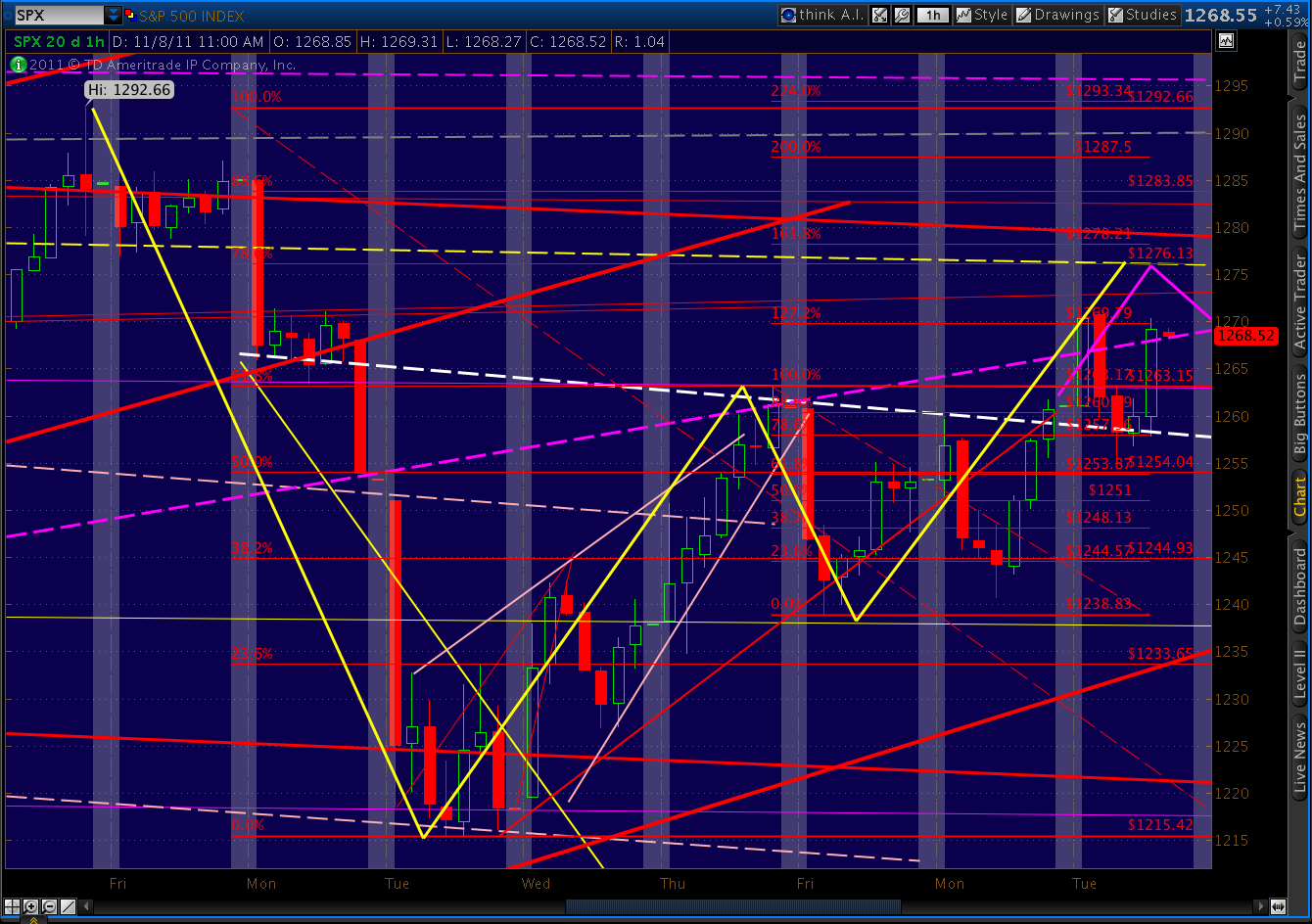
    And the 60-minute.

    UPDATE:  10:45 AM EDT

    As I mentioned in yesterday’s post, the last two times the US PMI came in negative like this were May 2 (the 1370 high, prompt reversal) and June 2 (a 31-point decline in SPX.)

    The Eurozone PMI report came in even worse than the US.  It’s worth a read.

    UPDATE:  10:10 AM EDT

    The ISM Manufacturing Report on Business came in every bit as negative as I expected.  The PMI is at 50.9, a 4.4 point decrease and well below the 54 the market expected.  It totally negates June’s increase.  The breakdown:

    Import/export activity was up slightly.  Every other category fell off, indicating a slower rate of growth, or outright contraction.  New orders contracted for the first time since June of 2009.   And, backlogs and customer inventories are contracting at a faster rate.

    The 50 point level is the division between growth and contraction, so the index still represents a slightly positive outlook.  But, the trend is clearly moving down again, indicating a contracting economy in the very near future unless something dramatic happens on the upside.

    Here’s a link to the full report.  The non-manufacturing report is due out Wednesday morning.

    ORIGINAL POST:  July 31, 2011

    Looking ahead, here’s a comparison of the USD/CHF vs ES reaction to the debt ceiling “news”…

    More later.
  • Random Thoughts While Awaiting Certain Doom

    While we’re all waiting for our heroes on Capitol Hill to ride in on white horses…

    FRIDAY

    Friday’s market proved, once again, the power of harmonics.  While I, and seemingly everyone else, was watching the 200-day moving average (1284.27) for a bounce, it was a Gartley pattern and a fan line that proved the more accurate forecasting tool.

    Here are the two Gartley’s I was watching:

    Pretty well drawn, except for the false start back at the end of June.  The .786 retrace completion, or D point, is at 1279.13.

    From the other apparent starting point, D is at 1282.90.  The actual low for the day was 1282.86.

    Normally, I look for a bounce of .618 of the DC leg from a Gartley pattern.  This would indicate an upside with potential to 1321.84.

    And, the fan line?  Take a gander at the yellow dashed-line.  It starts at the Nov 30 low and tags the Jun 15, 16, 24 and 27 lows.

    Here’s a close up:

    I normally consider Gartley targets pretty reliable.  But, under the circumstances, I gotta say it’s anyone’s guess how far and how fast the next couple of days go.  I believe we’re still under the influence of the 2007 pattern, but this debt ceiling matter will clearly determine the direction and magnitude of at least the next few days.

    LOOKING FORWARD

    If we get positive news on the debt ceiling, look for a relief rally that’s proportional to the perceived quality of the news.  I expect it to be a crock, providing no real cost savings or revenue increases. But, that doesn’t matter.  What really matters is how well TPTB sell the deal as the key to our salvation.
    It appears as though S&P; has folded in the face of what was probably unbelievable pressure from the government.  So, we’ll get a slap on the wrist rather than actual downgrade.  Moody’s and Fitch will probably fall in line.

    It’ll be interesting to see how the economic data shakes out.  ISM is scheduled to report at 10 AM.  The last two times they reported negative news, the market tanked.  On May 2, they reported the April PMI at 60.4, down from March’s 61.2.  It confirmed the downtrend that started with the previous month’s report.  May 2, of course, marked the top of the current pattern and the start of a 112-point decline in stocks.

    On June 1, ISM reported a PMI of 53.5, well below the previous month’s 60.4.   The 31-point decline was the worst of 2011.   I have no secret source inside ISM, but I have gone back and read the last few reports.

    The only “good news” the past two months has been the pickup in activity due to inventory buildup.  You could look at this as positive and represents increasing demand.  Or, you could look at it as a sign that purchasers jumped the gun, mistakenly believing demand would return.  I’ve included the breakdown from the past two reports below FYI.

    Also, here’s a look at the global picture.  It appears there’s a pretty good chance of a decline below the neutral reading of 50.

    LOOKING BACK

    Last, I’ve spent most of the weekend in the Wayback Machine, considering what really happened in the Great Depression that isn’t widely known these days.  Maybe I learned this back in college and have forgotten it, but I found it interesting that a real estate crash preceded the Great Depression.  Really.

    In “Securitization in the 1920’s“, William Goetzmann and Frank Newman of Yale describe a real estate market run amok, much like the early 2000s.  In New York, for instance, more skyscrapers were built (235) than in any 10-year period ever.   Many were financed with bonds, offered in denominations as low as $100 and offering interest rates of 4-7%.  Interestingly, the coupon payments were often paid in gold — as it was considered an excellent inflation hedge at the time.

    Annual issuance grew from about $58 million in 1919 to $696 million in 1925, representing 23% of total corporate debt nationwide.  The market peaked in 1928, falling over 75% by 1933.

    The stock market tanked after the crack in the real estate securities market, as is clearly demonstrated by the following graph:

    If I get really ambitious, I’ll put together a comparison of like spreads for the past 10 years.  But, I think I know what it will look like.

    Sure makes me wonder about that uptick in subprime loan delinquency rates in the first quarter…

    Additional ISM data:

  • Just made an interesting discovery, that led to an even more interesting discovery.

    I’ve been watching the VIX calls, and in fact am very happily invested in the August 25’s at .50.  Last night, someone pointed out that the in the money calls were trading below intrinsic value.  A few minutes ago, with the index at 25, the August 20 calls were only trading at 3. 

    Strange, because arbitrageurs would normally not allow such a gap to exist.  I talked to a trader friend of mine and, it turns out, VIX options trade off VIX futures.  I’m not a futures trader, so I have to admit I didn’t know VIX traded in the futures markets. 

    But, it makes sense.   With the cash index at 25 earlier today, the close-in futures contracts were about 3 points lower:

    Aug 16:  21.60
    Sep 21:   21.65
    Oct 18:   22.40

    I can’t get VIX futures on TOS, but CBOE has a quote webpage.   Interesting, right?

    But, that got me to thinking.  What do futures traders know that I don’t?   If futures prices are lower than cash, that reflects an expectation that prices are going lower.  What about the big move down, the start of the next bear market, P[3], financial Armageddon, etc…

    I decided to make a chart, looking at the premium/discount paid for futures prices vis-a-vis the cash market and SPX.  This might be an interesting indicator, right?

    I didn’t have to.  Turns out the nice folks at CBOE already did it.   They even covered the time period I’m most obsessed with interested in.  Take a look.

    The green line indicates whether the futures are trading at a premium (above the line) or a discount (below the line) to the cash index.  ATL would indicate an expectation of increased volatility.  BTL would indicate an expectation of decreased volatility.

    Note how the discount/premium lines up with the blue line above, representing the SPX.   In the above chart, we can see how the futures premium generally increases from early November into late December as SPX declines, then recovers to make some lower highs.  They move inverse to one another, which is to be expected.  A declining market should generate higher volatility premiums.

    But, look what happened after that interim high (Dec 27).  Even though the market drops pretty steadily, the VIX premium marches right along with it — no longer inverse.

    Even though SPX had dropped from 1576 to 1406 in 31 trading days, that 170-point drop was all but forgotten when SPX rebounded by 92 points in 21 days.  Investors figured the market had reached the bottom of its trading range and was making the next leg up, when in fact it was a corrective wave setting up for a new low.
     
    VIX futures dropped to a big discount to the cash market starting on 12/26/07, just as the market began a decline that would total 228 points in less than a month.