Year: 2019

  • Analog Watch: Jul 15, 2019

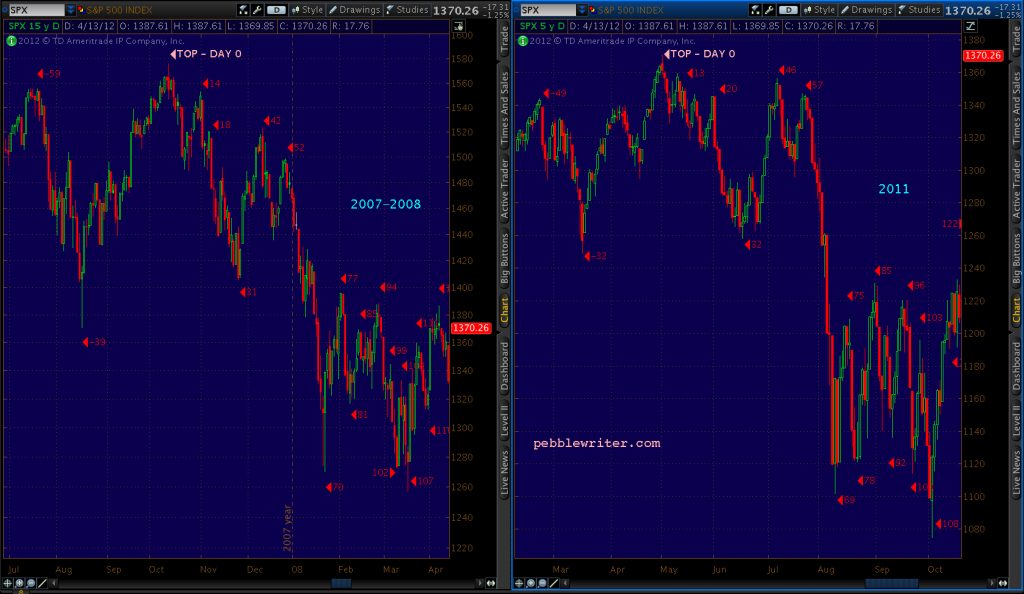
    We’ve only done five analogs over the years.  One worked out spectacularly, three were fairly accurate, and one just plain fizzled. Ideally, an analog provides exceptionally accurate forecasts of a very significant move.  I think this could be one of those and that stocks are on the cusp of the biggest drop since the Great Financial Crisis.

    For more on analogs, click here.

    continued for members(more…)

  • Why Interest Rates Must Not Rise

    In May 2014 many of us were shocked by a report that Ben Bernanke, who had recently departed the Fed, told a group of wealthy investors that he did “not expect the federal funds rate…to rise back to its long-term average of around 4%” in his lifetime.

    I remember feeling Bernanke’s statement represented both extraordinary hubris and wishful thinking. Surely, the trillions being pumped into the financial system would drive inflation to levels that would produce higher rates.  After all, I reasoned, the bond market isn’t as easily manipulated as is the stock market.

    Last year, I called attention to the fact that the cost of servicing the US debt had broken out to new highs [see: Why Rising Rates are a Problem This Time.]  Even though interest rates had fallen dramatically, the spiraling debt had send annual interest expense on that debt to roughly $450 billion in FY 2017.

    Bernanke’s 2014 words came back to me as I did the math.

    Clearly, if rates were to normalize the interest expense would be unmanageable… Between 2000 and 2007, the average interest rate was 4.84%.  On the current $20.6 trillion balance, that would mean an annual interest expense of roughly $1 trillion.

    Of course he was confident in his prediction!  He understood that rates could never be allowed to rise.  A return to normalcy — and, I don’t believe this to be an exaggeration — would absolutely destroy the economy.

    I had always found the Treasury’s increasing dependence on short-term, floating rate and inflation-indexed borrowings a bit unsettling. Why not lock in a boatload of 30-yr bonds at 2.1%?  Now we know.

    In their wisdom (or desperation…time will tell) the central bankers and those maxing out America’s Gold Card have bet our very futures that Bernanke was right — that everything will be okay in the end…as long as the end never gets here.

    By the way, here’s an update of the above chart…which has been appropriately renamed.


  • The Inflation Problem

    It’s great sport to criticize the Fed for what seem like bone-headed moves. Yesterday wasn’t one of them. What Powell knew and rest of us had guessed was that June CPI was headed significantly lower and would continue to widen its divergence with core CPI.While the futures were ramping higher thanks to Powell’s dovish prepared remarks (which were conveniently released prior to the open)… …few stopped to question why the Fed should ease amidst the most accommodative monetary conditions since 2013.

    The fact is that Powell was boxed in.  Everybody knows that the official inflation data woefully understates actual inflation.  This comes in handy when trying to keep a lid on interest rates — a necessity when you’ve got $22 trillion in debt and a $1 trillion budget deficit.

    But, even flawed CPI is an important signal.  It goes a long way toward explaining why oil and gas prices magically decline every time inflation starts to get out of hand……and inflation magically declines every time interest rates threaten to get out of hand.

    Put them together and RBOB’s 42% Oct-Dec 2018 plunge (which began only 2 days prior to the 10Y topping out) suddenly makes a whole lot of sense.Unfortunately, understating inflation is not convenient at all when investors start worrying about deflation — as the current interest rate environment suggests they do.

    Trump & Co. say they want low interest rates and a cheap dollar. Plunging oil and gas prices are the best way to get there. The latest CPI print at 1.65% is testament to how well the mechanism worked.  Score one for the White House.

    Sure, the trade war, real estate bubble and rising health care costs are bumping Core CPI higher.  But, the average voter couldn’t tell you what “CPI” stands for, let alone the difference between the various inflation measures.  And, the average investor only cares about inflation if the Dow should happen to slide more than a few percent which, if it occurs, is easily negated by a breathless update on the excellent progress of the trade war negotiations.

    Bottom line, the Fed would face heavy criticism if they stood pat with CPI at 1.6% and falling.  The White House is no doubt well aware of this, and is also well aware that YoY comparisons will be pressured by oil and gas’s recent rallies — particularly when October arrives.

    This is why oil and gas prices are very unlikely to continue to rise — as the charts confirm.

    continued for members(more…)

  • Powell Placates

    Powell’s prepared remarks, released in advance of his testimony before the House Financial Services Committee, confirmed the FOMC is likely to deliver a 25 bps rate cut at the end of the month.  This is what almost everybody demanded expected, so the algos have found their happy place.

    S&P futures, which lagged all night, are currently showing a 24 pop off the overnight lows — nearly enough to send the cash index to new all-time highs.continued for members(more…)

  • Be Careful What You Wish For

    Who’s in charge of ‘splaining things to the prez?  Trump says he wants a cheaper dollar so the US can be more competitive in global trade.  Yet, because the US is a net importer, a cheaper dollar will simply increase the cost of imported goods (just like tariffs.)

    The net effect will be higher inflation which will in turn make it that much less likely for the Fed to lower interest rates — a frequent topic of Trump’s tantrums.

    Sometimes interest rates and the DXY play nicely; sometimes they don’t.  Rates have already settled quite a bit lower even as the dollar edges slightly higher.

    Perhaps Larry “King Dollar” Kudlow should also explain to Trump that a breakdown in the dollar (the dashed red trendlines) is sometimes detrimental to inflated stock prices — a frequent topic of Trump’s boasts — while a breakout (the purple TL) can be very positive.And, while it’s possible Powell can be intimidated, who among us would be surprised if the Fed ignored the next opportunity to cut rates — no matter how justified — in order to send the message that they won’t be bullied?

    Futures are edging lower as the SMA10 edges higher, setting up the another test of the first line of defense.Speaking of tests, we should find out today how much support DB can expect from the ECB et al.

    continued for members…
    (more…)

  • Deutsche Bank: Kann Dieses Schwein Pfeifen?

    There’s a lovely English figure of speech which suggests the ridiculousness of something happening: “when pigs fly.”  In German, the same sentiment can be expressed by the expression “ich glaub mein Schwein pfeift” which means “I believe my pig whistles.”  DB is surely trying, but it’s having a hell of a time whistling a happy tune.

    We last visited the stock on March 13 [see: When Push Comes to Shove] when it was threatening to break out of a small consolidating triangle after breaking down below our previous short signal at 11.  From the Mar 13 post:

    A breakdown from a falling channel is incredibly bearish, but a move back above the bottom of the falling channel (around 9.50) would be net positive. To get there, it will need to break above the red TL and will then face its SMA200, now at 10.32.

    A long position with very tight stops would make sense for those willing to roll the dice. However, if it can’t retake the channel bottom, then it remains a dead bank walking and a good short.Obviously, shorting it in the hopes that the ECB lets it fail would entail some risk. No doubt the ECB is trying to figure out a way to restructure it in such a way that it’ll survive and, ideally, not take the rest of the world down with it. Until then, I think it’ll remain on life support.

    As it turned out, the triangle broke down and not up.  The stock spent 6 weeks being propped up around $8/share before finally breaking down again and shedding 28% in a nifty little falling channel.

     * * *
    Deutsche Bank has been a terrific source of trading ideas which have paid off nicely
    over the years.  While the stock has lost 32% since our initial forecast in Sep 2016, our
    long and short trade ideas have totaled 237%. CLICK HERE for forecasts and results.

     * * *

    It finally bottomed at 6.49 in June and bounced back up above 8 where it collided with overhead resistance and is currently backing off in the wake of the latest restructuring news.

    Make no mistake about it, DB is in a world of hurt.  Given that it’s the 15th largest bank in the world with over $40 trillion in derivatives, its demise could devastate the financial system.  Can this pig whistle?  If so, is it just whistling past the graveyard?

    continued for members(more…)

  • Turn About: Fair Play?

    Since the market rallied 170 points on May’s dreadful 75K jobs report, should we expect it to give up those gains on June’s stellar 224K jobs report?As we approach the open, we can see that sort of logic working its way through the futures.  It might not be quite as easy for the Fed to justify any rate cut in July, let alone a 50 bps cut.

    continued for members(more…)

  • Algos to VIX: Thank You for Your Service

    When USDJPY, WTI and TNX all plunge, stock prices almost always follow suit.  When they don’t, it’s usually because VIX is signaling the algos that there’s nothing to worry about.

    It’s no surprise, then, that the three equity breakouts (the purple, gray and white channels) we’ve seen over the past month have all been precipitated by breakdowns in VIX.

    It’s particularly common on weekends and during low-volume holiday weeks and is frequently contrary to the economic news of the day.

    continued for members(more…)

  • Charts I’m Watching: Jul 2, 2019

    The breakout fell flat, yesterday.  ES might have closed 26 points off the ramp highs had VIX not performed its usual theatrics.  Futures are essentially flat this morning as we await Fedspeak from Williams (centrist) and Mester (hawk.)  Despite nearly unanimous expectations for a rate cut in July, most of the recent such comments have tilted hawkish.Will today’s comments support the prevailing view? I’m not so sure.  And, I’m not so sure it matters that much.  The 10Y continues to cling tenuously to 2%.continued for members(more…)

  • Here We Go Again

    The August 2018 new all-time highs lasted five weeks and, when they failed, yielded a 600-pt plunge.  The May 2019 new all-time highs lasted about 6 hours and yielded a 225-pt plunge when they failed.  The June 2019 new, all-time highs lasted 3 days and yielded a 51-pt decline before staging a recovery that will (coincidentally, I’m sure) see new highs posted on this morning’s open.

    Perhaps the trade war really will be resolved this time. And, maybe OPEC really will ink a new trade output deal. Heck, the Fed might even cut rates even though markets are at all-time highs.

    All I know is that while chasing new highs on the back of VIX “breakdowns” and oil “rallies” has worked out fine for buy-and-hold types (who have no fear of the music stopping), it has been a losing proposition for traders.

    continued for members(more…)