
Month: September 2015

  • The Cost of Central Banks’ Protection

    wildfireWildfire is a common occurrence in  many parts of California.  But, unlike earthquakes, mudslides and bad plastic surgery, The Powers That Be seem to feel they can prevent it.

    If you live in fire country, you’re awfully glad that Cal Fire is quick to respond when things go south.  In financial terms, it’s like having a protective put.

    Long before Man arrived on the scene, however, Mother Nature had her own way of responding to periodic wildfires: let ’em burn until the available fuel was consumed and/or a timely downpour came along.  And, it wasn’t necessarily a bad thing.

    The negative effects of wildfires are often outweighed by ecological benefits such as the removal of non-native plants and insects and the release of nutrients from older vegetation into the soil to support new growth.

    And, there’s a bonus.  If much of the dry, combustible underbrush is consumed by periodic smaller fires, the next wildfire won’t be anywhere near as bad.

    The economy is much like nature in that downturns are both natural and cyclical.  As any econ student knows, business cycles entail periods of expansion and contraction, punctuated by peaks and troughs.

    business cycleThroughout modern history, financial wizards have tried various methods to prevent or at least smooth out the peaks and troughs (especially the troughs.)  But, the real economy rarely cooperates.

    For starters, excess optimism and pessimism are baked into human nature — both the cause of and the antidote for one another.  Behavioral yin and yang, if you will.

    And, there’s also what could be called the “wildfire principle.”  When a central banker acts to prevent the occasional financial wildfire, the cycle might be delayed or interrupted — but, not eliminated.  And, delaying or interrupting it is likely to only make the next one worse.  As we discovered (but, have apparently forgotten) in the last financial crisis, prices do eventually revert to the mean.

    Even along the way, the negative effects can greatly outweigh the benefits.  When the Fed forced “risk free” interest rates to historically low levels, for instance, they increased the present value of streams of cash flow (earnings, dividends, rents or whatever.)  This ratcheted up the price of things without increasing their utility (i.e. created asset bubbles.)

    And, by rendering bonds relatively useless from a cash flow standpoint, central bankers encouraged investors to pile into overpriced assets without regard to the historical risks.  They’ve even taken extraordinary steps to reassure investors that these assets are risk free.  It’s the equivalent of building wood-framed houses on fire-prone prairies and then offering interest-free loans and move-in specials.  What could go wrong?

    Yen Carry Trade PicturePerhaps the most egregious example of central banker interference has been the yen carry trade [see: Yen Carry Trade Explained.]  I believe most of equities’ gains since 2011 are attributable to this effective, but ill-advised scheme.

    Large investors can borrow in yen at near 0%, invest in equities certain to rise, and repay their  debt with yen guaranteed to have declined. It works because the BoJ has been willing to ignore the negative effects on the Japanese people in order to keep stocks rising.

    Like a forest that never burns, Nikkei 225 has gained about 140% since its Fukushima lows.  The chart below shows how QQE and stock purchase programs extinguished various flare ups along the way, while the falling yen (rising USDJPY) essentially acted as fertilizer.  [Note: the BoJ and GPIF purchase stocks directly and are currently the largest shareholders of Japanese stocks — amounting to $666 billion, about 14% of Japan’s GDP and the NKD’s market cap.]

    2015-09-22 NKD BoJ Intervention Notes

    After such rapid, uninterrupted gains, the Nikkei was an ideal target for arsonists.  But, the BoJ kept it growing by: (a) constantly debasing the yen; and, (b) buying every dip that came along.  So, it’s no surprise that, nearly a year after QQE and USDJPY flatlined, NKD has actually lost value.  If USDJPY ever actually suffered a meaningful decline, the gains of the past four years would no doubt go up in smoke.

    The FOMC’s recent non-rate increase was evocative of the BoJ’s behavior.  In a stunning impression of a forest that should have been thinned long ago, Yellen & Co. deemed a 1/4% increase in the Fed Funds rate too great a threat!

    Furthermore, the Fed — like the BoJ — has been fundamentally deceitful regarding its reasons for holding rates near zero for over seven years.  It has nothing to do with reaching a desirable rate of inflation (if it ever did.)  There’s plenty of inflation to be found if it were properly recognized and acknowledged.  The reason is much more straightforward.  We can’t afford it.

    The US spent seven long years landscaping its economy, budget and stock market with unnaturally low rates.  A return to normal rates now would bankrupt borrowers who built business plans around ZIRP and slash the value of investments whose prices are based on cash flow.

    It would also triple the US’s annual interest expense, boosting it from last place to third in the race to waste the most taxpayer money.Screen Shot 2015-09-22 at 8.53.58 PM
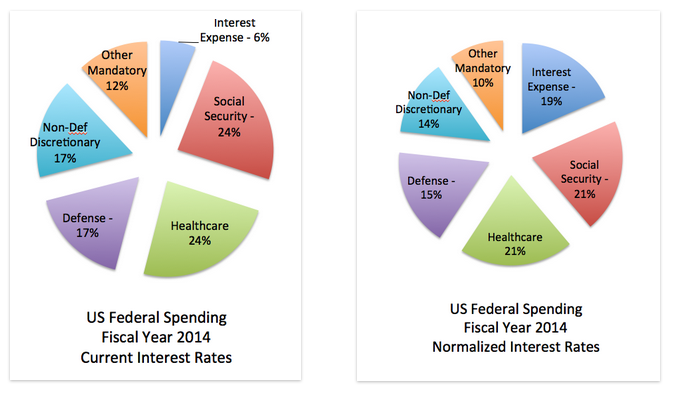
    As the Fed Governors so aptly demonstrated last week, it’s probably too late to attempt a controlled burn. Their only choice, now, is to remain hyper-vigilant, hoping against hope that the ultimate reversion to the mean won’t come during their tenure.

    The hapless ECB is content to sit in Franfurt with their fingers crossed, secure in the knowledge that while they don’t know how to fix the euro zone’s problems, no one else does either.  Their trillion euro experiment has produced negative interest rates, which allows overindebted countries to continue to appear solvent.  But, they’re not really fooling anyone.  Like Japan, only ECB-funded banks and the ECB itself are buying those bonds.

    The BoJ, after watching 2015’s gains go down in flames over the past three weeks, will no doubt throw more fuel on the fire in the form of expanded QQE and/or additional yen debasement.  In fact, since last March [see: A New Analog], my market forecasts have presumed that TPTB would tank stocks if necessary in order to “help” the BoJ make the right decision.  They’re in an equity trap of their own making.

    The late-August conflagration was a good start.  The flames currently racing towards us just might do the trick.

    Stay tuned.


  • Currencies Continue to Rule

    The big story around here yesterday was NKD, which nailed our downside target and dutifully recovered into the close — only to fall back below it in the after hours as USDJPY dipped even further.

    It provided great guidance for a short position that delivered some nice gains, and for the long position after the bounce.2015-09-23 NKD 60 0612With USDJPY back above its .618, futures are back in the green.  Even the EURUSD had a nice bounce. But, are “markets” really out of the woods?

    continued for members(more…)

  • USDJPY Strikes Again

    Ignore the headlines.  If you’re looking for something to blame for this morning’s sell off, look no further than USDJPY, which has once again stumbled at the all-important .618 Fib at 120.11.2015-09-22 USDJPY daily CU 0600It’s easy to see from the chart above that every time USDJPY pops up above 120.11, ES rallies.  Every time it drops below, ES declines.  This morning, it even put in lower lows after registering a lower high than yesterday.  With any other financial instrument, we’d call that a trend.  With the tightly managed USDJPY, it’s more of a tool.

    Yen Carry Trade PictureSo, why the inability to decisively retake 120.11?  What’s the end game?  As regular readers know, most of the “market’s” gains since 2011 have been driven by the yen carry trade.  If the yen doesn’t keep dropping in value (USDJPY gains in value) then the bull market is over.

    So, the question remains, what will it take for the BoJ to keep bashing the yen — especially as negative political repercussions continue to rise?  For the answer, we turn to another important chart, the Nikkei.

    The Nikkei 225 is nearing an important trend line of support that we’ve been watching.  If it bounces off that TL and continues northward, all is well.  Kuroda and Abe can go back to fleecing the Japanese people in the knowledge that their phoney baloney jobs are safe.  But, if it plunges through that TL…well, that might be just what carry traders need in order to get the BoJ off its keister.

    Could it happen?  And, more importantly, would it work?  As we discussed in our last update on the Nikkei [see: Update on Nikkei, Sep 10], it might just be the pivotal moment for the bulls.

    continued for members…

    (more…)

  • Will BoJ Rescue “Markets” Again?

    Reuters reported over the weekend that the BoJ was “brainstorming” an overhaul of its massive QQE program.  Given that equities have been sliding ever since USDJPY’s rising trend was broken in mid-August (the white arrow, below), I’d say the term “brainstorming” doesn’t convey near enough desperation. 2015-09-21 USDJPY daily 0600As the article points out, the BoJ now owns 25% (some say 30%) of all JGBs.  It’ll be 40%+ in 2016.  And, given that most banks, insurers and brokers are required to hold JGBs for collateral purposes, one can easily envision a shortage of bonds for QQE.

    What the article doesn’t mention, however, is the BoJ’s massive and growing position in equities.  Along with the GPIF, it amounts to around 18% of Japan’s GDP.   It’s hard to imagine them throwing a huge leveraged bet like that under the bus on a technicality like what’s eligible collateral under the QQE guidelines.

    Yen Carry Trade PictureAnd, let’s remember that it isn’t the growth in money supply per se that’s propping up stocks.  It’s the money directed at equity purchases and, more importantly, the ongoing yen debasement that fuels the yen carry trade.

    The BoJ and others are very adept at manipulating the USDJPY — down to .01 moves when need be — in order to keep the carry trade alive.  But, at some point, it’s going to be pretty obvious to everybody that the USDJPY has gone nowhere since first tagging the yellow .618 at 120.11 on Dec 4.

    However they accomplish it, BoJ has to hammer the yen lower or face the consequences of its inaction.  On Dec 4, NKD closed at 18,105.  Nine months later, with USDJPY still lingering near 120.11, NKD is trading at 18,060.  The 3,000 point (16%) rally in between is a rapidly fading memory.

    Brainstorming?  It’s more likely that BoJ is mapping out the exact time and place for USDJPY’s next leg up.

    continued for members(more…)

  • Unintended Consequences

    With the prospect of higher rates off the table for now, the US dollar has suffered a bit of a body blow that has translated into relative strength for the euro and the yen.  It is the yen strength that is problematic for equities, as the yen carry trade relies on an ever weakening yen.

    2015-09-18  DX daily 0600continued for members(more…)

  • Assume Crash Position?

    Screen Shot 2015-09-17 at 6.10.38 AMIf there’s one thing we’ve learned from the FOMC over the past 7 years, it’s that they care more about equity prices than anything else.  Anything.

    So, it makes sense to question whether they’d risk it all by raising interest rates 1/8-1/4%.

    The BoJ didn’t help matters by punting on an QQE expansion earlier this week — leaving the yen carry trade in limbo at the moment.  Knowing what’s at stake should it unwind, this leaves the Fed somewhat more likely, IMO, to hazard a small hike.

    This is counter to everything I’ve been expecting for months, and completely contrary to the original intent of our USDJPY analog.  But, obviously last month’s dive to almost the .886 Fib was neither deep nor persistent enough to induce Abe/Kuroda to endure even more ridicule (if that’s even possible.) Maybe they need a little more convincing?

    continued for members(more…)

  • But, The Emperor Has No Clothes!

    Emperor-Has-No-ClothesIn the classic Hans Christian Andersen fable, a self-absorbed emperor parades through town in a suit made by two swindlers of “magical fabric” that is supposedly invisible to the stupid or incompetent.

    Not wanting to be seen as stupid or incompetent, everyone gushes about how beautiful his suit is — that is, until a child cries out the obvious: “but, the emperor has no clothes!”

    I can’t help but think of this story every time I see Abenomics mentioned in print, but not for the reasons one might imagine.  In my minds eye, I see Abe and Kuroda as the two swindlers — spinning magical economic policy into a non-existent recovery.

    Earlier this morning, S&P finally cried out what a few of us have been saying all along: Abenomics isn’t working, and it is unlikely to work.  Japan was downgraded all the way from AA- to A+ (hey, it’s a start.)  And, in a statement that would only make sense in a fairy tale, they pronounced Japan’s outlook “stable.”

    The S&P press release came out at 5:47 ET, so naturally at 5:47 the Nikkei futures dropped a massive (sarc) 0.245%, regaining 0.547% over the next 2-1/2 hours.  2015-09-16 NKD 1 0622Currency traders at the BoJ, having obviously already been tipped off, actually made sure that the yen strengthened after the announcement (the white arrow), then continued the weakening which is essential to the yen carry trade’s effectiveness.  2015-09-16 USDJPY 1 0633Ironically, it strengthened much more when this morning’s US economic data hit a few hours later (the yellow arrow.)  The e-minis (in purple) declined all of 4 points in sympathy, but added back 8 points as USDJPY “recovered.”

    The “market” might be manipulated, corrupt and very much rigged, but it’s not stupid.  The downgrading, the continuing economic malaise in Japan and the US, all point to one thing: more magical fabric!

    continuing(more…)

  • Update on COMP: Sep 15, 2015

    COMP has been one of those nonsensical indices that — just when you thought it was finished — always found a way to make new highs.  That was, of course, until August rolled around.

    It broke down through every element of support we discussed in our last update: the rising wedge, the red TL, the 2007 high, and even the .886.  Most importantly, the red channel which has guided its incessant rise since 2009 finally gave up the ghost.

    continued for members(more…)

  • Plenty of Shadow

    haru groundhogAccording to folklore, if a groundhog emerges from its burrow then a spring thaw will come early.  If, instead, it sees its shadow, it’s scared back into its burrow and winter will continue for another six weeks.

    Yen Carry TradeHaruhiko, the carry trade groundhog, poked his head out of his burrow last night, saw the strikingly bright light of futile, failed policy, and quickly withdrew.  There will be no more QQE (at this time) to thaw the market’s recent freeze.

    Although the yen can and has been heavily manipulated without QQE expansion, it’s been a key component of the carry trade since 2011.

    USDJPY traded as low as 119.39 before the intervention arrived, boosting ES by 6-7 points in the hour after dismal retail sales and Empire Mfg numbers raised “bad news is good news” hopes that the Fed won’t also disappoint.

    Screen Shot 2015-09-15 at 6.06.27 AMBut, the bottom line is that it’s now up to the FOMC to prevent an extended winter for stocks.

    continued for members(more…)

  • Update on RUT: Sep 14, 2015

    RUT overshot the large white channel top for most of the past year, dropping back below it in late August when the rest of the “markets” took a pause.  Note, however, that the yellow channel top never was exceeded.2015-09-14 RUT big weekly 2000

    As we noted at the time, the smaller white acceleration channel broke down.  But, RUT climbed alongside its belly rather than react as indices normally would.

    2015-09-14 RUT weekly 2000The late-August plunge changed things.

    continued for members(more…)