
ORIGINAL POST: 4:15 AM
Whether driven by fundamental constitutional considerations or a keen awareness of the implications for their pensions, the German Constitutional Court granted the German government conditional approval to throw good money after bad. How conditional?
Germany’s ESM share will initially be capped at EUR 190 billion. As Germany is the only ESM participant with any meaningful extra cash laying around, this action turns Draghi’s bazooka into more of a pellet gun. It limits the ESM’s “unlimited purchases” of sovereign bonds. And, it waters down Draghi’s “whatever it takes” pledge to “whatever we can dig out from behind the sofa cushions.”
The markets immediately ramped on the news, but I suspect it’s only a matter of time before less bullish implications fully sink in.
The dollar sank slightly beyond our immediate target of 79.859, reaching 79.78 at the low so far. The next lower level of support is a .786 at 79.30 – 79.43.


The EURUSD tagged 1.2905, the 1.272 of the smaller of our two harmonic patterns.

There is substantial resistance at 1.2938, and then 1.3046.

More later this morning, including implications for stocks going into the FOMC announcements this afternoon.
UPDATE: 10:45 AM
The GCC’s decision practically guarantees more legal wrangling down the road. Thus, the ESM’s efficacy will most certainly be procedurally hampered. But, the larger issue is its size/composition.
As currently laid out, the fund will amount to EUR 700 bn. Consider, however, who’s putting up the lucre and when it arrives.
 As Mish reported in June, the EUR 700 bn is funded in 5 annual payments. For 2012, there should be EUR 140 bn with which to beat back the bond vigilantes. However, several of the supposed contributors on the list are also likely contributees.
How much can we expect from the likes of Ireland, Greece, Portugal and Spain? Subtract their EUR 25 bn 2012 share, and the ESM is left with EUR 115 bn. How long will that last, given that Spain, itself, is estimated to require upwards of EUR 300 bn?
Another fun fact: according to recent polls, 54% of Germans are none too happy about forking over hard-earned euros to support their spendthrift neighbors. Angela Merkel, who’s tied her political career to the preservation of the euro, is up for election next year.
Her party, the Christian Democrats, is already in the cross hairs, having lost control of Germany’s most populous state — North Rhine-Westphalia — to the Social Democrats in May. How well can she defend the ESM/ESFS’s actions when she’s watching from the sidelines?
More in a few.
UPDATE: 11:15 AM
Can’t escape the irony of the Libyan embassy attack, juxtaposed against the iPhone 5 announcement. While the risk of war in MENA escalates further (finger pointing at Gadhafi and Al Qaeda, there must be an Iranian connection) the financial world will celebrate the introduction of another shiny new toy. I wonder which will get more air time…
UPDATE: 11:30
So far, the market is reacting as we discussed earlier: not exactly ecstatic with the GCC news. SPX made it as high as 1439.15 before beginning a slow fizzle to almost breakeven. It’s currently up 4 and change.
 While waiting for the red-hatted ones to make their appearance last night, I had time to do a total reset on SPX. Every month or so, I erase all patterns on my charts and start with a fresh slate — just to see if I come up with the same conclusions.
Bear with me while I work through some fascinating long-term charts that have much to say about the market’s immediate future.
continued…
The basic idea was to look for repeating patterns. I started with one all-inclusive channel that dates back to the 1920’s and added corrective channels where appropriate. Remember, a channel is just two parallel trend lines. A channel system is 3 or more parallel trend lines. When I find many, many parallel trend lines, I am a very happy camper.
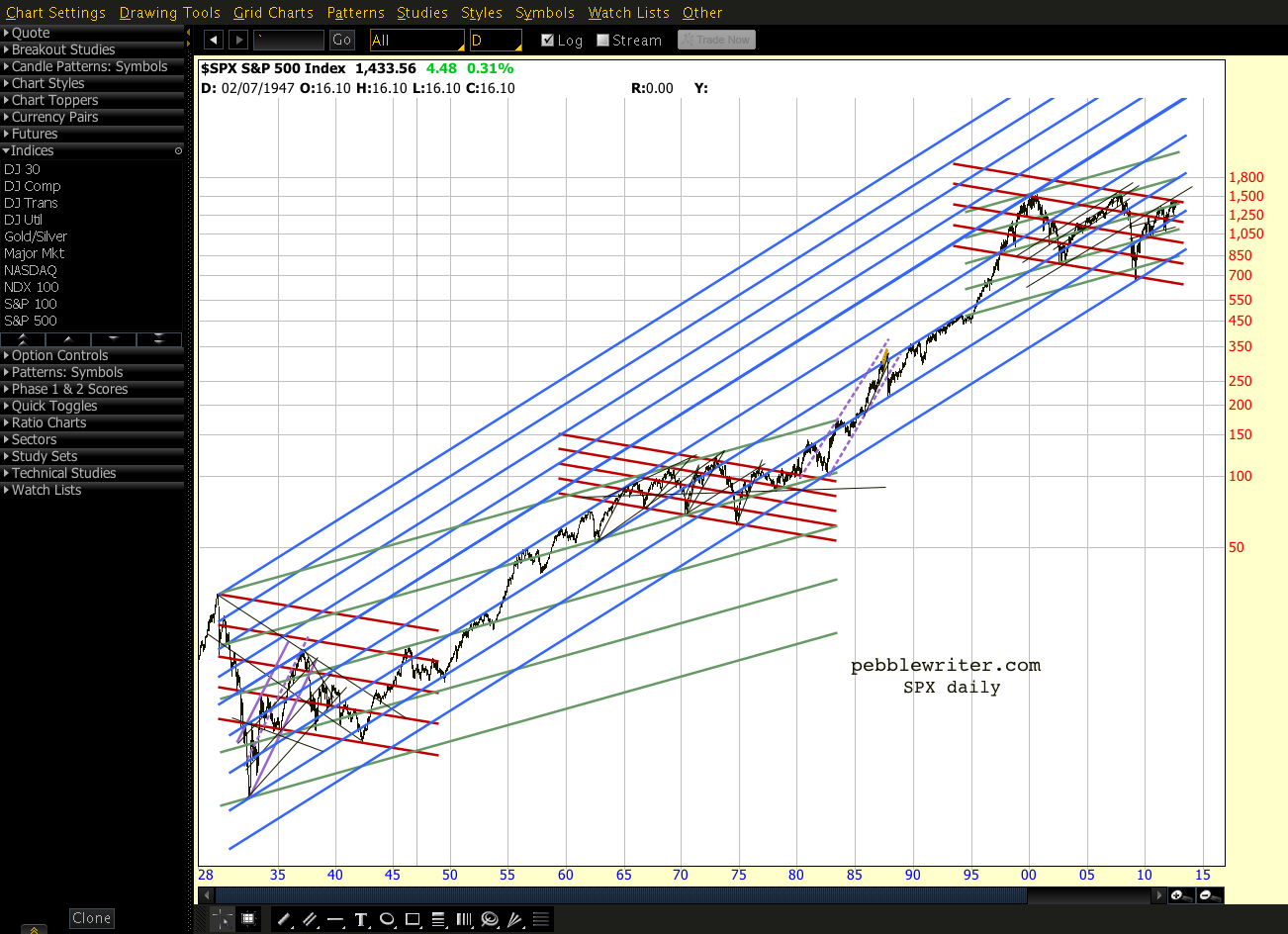 Prophet, which goes back to 1928 on the TOS platform, is very accurate. It took some doing, but my chart shows that only three primary channel systems have guided SPX for the past 84 years.
In other words, there were very few reversals that couldn’t be accounted for by one of the channel lines. I’ve sketched in enough channel lines to give the general idea, but if you zoom in tighter, you can see how smaller scale channel lines capture ALL the movements.
Consider the 1987 crash: 36% in two months. It bumps up above a blue channel line and reverses without any apparent reason. What happened?
UPDATE: 3:15 PM
In May of 1987, SPX hit one of the green channel lines and had a nice 9% correction. It based around 275 and started rebuilding. It put in a Point B at the .786 — at one of our solid blue channel lines in the chart above. It then retraced exactly 78.6 of the rise from 275, before it continued its climb toward what we would expect to be a Butterfly reversal at the 1.272 or 1.618.
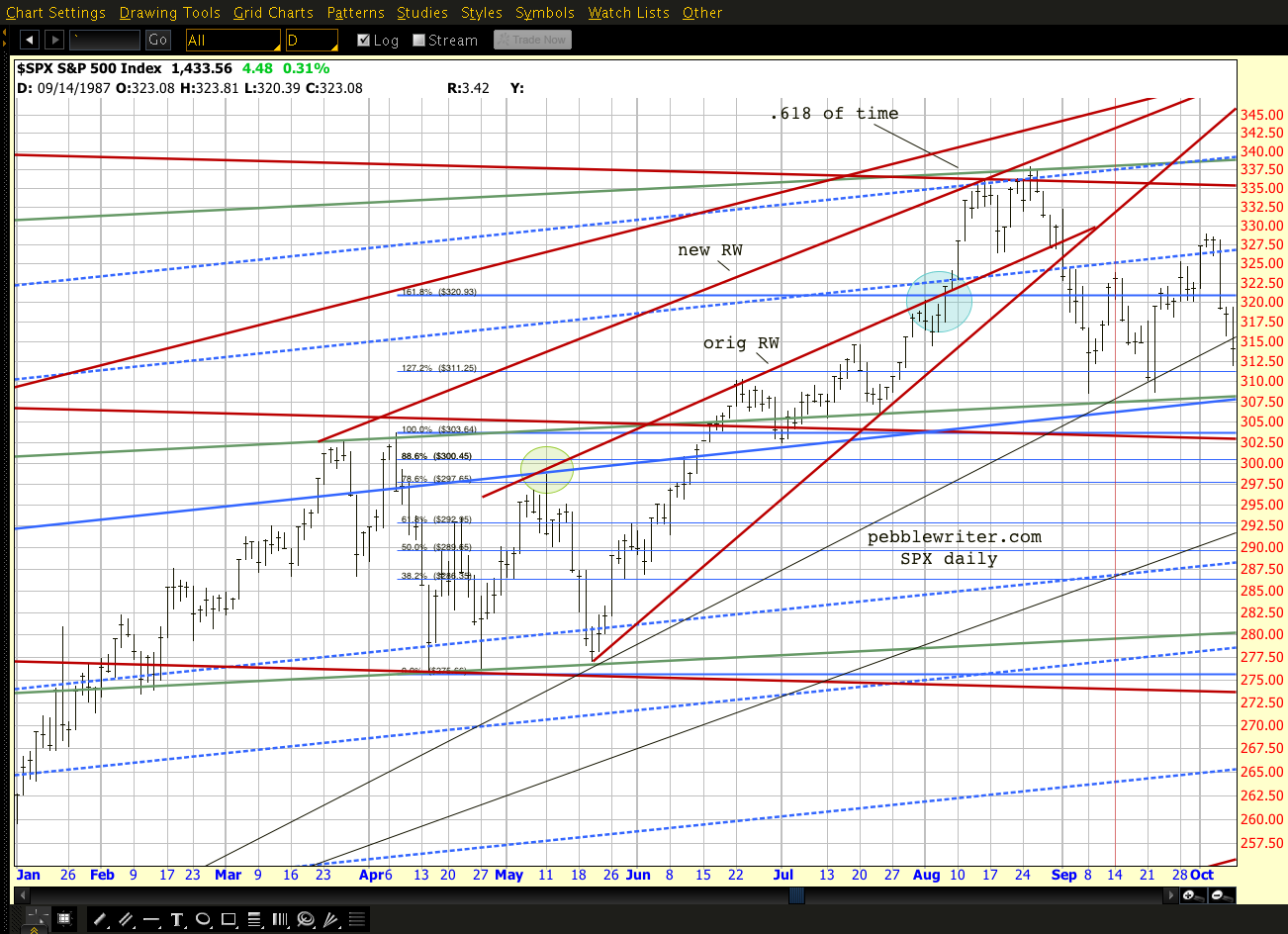
The correction at the .1.272 was a whopping 2.5%, back testing the solid blue channel line. It kept climbing. Six weeks later it peaked again very close to the 1.618, fleshing out what had looked like a well-formed rising wedge. Note the blue shaded area above.
For whatever reason, it reversed a lousy 6 points (2%) and zoomed up through the rising wedge bound and 1.618 to establish a new high. (when I have time, I’ll go back and research what happened on August 6, 1987.) In so doing, it reached the 2.240 Fib at 337.88 — where it promptly plunged 36%.
Here, it also met an important trend line — one slightly higher and parallel to the solid blue line it had just broken through and back tested at the .786. This was no ordinary channel line, though.
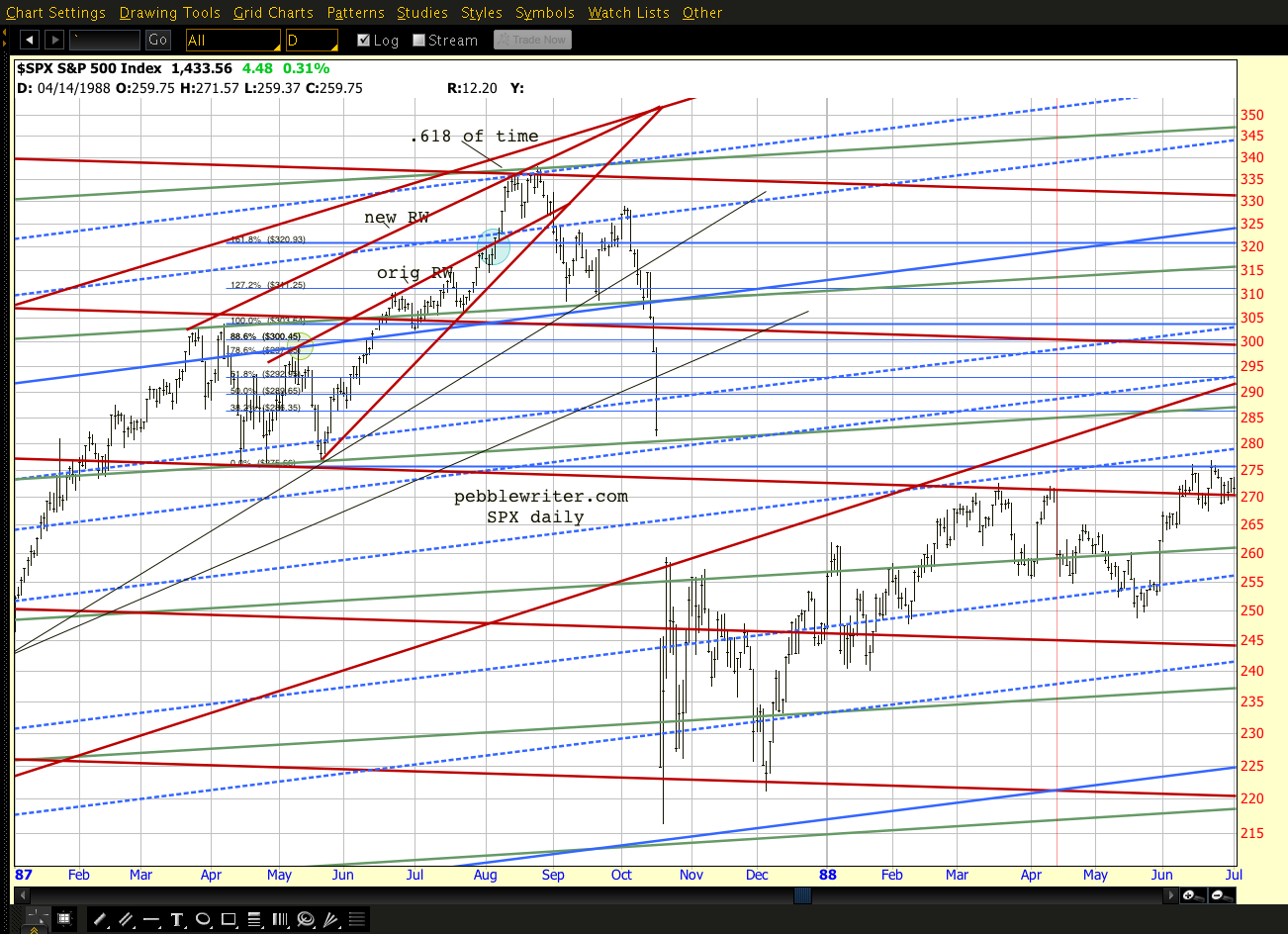 First, it happened to come along at the Fib 786 in price and .618 in time from inception to apex of the newly expanded rising wedge (which happened to feature an upper bound parallel to the previous RW’s.)
Second, this particular channel line had a reputation as a bit of a spoiler.
Here it is in 1973, when it smacked SPX for a 48% crash. I’ve taken the liberty of labeling it “Crash TL.” Notice the peak then was at the intersection of the Crash TL and a green channel line, and occurred at a Fib .786 of the rising wedge’s life span.
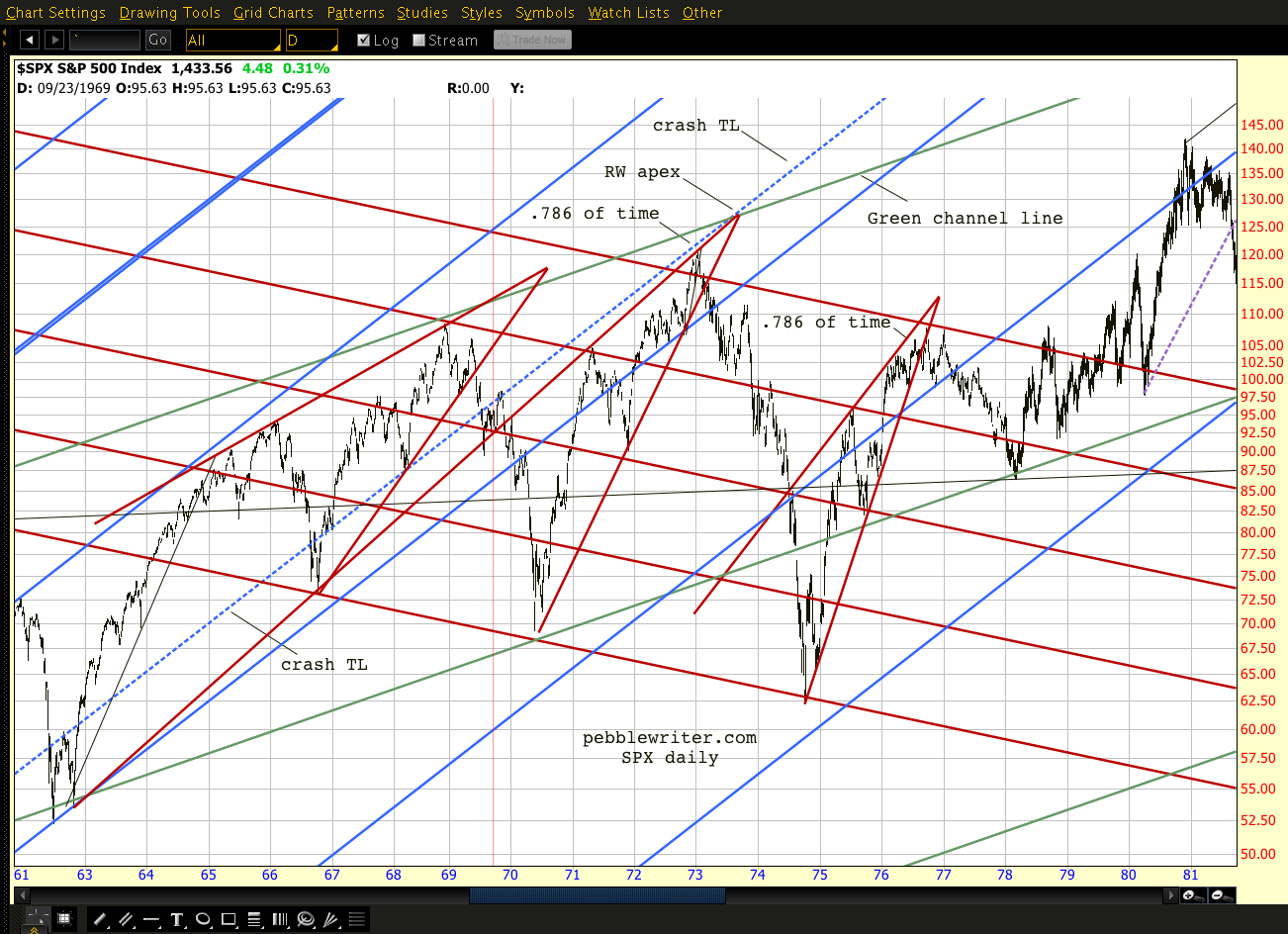
Even though SPX was working on a Crab Pattern targeting the 1.618 extension (having put in a .886 Point B), it was stopped just a tad beyond the 1.272 where the Crash TL was waiting for it. In fact, it didn’t reach the 1.618 for another six years.
It’s also worth noting that TLs parallel to the same three systems of channel lines, when sprinkled into the chart, did an amazing job of signalling every important move.
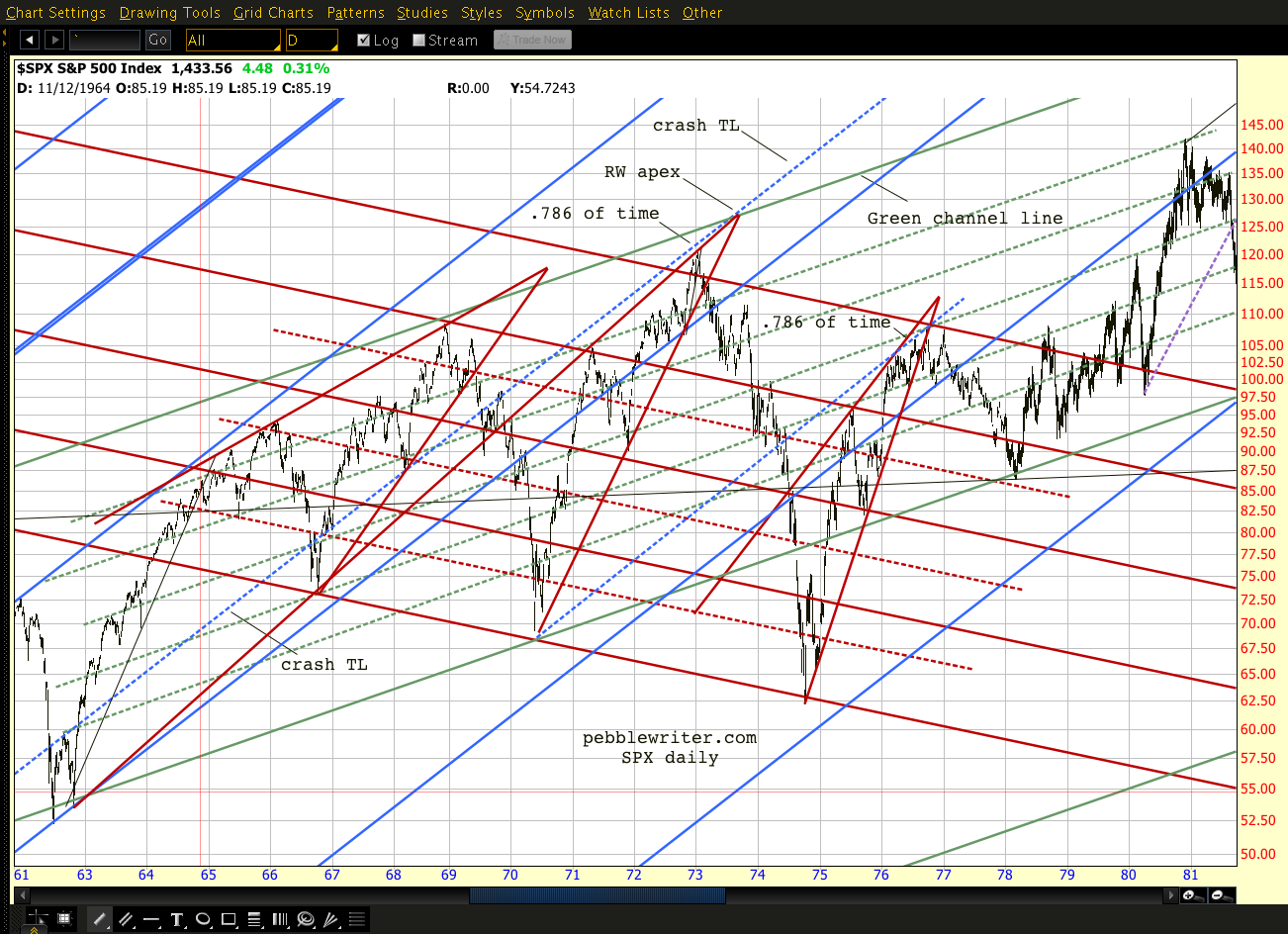 Once the crash began, it retraced 1.21 of the previous rise. It might have fallen all the way to it’s Oct 29, 1962 low of 55 (also the Fib 1.272 of the previous rise), but it caught a break from (drum roll, please) one of the red channel lines.
Remember the red channel lines? Here’s what they looked like during The Crash and Depression back in the 1930’s. I’ve marked the instances of critical support (and one of heavy resistance) with light blue circles.
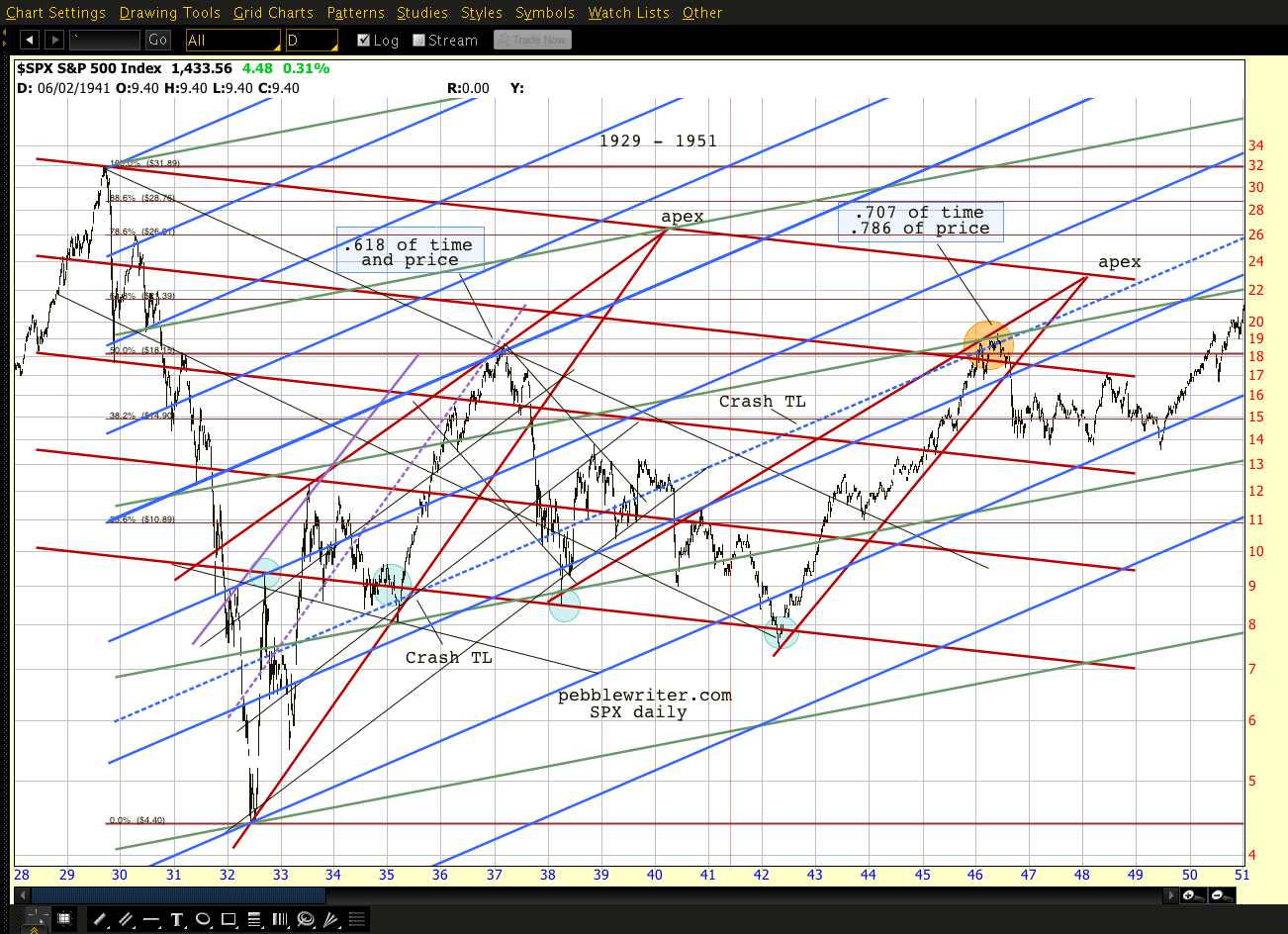 Note that one red channel line in particular marked the apex of the two multi-year rising wedges during this period. And, in each of the rising wedges, SPX made its high at an important Fib time level (.618 and .707) and an important Fib price level (.618 and .786.)
Coincidentally (?), the apex of the 1932-1940 RW was at the Fib .786 retracement of the 1929-32 crash.
The Crash TL is also visible, providing support along with a red channel line in 1934. It was also the TL around which the market revolved from 1937 – 1940. And, beginning on May 29, 1946 (at the Fib .707 of that rising wedge) it kicked SPX to the curb with a 27.5% crash.
That May 1946 high, BTW, exceeded the previous high made on March 10, 1937 by 0.60 points — a difference of 4.19% off the all-time low in June of 1932. For all intents and purposes, it was a double-top.
As an aside, there is much debate about the causes of the 1937 Recession. I find it fascinating that the market ran out of steam at:
- the .618 of the rising wedge’s lifespan
- the .618 of the rising wedge’s price range
- the .500 of the 1929-32 price crash
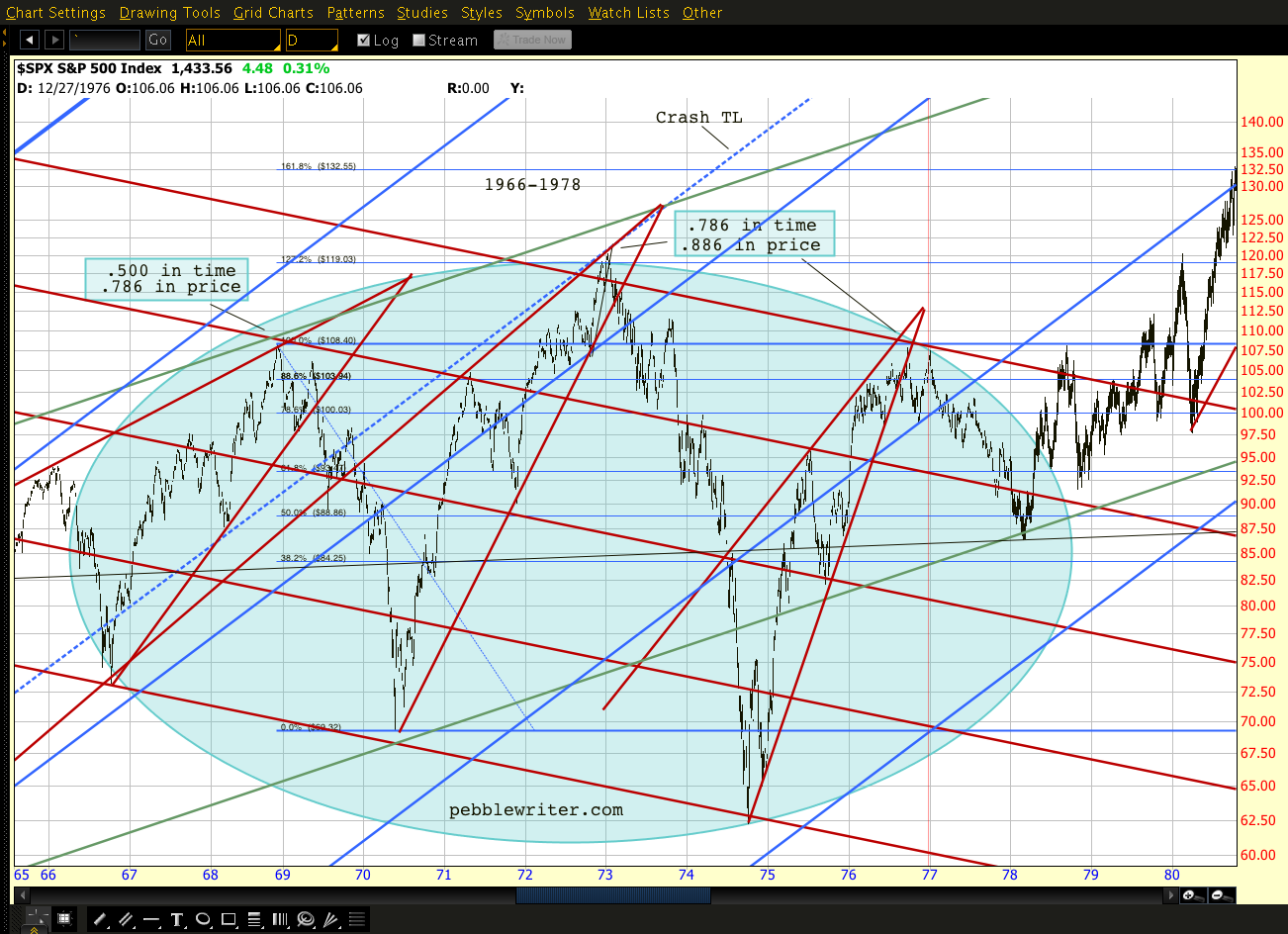
One last set of charts, and we’ll focus on more modern times. Many analysts use ovals (eggs) to frame patterns. I like them from the standpoint that they can help in the comparison of one pattern to another. Here’s the 1930-1950 egg, from the initial bounce off the left side to the eventual back-test of the right side.
 And, the chart for 1966-78:
 And, the chart for 1987:
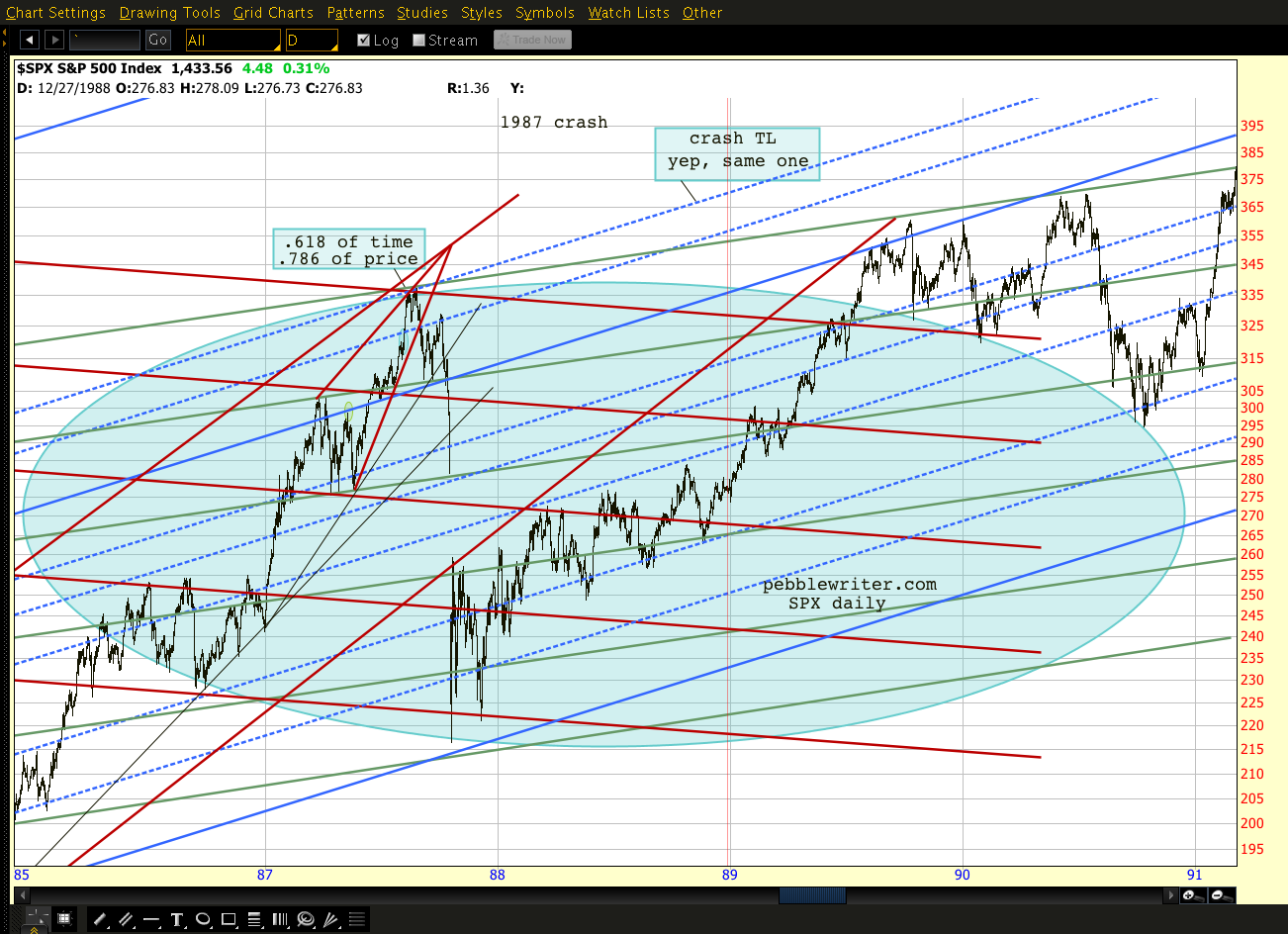
Kudos for anyone with enough patience to still be following along. I realize this isn’t exactly The French Connection. But, hopefully, you’re starting to see some very strong similarities between the three crashes of the 1930s, the 1970s and 1987.
- Every pattern was completely contained within a set of parallel red, green and blue channels.
- The major channel lines generally define major moves; other, lesser parallel lines define lesser moves. Major moves almost always resonate at a later time.
- The Crash TL, one of the blue channel lines, marked an important top in all three patterns — resulting in crashes of 28, 48 and 36%.
- These tops generally occurred at the intersection of the Crash TL with important green channel lines and red channel lines.
- They also occurred within rising wedges at key Fibonacci points in time and price.
- In general, the blue channel lines define the upside and the tops.
- The green channel lines usually define tops, and intra-pattern bounces.
- The top green line from each pattern connects with the bottom of the subsequent pattern (with one exception.)
- The red channel lines also mark tops, and generally guide the overall downside of each pattern. They define the very bottom of each pattern.
- Upon breaking up through the top red line, the correction is done.
UPDATE: SEP 13, 2012 12:15 PM
Extending the above red, blue and green channel lines to the past 15 years, we get the following chart. We’re clearly at the intersection of significant red, green and blue channel lines.
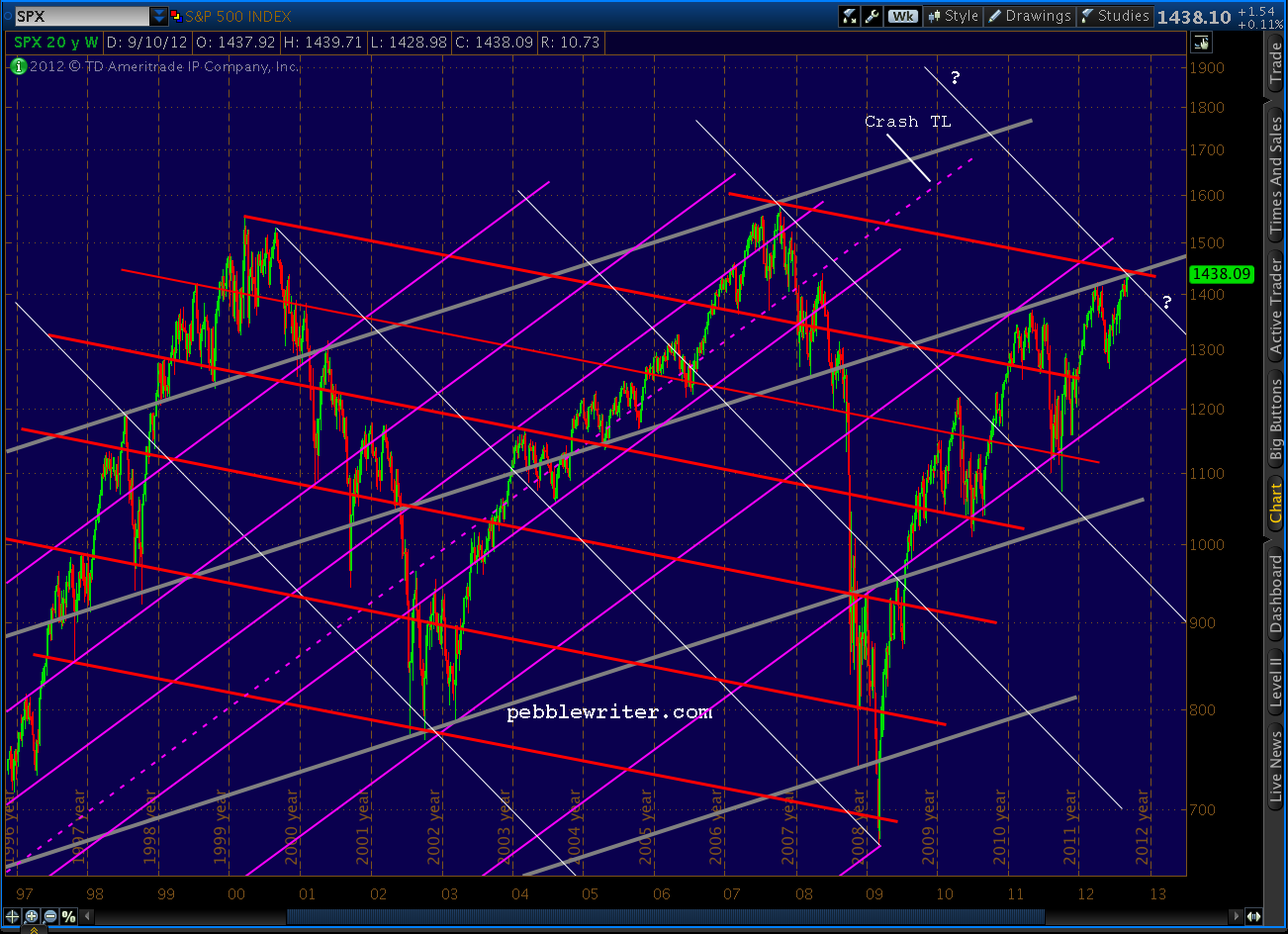 The Crash TL already did it’s thing in May 2008, so it’s not an immediate concern. Adding in the rising wedges, we see a pattern very evocative of 1966-1977. The latest rising wedge looks to be complete, but of course they are always subject to a redraw (the fact that we’ve registered higher prices since the highest price within the wedge is cause for concern.)
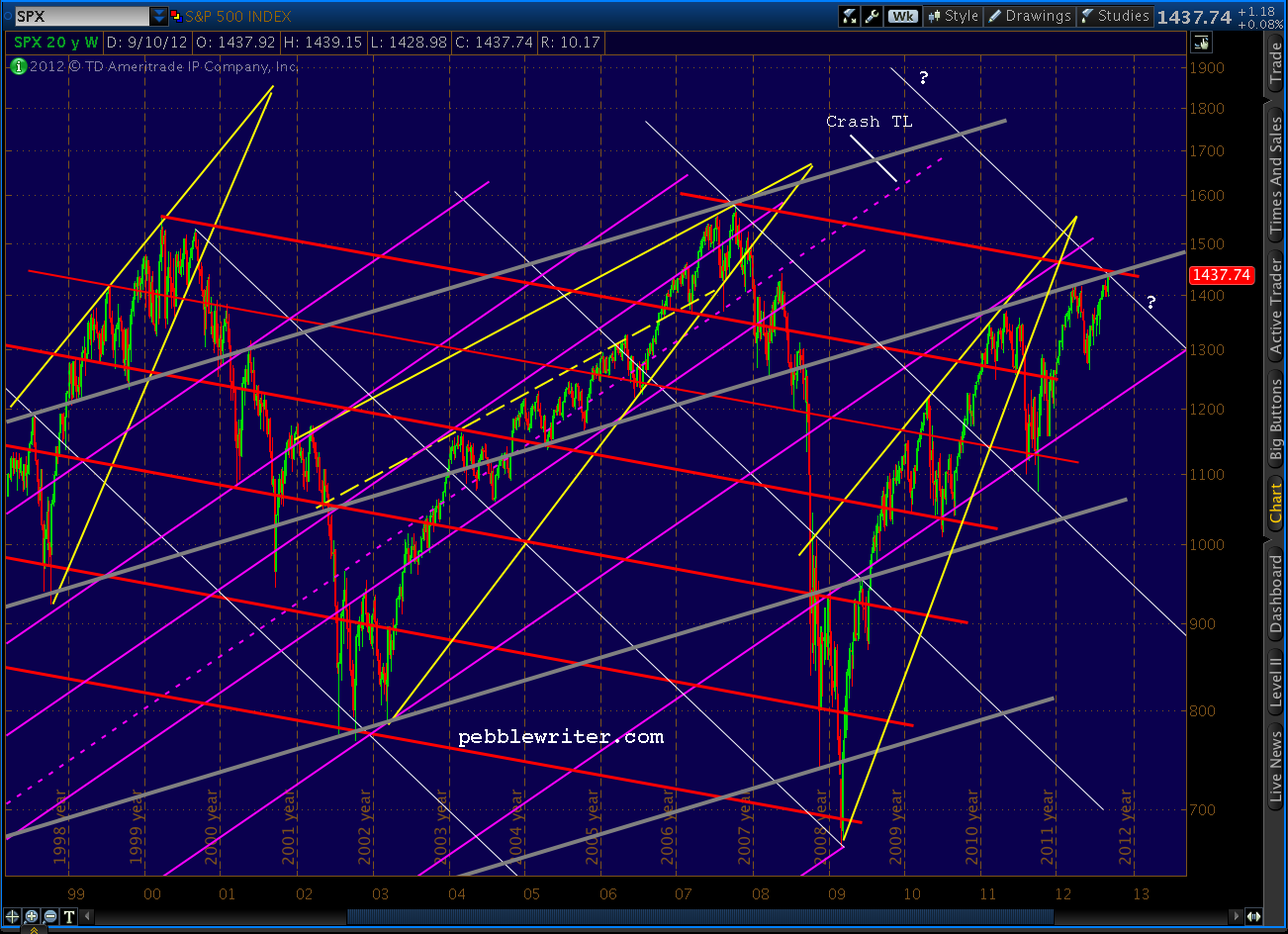
If we add in the harmonic grids, we can see each of the RW’s behaved similarly to those in past corrections.
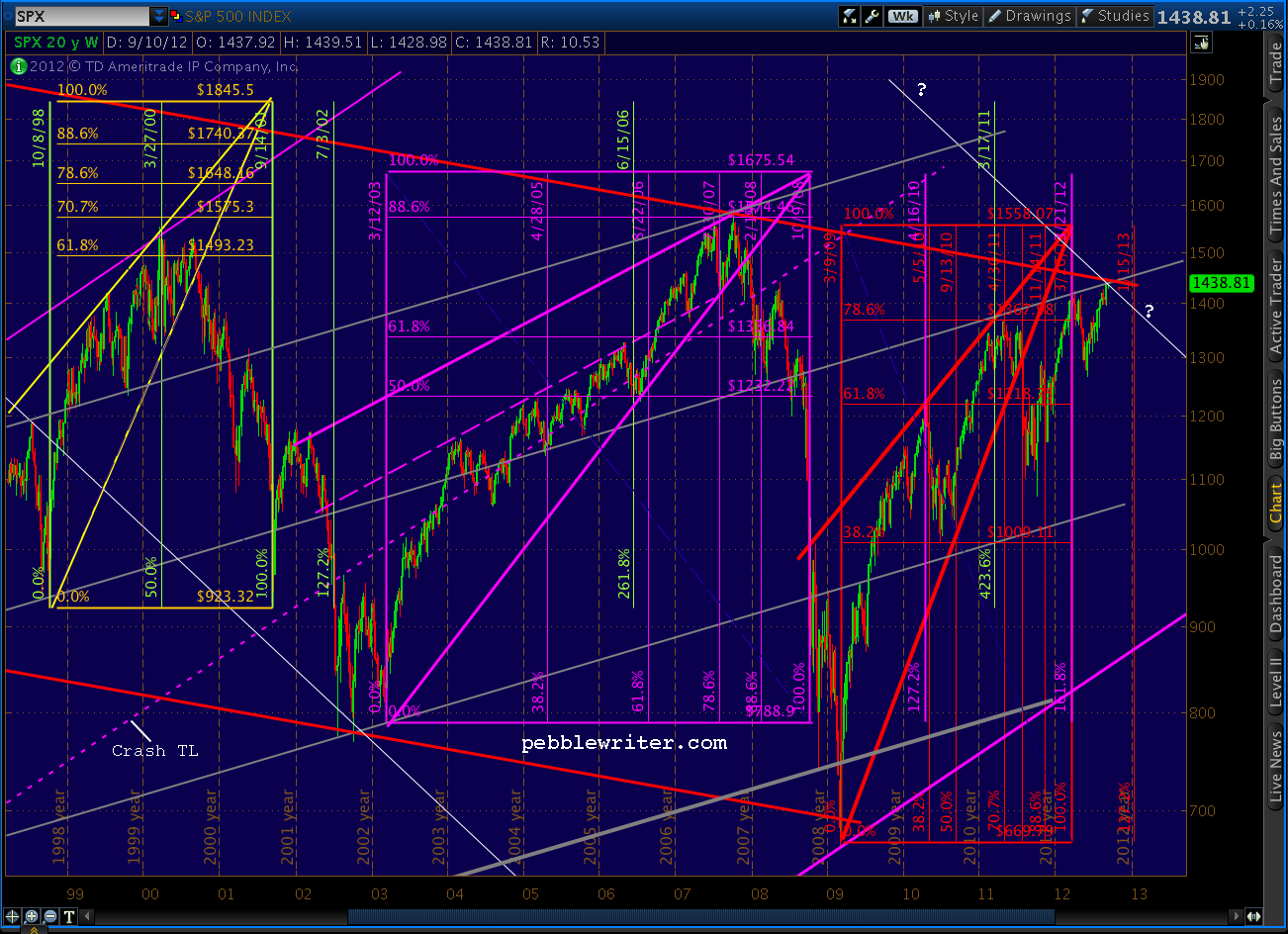 Note that the yellow pattern time Fibs resonated in the 261.8 and 423.6 time extensions. More importantly, the major pattern (in purple) resonated at the 1.272 and the 1.618 — marking the April 2010 correction and the April 2012 correction.
We recently reached some important Fib levels within the latest rising wedge. Yet, we’ve moved higher since. This hasn’t happened in previous patterns.
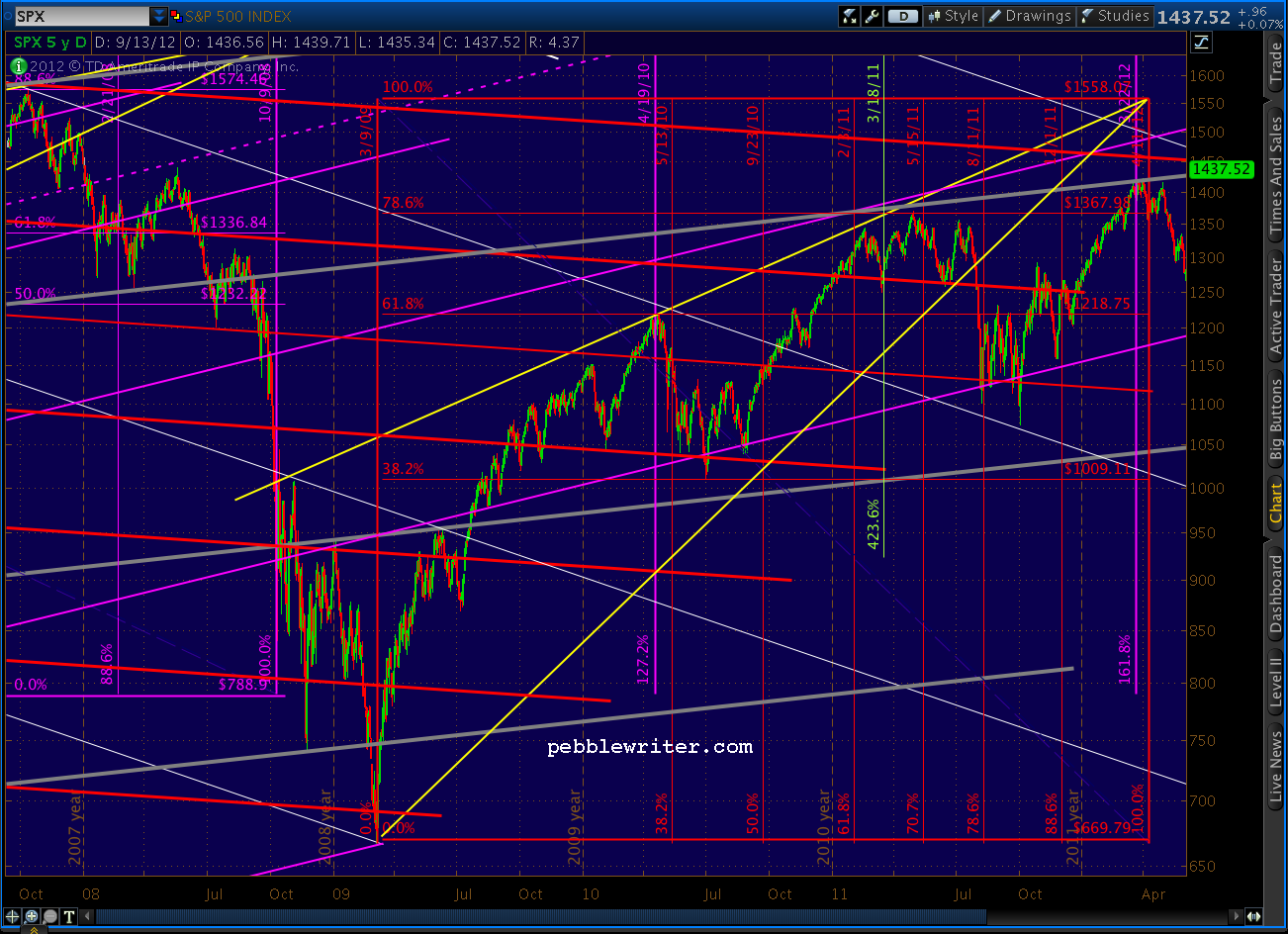
Bottom line: we are as high as we can go without breaking a significant red and green channel line, thus higher prices than these could represent a significant break out.
If they announce QE, I plan on buying. If they don’t, I’m shorting. Targets coming up.
UPDATE: 12:45 PM
So, we have more QE. Targets coming up.
UPDATE: 2:30 PM
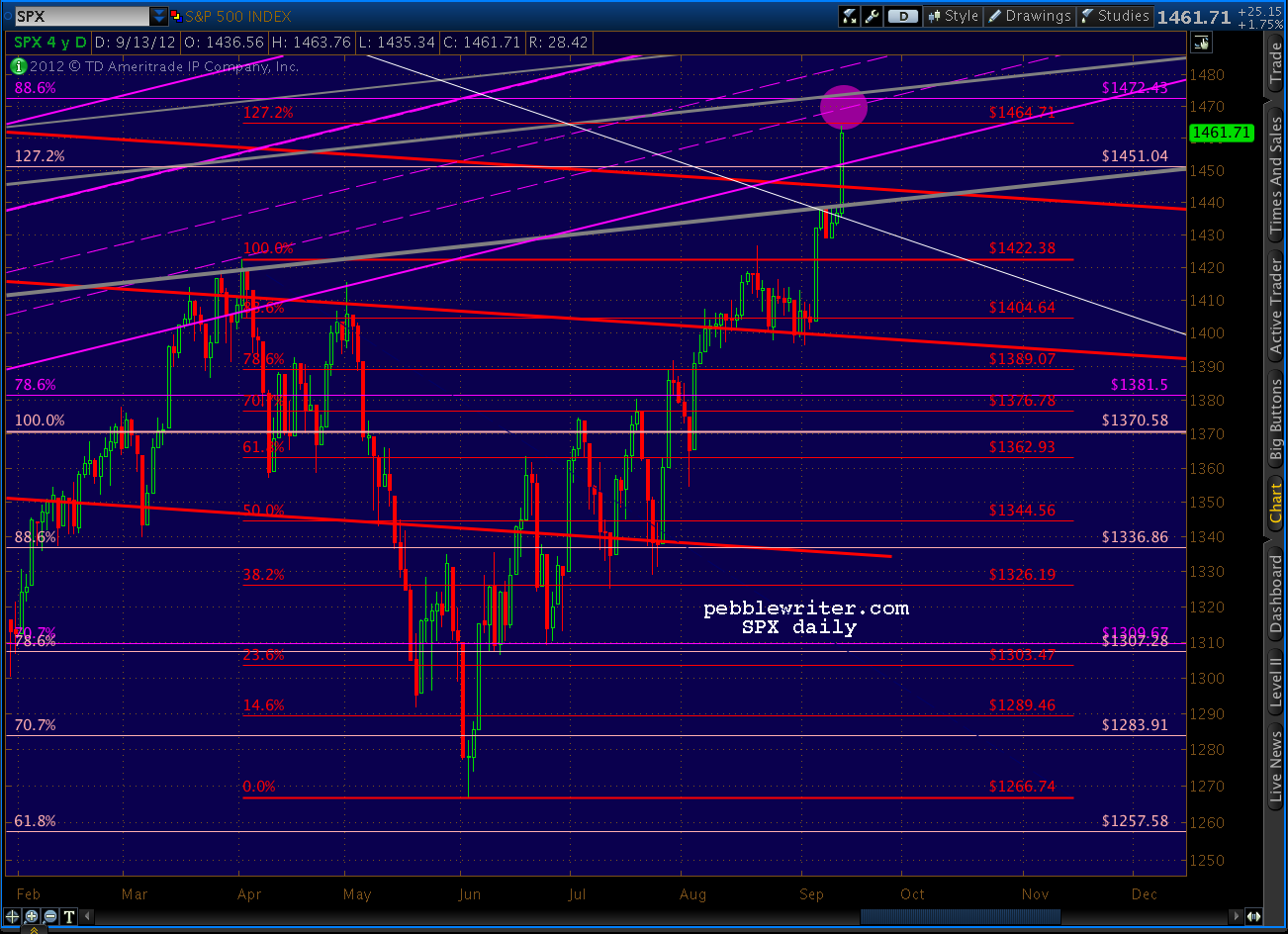
Apologies for the delay in posting. Lots to think about. We’ve nearly reached the 1464.71 Fib — the 1.272 of the smaller pattern since April’s 1422 high. We should see some reaction here, but the more important target is the .886 retracement of the 1576-666 crash at 1472.43.

 The daily RSI shows the potential for higher prices.
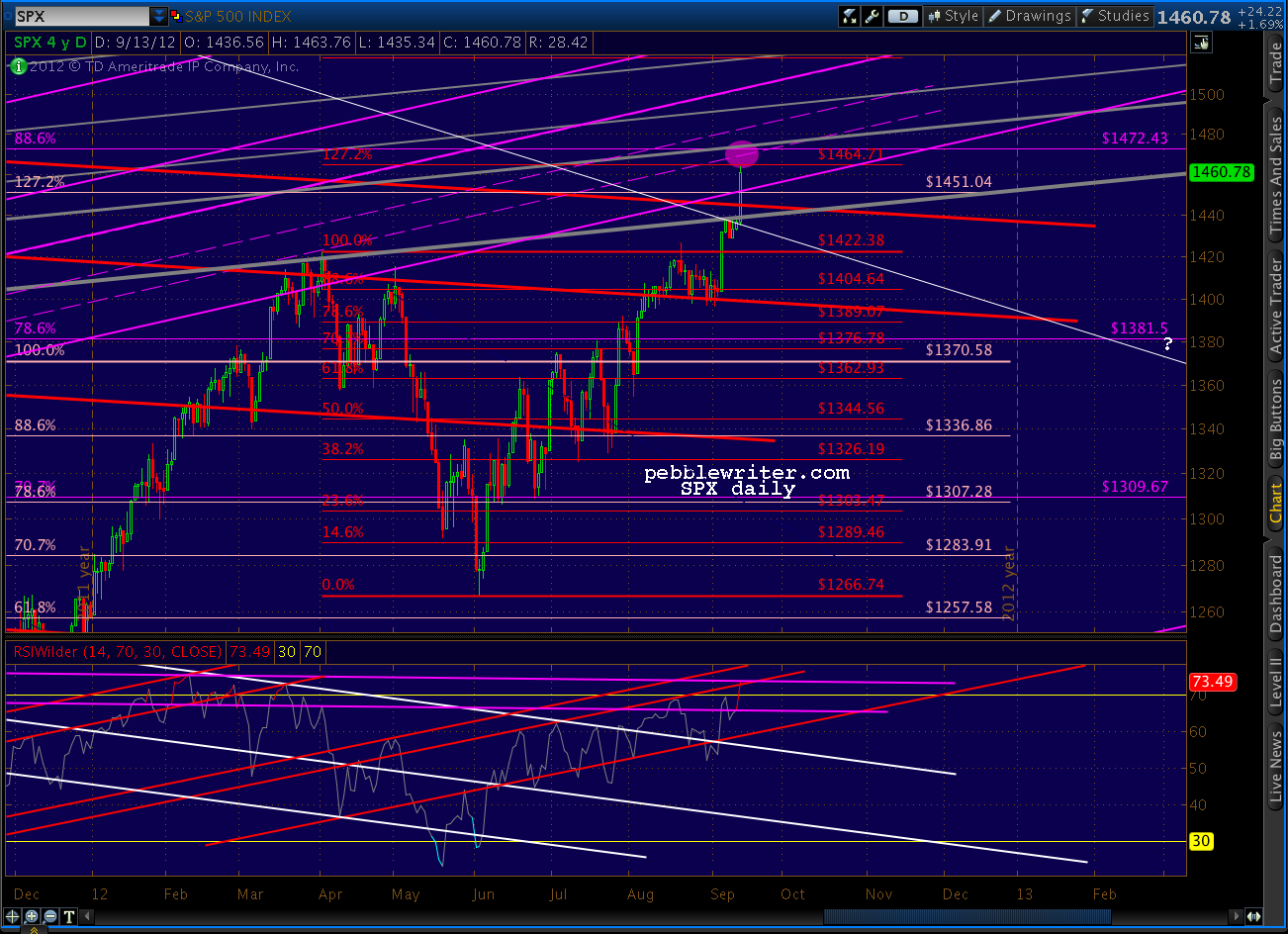 We have reached an important RSI trend line — the purple TL from January 2011. But, tags of this TL have always represented interim highs — not absolute highs. The eventual high has always come at a lower RSI value. That is, a higher stock price that comes at a lower RSI — or negative divergence.
The white TLs below illustrate. Price highs typically occured 4-5 peaks later than the RSI highs that tagged the purple TL.
 More in a few minutes…
UPDATE: 3:10 PM
This channel is ridiculously steep, now.
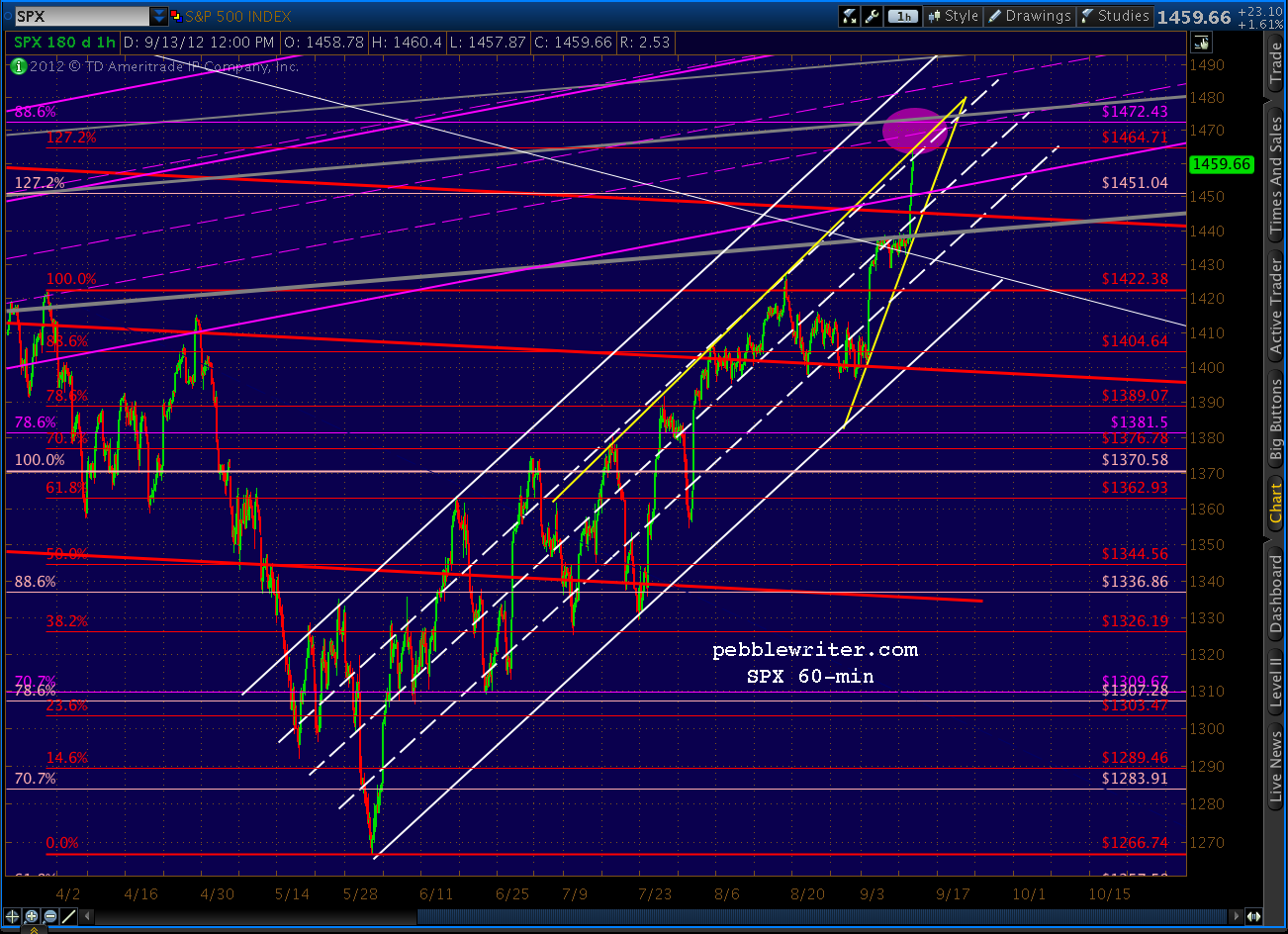
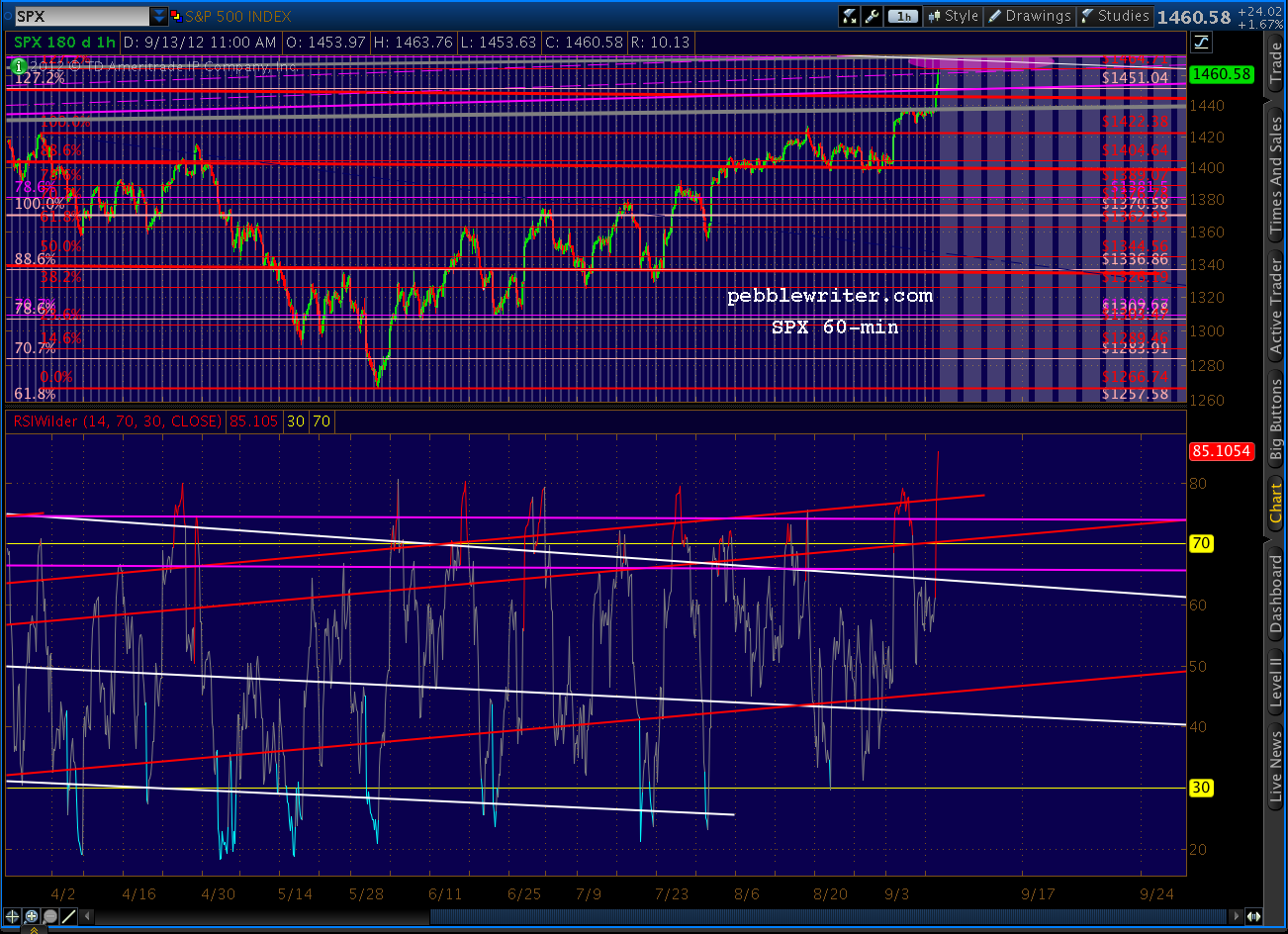 Every one of the indices I watch has broken out — even NYA. It doesn’t mean prices are going straight up forever, of course, but please be cautious fading this move. For the time being, our task has become looking for the pullbacks in a general advance, rather than looking for bounces in a general decline.
UPDATE: 3:30 PM
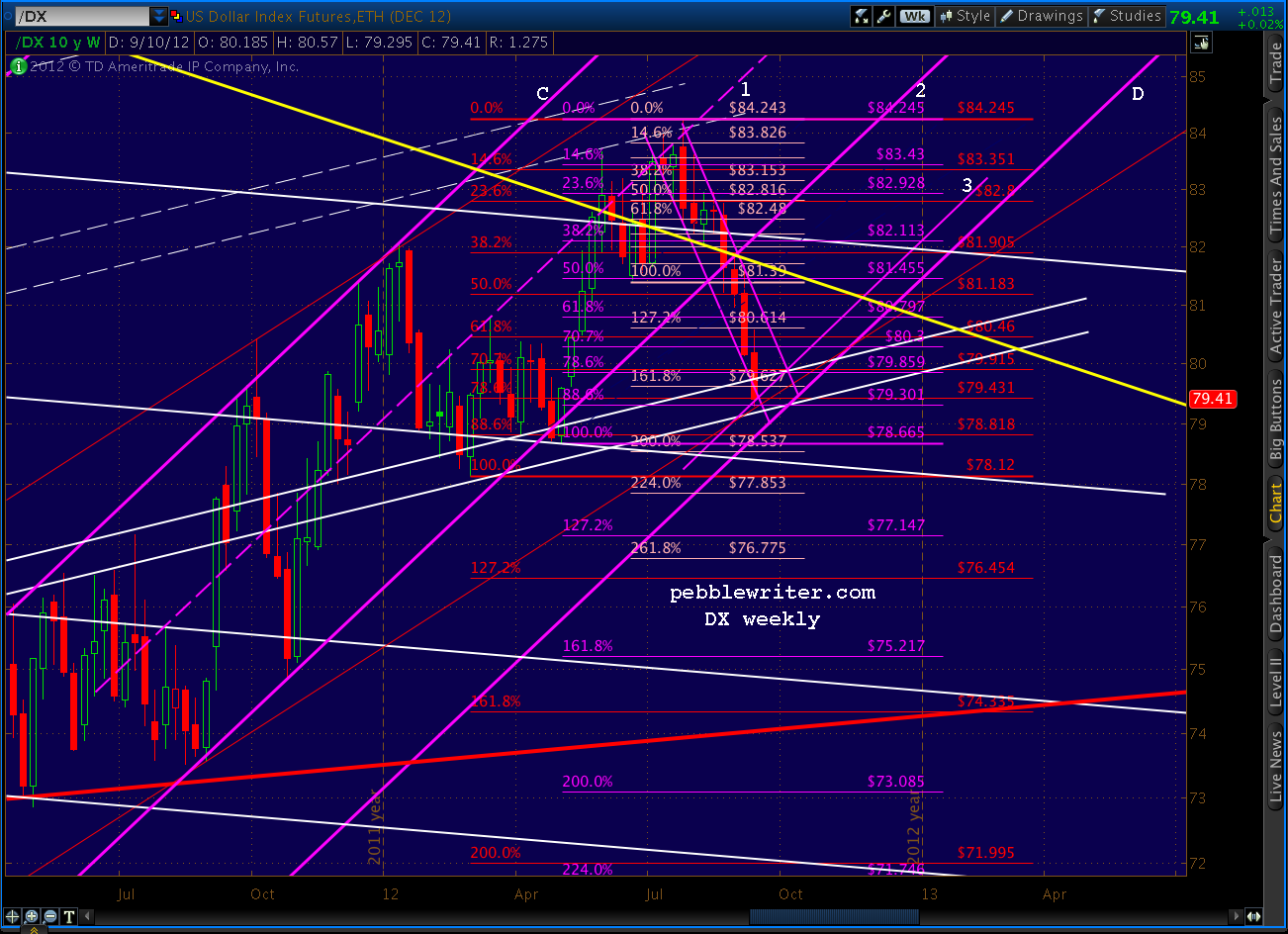
The dollar has reached an important interim target, but likely has further to go. We tagged the smaller, purple pattern .886 at 79.301. But, note the larger, red pattern’s .886 is down at 78.818. This probably correlates with our 1472 SPX target, and should represent the greater reaction.
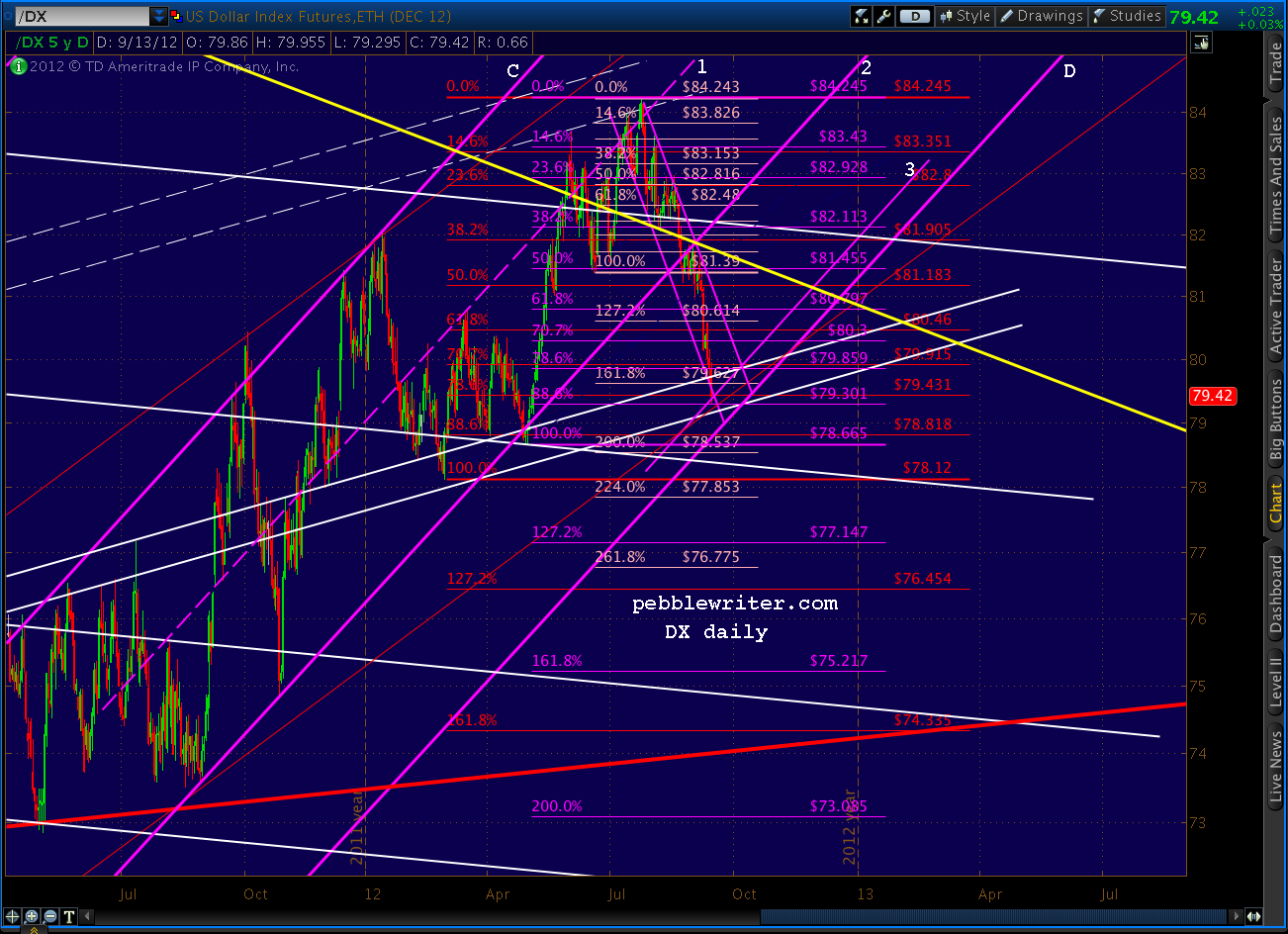 We tagged the purple channel line labeled 3 — which would be an acceptable new channel to go along with C, 1 and 2. But, looking at the bigger picture, I think it’s more likely that D will be the ultimate wide channel bound.
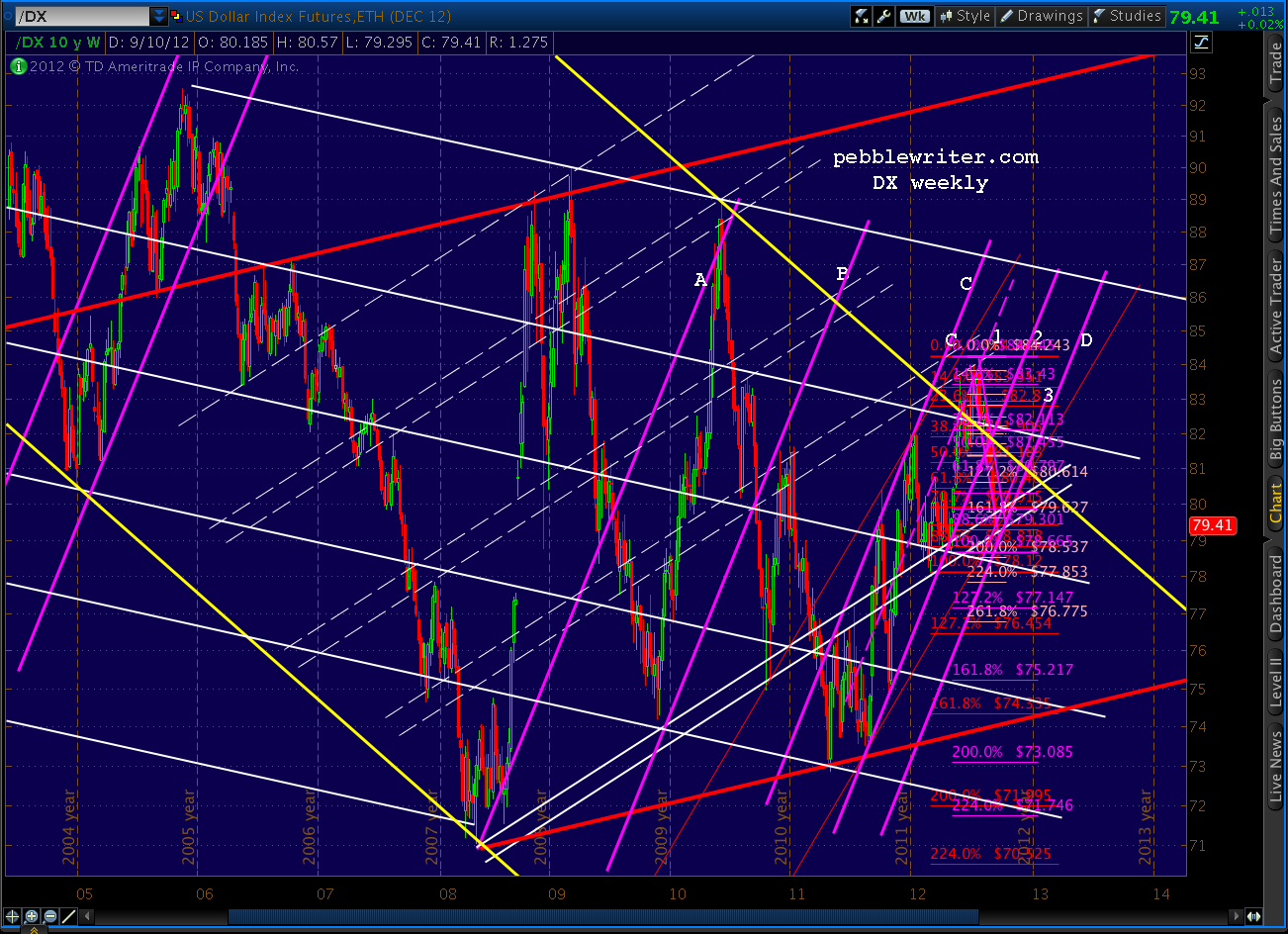
The SPX channel, relabeled in red, is aligned with a TL off the 1074 low from last fall. We’ll likely have a test of this break out, but this is a break out. Next stop should be 1472.

* * * * * * * *
Comments
7 responses to “What a Wonderful World”
I hear your apologies. During your times of processing maybe you would be willing to toss out a reminder of a significant fib level when you see the market is approaching one. I still lose track of those levels sometimes. I would be delighted to be aware approaching them rather than reading about it after the market has reacted…like what happened to me a few moments ago at 1464.71.
I need to do a better job of keeping up. Thank you for all you are doing to help.
Hello PW, one quick and important question! Since all the “good news” is out with unlimited Euro bond buy, German court decision and QE3, what is the upside? You mentioned that you are buying if there is QE3. Pardon me, is it a good time go long?
PW, in your channel chart, it seems like the green line (from green channels) is acting a strong resistance and it triggers a reversal. This explains the Oct 1987 reversal.
From your chart, the 2 tops in 2000 and 2008 were stopped by a green line in the green channel, and then they reversed.
Yup, my day trades go bottom ticked over the last TWO days again. There is obviously an issue between Schwab and the algo servers/MM going on. That is 4 out of 5 trades that have been bottom ticked over the last few weeks on day trades. Just sayin’… That 11:20 candle on the 5 min is what I am talking about. Watch your backs folks…watch your backs.
Hello PW. This morning, I was told by an ordinary investor that one should not sell European stocks as those stocks can only go higher. Perhaps he is right and I am wrong. A month ago, I was bearish in Euro. In the past few weeks, Euro currency and Euro ADR have great performance. (a few big cap Euro ADR has 20% or more gain in a month. See DB, SI, TOT)
I did not have a counter argument for the recent performance and continuous strength in Euro. The number speaks for itself.
Still, I am aware of the limit of ESM/ESFS now. Thanks for info on ESM/ESFS.
it seems euro has broken resistance on the weekly and daily. should get a correction soon but I will consider the euro downtrend as over. It looks to me on the weekly it has lots of room to go up. give me 1,26 on the correction and I would get out of my dollar position. Or am I just capitulating??