
Tag: gartley

  • Charts I’m Watching: Dec 6, 2012

    ORIGINAL POST:

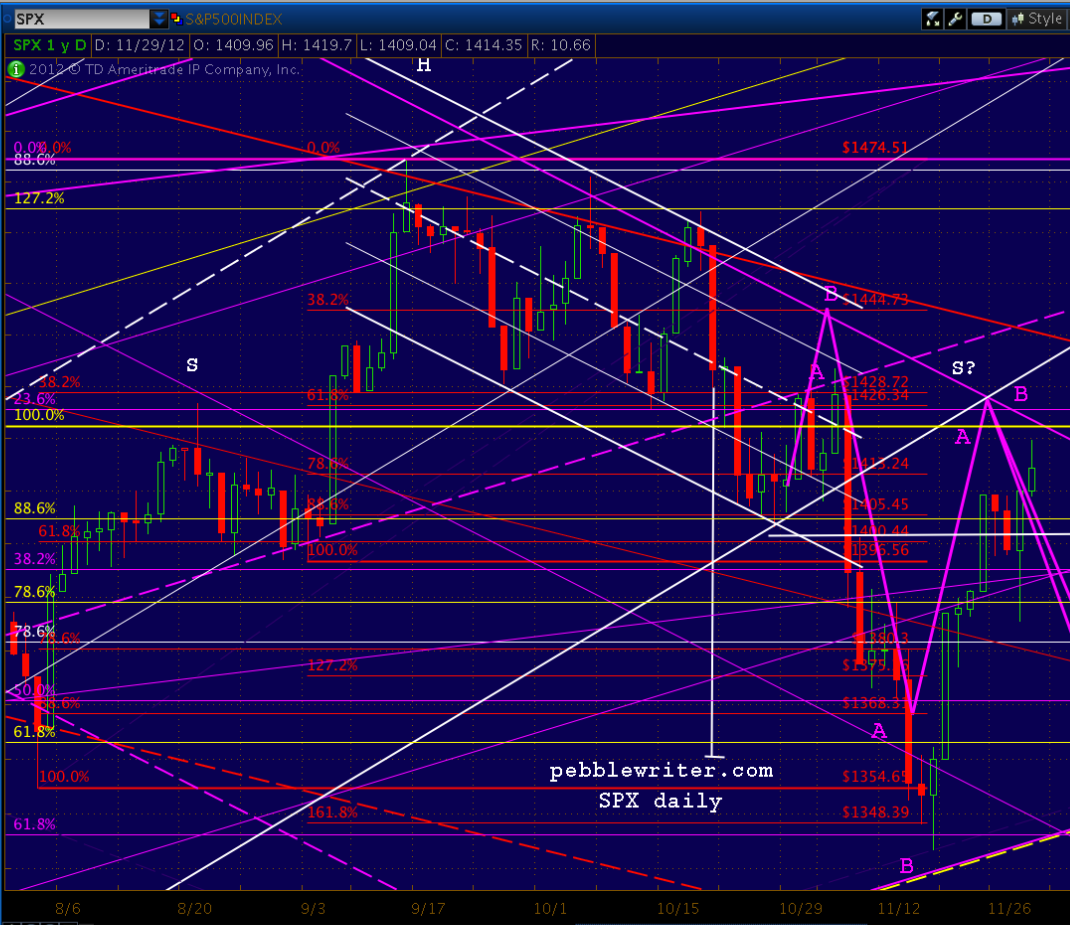
    We can’t call the corrective wave over just yet.  There’s still potential to one of those fibs or channels we discussed yesterday before the 3rd wave down gets going.

    But, RSI is still showing no breakout potential on any time frame.

    A 50 – 88.6% retracement is considered “normal” for 2nd waves.  This one had a little reversal at a little over .618 on the largest white scale, which opens up the possibility of a Gartley (which completes at the .786) or a Bat Pattern (completes at the .886.)

    As the chart shows, the .786 is at 1418.27 and the .886 is at 1420.82.  Each of them looks possible, and one of them is very likely if SPX edges up past 1415.56.  If it does, my leading candidate is the .786 at 1418.27 — especially if we get a little reversal at 1413.50 — the .786 of the smallest red pattern.

    That would set up a Butterfly Pattern on the little red pattern which completes at its 1.272 at 1418.27 — intersecting nicely with the white pattern’s .786 at 1418.27.  Such a price point intersects with the channel lines (as drawn, but not yet firmly settled) at the end of the day or very early in tomorrow’s session.

    If SPX can’t get past 1415.56, then the downside harmonics (represented by the small purple grid) are in play, and the initial target is back to the 1398 level (previous low, and a Bat Pattern .886.)  Once prices move past 1398, the decline should accelerate.

    UPDATE:  12:30 PM

    If the analog were to play out exactly as before, with no deviation from the past pattern, we’d not see any higher prices at all.  In fact, we’d be back below 1343 in the next day or so — starting this afternoon.  But, that’s a bit much to expect, given the big deviations we’ve already seen within each wave.

    UPDATE:  3:15 PM

    Lots of excitement around AAPL the past couple of days.   A couple of weeks ago, after AAPL soared 90 points in 7 sessions and was approaching 600, I was a little skeptical [see: AAPL update.]  I posted the chart below, and nervously took a stand.

    Combining all the above, it’s easy to imagine a scenario where prices drop to 500 into the end of the year, but can’t quite seal the deal on the H&S pattern.  A nice bounce there and rally into February would fit nicely with my general equities forecast (see below.)

    AAPL gained 4 more points over the next couple of sessions, then took a swan dive that has seen it lose nearly 75 points in less than a week.  Here’s the same chart, updated for the actual price action.

    Aside from the fact that AAPL did what we expected, nothing’s really changed.  There’s a H&S pattern that would complete at about 504.  Given the number of hedgies and mutual funds rushing for the exits, who could be surprised if AAPL went ahead and completed it?

    But, I’m not beating the table for that scenario, only because a bounce just shy of completing the pattern better fits with my general equity forecast.  AAPL came within 3 points of a .886 retracement of the bounce from 505 today (and 14 pts shy of the H&S completion) so there’s ample reason for a bounce.

    It could easily stay in the little white channel, forming a falling wedge into the year end as the rest of the market melts down a bit.  Personally, I wouldn’t have anything to do with it in my portfolio unless it was an iron condor or the like.  The volatility is too great and I don’t like the odds in either direction.

    More later…
  • Stay Groovy

    “It was an expression used by small recon units and sniper teams in hostile terrain in Vietnam. They would tell one another to stay groovy when the danger level was so insanely high they popped amphetamines to stay awake and ready to rock twenty-four/ seven, because anything less would get them all killed. Stay groovy; take your pill. Stay groovy; safety off, finger on. Stay groovy; welcome to hell.”

     The Watchman, Robert Crais

    Those who have been following this blog or its predecessor for any length of time know I’m a big fan of analogs.  I was asked just yesterday why I thought they worked, and found myself fumbling for an answer.

    Like harmonics, I know that they do, because they’ve enabled us to make some nice calls that were accurate as to price and time such as the big downturn in April and the subsequent 1474 top in September.

    The big Kahuna, of course, was the July/August plunge in 2011 that mirrored that of Dec 07-Jan 08.  It’s just plain scary how well that turned out.

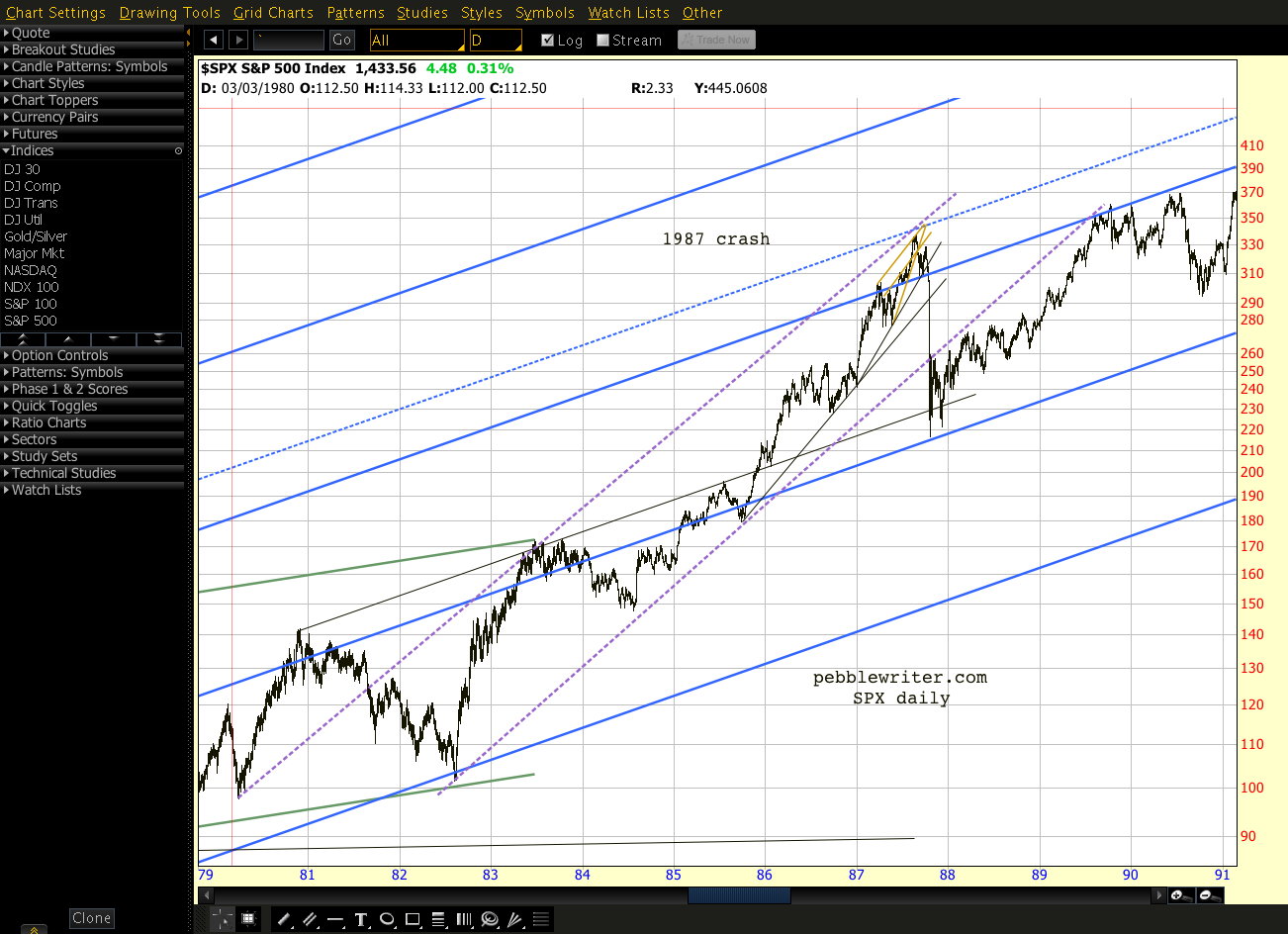
    I think analogs work mostly because of channels and harmonics.  In the simplest terms, channels keep prices pointed in a general direction for a noticeable period of time.  They can last for decades…

    a few years…

    or a few days.

    Regardless, I’ve found that most significant moves occur within or interact with channels.  Very often, as in the above chart, they’re channels within channels.  Even big channels that seem to generate their own atmosphere are usually aligned with other big channels.


    So, it’s not terribly surprising when moves that bring the market to the brink of disaster or reach ridiculously overbought levels react “just like it did last time!”

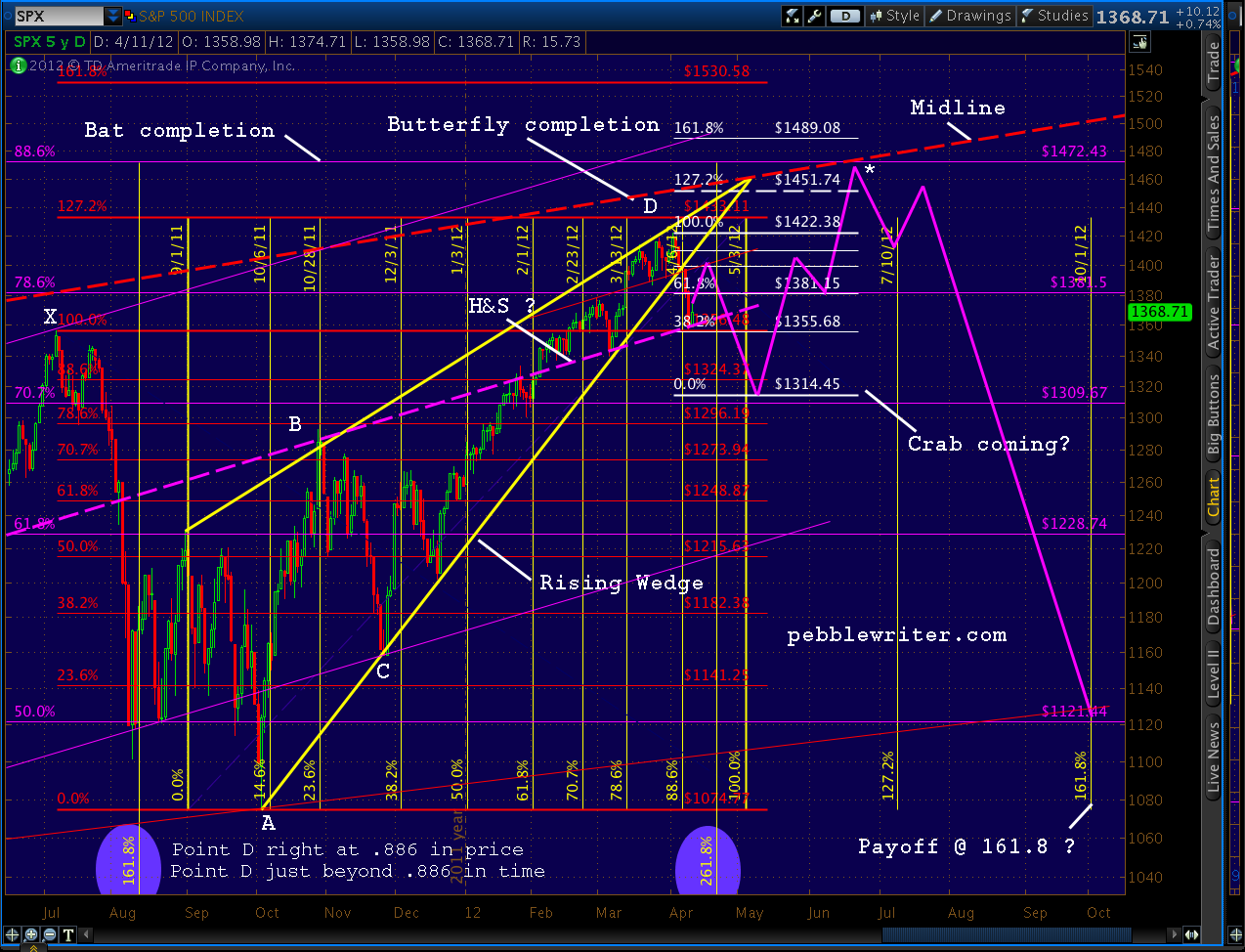
    Harmonics, likewise, are usually related.  The easiest example is the 2007-2009 plunge from 1576 to 666 which, when followed by an intial reversal at its .618 Fibonacci level, signaled both a Gartley Pattern reversal at its .786 retracement (the May 2011 high) and a Bat Pattern reversal at its .886 (Sep 2012 1474 high.)

    Combining the two, and tossing in some other chart patterns and traditional technical analysis, it’s easy to see why the market has done what it has most of the time.  If markets move in somewhat predictable and repeatable ways, then analogs can be viewed as a predictable aggregation of those predictable moves.

    Of course, its not always as simple as that sounds.  Even great analogs usually present alternatives. Over the past couple of months, the one we’re following now has hit our primary target at times and our secondary targets other times.

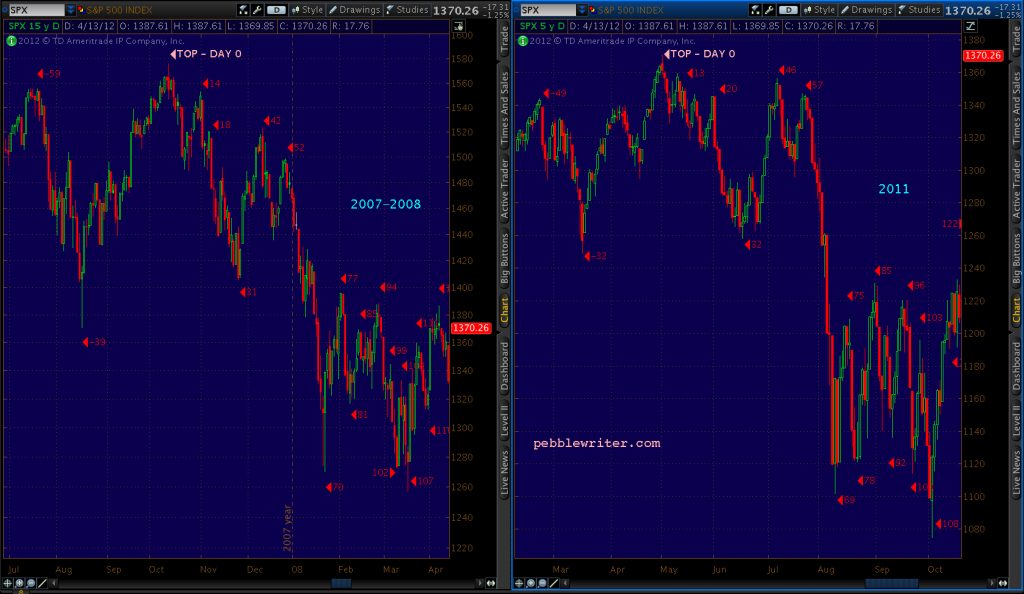
    And, some can be tough to get a handle on.  The one from this past April [see: New Analog I’m Watching] that very capably guided us from 1422 to 1266 and back up to 1474 (the top chart above) worked beautifully from a price standpoint, but was way off in terms of timing (since licked, I think.)

    And, last, there’s one truism that’s the bane of every analyst who charts analogs:

    Every analog works forever…until it doesn’t.

    Even as we’re counting down the last few points to the 10% downturn we charted all those months ago, a well-timed Bernanke comment or Hilsenrath article (is there really a difference?) could nudge the markets just enough to complete a Zweig Breadth Thrust event that ushers in a new high.

    If that happens, never mind.  End of the road.  It’s been a nice ride for the past nine months, but it’s time to change partners.  If it doesn’t, however, and we reverse in the next 10-15 points, it’s just about time for the song.


    UPDATE: 1:20 PM

    I’ve had several messages asking whether we’ve reached the target or not.  Frankly, I’m surprised.  The answer should be perfectly obvious to everyone:  maybe.

    continued for members… (more…)

  • EURUSD Update: Nov 20, 2012

    Good morning, all.  The markets should get no help from across the pond today.  Though Moodys’ downgrade of France was not exactly news, it should serve to remind investors of the structural issues facing the euro-mess.

    The EURUSD completed a well-formed Gartley Pattern early this morning, reacting off the .786 of the latest move down.  More importantly, though, the pair is bumping up against three significant channel lines.  The Gartley is visible here as the small pattern in purple.

    The dashed, yellow line is the midline of one channel, and the solid purple line is the 25% line of another channel.  They’re both easier to see from further out, and are basically two different ways of viewing the rally from this past July (which happens to exactly parallel the last one from earlier in the year.)

    Note that the pair has also come back to its Point X of a recently completed Crab Pattern that came up a little short of the 1.618 (or overshot the 1.272.)  It’s the small red pattern on the above charts.

    The third channel I referred to above is the daily RSI channel.  The pair broke down from the rising purple channel around Nov 1 while establishing another falling white channel parallel to the last one from Feb-May.

    It’s now back-testing the purple channel — which should ultimately provide resistance that should send the pair down by no later than December 5.  Note this time frame fits with the intersecting price channels as well.

    Bottom line, while the rally could extend a little further after this interim resistance, the next big leg is down.  My money’s on the white .886 at 1.2169 around the end of the year in a plunge reminiscent of the May 2012 move.

    In the meantime, keep an eye on the rising wedge and RSI channels on the 60-min chart.  While the wedge hasn’t yet broken, the yellow RSI channel has.  After a back-test, there is  downside exposure with the falling white channel.

    The Big Picture:

    EURUSD completed a Bat Pattern (purple D) at its .886 in July — also the bottom of the falling purple channel.  This was also a Crab Pattern completion (the small purple grid.)  Many times Bat Patterns go on to become Crabs, meaning the ultimate target of this decline could be .9982.  But, my intermediate-term target is 1.10-1.13 by May of 2013.

    • bottom of the big red channel
    • intersection of the red and purple channels
    • white Crab Pattern completion at 1.618 (1.1342)
    • .618 tag of largest white pattern
    • bottom of large rising yellow and purple channels


  • Charts I’m Watching: Oct 1, 2012

    ORIGINAL POST:  9:40 AM

    We posted this chart early Friday morning [see: CIW Sep 28]:

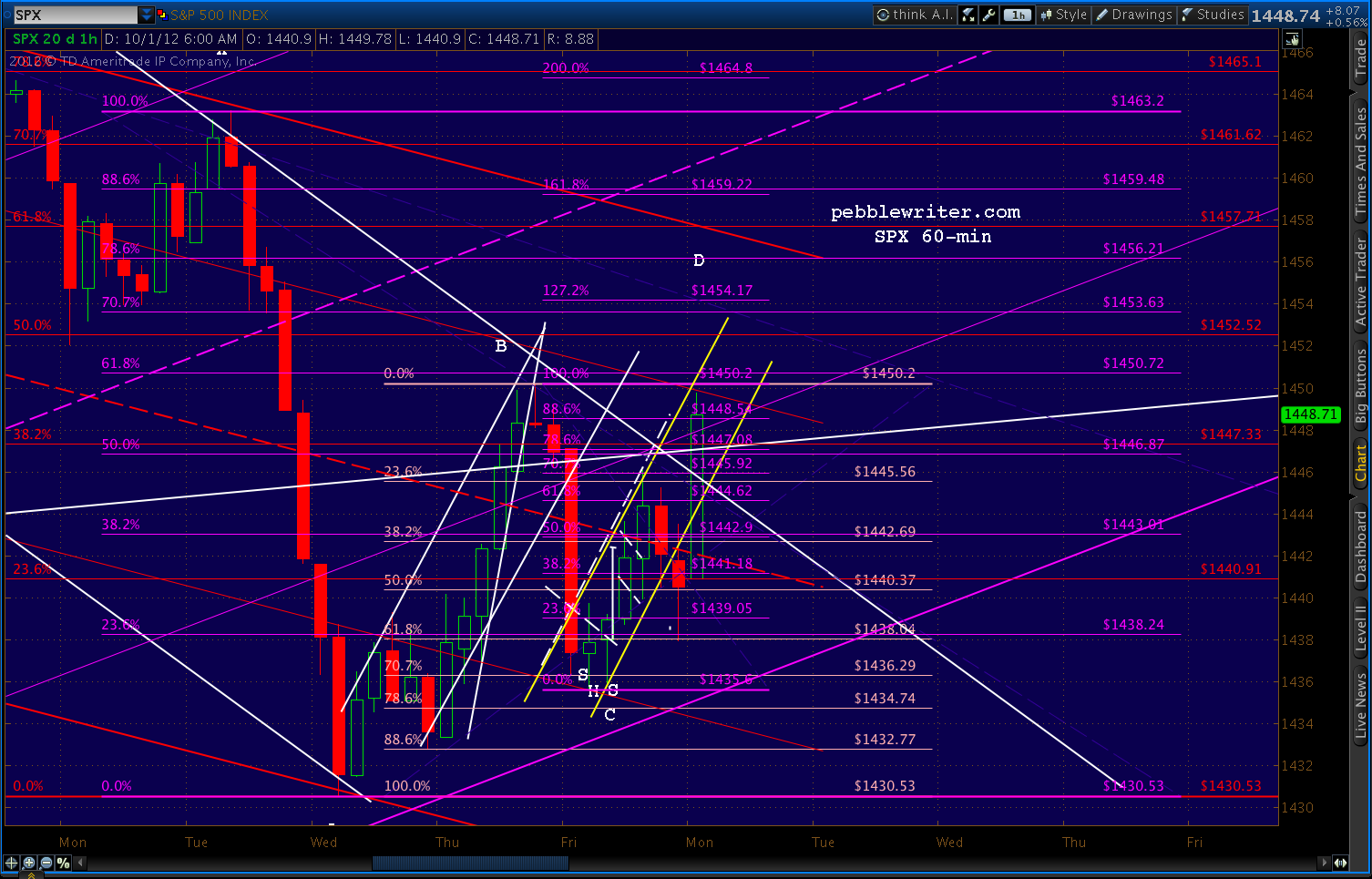
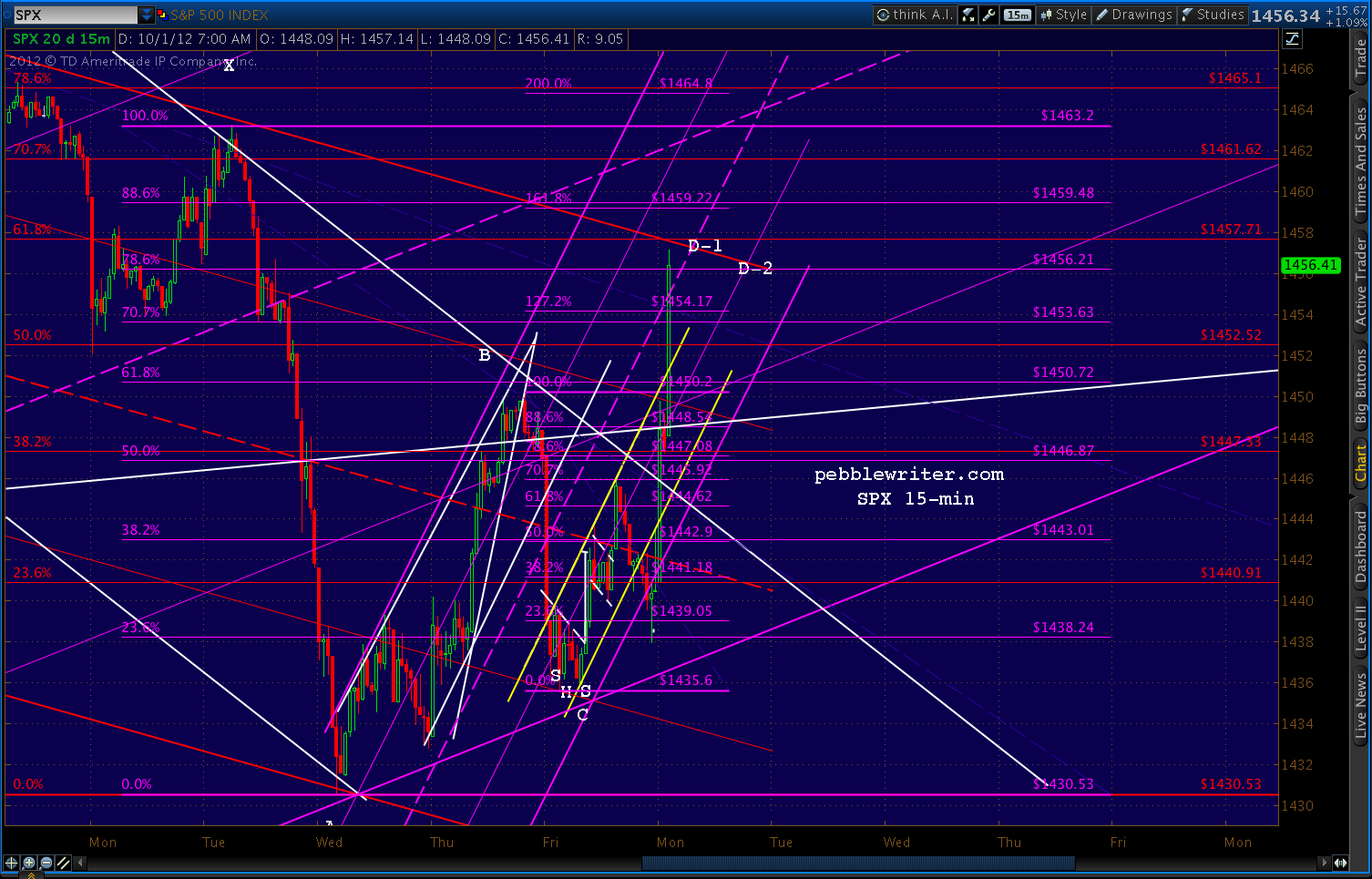
    SPX is selling off this morning, but should find support at the purple channel bottom around 1435-1436 and rebound…  If the channel does hold, preferably at the .786 or .886 of the pink pattern, look for the Gartley Pattern we discussed yesterday to complete at 1456.21.  Why?  Yesterday’s high was a perfect Fib .618 retracement of the 1463.20 to 1430.53 drop.

    In fact, SPX reversed at 1435.60 minutes later, starting up right at our Point C.  That left the Gartley Pattern completion at 1456.2 (Point D) as our next target.  Don’t look now, but it’s not all that far away.

    SPX just hit our interim target of 1450 — the upper bound of the channel it’s been in (and fell out of) for the past several days.  This also represents one of the larger red channel lines and is the Sep 27 top, so we should get a reaction here.

    But, we will likely go higher.  Why?

    Note that on the 27th, we reversed at the .618 retracement of the 1463 – 1430 drop.  This set up a potential Gartley Pattern at 1456 or Bat Pattern at 1459.

    In the midst of that range is the .618 of the larger 1474 to 1430 drop at 1457.71. And, the top of the red channel is currently at, drum roll please, 1457.

    In other words, we should get a decent downturn somewhere in the 1456-1459 area — with 1457 being my favored target. We remain long from 1437, but I plan on taking profits and playing the downturn at that point.  I’ll look for a shift in momentum first.

    More in a few…

    UPDATE:  10:10 AM

    That’s close enough for me.  Going short here at 1457, with stops at 1460.

    We could see one last spurt and tag 1459 or so, but I’d rather bank the 20 points we’ve earned in the past week and play the reaction.

    continued for subscribers…

    (more…)

  • Lemmings and Us

    ORIGINAL POST:  9:30AM

    The dollar and the euro each overshot our short-term targets just a tad, but are resuming the path we mapped out for them last week.

    The EURUSD came very close to a key .886 Fib level, prompting many to wonder “was that it?”  I wasn’t so sure, myself.  The resultant sell-off was pretty convincing, taking out the previous low.  It reversed as we expected it would overnight, and appears to be taking a run at 1.2588.  If it can break that level, it would complete a measured move to the .886 at 1.2617.

    The dollar, meanwhile, bounced hard off the channel midline as expected, and has resumed its decline towards the 1.272/.5000 at 80.83 – 80.88.

    Each of them is at a smaller degree .786 or so, meaning they’re due for a pause here.  And, if they can’t seal the deal with a higher high (euro) or lower low (DX), then the party’s over sooner rather than later.

    But, I’m still operating under the assumption that we’ll get one last push in this corrective wave before things come undone at Jackson Hole.  I have yet to see any serious trial balloons regarding an imminent QE announcement.  While not necessary, I would expect the very political Fed to do so, especially given the diatribe coming out of Tampa this week.

    If DX and EURUSD are only in a corrective wave, can SPX break out to new highs as we wondered last week?

    continued… (more…)

  • NDX Update: Aug 12, 2012

    It’s been a while since our last look at the big picture in NDX.  I’ve focused more on broader indices such as SPX, RUT and NYA.   And, NDX has been subject to excesses, thanks to the impact its largest component — AAPL — has on its performance.

    But, over the past several months, it’s been one of the more predictable indices.  In our Apr 1 forecast, I wrote that its small rising wedge had run out of steam and it was due to reverse and test the lower bound of its larger wedge.

    In the May 1 update, I put a number (2438) on the downside target, revising it on May 8 2446 to reflect the just-completed H&S pattern.  Sure enough, on June 4 it bottomed at 2443.92 to tag the lower bound of the big wedge.

    Since then, NDX has reached the Fibonacci .786 of one pattern and the .886 of another.  Is this another important turning point?

    continued… (more…)

  • The Waiting Game: July 31, 2012

    ORIGINAL POST:  11:30 AM

    SPX might be tracing out either a flag or pennant pattern on the 15-min chart.  While either could portend higher prices (2/3 of the time), a flag would mean lower prices first — probably down into the mid 1370s.


    At first blush, the market seems to be respecting the last high of 1380.39 on July 19.  I suppose it makes for a more positive wave structure.

    But, I suspect the bigger worry for bulls is the Fib .786 at 1381.50 (in yellow).  This retracement from the 1576 to 666 plunge (Oct 2007 – Mar 2009) was only recently exceeded again, and a real, live bull market shouldn’t have any difficulty retaking and defending it.  Here’s the big picture, again:

    continued… (more…)

  • Bat Patterns

    Bat Patterns are one of the more common harmonic patterns.  They are similar to Gartley Patterns, except that the AB retracement can be anywhere less than the Fibonacci .618 of the XA leg and the AD leg completes at the .886.

    Because the AB leg can be anything < .618, we have to be a little careful as we approach the .618.  A reversal at .600, for instance, could be a Bat or a Gartley that came up a little short.  So for those that are close enough to go either way, we’re cautious around the .786 (the Gartley completion) too.

    Likewise, a presumed Bat pattern that is approaching the .786 on its CD leg can throw us a curve and put in a bigger reversal there than at the .618.  If this happens, there’s a pretty good chance we need to move the Point B to the .786 and prepare for a Butterfly Pattern extension to the .1.272 or 1.618.

    Likewise, a Bat Pattern that completes at the .886 could evolve into a Crab Pattern — which features a Point B anywhere up to the .886.   The pattern above, for instance, could be just the XA and AB legs, with an ultimate completion at the 1.618 of 892.12.  Bottom line, either play a minor reversal at the .886 or have a pretty clear idea of the medium and longer-term potential.

    In the chart above, for instance, there’s a trend line that should provide support near the last session’s low.  So, there’s a decent chance that the existing reversal is all we’ll see.  As always, stops are recommended just beyond the expected target just in case the pattern fails — as it does about 30% of the time.

  • There and Back: June 27, 2012

    The market continues to follow our forecast nicely.  Recall we sold our longs and went short at 1330 on Monday’s opening, only to cover and go long later in the day at 1315 [see: Channel Watch].  Now, we’re back to 1332 and still long — as long as the channel holds.

    It’s been a wild couple of days, but we’re net 32 points ahead (yay!) versus just riding it out.  Looking at the bigger picture, I think we’re still well positioned.

    continued…

    (more…)

  • Update on FTSE: June 27, 2012

    I haven’t traditionally followed the FTSE-100, having found plenty of ways to lose money in markets closer to home over the years.

    But, at the urging of several members who have promised to go easy on me as I get up to speed, I’ve been taking a crack at it.  I trade and chart on Think or Swim, and unfortunately they don’t quote the index itself.  But, they do quote the UKX, which is 1/10th the value of the index.  So, it tracks just fine and it’s easy to do the math.

    The FTSE represents about 80% of the UK market and is cap-weighted.  As of March 2012, the top ten comprised about 50% of the $1.5 trillion whole:  Royal Dutch Shell A/B, HSBC Hldgs, Vodafone Group, BP, GlaxoSmithKline, Rio Tinto, British American Tobacco, BG Group, Diageo and SABMiller.


    Over the past five years, UKX has formed a triangle of sorts.  Its price pattern greatly resembles SPX’s, completing a .786 retracement of the 2007-2009 decline in early 2011.  Unlike SPX, however, it hasn’t topped its Feb 2011 high of 609.58.  It came close in May (608.94) and July (608.41), then did the same swan dive as the rest of the markets in July – October — eventually falling 20% before retracing all but 11 points by March 2012.

    During the course of its recovery, UKX has done a nice job of following fairly well-defined channels and fan lines.  A close up reveals sort of a coiling behavior, as prices have made progressively higher lows and lower highs.

    continued…

    (more…)