Tag: butterfly

  • Charts I’m Watching: Mar 1, 2013

    Getting a nice sell-off following the completion of the Bat Pattern we were tracking yesterday.  Shown below on the eminis…

    The downside path is clear.  But, bulls will probably go for the obvious IH&S with what should be a decent bounce somewhere around 1495-1500.

    The dollar reached our 82.136-82.281 target from several days ago, and the EURUSD has lost another important level of support: 1.30.

    More in a few…

    UPDATE:  09:40 AM

    SPX opening down sharply…Note that it turned yesterday at 1525.34, only 36 cents from one of the two targets we identified just before it opened at 1515.99.

    The market didn’t fall out of bed overnight, so I’ll take a long position on the open this morning in anticipation of tagging the .786/.886 combo at 1521.11/1521.19 or the .886 at 1525.70.

    I remain full short from 1525.34 (the 2:20 update for members) but will play any bounces as mentioned above.

    The key level today is 1496 – the bottom of the purple channel.  If this is broken, lots more downside where that came from — especially if the previous low at 1485 is taken out.

    UPDATE:  10:00 AM

    Nice post on Zerohedge earlier: You Rarely Know You’re in a Recession Until it’s Too Late.

    Referring to an ECRI report, ZH makes the following points:

    1) Think back to 2008, a couple of days before the Lehman failure. Looking at the data in hand, you would see GDP growth at about 1% in Q1 and 3% in Q2. More specifically, Q2 GDP growth had just been revised up on August 28 from 1.9% to 3.3%, sparking a 212-point Dow rally that day. http://www.nytimes.com/2008/08/29/business/29econ.html?_r=0

    2) In March 2001, 95% of economists thought there would not be a recession, but one had already begun.

    3) No economist predicted the 1990-91 recession beforehand.

    4) Hardly any economists recognized the severe 1973-75 recession until almost a year after it started. Indeed, that recession began with the ISM at 68.1, and payroll jobs growth did not turn negative for eight months.

    5) In 1970, unaware that the economy was nine months into recession, none other than Paul Samuelson said that the NBER had worked itself out of a job, meaning that improved policy expertise had made recessions very unlikely.

    6) In three of the last 15 recessions – specifically, in 1980, 1945, and 1926-27 during the Roaring Twenties – stock prices remained in a cyclical upturn.

    ECRI has caught a lot of crap for their recession call last Fall.  I know the feeling, as most economists I know (yes, I travel in exciting circles) think the worst is over.  I wish I shared their optimism.

    I mention this because of the positive ISM Mfg Report released this morning.  It’s being cited as proof of expanding activity.  Remember, the PMI is a survey of purchasing managers’ opinions about their business.

    They read the same newspapers and websites, watch the same TV, and are subject to the same MSM brainwashing as the rest of us.  A better than expected snapshot in time of their opinions does not mean the economy is just fine.

    UPDATE:  10:35 AM

    We got a bounce off 1501 — pretty close to the 1495-1500 range where we expected it.

    Any push back into green territory would be cause for an intraday long with tight stops, but not for giving up shorts.

    We just hit the .500 Fib of this morning’s decline, and the .618 is at 1516.63.  The top of the white channel is up ahead at 1518.50.  Any of these would take the index positive on the day.

    Would that mean the correction is over?

    continued for members... (more…)

  • Charts I’m Watching: Feb 28, 2013

    Yesterday was a great example of the beauty of Harmonics.  In conjunction with my RSI work and channel work, we were able to rack up 23 points on a day when the big picture is still fairly negative (remember Italy, the sequester, negative GDP, retailers’ horrid guidance?)

    By drawing important Fibonacci lines in the sand, we made the market prove to us it had more upside by crossing those lines. As we’ve discussed many times before, Harmonic Patterns don’t, by themselves, always tell you what the market is going to do in a particular time frame.

    But, they do an excellent job of “if-then” forecasting, such as “if the market reverses at Point A, we can be very confident of reaching Point B.”  Again, combining this information with other fairly reliable patterns, we can capture most of the points most of the time

    The market didn’t fall out of bed overnight, so I’ll take a long position on the open this morning in anticipation of tagging the .786/.886 combo at 1521.11/1521.19 or the .886 at 1525.70.

    Fresh charts in a few…

    UPDATE:  9:45 AM

    The channel placement is still somewhat speculative.  But, again, in a volatile situation like this, the market will show us whether it has more potential or not.

    We are nearing the .786 retracement of the move down from 1530, and the .886 of the move down from 1525.  They’re on top of one another, lending added validity.  So, all else being equal, we can expect a reversal here — especially given the 60-min RSI chart.

    Note we’re taking a 2nd crack at breaking out of the yellow channel at 61 — the range in which most moves fail.  Stay tuned.

    UPDATE:  9:50 AM

    Just tagged our target level, so I’m booking the 5 points from this morning here at 1521.29.

    A strong move back up through 1521 opens up 1526.  The immediate downside target is around 1510 a combination of Fib levels and the next lower purple channel line (the 25%.)  If that doesn’t hold, the bottom of the purple channel is currently down at around 1494.

    BTW, I’ve had a number of questions about the new fund in the works and the changes it might bring for this website.  I think the past few days are an excellent example of why a fund makes a lot of sense.  Yesterday, I was in and out of the market (on these pages) six times for a total of 23 points:

    1. Bought at 1497
    2. sold at 1507 (+10)
    3. bought at 1507
    4. sold at 1514 (+7)
    5. bought at 1514
    6. sold at 1520 (+6)

    Twenty-three points on 1497 is a little over 1.5% — a decent day, especially given that it occurred on a bounce in the midst of a downturn, which are generally tricky.  Twenty or thirty of those in a year would be a great year for most investment advisors.

    Given that it takes a few minutes to identify a situation, a few more to chart it, a few more to make the chart readable for members, and more still to post it online and compose a cogent comment or two, it’s challenging to get that information out to readers fast enough so that you can capture every single point that I do.

    Then there’s the issue of how to trade the information.  I just shorted SPX at 1521 with the expectation of an initial 10-point drop.  Suppose it pops up to 1525 60-seconds later?  Were you stopped out?  Do you hold on?   Wait, now it just dropped 20 points!  You refresh the screen…where’s the update!?

    While you’re anxiously refreshing the webpage, I’m looking at RSI channels (in multiple time frames), various chart patterns, checking the dollar/euro/bonds/VIX, looking for any news just out, etc.  I make a determination and either trade on it or sit pat.

    I then start the process of updating the chart and posting it online with supporting comments.  Best case…3-5 minutes.  Worst case, all hell is breaking loose and it takes 10-15 minutes or more.

    This is why I like the idea of a fund.  For better or worse, it’s the quickest, most efficient way to transfer value from my noggin into your net worth.  Investors can go on with their business meeting/golf game/ski run and leave all the sweating it out to me.

    BTW, I know a fund isn’t for everyone. For the rest of us, the website will continue to provide the exact same kind of information it always has.  But, it will evolve, ideally becoming more efficient with streamlined delivery accompanying the charts for the pebblewriter.com veterans and investment professionals who want to go it alone.

    For example, those who have been around for a while would completely understand a comment like “hit .786/.886 combo at 1521, Gartley/Bat or Butterfly Point B?  Charts later.”   That way, I could cut down on the time it takes to convey the essence of the post.  I’m also looking into ways to post the information on a chat-like platform, which might also eliminate email and log-in problems.

    The trick with investment advisor clients is finding a way to deliver timely information at a reasonable price without giving away the secret sauce to potential competitors.  It will mean substantially higher fees for future subscribers ($2,500 on Mar 4), but won’t affect current members who have taken advantage of the current membership offer.

    Have you locked in your subscription price yet? CLICK HERE

    More shortly

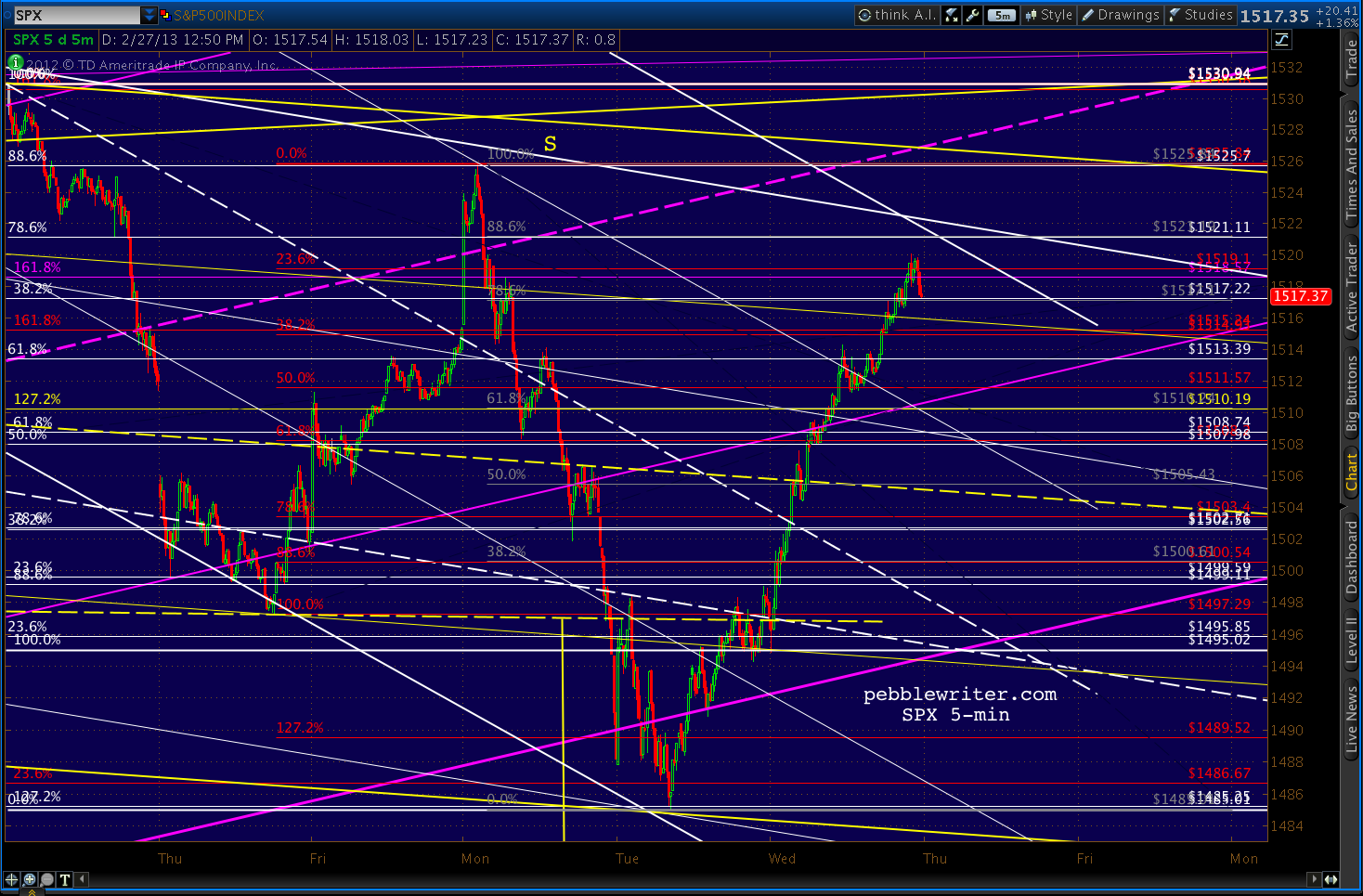
    UPDATE:  12:50 PM

    SPX won’t go down without a fight.  It has retraced almost .886 of its declines from 1521.37, meaning it’s about to reverse at 1520.65 and head lower (a Bat Pattern) or is destined for the 1.618 at 1525.29 — also the .886 retracement of the 1530-1485 decline (1525.70) and the level of the last high on the 25th.

    As noted earlier, a push through 1521 opens up 1526.  SPX has till about 1:30 EST to decide: push up through 1521 or a channel breakdown.

    Note the close proximity of the white channel line, which will always, always offer support… until it doesn’t.

    The RSI picture is mixed at present, so we’ll stay focused on harmonics and channels.  Looking at other indicators, the dollar is hanging in there in its own rising channel.

    It recovered its midline just before equities opened this morning, and broke out of its a channel on its 15-min RSI.  It tagged 82, but hasn’t yet been able to break above — much less reach its short-term target of 82.136-82.281.

    UPDATE:  1:20 PM

    There’s our answer, a breakout above the .786/.886 Fib at 1521.11.

    Playing the long side again, with initial target of 1525.70, trailing stops starting at 1521.

    Charts in a few…

    UPDATE:  2:05 PM

    Getting pretty close, now.  This should also be a tag on the large purple channel midline and the proposed yellow channel top.

    UPDATE:  2:20 PM

    Let’s review the implications to our forecast of tagging 1525.70.  We started into this yesterday, but got interrupted by a pretty wild intra-day ride.

    continued for members(more…)

  • The Big Picture: Feb 27, 2013

    ORIGINAL POST:  6:00 AM

    SPX ended yesterday just below our 1497 trigger point at the neckline.  I know the bulls would love to blow through this level and negate the H&S, but I think they’ve really got their work cut out for them, especially given the political mess in Italy and the looming US sequester.

    Bernanke isn’t likely to say anything new today.  And, judging from AAPL’s price action, the market isn’t looking to Cupertino for salvation.  The durable goods data?  Ho hum…  Saying it was a good number if you ignore defense and aircraft is like saying a shark attack was fine except for those pointy things in their mouths.

    Defense is due to get a lot worse starting next Monday.

    I’d put slightly greater odds on a breakdown of the purple channel.  As for targets, I’ve mentioned the 1474.51 level a lot – the Sep 2012 high and roughly where the SMA 50 was at the EOD (hat tip to Mike for the question.)

    I still think this area has potential, as a retracement to the .886 of the 1576-666 decline would set up a move to 1576 itself.  Why?  Think of stair-steps, where each major Fib tag or break is followed by a back test to a significant lower Fibonacci level.

    continued for members(more…)

  • Charts I’m Watching: Feb 22, 2013

    ORIGINAL POST:  09:25 AM

    UPDATE:  09:30 AM

    SPX overshot our initial target by just a couple of points yesterday, reaching the channel 25% line at 1497.29 before getting the bounce I expected at 1499/1500.  Note that SPX completed a Bat Pattern down to the .886 in the process (larger white pattern.)

    The .618 Fib of the decline from 1530 is up ahead at 1518.09 — also the 1.618 of the 1422-1266 decline last summer (1518.57.) It intersects with the channel midline either later today or early Monday.

    Daily RSI reached the white midline as we expected, and is currently backtesting the purple midline. It’s still too early to say whether the new falling channel I sketched in yesterday is legit or not.

    The dollar is backtesting the channel line it broke through Wednesday after completing a Butterfly Pattern (the small white grid) to the 1.272, but the 1.618 awaits at the confluence of the purple 1.272 and red .618 up around 82.1-82.2 after the backtest is complete (not yet, I think.)

    The big question: what happens after the backtests are complete?

    continued for members(more…)

  • Charts I’m Watching: Feb 19, 2013

    The dollar index has cleared an important hurdle to higher prices.  Note RSI has broken above and is back-testing the red channel on the daily chart.

    Of course, it’s not a back-test until it reverses and stays higher.  The first key level to confirm a breakout are the Jan 4 80.995 high — at which point DX will run into the 25% white channel line.The harmonic picture is muddled at best, as DX has tagged the .886 retracement of the move from 78.725 to 81.515 three separate times – preferring to remain in a trading range rather than breaking down or out.

    Breaking this RSI channel is the first very (potentially) positive news for the bears in quite a while.  One caveat, there’s probably a 50:50 chance that the DX RSI will need to tag the midline of the rising white channel before the reversal really gets going.

    One potential problem here is that the midline and the red channel top don’t intersect until early March, so this could mean sideways currency markets for several weeks — which would likely be accompanied by higher stock prices.

    For the past week or so, I’ve been opening intra-day long positions on strength while maintaining a short core position.  Today is no exception.  I’m closing my intra-day longs here at 1526.50, as we’ve reached a 1.618 Fib level of the latest move up.  A move back up through this level, and I’ll add them back on again.

    I must admit, though, that I find the SPX RSI chart a little unnerving.  If DX looks bullish based on a channel breakout, SPX does, too.  Chart coming shortly — if my internet signal will cooperate.  I’m writing today from a hotel lobby in Lake Tahoe, and the connection is a bit slow.

    SPX is obviously trading above the upper bound of the big rising wedge again today (the yellow TL).  This marks five days in a row, though we’ve managed to close below it every day.  As we’ll discuss today, the next day or two is vitally important to the market’s overall direction.

    I put the yellow TL at about 1524 today (1521 on the arithmetic scale rather than log).  This is drawn from the July 21, 2011 high of 1347(inception) through the Sep 14, 2012 1474.51 high.  IMO, a strong move through this TL would be very bullish and practically guarantee 1553-1555 — with one caveat.

    In 2011, there were three potential Point X’s to kick off the downside and calculate the upside: 1370.58 on May 2, 1356.48 on July 7 and 1347 on July 21.  I referred to these in the post All The Pretty Butterflies in calling the April 2012 high.

    I favored the 1347 high because it best fit with the definition of a Butterfly – a Point B reversal at the .786 retrace. The 1356.48 Butterfly didn’t quite reach its .786, and the 1370.58 Butterfly didn’t come close.

    As we found out, the 1347 pattern was the correct one.  It signaled a reversal at its 1.272 Fib of 1421.05 and, in fact, the market reversed at 1422.38.  The decline from there to 1266 set up another Butterfly Pattern (in purple). The 1.272 actually targeted 1464, but SPX stretched to reach the .886 of 1576-666 at 1472 (ultimately reaching 1474.51).

    Because 1347 figured prominently in two important patterns, and neither of the other potential point X’s have seen any real reaction off their Fibs, I have pretty much discarded them.

    But, I show them above just in case.  This market is currently flouting, if not completely ignoring, the rules.  And, the 1356.48’s 1.618 at 1530.58 might suddenly decide to assert itself.  It’s just above current levels and would make for a nice intra-day high.

    And, the 1370.58’s 1.618 at 1553.39 lines up very nicely with the 1.618 extension of the 1474-1343 decline (yellow pattern.)  It also would fulfill a measured move I’ve been tracking.

    On the chart above, the distance from (2) to (3) is 207.77.  Adding 207.77 to the 1343.35 low (4) yields 1551.12 – right there with those 1.618 Crab Pattern completion points. If SPX can break through 1530.58, there are no other Fib levels between there and 1553.

    Obviously, we are still looking at strong negative divergence on the daily and 60-min charts. And, with the sequester looking more and more likely, we’re not lacking for a catalyst. But, the market continues to shrug off some pretty strong headwinds.  I still wouldn’t commit new capital at these levels, and I sure wouldn’t be long and unhedged. But, a close above that yellow trend line and 1530.58 Fib would be hard to ignore.

    More later.

    UPDATE: 2:00 PM

    SPX broke back above 1526.50, so I put the intra-day long on yet again.  As we approach 1530.58, I’ll take another stab at lifting it.  We’re certainly not making any money with this approach, but I’m much less concerned with a sudden 30-point updraft than a sudden 100-pt downdraft.  I seem to have plenty of company, however, and this concerns me.

    OTOH, today’s USA Today headline reads: Mutual Funds Breaking Records.    The only thing missing is the exclamation point.  Inside the Money section, you can take your pick of “Has Dow Outgrown Crazy Days?”, “It’s Hard Out There for a Repo Man” and the imponderable “Fast Foreclosures Help Home Prices.”

    Turns out judicial foreclosures slow things down because the banksters are occasionally restrained by the rule of law (that must really suck for them.)  When it takes too long to kick families out of their homes, it creates “real uncertainty.”  Of course, so does having your former neighbors living out of their Toyota.  Guess that’s where the repo man comes in.

    More shortly.

    UPDATE:  2:45 PM

    Taking another stab at an interim top here at 1530.50 — lifting the intra-day long, full short again. Tight stops on this sucker; as mentioned above, whole lot of blue sky between 1530 and 1553.

    Remember, this is the 1.618 of the Crab Pattern formed by the 1356.48 to 1074.77 decline between July and October 2011.  Downside targets that matter include 1474.51, of course. But, first, let’s think about the scenario that would confuse the most people: a decline to 1490-1497 that would leave open the possibility of a new Butterfly/Crab higher to 1553-1555.

    I’m being summoned for Dad duty (the kids are off school this week and it’s snowing outside – yay!) so I’ll leave it at that for the time being.  I’ll be back later this evening to tidy things up and answer any questions.

    GLTA.

  • What Gives? Feb 13, 2013

    It was worth watching the SOTU last night just to see Boehner’s contortions, trying to scowl in a dignified, statesman-like way.  Nothing much new in the speech or the response.

    More interesting was Mitch McConnell’s comment on CNBC last night that the sequester will go into effect. I don’t know any reputable economist who believes we can go through sequester without a sizable hit to GDP.

    But, the market is ignoring the tenuous economic situation and continues to edge higher.  What gives?  Aside from the $85 billion mainlining into the banks every month courtesy of the Fed, that is…

    Zerohedge ran a BofAML study last night that pretty much says it all.  The market is currently reflecting bullish sentiment that’s higher than almost any time since 2002.  I imagine it’s even a little higher this morning.

    Most past ventures into this sentiment range have not ended well for the markets – especially when there is a huge divergence between soaring markets and faltering economic backdrops, as the charts below show.

    Notably, the market is ramping these past few days on negative divergence in every single time frame – from weekly on down to 5-minutes.  And, it has completed some very significant harmonic patterns at the very top of a massive ending diagonal/rising wedge that’s precisely aligned with several previous tops (Jul 2011, Apr 2012, Sep 2012.)

    SPX surpassed our IHS target of 1522.60 from yesterday.  I’m closing out longs here at 1524 and will play the downside.

    UPDATE:  3:15 PM

    Getting a nice little push to the downside here — now 7 points off the daily high.  The white channel line that had been providing support is now providing resistance at around 1518.60 (the purple Crab’s 1.618 Fib is 1518.57.)

    SPX just completed a little H&S pattern that targets about 1510.80.

    Stay tuned…


  • Charts I’m Watching: Feb 7, 2013

    Nice little intra-day sell-off again yesterday, culminating in a last minute positive close — another shake-and-bake by your friendly neighborhood market makers to separate you from your hard-earned money. Look for more of the same today.

    Today’s news is all about currencies.  Draghi’s comments are successfully taking some of the bloom off euro’s today.  The euro is up 11% since Draghi’s “whatever it takes” speech last July 26.  What has it gained them?

    Oil got a little cheaper — at least through the end of the year.  Germany might not care, but  Spain, Italy and France exporters are feeling the pinch at a time when they can ill afford it.

    IMHO, this will set up a battle of political wills between the haves and have nots in the EZ.  Bucking the global trend and trying to achieve nominal growth without more accommodative monetary policy is doomed from the get-go.

    The EURUSD chart shows how the market feels this will ultimately be resolved.

    Though the pair will likely find support right about here — an important Fib line (red .618) and the intersection of two prominent channel lines.

    The top of the big falling white channel is still out there as an upside target.  Timing would determine price, of course, since the channel features a fairly steep slope.  But, the range currently includes the red .886 at 1.3995 (the top of the purple channel), the white .500 at 1.3956 and the purple .618 at 1.3832 (the purple midline.)


    SPX isn’t enjoying the plunge in the EURUSD.  I’m taking an intra-day short position with the channel line cross at 1508 with a target of 1497.29 – 1499.29 — the .886/.786 of the latest run up.  Charts in a few.

    60-min RSI shows likely downside to at least the red midline and white channel bottom.  This likely translates into the .886 at 1497.29, but the purple midline is way down at 1492, so I’ll give it some rope (and reconsider our upside target) if SPX dips below 1495.


    continued for members(more…)

  • Trading with Harmonics

    The first of a two-part article on harmonics trading strategies.

    Part 1.  January 28, 2013

    Harmonics are a great source of information about the market, but they don’t tell you how or when to trade any more than do MACD crosses or breadth indicators.  So, how do you use them?  This discussion of the basic process might serve as a good starting place for beginners.

    I consider harmonics like trade alerts.  That is, every time we approach an important Fib level, I stop and consider whether the market is likely to react or not, then make a trade decision accordingly.

    There are pages for each specific pattern under the Learn>Harmonics tag on the Home Page.  But, they all relate to one another.  Let’s walk through a real world example.

    SPX has fallen from 1576 to 666 and seems to have bottomed (how to know it’s bottomed is the real trick.)  I draw a Fibonacci Retracement grid on the price range (100% for 1576, 0% for 666) and make sure every important level is showing as on the chart below.  For a discussion of Fibonacci levels, click here.


    ThinkorSwim makes this very easy with a built-in drawing tool, as do many other platforms.  If your platform doesn’t provide it, you might want to think about changing, or at least opening up a TOS account to facilitate your charting (and, no, they don’t pay me to say that.)  You can read about harmonics and study the charts I post, but there’s no substitute for doing your own charting.

    Back to our example: because we went long at the very bottom, we set our sights on the higher Fib levels.   All harmonic patterns are marked using the letters X, A, B, C and D.The inception point (high) is X, the low is A.  B is the first reversal, C is the next, and D is the completion. The location of the reversals relative to specific Fib levels tells us what kind of pattern we probably have.

    Suppose we’ve watched SPX climb all the way up to 956, where there’s a 9% correction down to 869.  Because this reversal occurred below the .618 Fib level, we might have a Bat Pattern on our hands.  Bat Patterns complete at the .886 (1472) so we’ll make a note of that for future purposes and consider 956 a potential Point B.

    We sail right through the .382 and .500 levels, then experience another 9% correction at just above the .500 (1150 to 1044.)  Again, it’s below .618, so it could be signalling a Bat Pattern.  But, it’s a relatively minor reaction, so we treat it as only a potential Point B.

    Now we’re approaching the .618 at 1228.74 — the most important of the Fib levels.  Because the two prior reversals were pretty tame, we might suspect more from this one. We begin to contemplate a short position, and look for other signs of a reversal.

    Because we’ve been watching closely, we notice a smaller Crab Pattern setting up as we approach the .618 (the purple pattern below.)  It features a Point D at 1215.93 — slightly below our .618 at 1228.74.  So, we feel pretty confident about this being a good trade entry.

    Are there other chart patterns such as a rising wedge, channel, fan line, etc. that also hint at a reversal?  In fact, there’s a nice channel that’s formed over the past 9 months, not to mention a broken RSI channel (in red) just shy of the Crab completion.  And, we’re nearing the 1240 target of the Inverted Head & Shoulders pattern completed at the 2009 bottom.

    These would all be good reasons to consider a short.  Taken together, they make for a pretty compelling argument.  Where, though?  Other traders are watching the same charts we are, so there’s a chance the reversal will come a little early.  We don’t wait to wait too long and miss the top.  But, of course, every point too early is a point of lost profit.

    In the end, timing is a judgement call based on many factors, including liquidity, risk tolerance, the type of instruments we’re trading, other positions in the portfolio, etc. and is worthy of its own article.

    Let’s assume we make the decision to open a short position around 1213 on the April 15 — in case SPX doesn’t make it all the way to 1215 or 1228.  We feel pretty good about our decision when SPX is down to 1186 the following day and 1183 the next.  That’s a 2.5% move in two days — not bad.

    On the third day, however, our plan is looking iffy.  SPX gaps up on the open and hits 1208.  Three days later, it pops above the Crab target of 1215.93 and tags 1217, seemingly in search of the .618 at 1228.74.

    Suddenly, we’re underwater by 15 points or 1.25%.  Is it time to bail?  Again, it depends on the type of investor you are.  Options traders might have closed their puts for large profits already, while swing traders might be happy as long as SPX doesn’t exceed 1230-1235.  Buy and hold types might have used the Fib level as a warning of a potential downturn and hedged or lightened up on their long positions.

    Checking our charts, we can see that neither the price nor the RSI channels have been broken to the upside.  In fact, the little red RSI channel which helped convince us of the downside potential shows the latest push higher came with a lower RSI score (negative divergence) and a pretty pathetic back test.  So, we’re inclined to hang in there.

    It turns out to be a great decision.  The following day, RSI plunges through the midline of the purple channel.  SPX plunges 38 points from its high, stabilizes for four days, then really starts falling apart.  On May 4, SPX reaches the white channel midline, a possible bounce spot.  We’ve already made 4.5% since shorting at 1213 less than 3 weeks ago.  Time to bolt?

    To be continued…

  • Now What?

    First, a quick overview…

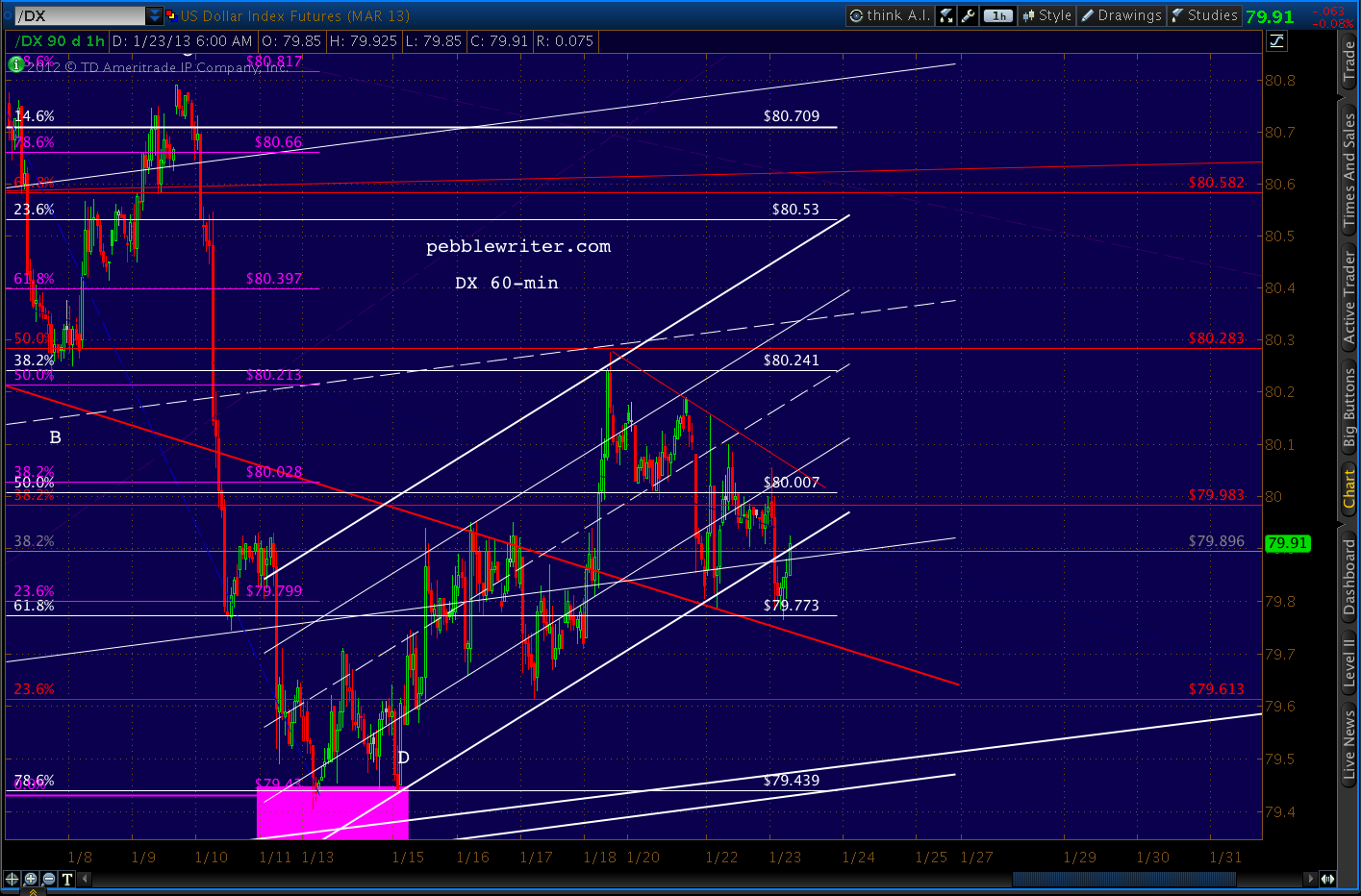
    The dollar got clobbered overnight, knocking it temporarily out of the white channel that’s guided it since Jan 11.
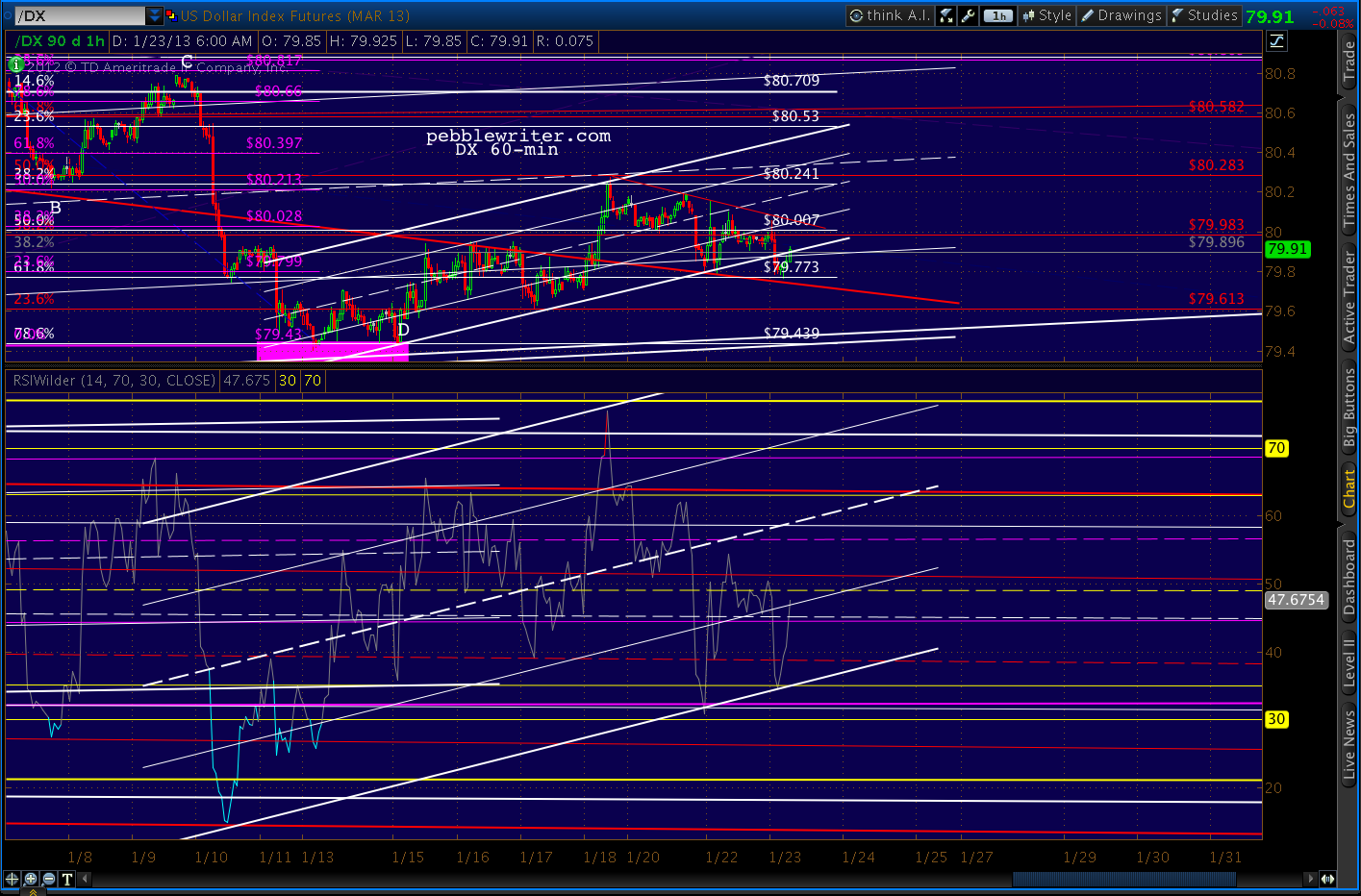
    But, interestingly, its RSI channel is doing just fine, thank you.
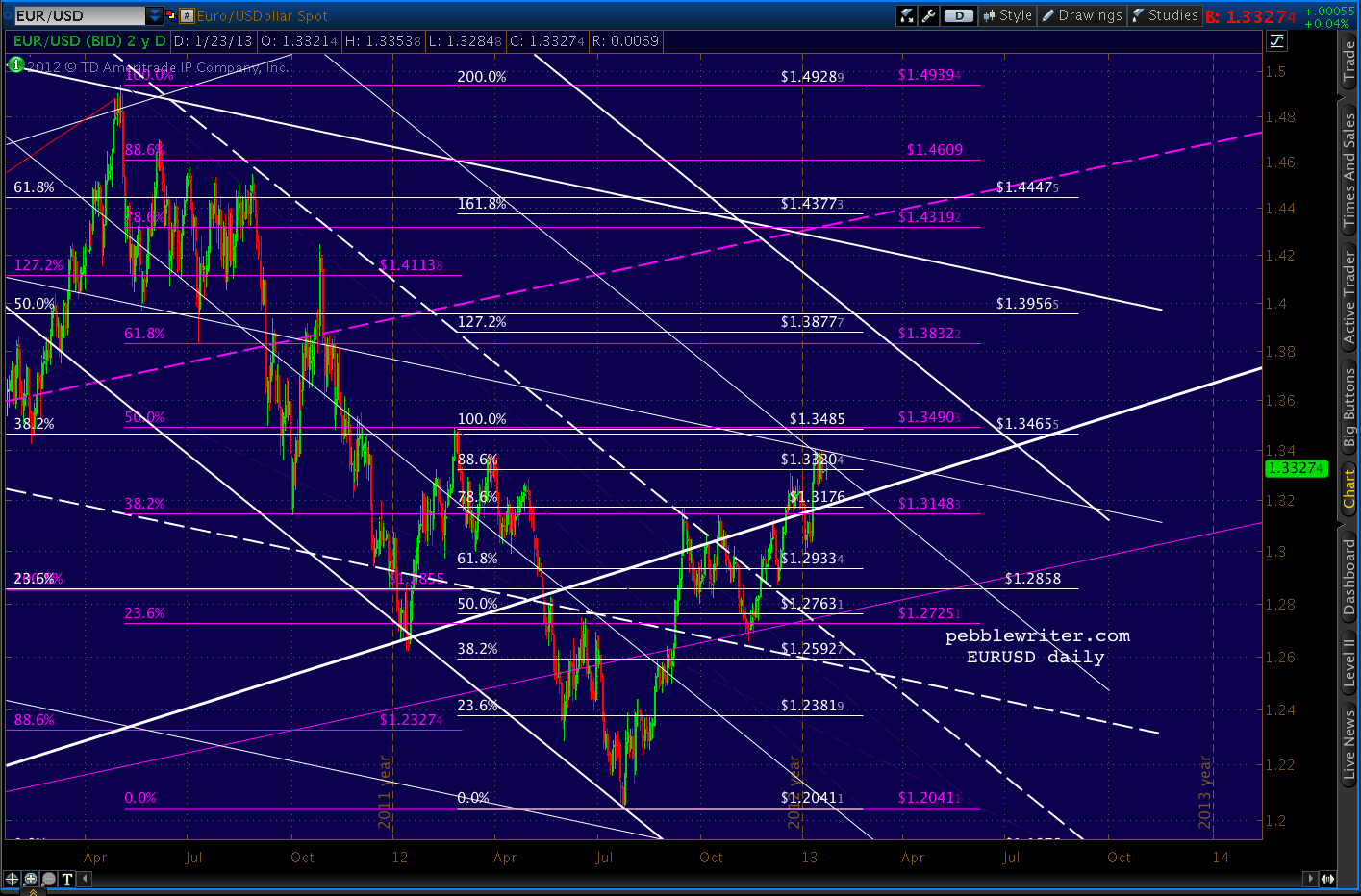
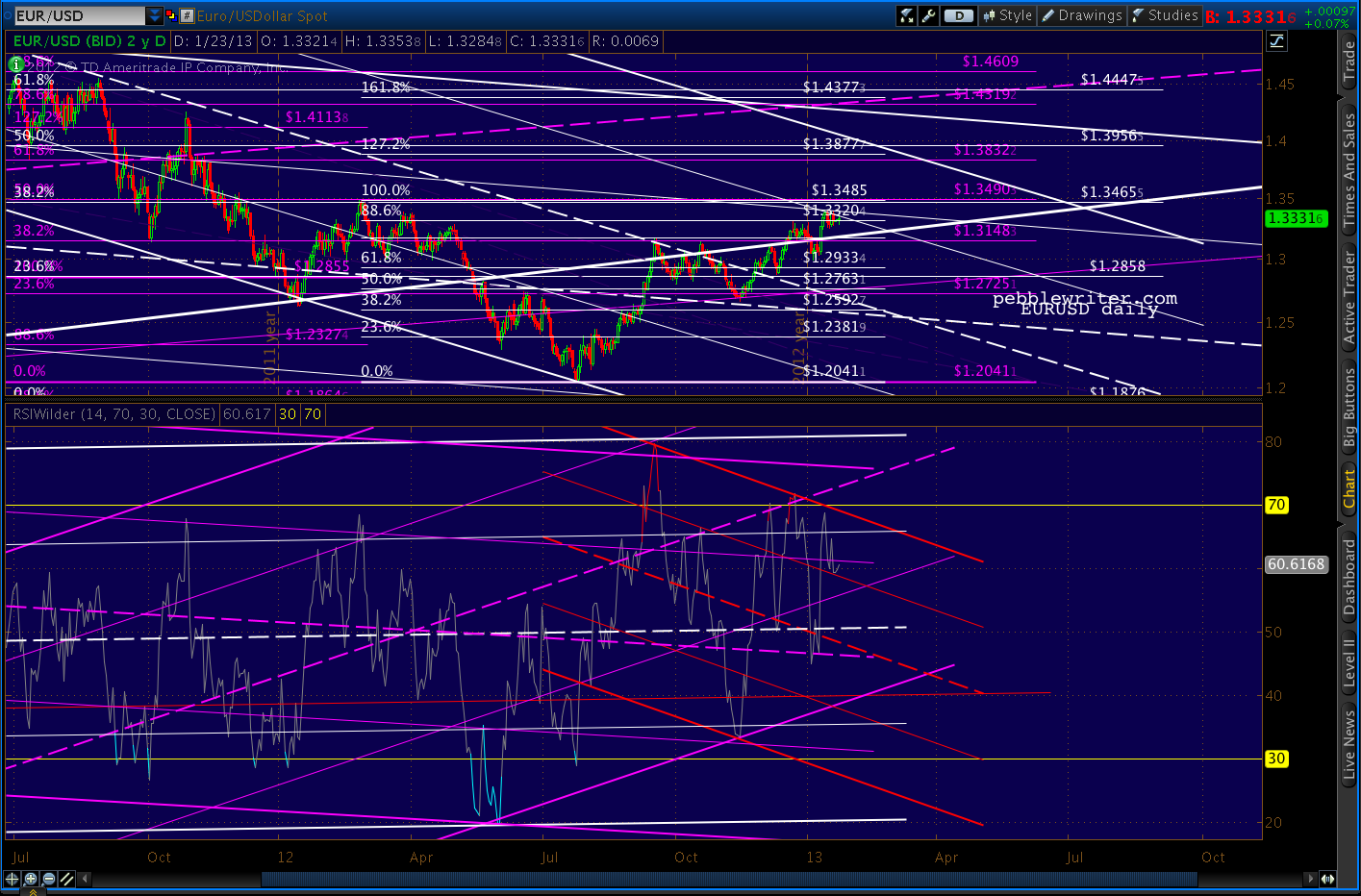
    The EURUSD continues to levitate, but still hasn’t broken the last important interim top put in on Feb 24.  It is also bumping up against two 25% channel lines, so could very well stall out here at the .886.
    There is still ample negative divergence regardless of which channel ultimately wins out.
     

    With the market exceeding the recent 1474 highs, the analog that did so well for us since last April is officially dead.  This begs the question: “now what?”  I see three big issues hanging over the market right now:

      1. earnings season —  AAPL in particular
      2. the US budget/debt ceiling imbroglio
      3. new highs justified?

    Earnings

    GOOG and IBM both gapped up this morning, but the earnings that can really move the market — AAPL — comes after the close.  We’ll take a fresh look at the AAPL chart later today.

    Budget/Debt-Ceiling

    In a few hours, the House will probably pass a measure to postpone the debt ceiling debate until May.  Reid and Obama have both said they’re on board, so this appears to be a done deal.  If House Republicans don’t fall in line, as occurred with “Plan B,” the market will sell off precipitously.

    New Highs

    The market’s strength has caught many off guard, including yours truly.  Many are calling for new all-time highs for SPX. The 2007 high of 1576 is now only 84 points away, so a few good sessions could do it.

    We’ll take a fresh look, focusing on the harmonic and chart pattern picture as well as the establishment agenda.  “What’s that?” you say.  Say all you want about random walks, CAPM, dividend discount models and Dow Theory.  Like any government-managed enterprise, the market is subject to the policy goals and needs of those who attempt to control it.

    Even to my cynical ears, this sounds a bit like rants from the tin-foil hat crowd.  But, consider the news on Egan-Jones yesterday.  This is one of the biggest stories of the month, yet predictably earned only this from WSJ/Marketwatch:
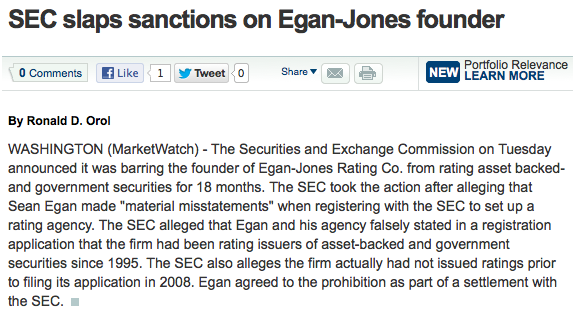
    CNBC was slightly more generous, yet still presented only the SEC’s side of the story.  It’s a story that deserves to be told because it speaks volumes about the degree to which the market is presently being controlled.  And, I’m not just talking about quantitative easing, though I suppose we’d have to consider QE exhibit #1.

    Last summer the market crashed 22%.  It was an analog (replay) of the 2007 top, so we saw it coming in plenty of time to profit quite handsomely.  But, it was a huge wake-up call for The Powers That Be (TPTB) or Plunge Protection Team, Wall Street Cabal — whatever you want to call it.

    With virtually unlimited power and unlimited resources, why couldn’t they prevent something like that from happening?  More importantly, if the top was a replay of the 2007 top, might the rest of 2011 play out like 2008-2009?

    It didn’t, because they learned from the crash of July-August.  First, they tweaked the markets just enough to bust important chart patterns that were playing out.  Second, they tweaked the rules to provide for more time to contain any damage which might otherwise occur (circuit breakers, etc.)  Third, they attacked those who had “caused” the crash.

    S&P CEO Deven Sharma was one of the first victims.  In the wake of the 2007 financial crisis, S&P was rightly pilloried for having pulled its punches — particularly on mortgage and banking related debt.  This was no surprise to anyone who’s ever worked on Wall Street — which pays for these supposedly unbiased views.

    An infamous exchange between two S&P analysts in April 2007 aptly illustrates:

    “BTW, that deal is ridiculous.”

    “I know, right . . . model def(initely) does not capture half the risk.”

    “We should not be rating it.”

    “We rate every deal. It could be structured by cows and we would rate it.”

    Imagine if Hollywood studios funded the reviews of their movies.  Would you care if they received thumbs up or down?  So, in August 2011 S&P found religion and bravely downgraded US debt.  Seventeen days later, Sharma was fired and replaced with the COO of Citibank, the bank whose existence relies on the absence of any future downgrades.

    Egan-Jones beat S&P to the punch, downgrading US debt on July 16.   Two days later, the SEC’s Office of Compliance Inspections and Examinations called looking for information on the downgrade.

    On October 12, Egan Jones was formally notified of a Wells Notice — they were being investigated.  On April 24, the SEC filed a cease and desist order against Egan-Jones — the only rating firm not on the take — stating the action was “necessary for the protection of investors and in the public interest.”

    The financial establishment’s interests, sure.  But, to frame this obvious smack down as “in the public interest” is laughable alarming.  Egan-Jones was the one rating firm with the balls to point out the country’s crumbling financial condition and stick to their guns.  Now they’ve been branded as deceitful, dangerous.  George Orwell spoke the truth in 1984:

    “In a time of universal deceit, telling the truth is a revolutionary act.”

    That other deep thinker, Jim Morrison, provided a similarly profound observation:

    “Whoever controls the media controls the mind.”

    The extent to which the market has been manipulated is deserving of its own post.  But, this Zerohedge article, forwarded by a member, is a great preview.

    Okay, so I know what you’re thinking: if the market is so heavily manipulated (and, presumably, insulated from downturns) why bother trying to beat it?  Simple.

    1. Chaos theory tells us they won’t have enough fingers to plug every hole in the dike (TPTB have similar “never again” strategy sessions after every crash.)
    2. Even when things do run as programmed, we can still effectively capture enough significant swings in the markets enough of the time to boost returns and, more importantly, try to avoid huge downdrafts.

    Over the very long-term, stocks return 8-10% — depending on the time frame examined.  But, sadly, most of us are limited to 40-60 years of investing.  And, a 60% crash right before starting a business, buying a home or beginning retirement could be devastating.

    So, we’ll keep plugging away, letting the markets tell us where they want to go…while trying to get there first.

    So, the question is “Now What?”  We’ll start by looking at the harmonic picture.  As detailed in our last review of all the previous tops, harmonic patterns are very likely to come into play.  So, we’ll start with the charts, then move on to the agenda question and, last take a look at AAPL.
    Since we’ve exceeded the range at which this rally could be considered a double top, we’re probably going higher still. So, we’ll examine the 1.272 and 1.618 extensions.

    In terms of a trading strategy, I’d be comfortable going long here at 1491.  But, disappointing AAPL earnings could knock the stuffing out of the market.  So, those with weak hearts should probably stay on the sidelines until tomorrow morning.

    The most recent patterns show a few possibilities, some of which are clumped together in fairly narrow ranges.  The largest of the patterns — the yellow grid — shows a 1.272 Butterfly Pattern extension at 1510.19 that intersects with the 2.24 extension of the decline (purple grid) from 1448 – 1343.

    A Butterfly Pattern is a good bet, as the Dec 18 reversal at 1448 pretty much nailed the .786 Fib level Point B (1446.44) which Butterfly Patterns require.
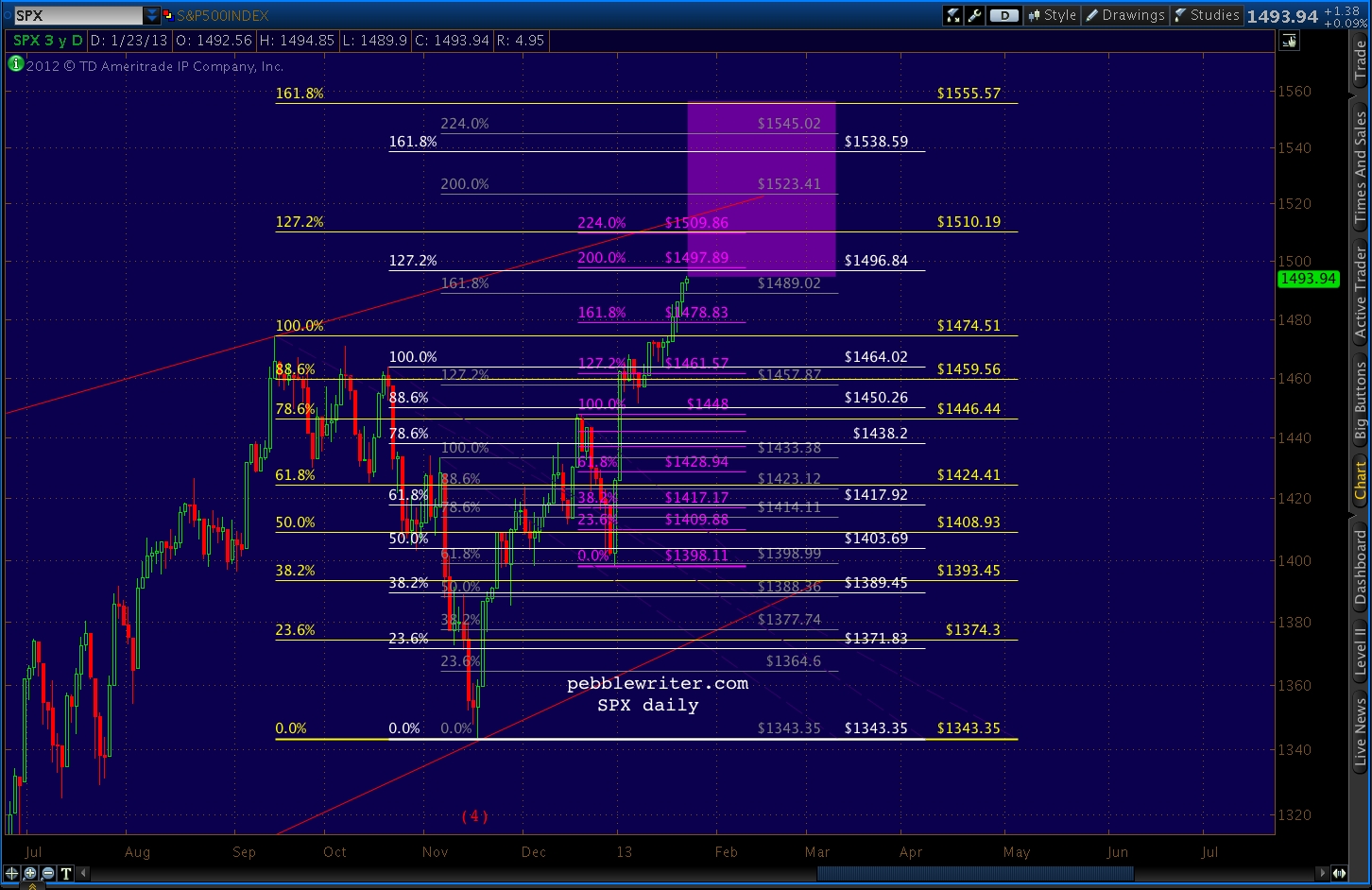
    1510.19 also falls within the confines of the thin red line — the TL connecting the Apr 2 and Sep 14 highs that would probably satisfy the EW requirements of an ending diagonal.  I know you’re out there, my Waver friends.  Please weigh in, as I know only enough EW theory to be dangerous.
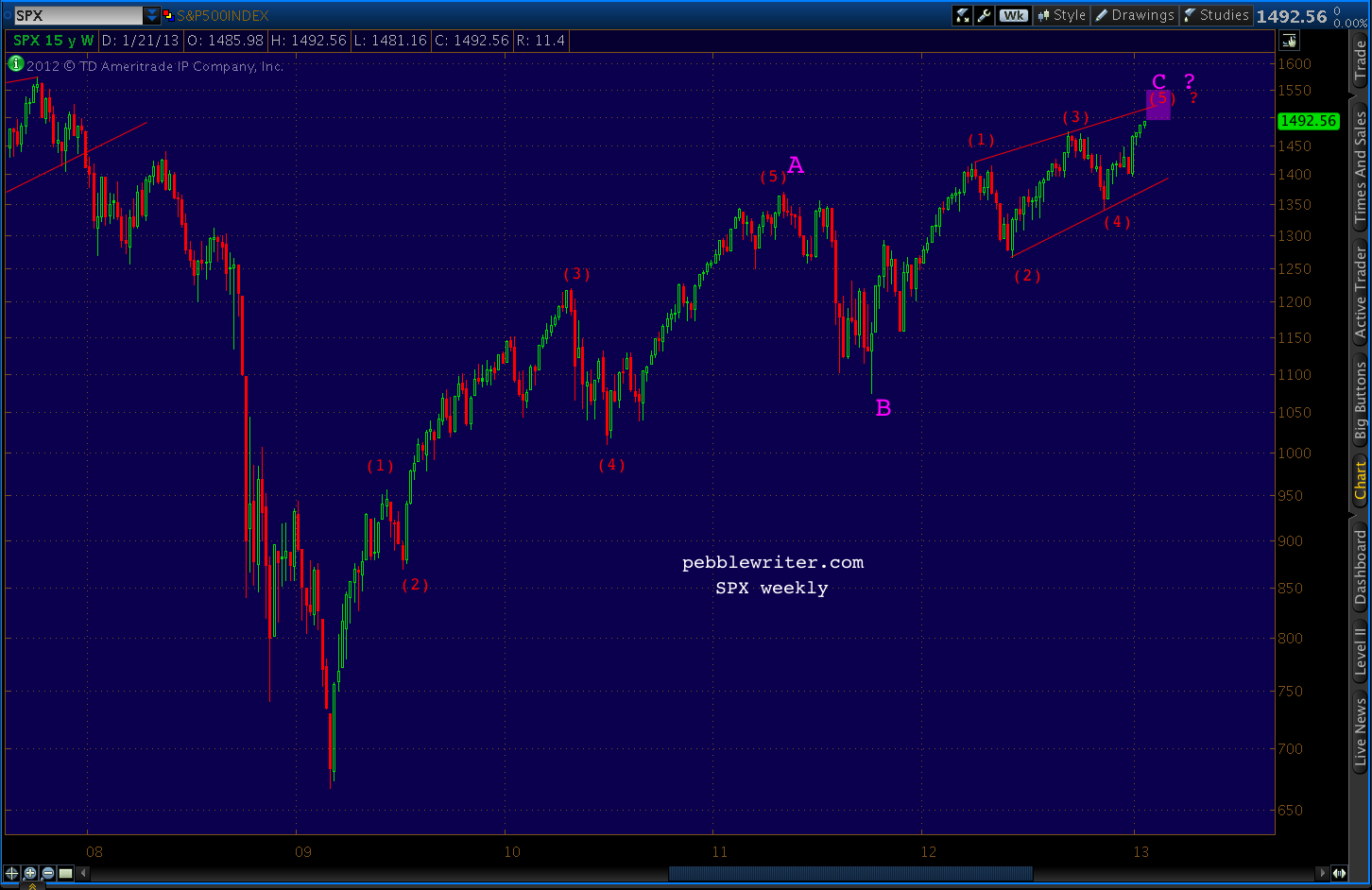
    The white pattern is appealing enough, but I would have to consider it secondary in importance to the yellow since it began at a less momentous point X.  Ditto for the grey pattern.

    Although it should be noted that we faced a similar dilemma when choosing between the Point X’s for the Butterfly patterns beginning in 2011 [see: All the Pretty Butterflies.] In the end, it was a point similar to the white pattern 1.0 Fib at 1464.02 that determined the April 2 turn.  It featured a Point B closest to the .786 Fib.

    Zooming out, we can see that the 2011 highs could very well still influence the outcome of the current top.  The chart that includes everything is a little busy…
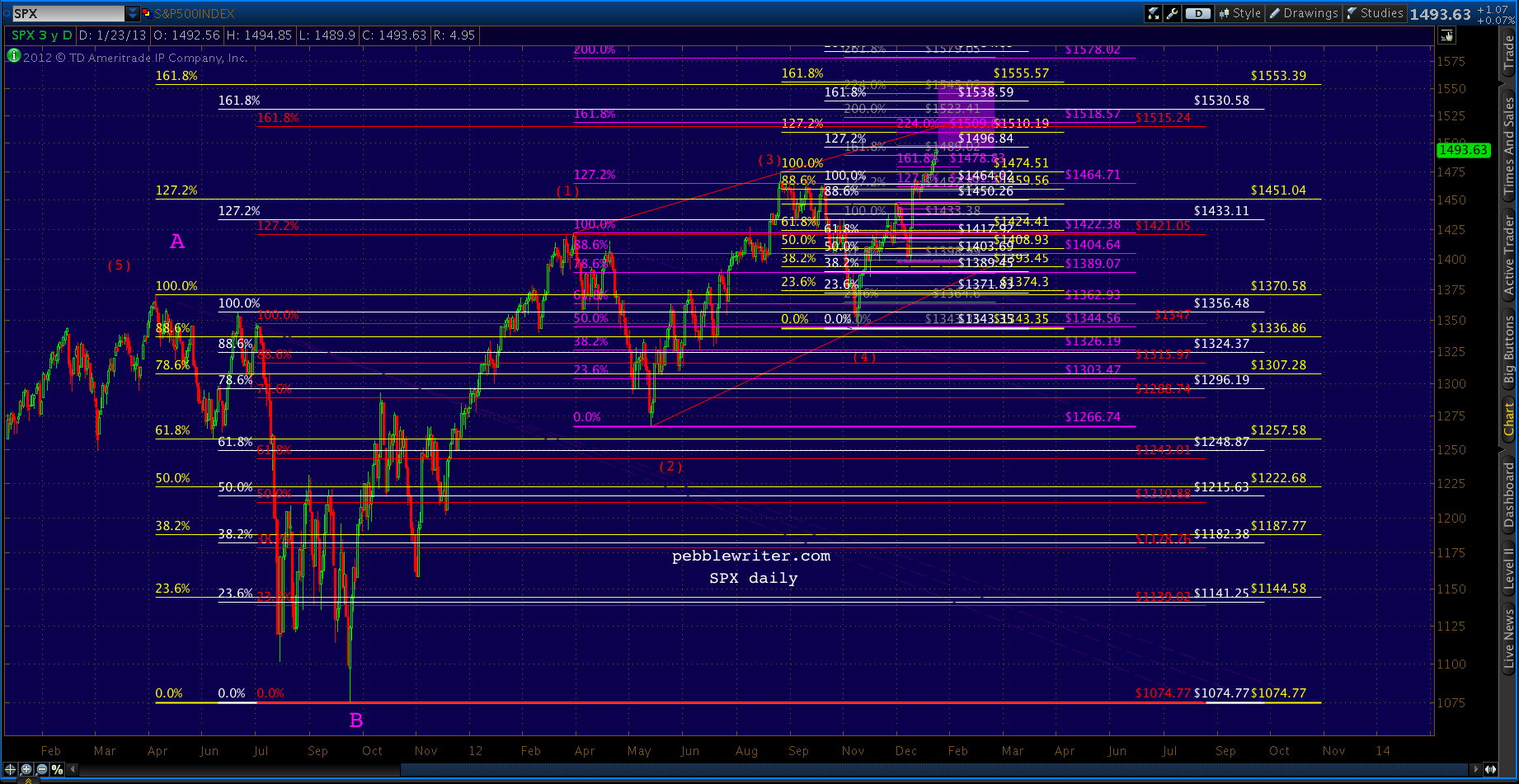
    …so I’ll clean it up by eliminating the interior retracement levels and switching to weekly.
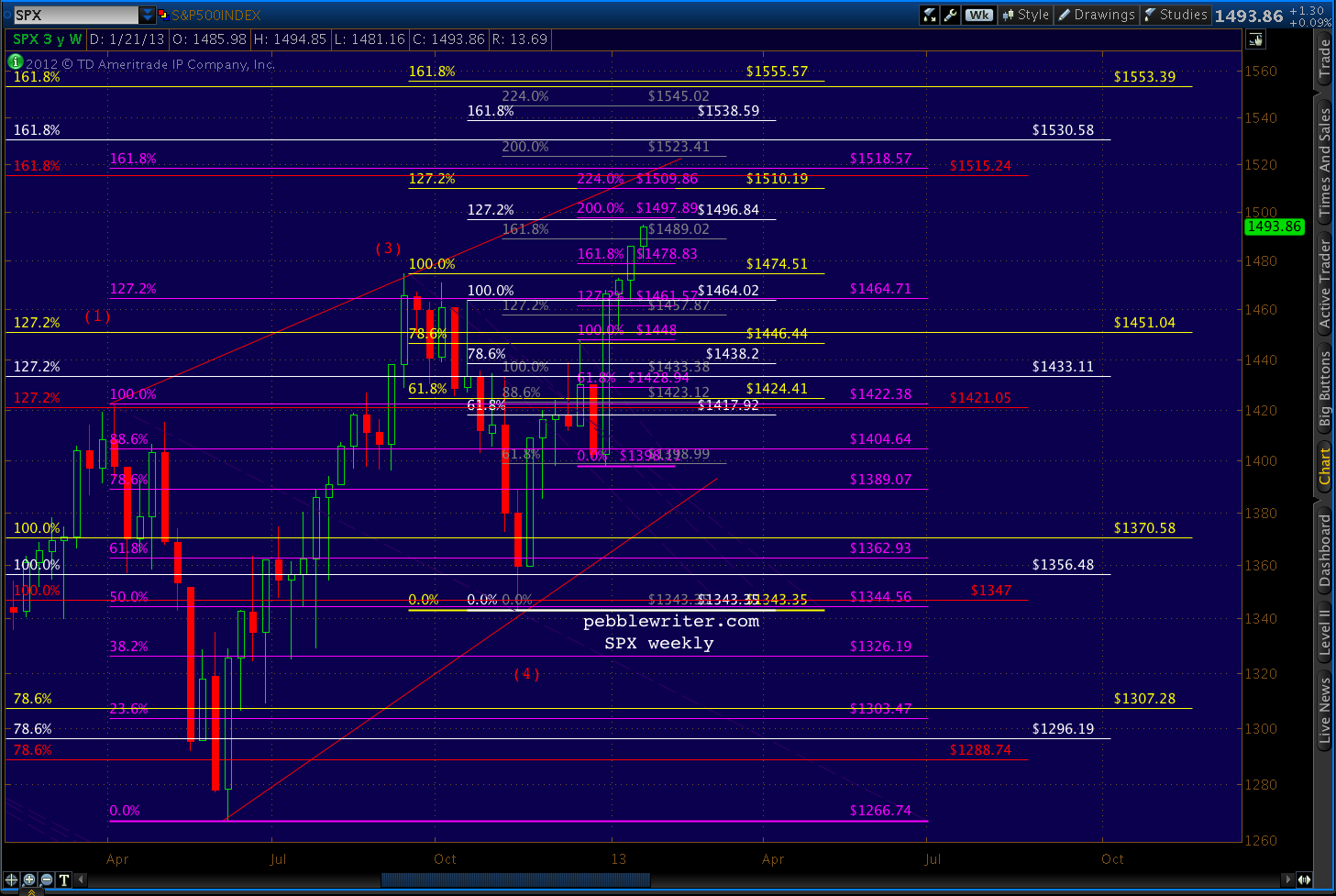
    The target areas can be more easily seen in this close up.
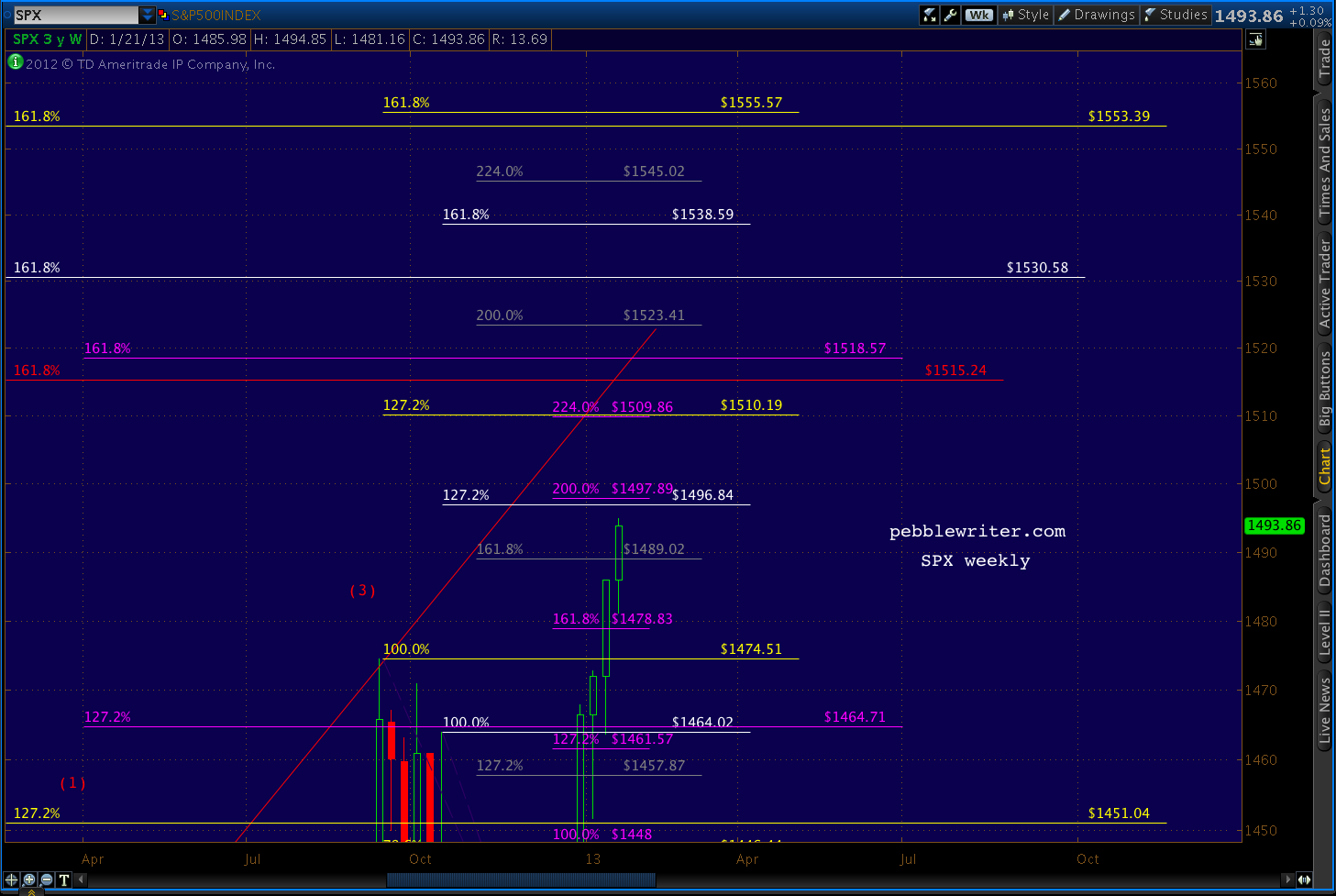
    Note that the large red pattern, the one whose 1.272 extension helped me accurately forecast the April top, comes into play at its 1.618 extension of 1515 – only a few points away from the 1509-1510 level discussed above.

    This is promising, as patterns that influence markets once (that was an 11% correction, after all!) are more likely to do so again.  And, patterns that the market completely ignores — such as the yellow and white patterns from May and July 2011 — are less likely to suddenly leap into a position of authority.

    And, there’s also a purple 1.618 extension (set up by the 1422 – 1266 decline) at 1518.57.  Again, this is close enough to be considered significant.

    If 1520 is exceeded, then we’ll look at the next higher grouping: 1553-1555.  This “group” is basically the two yellow 1.618’s.  Again, the larger pattern’s 1.272 had no influence on the market.  The smaller pattern’s 1.272 is the one coming up at 1519.

    Summary

    My leading harmonic forecast is for 1509-1515.  I can’t imagine getting this close to 1500 and not snagging it for the trophy case.  And, I like the idea of dancing with the harmonic patterns that brung us.

    My secondary goal is slightly higher at 1553-1555, so there should be opportunities to jump back in and capture most of any upside above 1520 if/when appropriate.  Such a move would likely follow a reversal from 1509-1515 back down to 1474ish and would constitute a fifth wave rather than the ending diagonal suggested above.

    If AAPL’s earnings stink up the joint after the closing bell, going long won’t have looked very smart.  But, judging from the steadily appreciating share values, I’m guessing that a relatively positive result is already being leaked.

    Chart Patterns

    I won’t rehash the stuff already posted in the past couple of weeks.  Just take a look at the rising wedge that would be confirmed by a reversal at 1510 as early as tomorrow.  The target would come at the .886 of the base to apex price range and .618 of the time range (almost too good to be true.)
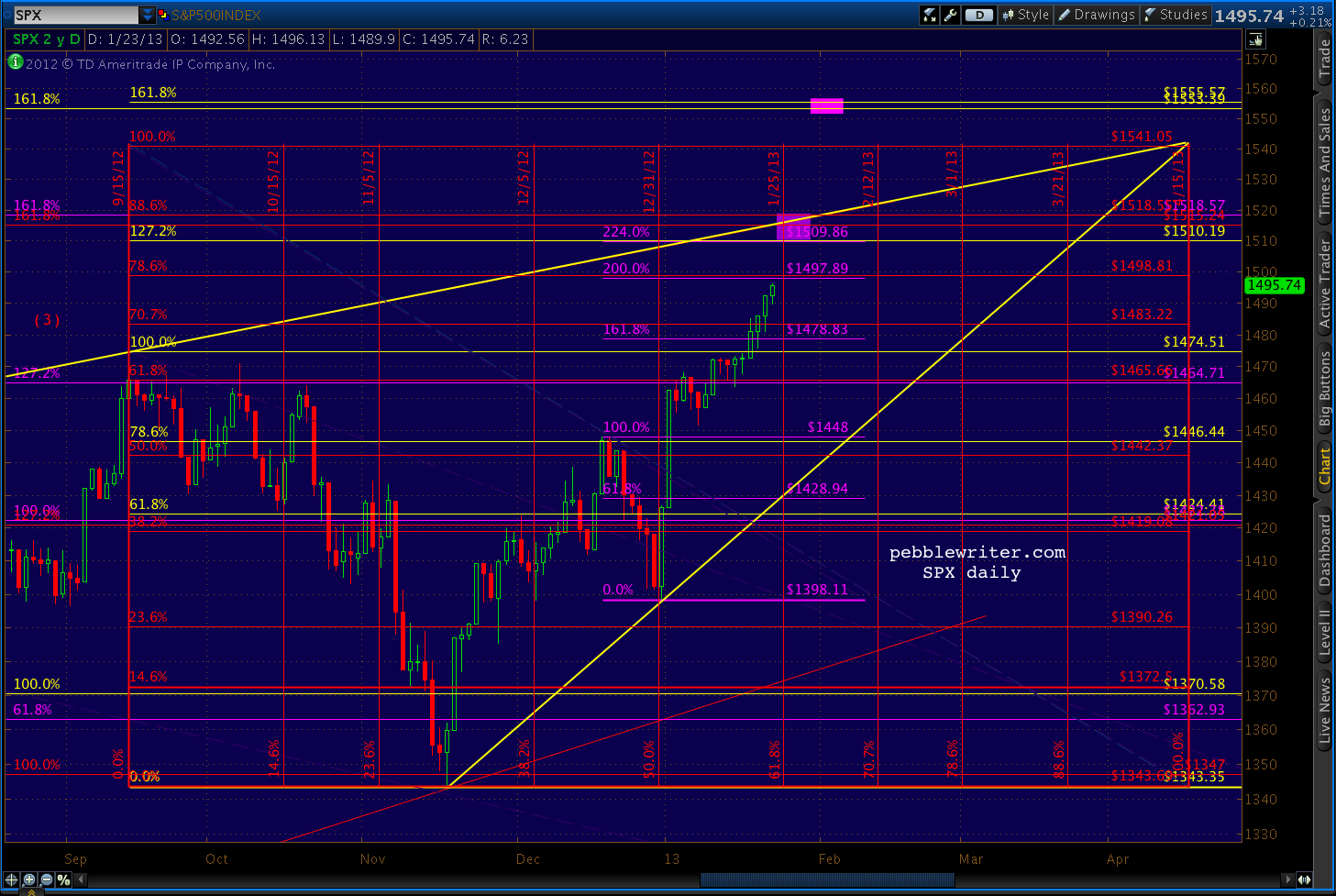
    We’re currently very close to the .786 of 1498, which tells me there’s a decent chance of a run up to 1500ish into the close.

    UPDATE:  3:45 PM

    AAPL is up almost 9 points at the moment.  A rally past 1426 would take it up out of the falling white channel it’s been in since last August.
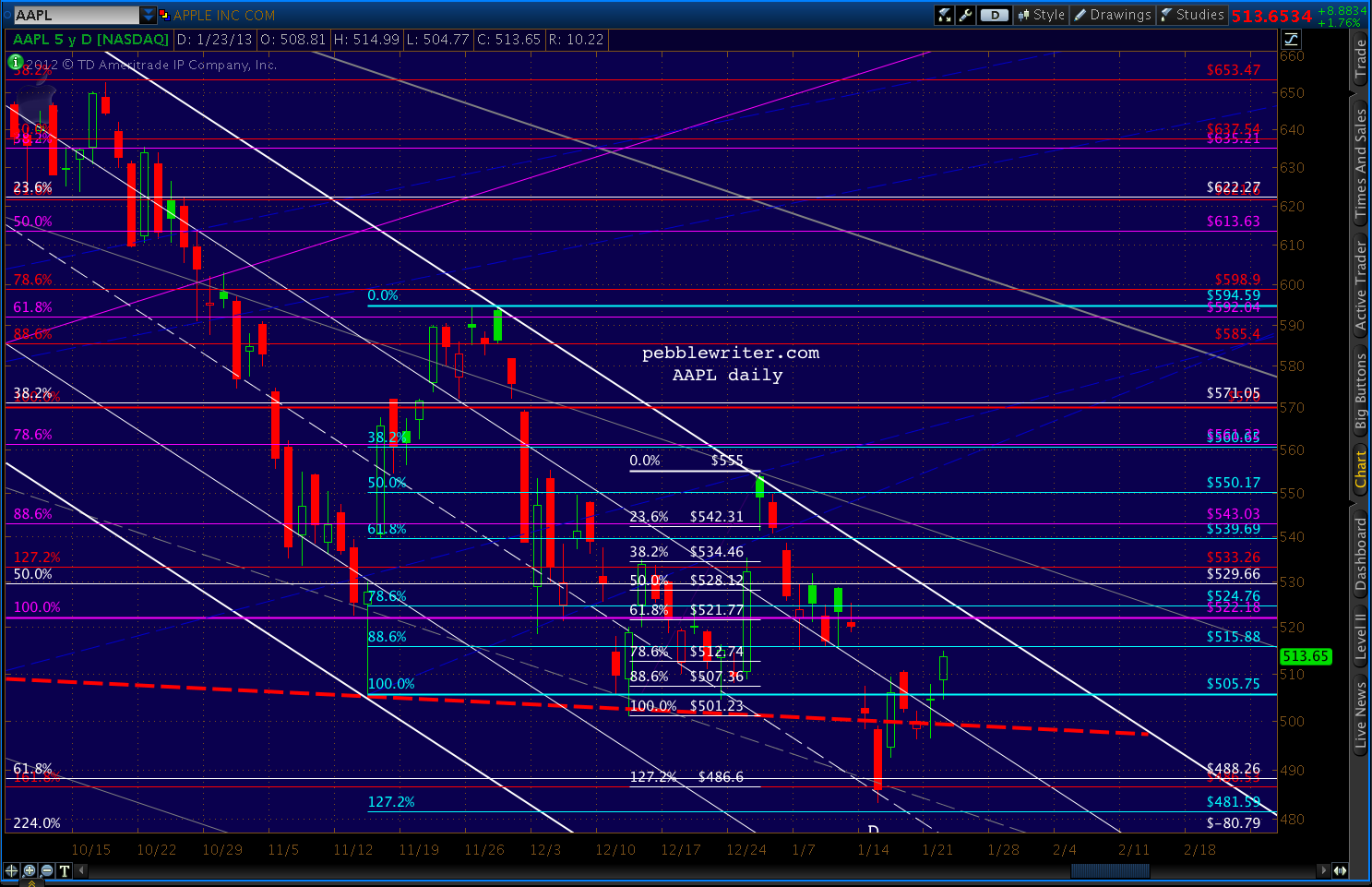
    Anything over 515 would take RSI above the white and purple RSI channel midlines.   So, as expected, much is riding on the earnings report and how it’s perceived.
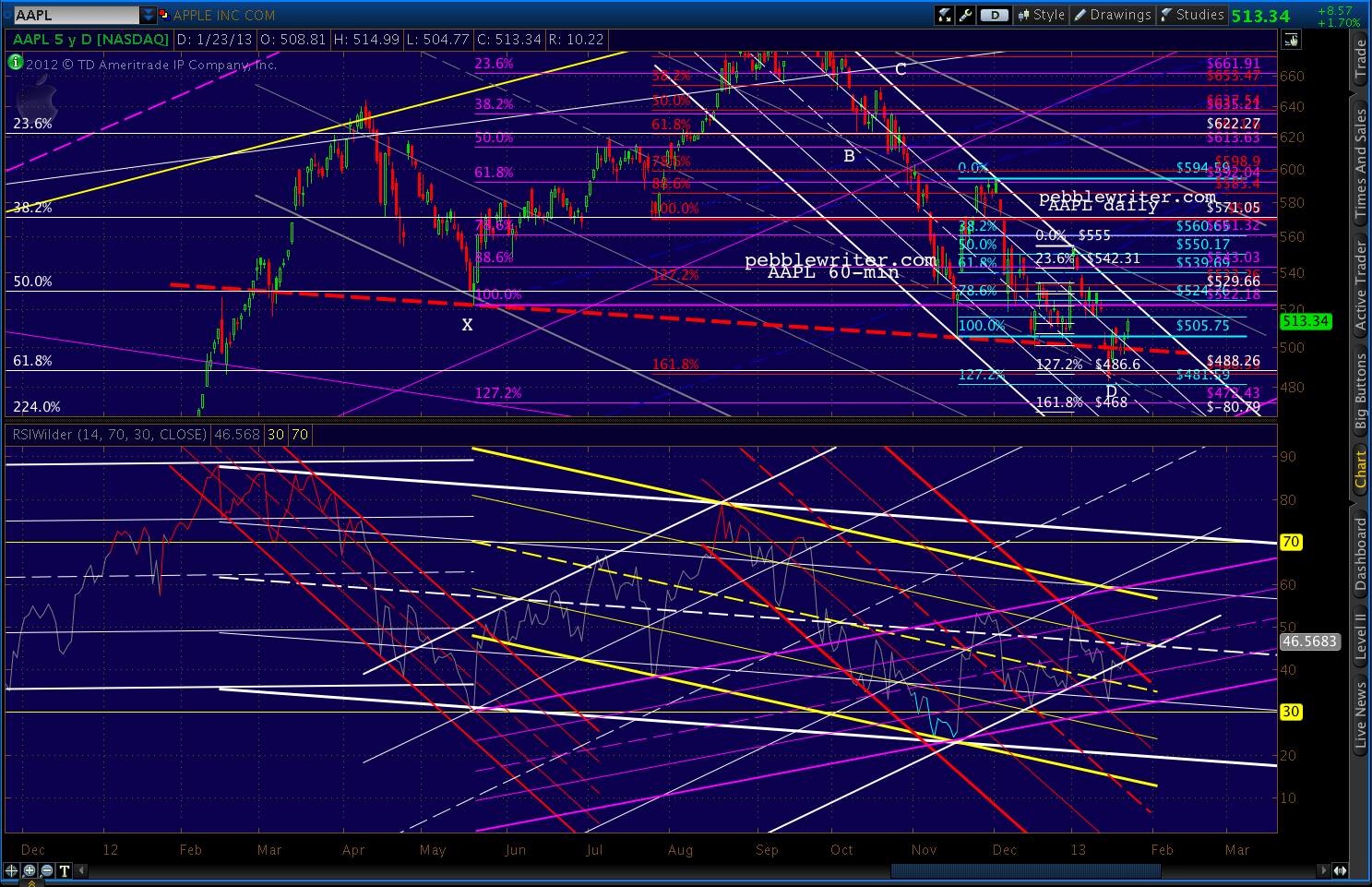
    We’ll watch these RSI channels, though. A return to the top of the yellow (and, especially the white) channel would surely spell a reversal.

    The Agenda

    I think it’s pretty straight-forward — bag an important new high, but without setting the bar so high that expectations can’t be managed.  At 1510, SPX clears 1500 but buys some time before the pressure of “will it exceed 1576?” comes to bear (no pun intended.)

    Then, get through the budget mess (or, more kicking of the can) and see where we are.  If we get a sequester, so be it.  The establishment will be well positioned ahead of time and the correction will be managed.

    After the shock of it wears off and prices have firmed in the 1200-1300’s, time to establish the next leg higher.

    Now, the big question is whether TPTB can engineer such a move without it getting out of hand — as it often does.

    Stay tuned.
  • Charts I’m Watching: Jan 14, 2013

    ORIGINAL POST:

    The dollar is making a stand at the upper end of the target range I charted Friday, but hasn’t yet broken out of the steep falling channel.  While there was a turn at the .618 Fib that would justify a .786 completion (a Gartley), the more obvious Point B was at the .382.

    In a perfect world, this would signal DX has further downside potential to the .886 for a Bat Pattern completion — though, obviously, not every corrective wave has to be a harmonic pattern.

    The EURUSD similarly reached a common turning point at the 1.272 extension of the latest move down from Dec 19 (or Jan 2, take your pick.)

    But, as can be seen, the rally from last week features no potential Point B whatsoever.   It’s hard to call this a Butterfly Pattern in the absence of an actual pattern.

    Furthermore, the tails on the daily candles offer an even more aggressive upper bound for the rising wedge we’ve been charting for the past several weeks.

    Equities are pointing to a soft opening, but nowhere near what one would normally expect with horrid AAPL news on the tape — much less the approaching budget showdown.

    Regular readers are well aware of the importance of the 500 price level for AAPL.  As we’ve discussed many times, the completion of the H&S pattern could have dire consequences for AAPL and the entire market.

    continued for members(more…)