
Posts

  • Remembering…

            Michael J. Novosel was only 19 when Pearl Harbor was attacked. Determined to fly for the Army Air Corps, he was too short to pass the flight medical. His friends carried him around on a stretcher for several days in the mistaken belief that he might grow a little if spared the effects of gravity. It didn’t work. But a flight surgeon, swayed by Mike’s patriotism and enthusiasm, fibbed on Mike’s physical so long as he promised to grow another quarter inch.


            Mike flew bombers over the Pacific during World War II, eventually commanding a B-29 squadron on the island of Tinian before he’d even earned a drivers license. He carried two cushions, sitting on one in order to see over the instrument panel and placing the other behind him in order to reach the pedals. He participated in the bombings of Tokyo, and later flew over the surrender ceremony on the Missouri.

            After Korea, Mike was RIF’d out of the Air Force – a victim of peacetime supply and demand.  He stayed active in the reserve, but focused on his growing family and a successful airline career.  He was moved when JFK encouraged Americans to “ask not what your country can do for you…”  And when Kennedy was assassinated, Mike watched as John Jr saluted his father’s caisson. The bravery of that three year-old – the same age as Mike’s youngest son, also named John – convinced him to request a return to active duty. The Vietnam war was heating up, and Mike couldn’t sit idly by while others risked their lives.

            But the Air Force determined that Mike, at 43, was too old to fly. Undaunted, Mike asked the Army if they could use someone with his experience. They welcomed him with open arms – and a paycut. Joining the army meant resigning his Lieutenant Colonel commission (and pension) in the Air Force. He would have to enter as a warrant officer – the same grade as guys half his age.

            After brushing up on helicopter flying, Mike was sent to Vietnam and joined a new unit known as Dustoff. Before Dustoff, wounded men were treated in the field – less than ideal conditions for a traumatic amputation or a sucking chest wound. Dustoff’s Hueys fanned out across Vietnam and rescued seriously injured soldiers and civilians – both allies and enemies – resulting in a 97% survival rate for the 900,000 who were saved.


             Flying these Huey’s was unbelievably harrowing. Crews’ only protection from constant hostile fire was a quarter-inch thick, plexiglass windscreen and aircraft skin the same thickness as a soda can’s. They had little armor and no weapons. Strapped in tight, they had no way to duck or dodge incoming fire. Their only defenses were their flying abilities and the efforts of the grunts who came to know the “whoop-whoop-whoop” of an incoming Huey as the sound of life.

            Mike distinguished himself as a pilot and a leader. He taught FNGs how to avoid being shot down and how to fly via instruments (not a part of helicopter training at the time.) Along the way, he also gained new perspective on the realities of war. He had gone from flying bombers high over a target to being in the thick of a brutal, bloody war – constantly being shot at, witnessing horrific injuries, hosing blood and body parts out of his Huey after each mission. The contrast could not have been greater.

            By then, Mike’s son Mike Jr had grown up, joined the army and become a pilot. As anyone who’s seen Saving Private Ryan knows, brothers can’t serve together. However, the army sensed a public relations opportunity in having father and son fly together – the first time in US aviation history. So Mike Jr joined his dad’s Dustoff unit in Vietnam.

            A father’s worst fears were realized when, several months later, Mike Jr was shot down (one of six times.) He was rescued, of course, by his father. A week later, Mike Sr was shot down and rescued by Mike Jr.   In all, Mike Sr flew 2,543 missions and rescued 5,589 wounded. He was later awarded the Congressional Medal of Honor for flying fifteen times, without air cover, into an enemy training facility to rescue 29 South Vietnamese soldiers who were pinned down by enemy fire.

            When Mike retired in 1984 – from the Army this time – he was the last former World War II pilot still on active flying duty – the last Eagle. When I first met him, he didn’t strike me as much of a hawk as war heroes go. After getting to know him, I understood. Unlike many Americans whose perception of war is shaped by CNN or Fox – a puff of smoke, viewed from five miles high – Mike saw the victims’ faces, heard their screams and was soaked with their blood. As a result, he understood war was a last resort, when all else had failed.


            At the time of his retirement, Mike’s awards and decorations included The Medal of Honor, Distinguished Service Cross, Distinguished Flying Cross with two Oak Leaf Clusters, Bronze Star Medal with two Oak Leaf Clusters, Air Medal with “V” Device and 60 Oak Leaf Clusters and the Purple Heart Medal.  He was proud to have been awarded the Medal of Honor for saving, rather than taking, lives.  But, he considered his greatest awards the countless simple nods of thanks he received from men who would otherwise have died in battle.
         
            Mike Jr. went on to an illustrious aviation career as well.  He inherited his father’s call sign “Dustoff 88” and his determination to make a difference.  During his tour, he flew 1,736 missions, earned 37 air medals and rescued more than 2,500 allied airmen, sailors, soldiers and civilians — also exemplifying the motto “no man left behind.”
     
            Mike Sr. passed away in 2006 after a tough fight with colon cancer.  He was laid to rest a stone’s throw away from JFK at Arlington National Cemetery.  Mike Jr. passed away in 2009, a few days after receiving his father’s Medal of Honor flag in a ceremony at his home in Florida.  Those fortunate to have known them will miss their fearlessness, their compassion and their uncommon wisdom.

    Mike Sr. is awarded the Medal of Honor as Mike Jr. (far right) looks on

    Michael J Novosel’s Medal of Honor citation

    Wikipedia page

    The Novosel Foundation

  • Margin Debt Highest Since the Crash

    Margin debt in April reached $320 billion, the highest level seen since February 2008, one of the most unfortunate cases of BTFD in recent memory.

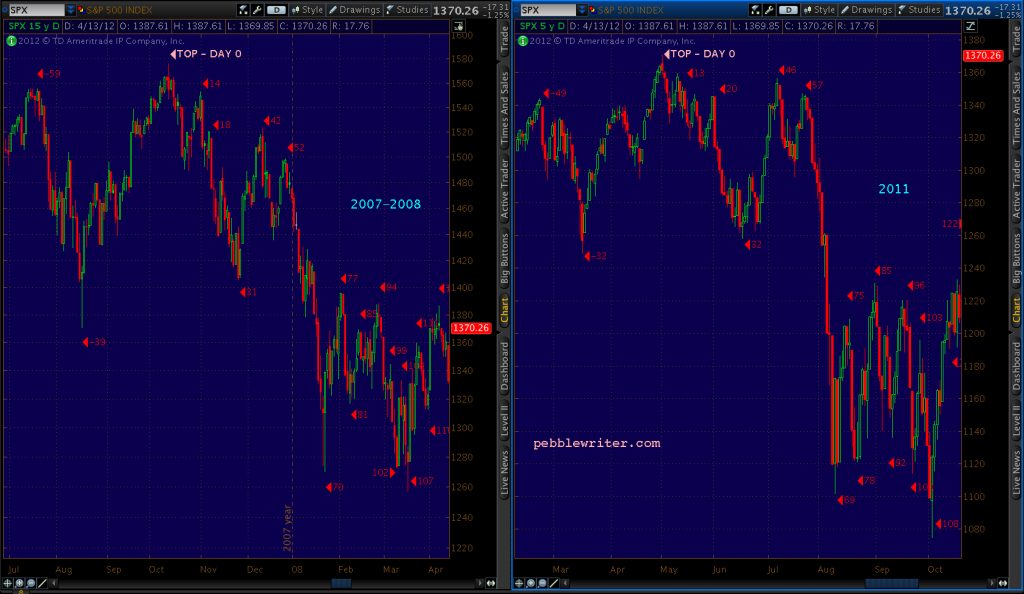
    Margin debt topped $381.4 billion in July 2007, just before the market peaked in October.  The S&P; 500 plunged 58% over the next 17 months.

    Source: NYXdata.com

    Why the $5 billion increase from March to April?  Could it be investors have bought the notion that the Fed won‘t let the market go down? 

    Let’s hope they don’t all rush the exits at once when someone finally notices the inferno into which the Fed has been sQErting lighter fluid. 

  • Credit Default Swaps Hint at the Next Casualty

    Short term US Government credit default swaps have more than tripled since April.  If this were solely the result of debt ceiling debate, I wouldn’t be so worried.

    http://blogs.wsj.com/marketbeat/2011/05/25/us-short-term-cds-spreads-sharply-wider/

    I suspect it has more to do with the fact that US debt is forecast to exceed 155% of GDP by 2035 (see the report from the Peterson Institute for International Economics, or read about it here.)  Even though the Peterson Institute’s solution is gutting Social Security and Medicare, I imagine their prediction is accurate.

    Can’t be, you say?  Those numbers are worse than Greece (102%) and Ireland (112%)!!! 

    Okay, I admit I shaded the truth a bit.  Those are the best case data.  The Peterson folks suggest the debt might actually climb to over 300% of GDP.

  • Who’ll Stop the Reign?

    “BOSTON (MarketWatch) — It‘s cost $600 billion of your money. And it was supposed to rescue the economy. But has Ben Bernanke’s huge financial stimulus package, known as “Quantitative Easing 2,” actually worked as planned? … Turns out the program has created maybe 700,000 full-time jobs — at a cost of around $850,000 each.  House prices are lower than before QE2 was launched. Economic growth is slower. Inflation is higher… Yes, it’s sparked a massive boom on the stock market… But even the stock market boom hasn’t been what it appears. An analysis shows that most of the rise in the Standard & Poor’s 500 Index under QE2 has simply been a result of the decline in the dollar in which shares are measured.  The truth? QE2 has created a massive new bubble in dollar-based financial assets, from stocks to gold. Meanwhile, it has had zero visible effect on the real economy.”

     http://www.marketwatch.com/story/qe2-was-a-bust-2011-05-21

    Most investors I know are bullish simply because the Fed has implicitly assured them they can’t lose.  If the economy improves, the market goes up.  If the economy tanks, order up another round of QE, and the market…goes up.   It will come tumbling down eventually, but meanwhile they’re happy picking up pennies in front of the steamroller.

    I used to think the Fed was simply misguided (Hanlon’s razor:  never attribute to malice that which is adequately explained by stupidity.)  Now, I believe it’s equal measures of greed (helping out their Wall Street homies) and last-ditch desperation.  How else to explain QE policies that lead the country further into crushing debt, rising inflation and reinflated bubbles — all without benefiting the marginalized? 

    If the greatest beneficiaries of QE (think Wall Street) reinvested even a fraction of their profits to the recession’s worst victims, I suppose you could say there has been a net “voodoo” economic benefit.  But, judging from the foreclosures, bankruptcies, folks raiding their 401(k) to pay the bills — it ain’t happening.

    We rant about China’s currency manipulation, but we set the standard — even though devaluing the buck only delays the inevitable.  Congress cheers on the Fed, because politicians serve at the pleasure of their bankster johns  (politicians, after all, declared everything was fine even as banksters stuffed no-doc loan solicitations into mailboxes like peep show hawkers in Times Square.)  Anyone who objects will be back in the private sector faster than you can stop payment on a campaign contribution.

    Obama was supposed to stand up to these bozos we bailed out by the billions, but has proven himself inept at best or, worse, in cahoots.  He tries to reassure us, but the folks buying $4 gas and $3 bread know better, as do those whose unemployment benefits have long since run out.  Optimism only gets you so far, and right now we’re running on fumes.  We have more to fear than fear itself.

    The list of once-peaceful countries wrecked by protests in the streets grows longer by the day.  At what point do Americans decide the rich are rich enough?  That bailing out an inner-city clinic is at least as important as AIG?  That students are more deserving than for-profit diploma mills, and homeowners deserve a fair shake from the banks that created this mess?  Will we work ourselves up to a little righteous indignation, if not full-blown riots?

    With apologies to CCR, “who’ll stop the reign?”

  • You Say Potato…

    Tuesday’s declines had an impact on the harmonic picture, but not exactly how I expected.

    The large bullish Gartley that has been forming since 4/18 was completed at the lows (* on the chart).  The smaller 5/17 – 5/22 bullish Gartley targeting 1352 failed due to the extension of the CD leg; but, thanks to Wednesday morning’s action, became a Butterfly pattern with a near-term target of 1355.  Meanwhile, the 4/18 Gartley becomes a Crab — now targeting 1358 at the .618 retrace.

     I have no clue as to the correct EW count and,  judging from the debates going on, only half the people do.  The other half are dead wrong.  Whether we bounce from here or not is anyone’s guess.

    But, if the decline stalls, look for a big rebound to at least the .618 XA retrace to 1358 on the larger Bat pattern, egged on by the smaller Butterfly pattern — with targets ranging from 1328 at its .618 retrace to 1358 at its 1.618 extension. 

    There’s plenty of overhead resistance all the way up — starting with 1332, the .50 fib and top of the channel that’s taken us down to these levels.   But, now we have a quantifiable motive for a sizable rebound, whether it’s the start of Minor 5, a 3rd of a 3rd, or whatever.

    Backing up a bit, we can see the market trying to establish a higher low from the 4/18 low of 1318.  If we go up from here, as I expect, the decline from 1370 will prove to be corrective — some form of wave 4 that drives us to a higher high.  Market Sentiment on the chart below would support that view.

    If prices hold up, we should also see a bullish engulfing candle on the day, adding fuel to the short-term bullish case made by harmonics.

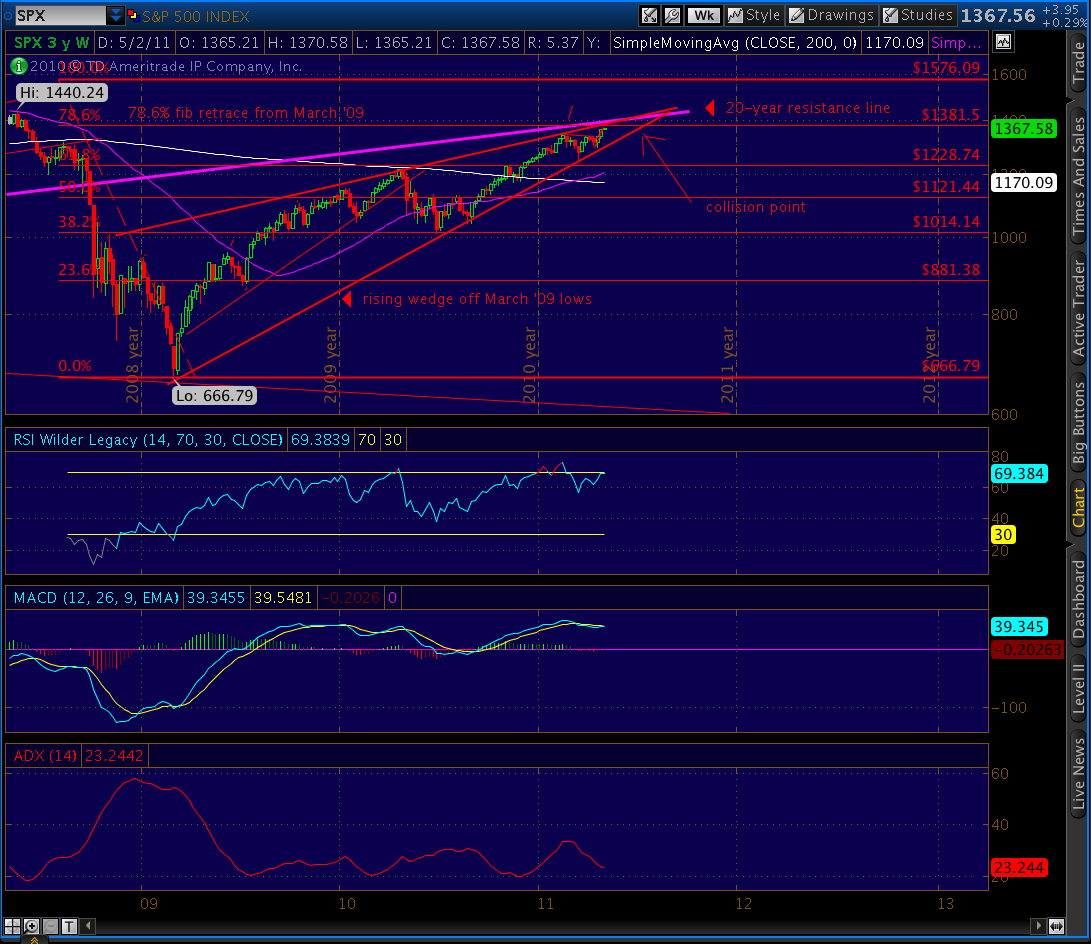
    The large bearish pattern set up off the Mar ’09 lows is unchanged, still indicating 1381.50 near term and much, much lower long term.

  • The Turd in the Cocoa Puffs

    Long term, financials have a dim future (XLF will be the sector wearing a name tag when it grows up.)

    Back on May 3, I noticed XLF was running into heavy resistance at 16.40 and started looking for a drop to the mid-15s.  XLF fell to 15.67 by the 17th, a decent 4 1/2% return for 2 weeks.

    XLF did a little pirouette, then sold off even more with the rest of the market.  It hit 15.39 this morning.  Which is great…right?

    The only turd in the bears’ cocoa puffs is it’s now fallen enough to have formed a nice big harmonic pattern: a bullish Bat.  A valid Point D could be at the current .618 retrace (15.44) or the .786  retrace (14.96).

    Best seen on the daily chart, it could potentially take prices back above 17.  Of course, harmonic patterns sometimes fail.  The sell off might continue and XLF could be flipping burgers by next Friday.

    Long-term investors probably need not worry, but traders might consider taking profits or, at the very least, placing tight stops until the near-term picture is clearer.

  • Skating on Thin Ice

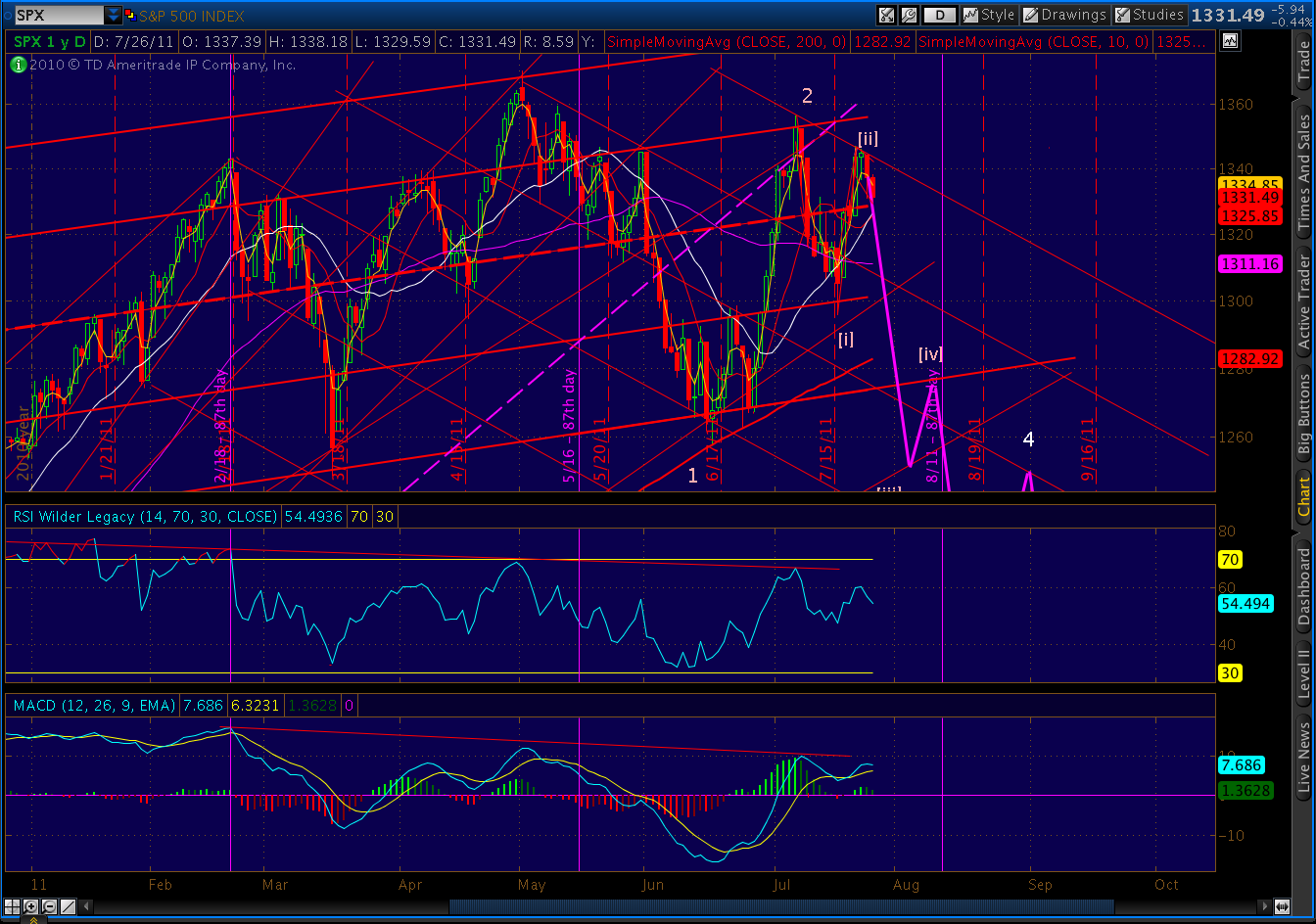
    Putting together the harmonics with important support and resistance levels, I’m looking for the Apr 20 gap to be filled, then a strong rebound, reaching the 1350 area in the next few days.  I still have a target of 1380 as the end of P[2], but am looking at the possibility of a truncated fifth at 1350-1355, depending on how the next few days play out.

    If we rebound off the 1312.70 gap low, it would appear that the 1370 high from May 2 was the 87-day cycle high, with a 4.2% decline — at the low end but within the range established over the past 4 years.  But, the cycle’s declines average 11.4% within the first 30 days, so it’s also possible we’ll see further declines within 30 days (by June 2) that could reach the theoretical target of 1214. 

    I’m watching the primary rising wedge very closely.  The end of May marks 2/3 of the time span from 2/18 (when the rising wedge began tightening) to its apex in late July/early August.  Today, it intersects with the channel from the May 2 top.

    A close above 1319 today keeps us within the channel and the rising wedge, and should result first in a rebound to the upper end of the channel (1339), then potentially the wedge (1372.)  With so many anticipating the .786 fib target of 1381.50, and the overwhelming bullishness that would accompany a strong rebound from this scare, I would not be surprised if we ultimately fell short of it.

    But, eventually we will.  The wedge’s range began at 530 points in Mar ’09, diminishing to 270 by Apr ’10, 100 by this past February and currently stands around 50-60 points.  By comparison, the range of the rising wedge that produced the Oct 2007 high started at 265 points in Mar ’03, shrinking to 210 by Jul ’06, 120 by Jul ’07 and 100 just before the market crashed.  Over 4 years of gains were wiped out in 17 months.

    You can almost feel the market tugging at the constraints.  Today is only the 7th time in the past 3 months that the daily range has exceeded 20 points.  In the 3 months leading up to the 2007 highs, there were 28 such days.

    In comparison to 2007, we’re skating on very thin ice.  The further out we go, the greater the risk.  The Fed will do everything in its power to keep us skating, but is running out of magic tricks.  Once we plunge through, even a ruinous QE3 wouldn’t be able to save us.

    Significant numbers:

    Support

    Bottom of the primary rising wedge from Mar ’09:  1319
    Bottom of secondary rising wedge from Mar 18th:  1322
    Bottom of channel from May 2 top: 1310.60
    Gap from Apr 20:  1319.12 – 1312.70
    Previous low on May 17:  1318.51
    Next major prev low from Apr 15: 1294.70
    50 day EMA: 1328.46
    200 day EMA: 1256.48

    Resistance

    Channel from May 2 top:  1339
    Top of primary rising wedge from Mar ’09:  1372
    Previous high on May 19: 1346.82
    Next prev highs (past three weeks): 1351, 1359, 1370
    Trendline from Oct ’07 high:  1328.7
    Exhaustion gap from May 11: 1351.19 – 1356.19
    Apex of the primary rising wedge: late July – early August at 1390-1400
    Intersection of rising wedge with supercycle line:  8/31 at 1430
    10 day EMA: 1336.56

    Harmonics

    Bullish SPX Gartley 4/15 – 5/17 targets 1388 this week.
    Bearish SPX Gartley from Oct ’07 targets a high of 1381.50 before P[3] (near term)
    Bullish SPX Gartley 5/17 – 5/22 targets 1352 (poss invalid with today’s open)
    Bullish VIX Gartley 4/28 – 5/19 targeted 20.50 this week

    Other

    Inverse H&S; from May 10 targets 1370 (poss invalid w/ today’s open)
    Inverse H&S; from 2/18 targets 1436
    Hourly RSI and MACD: bottoming?  Daily and weekly declining
    Yesterday’s OPEX study suggests an up day, closing above 1334
    Memorial Day effect:  week before has been up 4 of last 6 years

  • Does OPEX Matter?

    This past Friday morning, with SPX down about 9 1/2, I made a crazy call based on some indicators I’ve been watching [more later tonight or tomorrow.]  They said the market would not only stop falling, but would completely reverse itself and open up, leaving a nice bullish hammer going into the weekend and thus, portending a big up day Monday.

    Indeed, SPX fell a little more, then made a spectacular comeback with well-formed 5-3 patterns all the way… until an hour and 15 minutes before the close.  When THEY screwed with my plan. You know who I mean.  The evil OPEX manipulators — thrashing my portfolio (and worse,  my pride) for the umpteenth time.

    Is it me, or are they really out to get us?  I did a quick little bit of research, and found out… “maybe.”  I studied the last 42 OPEX cycles since 11/16/07, dividing them into positive (21), negative (13) and neutral (8) cycles based solely on net price movement during the cycle.  I then compared performance on the day of option expiration with the day after expiration for each cycle.  The results are intriguing.

    • When the OPEX cycle was up, OPEX day was positive 62% of the time.  When the cycle was negative, OPEX day was also positive 69% of the time.  Neutral cycles were even.
    • In positive OPEX cycles, OPEX was usually followed by a reversal — regardless of whether OPEX day was positive or negative.  Negative OPEX days produced positive reversals 100% of the time; positive OPEX days produced negative reversals 62% of the time.
    • In negative OPEX cycles, negative OPEX days were always followed by another negative day (100%), while positive OPEX days usually produced negative reversals (67%).  
    • When the cycle was neutral, the day after OPEX reversed 75% of the time, regardless of whether OPEX was up or down.
    • In general, negative OPEX days were followed by positive days (69%), unless in the midst of a negative OPEX cycle.  And, positive OPEX days were followed by negative days (69%).

    I also looked at the size of the day to day moves.   In general, most negative OPEX days produced similarly-sized positive reversals — regardless of the cycle trend.  But, positive days in positive OPEX cycles produced outsized (2.14X) reversals, as did positive days in neutral OPEX cycles 1.63X).

    There are limitations to a study like this.  For one thing, I generalized when characterizing the OPEX cycle trend.  Many would say the recent trend has been down, although SPX rose between 4/15 and 5/20 — thus qualifying it as an up cycle.  Also, there wasn’t a single instance of a positive cycle with a negative OPEX day until after the market bottomed in Mar ’09 (and, yes, 5 of the 16 cycles during the bear decline were positive.)

    I also didn’t measure the gain or loss on the days studied, but focused instead on the total range and whether SPX was positive or negative on the day.  So, a big decline that reversed to close slightly positive was an up day; if it closed slightly negative it was a down day.

    There’s no particular justification for such methodology; it simply fit my desire to identify what trading opportunities, if any, OPEX might produce.  Has it?

    This past cycle was positive (although, again, open to interpretation) and Friday was down 10.33.  Despite what the futures currently indicate (down 5.50), the model would suggest an up day with a range of 11 1/2 or so.   On the actual 8 similar days (down OPEX in up cycle), the 5 bigger OPEX declines averaged 10.6 and were followed by 12.1 point rallies (smallest was 5 points.)  The smaller 3 declines averaged .8 points and were followed by average 10.3 point gains (smallest was 7 points), so size of the OPEX decline didn’t seem to matter much.

    Also, the 3 days following the reversals were mostly down (5 of 8), although the trend for the remainder of the next OPEX cycle was up (5 of 8 times.)

    Do I know any more than before I sat down to study all this?  Perhaps.  One of my favorite analysts put a huge red candle on one of his SPX charts for Monday that, I’ll admit, scared the crap out of me because it wasn’t at all what I expected (he put a bullish alternative up, too.)  Although medium and long-term bearish, I’m one of those looking for one last push up.

    Regardless of what Monday brings, it’s pretty clear to me that OPEX does matter.  The preponderance of reversals indicates to me that OPEX moves are “unnatural” in the sense that the subsequent market action “undoes” what the market makers did.  As someone always on the lookout for contrarian opportunities, this is useful information.

    In the future, I’ll look for trading opportunities on reversals (especially in up markets) and have a better idea what to expect.  And, when I’m itching to capitalize on the action unfolding in that last hour on an OPEX Friday, I’ll take a quick look at the historical data.  It could be that THEY really are out to get us.

    *******************************************

    NOTE:  Monday, May 23  1:15am

    The futures are down 6.50 to 1321.25.  If we were to close down tomorrow, it would be only the 6th time in over 5 years when a negative OPEX Friday was followed by a negative Monday.  Three of the previous five were in the midst of the 2008-2009 bear markets.

  • Takes Me Back to ’99

    John Dvorak writes a great piece on the LinkedIn IPO.  Could this be yet another sign of the top?

  • Zombie Snacks in the Making

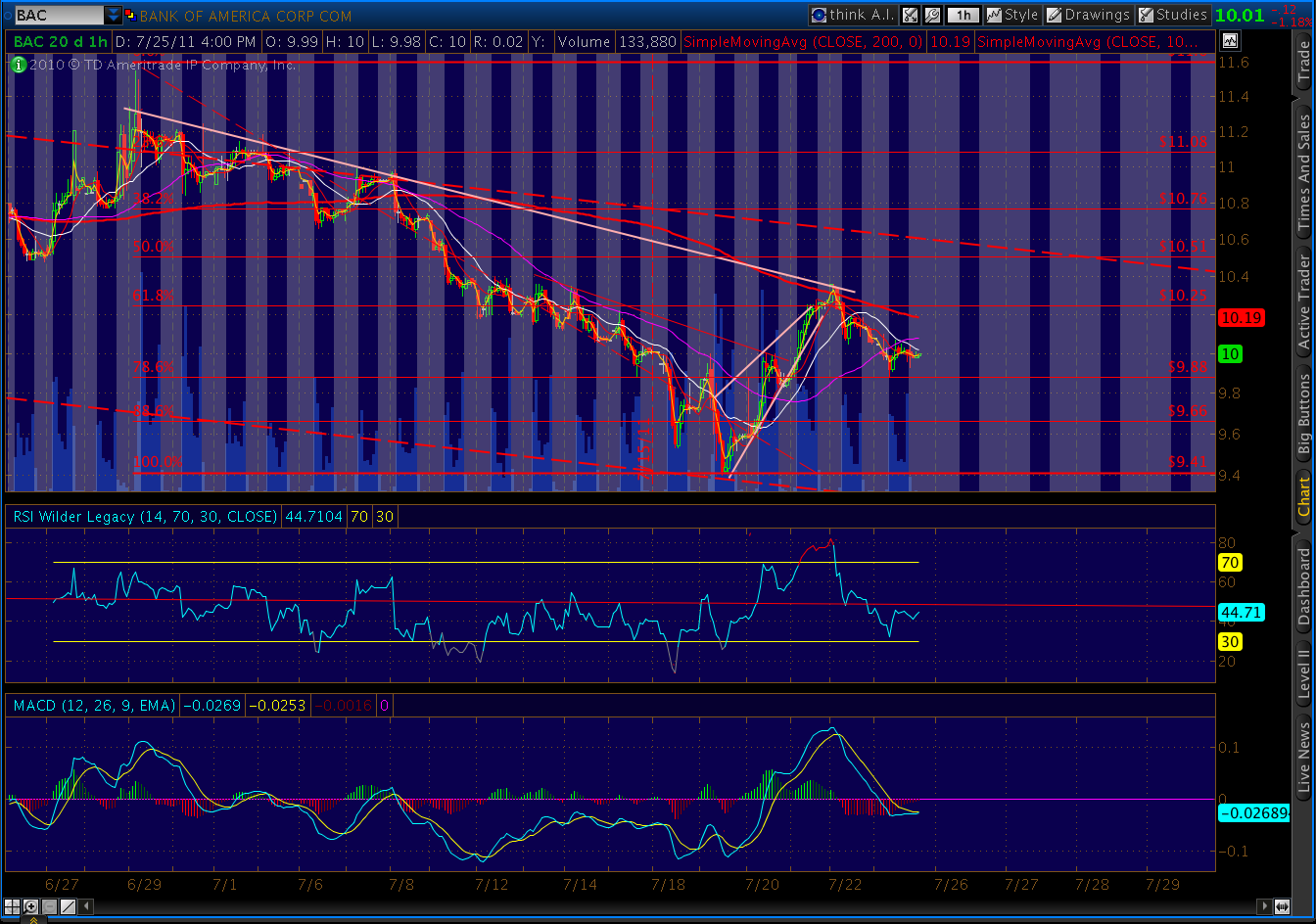
    In a couple of 5/3 posts [Short the Banks and Follow Up on Financials] I suggested XLF — then at 16.40 — was due for a drop to the mid-15s.  It hit 15.67 on the 17th and has been in a what I think is a rally in a ongoing bear market for financials.  Those who didn’t take profits a few days ago may be wondering whether the worst is over.

    Short answer is NO.  The banks are dead meat; they just don’t know it yet.  Rising interest rates, investors and cash-strapped governments looking to win the legal lottery, ugly balance sheets (their most craptastic assets not even listed), worsening credit quality — take your pick.  That’s an oncoming train, not a light at the end of the tunnel.

    IF they can arrest today’s decline, they MIGHT rally up to 16.05-16.10 before the bears take control again, driving XLF down to 15.50 in short order.  But, that’s just the start.  From there, we finally lose the channel altogether and head for single digits.

    Financials led off the last market crash; I believe their collapse in the next week or two will be the final straw for this market, too.  I wonder if it’s too soon for Vikram to renegotiate his contract?