
Category: Charts I’m Watching

  • Wedge no More?

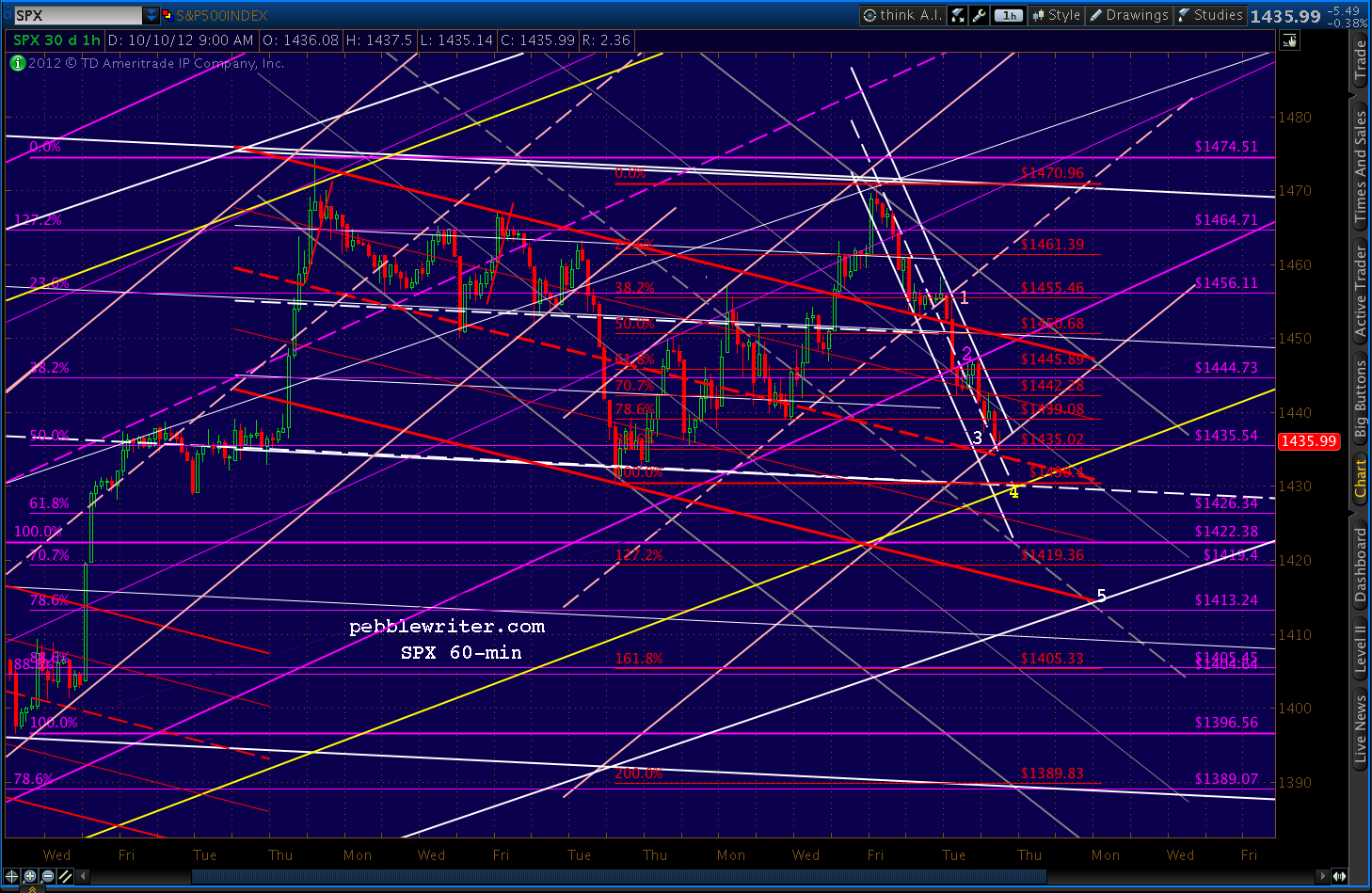
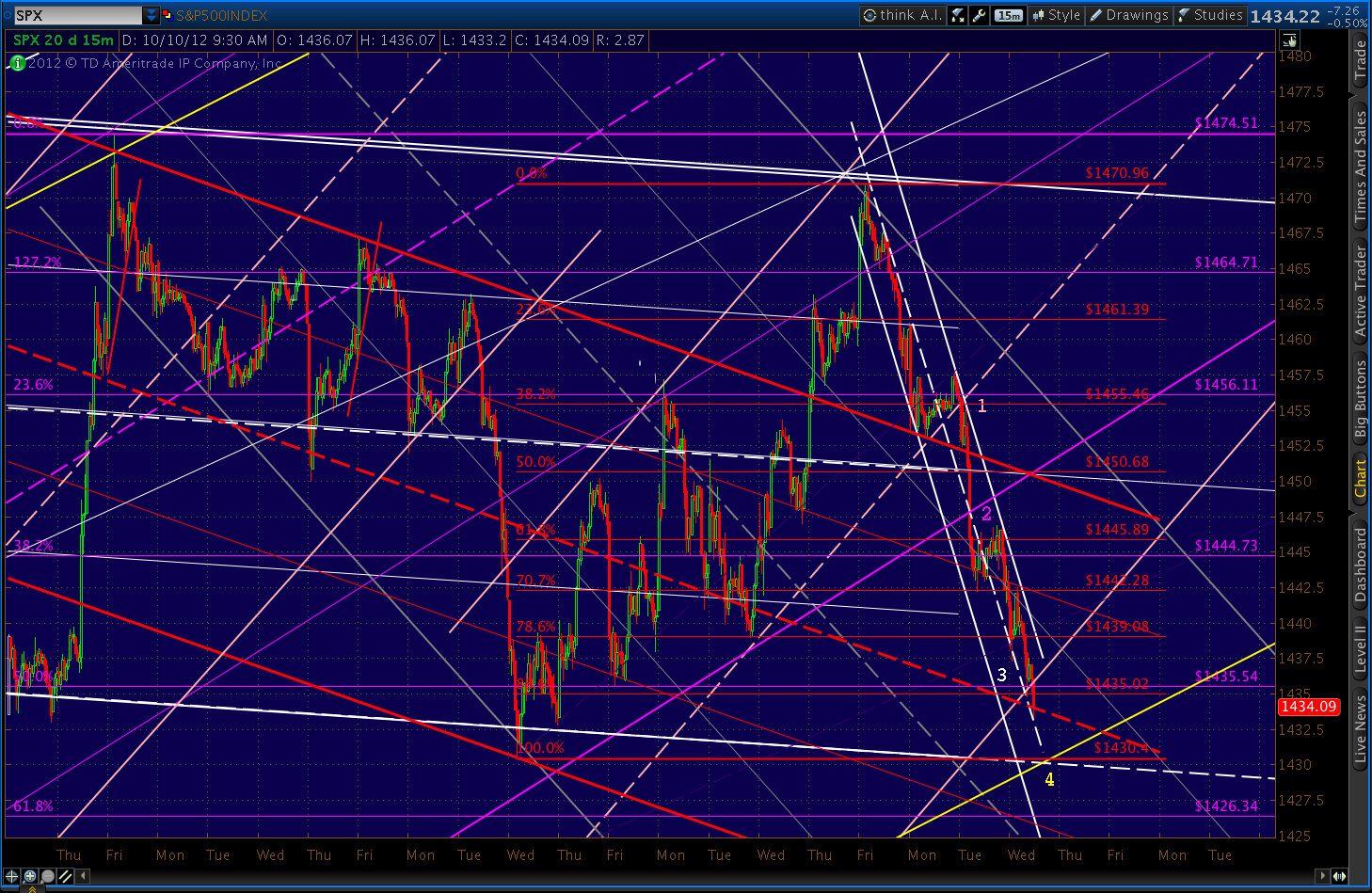
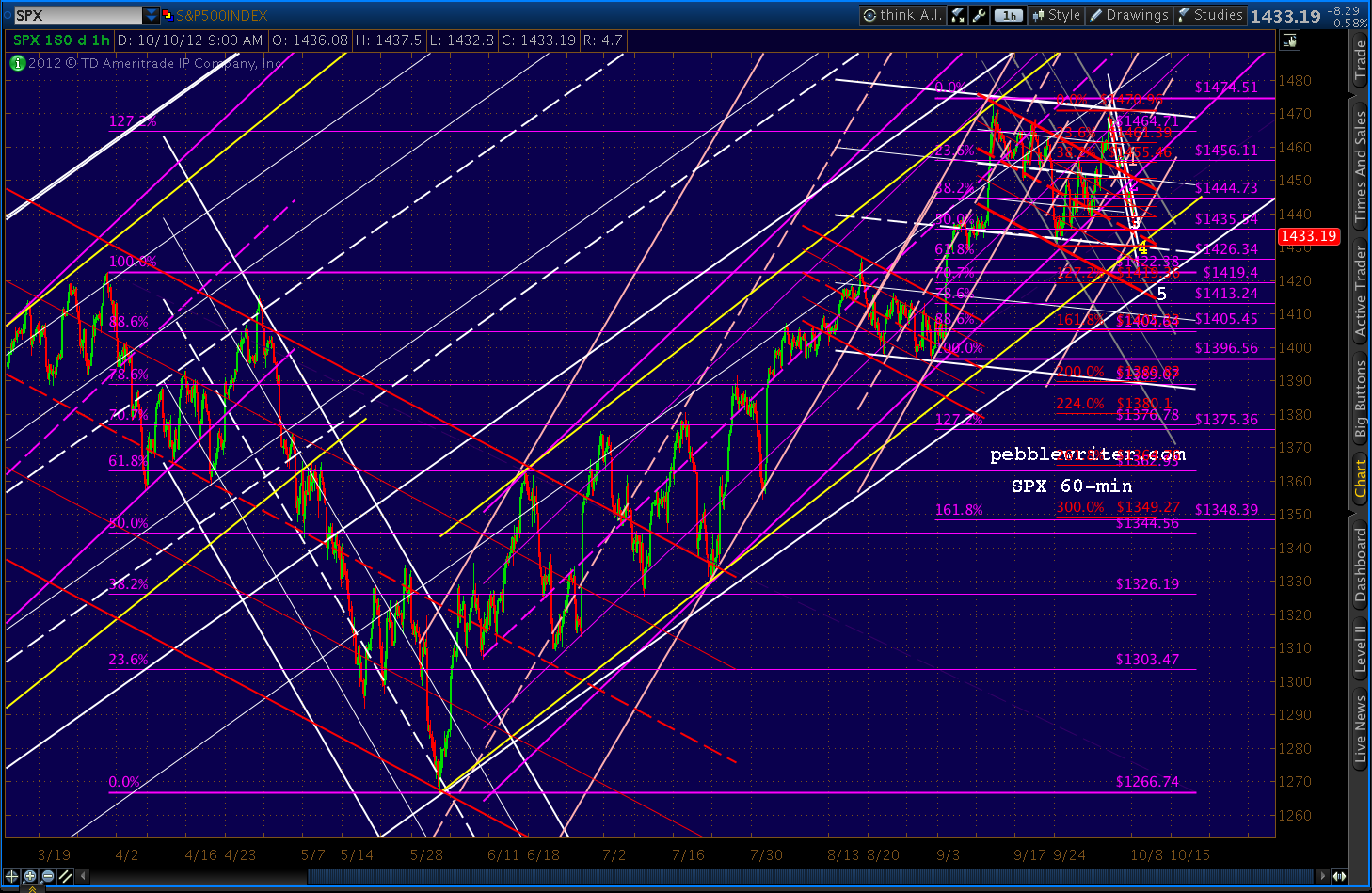
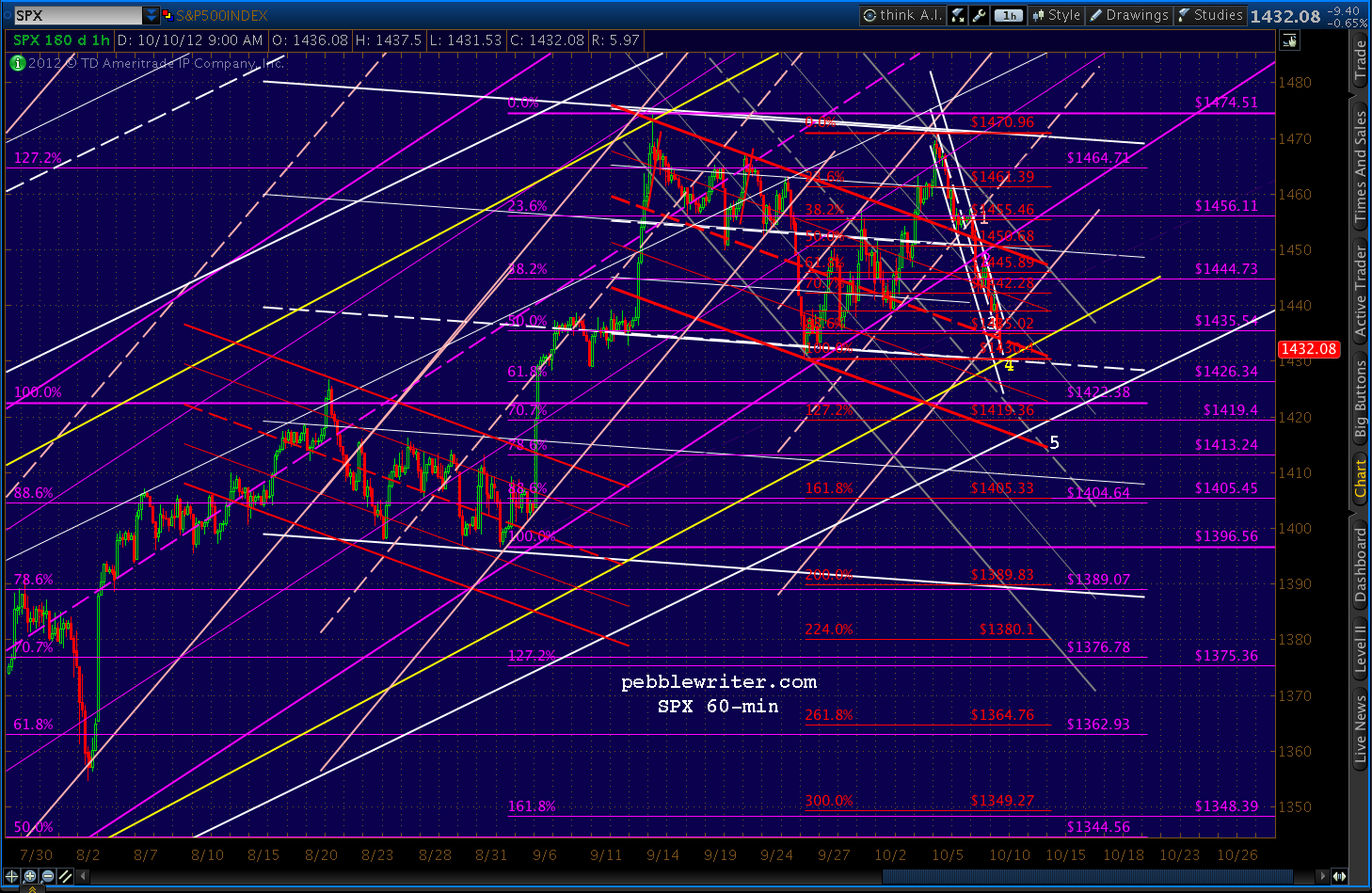
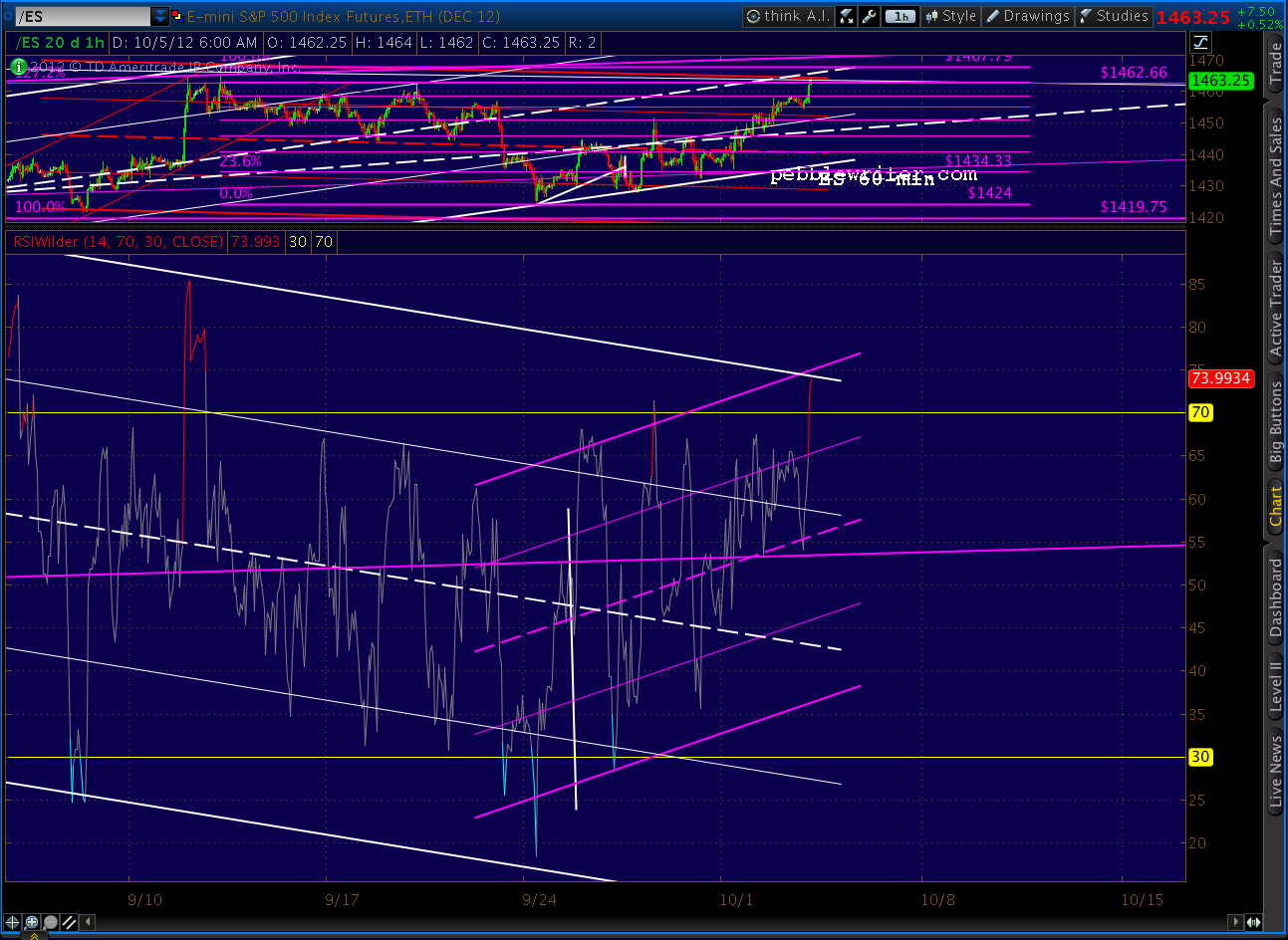
    The rising wedge we’ve been following will have pretty convincingly widened to a channel if it’s able to close at these levels.  We just reached the .886 of the latest dip, meaning we’re likely near the bottom of this latest move.

    The proposed channel lines (purple) are parallel to some pretty important ones, seen here in a 3-yr daily chart.  So, there’s a good chance that they’ll hold up over time.

    Note how the smaller purple channel is parallel to the larger one in which it resides.  The only thing that troubles me is the price action around June 4.  I don’t like leaving a few days out of the channel pattern; it feels like a bit of a cheat.

    So, I think we have to at least be open to the idea of a drop to the larger channel line — in line with the June 4 low.  Such a drop would be to around 1316.

    Note that I’ve moved the red channel line down a smidge, lining it up with the Oct 27 high.  It gives us a bit more room on the downside, today.

    There’s also an apparent H&S pattern that’s been set up with the (now failure of the) latest move higher.  In studying the pattern, though, the left shoulder and head are almost exactly the same height — 57 points. In a proper pattern, the head would be higher than either shoulder.  But, sometimes these things bend the rules a bit, and that could happen here.

    The key will be whether we can maintain the 1325.41 low from July 12.  If so, we have a series of higher highs and higher lows – no matter how bearish things feel.  If not, there are plenty of downside targets from which to choose — including the aforementioned 1316.

    If you weren’t stopped out this morning, 1324 might make a good choice to place a stop, with 1316 the next stop.


    UPDATE: 3:45 PM

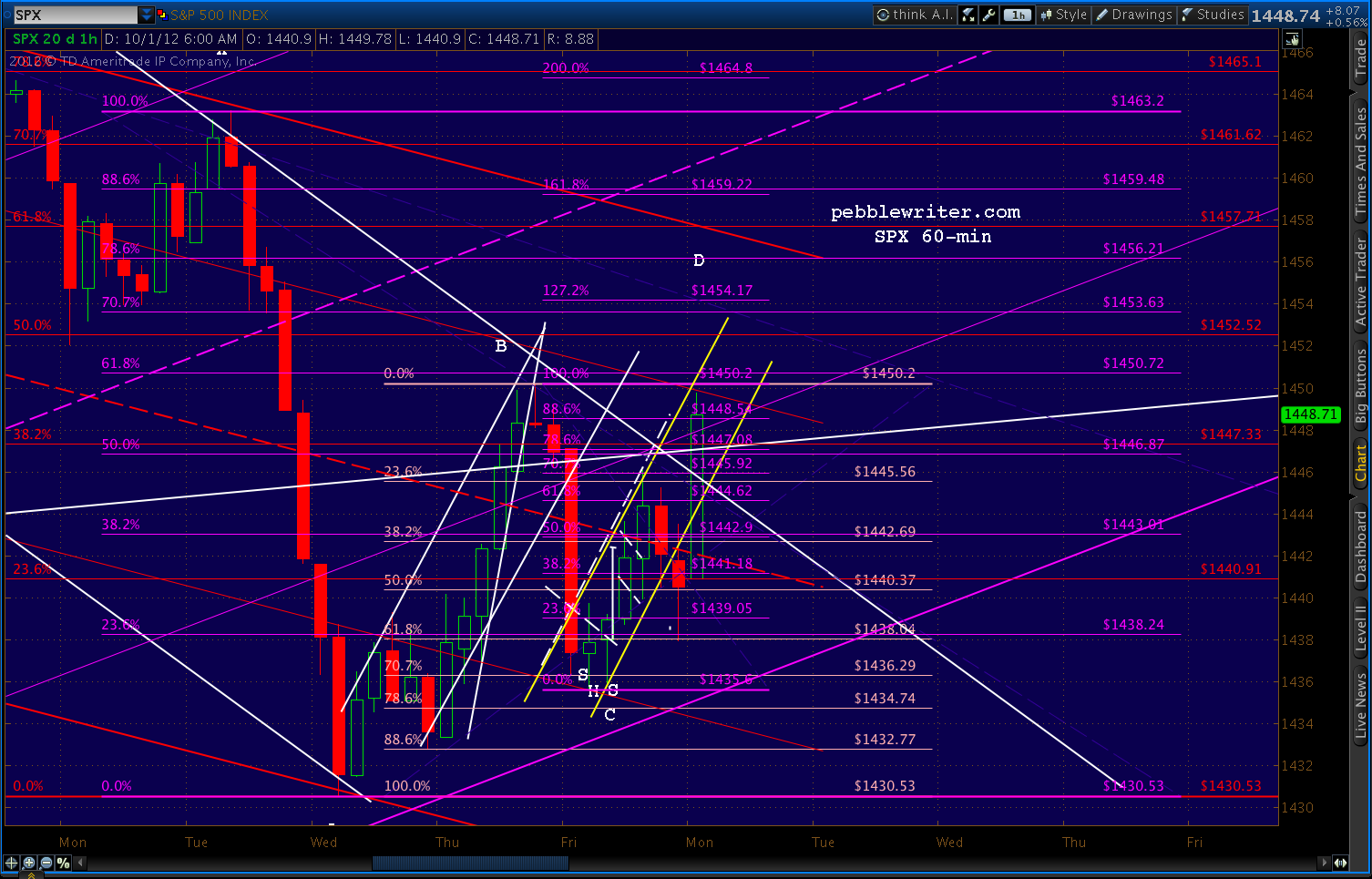
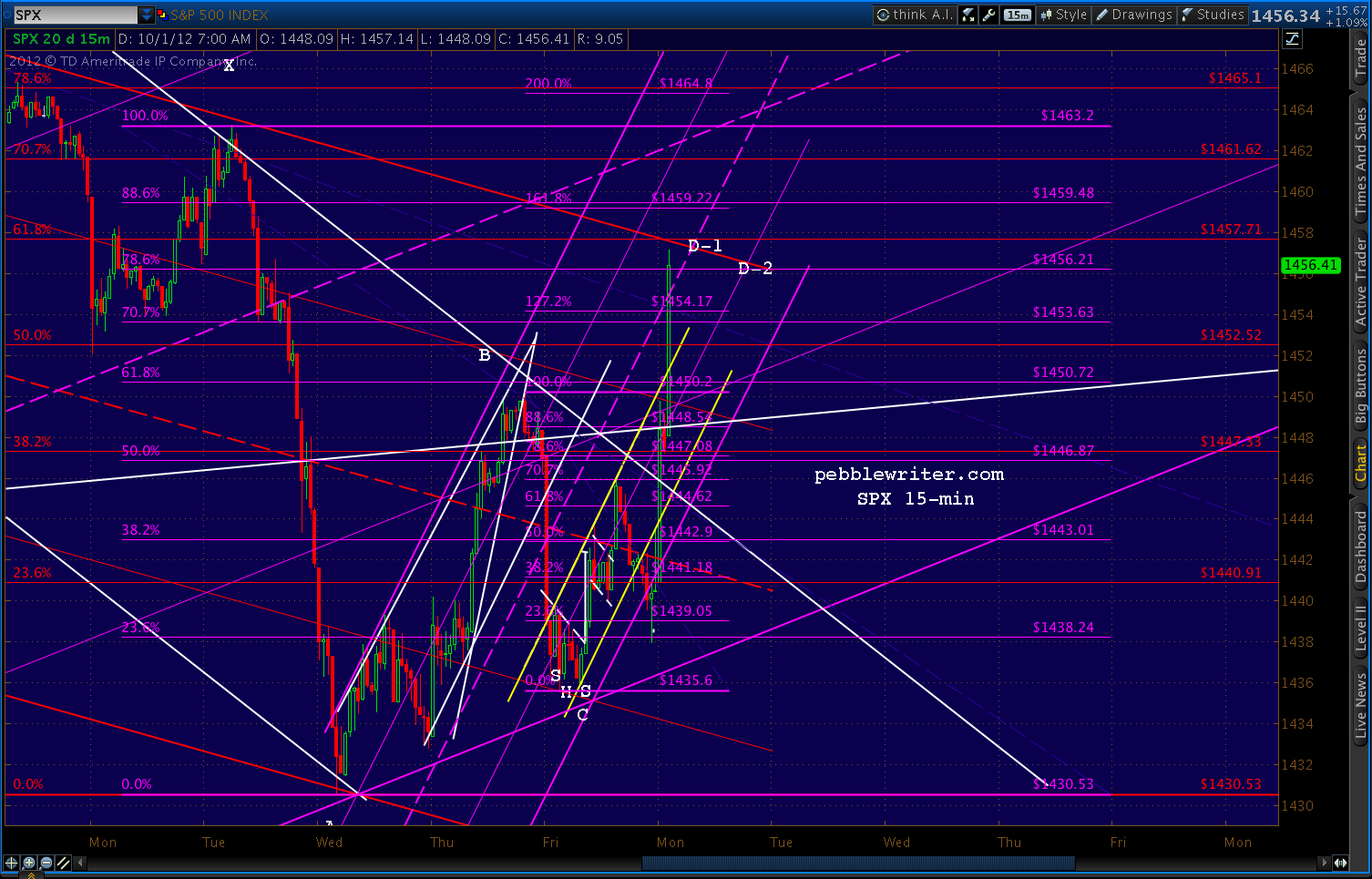
    SPX has formed a pretty clean-looking falling wedge on the 30-min chart.  It’s not definitive, however, as it has the potential for widening/lower prices.

    We tagged two major RSI TL’s on the daily chart, as well.

    Likewise, VIX has nearly reached an important intersection of several channel lines and has, as yet, failed to retake a higher high than the presumed H&S right shoulder.


  • Update on the Dollar: July 24, 2012

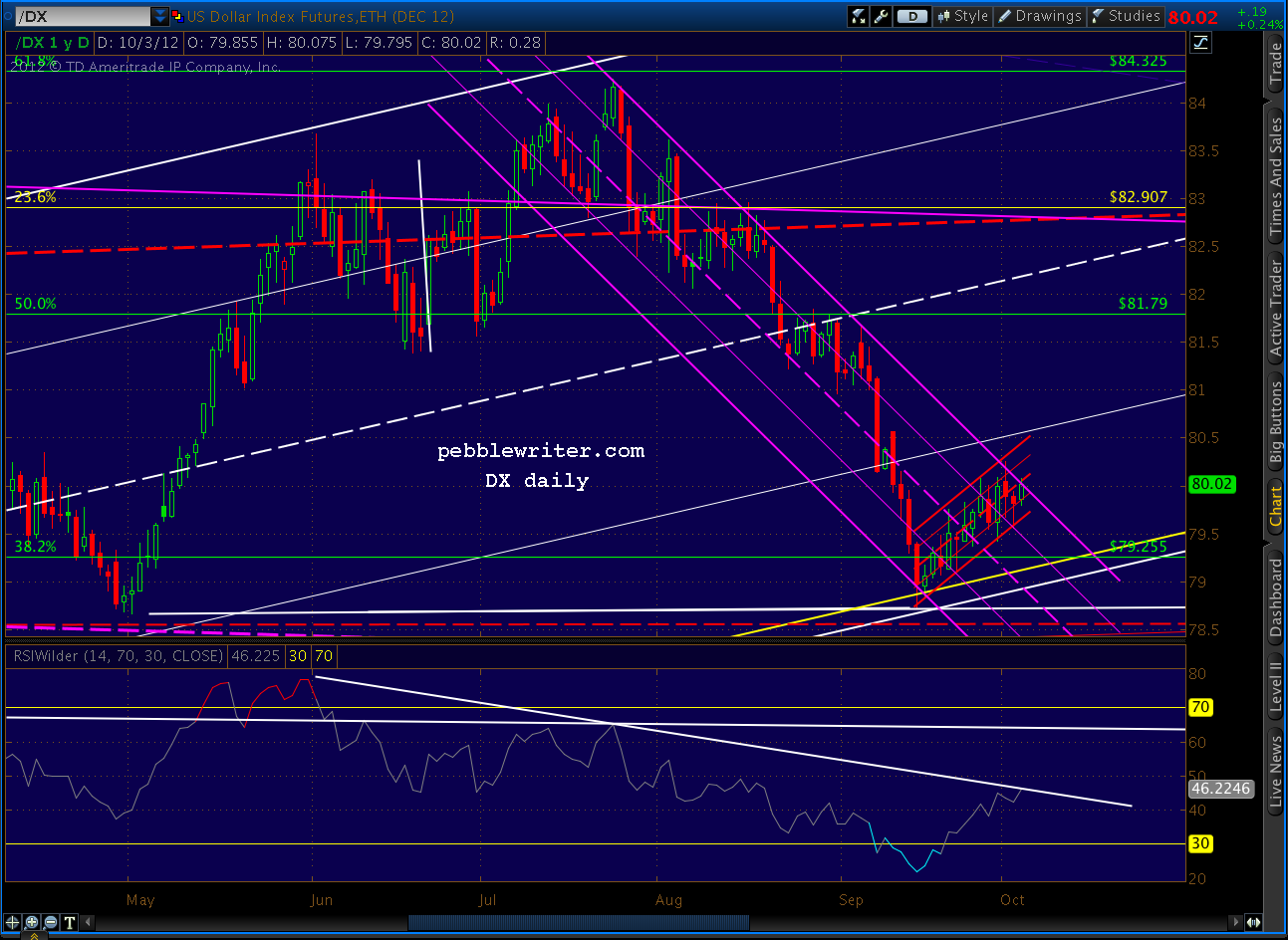
    There is significant negative divergence on the dollar on both a daily and weekly basis.

    DX is also very close to completing those harmonic patterns it hasn’t already completed.

    It’s approaching the .707 of the largest (yellow) pattern, tagged the 1.272 of the next largest (purple) pattern, tagged the 1.618 of the red pattern, nearing the 1.618 of the pale blue pattern and the 1.272 of the smallest Butterfly pattern, seen in the chart below.

    DX is also approaching the price level of the last rising wedge apex — which is the next best thing to an actual back test to the RW itself.  No guarantees — because the dollar is suddenly the asset everyone wants to own — even if it costs money to do so.

    I have a bunch of charts to post this morning.  Check back around 10 AM EDT.

  • Charts I’m Watching: July 23, 2012

    Looks like I jumped the gun Friday, getting back in too early after scoring 15 points on the downside.  We have a substantial cushion, being up 626 points/45% since inception on March 22, but I really hate giving any of it back on a off-hours dump like this.

    As I posted Friday:

    If you didn’t get short ahead of time, the likely downside of this push is the small channel bound at around 1364.  I don’t think it would be worth jumping in at this point.  Of course, if we break 1360, it’s a different story.

    Having a stop at 1360 doesn’t help much when the market gaps open down 20 points.  So, we’ll focus on where we’re likely to end up today.

    While the upper bound of our rising wedge has been pretty clear, the bottom has so far refused to present a crystal clear picture.  Whether or not to include which tails has left the exact slope muddled, which means it’s difficult to anticipate the probable low this morning.

    There is a trend line (yellow, dashed) in the daily RSI that indicates a bottom is already in, but it’s not a TL or channel line I’ve been following, so it warrants further study.

    It caught the tumbles on Apr 10 (-28.25), June 11 (-42.25), June 25 (-24), July 12 (-19.75) and is thus skilled at putting a stop to big drops.  It has just been tagged this morning. (more…)

  • Bat Patterns

    Bat Patterns are one of the more common harmonic patterns.  They are similar to Gartley Patterns, except that the AB retracement can be anywhere less than the Fibonacci .618 of the XA leg and the AD leg completes at the .886.

    Because the AB leg can be anything < .618, we have to be a little careful as we approach the .618.  A reversal at .600, for instance, could be a Bat or a Gartley that came up a little short.  So for those that are close enough to go either way, we’re cautious around the .786 (the Gartley completion) too.

    Likewise, a presumed Bat pattern that is approaching the .786 on its CD leg can throw us a curve and put in a bigger reversal there than at the .618.  If this happens, there’s a pretty good chance we need to move the Point B to the .786 and prepare for a Butterfly Pattern extension to the .1.272 or 1.618.

    Likewise, a Bat Pattern that completes at the .886 could evolve into a Crab Pattern — which features a Point B anywhere up to the .886.   The pattern above, for instance, could be just the XA and AB legs, with an ultimate completion at the 1.618 of 892.12.  Bottom line, either play a minor reversal at the .886 or have a pretty clear idea of the medium and longer-term potential.

    In the chart above, for instance, there’s a trend line that should provide support near the last session’s low.  So, there’s a decent chance that the existing reversal is all we’ll see.  As always, stops are recommended just beyond the expected target just in case the pattern fails — as it does about 30% of the time.

  • Lucky #37

    Pebblewriter.com wrapped the 2nd quarter at the top of its class.  Investors who simply bought SPX at called bottoms and sold at called tops would have earned over 37% (about 42% since inception as of July 13.)  For details, click here.

    The first 100 annual members got their membership rate grandfathered for the life of the site.   It was a pretty decent deal (unless I’m hit by a bus tomorrow, in which case we’re both screwed.)

    So, I wanted to come up with something just as cool to celebrate our über-successful first quarter.   Annual membership rates are going up by $100 on July 28.  But, the next 37 new annual members who sign up by midnight July 27 will save 37% off the new rate.

    That’s an $800 membership for only $500 — about what you’d pay in 12b-1 fees on a $10,000 mutual fund, or to pick up one Krispy Kreme on your way to work every morning, or for four tanks of gas for your Escalade.

    Seriously, wouldn’t you rather spend money on improving your investment IQ than on highly-processed, decomposed organic material that’s millions of years old  — or gas for the Escalade, for that matter.

    Just enter the discount code SAVE37 when you sign up.  Thanks muchly.

    sign me up!

    p.s.  if you’re currently a monthly, quarterly or semi-annual member, we’ll just tack it on your existing membership.   If you’re already an annual member, pass this along to a friend and get three free months when they become an annual member, too.

  • A Thief in the Night

    ORIGINAL POST:  9:55 AM

    The night watchman at the plunge protection team was obviously dozing last night when futures traders snuck in and engineered the dip we discussed yesterday:

    The trend remains up, but I will look for any weakness to scalp a few points on the downside, with an objective of 1367 and stops at 1380… How we get there from here is anyone’s guess.  But, I mostly expect one last retrenchment before the final push to TL 2.  A logical place would be TL 1…

    If you didn’t get short ahead of time, the likely downside of this push is the small channel bound at around 1364.  I don’t think it would be worth jumping in at this point.  Of course, if we break 1360, it’s a different story.

    The channel bottom isn’t absolute, as there are a few different legitimate choices depending on whether one includes tails or not.

    The picture is a little clearer on the daily chart.

    If I’m not mistaken, that’s a very nice tag of TL 1 at  our objective of 1367 (well, 1366.64)  and probably marks the low for the day…less a few more easily rattled options buyers whom the market makers wanted to shake free of their winning positions.  Gotta love OPEX.

    Now, onto the big questions:  Where do we go from here?  What happened to our price targets?  And, what happens after we get there?

    continued…

    (more…)

  • Rant of the Week

    I just read a little blurb regarding the Pennsylvania GO bonds being affirmed by Fitch at AA+ but with a negative outlook.  One of the primary reasons cited for the outlook was pension obligations — one of the big bugaboos in the debate regarding fiscal responsibility these days.

    --PENSION FUNDING DEMANDS: The funding levels of the commonwealth's pension
    systems, historically adequate, have materially weakened, with annual
    contribution levels remaining well below actuarially required levels. Despite
    changes made in 2010 to soften sizable increases in contributions due to the
    systems, significant increases were required in the current-year budget and are
    forecast in the coming years.

    It reminded me of a rare dinner out with my wife last week.  We were watching a spectacular California sunset when a group of inebriated vacationers was seated behind us.  We got to talking, and the conversation turned to the California economy.  One woman (who visits our town several times a year from Texas because she just loves it here!) asked how we could stand living in a place like California.  She whispered conspiratorially: “Why, all the public employees are trying to bankrupt ya’ll’s state!”

    I get asked about pension obligations a lot.  I spent most of my Wall Street years helping pension plans with their investments, so I have more than a passing familiarity with the subject.  And, my uncle was one of the drafters of the original ERISA legislation back in 1974 (I’m sure you’ve all read The Effect of Actuarial Methods and Assumptions on ERISA Minimum Funding Standards and Actuarial Statements.)  In my family, you’re nobody until you’ve passed at least two actuarial exams (they tolerate me because I have degrees in math and economics and am an MBA/CFA.)

    I think ERISA is one of our country’s finest pieces of legislation.  Personally, I think defined benefit pensions are essential to the economic security and well-being of retired persons in our country.  We all know how hard it is to invest well — and we devote a great deal of time and study.  So, how in the world can we expect the average construction worker, teacher or middle-manager to effectively manage a portfolio of securities in such a way that their retirement needs will be met?

    In the old days, you saved your money and hopefully your kids took pity on you if you went broke.  Then, social security came along — providing a security blanket of sorts.  But, it wasn’t adequate for most folks retirement needs.  ERISA provided that employers set aside a portion of employees’ paycheck and invest it prudently for their future retirement needs.  The traditional defined benefit plan promised a specific amount of money based on your income.

    It was correctly assumed that with millions or billions of dollars in a common fund, plan sponsors could hire excellent investment advisors and consultants to professionally manage the assets.  Actuaries could tell companies how much of a future benefit could be paid based on the amount of money contributed, the expected retirement dates of employees and the investment return assumptions.

    As long as nothing goes wrong with any of those inputs, a plan sponsor wouldn’t have to worry about not having enough money to pay out the promised benefits.  If they invested poorly, didn’t contribute enough money or had a bunch of people retire all at once, they’d have a liability on their books that would require better returns or more contributions.

    On the flip side, they could have surplus funds.  Many takeover artists made a killing by acquiring companies with overfunded plans that could be cashed out post-acquisition.  And, many corporations discovered that employees could easily be fooled into exchanging their future retirement benefits for a pile of cash that could be rolled over to an IRA (and cashed out) at the whim of the employee.

    It was billed as “giving employees more control,” but was really all about “liberating” the surplus pension funds and eliminating the future liability implicit in sponsoring a plan.   True defined benefit plans have been under assault for years — from 112,000 in 1985 to only 25,000 in 2011.

    Many union employee groups have been successful in maintaining their plans — as have many public employees.  They’re extremely popular.  When I first ventured into the working world, it was understood that the lower compensation and sex appeal of a government job was largely offset by greater job security and retirement benefits.

    Most of those who work for the government, whether it be state, local or federal, performed the same calculation when they took their jobs.  Their leaders did their jobs and bargained for increases over the years.  And, the politicians who control the purse strings were generally amenable to reasonable increases.  Access to ever-increasing tax revenue meant they could afford it; and, moreover, they could curry the favor of thousands of registered voters at a time.  What could go wrong?

    Everything.  For starters, investment returns haven’t exactly been stellar.  Big investment management firms have mostly underperformed the markets — which themselves have delivered sub-par returns.  Those funds whose solvency is based on a 8-9% return are sucking air right now.

    Remember, if you’re short on funds to cover future liabilities, you have to earn more or contribute more.  Many plan sponsors sought higher returns in such areas as real estate, venture capital, private equity, hedge funds, etc.  And, of course, some of those asset classes blew up spectacularly over the past few years.

    Contributing more hasn’t worked out so well, either.  Recessions reduce tax revenue from all sources, meaning governments have less money to work with.  At the same time, they are reducing the rolls of active employees who are paying into the system (if that sounds familiar, it’s because it’s the same basic problem social security has had for decades.)

    Government employees have been laid off at a disproportionately high rate during the Great Recession.  And, now the military is downsizing, too.  Put simply, increasing numbers of retirees means greater pension expense outflow at a time when less funds are coming into the system (less from tax revenues and less from employee contributions.)

    It’s a leaky boat that’s rapidly taking on water.  Those in the front of the boat, who have jobs, health insurance, well-funded pensions and/or money in the bank are pointing to the have-nots in the back, shouting “look!  Their half of the boat is sinking!”

    If you’re a Greek civil servant, this is old news.  You’ve already had your retirement benefit slashed by 20%.  And, another 22.7% is on the way.   But, hey, this is America — not Greece.  Nothing to worry about here…

    …unless you’re an employee of Stockton, San Bernardino, Scranton, Harrisburg, Jefferson County, Central Falls, Boise County, multiple cities and school districts in Michigan, etc.  The list goes on — cities, counties and school districts across the country that are filing bankruptcy or operating under receivership in order to “restructure” their pension obligations.  It’s a two-fer: lose your job and the retirement benefits you’ve worked for.

    …or, unless you’re an employer who’s trying to do the right thing by offering employees solid retirement plans, but has to compete with companies who threw their plans overboard in order to goose last quarter’s earnings.

    …or, how about the 1.5 million retirees who’ve lost their home to foreclosure in the past five years?  It’s tricky getting a reverse mortgage to supplement your retirement income when the bank takes your house (and, somehow that $2,000 you got from the settlement doesn’t go very far.)

    There is no shortage of potential culprits or victims in this debacle.  Obviously, we can reduce expenses by cutting benefits to retirees, just like we can cut back by firing teachers, downsizing police and fire departments, riffing soldiers, eliminating school days, buses and kindergarten.  We can increase revenue by raising taxes, charging for public education, giving oil companies more access to offshore drilling and settling huge lawsuits (tobacco, foreclosures and now LIBOR) “on behalf” of the afflicted without passing along any benefits.

    But each of those “solutions” has negative repercussions and can potentially cost more in the long run.  And, they each chip away at the foundation of what makes America great — a commitment to fairness, equality, sovereignty, opportunity and our environment.

    In a country where we spend $3 for every $2 we take in, something has to give.  But, don’t blame the public employees who took the deal offered to them and now expect their employer to honor a promise.  Blame the politicians who made the crummy deals, took kickbacks from the lame investment advisors and consultants they hired, and refused to deal with the whole mess back when it was solvable.

    And, while you’re at it, blame the media which has devoted 1,000 X more air time to Octomom and the Kardashians than to the financial future of our nation — and brain-dead American citizens who question nothing as long as there’s something funny on the boob tube and TV dinners in the fridge.

    Who’ll stop the reign?

  • Baby Steps

    ORIGINAL POST:

    We just tagged the two harmonic targets discussed yesterday: the 1.618 of the smaller, red pattern (from 1334 to 1266) and the .707 of the larger, purple pattern (1422 to 1266.)  In so doing, we’ve gone about as far as we can within the (red) rising wedge here at 1377.

    The wedge must either break out or break down.  They usually break down; but, either way, it should be enough of a move to flesh out the small (purple) channel some.

    The trend remains up, but I will look for any weakness to scalp a few points on the downside, with an objective of 1367 and stops at 1380.  Absent any weakness, I’ll hold long.  Prices often move sideways just prior to options expiration day. (more…)

  • COMP Update: July 18, 2012

    When we last left off on July 2, COMP was pointed toward a forecast of 3044 — the .886 retracement of the most recent decline from 3085 to 2726.  Since then, the slightly larger pattern has begun to look more well-formed; that is, the drop from 3134 to 2726.  This puts a Point B very close to the .618 on July 5.

    continued…

    (more…)

  • Charts I’m Watching: July 18, 2012

    ORIGINAL POST:  9:33 AM

    SPX reacted off its .786 yesterday exactly as expected.   For those who played the Gartley Pattern and shorted at 1364.24, I don’t think this dip will be significant.  The potential Point D’s when we’ve put in a Point B at the .618 are:  Gartley at the .786, Bat at the .886, and Crab at the 1.618.

    Of course, if we get much of a reversal at the .786, it opens the door to that Point D at .786 being shoved into service as a Point B in a Butterfly pattern — which gives us a potential Point D at the 1.272 as well.

    In other words, a .618 Point B opens up the possibilities of the next reversal being at practically any of the higher significant Fibonacci levels!  The trick, with a smaller pattern like this, is to examine the various Point D targets and see which is most likely.

    continued… (more…)