Month: April 2013

  • Breakout or Breakdown?

    NOTE: Protect yourself from future price increases. I am again offering charter annual memberships that lock in your current annual membership price ($1,200) for the life of the site to the next 20 subscribers or until May 1, whichever comes first. Afterwards, annual memberships are slated to increase to $1,800, followed by a final increase to $2,500 when the fund launches. For details, click HERE. Or, to sign up, click HERE.

    *  *  *  *  *  *  *  *

    I’m closing my long position position and going short this morning. If SPX can break above the key levels we discussed yesterday afternoon, I’ll change my stance.

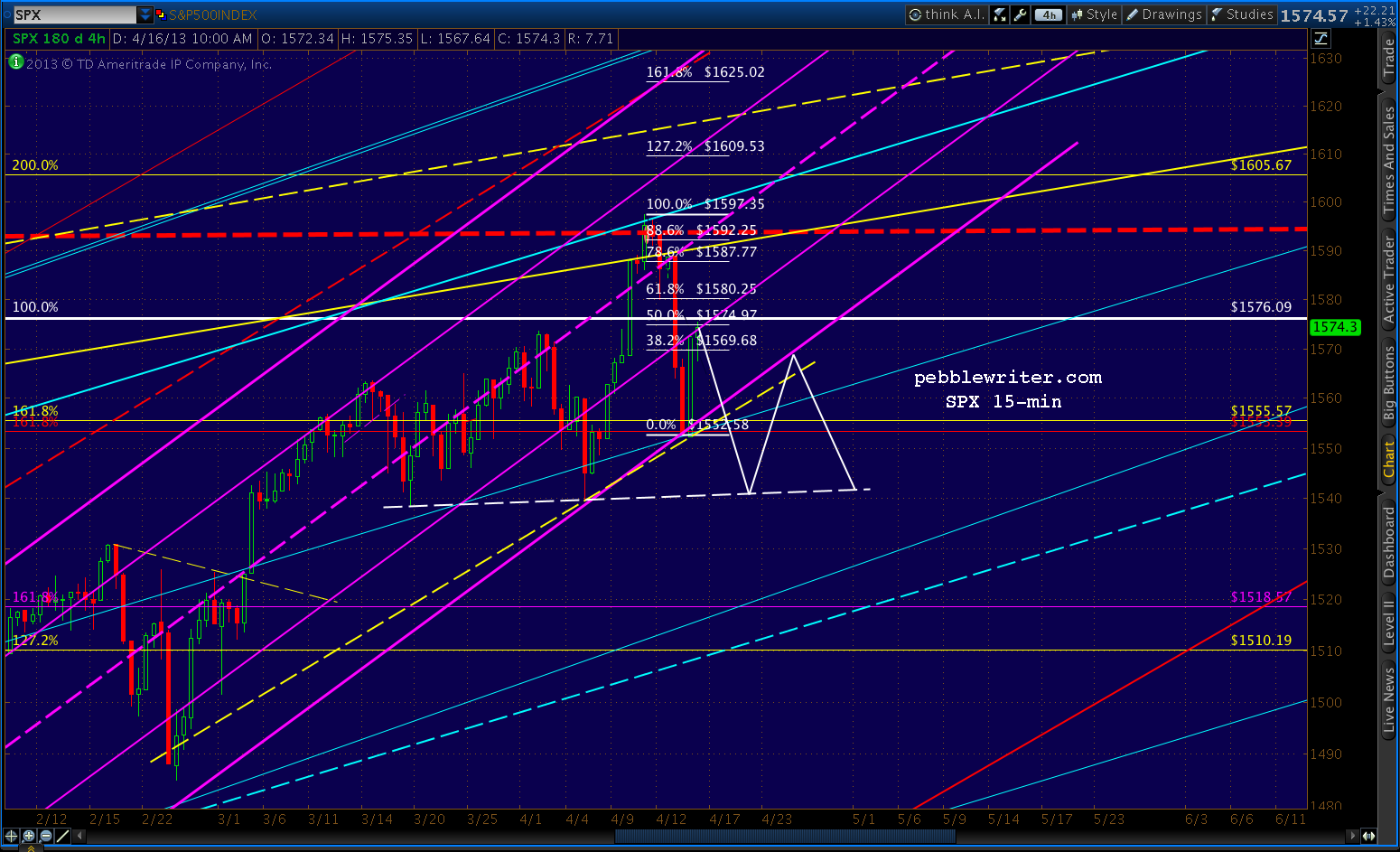
    As I discussed last night in Trading for Fun & Profits, the market is at another critical turning point.  After topping many levels of resistance, SPX is nearing some of the most important.  A break above can usher in much higher prices, while a reversal here could do a lot of damage.

    It’s no wonder that the market has bounced back and forth in a fairly tight trading range for the past week.  We’re likely to see more whipsawing over the next couple of days.  So, those who like to remain above the fray could wait for a break above 1603 or below 1580 and not miss too much of the action.

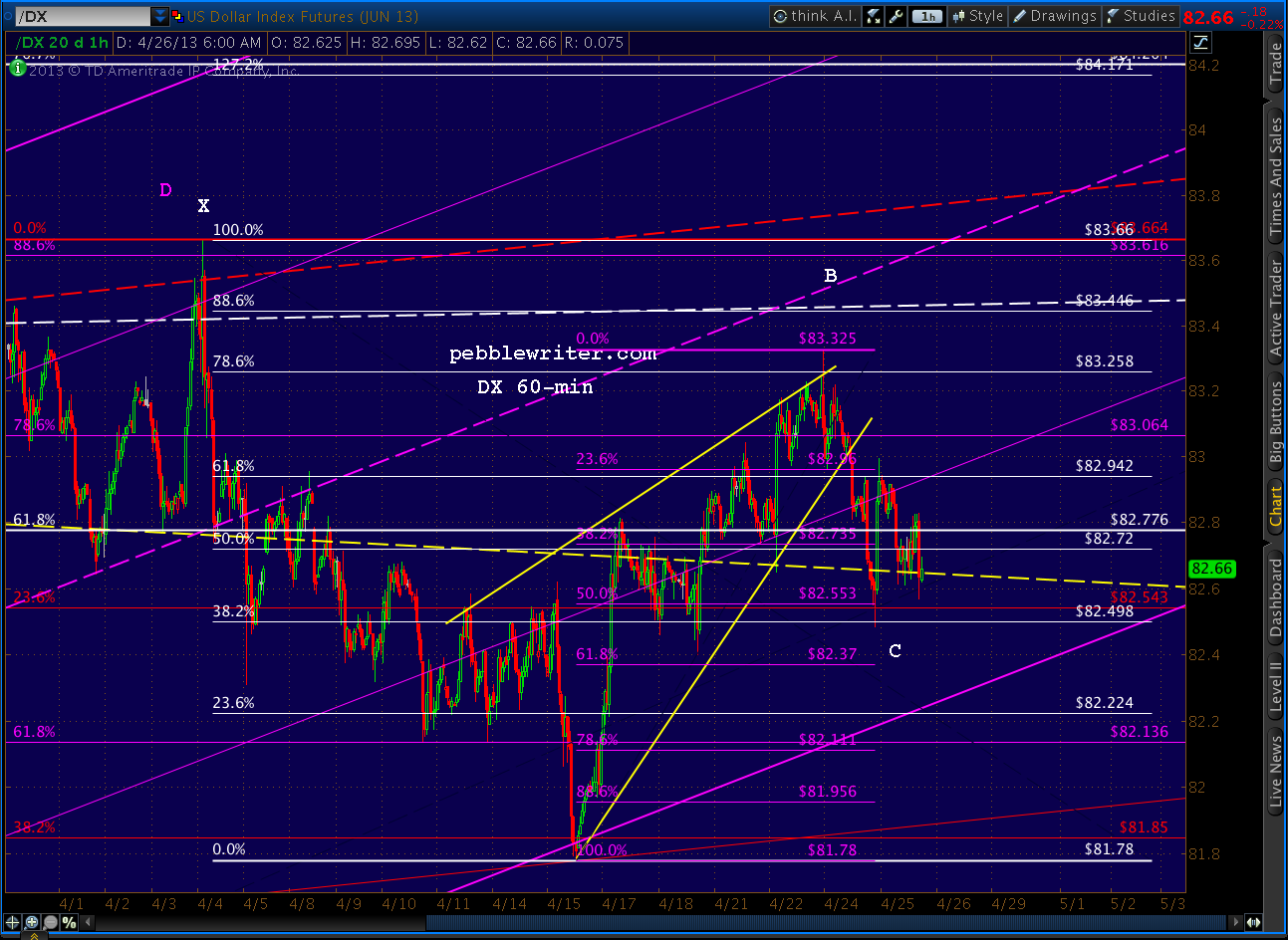
    The dollar should base here between 81.920 and 81.956.  81.67 is the key level to hold.

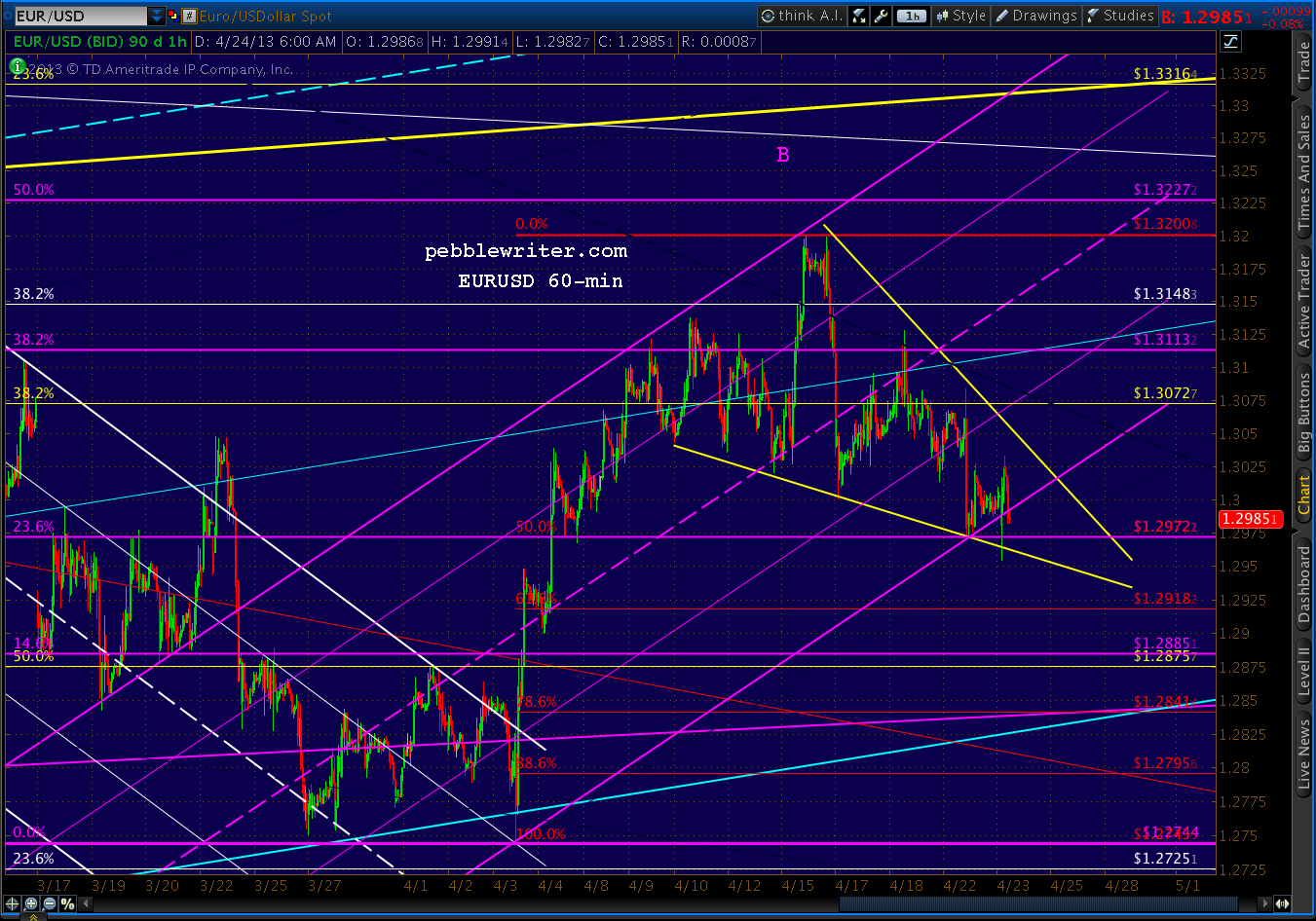
    The EURUSD has a little more harmonic upside potential, but that channel line could prove problematic.

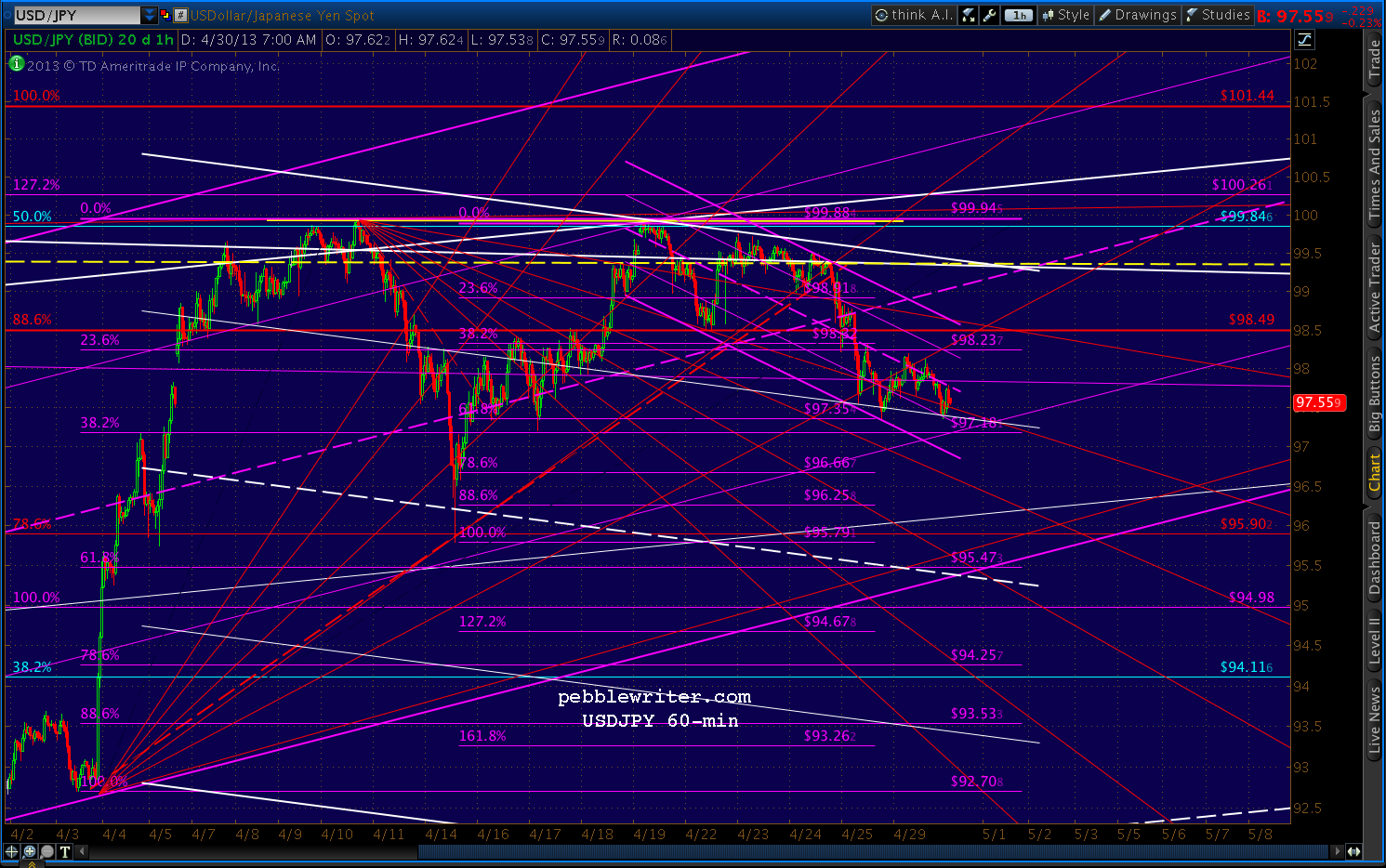
    USDJPY continues to have downside risk to the bottom of the purple channel.  It intersects with the white midline around the .618 of 95.47.

    UPDATE:  10:30 AM

    AAPL is getting a lot of attention for its “breakout.”  Recall when we last charted AAPL [see: Is It Safe?] on April 19, we noted the presence of a channel line that should support a rebound.

    “the chart patterns and the harmonic patterns that suggest AAPL is due for a substantial bounce.  Whether it turns into something more than that will depend on whether it break free of the falling channel from hell…  AAPL should find support at the .75 line of the white channel around 380-385.”

    I was a little off, as the actual bottom was 385.10.  But, it’s back to that channel bound discussed and is thinking about breaking free.  Unfortunately, it’s also reached a .618 Fib line that could spoil all the fun.

    It needs to close above 437.54 in order to be considered safely out of the woods.  In fact, a failure and close below 429.70 would be quite negative – at least in the short run.

    UPDATE:  10:40 AM

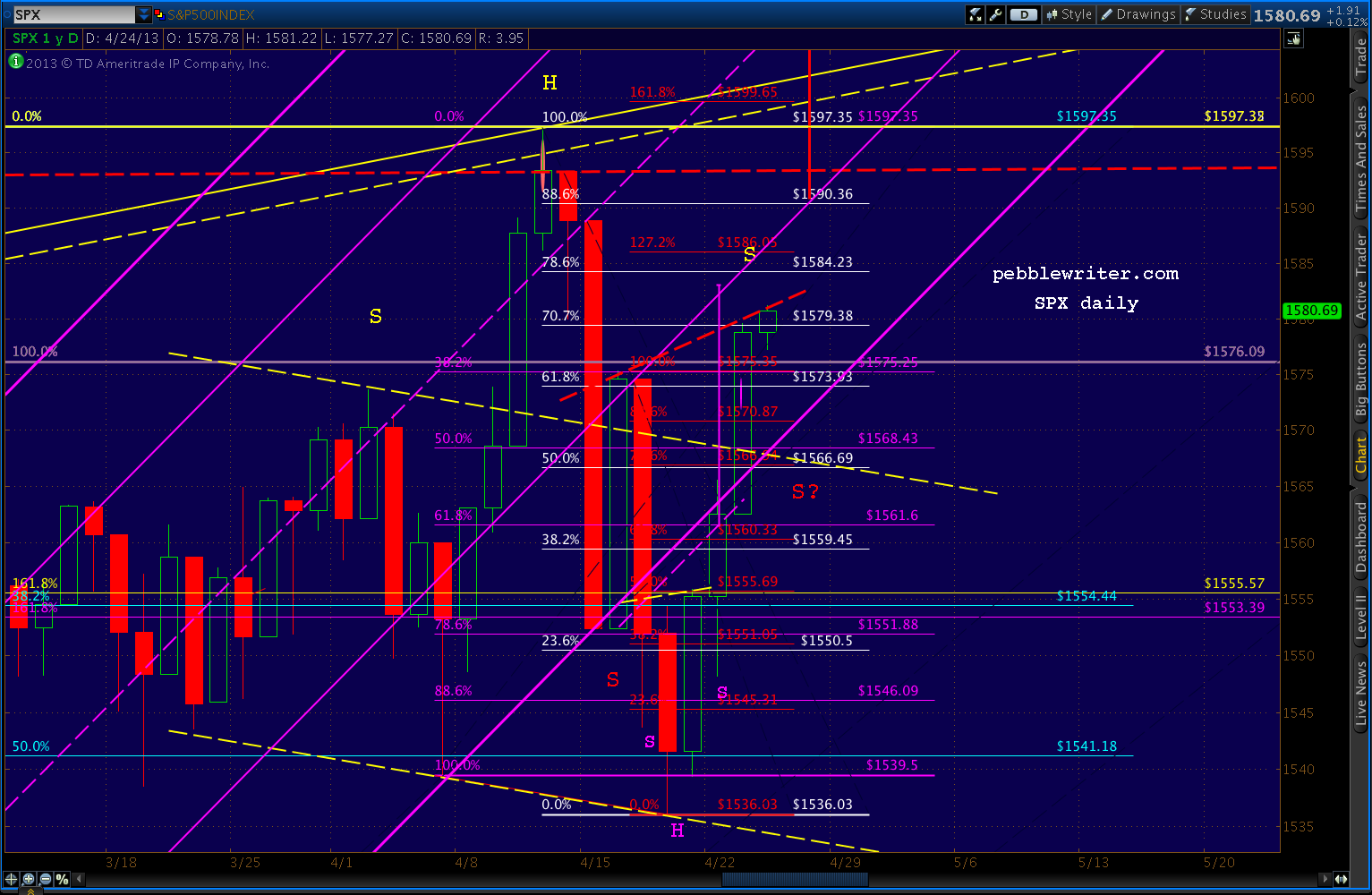
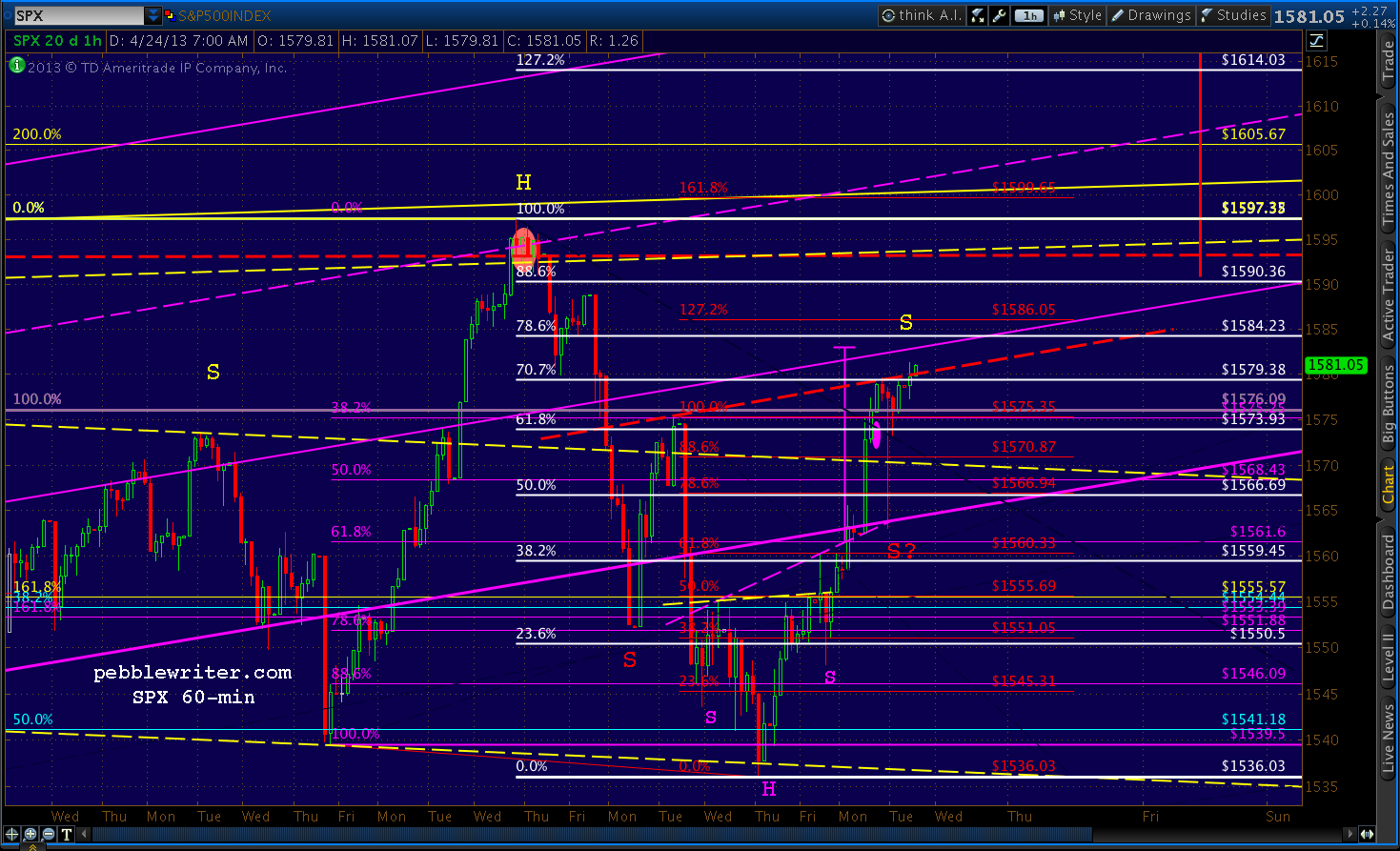
    SPX is getting a bounce off its lows of this morning. It should run its course by 1592.  Any higher would be cause for considering switching sides.

    UPDATE:  11:00 AM

    An update on the bounce…

    I’m taking an interim long position here, stops at 1591ish.   Key level = 1593.47 — the 2000-2007 TL (red, dashed.)

    more in a few

    UPDATE:  11:50 AM

    SPX just moved back through the long term TL mentioned above, so I’ll close my short position and play the upside. This leaves us full long at the moment, though this could obviously still break either way.

    The IH&S neckline is currently up at 1599.63, and the channel midline is around 1598.26.  Look for a backtest of the broken TL.

    For anyone who doesn’t enjoy being caught here in the surf zone (does anyone?) here are the approximate key levels to watch:

    • TL (red, dashed) from 2000 and 2007 tops: 1593.44
    • previous high: 1597.35
    • purple channel midline: 1597.48
    • the neckline of the almost completed IHS (yellow) at 1599.82
    • TL (yellow, dashed) from 1994 and 2003 lows: 1600.22

    It was that last TL that stopped SPX on the 11th, so that’s the most important.  Topping it means exceeding the other three, so it’s obviously bullish.

    And, as we discussed late yesterday, the failure to tag the IH&S neckline  — now at 1599.82 — could be quite significant.

    If the current backtest of the red 2000-2007 TL holds at 1593.40 or so, there’s another little IH&S waiting to complete at 1595.75 that targets 1604.53.

    But, there’s a significant point of confusion coming up that I’m sure the market makers will take advantage of.

    continued for members(more…)

  • Trading for Fun & Profits

    NOTE:  Protect yourself from future price increases.  I am again offering charter annual memberships that lock in your current annual membership price ($1,200) for the life of the site to the next 20 subscribers or until May 1, whichever comes first.  Afterwards, annual memberships are slated to increase to $1,800, followed by a final increase to $2,500 when the fund launches.  For details, click HERE.

     *   *   *   *   *   *   *   *

    I received an email from a prospective subscriber over the weekend who had a modest amount of money to invest and wanted to know how to use pebblewriter.com to invest in options — a field in which he hadn’t much experience.  He described himself as a passive participant who isn’t particularly interested in playing intra-day moves.

    First, let me congratulate this gentleman for asking the right questions.  Even the most experienced among us started out as a newb. I can, unfortunately, recall many times when I wish I had taken the opportunity to ask more questions before plunging in.  Experience is a great teacher, but it can be an expensive lesson.

    Second, his question made me think: what is the best way to use this site?  We’ve had a great run so far [see: RESULTS.] Given the way it has evolved and the way the market is moving these days, do options even make sense?  If not, then what?  And, how?

    OPTIONS

    I’ve traded options on and off for over 30 years.  I’ve enjoyed some unbelievably great trades, and I’ve had some real stinkers.  In a strongly trending market where we’re going to make a big move one way or the other, they can be a lot of fun.  When the market moves against you and you’re running out of time, it’s like being strapped to the front of a runaway locomotive that’s about to T-bone a nuclear power plant.

    I’ve pretty much decided that unless someone has the time, experience and resources to become expert at options trading, it’s really best to stay away with any serious money — at least with directional trades.

    There are all sorts of strategies that can mitigate risk, but buying at- or out-of-the-money calls and puts in the hopes of the market moving in the right direction, by the right amount and in the right time frame is like tossing your money up in the air and hoping more of it falls back down.

    I can’t count the number of times I got direction and price right, but the move I expected didn’t happen until the Monday after expiration.  I’ve seen many very smart people get hosed in this and countless other ways.  Bottom line, unless you’re brilliant, rich, experienced and have great trade management skills, I can’t recommend them.

    EQUITY STRATEGIES

    So, how might someone use the information on this site to make money in the markets?  If you can stay on the right side of the markets most of the time — long when it’s going up and short when it’s falling — then it turns out you can make some decent dough.

    Many investors use an ETF such as SPY or the eminis to establish a long or short position.  This is easiest for those who have the time to watch the markets during the day and respond relatively quickly to trade signals which, like the markets, can be unpredictable.

    There’s no way for me to know whether our 2nd year will also produce an average of 10% per month.  But, at even half that, I’m a very happy camper.  At a quarter, we’d still be way ahead of the pack.  As such, I see no particular benefit to using leverage.

    In a vibrant and trending market, I love nothing more than raising all the sails and running before the wind.  But, this can be unproductive — or even dangerous — in gusty, shifting winds.  Then, I try to be a little more cautious.

    It was smooth sailing from March to May 2012.  We earned almost 25% during SPX’s 11% drop from 1422 to 1266 with a minimum of effort — a nice payoff for the new pebblewriter.com just getting under way.

    Even the whipsawing rebound from the June lows to the September high wasn’t too bad.  We had a big harmonic pattern to complete at the Sep 14 high of 1474, which was the 88.6% retracement of the 1576 – 666 crash.  It provided a great target and we were able to generate another 36% on a 16% move in the underlying.

    The decline to 1343 over the next two months, once it got going, was fruitful — earning us 25% on the 9% decline.  But, thanks to the unusual structure, it took 44 trades to get it.  The rebound over the following month was much easier, earning 14% versus SPX’s  7%.  Then, sadly, our analog crapped out around the end of the year.

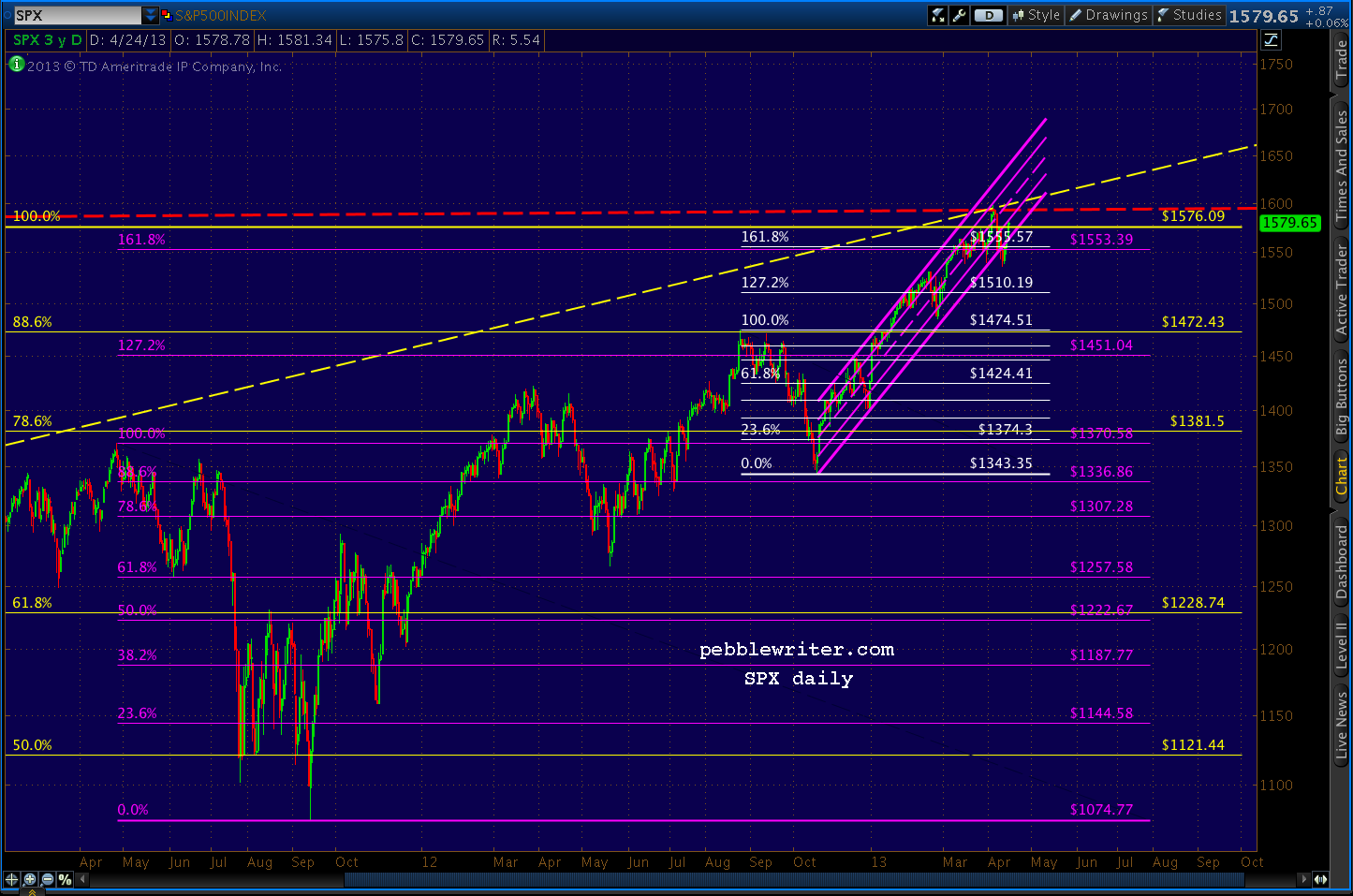
    The following months were painful.  Once a harmonic retracement exceeds the .886, there are oodles of possibilities: a slight throwover, a double-top, a 1.272, or a 1.618 extension.   What’s worse, we had conflicting signals — with two major Crab Patterns calling for a 1553-1555 top, only 20 points below the 2007 high of 1576.

    We spent much of January through March trying on different scenarios for size, waiting for a trend to emerge.  It came in the form of a five month, 260-pt narrow channel whose biggest correction was about 50 points.  It blew through several important Harmonic targets, Head & Shoulders Patterns, and pretty much everything else the bears could throw at it.

    In the end, we did well enough — scoring 23% in the first quarter versus the S&P’s 13%.  But, it’s been a heck of a lot of work — much of it feeling like we were lost in the reeds.  I have used tighter stops, gone to cash more often overnight and weekends, and looked for opportunities to pick up 5-10 points on an intra-day basis.

    THE CHALLENGE

    But, the volume and sometimes conflicting nature of more short-term trades can make them hard to track (e.g. are we taking an interim long position in addition to our core short, or a short-term long trade in expectation of re-shorting?)

    I created a new page to help folks keep track of the big picture: Current Position.  But, there have been many times when a perfectly good chart pattern busted or didn’t play out as expected, and even the big picture or “core” trade got stopped out.

    One long-time subscriber suggested color-coding transactions, and I’m trying to figure out whether it might work.  My concern is that the nature of positions sometimes changes. For example: SPX closed at 1593 today.  My current expectation is that if it exceeds 1596, it has potential to 1602.  If it tops that, 1635 is on the table, etc. etc…

    On the other hand, if it dips below 1592 in the morning, it has downside risk to the channel bottom at 1576 where it would likely catch a bid and start a run to 1635.  But, if it fell through the channel bottom, though, look out 1500.

    I’m not sure how to even begin to characterize those scenarios as long-term or short-term, much less color-code them — as much as I  would like to.  And, then there’s the question of you, my faithful subscribers.  Are you a swing trader?  A day trader?  Maybe the buy-and-hold type?  What’s short-term for a swing trader can seem like an eternity to a scalper.

    BE THE SOLUTION

    What I’m best at is figuring out where the market is likely to be.  Sometimes,  I can see very substantial moves weeks or even months ahead.  For example, we positively nailed the July-August 2011 crash, the Apr – June 2012 correction, the June – Sep 2012 rally and the Sep – Nov 2012 correction.

    But, sometimes, the long-term picture is as clear as mud — especially at key inflection points such as right now.  I can make a very good case for a sharp pullback to SPX 1497, and nearly as good a case for 1823.

    Those who can take this information and adapt it to fit their circumstances (objectives, resources, liquidity, risk tolerance, etc.) in a timely manner will do well as long as I can keep feeding you good information.  It will mean staying pretty active during choppy, directionless markets, and less so in trending markets.

    But, the onus is on subscribers to take the time to determine whether the scenarios I foresee unfolding are compatible with their needs and objectives.  I’ll always do the best I can to provide a sense of the big picture.  But, there will be times when we are “lost in the reeds” and alerts come more frequently — requiring more effort on the part of subscribers.

    It’s not possible to repeat everything going on in a cumulative fashion. So, important tidbits discussed yesterday might or might not make into today’s post.  Therefore, it will be much easier to stay up with what’s going on if you take the time to read each post.

    Those who don’t have the time or the energy to follow along might find the idea of a managed fund more appealing.  Or, you might check in whenever able — knowing that catching some of the moves some of the time is better than waiting for Cramer’s next brainstorm.

    A month ago, many of you were kind enough to fill out questionnaires that we sent out.  I’ve read each and every one from top to bottom, and there are some great ideas amongst the  feedback.  I’ll be working to incorporate as many ideas as possible as we move ahead.

    In the meantime, please don’t hesitate to drop me a line with your thoughts.  I don’t always have time to respond immediately, but I read everything that comes my way.

    Good luck to all.


  • Charts I’m Watching: Apr 29, 2013

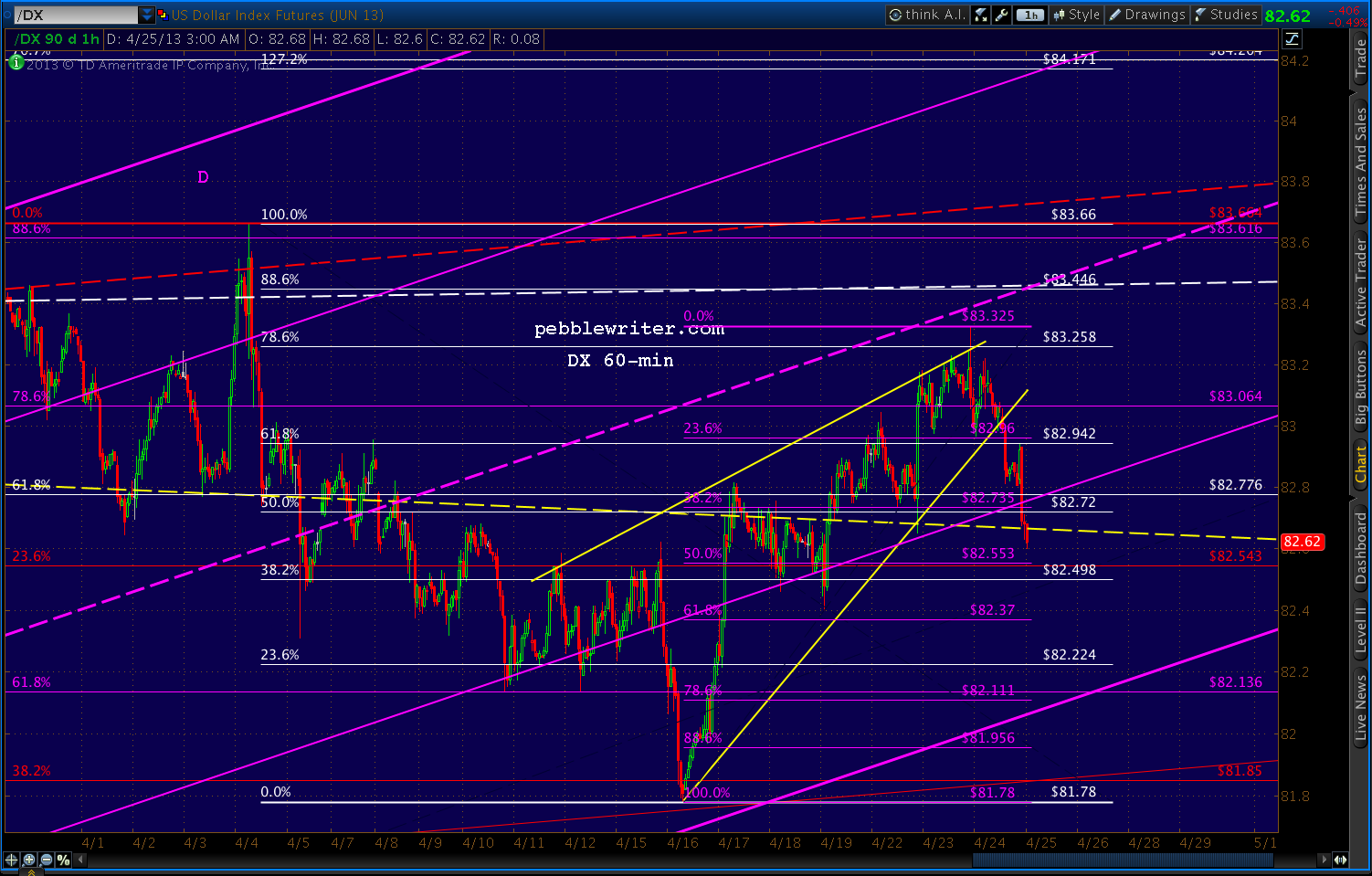
    The dollar continues to settle, and is currently below the purple channel bound.  DX tagged the .786 of its rally from Apr 16, so should reverse from there or, alternatively, the .886 at 81.956.

    The USDJPY, which fell through the purple midline last week, reached the .618 of its last leg up and is likely to rebound to backtest the purple midline before correcting any further.

    SPX needs to reach about 1596 to complete the latest IH&S in the works.

    We’ll play along on the upside at the opening, but beware of the upcoming Fib levels.

    UPDATE:  9:35 AM

    The opening surge took SPX above the red .618 of the move down from the latest tag of the TL from the 2000 and 2007 highs (red, dashed below.)

    If SPX can maintain any downside momentum, that could suffice as a corrective wave.  But, there’s no operative falling channel at the moment, so not much evidence to support that idea.

    I’m inclined to let it run, but maintain stops near our entry point just in case.

    Remember, SPX bulled its way back into the broken purple channel on the 23rd — an unusual occurrence with bullish overtones.  It damaged, and probably destroyed, the traditional H&S pattern (in red, above) that was setting up.

    I’ll continue to believe in the ability of the TL from the 2000 and 2007 highs to limit the upside until proven wrong.  But, the inability of the bears to seal the deal with that H&S is disturbing to the downside case.

    Looking at the white harmonic grid above, the upside goal is obvious.  But, it means breaking through that TL in what appears to be an already overextended market.  The bulls shot themselves in the foot with the push above 1573.  The yellow IH&S would have been much more believable if we’d seen a reversal to the bottom of the purple channel there.

    Now, we’re looking at an insanely steep neckline that doesn’t exactly inspire confidence.  Given the mixed signals, we don’t have much choice but to continue playing the swings — at least until there’s some sort of breakout or breakdown.

    The next one is coming up at 1590.92 — the .886 of the drop from 1592.64 and roughly a tag of the purple .25 channel line.

    UPDATE:  10:25 AM

    That’s the .886, and the channel line.  I’ll close the long here at 1591 and revert to short, but with stops at 1593ish just in case there’s something bigger in the works.

    UPDATE:  12:05 PM

    SPX just tagged the TL (red, dashed) connecting the 2000 and 2007 highs.  From a harmonic standpoint, this is bullish.  But, this TL — which was only broken intra-day on the 11th — is technically very important.  A sustained push through 1593.50 and I’d say we’re heading up to at least 1596-1601.  But, I wouldn’t abandon my shorts until that point.

    Note that we’ve now tagged the purple channel line, rather than merely coming very close as we did earlier this morning.

    UPDATE:  12:25 PM

    That didn’t take long.  We’re pushing on through 1593.50, so I’ll take an interim long position here and ride it up.  Targets and implications coming in a few…

    continued for members(more…)

  • While You Were Sleeping

    Another disappointing GDP print, and the markets seem to be reacting with a shrug.

    Look closer, though, and it’s apparent the markets are teetering.  Many currencies and equities reached the point where they should correct yesterday, and now appear to be tipping over the edge.

    The magnitude of the correction is still a question, but it should start either today or Monday — as long as central bankers don’t do anything to upset the bears’ apple cart.  But, they wouldn’t do that, right?

    In one of the more disturbing videos I’ve seen in a while, Goldman Sachs Jim O’Neill came on CNBC [watch HERE] and said he thought it was just great that 23% of central bankers recently surveyed were either buying stocks with their reserves or will be soon.

    The top reasons given include diversification and yields on government bonds that are too low.  One fellow interviewed for the Bloomberg article remarked that it was a “very logical move” given that stock dividends [at 2.2%] were higher than bond yields [1.69%.]

    I could devote today’s entire post to the idiocy of this train of thought.  Thankfully, 70% of central bankers agree with me and still consider investing in equities “beyond the pale.” But, many of these same bankers probably never thought they’d be locked in a defacto currency war, printing currency non-stop to “stimulate” their economies.

    Global central bank currency reserves currently total about $11 trillion.  This compares to the S&P 500’s market cap of $13 trillion, or the DJIA’s of $4.3 trillion.  But, of course, a market can be stabilized with the timely purchase of a handful of key components, as we have seen many times when the Plunge Protection Team swings into action.

    While many have characterized the PPT as the imaginings of the tin foil hat-wearing fringe, it’s easier to accept the concept and envision the construct given these survey results.  This survey merely brings one element out of the shadows and into the light.

    If central banks feel free to buy stocks, is it much of a leap to think they might time those purchases to “help” the markets in times of need?  I don’t think it’s a leap at all; it’s more of a foregone conclusion.  But, the terms and mechanisms used obscure what’s really going on.

    The Bloomberg article points out the Fed and the Bank of England have “no mandate to buy stocks directly” — which is a little different from saying they have no hand whatsoever in buying stocks.  By providing virtually unlimited and free cash directly and indirectly to banks — the Fed most certainly supports stocks.

    For example, when Goldman Sachs — which in 2012 had $47 trillion in derivatives exposure against $20 billion in tier one capital — sees a swap going against them, they can tap their rich uncle for a low interest loan to help prop up the underlying [see: The Wipeout Ratio.]  We frequently see this in the futures markets — especially overnight in what are known as “ramp jobs.”

    Some might wonder whether a caring and benevolent government that steps in to avoid market meltdowns is such a bad thing.  We want our banks, insurance companies, pension plans and trading partners to stay solvent, right?

    There’s no question that we do.  But, stock prices are supposed to be driven by the “free hand” of the market, where values are driven by widely divergent views on opportunity and risk.  Should participants come to believe there is no longer any risk, prices will move even further out of line with the fundamental drivers of value.

    When inevitable black swan events come along (an earthquake, a Lehman, an AIG, a sovereign downgrading, a tweet, etc.) they could overwhelm the support structure in place, triggering an even bigger financial calamity than would have taken place in a normalized market.

    And, what about the misallocation of capital?  Why should banks, which can and do play the markets with all that free cash, risk even a penny of it on your new consulting firm or dry cleaning business — especially when the government is backstopping their trading activities?

    Ben Bernanke has been quoted as saying:

    “I want to be very, very clear: too big to fail is one of the biggest problems we face in this country, and we must take action to eliminate too big to fail.”

    That quote was taken from his 2009 Time Magazine’s Man of the Year interview, and the problem is even worse now than it was then.

    If we believe the market is rigged, or a casino, or has lost touch with reality…should we stay away?  I believe there is ample opportunity for those who understand how the game is being played to profit from it.  The analysis I use to decide when to go long or short is exactly the same analysis I would use if the PPT hired me to alert them to potential dangers.

    We’ve all heard the axiom “the trend is your friend.”  But, what about market reversals that lead to 10-20% downdrafts?  Much of my work is dedicated to finding inflection points where markets are poised to reverse.  Rather than riding them out, we are often able to position ourselves ahead of and capitalize on the coming move.

    Equally important, these inflection points provide a discreet price point with which we can determine if our outlook and current stance is correct.  Typically, if a pattern calls for a reversal at X but prices exceed X, I know what the next reversal point Y will be and whether to change from a long position to short, or vice versa.  This is infinitely harder to accomplish by studying a balance sheet.

    It doesn’t always work, and it’s rarely as easy as I’d like it to be, but it’s been fairly effective.  And, because I usually know when to pull the plug, I believe it really helps mitigate risk.

    So, rather than complain about the market being rigged (okay, I still do sometimes) I’ll devote my energy to understanding how it’s being run and how to profit from it — and, try to sock enough away just in case it all comes crashing down.

    *  *  *  *  *  *  *  *

    We’ll start with developments in the currency markets last night…

    The USDJPY broke the trend line and Fib Fan line I charted yesterday – indicating a continued decline to at least the 96.25 level.

    The EURUSD has broken beneath the channel yet again, but is backtesting it from below this time.

    And, the USD is finding support (a second time) at an important channel line.

    Yesterday, SPX reached our .786 target of 1584.23, then spurted higher to tag our alternate target of 1590.36.  We closed our long position and shorted @ 1584.80, then rode an interim long position up to 1590 where we closed it as well.  So, we’re short from about 1588, net.

    This isn’t the sort of market to let bears off easy, though. SPX ran up to 1592.64 — a nervous moment for those shorting into a rapidly rising market at 1590.  As I posted when SPX pushed through 1587:

    I wouldn’t start getting nervous about the short position until around 1594 — the trend line (red, dashed) that extends from the 2000 and 2007 peaks.

    Market makers watch Fib levels, too.  So, when we muppets take positions at important inflection points, they like to inflict just enough uncertainty to shake out weak players — those lacking the conviction to hang in there when their position is slightly underwater or who set tight stops at obvious levels.

    UPDATE:  1:05 PM

    SPX is off about 6 points, but seems to be catching some support here. It looks like backtest support, but we’ll keep an eye on the strength of the move.  We’ve technically come far enough to have a right shoulder to go with the left for the Inverted Head & Shoulders pattern we’ve been tracking.

    Any move back through the .786 at 1584.23 (now resistance) would represent more than just a backtest and would be cause to suspect the pattern is ready to complete.

    A close-up of the proposed falling channel…

    continued for members(more…)

  • XLF: Playing Catch Up

    On April 2, 2012, SPX completed a Butterfly Pattern at 1421 — the 1.272 extension of the July – October 2011 plunge.  It provided a great entry point for the fledgling pebblewriter.com’s first major short position.

    We scored over 20% in about 2 months [see: All the Pretty Butterflies] trading the 11% decline.

    XLF hadn’t done as well up to that point.   It had only retraced a Fibonacci 78.6% of its 2011 decline from 17.2 to 10.95.  So, no surprise that it sank by a whopping 18%.

    In response to a consulting client who was bottom-fishing for financials, I discovered they were probably bottoming in early June.  I posted my results in the appropriately titled:  So Crazy It Just Might Work.  If anything, my estimates were conservative.  XLF has soared 41% since that low (turns out it was the day before.)

    And, wouldn’t you know it, XLF has gone and formed its own Butterfly Pattern — just like SPX did in Apr 2012.

    continued for members(more…)

  • The Best Laid Plans

    The best laid plans of mice and men
    Go often awry,
    And leave us nothing but grief and pain,
    For promised joy!

    Robert Burns, 1785

    ORIGINAL POST:  6:45 AM EDT

    The wedges we’ve been watching on DX and EURUSD are playing out.  EURUSD has broken out…

    …and DX has broken down.

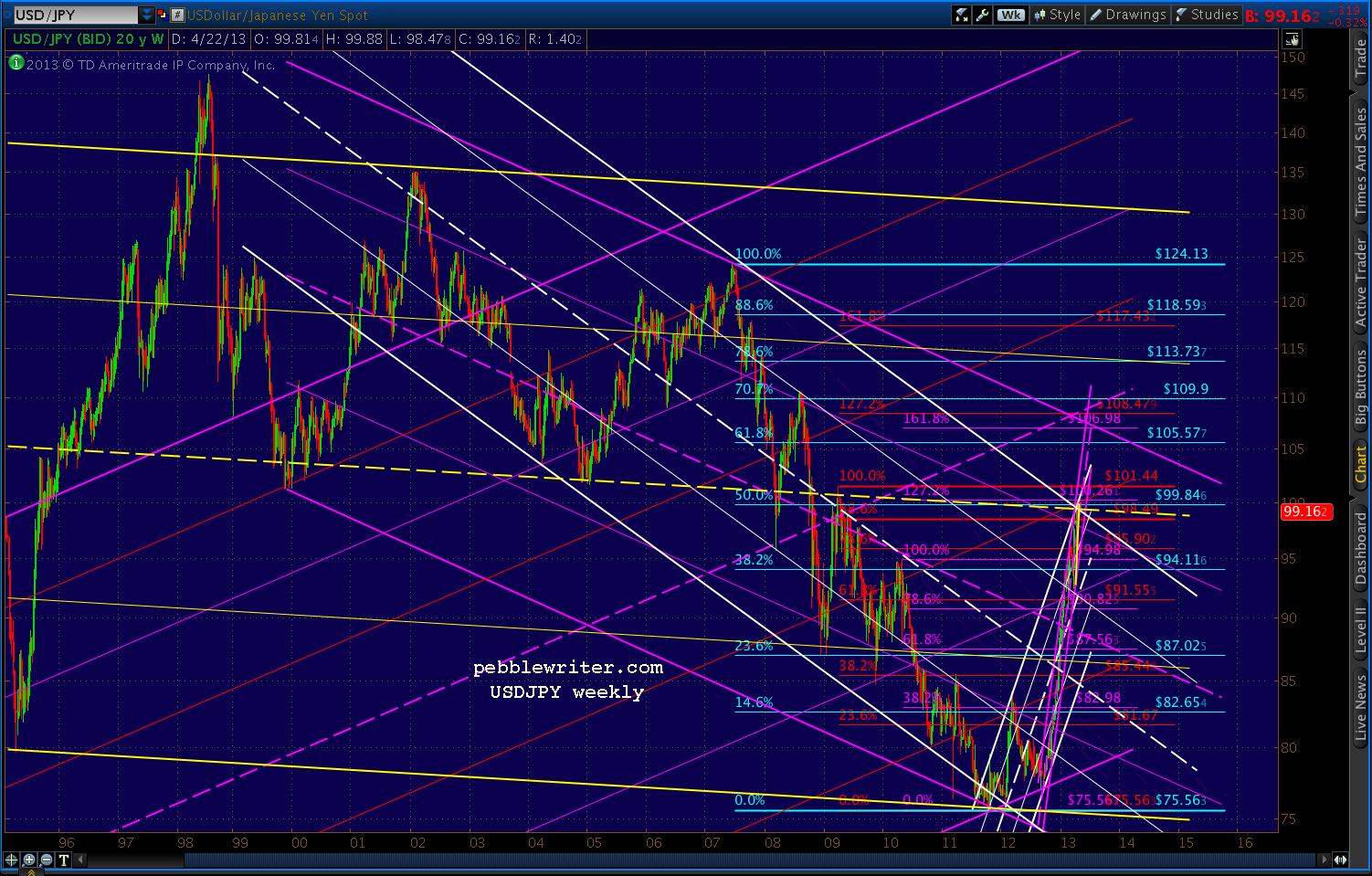
    But, it’s the USDJPY that I’m watching especially closely this morning.  It still hasn’t broken 100 since our Apr 8 observation [USDJPY update] that it was running out of steam:

    “…there is growing risk of a downturn as it approaches 100… it appears the pair might have hit at least interim resistance at today’s high.”

    It topped out 3 sessions later at 99.94, and two weeks later is in danger of a larger pullback.

    Remember, weakening the yen was a critical element of the BOJ’s stimulus program that was supposed to generate inflation, boost Toyota sales and send Japanese investment funds flooding into foreign markets.

    Instead, Japanese investors are repatriating their funds from abroad — a net Y9.5 trillion ($95 billion) since the first of the year.  Why?  As any US investor could tell you, QE might not inflate economies, but it sure as hell inflates markets.

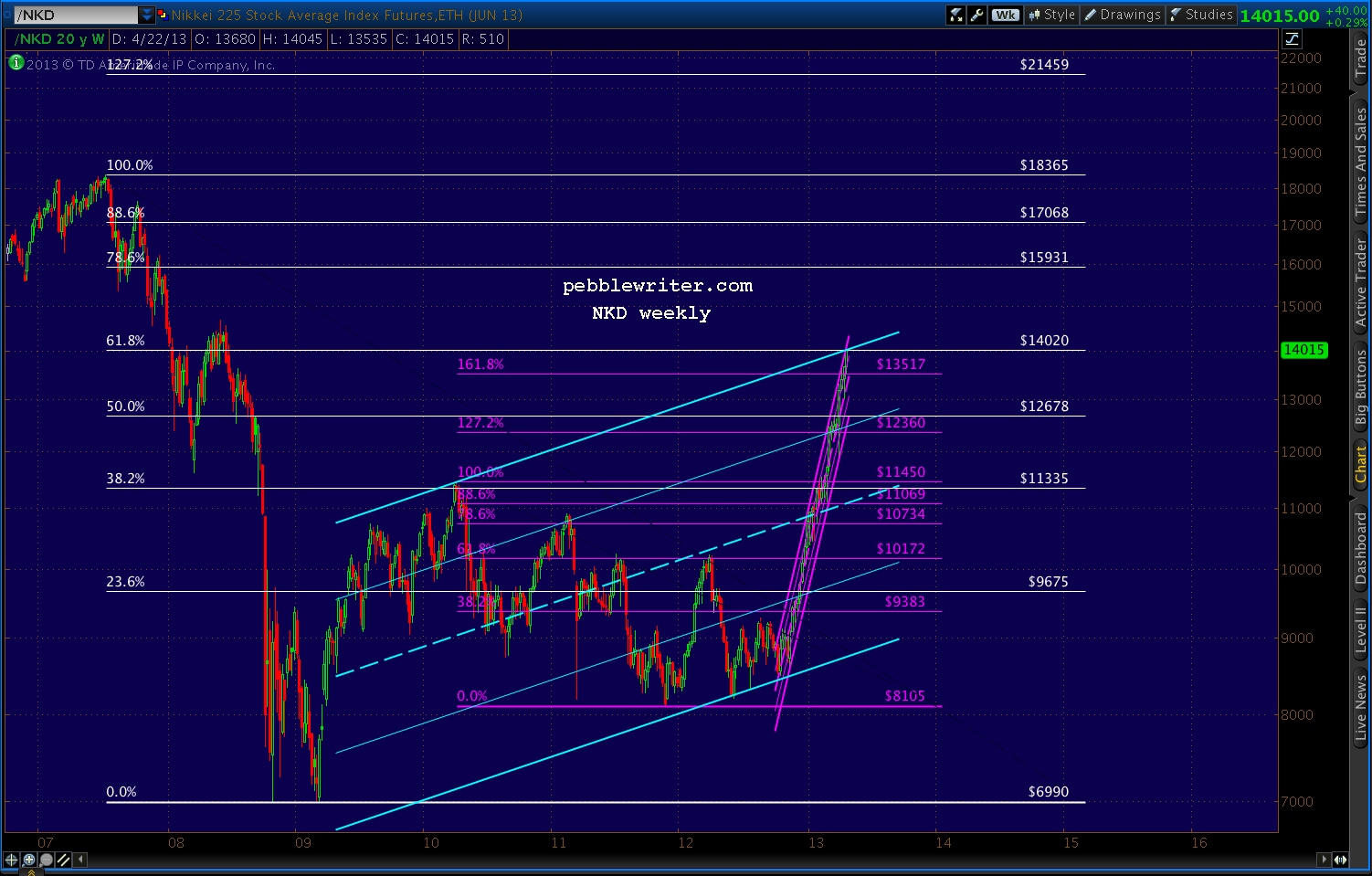
    The Nikkei 225 is up 65% since last October’s lows….

    …and, still hasn’t even recovered 2/3 of its losses from the 2007 crash.  The Dow and the S&P 500, by contrast, have recovered all of them — and, then some.  So, to many, the Nikkei still seems the better value.  It’s hard to argue with success.

    But, I’ll do it anyway.  In reaching 14,020 a few hours ago, NKD tagged the .618 Fibonacci retracement of its 2007-2009 crash from 18,365 to 6990.

    To those not familiar with harmonics, this tends to be a big deal.  When SPX reached the equivalent point in April 2010, it plunged 17%.  The DJIA fell almost 15%.  The USD, represented by DX, soared 9.3%.

    But, the yen positively soared.  USDJPY started a 17-month slide that took the pair down 20% from 94.98 to 75.78.  NKD, which had just reached its .382 Fib, shed 23% over the next 4 months, eventually reaching almost 30% in Nov 2011.

    Could the USDJPY’s failure to break 100 be telling us something?  You better believe it.  I called a top a few weeks ago because the pair had reached several important Fib levels as well as the midline of an important channel (in yellow, below)…

    …that dates back to 1995.

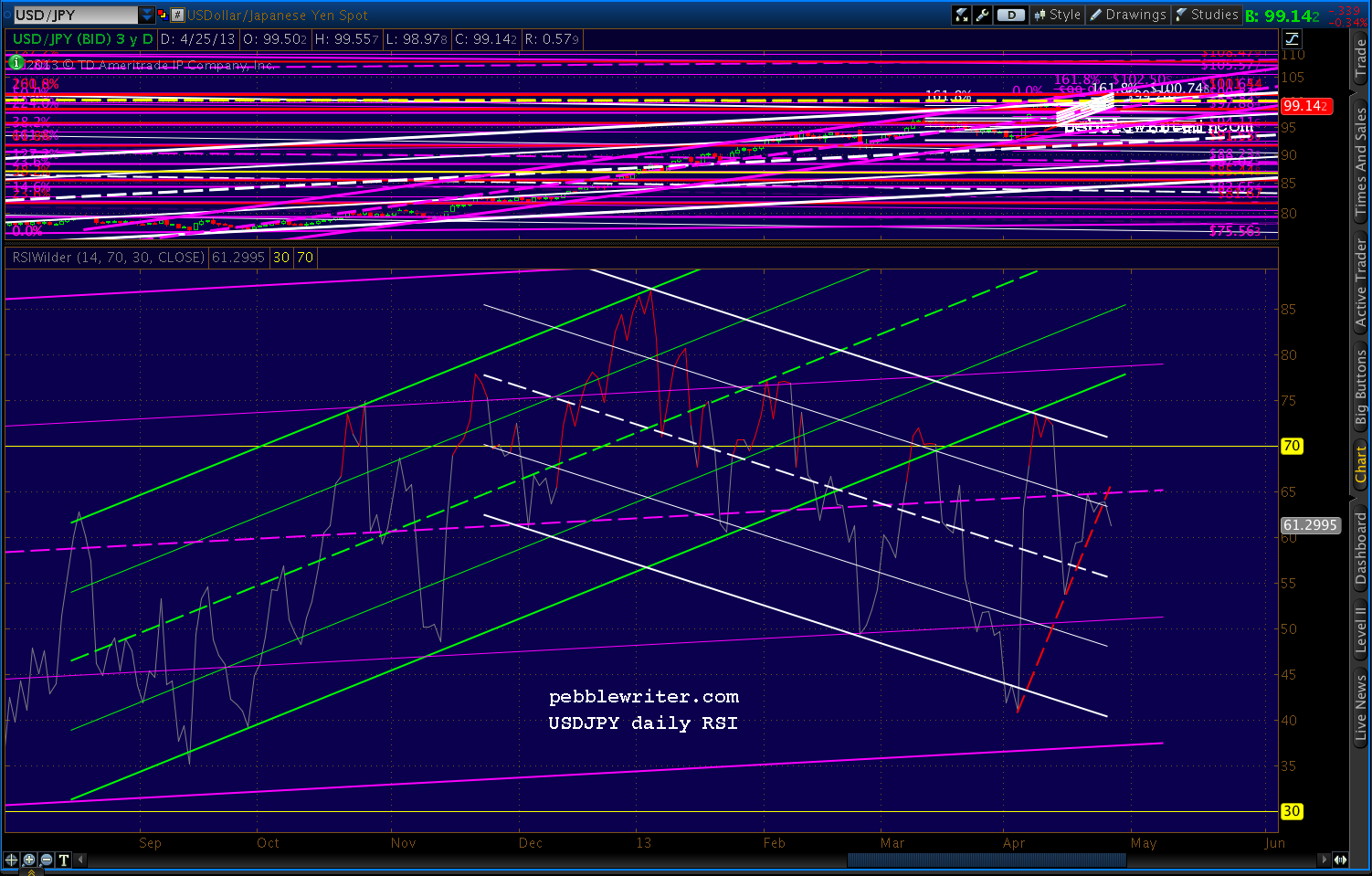
    There’s no guarantee it won’t push through instead of retreating, but the RSI picture supports the danger of a significant retreat.

    Daily RSI has backtested the broken yellow channel twice, but the trend is clearly down — with the latest push being rebuffed by the purple midline.

    And, a close-up reveals that a breakdown has already started.

    Stay tuned.

    UPDATE:  9:25 AM EDT

    With SPX set to open 5-6 points higher, it stands a very good chance of reaching our 1584.23 target. In other words, a pop and drop is very much in the cards.

    If it goes any higher, look for 1590.36 instead.

    UPDATE:  9:40 AM

    That’s good enough for me.  I’m closing my long position and reverting to full short here at 1584.80.  Stops around 1586ish.

    The .25 of the purple channel is right around 1587, so I’d use some discretion around that stop level and look to see if there’s any real strength behind a move higher.

    UPDATE:  10:25

    Getting a push through 1587, so I’ll open an interim long position for what should be only a few points higher to the .886.  Core short remains in place.  Tight trailing stops.

    I wouldn’t start getting nervous about the short position until around 1594 — the trend line (red, dashed) that extends from the 2000 and 2007 peaks.

    UPDATE:  10:50 AM

    I’ll go ahead and close that interim long here at 1590.  While I still think there’s potential to the 2000-2007 trend line, it could easily happen after the correction that should begin in the next hour.

    That way, the Inverted H&S Pattern would feature a neckline that’s roughly the same as the purple channel .25 line, and would target the same price level as the 1.618 extension of the 1597-1536 slide: 1635.

    This is a very artfully crafted scenario to justify (from a technical standpoint) a rally above that red TL — which is one of the last remaining technical impediments to a continuation of the rally from 1343 in November.

    Can they pull it off?

    continued for members(more…)

  • Chart Patterns and You

    ORIGINAL POST:  9:15 AM

    Last night, the dollar tagged the .786 Fib retracement of its decline from Apr 4.  It subsequently sold off almost to the .618 but, so far, is hanging in a rising wedge.

    The EURUSD re-tested the .500 Fib of its rise from Apr 3, and snapped back into its falling wedge and the (purple) channel that’s guided prices since then.

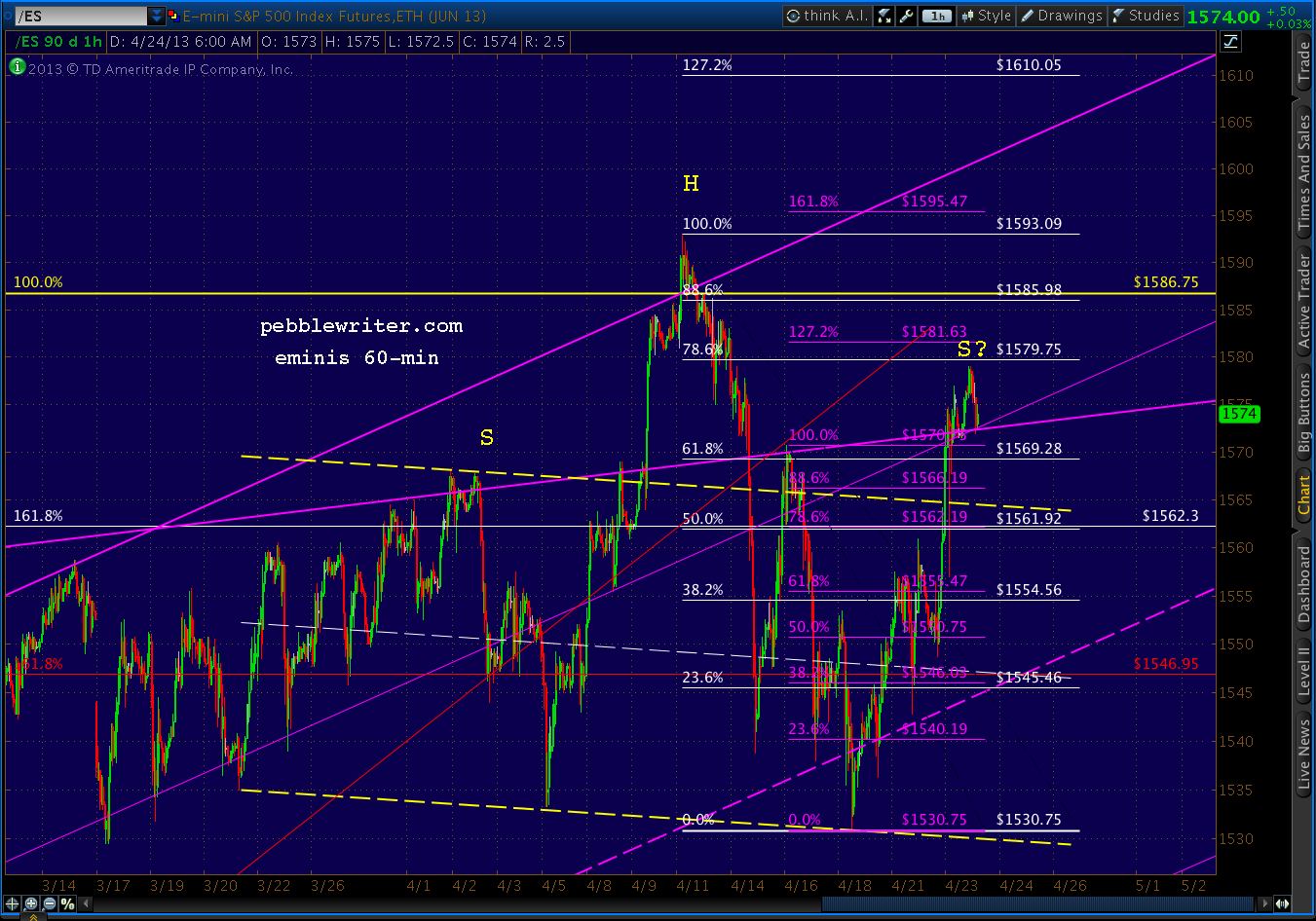
    The e-minis tacked on a few points overnight — almost reaching the .786, only to give them all back with this morning’s underwhelming Durable Goods report.  The H&S Pattern that was looking pretty good at yesterday’s open is now looking a little ragged, with a right shoulder that’s already 15 points higher than the left.

    UPDATE:  9:45 AM

    SPX continues trudging toward the .786 retracement (1584.23) of its decline from 1597 to 1536.

    After plunging beneath the channel that’s guided it from 1343 to 1597 on Apr 17, SPX rallied and re-joined the channel yesterday.  This was a very bullish development, as long as SPX remained in the channel all the way to the closing bell.

    Despite a five minute thrill ride from 1578 to 1563 (the channel bottom) and back, SPX managed to regain and hold the 2007 high of 1576.09 into the close.

    It now sits perched on the neckline of an Inverted H&S Pattern which has either completed or not, depending on whether a 5-minute plunge qualifies as a shoulder.  Short answer — I have no clue.

    Here’s what we do know:

    1. Prior to Apr 17, SPX had been locked into that purple channel below since 1343 on Nov 16 — an 18.9% gain in five months
    2. SPX barely paused when it completed two big Crab Patterns — the 1.618 extensions of the 1370-1074 decline and the 1474-1343 decline (purple and white below)
    3. Instead, SPX exceeded the Oct 2007 high of 1576.09 (yellow)
    4. SPX reversed at 1597.35, almost precisely at a trend line drawn between the 2000 and 2007 highs
    5. SPX fell 3.8%, making a lower low, dropping out of the channel mentioned above and suggesting a H&S pattern that targets 1474 — the Sep 2012 high (white pattern)
    6. It roared back into the channel, retracing almost 78.6% of its drop
    7. In the process, it topped the 1576.09 high and the 1553 and 1555 Fib levels and almost reaching the 1583 target of an IH&S Pattern
    8. Depending on your interpretation, it might also have completed an IH&S that targets 1621.

    What Does It All Mean?

    When I forecast markets, I look for lines in the sand.  I try to determine price levels that, if crossed, would signal a change in trend.  When that trend switches from bullish to bearish, I want to be short.  When it switches from bearish to bullish, I want to be long.

    A channel is one such method that features boundaries rather than absolute price levels.
    As long as prices remain in a rising (or falling) channel, we can expect prices to continue to rise (or fall.)  It’s rather simplistic, but it usually works.  We can make educated guesses as to future price targets based on where the channels point.

    Of course, even well-formed channels (multiple tags on the top and bottom and over a sufficient time period) can’t go on forever.  I look for moments when prices have to choose whether to remain in or leave the channel.  A tag of a top or bottom bound or midline usually create opportunities, though other lines can as well.

    The Real World

    Recall that we shorted SPX at the 1597 high on the 11th [see: Big Picture], riding down to the channel bottom where I went long at 1554, expecting at least a bounce.  We got one on the 16th with SPX rallying up to 1575 — the channel .25 line.

    We closed our long position, going short the following morning for the trip back to the channel bottom at 1555.  We tried another long position there, but were quickly stopped out as the channel was broken — signalling a bearish trend change.

    So, we shorted again, playing quite a few bounces down to 1540 where we eventually went long in anticipation of establishing a H&S Pattern neckline [see: Dollar Daze.]

    At that point, I expected a back-test of the broken channel.  We got it, reaching 1565 on the 22nd but closing beneath the channel’s lower bound.  Note that this move completed 5/6 of a H&S, but the right shoulder was underdeveloped relative to the left.

    Anticipating an intra-day retracement to 1567 (the .500 Fib) or 1574 (the .618) the next day (yesterday), I stayed long — trying without much success to anticipate the top.  Since SPX topped the .618, the next up on the chart is today’s target: the .786 at 1584.23.

    Going Forward

    With all that as preamble, here’s what I expect going forward.

    continued for members(more…)

  • Charts I’m Watching: Apr 23, 2013

    Watching the eminis this morning…

    Rallying with the dollar again…   Something’s gotta give.

    We discussed what a push up to the white midline would mean last week [see: Dollar Daze.]

    As SPX approaches the white .618 at 1573.93, we’ll find out whether the H&S Pattern is still in the cards.  Note that this is the .618 retracement of the 1597 to 1539 decline between Apr 11 and Apr 18.  It was our secondary target, as discussed yesterday [members’ section: 2:35 update.]  And, it’s arriving right on schedule.

    We’ll look for a pullback here to backtest the neckline just established (1561.50) and then a rally to 1567 either late in the day or (more likely) tomorrow morning.  From there, though, I’d give a continuing rally to the 1574 level a 60:40 shot.

    The beauty of investing with harmonics is not so much that they tell you where the market is going — although that can be nice when it works out like this.  It’s that you know relatively quickly whether or not you’re on the right side of a trade.

    I’m going to take the 19-pt profit on our interim long position (from 1555 yesterday) and revert to full short here at 1573.70.

    Obviously, SPX has quite a head of steam going, so loose stops make sense here.  I’ll likely reestablish a long position if it moves strongly through 1576.

    UPDATE:  10:25 AM

    So far, so good.  The MM are making their move to stop out the weak shorts.  Remember, 1576.09 was the 2007 high and a key level of resistance/support.  Many traders would naturally use it in setting stops at, say, 1577.

    I’m going to hold short here, as all my other indicators continue to point south.  It might seem a little counter-intuitive, but the bulls need a retreat more than an advance right now.  A 10-20 point reversal would set up a potential Inverted Head & Shoulders Pattern that targets 1617 or so (shown below in red.)

    Whereas, a push through 1577 would likely fizzle out at the white .786 (1584) or .886 (1590.)  But, I’ll keep an eye on it, anyway.  The best laid plans, etc…

    SPX has obviously pushed back into the purple channel from the Nov 2012 low of 1343, the bottom of which is way back at 1568.  We’ll take a look at what this does to the medium and longer-term scenarios.

    BTW, I am posting the updated charts for DJIA, NYA and RUT this morning.  NYA is already updated, and I’ll get the others up ASAP.

    continued for members(more…)

  • Charts I’m Watching: Apr 22, 2013

    Looks like we’re getting some follow-through this morning on Friday’s technical rally.  But, this doesn’t appear to be one worth chasing unless it can push up strongly through 1560.

    I’ll play along on the opening with an interim long position, with tight stops for the fizzle that could come quite quickly.  If 1560 is exceeded, look for 1573 or so.

    The dollar pushed above the TL from the prior highs as well as its .618 Fib of the Apr 4 high.  This bodes well for a run to at least the purple midline — probably at the .786 or .886 (83.258 or 83.446.)

    UPDATE:  9:35 AM

    There’s 1560.10, I’ll close the interim long here and revert to full short unless SPX can push higher.

    UPDATE:  9:39 AM

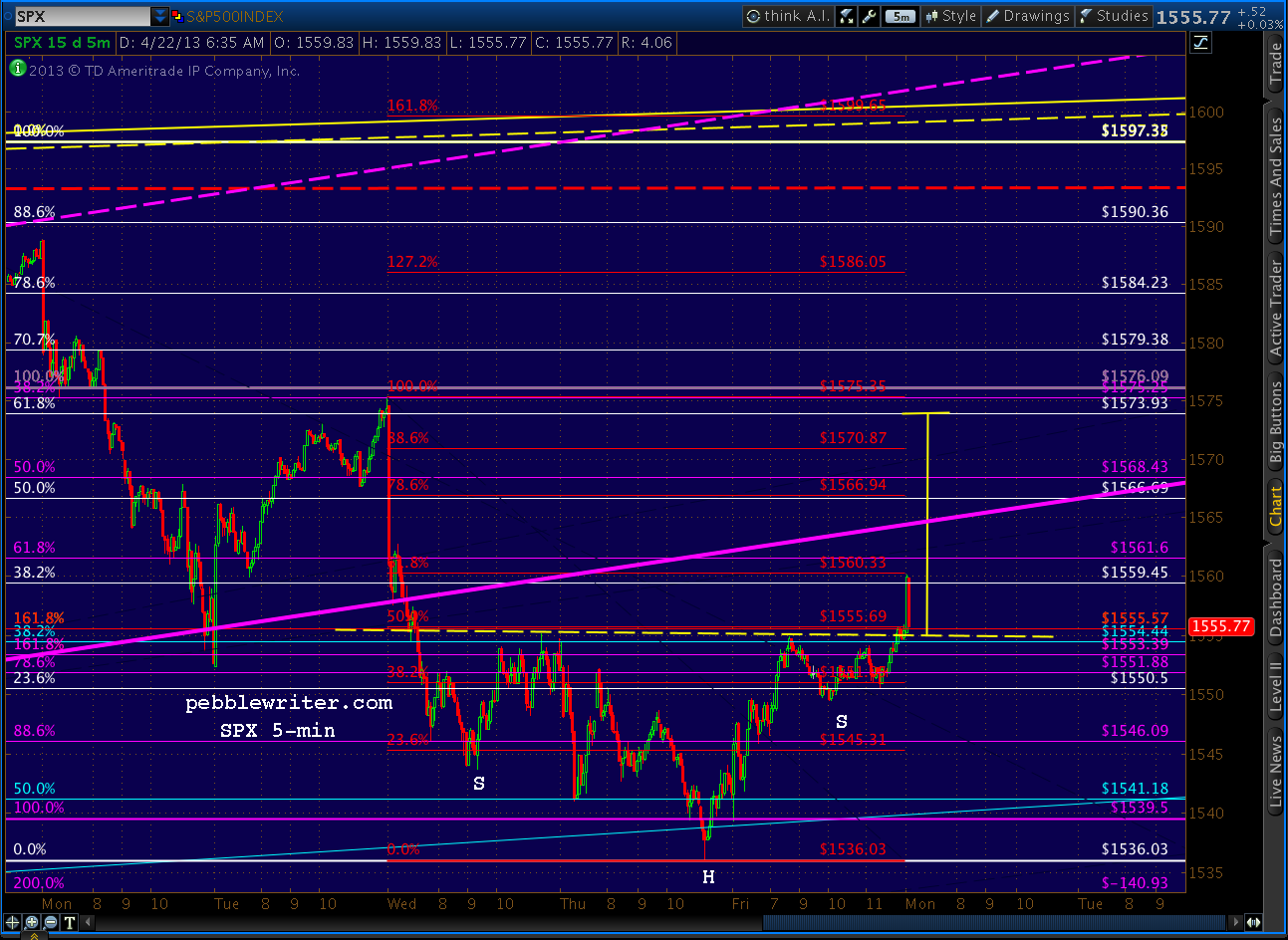
    Got a pullback to the neckline of the small https://pebblewriter.com/inverted-head-shoulders-pattern/ (in yellow, below) completed on the opening.

    I’ll try another interim long position here at 1554, with very tight stops (1553ish) in the event SPX pushes down through the neckline.

    The IH&S targets 1574 — which is also roughly the .618 retracement of the 1597-1536 decline.

    UPDATE:  9:50 AM

    I’m going to allow a little more wiggle room on the stop, as this setup is too good for the bulls to waste.  Hanging in there for 1574.

    UPDATE:  10:00 AM

    The existing home sales won’t make it any easier for more upside, here.

    Pulling the plug on the interim long unless it can push back up through 1555.

    As we discussed Friday, the right shoulder formed thus far is sufficient for the H&S Pattern proposed on Apr 16 to play out.  All we need now is a drop back to 1535 or so.

    But, getting SPX up to 1474 would be a coup for the bulls.  At that point, it would have formed 2/3 of another larger IH&S that targets 1610.  So, don’t expect them to give up this seemingly insignificant pattern easily.

    UPDATE:  11:55 AM

    SPX just shot through 1555 on weak technicals.  I’ll add an interim long position, but wouldn’t get excited about this move just yet.

    It’s questionable whether can push through 1558.74 — the .886 of this morning’s decline.  I’d have to classify it as corrective unless it can break out of the falling white channel.

    UPDATE:  12:15 PM

    Just reached 1558.53, pushed above the channel upper bound for about 3 1/2 seconds, and retreated.  I’ll hold on to the long, but raise stops to 1556ish.  The bulls really need a breakout here.

    *   *   *

    A quick shout-out to John Lounsbury, Managing Editor over at Global Economic Intersection.  He’s celebrating three years of fine reporting on economics and market analysis.  He’s a darn smart guy and fine writer in his own right, but also features some terrific guest writers on a regular basis (they’ve even been known to post occasional pebblewriter.com stuff when they’re desperate.)  Check it out HERE.

    * * *

    UPDATE:  12:40 PM

    SPX just burst through our channel line mentioned above.  This puts the red .786 at 1566.94 on the table — a Gartley Pattern.  Note that this is also roughly the level of the .500 retracement of the 1597 – 1536 decline.

    Assuming SPX will push through 1560 this time (the RSI chart below suggests it will) we’ll look for signs of weakness between 1567 – 1574.

    UPDATE:  2:35 PM

    SPX making nice headway toward our interim target range of 1567-1574.  I’ve had a chance to fine tune some of the charts; and, this move is shaping up pretty much as expected.

    Recall that we shorted at 1597 back on Apr 11, and held went long again at 1541 last Thursday.  SPX is coming up on the .500 retracement (in white, below) of that decline, which is a common enough corrective wave move.

    Note also that the red .786 and light blue 1.618 are very close to that same price level.  While the coincident Fib levels concur on the importance of 1566-1567, it’s the chart patterns that will likely determine the next 100-point move.

    continued for members(more…)

  • The Storm Before the Calm

    I’ve been quite bearish since going short on April 11 at 1597 [Big Picture: 11:30 update.]  Yesterday, though, SPX reached our initial downside target of 1540 and, as expected, paused.

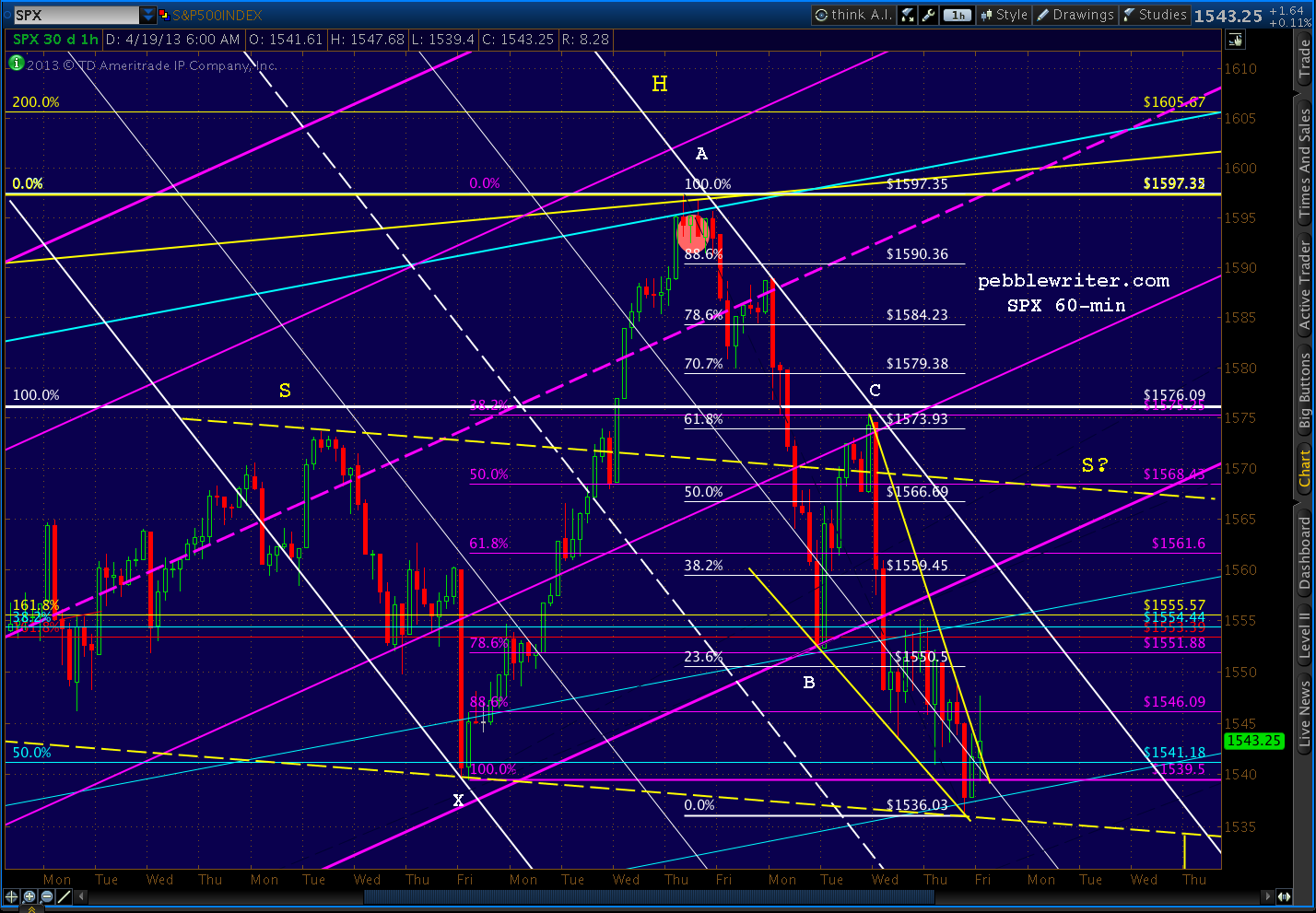
    As we’ve discussed, this was an important points for bulls to take a stand.  It was also the ideal spot from which to launch the right shoulder of a Head & Shoulders Pattern as I posted on the 16th.


    So, we closed our short position late yesterday [Dollar Daze: 3:45 update in members section] and played “catch the falling knife” with a long position at 1541. This morning, we’re being rewarded with a nice bounce that should have legs.

    Whether it will form the right shoulder we’ve been expecting, or resume its QE-fueled race to the moon is open to debate.  But, for now, the trend is higher.

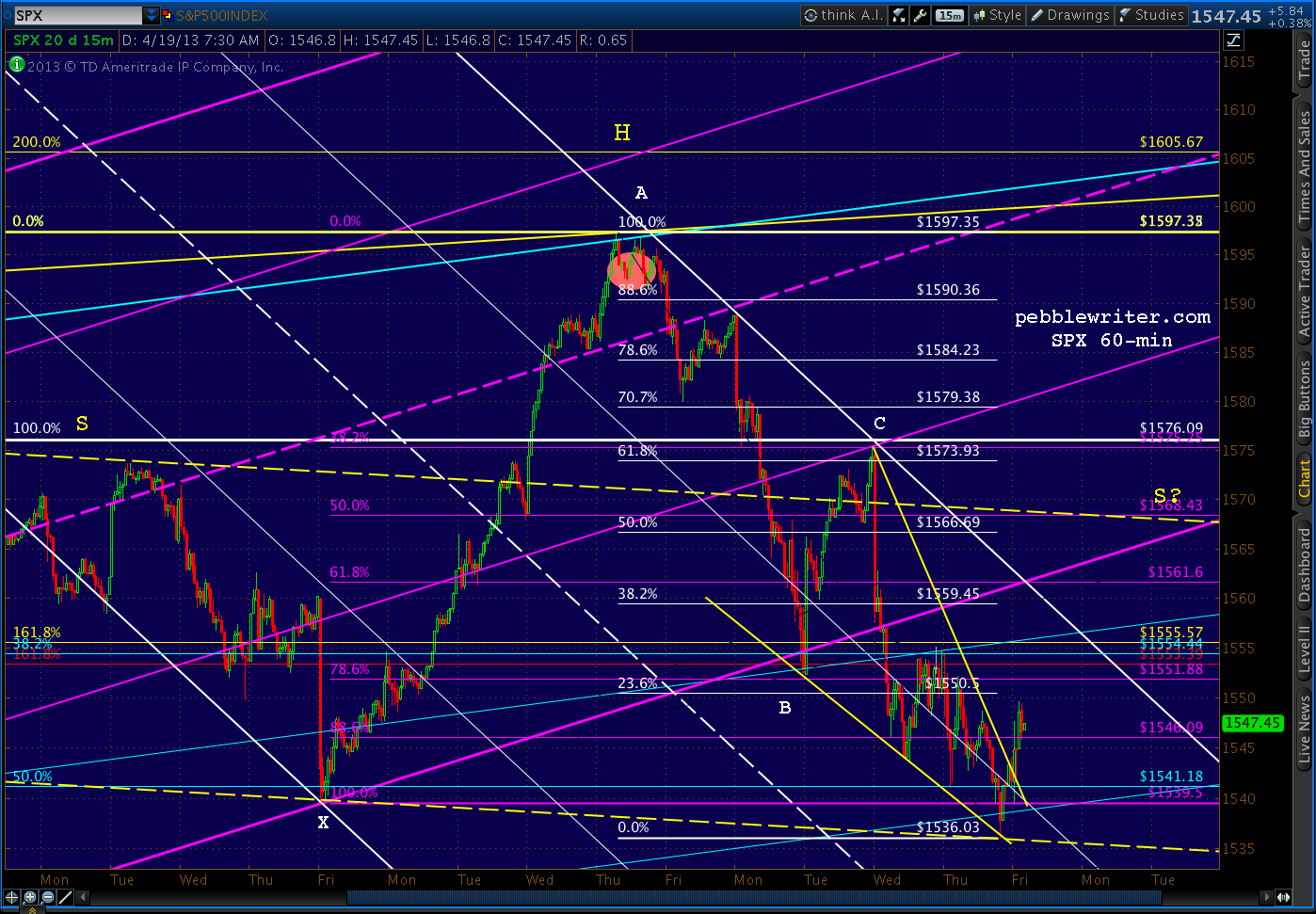
    Note that SPX formed a nice little falling wedge (in yellow above) that, if it plays out, supports the idea of a return to the idealized right shoulder height represented by the dashed yellow TL.

    The falling white channel I’ve slapped on the chart, as regular readers know, probably won’t last.  It’s rare for the initial slope of a decline to be maintained through the series of rallies and sell-offs that comprise a major move.  But, it’s a good initial fit, so it will do for now.

    UPDATE:  10:30 AM

    The ideal right shoulder in a H&S Pattern is the same height as the left.  But, it needn’t be in order for the pattern to play out.  The high so far for the day is 1549.63, which represents a 14 point bounce off the neckline — compared to the left shoulder’s 33 points.

    UPDATE:  12:15 PM

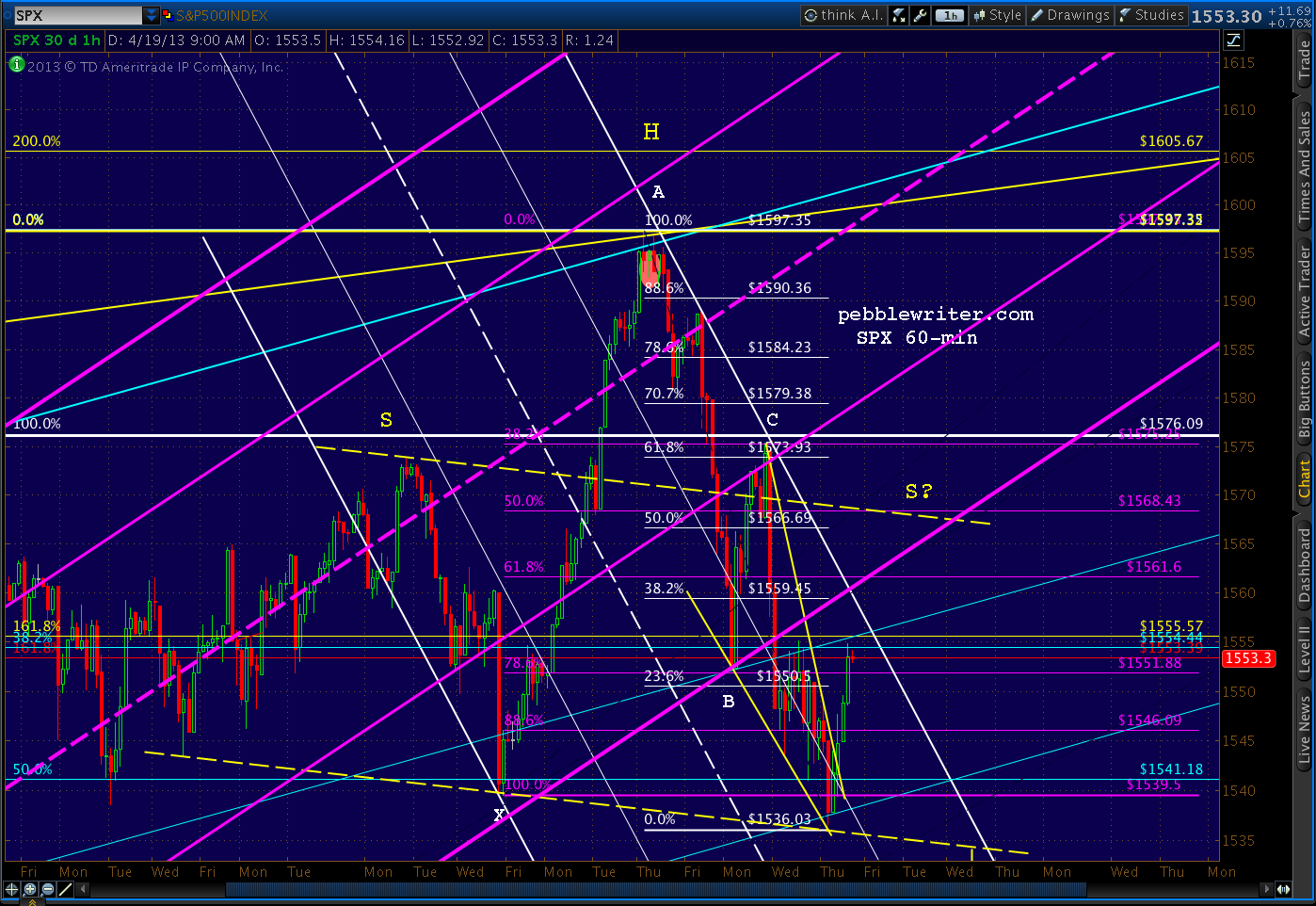
    SPX has reached the important Fib levels of 1553 and 1555 (the Crab Patterns from 1370-1074 and 1474-1343.)  This would be a natural place for prices to reverse, so I’ll close my long position here at 1554 and go short.

    This constitutes a 20-pt rise off the neckline, so it’s technically enough of a right shoulder for the pattern to play out.  And, the bears could really use a H&S Pattern completion to keep the downward momentum going.

    A good reversal here – or, at least by 1574 – and we can write off the 1576-1597 rally as a prank, a juvenile burst of irrational exuberance.

    Bulls, on the other hand, would greatly benefit from a push through the Fib lines that they completely dissed the first time around.  And, they should have mattered.  Take a look at yesterday’s Dollar Daze for a discussion of how the dollar confirmed the sell signal that a few good overnight ramp jobs were able to beat.

    There are other logical turning points as well.  This could quite likely be a short term trade to score a quick 10 points or so — unless 1535 is taken out and the H&S completes.

    Choices, choices.  We’ll take a look at different scenarios below.

    continued for members(more…)