
Tag: Yen

  • Why the Market Didn’t Correct Today

    Hint: it’s the same reason the “market” hasn’t corrected much at all for the past six weeks.  And, no, there’s no free lunch involved.

    The day started with some tragic news out of Brussels.  ISIS terrorists attacked innocent civilians at the airport and a metro station, killing dozens and wounding hundreds.  Brussels is the de facto capitol of the EU, so the attack understandably sent investors scurrying for cover.  Only, it didn’t last — thanks to crude light (CL.)

    For those who weren’t watching, CL spiked almost 3% in about 90 minutes on absolutely no news whatsoever.  Why?  Because, stocks were selling off.  That’s it.  If you don’t believe me, read on.

    2016-03-22 CL 5 0807 SPX had dropped almost 10 points (0.5%) in the first 5 minutes of trading.  This took it directly to a trend line connecting the last two lows (3/16 and 3/22) seen below in red.  It dithered here for a few minutes, then broke through the TL and started lower — seemingly to backtest a rising channel line or the 200-day moving average.

    2016-03-22 SPX 5 0807But, at exactly the same time that SPX reached that trend line, CL swung into action.  It reversed higher, pushing up through its short-term moving averages and, ultimately, through two falling TLs of its own.  It didn’t stop until it had topped yesterday’s highs.

    This would normally be highly unusual, given that CL had just broken down through a TL (from Mar 15) and reversed at a key Fibonacci level (the white .618 at 41.42.)

    2016-03-22 CL 15 0837But, it is most decidedly not unusual for CL, which has taken over from USDJPY as the single most influential driver of equity algorithms.  Needless to say, SPX reversed back above its broken TL and went on to register new highs for the fifth session in a row.

    How it Works

    Want SPX to stop dropping, or even reverse higher?  How about popping up through important overhead resistance?  All it takes is a sudden spike higher by CL.  The chart below illustrates how commonplace it’s been in the last few sessions.2016-03-22 SPX 1 0837The first instance on the chart above was when CL gapped higher in order to get SPX up past its SMA200.  There were many other instances when CL either reversed or at least propped up SPX (the yellow arrows.)

    Occasionally, an intraday SPX backtest of a Fib is prompted by a CL drop.  But, for the most part, CL’s drops are limited to after-hours — when S&P 500 futures are easily propped up in the light volume.

    When the “market” reopens in the morning, CL has already been reset and is ready to spike higher all over again in order to support SPX for the next 6 1/2 hours.  It’s been going on for months.  But, it’s never been more obvious than since our bottom call on Feb 11 [see: USDJPY Finally Relents.]

    The Unbroken Broken Channel

    CL traced out a rapidly rising (white) channel from Feb 11 to Mar 14, at which point the channel broke down (the red arrow.)  Normally, this would portend a reversal of some significance.

    2016-03-22 CL v ES 5 0931This breakdown occurred as SPX had finally climbed back to its 200-day moving average — a 10.5% rally off its Feb 11 lows.  Again, normally we’d see a significant reversal upon reaching major overhead resistance such as this.  Combined with the CL channel breakdown, it looked like a sure thing.

    Instead, it was limited to a minuscule 13 points.  And, few traders would have had the nerve to participate.  It came on a gap lower following a 3-day, 54-pt rally that saw SPX slice through the SMA100 without blinking and close above the SMA200 two days in a row.2016-03-22 SPX 60 1500Why such a puny reaction?  First, CL not only cut short its decline, it pushed back above its SMA20, SMA100, a TL from June 2015 and the midline of a channel from Oct 2012.  Second, just for good measure, it even gapped right back into the channel from which it had broken down (the yellow arrow above.)

    After already spiking 49.6% (in the face of obviously deteriorating fundamentals) between Feb 11 and Mar 11, this latest CL spike amounted to another 18.2% off the Mar 15 lows.  In those five sessions, it lifted SPX a total of 51 points (2.54%), with each day seeing a new higher high.

    What Happened Today

    Though it’s not particularly unusual, today’s action clearly illustrates the manipulation going on.  Note that CL broke down again from its rising white channel this past Friday.  It seemed destined for a backtest of its 10-day moving average (at least) when it was pressed into duty to prop up SPX.

    2016-03-22 CL 5 1500It bounced around a bit while SPX found its feet, then zigzagged higher until SPX backtested a little H&S neckline (purple.)  When SPX faltered there, CL suddenly popped up through a TL that had connected its overnight highs.  With SPX threatening to reverse lower, CL suddenly broke out through a TL (white) that connected the highs made since last Friday.  This drove SPX up over the neckline.

    With SPX back on track, CL was free to fall back below the white TL.  And, it was time for USDJPY to take over. 2016-03-22 USDJPY 5 1500

    USDJPY had sprung to life just as SPX had reached the neckline, zooming back to the top of the channel whose bottom it had briefly broken as the terrorist attack hit the newswires.  It was a strong 1% move in about 10 hours, and involved USDJPY breaking out through a TL (red, dashed) it had established overnight, and again through a TL (white) connecting Monday’s highs.

    But, after reaching the top of the rising red channel, USDJPY had nowhere to go.  With oil prices having increased so much over the past month, the Japanese need a strong yen to compensate — hence USDJPY’s flatlining since Feb 11 (there’s that date again.)2016-03-22 USDJPY v SPX 5 1500SPX saw USDJPY’s predicament, and started back down — only to be rescued again by CL, which not so coincidentally maintained an uptrend until the close.  At that point, it was free to reset — which it did.  It’s not free to do it all over again tomorrow if TPTB deem it desirable. 2016-03-22 CL v SPX 5 1500

    What Now?

    Speaking of TPTB, who’s behind this daily manipulation?  Some blame the big banks, which have much at stake in the energy sector.  I favor the central banks themselves, especially the BoJ.  It has a huge equities portfolio.  By my calculations, it costs about 5-10 cents on the dollar to prop up SPX with CL — a bargain if there ever was one.

    I firmly believe that central banks colluded to crash oil in order to keep the yen carry trade alive.  But, it got out of hand.  Oil companies started suffering.  More importantly (to the central banks, anyway) the banking industry started to suffer.  There came a point (probably about Feb 10) that they decided it was time for prices to recover.

    This was tricky, because with a terribly devalued yen (sky-high USDJPY) higher oil prices were a burden Japan couldn’t bear.  This explains why USDJPY has repeatedly returned to the Feb 11 lows (a more valuable yen) while CL and, hence, SPX have soared.2016-03-22 USDJPY v ES 60 1500How long can this go on?  It pretty much depends on us.  The stock “market” has rallied nicely, which benefits those with substantial equity portfolios.  But, the 64% spike in CL since Feb 11 amounts to a tax on everyone else.  The average price of regular unleaded gas has risen over 18% since Feb, making a mockery of central banks’ relentless “we need more inflation!” mantra.

    When rising gas prices are again deemed a problem, or start to show up in official inflation data, CL’s run will be over — not a moment sooner.  At that point, look for the yen carry trade to return in all its glory.  Or, maybe by then, the ECB will have established the euro carry trade.  Or, maybe the whole steaming pile of crap will implode under its own weight.

    As always, there will be winners (the “haves”) and losers (the “have-nots.”)  Guess which constituency TPTB will bend over backwards to protect?


  • The Only Charts That Matter

    Note: Final 24 hours for our celebratory Membership Special.  Annual memberships, normally $1,750, are being offered for only $640.42, less than $2/day for daily forecasts and live, intraday market commentary geared to helping you avoid and even profit from the volatility we’re seeing.  For more details and to sign up, CLICK HERE. 

    *  *  *  *  *

    I sat down to update the CL and GC charts tonight, but quickly realized there’s no point until the following pattern is resolved.  How about it, central bankers?  Are you ready to let the markets run where they will?

    Because, ES’ Head & Shoulders Pattern below targets 1530 — another 17% lower.  For anyone keeping track, that’s a 28% drop from last May’s highs.  Today’s key level, 1837ish.  A close below here would be quite bearish.

    2016-01-19 ES wkly HSBTW, the only reason the above chart is where it is…?  This chart: the USDJPY — which has gone nowhere for the past 14 months.  It’s also perched on a precipice.

    2016-01-19 USDJPY daily HSPut them together, and the relationship is unmistakable.  Every time USDJPY dips to the bottom of the red channel (at the yellow arrows), ES takes a dive.  In fact, the dives have been deeper with each successive dip.

    2016-01-19 USDJPY v ESSPX completed its own H&S Pattern last week [see: Are You Happy?], but hasn’t been able to rebound because it was waiting on ES to arrive at its own line in the sand.

    So, come on, central bankers.  We’re curious.  Have you more tricks up your sleeves; or, are you finally ready to take the quotation marks off the “markets?”

    continued for members(more…)

  • Drumroll Please…

    In our October 6 update on oil [see: Update on CL] I expressed skepticism regarding oil’s ability to continue rallying.  It had just popped 30% off the Aug 24 lows, and had broken out of a triangle formed while digesting those gains.  Still, I saw it declining rather than making new highs.

    …lower prices make sense.  And, they’re necessary — particularly in light of the critical yen carry trade.  Japan can’t very well devalue the yen against the dollar unless oil — which is denominated in USD — declines to offset the currency effect.

    Yes, it means that marginal players — like the entire shale industry — will be decimated.  But, that’s a sacrifice that central banks are willing to make.  The health of the oil industry versus the wealth effect of trillions in rising equities?  No contest.

    I was wrong about CL declining right away.  It didn’t start until October 9.  2015-12-29 CL 60 0600continued for members

    (more…)

  • Update on USDJPY: Jun 18, 2013

    The pair has dropped like a rock since the purple channel broke down on June 5.  It reached the .886 Fib as expected [CIW: Jun 6], then immediately bounced back above the neckline of the H&S Pattern it had completed (in red, below.)

    The following day, it fell back through that neckline, and has spent the past three sessions trying to climb back above it.

    In the process, however, it formed a second H&S Pattern (roughly the dashed yellow line as the neckline.)  Either of them could send the pair tumbling to the white 1.618 at 85.66.

    But, the defunct purple channel has given rise to a decent-looking new channel (in white, below) that — if it holds — could pick up where the purple channel left off and carry USDJPY to new highs?

    But, what if it doesn’t, i.e. if the H&S Patterns play out?

    continued for members

    (more…)

  • Update on USDJPY: May 29, 2013

    After recently completing a Crab Pattern at the 2.24 extension, USDJPY fell back through the purple channel midline to the 1.272 Fib level, where it is staging the backtest of the midline we forecast last week.

    While I expect the backtest to be successful, meaning a leg lower is in store, the 部屋に象 is the .618 at 105.58. Note that this is the 61.8% retracement of the 39% crash from the 2007 highs.  It happens to coincide with a number of significant channel lines, so tagging it could be a very big deal.

    continued for members(more…)

  • USDJPY Update: May 8, 2013

    USDJPY has continued to slide since our Apr 8 call for a top [HERE.]   It back-tested the broken purple channel midline on May 6, and is signalling a sell-off to at least the bottom of the purple channel (96.25 – 96.66) where it intersects with the white channel .75 line in the next day or two.

      But, if the most obvious harmonic patterns play out, we could easily see the purple channel break down and the white midline come into play at the intersection of the .886/1.618 at 93.40/93.26 towards the end of May.

    Remember, it was the white channel that confirmed the harmonic pattern reversals at 100 last month.

    “…there is growing risk of a downturn as it approaches 100… it appears the pair might have hit at least interim resistance at today’s high.”

    April 8, 2013

    continued for members(more…)

  • The Best Laid Plans

    The best laid plans of mice and men
    Go often awry,
    And leave us nothing but grief and pain,
    For promised joy!

    Robert Burns, 1785

    ORIGINAL POST:  6:45 AM EDT

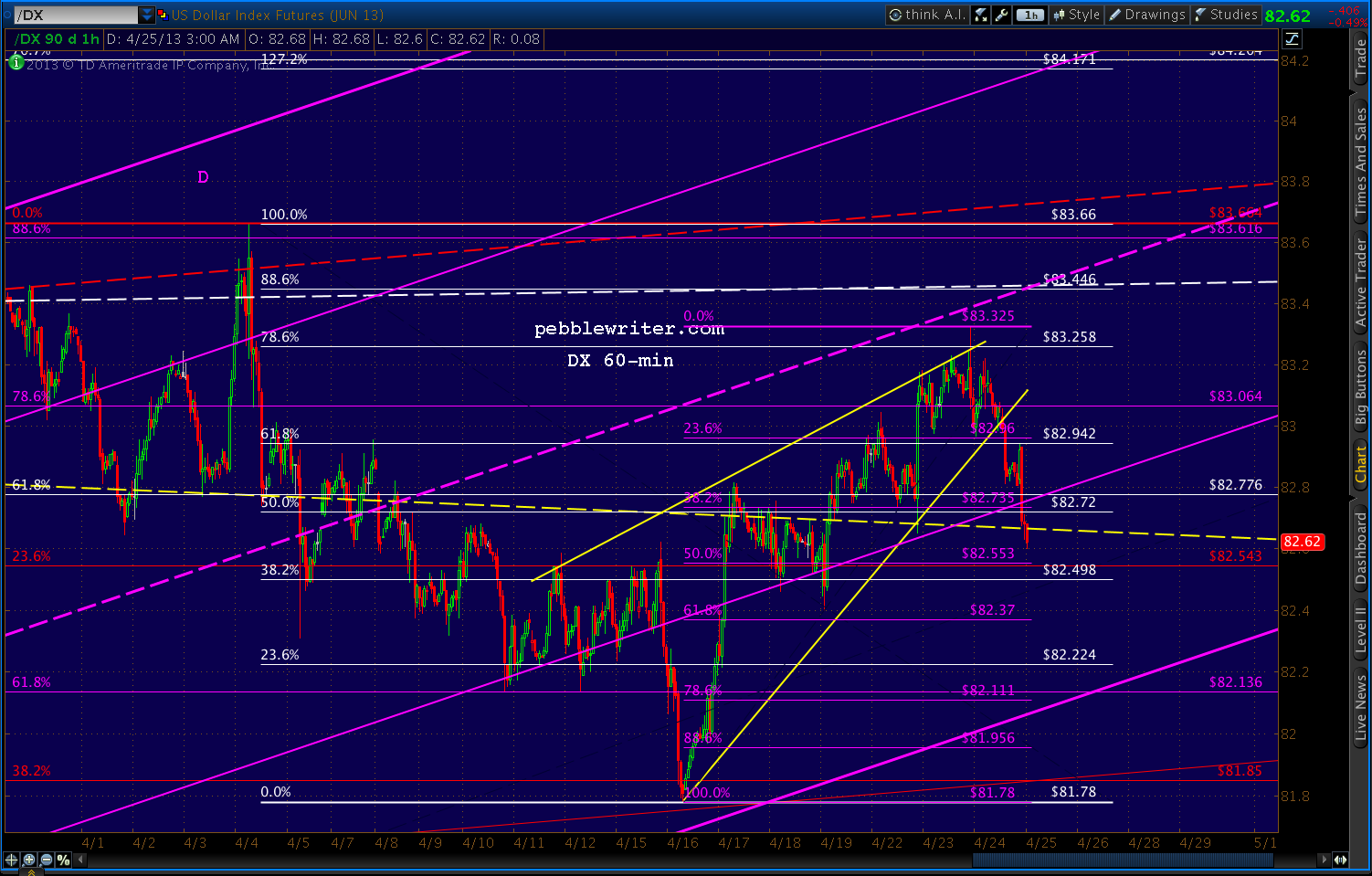
    The wedges we’ve been watching on DX and EURUSD are playing out.  EURUSD has broken out…

    …and DX has broken down.

    But, it’s the USDJPY that I’m watching especially closely this morning.  It still hasn’t broken 100 since our Apr 8 observation [USDJPY update] that it was running out of steam:

    “…there is growing risk of a downturn as it approaches 100… it appears the pair might have hit at least interim resistance at today’s high.”

    It topped out 3 sessions later at 99.94, and two weeks later is in danger of a larger pullback.

    Remember, weakening the yen was a critical element of the BOJ’s stimulus program that was supposed to generate inflation, boost Toyota sales and send Japanese investment funds flooding into foreign markets.

    Instead, Japanese investors are repatriating their funds from abroad — a net Y9.5 trillion ($95 billion) since the first of the year.  Why?  As any US investor could tell you, QE might not inflate economies, but it sure as hell inflates markets.

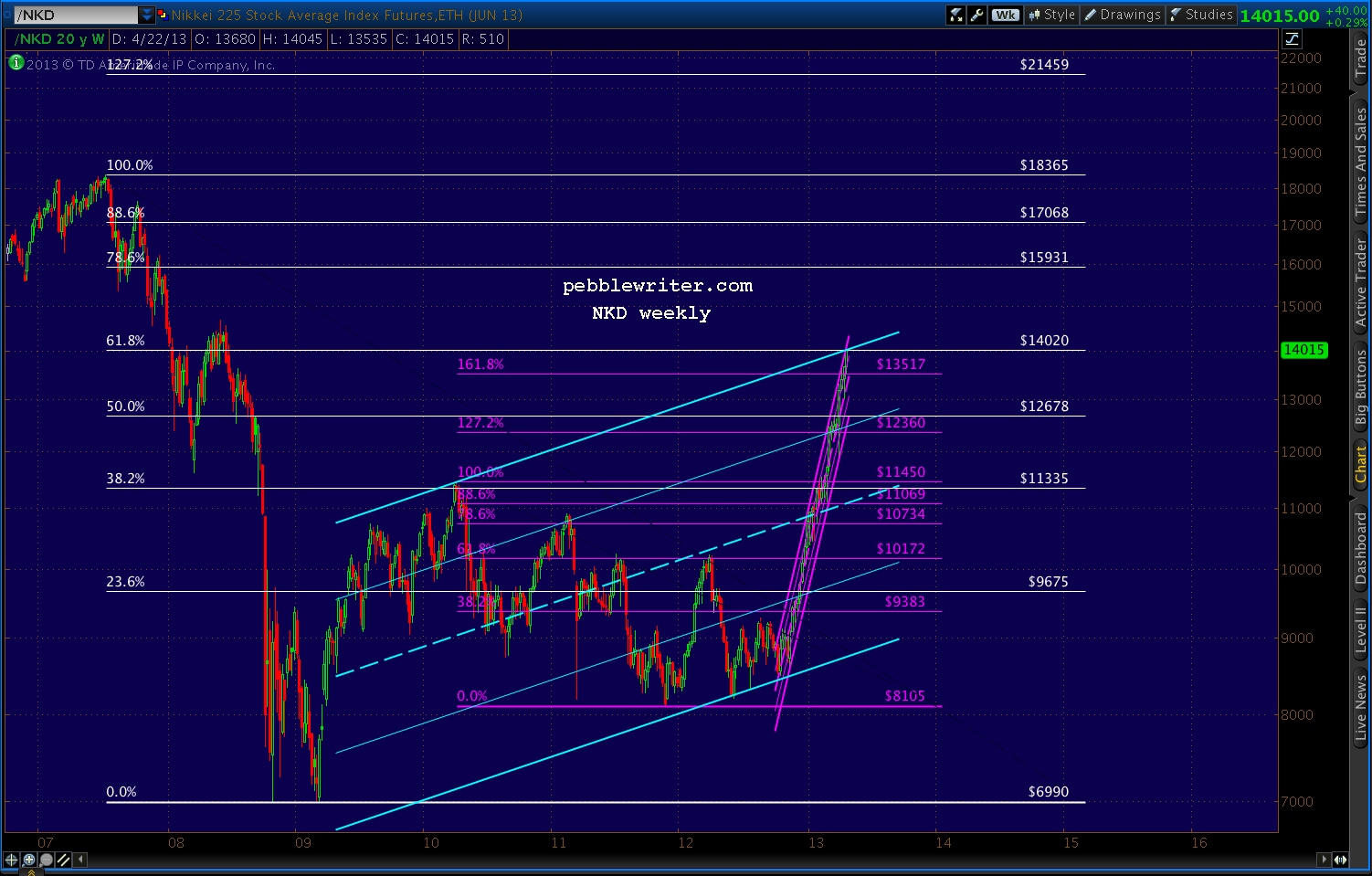
    The Nikkei 225 is up 65% since last October’s lows….

    …and, still hasn’t even recovered 2/3 of its losses from the 2007 crash.  The Dow and the S&P 500, by contrast, have recovered all of them — and, then some.  So, to many, the Nikkei still seems the better value.  It’s hard to argue with success.

    But, I’ll do it anyway.  In reaching 14,020 a few hours ago, NKD tagged the .618 Fibonacci retracement of its 2007-2009 crash from 18,365 to 6990.

    To those not familiar with harmonics, this tends to be a big deal.  When SPX reached the equivalent point in April 2010, it plunged 17%.  The DJIA fell almost 15%.  The USD, represented by DX, soared 9.3%.

    But, the yen positively soared.  USDJPY started a 17-month slide that took the pair down 20% from 94.98 to 75.78.  NKD, which had just reached its .382 Fib, shed 23% over the next 4 months, eventually reaching almost 30% in Nov 2011.

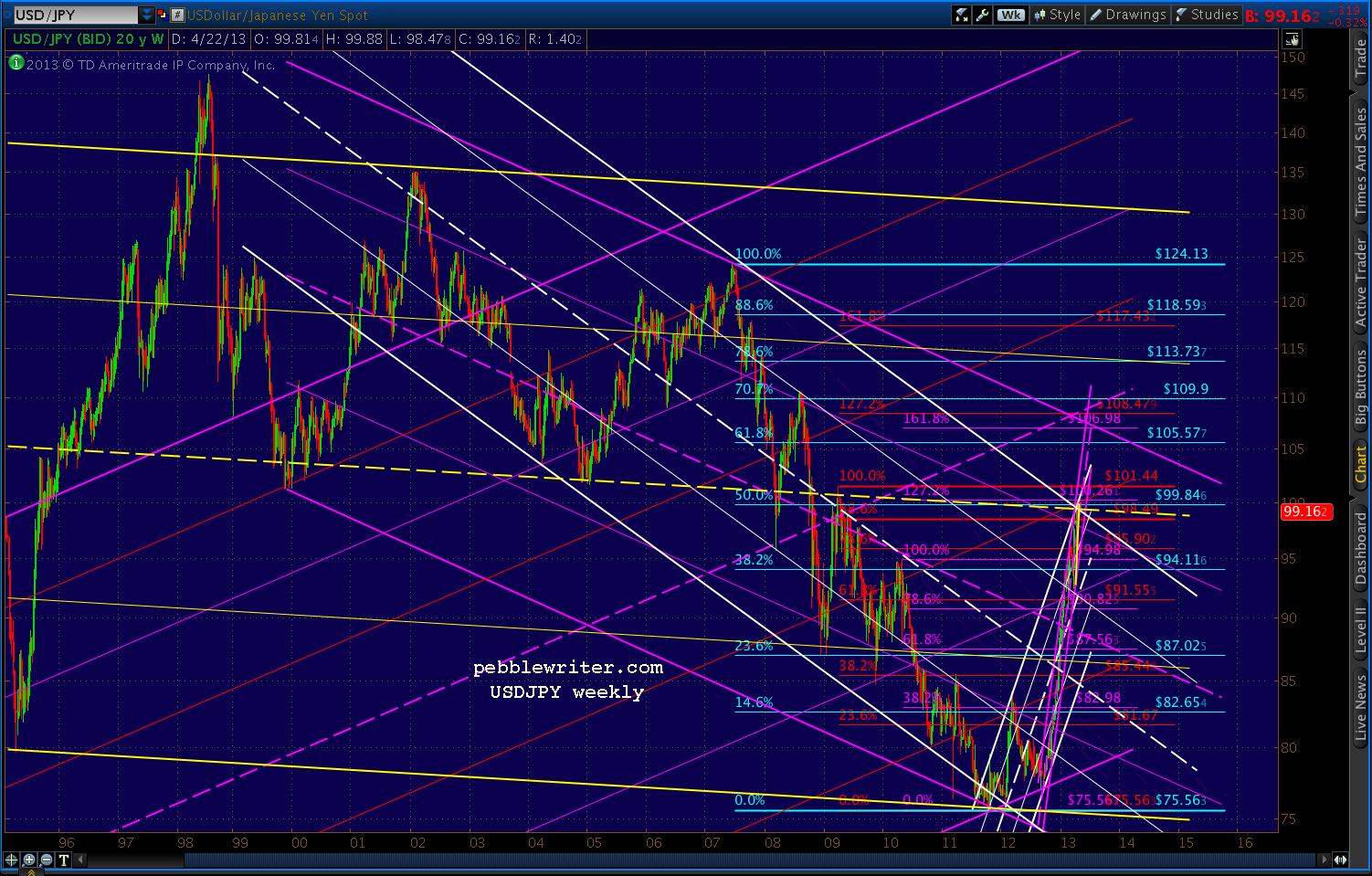
    Could the USDJPY’s failure to break 100 be telling us something?  You better believe it.  I called a top a few weeks ago because the pair had reached several important Fib levels as well as the midline of an important channel (in yellow, below)…

    …that dates back to 1995.

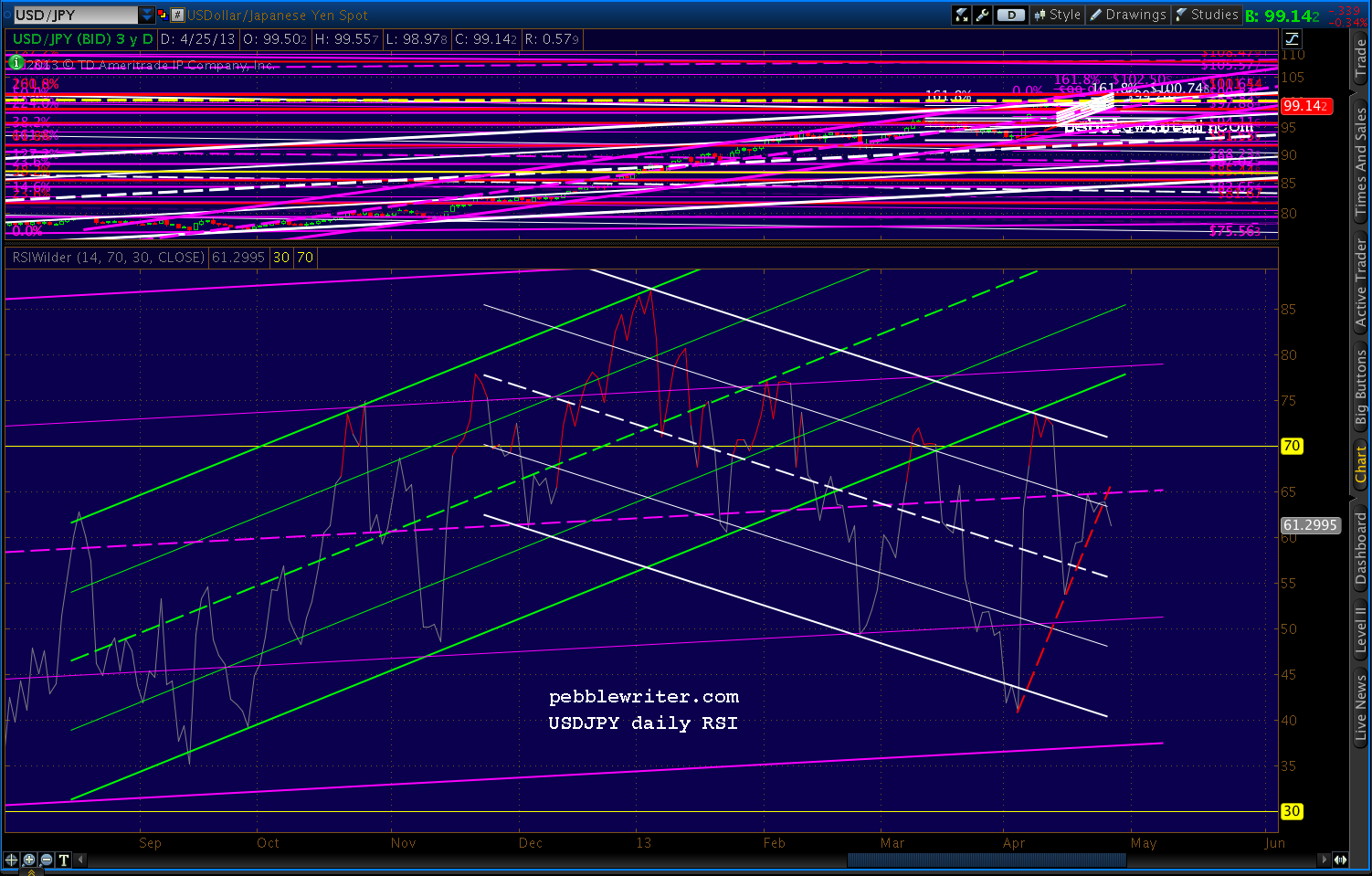
    There’s no guarantee it won’t push through instead of retreating, but the RSI picture supports the danger of a significant retreat.

    Daily RSI has backtested the broken yellow channel twice, but the trend is clearly down — with the latest push being rebuffed by the purple midline.

    And, a close-up reveals that a breakdown has already started.

    Stay tuned.

    UPDATE:  9:25 AM EDT

    With SPX set to open 5-6 points higher, it stands a very good chance of reaching our 1584.23 target. In other words, a pop and drop is very much in the cards.

    If it goes any higher, look for 1590.36 instead.

    UPDATE:  9:40 AM

    That’s good enough for me.  I’m closing my long position and reverting to full short here at 1584.80.  Stops around 1586ish.

    The .25 of the purple channel is right around 1587, so I’d use some discretion around that stop level and look to see if there’s any real strength behind a move higher.

    UPDATE:  10:25

    Getting a push through 1587, so I’ll open an interim long position for what should be only a few points higher to the .886.  Core short remains in place.  Tight trailing stops.

    I wouldn’t start getting nervous about the short position until around 1594 — the trend line (red, dashed) that extends from the 2000 and 2007 peaks.

    UPDATE:  10:50 AM

    I’ll go ahead and close that interim long here at 1590.  While I still think there’s potential to the 2000-2007 trend line, it could easily happen after the correction that should begin in the next hour.

    That way, the Inverted H&S Pattern would feature a neckline that’s roughly the same as the purple channel .25 line, and would target the same price level as the 1.618 extension of the 1597-1536 slide: 1635.

    This is a very artfully crafted scenario to justify (from a technical standpoint) a rally above that red TL — which is one of the last remaining technical impediments to a continuation of the rally from 1343 in November.

    Can they pull it off?

    continued for members(more…)

  • USDJPY Update: Apr 8, 2013

    The largest channels are all pretty loose fits, with plenty of incursions that make forecasting with them iffy at best.

    But, the smaller channels and Harmonic Patterns have been pretty effective.  Even though USDJPY has been running like a 燃える尾を持つ猫, there is growing risk of a downturn as it approaches 100.

    Consider the new channel constructed by today’s high.  It lines up with the Oct 31, 2011 and Mar 14, 2012 highs.  It would carry more weight if there were more than one tag on the bottom, but we shouldn’t ignore the potential for a correction.

    Given the tear the pair has been on lately, it would probably be motivated more by a weak US dollar than a strong yen.

    The pair put in a decent correction at the red .786 (of the decline from 101.44 in Apr 09), hinting at a future Butterfly Pattern.  The 1.272 is at 108.47 and the 1.618 is at 117.43 — right next to the large purple .886 at 118.59.

    There’s also a small Crab Pattern (white, above) completion at 99.26.  So, though I wouldn’t necessarily put money on it (the trend is your friend), it appears the pair might have hit at least interim resistance at today’s high.

    A failure to reverse here will likely mean a trip to the purple .618 (at least) at 105.57.

    But, that would mean barging back into the daily RSI channel (in green below) that broke down in mid-Feb and is undergoing its 2nd back test.  It’s certainly not impossible, but it would be easier after a pullback to reset RSI to lower levels.

    Stay tuned.

  • Update on USDJPY: Jan 31, 2013

    The pair continues on a tear, putting in a miniscule consolidation at the 87.5 – 89 range where I expected more of a correction and reaching our secondary target a full 10 weeks ahead of schedule.

    Will we still get a significant correction here?

    continued for members(more…)

  • Race to the Bottom: Jan 22, 2013

    Lots of big earnings announcements today:  JNJ, VZ, DD, TRV, DAL all missed, while GOOG, IBM, TXN, CA and AMD will report after the close.   It’s getting tougher to ignore slowing revenue growth, though the misses were almost universally blamed on Hurricane Sandy.

    But it’s the currencies that are getting most of the attention lately, with the yen making headlines all weekend. The BOJ followed through on expectations, confirming they will continue unlimited QE in 2014 once the current program ends in December.  They also embraced a 2% inflation target though, as many observers have pointed out, they’ve failed to even come close to the current 1% inflation target.

    USDJPY is the pair I watch the closest.   A weakening yen obviously strengthens the dollar index (the yen is 13.6% of DX) but it is easily offset by euro strength (57.6% of DX.)  Nevertheless, the pair’s importance shouldn’t be discounted, as it heavily influences trade.

    The two dominant chart features are the falling channel (purple) since 1998 and the falling wedge (yellow, dashed) since 2001.

    The pair broke out of the falling wedge in January 2012, but recently began reacting with the channel midline at a price level just beyond our target range of 87-89.  If you believe the BOJ, the pair will blow through this resistance and continue up to 95 without a hiccup.

    In fact, the daily RSI over the past six months suggests today’s little 1.2% correction might be all we get.

    But, if we back out just a bit, we can see this isn’t necessarily the case.

    continued for members(more…)