
Tag: jpm

  • Financials: End of the Line, Again?

    Financials have had a great run ever since we called the June 4, 2012 bottom [see: So Crazy, It Just Might Work].  But, all good things must come to an end.  I’d give them another few days/points at most.

    I had jumped on the short side Mar 27, 2012 [see: End of the Line and Lots More], riding GS, MS and JPM down around 30%.

    JPM:       46 – 32 = 31%
    GS:       127 – 92 = 28%
    MS:    20 – 12.50 = 38%

    On June 5, we loaded up on the long side.  Our targets, as posted that day:

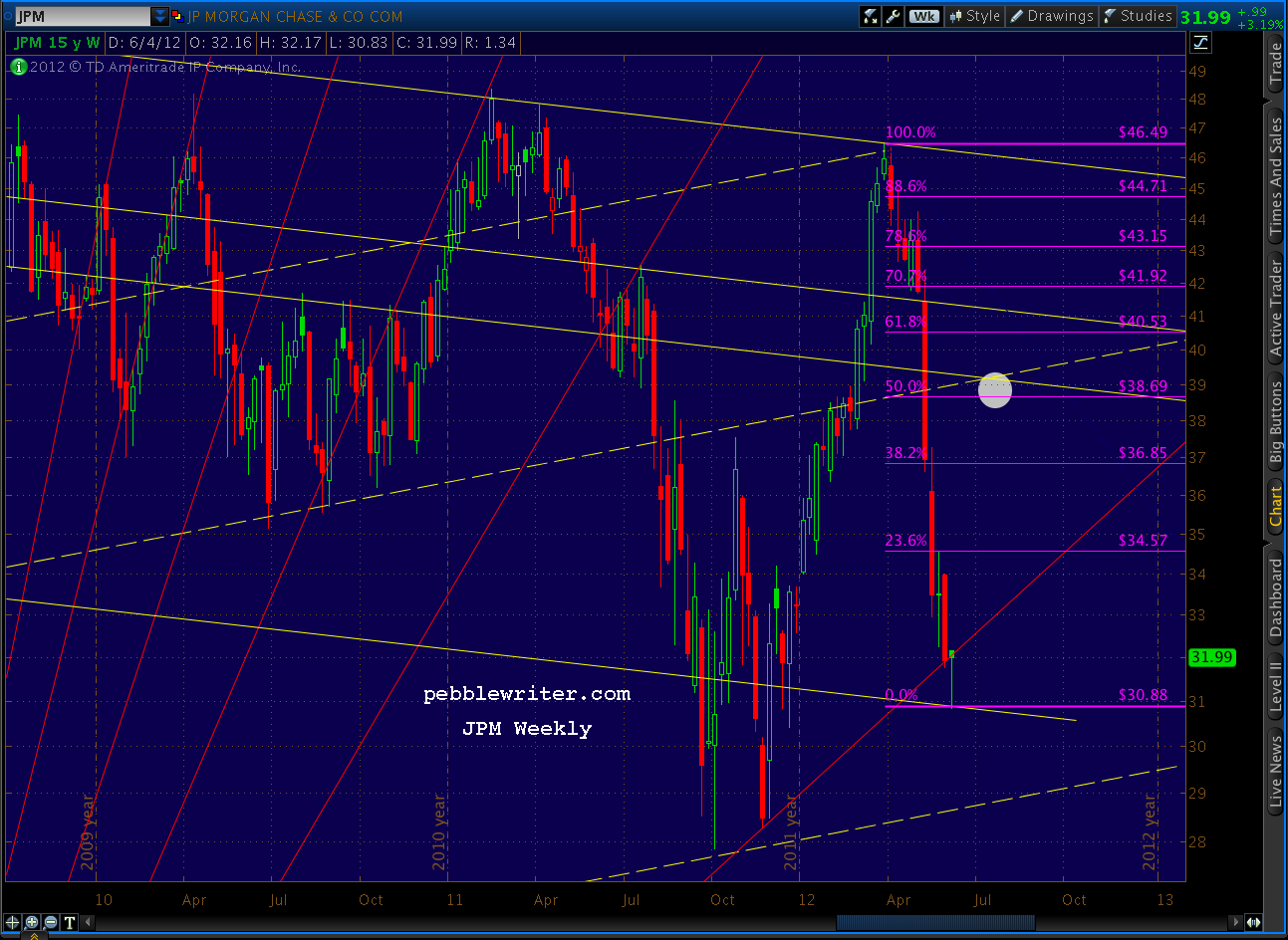
    JPM:  today’s close = 31.99, price target = 38.69 (+21%)
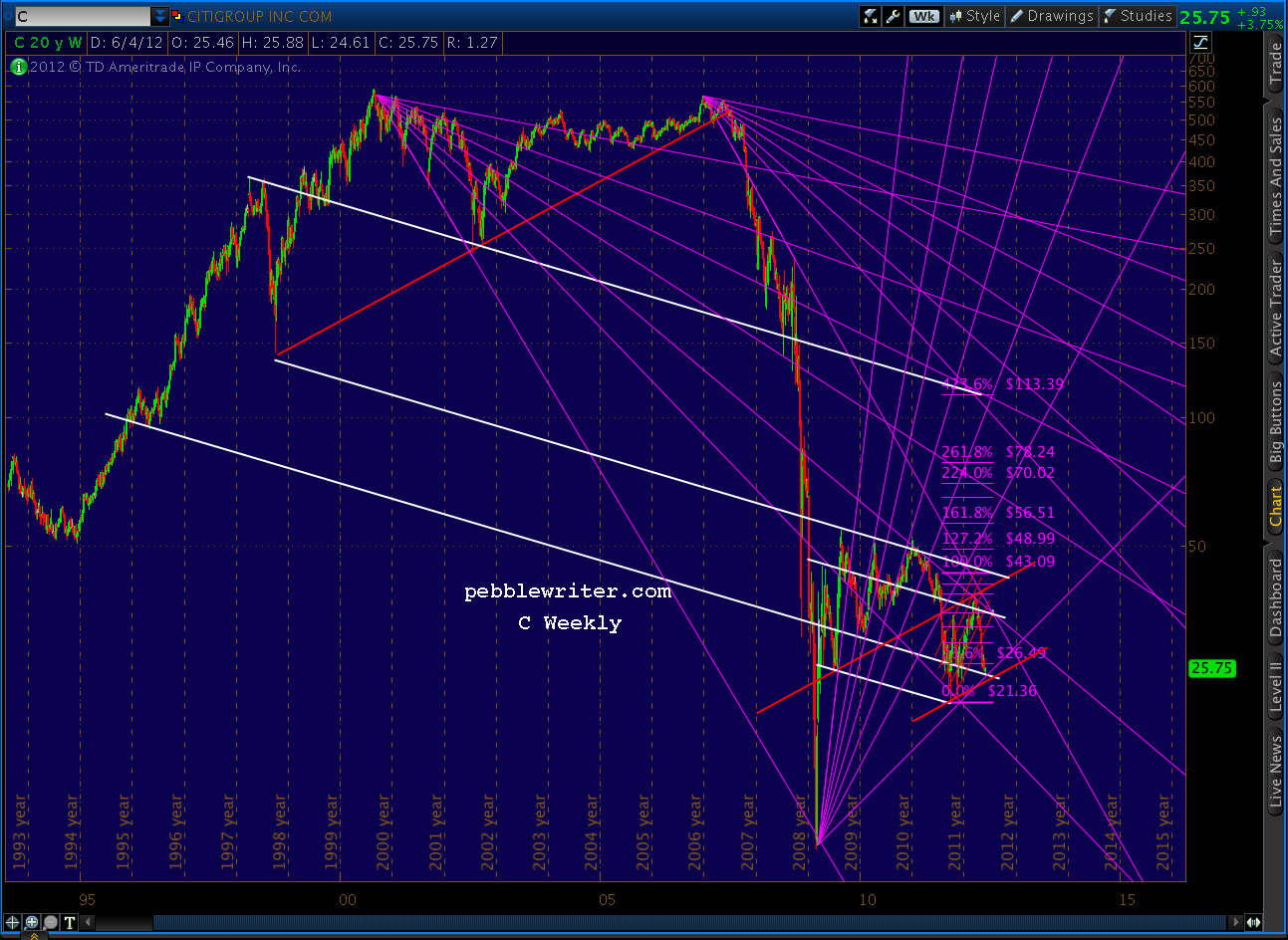
    C:       today’s close = 25.75; price target = 34.79 (+35%)
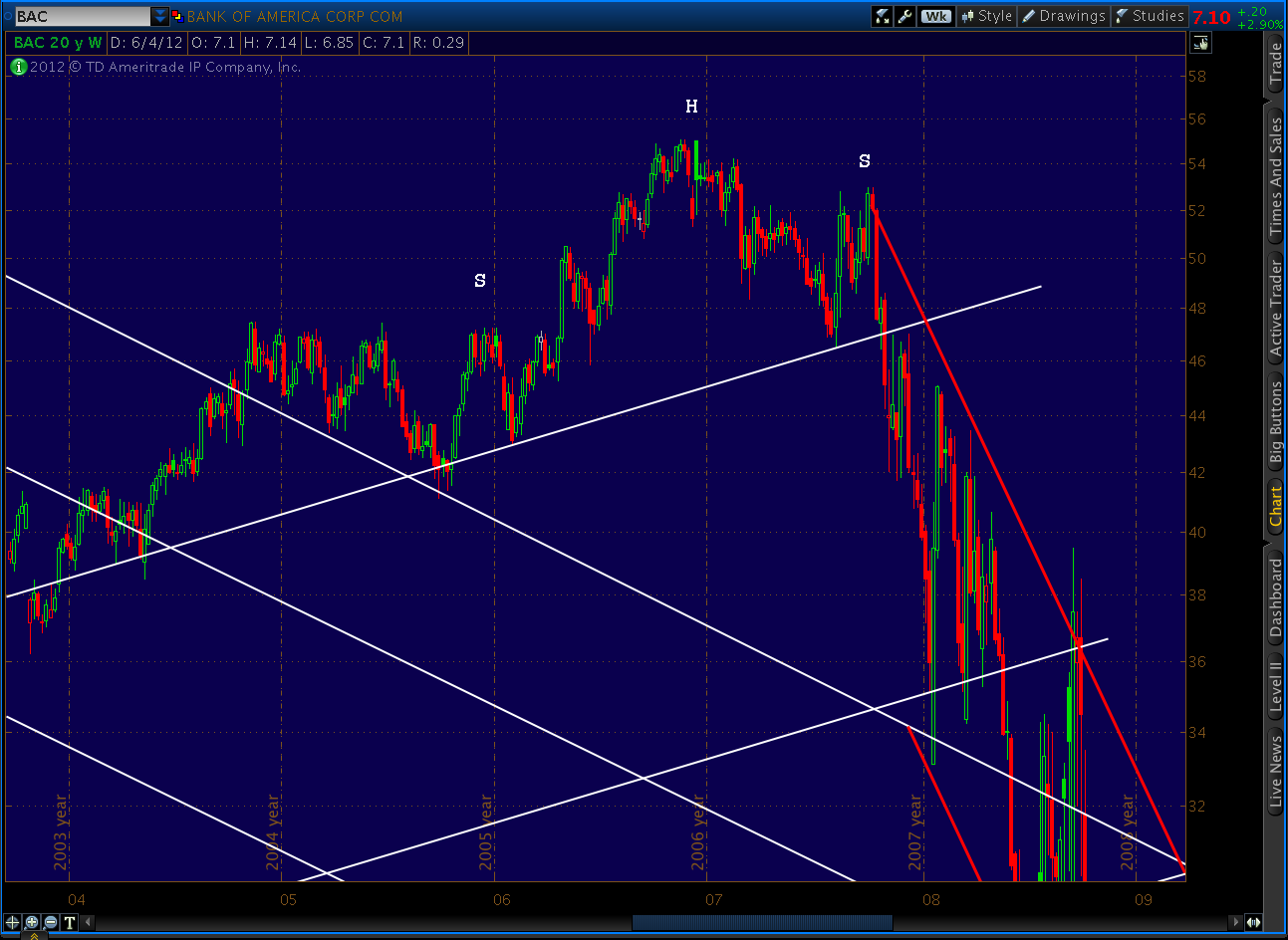
    BAC:    today’s close = 7.10; price target = 11.34 (+60%)

    Obviously, those targets proved to be a little conservative.  JPM reached its target by Aug 21, consolidated for 2 weeks, then zoomed even higher – reaching 49.31 today and finally (after 4 near misses) reaching the .886 retracement of its 53 to 14 plunge.

    C reached its 34.79 target on QE3 day (Sep 14 — lovely being able to dump all those crappy MBS on the Fed) backed off a few points, then proceeded to rally up to today’s high of 44.50.

    It only ever recovered 7.95% of its 2007-2009 plunge from 570 to 9.70 (adjusted for reverse splits) and is struggling to reach the .786 of its swan dive from Jan to Oct 2011: 51.50 to 21.4. If the .786 at 45.06 doesn’t do the trick, the .886 at 48.07 should.

    And, just today BAC came within a nickel of the 50% retracement (12.39) of its post-2009 high.  It reached our 11.34 target in mid-December.
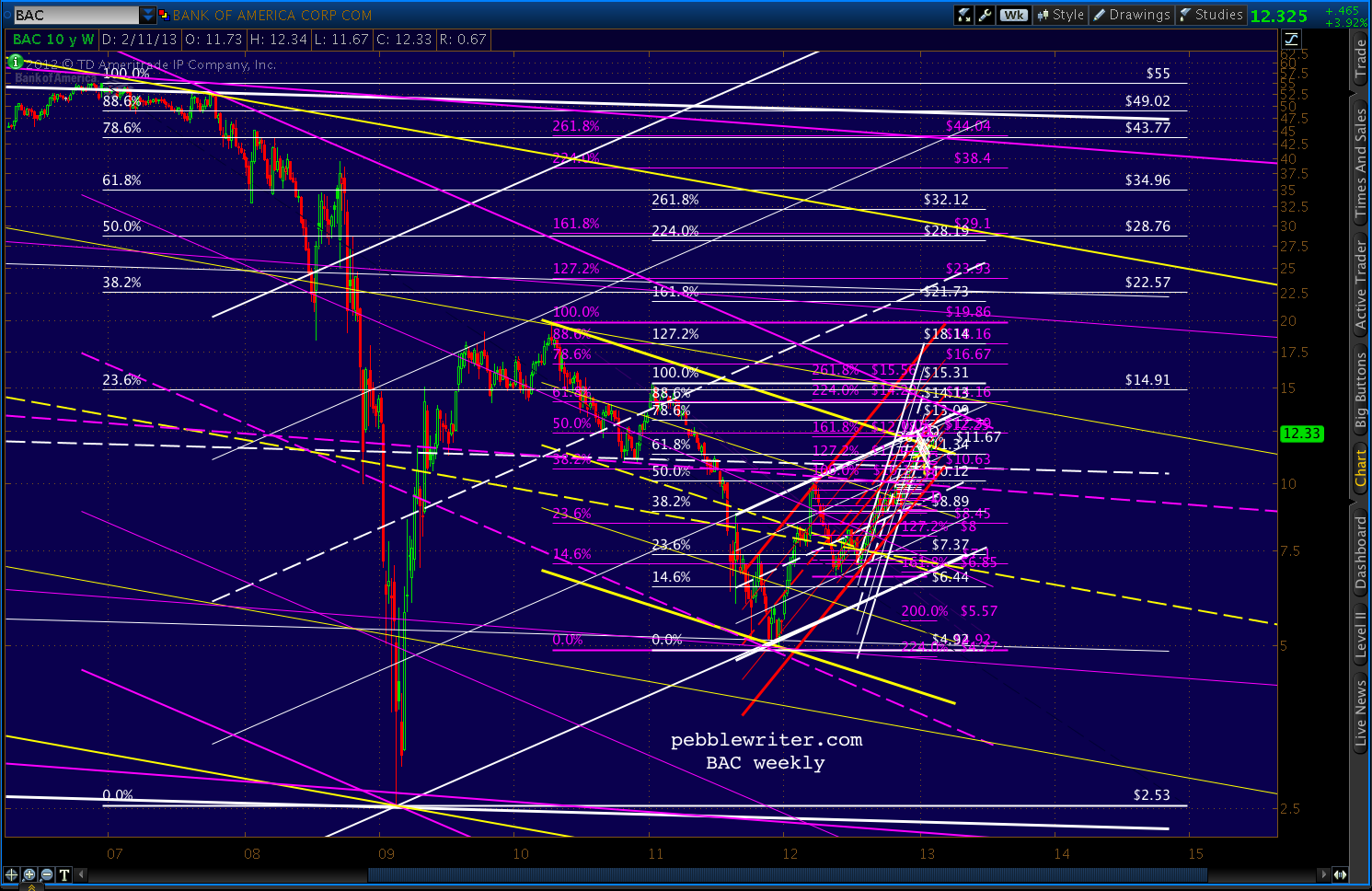
    If it gets past 12.67, it could still take a run at 14.13.  But, it won’t be easy.

    Most of the financials are in a similar situation — at or near major resistance either from Harmonic or Chart Pattern targets.  But, it’s XLF itself that looks shakiest.

    Today, XLF reached an important channel line as it tagged the 1.618 of the Mar-June 2012 decline.

    If it sneaks up past current levels, the .382 retracement of the fall from 38.15 in 2007 is waiting at 18.21.

  • So Crazy It Just Might Work

    As a member correctly pointed out in his comment on XLF Update, a ramp in XLF would mean some big returns for important components such as BAC, C, JPM, etc.  This is very true.  Though it pains me to say it, I think banks are ready for a bounce.

    I sold all my remaining JPM, GS and MS puts today.  I jumped on the downside March 27 when JPM was 46 [see: End of the Line], GS was 127, and MS was 20 [see: Lots More Where That Came From.]

    I bought puts, but even straight-up short positions would have made some decent returns over the past nine weeks:

    JPM:       46 – 32 = 31%
    GS:       127 – 92 = 28%
    MS:    20 – 12.50 = 38%

    But, all good things must come to an end, and I think the tide is turning for financials.  Don’t get me wrong…I still think they’re dead meat in the longer term.  I just think we’re looking at a sizable bounce here and now if — and let me be clear, it’s a very important IF — the rumors are true and Kumbaya Banking and Quantitative Whatever are back.

    If not, this entire exercise isn’t worth the bytes it’s written with.  The financials, along with just about everything else Bloomberg quotes, will roll over and die.  OK, with that huge caveat out of the way — and before you laugh me out of cyberspace — here’s what I’m looking at.

    My targets are as follows…

    JPM:  today’s close = 31.99, price target = 38.69 (+21%)
    C:       today’s close = 25.75; price target = 34.79 (+35%)
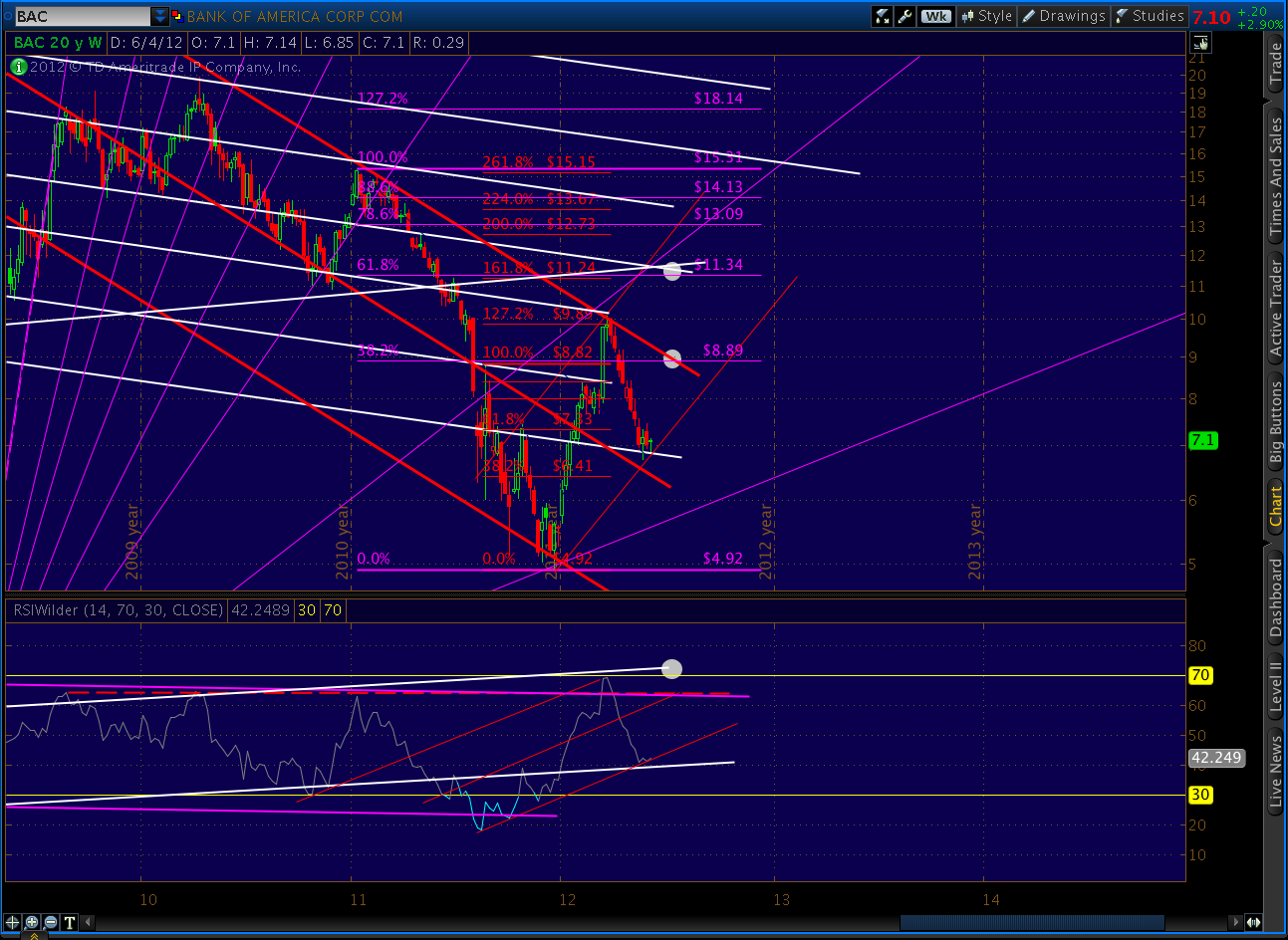
    BAC:    today’s close = 7.10; price target = 11.34 (+60%)

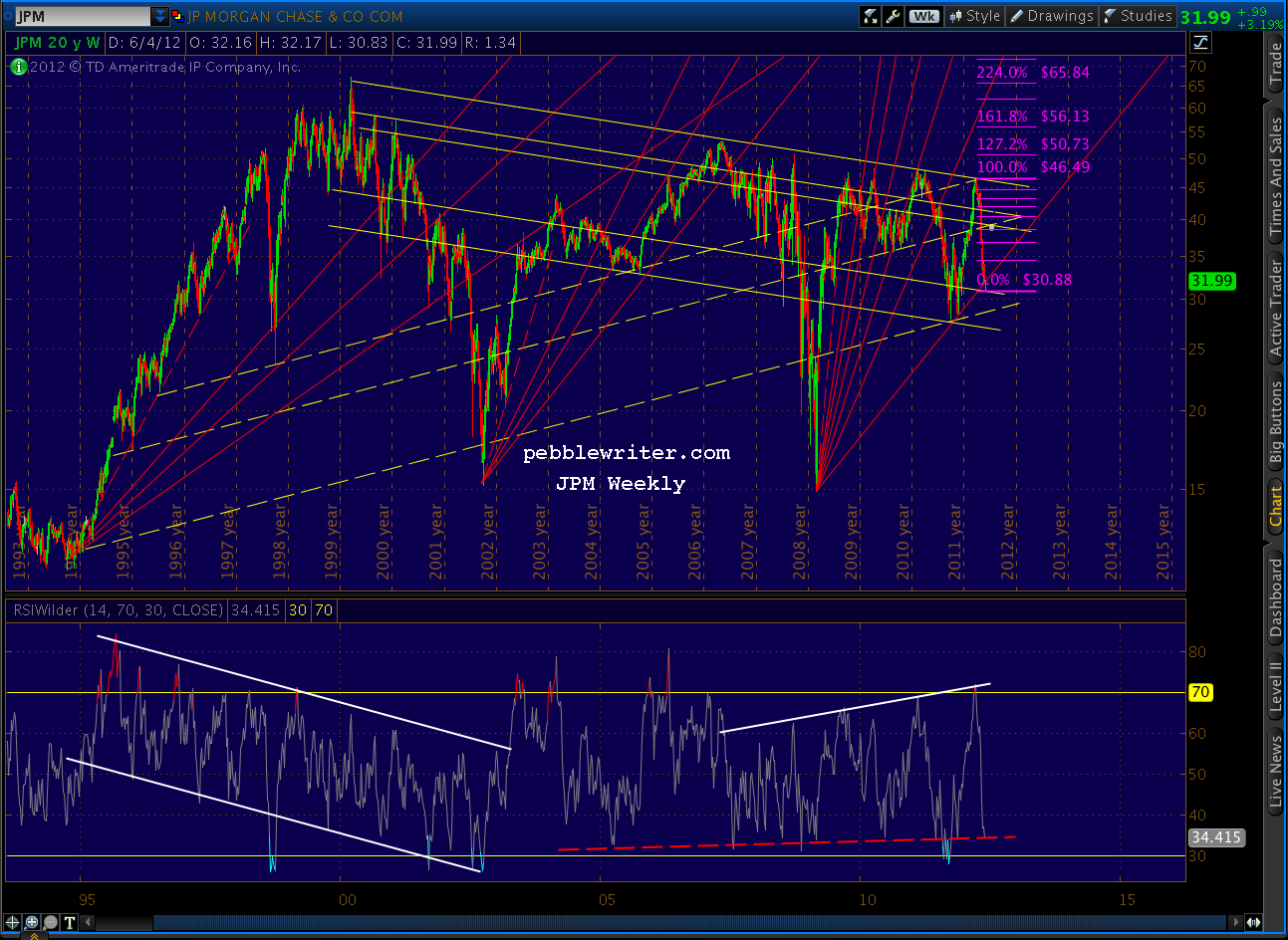
    JPM:

    CITI:

    BAC:

    My favorite.  It starts with this little H&S pattern back in the 2007 market top.  Keep an eye on those ascending trend lines.

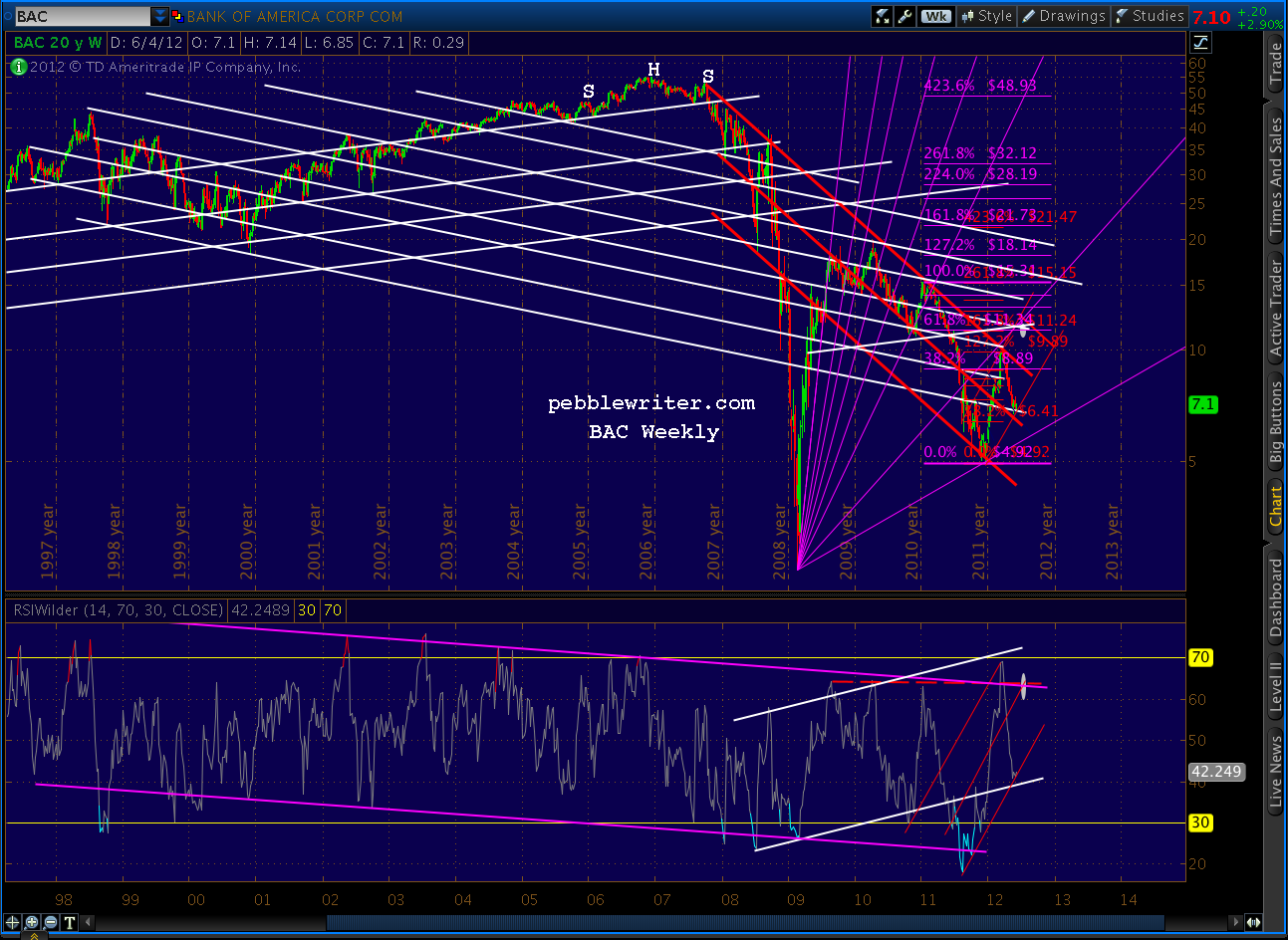
    Here they are again, on the bigger picture, along with some descending ones, and a nice little channel (red) that works pretty well since early 2009.  Couple of nice channels on the RSI, too.

    This one’s a bit of a long-shot, because it means breaking the red fan/channel coming down from the right shoulder up there, but the RSI channel makes me wonder if we might just make it up to that 61.8/1.618 Fib level.  If not, I think 8.89 is a safe bet.

    So, there you go.  Earlier today, XLF July 15 calls sold for .09 and the August 14’s went for .49.  If I’m wrong, they’ll probably go to negative eleventy-hundred.  Then again, it’s so crazy it just might work!


    Right about here, my attorney would want me to remind you this is not an investment recommendation — nor is anything on pebblewriter.com.  Investing is risky, and options are a particularly effective way to end up living in a van down by the river.  For full risk advisory and other legal disclosures, read this.

  • Running on Empty

    UPDATE:  EOD

    SPX went straight to our 1338 target and hung around pretty much all day — closing right on the H&S neckline.

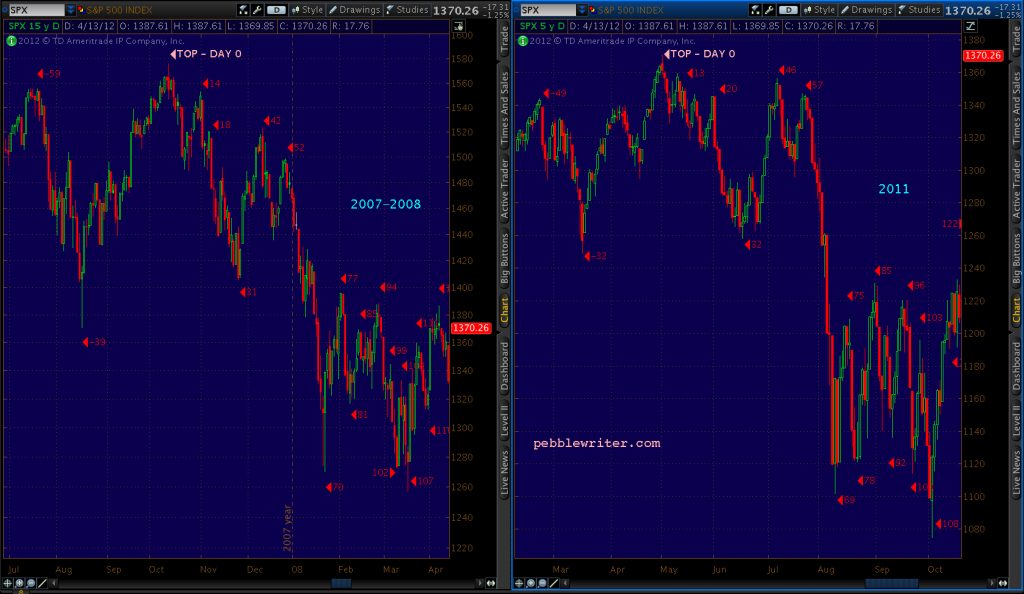
    The analog I first posted on Mar 9 is still very much on track.  It called for the low 1300s by May 16 — which looks doable if we have another day or two like today.  Keep in mind, though, that while I had to pick a particular price target in order to chart the analog, I consider the downside to consist of a range from 1295-1323.

    UPDATE:  10:00

    We got the H&S completion we discussed earlier, seen below on the daily chart.  As expected we also got a bounce at the neckline.


    ORIGINAL POST:  9:20 AM

    With this morning’s continuing fallout from the latest JPM debacle, we should see the completion of the smaller H&S pattern we’ve been watching.  The neckline is around 1338, so look for a bounce there on the opening.

    As we discussed last Thursday [see: Still on Track], the latest H&S pattern targets 1275, but I believe it’ll be a challenge getting below 1292.  Remember, the overall targets I originally laid out on May 6 [see: So Far, So Good]:

    • 1349.42 — .886 of the purple Butterfly  [tagged May 8]
    • 1343.41 — 1.272 of the yellow Crab pattern [tagged May 9]
    • 1340.03 — horizontal support, prev. Point X [should tag this morning]
    • 1323.85 — 1.618 of yellow Crab
    • 1317.63 — 1.272 of purple Butterfly
    • 1289.14 — 1.618 of purple Butterfly (and 2.24 of Crab)

    Completion of the neckline mentioned above around 1338-1340 should also find horizontal support from the previous Point X (Mar 6) in the Butterfly pattern we’ve been watching since March [see: All the Pretty Butterflies.]

    But, my base case remains 1295-1317 for now.  It’s hard to calculate the damage that could be done by JPM’s screw-up.  As discussed last week [see: There is Nothing Wrong] JPM can easily withstand a $2-5 billion trading loss.  The danger is that much more damage lies beneath the surface — not difficult to imagine given the enormity of their $78 trillion derivatives portfolio.

    As I said back on April Fool’s Day [see: The Wipeout Ratio]:

    I fear this is the story of the year, folks.  And, it’s just now starting to get some press.  As we learned with AIG, if one segment of the financial markets suffers huge unanticipated losses, the entire house of cards can come crashing down.

    Such is the nature of today’s leveraged, re-hypothecated securities markets.  And, 99% of this stuff isn’t even quoted or openly traded, so who knows what skeletons are out there?  My gut tells me there’s plenty more where this came from.

    ***************

    And, for you Jackson Brown fans…

  • There is Nothing Wrong…

    I can picture it clearly:  It’s 1963 and 10-year old Benny Bernanke sits staring at the black & white Zenith in the living room of his East Jefferson Street house, captivated by the voice of Vic Perrin…

    “There is nothing wrong with your television set.  Do not attempt to adjust the picture.  We are controlling transmission.  We will control the horizontal.  We will control the vertical.  We can change the focus to a soft blur, or sharpen it to crystal clarity.  For the next hour, sit quietly and we will control all that you see and hear. You are about to participate in a great adventure.  You are about to experience the awe and mystery which reaches from the inner mind to the outer limits.”

    click on the image for a trip down memory lane

    These were the formative years for the future leader of the financial world.  The idea that anyone could completely alter someone else’s reality must have captivated him then, as it clearly does now.

    How else to explain the market’s rise after one of the world’s biggest banks admitted to [tip: think icebergs] a $2 billion trading loss on what they insisted was a matched book?

    Now, $2 billion isn’t going to ruin JP Morgan Chase.  They have $1.2 trillion in assets and $112 billion in Tier 1 capital.  The ruinous aspect of this news is that they, as some of the smartest guys in the room, have lost control of their derivatives trading.

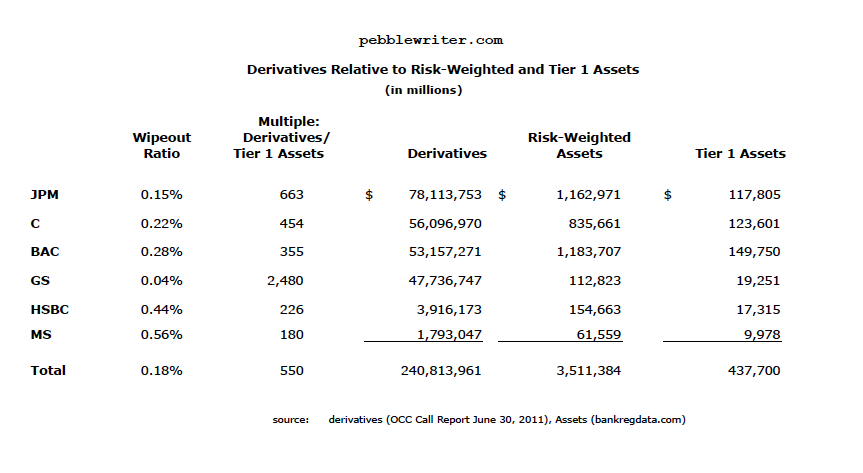
    As every aspiring muppet-master knows, JPM has the largest derivatives portfolio of any US bank — an astounding $78 trillion as of June 2011.  This represents a startling 663 times their Tier 1 capital, meaning a miniscule 0.15% move in the value of their derivatives portfolio would wipe out all Tier 1 capital [see: The Wipeout Ratio.]

    Needless to say, the Plunge Protection Team has been mobilized.  In yesterday’s conference call, Jamie Dimon as much as admits that the worst is yet to come:

    “Net income in Corporate likely will be more volatile in future periods than it has been in the past.”

    It’s as clear as the worry lines on Blythe Masters’ face that they have no idea how ugly this might get [read: much, much worse.]  And, if this guy — the Prince of Wall Street — has such tenuous control on the goings-on in his Chief Investment Office, what are we to think about the rest of his $78 trillion in derivatives?  How about the other $630 trillion held by other bankers? [see: City of Dreams]

    click on the above to watch

    In one of Bernanke’s first televised post-fed meeting interviews, Dimon joined in the Q&A, bashing Bernanke for the litany of regulations and reforms that were preventing the financial community from recovering from the financial crisis.  Needless to say, there was no mention made of his role leadership in creating the crisis.

    This is analogous to bailing your kid out of jail, only to have him complain about how long the drive home is taking.  I was impressed by Bernanke’s restraint as he provided a thoughtful response, while no doubt thinking: “I saved your sorry ass, and this is how you repay me!?”

    There’s an old adage in banking: if I owe you $100 and can’t repay it, I’m in trouble.  If I owe you $1 million and can’t repay it, you’re in trouble.  While the TARP loans have long since been repaid, Wall Street’s survival is still very much in the hands of its enablers — the Fed.

    As the guy ostensibly at the controls, Bernanke must feel more than a little perturbed that things aren’t going according to plan.  I wonder if Vic Perrin’s words ran through his mind yesterday as listened to the JPM call.  I wonder, as he called Dimon to lay down the law (“no, really, I mean it this time — no more bailouts!”) whether he heard those familiar words from the other end of the line…

    “There is nothing wrong with Wall Street.  Do not attempt to adjust the picture.  We are controlling transmission….”

  • The Wipeout Ratio

    A simple calculation comparing major banks’ derivatives positions to their assets and capital shows how little it would take to wipe out either.  The first ratio is the multiple that derivatives represent of Tier 1 capital.  The second shows the miniscule percentage decline in the value of derivatives portfolio it would take to completely wipe out Tier 1 capital.


    Goldman Sachs, for instance, has $47 trillion in derivatives exposure — 2,480 times its Tier 1 capital.  A 0.04% decline in the value of the derivatives portfolio would wipe out Tier 1 capital altogether.

    Overall, a 0.18% decline would do the entire bunch in.    Something to think about, especially as the vast majority of derivatives are OTC, are not priced in public markets, and are obscured/netted out in balance sheets.  Remember, “too big to fail” really means “subject to taxpayer bailout.”

    A little over a week ago in a Zerohedge article we learned that Italy’s previously hidden derivatives exposure amounted to 11% of the country’s GDP.    A recent $3.4 billion payment to Morgan Stanley to settle a 1994 contract wiped out half the value of the tax hikes recently imposed on an already crumbling economy.

    If this doesn’t seem terribly important, consider that the derivatives exposure of the five banks above alone, at $240 trillion, is four times the combined GDP of every country on earth.  JPM, by itself, has notional derivatives exposure that exceeds the combined global GDP.

    I fear this is the story of the year, folks.  And, it’s just now starting to get some press.  As we learned with AIG, if one segment of the financial markets suffers unanticipated losses, the entire house of cards can come crashing down.  Banks know how bad the situation is; how else to explain the lack of interbank lending — particularly in the euro zone?

    Stay tuned.

  • End of the Line

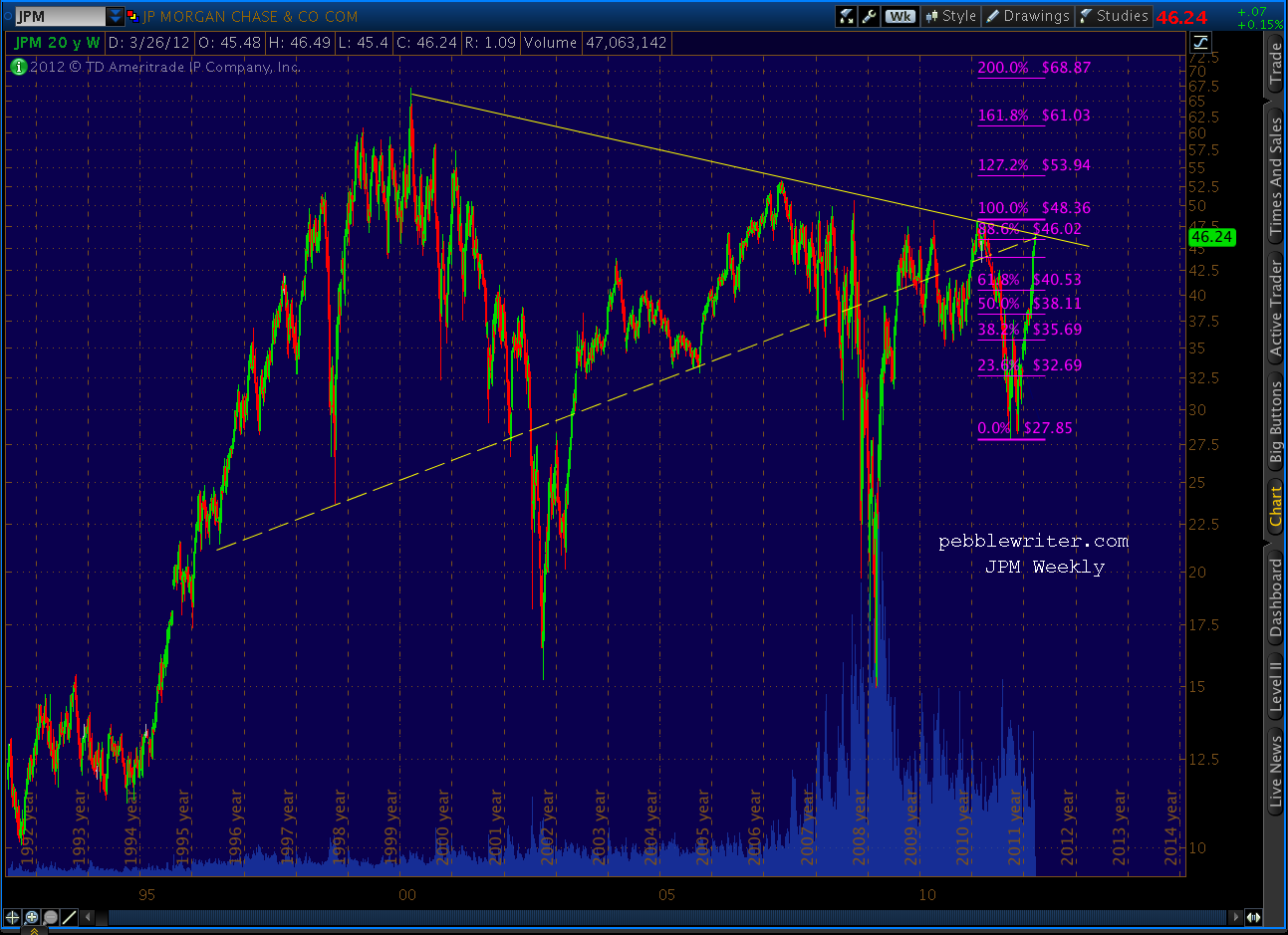
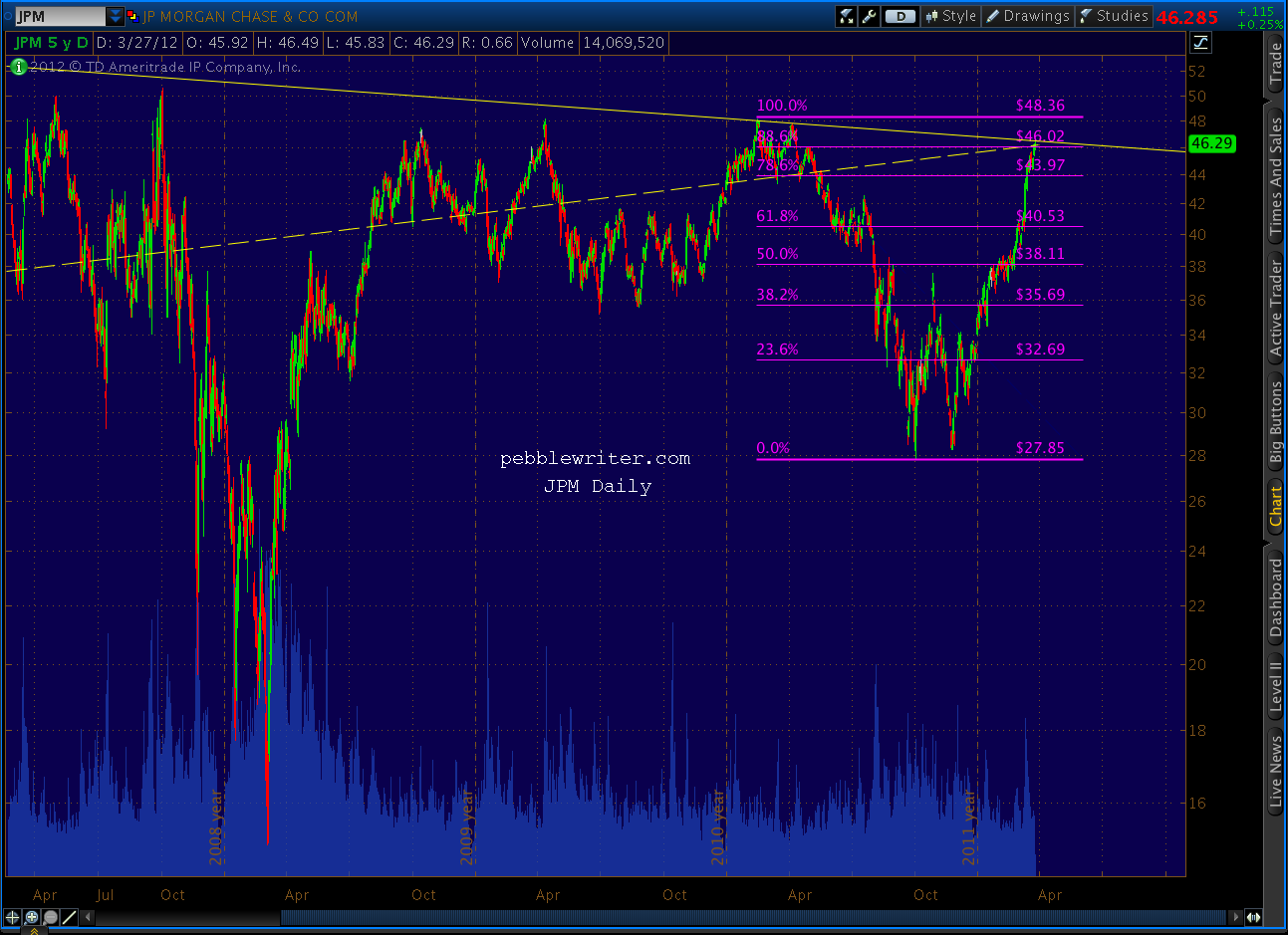
    JPM has had a phenomenal run of late, but a long term fan line off the Mar 24, 2000 all-time high should put an end to all the fun.

    It doesn’t help that JPM also just completed a bearish Bat pattern and is back-testing an internal TL that dates back to 1996.

    And, that over the last week, JPM has completed a Crab pattern way up in the tip of the Bat.

    Dimon’s pulled off some pretty slippery tricks in his tenure; we’ll see if he can beat the odds this time.