Tag: fibonacci

  • Charts I’m Watching: Apr 16, 2013

    We’re set to get a nice bounce here at the bottom of the purple channel — as revised in last night’s last post.

    Based on where the futures are pointing, I’m not sure whether it will have legs or not.  But, I’m inclined to play along on the upside, but with relatively tight stops in case it peters out.

    The EURUSD has rebounded nicely as we anticipated, but has reached a point of resistance at the midline of the rising channel at a price level that’s proven difficult to exceed since early March.

    The daily chart shows a bounce off the bottom of the purple channel as expected, but plenty of overhead resistance in the 1.33-1.34 range if it’s able to break through 1.316 or so.  The .618 is up at 1.3341.

    The dollar continues to tread water.  I’ve drawn a tentative new wider channel that might represent the expected range now that the rising white channel is officially kaput.

    Remember, this decline is a backtest of the broken red .25 channel line.  If the decline continues on track, we could reach that channel line (at about the .red .382) in very short order.  It’s currently at about 81.74.

    But, there’s no reason DX must retrace all the way to that line.  It has already back tested the purple .618 — a reasonable pullback after the Bat Pattern that completed at our 83.616 target back on Apr 4.

    The daily RSI, in fact, shows strong support from the bottom of the rising purple channel and the .25 of the rising white channel.

    The yellow midline on the RSI chart represents that dashed white channel midline cutting across the middle of the price chart above.  A thrust up through it should accompany the next big equities dump.  And, to my eyes, that’s the next major move.

    Though SPX is safely back in the purple channel, it can’t go on forever — right?  Even if our most bullish scenario plays out, there would need to be pauses of more consequence than the past two sessions.

    In that pullback, SPX reached the .786 of the 1539 – 1597 rally between Apr 5-11 (1552.36 vs 1551.88.)  The bullish case will consider that reversal as the full extent of the pause — a proper corrective wave that reversed at the bottom of a very well-defined channel dating back 5 months and 230 points.

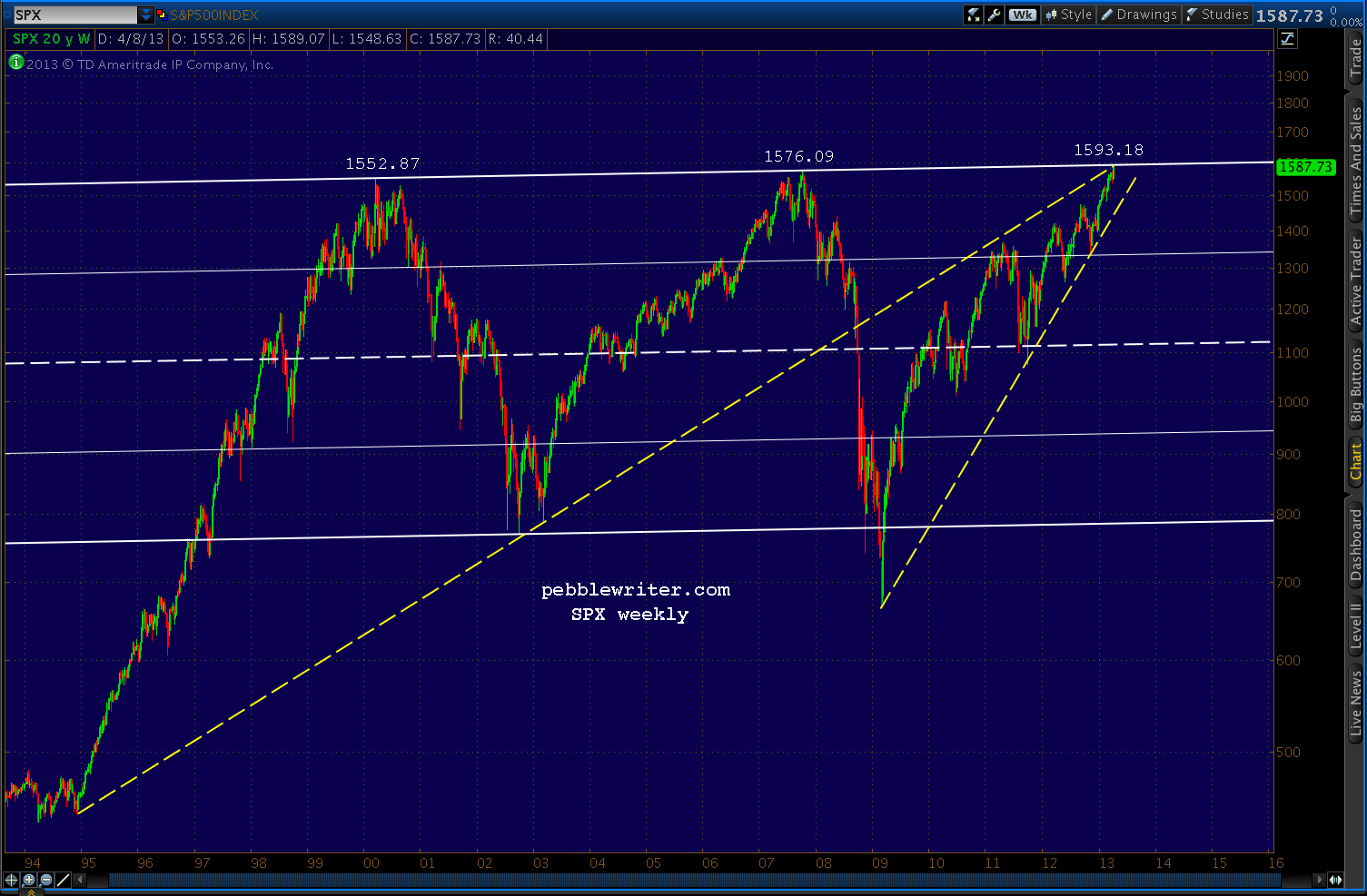
    If so, SPX should head up and push through the trend line extending from the 2000 and 2007 tops — currently around 1593.50 — on the way to its 1823 target.

    The bearish case suggests we slap a Point B on that reversal and call it a Butterfly Pattern that targets 1523 or 1503.

    So, which is it going to be?

    continued for members

    (more…)

  • Update on Gold: April 15, 2013

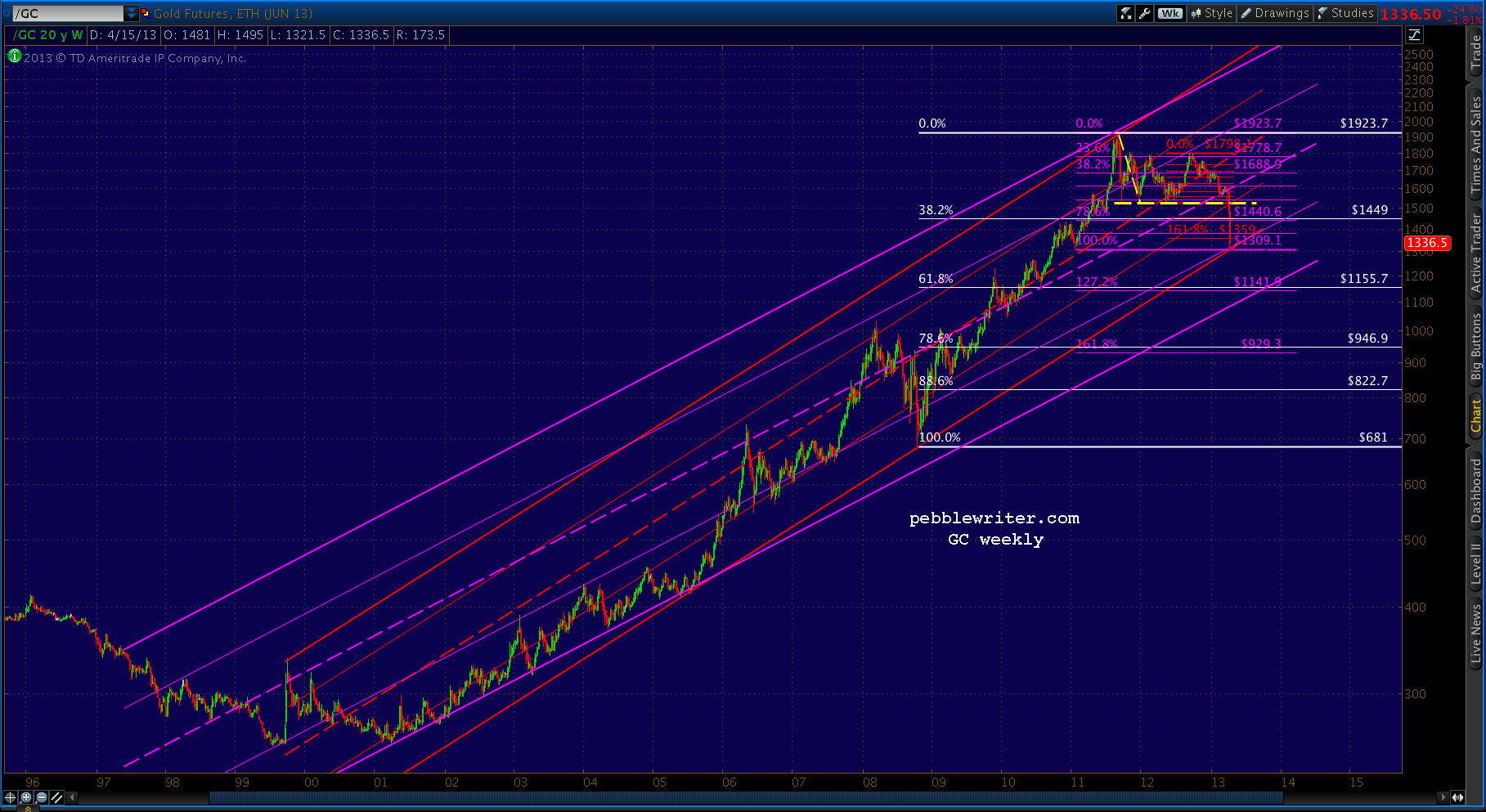
    Gold continued to melt down today, shedding another $126 and continuing the plunge that started on Friday with the critical loss of the LT channel we discussed last week, the horizontal support at 1520-1535, and the psychologically important 1500 level.

    Gold had a nice bounce from 1539 to 1590 after reaching the bottom of the channel and the horizontal support of several prior bounces on Apr 4.  In a dramatic demonstration of what can happen when channel support is lost, it has since shed almost $270/oz.

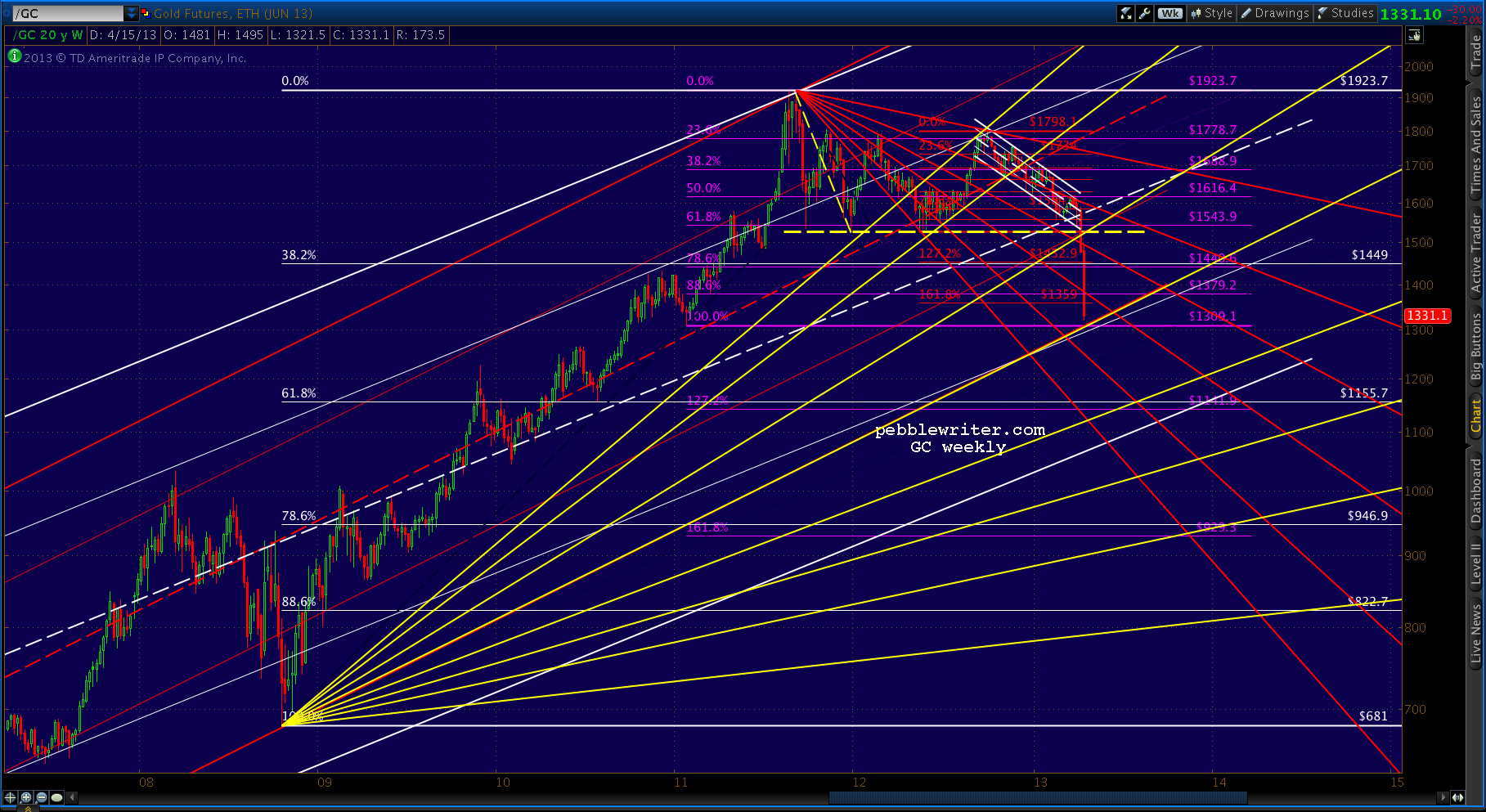
    The red channel below represents my best shot at the new operative channel.  It supports the idea of a bounce at the Jan 2011 low of 1309 — 3rd on our list of potential bounce spots during today’s onslaught.

    The next best available channel is well below the current one, but supports the idea of a bounce at 1379 or 1359 — the Bat Pattern and Crab Pattern completions shown in the first chart above.  If those levels should fail to hold, the next major support levels are 1309 and 1155.

    We got good bounces earlier today at the first two: the Fib retracements at 1359 and 1379  But, along came the CME with announcements of increased margins and that was the end of that.

    Please note, I am not a gold bug.  I don’t advocate the purchase of gold. I shy away from most assets that increase exponentially in price — especially those backed with the kind of religious fervor as is gold.

    The time may come when inflation is taking hold and it makes sense to switch everything you own into the metal… but, we’re not there yet.  It’s a crowded trade, and IMO, today’s price action underscores the risk.

    So, the following is offered in the same spirit as my picks for NCAA champion, Best Picture, and  Westminster Best in Show (the affenpinscher, really!?)

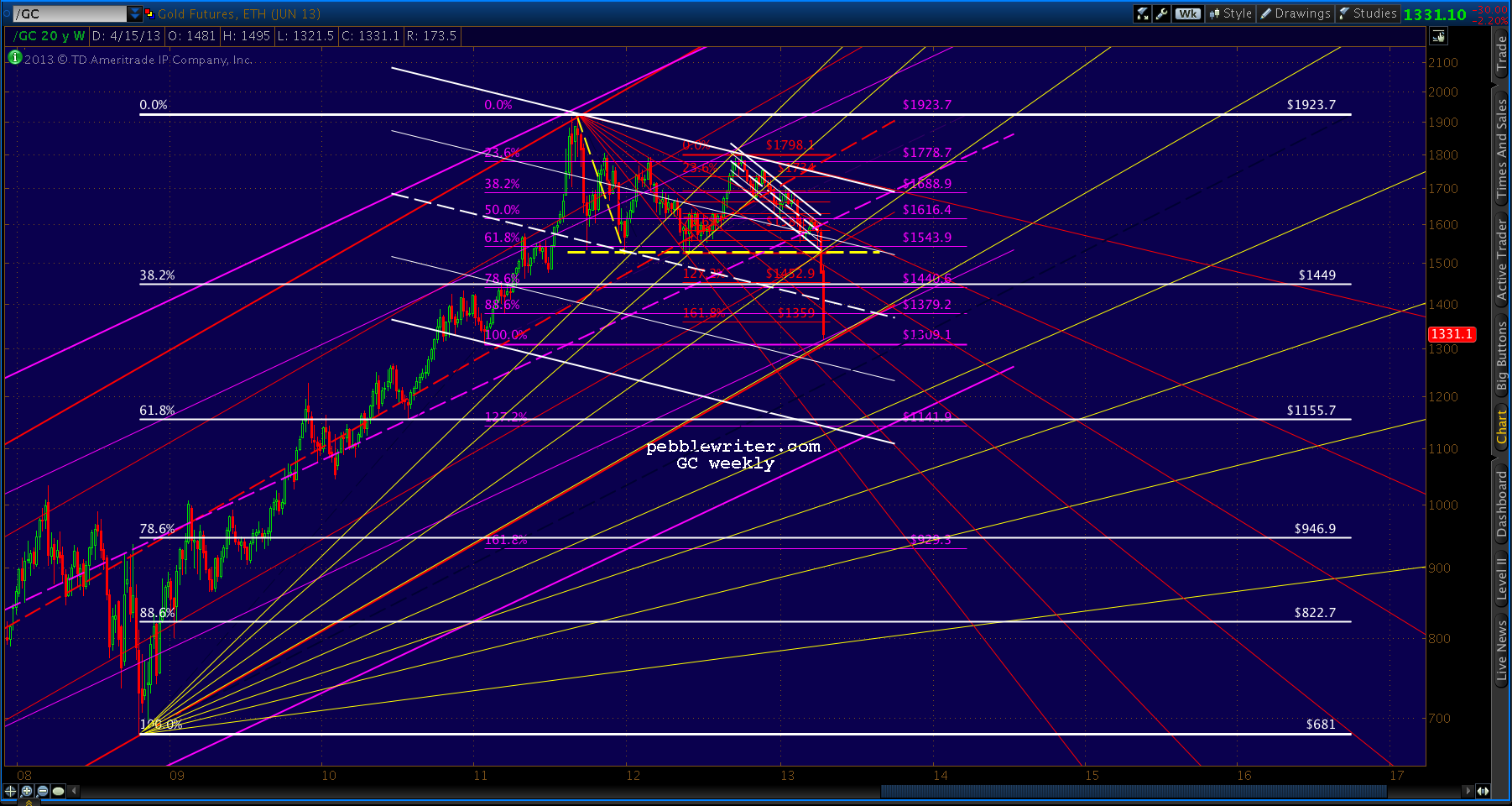
    There’s another channel (below, in purple) that kinda sorta supports the first, but shows the potential downside in the event that 1300 can’t handle the pressure.

    It’s speculative, for sure.  But, I like the fact that it crosses the white .618 at a key point in time, so I’ll leave it up for now.What’s interesting to me is the Fibonacci Fans that can be drawn on this chart.  The ones from 681 low (yellow) have done a pretty decent job of guiding the bounces on the way down.

    And, the ones from the 1923 high (red) have done well at halting several attempts at a breakout.

    I could almost believe we’ve seen the worst of the drop, but I wonder about this potential channel…

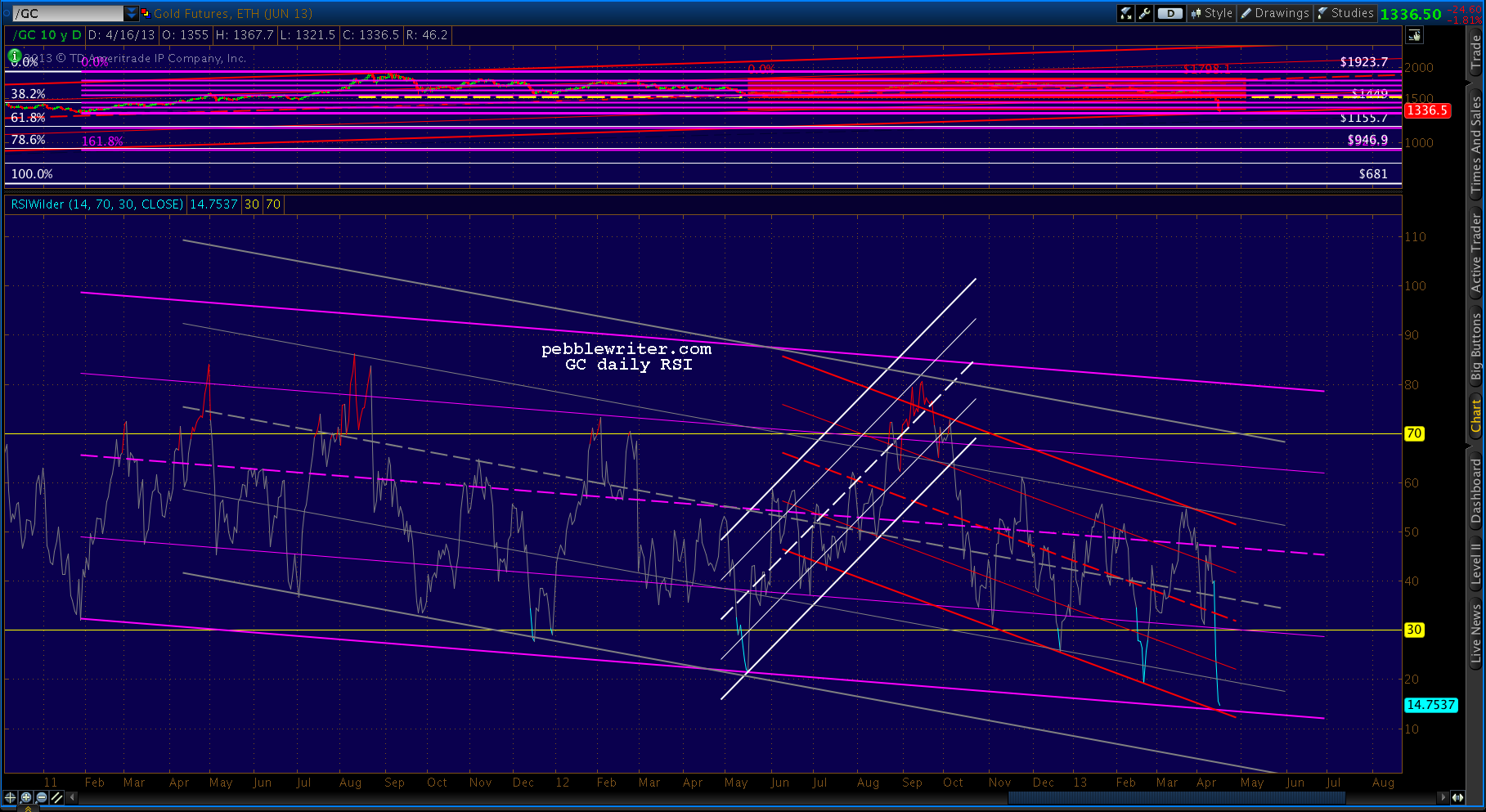
    …and, the daily RSI — which suggests at least a little more potential downside any way you slice it.  The bottom of the purple and red channels probably correlates to 1309, while the bottom of the gray channel represents something much more ominous.

    So, where do we go from here?

    I believe we’ll get a nice bounce here to backtest of one of the broken channel lines — say the white midline around 1410 or even the 1450 level.  But, it probably wouldn’t happen anytime soon.  After that, the downside risk is to 1155 or so.

    Of course, if the FBI were to announce irrefutable proof that the North Koreans were behind the Boston bombing, or the Iranians launched a Rahd SAM at an F/A-18, or [insert your favorite catastrophe here], it’s a whole new ball game.

    GLTA.

  • The Big Picture: Apr 11, 2013

    The chart of the day:

    We closed our longs (from 1539) yesterday, but are still a few points south of the market’s upside potential.  While yesterday’s 1589.07 might end up being the top, I rather suspect we’ll move just a little higher.

    Recall that we anticipated being in this situation a week ago [Charts I’m Watching: Apr 4 – 1:20 update.]

    I strongly suspect that any move that’s much higher than 1576 will terminate at the purple midline… On April 11, the midline of the purple channel intersects with the TL connecting the 2000 and 2007 highs (red circle below.)  Also on Apr 11, the .25 line of the same channel crosses 1576 (yellow circle.)  So, take your pick.

    So, we can’t very well ignore it now that we’re here, can we?

    I’ll take a shot at a long position this morning — with tight stops of course.  The bottom of the smallest purple channel (from 1539.50) is currently around 1582 and rising about 2.10 per hour.

    The dollar reached the next lower line on the falling red channel and will likely backtest the broken white channel as seen on the 60-min chart below.

    But, take a look at a daily chart, and it’s obvious that the push lower would be relegated to tail status and the channel would remain unbroken if DX climbs back to 82.515 or so.  Not a terribly difficult feat if equities top out this morning…

    UPDATE:  10:15 AM

    Just tagged the midline of the purple channel that’s guided SPX since 1343 on November 16.  I never dreamed when we went long that morning [CIW: Nov 16 – 10:05 update] that we’d tack on nearly 250 points in the next five months.

    SPX also reached the IH&S target (1591.66) from the small pattern completed on Tuesday.  It wasn’t a very well-formed pattern, but here we are.

    We’ve discussed it many times in many contexts, but completing a tag on even a 13-year old channel top doesn’t guarantee a bear market.  But, the odds of at least a correction are pretty good.

    If anyone’s wondering about the dashed yellow line that intersects with our smallest channel around 1597.68, it’s the TL shown on the first chart up above.  It connects the 1994 low and the 2002-2003 lows. If we exceed the TL connecting the 2000 and 2007 tops, this is also a great target.

    UPDATE:  11:30 AM

    SPX just topped 1597, which is good enough for me.  I’m switching sides here and opening a short position.  Stops around 1605 should work.

    My only hesitation is that we’re sooo close to 1600.  Do we leave a milestone like that for another day or go ahead and add it to the QE trophy case.  Hmmm…

    If 1600 is in the cards, expect a bounce at the red TL (1593.25) which bulls will, quite legitimately, interpret as a backtest of an important broken TL of resistance.  BTW, a bounce there would also be a backtest of the large purple channel midline.

    If we fall back through both, however, this excursion to 1597 will appear as a shooting star at the top of a nice little Crab Pattern (the 1.618 extension of the drop from 1573 to 1539.)

    Next key level below the red TL is the bottom of the little purple channel from 1539 — currently around 1589.  And, of course, the 2007 1576.09 high is awaiting its own backtest.

    UPDATE:  1:40 PM

    SPX has retraced .886 of its drop from this morning’s 1597.35 high.  If it’s going to try for 1600, now’s the time.  For the bears, a drop through the channel bottom at 1589.40 would really help get the downside going.

    UPDATE:  2:15 PM

    Got the reversal almost to the penny at the .886 retracement, completing a nifty little Bat Pattern.  The bottom of the small channel is coming up at about 1590.

    Since we’re dropped back through the red TL and the purple channel midline, the next backtest will be from below.

    I’ll update our forecast if/when SPX drops through the channel bottom.

    UPDATE:  3:25 PM

    Such a simple thing: breaking through a channel bottom.  SPX doesn’t even have to chase it.  The channel is rising up to meet the index.  But, no breakdown yet.  Instead, two well-engineered bounces that came at just the right time and place to prevent more serious damage to the bullish case.

    And, now we’re entering into the last-minute ramp zone — the last 30 minutes of the session where markets are only allowed to go up.  Good thing it’s an efficient market, randomly walking down a present-value path to future cash flows and not some trillion-dollar casino manipulated by rich and powerful interests with unlimited funding.  That would suck, right?

    If the little H&S is permitted to complete, it targets all the way down to 1585 — the neckline of the last H&S that completed but didn’t pay off thanks to a ramp job in the futures overnight.

    The way this market has been going, it’ll close at the neckline — forcing us to choose whether or not to play ramp job roulette with an overnight position.

    continued for members(more…)

  • USDJPY Update: Apr 8, 2013

    The largest channels are all pretty loose fits, with plenty of incursions that make forecasting with them iffy at best.

    But, the smaller channels and Harmonic Patterns have been pretty effective.  Even though USDJPY has been running like a 燃える尾を持つ猫, there is growing risk of a downturn as it approaches 100.

    Consider the new channel constructed by today’s high.  It lines up with the Oct 31, 2011 and Mar 14, 2012 highs.  It would carry more weight if there were more than one tag on the bottom, but we shouldn’t ignore the potential for a correction.

    Given the tear the pair has been on lately, it would probably be motivated more by a weak US dollar than a strong yen.

    The pair put in a decent correction at the red .786 (of the decline from 101.44 in Apr 09), hinting at a future Butterfly Pattern.  The 1.272 is at 108.47 and the 1.618 is at 117.43 — right next to the large purple .886 at 118.59.

    There’s also a small Crab Pattern (white, above) completion at 99.26.  So, though I wouldn’t necessarily put money on it (the trend is your friend), it appears the pair might have hit at least interim resistance at today’s high.

    A failure to reverse here will likely mean a trip to the purple .618 (at least) at 105.57.

    But, that would mean barging back into the daily RSI channel (in green below) that broke down in mid-Feb and is undergoing its 2nd back test.  It’s certainly not impossible, but it would be easier after a pullback to reset RSI to lower levels.

    Stay tuned.

  • Charts I’m Watching: Mar 25, 2013

    With Cyprus saved, the sanctity of the EU intact, and a US budget deal passed, we can all go back to watching the market ratchet up 10 points/day, right?

    Here’s the fundamental problem.

    continued for members(more…)

  • Charts I’m Watching: Mar 21, 2013

    ORIGINAL POST:  9:25 AM

    The EURUSD is still trying to change trajectories (purple channel to red), but hasn’t been able to break out yet.

    The dollar is similarly facing a change in direction if the red channel can hold.

    Judging from the futures, SPX is set to react off the neckline and TL we’ve been talking about for several days. Though, daily RSI still shows a little more upside potential.

    I’ll play along on the downside, but will be looking to see if it gains support at the purple channel midline.

    UPDATE:  09:23 AM

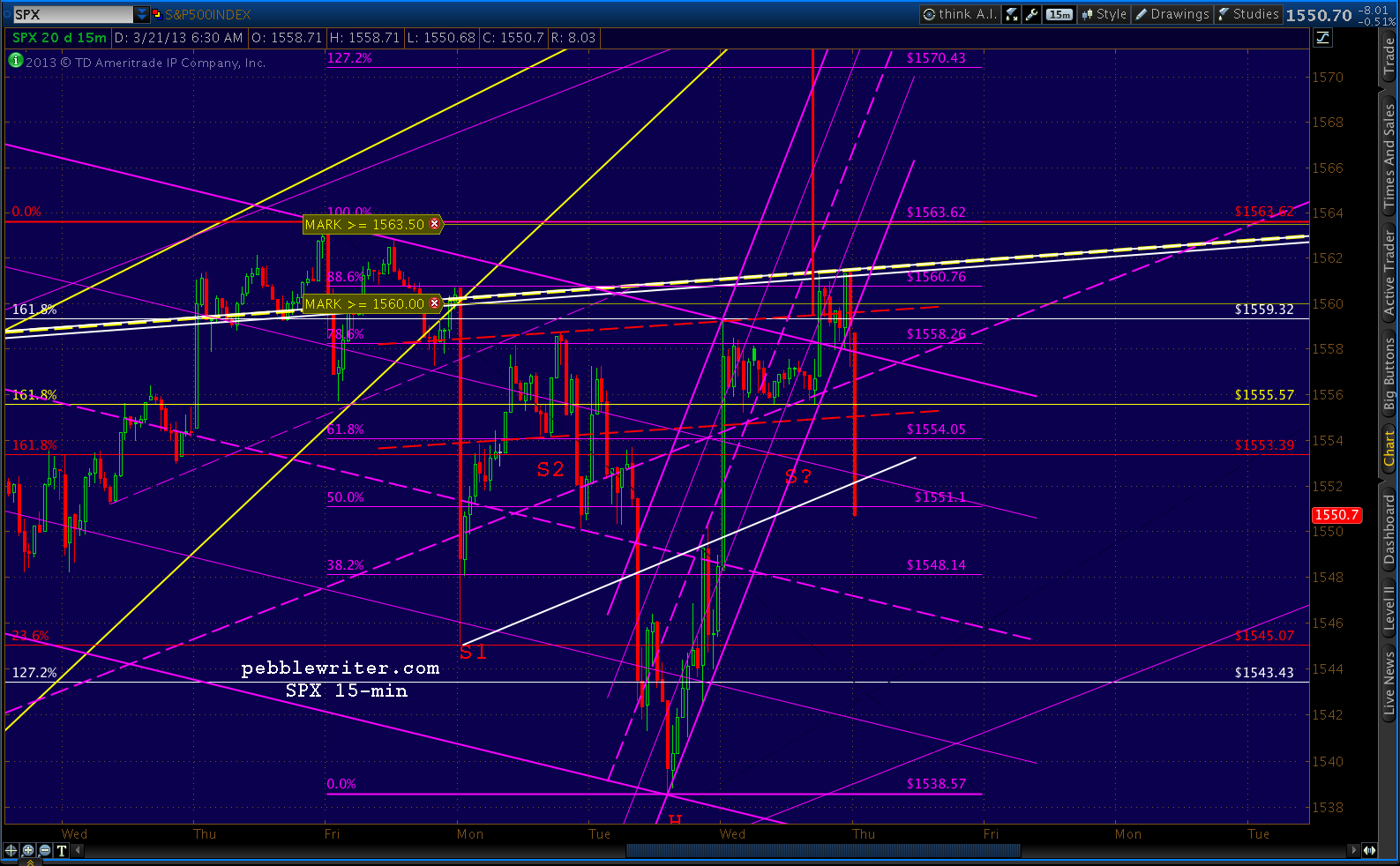
    That should do it for the short side, going full long again here at 1550.7 with stops at 1548ish.  Always fun, trying to catch a falling knife…

    The 15 min RSI shows support with SPX here at the .500 Fib.
    Fresh charts in a few…

    UPDATE:  9:50 AM

    If SPX reverses here, it leaves a much nicer right shoulder for the IH&S we discussed yesterday.  And, the revised purple channel looks more sustainable.

    Existing home sales, Philly Fed and Leading Economic Indicators are due out at 10 EDT.

    UPDATE:  10:01 AM

    Data better than expected on Philly Fed and Conference Board Leading Indicators, a miss on NAR existing home sales.

    The leading indicators look a lot more positive than the current, which barely moved.

    No charts for the NAR, but sales came in at 4.98 million vs expectations of 5.0 million.  Inventory increased from 4.3 to 4.7 months, which flies in the face of the most commonly heard argument that a shortage of product was driving prices higher.

    There are no doubt pockets of actual product shortages, just as there are many with a huge excess.  But, the price increases have more to do with math than with supply and demand at the moment.

    The NAR, like everyone else, reports average (median) prices.  The entire market could remain at a standstill, but if the bottom 5-10% (in price) of houses are bid up, the average price increases.  It wouldn’t affect the average house, just the average price of all houses.

    That’s why many average homeowners remain underwater and unable to sell their houses for the asking price despite the “good news” from the NAR/MSM.  So, what’s happening to bid up prices on the low end?  Enter our friends at the Fed.

    As Bloomberg reported a few days ago, big institutional money is chasing single-family homes.  With the stock market at all-time highs, bonds at 2% and much of the rest of the world in questionable economic condition, the new bubblicious investment is housing.

    Blackstone, which put $3.5 billion to work buying 20,000 houses, just increased its credit line by another $1.5 billion.  Colony Capital owns 7,000 units and is raising another $2.2 billion.  American Homes-4-Rent owns 10,000, and is buying up more.

    Institutions represent a large percentage of the buyers in many markets which have rebounded the most:  Miami (30%), Phoenix (23%), Charlotte (21%), Las Vegas (19%.)   But, will the dead cat bounce translate into profits for investors?

    As fools rush in, rents are falling in many of the markets in play — making it tough to derive much cash flow.  Colony Capital will be buying another $2.2 billion worth of houses, even though their current portfolio occupancy is only 53%.  In an environment of 2% 10-year treasuries, the 4-5% cash-on-cash yield might look pretty good — especially coupled with some degree of inflation protection.

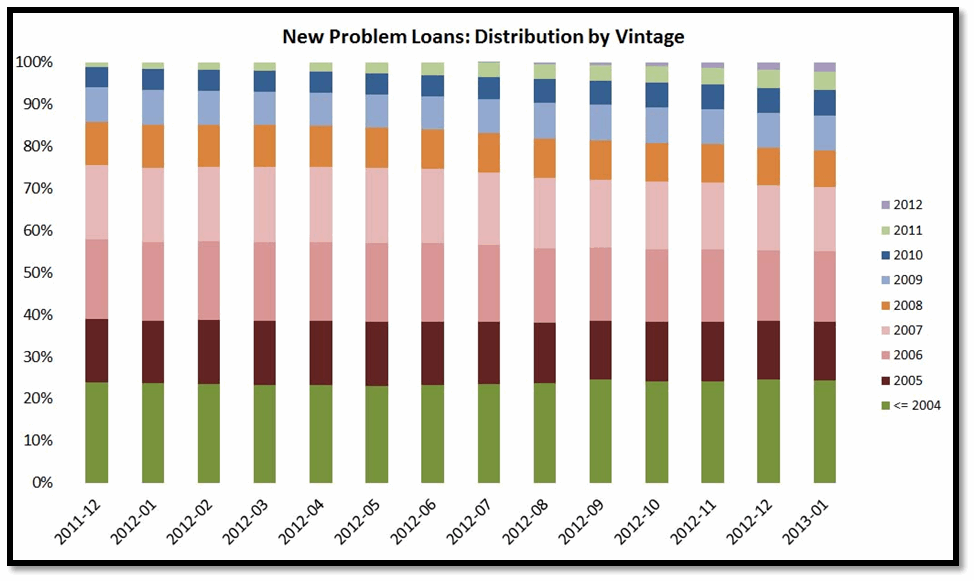
    I can’t help but think this is another big bubble in the making — courtesy of the Fed’s ZIRP.  Even after 5,000,000 foreclosures since the 2006 peak, new delinquencies continue to surface — including a steady contingent of older, more seasoned loans as this LPS chart shows:
    Global Economic Intersection ran a nice piece Tuesday posing a thought-provoking idea:

    “The housing market is therefore the hostage of economic growth and not the signal of economic growth.”

    The evidence of yet another liquidity-fueled, lack-of-any-better-alternatives bubble is here.  Investors must decide whether to button their chin straps and get in the game, or watch from the sidelines as the greater fools slug it out the red zone.  Stay tuned.

    UPDATE:  2:05 PM

    With the move down through 1548, I gave SPX a little more wiggle room to the .618 of the last move up at 1547.35.  It bounced, but couldn’t hold, prompting me to take a short-term short to cover my core long position.

    I’m closing the short here at the .786 of 1543.75 for a small gain.  More charts, revised channels coming up.

    The bullish case needs 1546.27 to hold firm.

    UPDATE:  2:30 PM

    Hard to keep up with charting this morning, with things moving rather quickly and dropping a little further than I expected.  Looks like the .786 will hold, but let’s make that the new stop.

    The 60 min RSI has found midline support at a potential falling channel (purple) and a rising channel which isn’t as convincing as I’d like (yellow.)

    UPDATE:  5:30 PM

    Weakness everywhere around the close.  I’m going to lay out the bullish and bearish scenarios, but from a chart pattern standpoint, this is a toss-up.

    Taking a look around the indices, I see a lot of indices at make or break points.  I just revisited RUT, a great case in point.  Drawn from the 98 and 02 lows, one channel makes a great case for the upside being done.

    The daily chart CU shows just how precisely we’ve tagged the top of that channel and the TL’s the make up the rising wedges.

    Drawing the channels off the 98 and 09 lows, however, shows RUT has already pushed above and backtested the channel top (in purple.)

    Throw in some Harmonic Patterns and things get really interesting…

    There was a big reversal at the .786 of the 2007-2009 crash, so we should expect a Butterfly Pattern to play out at the 1.272 of 996.26, right?

    But, look at all the TL’s of resistance we’d have to push through first…

    Besides the trend lines, the purple 1.618 hasn’t really caused a reaction yet.  The white 1.618 has, but not much of one.  And, note that the yellow pattern calls for a run to the 1.618 at 1033.  Mixed signals, to say the least.

    More in the morning…


  • Financials: End of the Line, Again?

    Financials have had a great run ever since we called the June 4, 2012 bottom [see: So Crazy, It Just Might Work].  But, all good things must come to an end.  I’d give them another few days/points at most.

    I had jumped on the short side Mar 27, 2012 [see: End of the Line and Lots More], riding GS, MS and JPM down around 30%.

    JPM:       46 – 32 = 31%
    GS:       127 – 92 = 28%
    MS:    20 – 12.50 = 38%

    On June 5, we loaded up on the long side.  Our targets, as posted that day:

    JPM:  today’s close = 31.99, price target = 38.69 (+21%)
    C:       today’s close = 25.75; price target = 34.79 (+35%)
    BAC:    today’s close = 7.10; price target = 11.34 (+60%)

    Obviously, those targets proved to be a little conservative.  JPM reached its target by Aug 21, consolidated for 2 weeks, then zoomed even higher – reaching 49.31 today and finally (after 4 near misses) reaching the .886 retracement of its 53 to 14 plunge.

    C reached its 34.79 target on QE3 day (Sep 14 — lovely being able to dump all those crappy MBS on the Fed) backed off a few points, then proceeded to rally up to today’s high of 44.50.

    It only ever recovered 7.95% of its 2007-2009 plunge from 570 to 9.70 (adjusted for reverse splits) and is struggling to reach the .786 of its swan dive from Jan to Oct 2011: 51.50 to 21.4. If the .786 at 45.06 doesn’t do the trick, the .886 at 48.07 should.

    And, just today BAC came within a nickel of the 50% retracement (12.39) of its post-2009 high.  It reached our 11.34 target in mid-December.

    If it gets past 12.67, it could still take a run at 14.13.  But, it won’t be easy.

    Most of the financials are in a similar situation — at or near major resistance either from Harmonic or Chart Pattern targets.  But, it’s XLF itself that looks shakiest.

    Today, XLF reached an important channel line as it tagged the 1.618 of the Mar-June 2012 decline.

    If it sneaks up past current levels, the .382 retracement of the fall from 38.15 in 2007 is waiting at 18.21.

  • Charts I’m Watching: Feb 11, 2013

    It was a beautiful weekend here on the central California coast.  Seems like everyone was out surfing, golfing, taking walks on the beach — at least that’s what I heard.  I spent the weekend poring over ECRI’s Weekly Leading Indicators for the past 30 years.

    Okay, in the interest of fair disclosure, Friday night was the annual Father-Daughter dance at my 10-year-old’s elementary, and I needed a couple quiet days off my feet.  If you’ve ever been in a room full of screaming prepubescent girls for two hours of JB and 1D, you know what I mean.

    Bottom line, the WLI research bolstered my confidence that our current position is the right one — whether or not the US economy is still in a recession, about to double dip, or is on the mend.  The key takeaway is this chart, showing the QE-fueled market continuing to pull away from the underlying economy (as measured by the WLI.)  Check out the article HERE.

    This morning, I’m hearing more and more talk about the market being frothy.  This is somewhat reassuring, as shorting at tops based on Harmonics often leaves one feeling very lonely.  I mentioned that SPX 1518 was at least an interim top to several other dads at the dance (guys who are in the biz) and they looked at me like I’d had too much fruit punch.

    I could have talked for hours about how applying derivations of a golden ratio based on 2,400-year-old mathematics enables effective market timing, but for some reason they had a sudden urge to go find their daughters and dance.  Funny how that always happens, and just when I’m getting to the good part…

    Of course, frothiness is what leads to overbought conditions — which, of course, is what you want when you short the S&P 500.  So far, the market is behaving itself — selling off a little while trying to sort out economic data, quantitative easing, currency wars and the upcoming sequester battle.

    continued for members(more…)

  • Is It or Isn’t It a Recession?

    ECRI’s Weekly Leading Indicator (WLI) came out Friday at 130.2 — up from 129.6 the week before.  Further, they reported that the index’s annualized growth rate increased from 8.2 the previous week to 8.9% — the highest since May 2010.  I wondered: are they retracting their Sep 2011 recession forecast?  Are things really getting better?


    CAN’T WE ALL JUST GET ALONG?

    There’s currently an argument raging between various economists and analysts as to whether the US is still in/dipping back into a recession or is on the mend. ECRI is pretty sure we’re in one, while folks like Doug Short and, of course, the mainstream media think not.

    There’s no question that we’ve seen an uptick in several economic measures. My own thesis is that most of these have been not secular, but cyclical swings.  In other words, I don’t yet see evidence of a sustainable trend change, only natural swings from one side of a channel or wedge to the other.

    Here’s an example I posted last week. Total Confidence has traced out a pretty solid-looking channel, while the Present and Expectations indices have formed expanding wedges (and are nowhere near their upper bounds, especially given the recent downturns.)

    underlying chart from briefing.com


    Hardly a day goes by when I don’t second guess myself.  Is all the “good news” just one big, well-coordinated head fake or am I missing something?  I spent much of the weekend studying ECRI’s historical WLI (who says technical analysts don’t live exciting lives!?) and found a lot to think about.  First, a brief primer on Harmonics.


    HARMONICS

    Regular readers of pebblewriter.com (heck, even the irregular ones) know all about Harmonics and that the corrections experienced in April 2010, May 2011 and Sep 2012 correspond to the important Fib levels of 61.8%, 78.6% and 88.6%.

    For the uninitiated, measure the drop from SPX 1576 (Oct 2007) to 666 (Mar 2009) and multiply it by a Fibonacci 61.8% and you get 1228.74.  SPX reached 1219.80 in April 2010 (within 10 points) and promptly sold off by 17% over the next three months.

    In May 2011, SPX peaked about 10 points away from the 78.6% Fib level (completing a Gartley Pattern) and plunged 21.6%.  And, in September 2012, SPX reached the 88.6% Fib level (completing a Bat Pattern) and corrected by almost 9%.

    Those of us who follow Harmonics were well aware of each of these downturns well in advance [see: HERE, HERE and HERE] and profited nicely from the market’s plunges.  Those who rely solely on fundamentals or [involuntary shudder] the mainstream media…not so much.


    THINGS THAT MAKE YOU GO “COOL!”

    While I had noticed the WLI’s channel-like general decline before, I never noticed that it also complied with the rules of Harmonics.  From its all-time high of 143.73 in Jun 2007, the WLI plunged to a low of 105.40 in Mar 2009.

    Like SPX, it found its footing (thanks to QE1) and started higher.  Its first big pause was in Oct 2009 at the 61.8% Fib level.  It paused again in Jan 2010 near the 70.7% Fib, and eventually reached the 78.6% level in April — completing a Gartley Pattern as SPX had finally retraced 61.8% of its drop.

    One could infer from the mismatched Fib levels that the economy — as measured by ECRI’s leading indicators — was ahead of the market at this point. The WLI had retraced 78.6% of its drop, while SPX had only retraced 61.8%.  In any case, they both suffered from the removal of the QE drip – SPX shedding 17% and WLI 11%.

    When the Fed realized their patient would flatline without more QE, they were back with QE2.  The market took off, reaching the 78.6% Fib in May 2011.  This also completed a Crab Pattern, a 161.8% extension of the amount of the Apr-Jul 2010 slide.

    The WLI, however, retraced only 78.6% of its slide since its 2010 high.  In other words, the market was now officially ahead of the economy.

    Following the expiration of QE2, SPX plunged 21.6% to 1074 through October 2011, while WLI gave up 8.9%.  From there, SPX climbed to 1474 primarily on Fed jawboning and promise of more QE — which it finally delivered the day before the 1474 high.

    The timing was no doubt an effort to send the SPX soaring right through the 88.6% Fib retracement of the 1576 – 666 crash.  I seriously doubt that “two points over” was what they had in mind (the market sold off anyway, correcting a respectable 8.8% to 1343.)

    The WLI, in the meantime, topped out at 127.77 — only an 88.6% retracement of its decline from its previous high in 2011.  Again, the market was outpacing the economy.


    IS IT OR ISN’T IT?

    The world of market prognosticators is, as always, divided.  There are those who believe the economy is improving, and the market – as a leading indicator itself – is all the proof we need.  Then, there are those who believe the market is priced well in excess of levels justified by the underlying economy — which remains in or is dipping back into a recession.

    Whether QE has “saved” the economy or not, I don’t know of any respected economist or technician who doubts that it has significantly goosed (i.e. “manipulated”) the markets. And, we should pay attention to the disconnect between the markets and the economy as evidenced by the SPX/WLI comparison.

    The WLI just hit an important Fib level (88.6%) after demonstrating that it does, indeed, pay attention to such things.  This occurred at the same time that the S&P 500 hit several important Fib levels and is thus, by my reckoning at least, poised to correct [see: Satisfaction.]

    We all know the old truism “the market isn’t the economy.” However, another quarter of negative GDP following the tax hikes recently enacted and spending cuts in the works would certainly remind investors that the market and economy are, indeed, joined at the hip.

    I care about the economy because I have children.  The Fed’s unprecedented experiment in QE will quite possibly end very badly for the country, for my children and for yours.  But, there ain’t much We the People can do to influence Fed policy.  They don’t answer to us or our political “leaders.” So, we play the cards we’re dealt.

    As an investor, my goal is to capitalize on whatever the market throws at us — regardless of how manipulated it might be, and regardless of what economists call the current business cycle. If depression or hyper-inflation come along, we’ll hopefully see it coming and be well-positioned.

    Are we still in or dipping back into a recession? Will the current QE4-ever result in another 2009-2011 run, or does the market’s yawn last September signal the end of QE’s effectiveness?  We’ll find out in time.  In the meantime, we have some very good tools at our disposal that have provided excellent returns in a very difficult market.  I’ll continue to call it as I see it, and appreciate having you all along for the journey.

     *   *   *   *   *   *   *   *

  • Satisfaction

    Will the sixth try be the charm?  SPX has futzed around in our target area for six sessions in a row.  Today, we should finally get some satisfaction.

    The dollar has broken out of and is back-testing the yellow triangle. Lots of juicy Fib levels ahead, starting with the cluster at 80.758-80.883.

    RSI appears poised to break out of the red channel and explore the upper half of the white.

    While the EURUSD looks like it’s ready to tumble.  The test I’ll be watching closest is the intersection of channels around 1.3253.  But, merely popping back down below those falling white channel lines would be a great start.

    If I’m right, the falling white and/or yellow channels will take it from here.  Note the negative divergence represented by the last two spikes up to the top of the yellow channel.  The flatish red channel dates back to the fall of 2008, and every sustained push below its midline — currently around 50.51 — has been accompanied by a nice sell-off in EURUSD.

    Japanese finance minister Taro Aso is frantically searching for the “off switch” on the yen-cinerator.  In a chat with a legislative budget committee, he admitted: “it seems that the government’s policies have fueled expectations and the yen weakened more than we intended in the move to around 90 from 78.”

    The 7 sessions in (and slightly above) our target area are looking tenuous.  A dip to the bottom of the white channel could take the pair back to 90.82.

    And a fall from the white channel could easily see a back-test of the midline from the purple channel dating back to 2000.

    continued for members(more…)